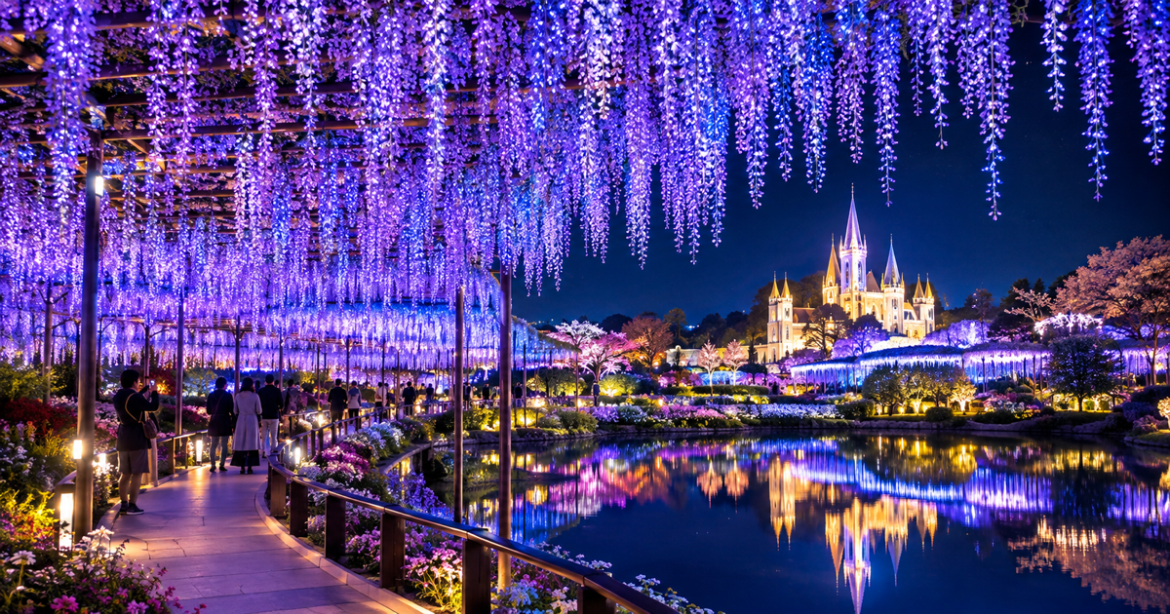

Ashikaga Flower Park Illumination 2026: Key Winter Details
Ashikaga Flower Park’s winter illumination, often known as the “Garden of Illuminated Flowers,” is a realistic day trip from Tokyo, but it requires more planning than a city-centre light-up. The three decisions that matter most are which seasonal phase you want to see, what time you enter, and which JR Ryomo Line train you plan to take home.
Ashikaga Flower Park has announced the official 2026–following-year illumination season. The event runs from October 17 2026 to February 14 of the following year. Evening admission is from 15:30 to 20:30 on weekdays and 15:30 to 21:00 on weekends and national holidays. From early November to early January, opening is extended to 21:00 on weekdays and 21:30 on weekends and national holidays. The lights generally come on at around 17:00, or around 16:30 during the extended winter period.
| Item | 2026–following winter details |
|---|---|
| Event period | October 17 2026 to February 14 of the following year |
| Evening opening | Weekdays 15:30–20:30; weekends and national holidays 15:30–21:00. Early November to early January: weekdays until 21:00, weekends and national holidays until 21:30 |
| Lighting time | Usually around 17:00; around 16:30 from early November to early January |
| Evening admission | Adults ¥1,500; children aged 4 through elementary school ¥800 |
| Closed | December 31; additional maintenance closures may apply |
| Nearest station | JR Ryomo Line Ashikaga Flower Park Station |
| Driving | Free parking is available; temporary parking may open during busy periods |
If you are still comparing places to visit outside central Tokyo, see our Tokyo day trip guide. If most of your trip is based in the city, it is also worth checking the Tokyo travel guide before deciding which day to set aside for Tochigi.
Is Ashikaga Flower Park Worth a Day Trip from Tokyo?
The main appeal is not proximity. It is the scale of the garden, the number of themed illumination areas and the fact that the landscaped park itself remains central to the experience. If you have already seen urban illuminations such as Marunouchi or Roppongi, Ashikaga feels quite different. For more city-based alternatives, compare it with our Tokyo winter illuminations guide.
- A good fit: travellers who enjoy large-scale light displays, reflections on water and spending half a day or more around one evening attraction.
- Suitable for families: but avoid leaving admission, dinner, souvenirs and the return journey until the final hour before closing.
- Suitable for older travellers: arrive earlier, avoid the first major weekend rush after the lights come on, and do not plan around the very last train.
- Less suitable: travellers already doing Nikko, Karuizawa or a long shopping day who hope to add Ashikaga casually at night. A delayed connection can make the whole evening rushed.
Which of the Three Illumination Seasons Should You Choose?
For 2026–2027, the official programme is divided into three seasonal themes: October 17 to mid-November focuses on the collaboration between flowers and light, late November to late December becomes Flower Park Christmas, and New Year’s Day to February 14 features the New Year Illumination. Exact transition dates and individual programmes may still vary according to the park’s operational schedule.
Late October to November: Best for Flowers and Lights Together
If you care more about the garden atmosphere than Christmas decorations, the first phase is particularly worth considering. In previous seasons, autumn flowers and purple-toned illumination displays have been combined across the park. Temperatures are generally easier to manage than in midwinter, although flowering conditions depend on the weather and should never be judged solely from photographs taken in a previous year.
Late November to December: Strongest Festive Atmosphere
This is the most obvious choice if you want a classic winter-holiday atmosphere. It is also the period most likely to attract concentrated crowds, especially on weekends, around Christmas and during the year-end holiday period. If your dates are fixed, a weekday visit with entry at around 15:30 is usually much easier to manage than arriving only after it is fully dark.
January to Mid-February: A Quieter Alternative After Christmas
The third phase traditionally shifts toward New Year and winter-flower themes. The main advantage is that the Christmas peak has passed, making the evening easier to organise. The trade-off is colder nighttime weather. If you are travelling with young children or older family members, shortening the visit is often more sensible than trying to stay until closing.
Tickets and Entry Time: Why 15:30 Is Better Than Arriving After Dark
For the 2026–following winter season, evening admission is ¥1,500 for adults and ¥800 for children aged 4 through elementary school. Evening admission begins at 15:30. The lights normally come on at about 17:00, moving to around 16:30 from early November through early January.
That gap before illumination is useful rather than wasted time. Arriving while there is still daylight gives you time to enter, find restrooms, understand the park layout and locate the main displays. You can then photograph the first lights during blue hour before seeing the same areas again after full darkness.
Arriving after 18:00 is still possible, but you are more likely to encounter three things at once: entrance queues, photo lines at the most popular displays and peak dinner demand. That can make a short two-hour visit feel surprisingly rushed.
Getting from Tokyo to Ashikaga Flower Park by Train
The Most Straightforward JR Route
From central Tokyo, one practical route is to take the JR Utsunomiya Line toward Oyama Station, then transfer to the JR Ryomo Line for Ashikaga Flower Park Station. The same basic routing works from Ueno. Total travel time varies with your departure station and transfer wait, so budgeting roughly two hours each way is a sensible starting point.
If this is your first long-distance suburban JR trip from Tokyo, save your preferred return connections before leaving. Our Japan transport apps guide can also help with route planning.
Do Not Just Memorise the Last Train
The park itself warns that the station may become crowded after the illumination and recommends checking the balance on your transport IC card in advance. The Ryomo Line does not run every few minutes like the Yamanote Line, and gaps between services can become much longer at certain times.
A better strategy is to choose two return trains before you arrive: your preferred departure and the latest train you are genuinely comfortable taking. Allow time to leave the park, walk to the station, enter the platform area and deal with post-event queues.
Practical rule: on weekdays, if you want to see the main displays without feeling rushed, treat around 19:30 as the point when you should start wrapping up. On weekends, do not assume that a 21:00 closing time means leaving the park at 20:55 will still result in an easy journey back to Tokyo.
Is Driving Better?
The park provides free parking, with ordinary parking capacity of around 300 vehicles under normal conditions. Temporary free parking areas may be opened during busy periods. Driving is convenient for families with children, older travellers or bulky winter clothing, but peak weekends simply shift the bottleneck from railway queues to traffic leaving the car parks.
If you are coming from Tokyo and are not comfortable with nighttime driving in Japan, the JR option or an organised bus tour is usually easier.
How to Avoid the Worst Crowds
- Enter at around 15:30: use the daylight period to find restrooms, food outlets and the major illumination zones.
- Be ready between 16:30 and 17:00: the sky still has some deep-blue colour, giving photos more depth than a completely black background.
- Avoid the first dinner rush: many visitors look for food immediately after seeing the first round of illuminated displays.
- Do not leave at closing time: especially if travelling with children, slower walkers or anyone making multiple train transfers. Catching an earlier connection is usually worth more than another 20 minutes inside the park.
How to See the Park Efficiently
Signature displays in previous seasons have included large-scale wisteria-inspired illuminations, reflection areas around water and season-specific themed scenes. Installations change each year, so check the current park map on arrival rather than following an old video or social-media route in reverse.
A practical approach is to choose the two large displays you most want to see first, then follow the natural walking route for everything else. That way, even if you decide to leave early for your return train, you will not discover that the main attraction is still on the opposite side of the park.
If you mainly want convenient city illumination rather than a two-hour journey into Tochigi, consider our Marunouchi illumination guide. The difference is not simply which one is “better”: Ashikaga is a large garden-based light experience, while Marunouchi is much easier to combine with a central Tokyo evening.
Families, Older Travellers, Wheelchairs and Strollers
According to the park’s official FAQ, wheelchairs are available free of charge, although numbers are limited and they are provided on a first-come, first-served basis. The park does not provide stroller rentals, and certain cart or wagon-type push vehicles may not be permitted. If you are bringing your own stroller, check the current-season FAQ again before travelling.
For families, the biggest problem is usually not whether the park is child-friendly. It is leaving dinner, photos, souvenirs and the return train until everyone is already tired. With younger children, a much easier schedule is 15:30 entry → first illumination round → early dinner or departure rather than trying to stay until the end.
For more alternatives in the city, see our Tokyo family attractions guide.
What to Wear in Winter and What Happens if It Rains
Ashikaga Flower Park is an outdoor garden, and spending two or three hours outside at night feels very different from walking between a railway station and a department store. Dress in layers: a warm base layer, insulating mid-layer, wind-resistant outer layer, gloves and comfortable walking shoes. Hands often feel cold first when taking photographs, so touchscreen gloves or pocket warmers can be useful.
Do not assume that rain automatically means cancellation or that the event will definitely operate unchanged. Adjustments to opening, illumination displays or specific activities depend on the park’s official announcement for that day. Strong winds, equipment safety or maintenance can also affect operations. If the forecast only shows ordinary rain, prepare a waterproof outer layer and compact rain protection, while keeping enough flexibility in your itinerary to change the date if necessary.
Photography Tips
- Shoot wide views before portraits: immediately after the lights come on, the remaining blue in the sky makes it easier to preserve detail in the garden, lights and people.
- Check the wind around water: calmer conditions usually produce cleaner reflections.
- Reduce phone exposure slightly: bright bulbs are easy to overexpose, and slightly lowering exposure can look more natural than relying entirely on automatic night mode.
- Do not use drones: the park explicitly prohibits them. If using a tripod, avoid blocking paths and follow staff instructions.
Food Inside the Park
The park has restaurants, cafés and light-meal options, and winter seasons have previously included warm dishes and seasonal menus. Exact menus and operating hours vary, so check the current information for your visit.
The park does not allow visitors to bring their own food inside. If you are travelling with children, older family members or anyone who needs to eat at a regular time, deal with dinner earlier rather than relying on the final hour before closing.
If you plan to eat after returning to Tokyo instead, check the train schedule first. The inconvenient scenario is not simply missing dinner at the park: it is missing your intended Ryomo Line service because you stayed to eat, then having every onward connection at Oyama shift later as well.
Why One Train Can Change the Entire Evening
Consider two visitors who leave Tokyo in the afternoon, arrive after 18:00, queue for the most popular illumination area, look for dinner and only then open a route-planning app. If their preferred train has just departed, the next Ryomo Line service may require a significant wait, pushing the entire journey back to Tokyo later and affecting an early start the next morning.
A better version of the same trip is to leave Tokyo at around 14:00, arrive near 15:30, see the park transition from daylight to illumination, visit the main displays and start heading toward the exit around 19:00. You still get the changing sky and the major light-up zones, but with much more flexibility for the return journey.
For a suburban nighttime attraction such as Ashikaga, transport buffer is usually more valuable than squeezing in one additional display.
Bus Day Tours from Tokyo: Are They Worth It?
If your biggest concern is working out the return train, you are travelling with older family members, or you want to combine a daytime stop with the illumination in one long excursion, a bus tour from Tokyo can simplify the day considerably. The trade-off is fixed timing: you cannot decide to stay an extra hour simply because the photography conditions are good.
Check a Tokyo departure day tour that includes the Ashikaga Flower Park illumination. This type of tour works well if you do not want to plan JR connections yourself, but always confirm the meeting time, stop duration and exact itinerary before booking.
Another option combines Nikko with Ashikaga Flower Park: see the Nikko and Ashikaga Flower Park bus day tour. The advantage is that two relatively distant destinations are handled in one organised trip. The downside is the long day and fixed schedule. If your priority is spending more time photographing the illumination, travelling independently by JR gives you more flexibility.
Day Trip from Tokyo or Stay Overnight in Ashikaga?
For most first-time visitors, a day trip from Tokyo is enough. As long as you do not wait until closing time to leave, the JR route is straightforward enough that moving your luggage solely for the illumination is usually unnecessary.
An overnight stay in Ashikaga or the surrounding area becomes more appealing in three situations: you are travelling with young children or older family members and do not want to rush for trains; you want to photograph the illumination until close to closing time; or you already plan to continue through Tochigi or Gunma the following day.
The main value of staying locally is not simply sleeping closer to the lights. It is removing the pressure of a late-night return to Tokyo.
Final Checklist Before You Go
- Check the official 2026–following-year page for current dates, the three seasonal phases, the December 31 closure and any temporary changes.
- Confirm whether your visit falls on a weekday, weekend or national holiday so you do not use the wrong closing time.
- Save one preferred JR return train and one latest acceptable backup before leaving Tokyo.
- Make sure your transport IC card has enough balance before the evening crowds build.
- If you want blue-hour photographs, aim to enter at around 15:30 rather than leaving Tokyo only after dark.
- If travelling with children, older visitors or wheelchair users, recheck the current rules on mobility equipment and stroller use.
- For rainy weather, check the park’s same-day announcement and bring a wind-resistant layer, gloves and comfortable shoes.
- If driving, check current parking information. If joining a bus tour, confirm the meeting point, return time and actual duration inside the park.
The key to an easy Ashikaga Flower Park illumination day trip is not simply deciding whether the lights are worth seeing. It is planning your entry time and return JR connection together. Choose the train home first, then work backwards to set your lighting, dinner and photography schedule, and the trip from Tokyo becomes much easier to manage.