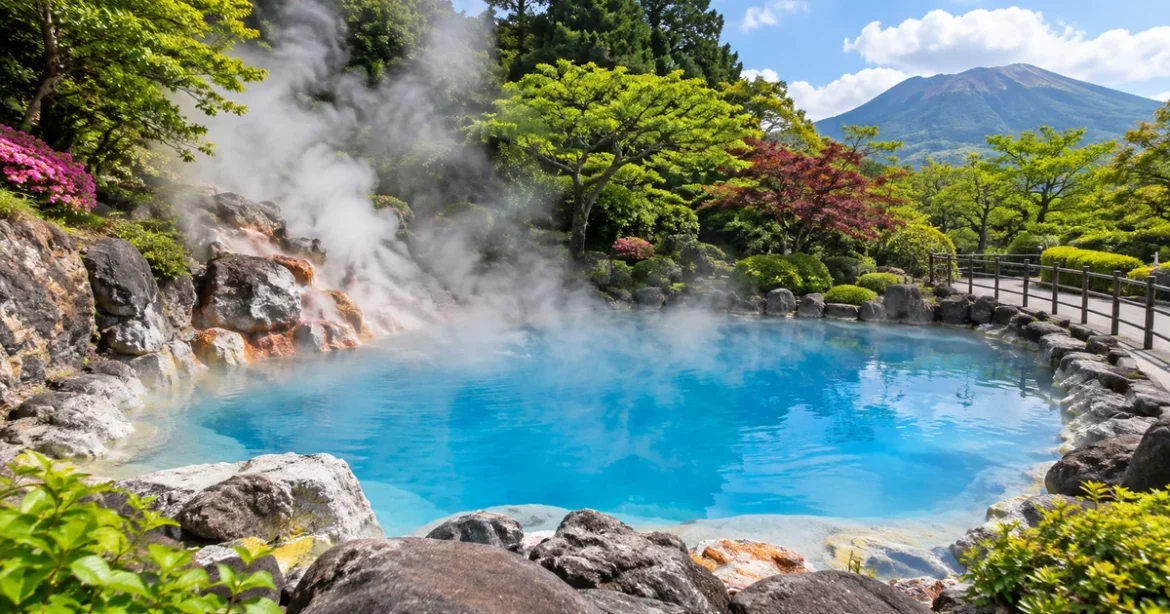
The Beppu Jigoku Hell Tour, often called the Hells of Beppu, is a circuit of seven dramatic geothermal sites in Oita Prefecture. Instead of entering the pools, visitors walk around steaming blue, red and grey ponds, watch bubbling mud, see a naturally powered geyser and explore attractions shaped by Beppu’s intense volcanic activity.
It is worth visiting for most first-time travellers to Beppu, particularly anyone interested in geology, unusual landscapes, photography or hot-spring culture. The experience is more commercial and structured than a remote natural attraction, but the range of colours, steam, food, footbaths and local history makes the complete circuit more varied than photographs suggest.
The main point to understand is that the seven hells do not form one continuous walking route. Five are grouped around Kannawa, while Chinoike Jigoku and Tatsumaki Jigoku are approximately three kilometres away. Trying to walk the entire distance is one of the easiest ways to waste time and energy.
For a first visit, allow three to four hours for all seven hells. Two hours is technically possible with a car or carefully timed buses, but it leaves little room for a footbath, lunch, shopping or waiting for the Tatsumaki geyser. Travellers who prefer a slower pace should reserve four to five hours.
The current seven-hell common ticket costs ¥2,400 for adults and high-school students or older, and ¥1,200 for elementary and junior-high-school students. Because an individual hell costs ¥500 for an adult, the common ticket makes financial sense when visiting five or more sites.
Travellers who prefer an English-language booking interface can check the Beppu Jigoku seven-hell admission ticket. The important restriction is that the current Klook voucher must be printed and exchanged for a physical ticket. Anyone without printer access may find direct purchase at the first hell considerably simpler.
For broader destination planning, including hot springs, food and places to visit after the hell tour, see the complete Beppu travel guide.

Is the Beppu Jigoku Hell Tour Worth Visiting?
| Question | Practical answer |
|---|---|
| Is it worth visiting? | Yes for most first-time Beppu visitors, particularly those interested in geothermal landscapes and unusual photography. |
| Best suited to | First-time visitors, couples, families with school-age children, photographers and travellers interested in hot-spring culture. |
| Who may prefer to skip it? | Travellers looking only for a traditional bathing experience, anyone with very limited time or visitors who strongly dislike commercial sightseeing sites. |
| Suggested duration | Three to four hours for all seven; four to five hours with lunch, footbaths and a relaxed pace. |
| Minimum useful visit | About 60–90 minutes for Umi Jigoku, Kamado Jigoku and one nearby site. |
| Ticket recommendation | Buy individual tickets for one to four hells. Buy the common ticket for five to seven. |
| Main highlight | Umi Jigoku’s cobalt-blue water and landscaped grounds. |
| Main disadvantage | The seven sites are divided into two clusters requiring a bus, taxi or car transfer. |
| Transport difficulty | Moderate by local bus; easy by car, taxi or the regular sightseeing bus. |
| Children | Visually engaging, but close supervision is essential around extremely hot pools and steam. |
| Older travellers | Possible with a slower itinerary; the regular sightseeing bus or taxis reduce walking and transfer stress. |
| Accessibility | Accessible toilets and loan wheelchairs are available, but not every path or viewpoint should be assumed to be fully step-free. |
| Overnight stay | Not essential for the hells alone, but worthwhile when adding a hot-spring stay, Yufuin or another Beppu attraction. |
Editor’s recommendation: prioritize the full circuit when Beppu is one of the main destinations of the trip. When Beppu is only a brief stop between Fukuoka, Yufuin and Oita, visiting Umi Jigoku and Kamado Jigoku gives a useful introduction without consuming half the day.
The full seven-hell tour is not seven completely different natural wonders. Some smaller sites feel less essential when viewed individually. What makes the common ticket worthwhile is the combined progression from blue water and boiling mud to crocodiles, red clay and the final geyser.
Essential Beppu Jigoku Information
| Item | Verified information |
|---|---|
| Official circuit | Umi, Oniishibozu, Kamado, Oniyama, Shiraike, Chinoike and Tatsumaki Jigoku |
| Opening hours | 8:00–17:00 |
| Regular closing days | None; the circuit is normally open throughout the year |
| Adult common ticket | ¥2,400 for adults and high-school students or older |
| Child common ticket | ¥1,200 for elementary and junior-high-school students |
| Individual admission | ¥500 adult; ¥250 child per hell |
| Common-ticket validity | Purchase or exchange day and the following day |
| Re-entry | Each hell may be entered once with the common ticket |
| Recommended duration | Three to four hours; longer with food and footbaths |
| Starting point | Umi Jigoku is the smoothest first stop for most visitors |
| Nearest practical bus stop | Umi Jigoku-mae for the Kannawa cluster |
| Parking | Free parking is available at the individual hells, with approximately 615 spaces across the circuit |
| Accessible facilities | Accessible toilets at all seven; limited wheelchairs available to borrow |
| Nursing rooms | Umi Jigoku and Kamado Jigoku |
The association publishes a 17:00 closing time but does not separately present a universal final-admission time on its main fee page. Do not interpret 17:00 as a sensible arrival time. For one hell, arrive by approximately 16:00. For all seven, start no later than early afternoon and preferably before 13:00.
Latest Opening and Transport Status for 2026
The official association currently presents all seven hells as operating from 8:00 to 17:00. No general closure of the complete circuit was displayed during the latest review.
Local Kamenoi Bus timetables were revised in 2026, affecting several routes used around Beppu. Older blogs, screenshots and printed itineraries may therefore show departure times or route patterns that no longer match the current schedule.
Check the current timetable on the day of travel, particularly when transferring between the Kannawa cluster and Chinoike Jigoku. The distance between the two areas is too long to treat a missed bus as a minor inconvenience.
Geothermal attractions can also be affected by maintenance, weather and natural conditions. Check the official news page shortly before travelling when a specific feature, demonstration or event is essential to the visit.
Beppu Jigoku Tickets, Reservations and Passes
Seven-Hell Common Ticket
The standard common ticket is the most straightforward option for a complete tour. It covers all seven hells and is sold at the ticket counter of any participating hell.
Its two-day validity is especially useful for travellers staying in Kannawa or Beppu. You can visit the five Kannawa hells on the first afternoon, then see Chinoike and Tatsumaki the following morning without repeating the entire route in one session.
| Plan | Adult cost | Best ticket | Recommendation |
|---|---|---|---|
| One hell | ¥500 | Individual ticket | Choose Umi Jigoku |
| Two hells | ¥1,000 | Individual tickets | Umi and Kamado are the easiest combination |
| Three hells | ¥1,500 | Individual tickets | Best for a short Kannawa visit |
| Four hells | ¥2,000 | Individual tickets | Still cheaper than the common ticket |
| Five hells | ¥2,500 separately | Common ticket at ¥2,400 | The common ticket becomes worthwhile |
| Six or seven hells | ¥3,000–¥3,500 separately | Common ticket | Clear best choice |
Klook Beppu Jigoku Ticket
The Klook product covers the seven-hell circuit and can be convenient for travellers who prefer to arrange admission before reaching Japan. However, it is not currently a completely digital entry process.
The voucher must be printed and exchanged for a physical common ticket at a Jigoku ticket counter. Check the package’s current age classifications and conditions carefully because third-party categories may be presented differently from the official Japanese school-age categories.
Buying directly at the first hell is sufficient when:
- You do not have access to a printer.
- You are unsure how many hells you will visit.
- You want maximum flexibility on the day.
- The third-party price does not provide a meaningful advantage.
Regular Beppu Sightseeing Bus
The regular sightseeing bus is one of the easiest ways to see all seven hells without studying local timetables. The official tour currently operates twice daily, takes approximately three hours and includes the common admission ticket.
The official page currently lists:
- Adult: ¥4,000
- Junior-high-school student: ¥3,000
- Child: ¥1,950
Reservations are required. The tour is particularly useful for solo travellers who dislike transfers, older visitors who want to limit route finding, and travellers staying near Beppu Station or Kitahama.
The main compromises are the fixed pace and reduced flexibility. You cannot easily extend a footbath, wait for better photography light or spend a long lunch in Kannawa. Confirm the current commentary language when booking rather than assuming that a full English-language tour is provided.
Which Booking Option Is Best?
| Option | What it includes | Best suited to | Main advantage | Main limitation |
|---|---|---|---|---|
| Direct common ticket | Admission to all seven hells | Most independent visitors | Simple and flexible | Transport is separate |
| Klook admission ticket | Seven-hell admission after exchange | Travellers who can print the voucher | English booking interface | Printed voucher currently required |
| Regular sightseeing bus | Transport, guided circuit and admission | Older travellers and visitors avoiding transfers | No need to plan the two clusters | Fixed schedule and pace |
| Fukuoka day tour | Round-trip transport and selected attractions | Travellers based in Fukuoka | Removes intercity and local transport planning | Usually does not cover all seven hells |
Should You Visit All Seven Hells?
Visiting all seven is worthwhile when you have at least three hours and this is your first trip to Beppu. The smaller hells add variety, and the common ticket turns the route into a coherent sightseeing circuit.
However, travellers should not feel that all seven are compulsory. The best choice depends on available time and transport.
If You Visit Only One
Choose Umi Jigoku. It has the most impressive colour, substantial grounds, a footbath, seasonal planting and enough supporting facilities to feel like a complete attraction rather than a quick photo stop.
If You Visit Two
Choose Umi Jigoku and Kamado Jigoku. They are close enough to combine on foot, and Kamado adds colourful pools, steam demonstrations, snacks and a livelier atmosphere.
If You Visit Three
Choose Umi Jigoku, Kamado Jigoku and Oniishibozu Jigoku. This combination gives blue water, multiple geothermal displays and bubbling grey mud without requiring the transfer to the second cluster.
If You Have a Car
Adding Chinoike Jigoku becomes much easier. Its deep red appearance is visually different from the Kannawa sites, and parking removes the uncertainty of the local transfer.
Who Should Complete All Seven?
- First-time visitors with half a day
- Travellers interested in geothermal landscapes
- Families with children who enjoy collecting stamps or completing themed circuits
- Visitors using the regular sightseeing bus
- Travellers staying overnight and able to use the ticket over two days
The Correct Beppu Jigoku Route for First-Time Visitors
The smoothest independent route is:
- Beppu Station West Exit
- Bus to Umi Jigoku-mae
- Umi Jigoku
- Oniishibozu Jigoku
- Kamado Jigoku
- Oniyama Jigoku
- Shiraike Jigoku
- Lunch or snack in Kannawa
- Bus, taxi or car to Chinoike Jigoku
- Chinoike Jigoku
- Tatsumaki Jigoku
- Return to Beppu Station or continue to the hotel
Starting at Umi Jigoku works well because it is the strongest attraction, has extensive facilities and lies at the upper end of the Kannawa group. From there, the route generally works downhill or across the neighbourhood rather than requiring repeated backtracking.
Do not walk from Shiraike Jigoku to Chinoike Jigoku unless a three-kilometre roadside walk is genuinely part of your plan. The route adds little sightseeing value and can be uncomfortable in summer heat, winter weather or rain.
At Tatsumaki Jigoku, ask when the next eruption is expected before settling into the viewing area. The geyser generally erupts every 30–40 minutes, so arriving just after an eruption can significantly extend the visit.
Highlights of the Seven Hells of Beppu
Umi Jigoku: The Essential First Stop
Umi Jigoku, or Sea Hell, is the attraction most visitors should prioritize. Its cobalt-blue pond appears cool in photographs, but the water is close to boiling temperature and produces heavy steam in cooler weather.
The surrounding garden, greenhouse, footbath and food options make Umi more substantial than a single viewing platform. It is also one of the four hells nationally designated as a place of scenic beauty.
Morning generally provides the most comfortable balance of lower crowds and enough daylight for the blue colour to appear clearly. Heavy steam can partly obscure the pond on cold days, though the dramatic atmosphere may be more memorable.
Oniishibozu Jigoku: Bubbling Grey Mud
Oniishibozu Jigoku looks completely different from Umi. Thick grey mud rises in rounded bubbles said to resemble the shaved heads of Buddhist monks.
The site is compact, so it does not require a long visit. Its value comes from seeing a different form of geothermal activity rather than another colourful pond. A footbath is also available.
Kamado Jigoku: Best Variety for Families
Kamado Jigoku is divided into several areas with different colours and geothermal features. Staff demonstrations involving steam and pressure make it one of the more interactive stops.
It is a practical choice for families because there is more happening than at the quieter ponds. Visitors can also try snacks and use the footbath, although demonstrations and food offerings may vary by day.
Oniyama Jigoku: The Crocodile Hell
Oniyama Jigoku uses geothermal heat to support a crocodile-breeding environment. Crocodiles have been raised here since 1923, giving the site a zoological component rather than relying only on a steaming pond.
This stop divides opinion. Children often find it memorable, while travellers expecting only natural scenery may consider it less essential. Current feeding demonstrations are normally scheduled on selected weekend mornings, but confirm the day’s programme before arranging the itinerary around one.
Shiraike Jigoku: A Quiet Scenic Stop
Shiraike Jigoku is known for its pale blue-white water and landscaped setting. Minerals change the colour as the geothermal water reaches the pond.
The tropical-fish facility heated by geothermal energy gives it an unusual additional feature. The grounds are smaller and quieter than Umi or Kamado, making this a short but pleasant final stop in the Kannawa cluster.
Chinoike Jigoku: The Red Pond
Chinoike Jigoku, or Blood Pond Hell, is one of the most recognisable images of Beppu. Red clay and minerals create its rusty colour, particularly where the water and sediment are clearly visible.
It is in the second cluster, so reaching it requires more effort than simply walking around Kannawa. The site has shops, food facilities and a footbath, making it a sensible place for a break before Tatsumaki.
Tatsumaki Jigoku: The Natural Geyser
Tatsumaki Jigoku is a naturally erupting geyser and one of the four nationally designated scenic hells. Its eruptions usually occur every 30–40 minutes.
A protective structure limits the visible height of the water for safety. Visitors expecting an unrestricted geyser shooting high into the sky may initially find this surprising, but the regular geothermal pressure cycle remains impressive.
Place Tatsumaki last so you can adjust the final part of the itinerary around the next eruption. When the wait is long, use the time for a break rather than rushing back and forth between the two final hells.
Best Time to Visit the Beppu Hells
| Time | Crowds | Advantages | Disadvantages |
|---|---|---|---|
| 8:00–9:30 | Usually lowest | Comfortable walking, easier photography and more time for all seven | Some surrounding food businesses may not yet be fully active |
| 9:30–11:30 | Moderate | Good balance of atmosphere, facilities and daylight | Tour groups begin arriving |
| 11:30–14:00 | Often busiest | Easy to combine with lunch in Kannawa | More congestion and greater summer heat |
| 14:00–15:00 | Variable | Possible for a focused three-hour circuit | Bus delays or a long geyser wait may threaten the schedule |
| After 15:00 | May become quieter | Suitable for one to three hells | Not recommended for a complete seven-hell tour |
For a first visit, arrive at Umi Jigoku between 8:00 and 9:30. This leaves enough time to complete the Kannawa cluster before lunch and transfer to Chinoike without worrying about the 17:00 closing time.
Cooler months produce thicker steam and a more dramatic atmosphere. Warmer months can offer clearer views of the coloured water, but the exposed walking route becomes tiring around midday.
Walking, Slopes and Physical Difficulty
The five Kannawa hells can be explored on foot, but “walkable” does not mean completely flat. The neighbourhood includes slopes, uneven transitions and occasional steps. The grounds of individual hells also contain viewing areas at different levels.
The most physically demanding mistake is walking between Kannawa and the Chinoike cluster. Use a local bus, taxi or car for that section.
Allow approximately five to fifteen minutes between neighbouring Kannawa sites, depending on the route, crowd level and walking speed. The route can take longer with a stroller, wheelchair or anyone who needs regular rests.
Large suitcases are unsuitable for the circuit. Store luggage at Beppu Station or leave it at the hotel before travelling to Kannawa. Even when a bus accepts luggage, manoeuvring a suitcase through the attraction grounds and between bus stops is unnecessarily difficult.
Summer heat deserves particular attention. Much of the route is outdoors, and the geothermal steam can make some viewing areas feel hotter. Carry water, use sun protection and schedule lunch or a footbath as a genuine rest rather than treating the tour as a continuous race.
Families, Older Travellers and Accessibility
Families with Children
The coloured ponds, bubbling mud, crocodiles, steam demonstrations and geyser make the tour visually engaging for school-age children. Kamado Jigoku and Oniyama Jigoku usually hold children’s attention more easily than the quieter scenic ponds.
Young children must be supervised closely. The pools and steam are extremely hot, and barriers should never be climbed or leaned over.
Strollers are practical on many paved areas but can become inconvenient on slopes, crowded paths and bus transfers. A lightweight folding stroller is easier than a large travel system.
Nursing rooms are available at Umi Jigoku and Kamado Jigoku. Accessible toilets are available at all seven hells, while Tatsumaki also has a changing facility in its accessible toilet.
Older Travellers
Older travellers who can manage moderate walking can complete the circuit independently by allowing four to five hours and using a bus or taxi between the clusters.
The regular sightseeing bus is the smoother choice when route planning, standing at bus stops or checking timetables would cause stress. Its fixed pace is the main disadvantage, so travellers who need frequent rests may prefer a taxi-based itinerary.
A good partial route is Umi Jigoku, Oniishibozu Jigoku and Kamado Jigoku. These provide three contrasting geothermal experiences without requiring the distant cluster.
Travellers with Limited Mobility
The official facility information confirms accessible toilets at all seven hells and a small number of wheelchairs available to borrow without advance reservation. However, it does not describe every viewing route as completely step-free.
Treat the circuit as partially accessible rather than universally barrier-free. Some landscaped areas, slopes and secondary viewpoints may be difficult or unavailable.
Travellers who need a guaranteed step-free route should contact the association before visiting and ask about the exact hells they plan to enter. A car or taxi between sites is more practical than relying on repeated local-bus boarding.
The main experience can still be worthwhile without reaching every elevated viewpoint. Umi, Kamado and Chinoike provide significant visual interest from their principal areas.
How to Get to the Beppu Jigoku Hell Tour
From Beppu Station
Use the West Exit of JR Beppu Station and take a Kamenoi Bus toward the Kannawa area. Current routes serving the Umi Jigoku area may include route numbers 2, 5, 24 and 41, but timetables and route patterns can change.
For the smoothest start, get off at Umi Jigoku-mae rather than beginning in the middle of the Kannawa cluster. From the stop, follow signs to the entrance and buy or exchange the common ticket there.
The journey from Beppu Station to Umi Jigoku generally takes approximately 20 minutes under normal traffic conditions. Allow extra time on weekends, public holidays and peak travel periods.
Between Kannawa and Chinoike Jigoku
After Shiraike Jigoku, use a local bus, taxi or car to reach Chinoike Jigoku. The road distance is approximately three kilometres, and the bus ride itself can be short when the connection is well timed.
The difficulty is not the riding time but the timetable. Missing a departure can create a longer wait than expected, especially late in the afternoon.
A taxi is worth considering for two to four travellers. Splitting the fare may cost more than a bus but can protect the schedule and remove uncertainty about the final geyser visit.
Kamenoi Bus Day Pass
A local bus pass can make sense when the day includes several bus journeys around Beppu. Travellers adding Yufuin should compare the Mini and Wide versions of the Kamenoi Bus Day Pass.
The important limitation is redemption. The Klook version currently requires physical collection at the HIS counter in Fukuoka Airport, so it is mainly suitable for travellers arriving through that airport. Anyone already in Beppu should compare locally available tickets instead of assuming that the Klook pass is convenient.
From Fukuoka
The JR Limited Express Sonic connects Hakata with Beppu and is the standard rail choice for independent travellers. From Beppu Station, continue by Kamenoi Bus or taxi to Umi Jigoku.
The complete process is:
- Hakata Station
- JR Limited Express Sonic to Beppu
- Beppu Station West Exit
- Kamenoi Bus to Umi Jigoku-mae
- Walk to Umi Jigoku
Seat reservations are sensible during weekends, public holidays and major travel periods. For route comparisons, reservations and highway-bus alternatives, use the Fukuoka to Beppu transportation guide.
A regional rail pass may be useful when Beppu is part of a wider Kyushu journey, but it does not automatically cover local Kamenoi Bus travel between Beppu Station and the hells. Compare the itinerary with the Kyushu Rail Pass guide before purchasing a pass solely for one return journey.
Fukuoka Day Tour
A day tour is the easier option when travellers want to combine Yufuin and Beppu without reserving trains, checking local buses and protecting the return connection.
The available Klook itinerary combines Fukuoka, Yufuin and selected Beppu attractions. It currently includes Umi Jigoku and Kamado Jigoku rather than the full seven-hell circuit, so it suits travellers seeking representative highlights rather than completion.
For additional excursion ideas, compare the best day trips from Fukuoka.
From Oita Airport
Take an airport bus toward Beppu and alight at a central Beppu stop such as Beppu Kitahama or Beppu Station, depending on the current service. Continue to Kannawa by local bus or taxi.
Travellers arriving with large luggage should visit the hotel or station storage first. Going directly from the airport to the hells with suitcases complicates every transfer.
By Car
Driving is the easiest way to connect the two clusters. The Kannawa area is approximately five minutes by car from Beppu Interchange under normal conditions.
Free parking is distributed across the seven hells, with approximately 615 spaces in total. Umi Jigoku has the largest allocation and is a practical starting point.
Do not drive from one Kannawa hell to the next unless someone in the group has limited mobility. Parking once and walking around the five nearby sites is usually smoother. Return to the car for Chinoike and Tatsumaki.
Travellers planning a wider Kyushu road trip can compare collection locations, tolls and route strategy in the Fukuoka car rental guide.
Half-Day Beppu Jigoku Itinerary
Morning Half-Day Route
| Time | Plan |
|---|---|
| 8:00 | Enter Umi Jigoku, buy or exchange the common ticket |
| 8:45 | Walk to Oniishibozu Jigoku |
| 9:15 | Visit Kamado Jigoku and take a short snack break |
| 10:00 | Continue to Oniyama Jigoku |
| 10:30 | Visit Shiraike Jigoku |
| 11:00 | Bus or taxi to Chinoike Jigoku |
| 11:20 | Visit Chinoike and check the next geyser time |
| 11:50–12:30 | Watch Tatsumaki Jigoku and return toward central Beppu |
This itinerary works only when the transfer and geyser timing cooperate. Keep lunch until after the circuit, or limit the food stop to a snack.
Afternoon Half-Day Route
Begin by 13:00. Complete Umi, Oniishibozu, Kamado, Oniyama and Shiraike before approximately 15:15, then transfer directly to Chinoike and Tatsumaki.
Starting after 14:00 is not recommended for all seven. A delayed bus or a freshly completed geyser eruption could leave insufficient time before closing.
Full-Day Beppu Itinerary
| Time | Plan |
|---|---|
| 8:30 | Start at Umi Jigoku |
| 9:20 | Oniishibozu Jigoku |
| 9:50 | Kamado Jigoku, demonstrations and footbath |
| 10:50 | Oniyama Jigoku |
| 11:20 | Shiraike Jigoku |
| 12:00 | Lunch in Kannawa |
| 13:15 | Transfer to Chinoike Jigoku |
| 13:30 | Chinoike Jigoku and footbath |
| 14:15 | Tatsumaki Jigoku |
| 15:00 | Return to central Beppu or continue to a hot-spring experience |
| 16:00 onward | Sand bath, hotel check-in, dinner or Beppu Tower |
The full-day plan is considerably more enjoyable than trying to combine all seven hells, Yufuin and central Beppu in one rushed loop.
Nearby Attractions and Logical Combinations
Kannawa Onsen
Kannawa is the most natural addition because it surrounds the main hell cluster. Its steam-filled streets, traditional bathing facilities and jigoku-mushi cooking help place the sightseeing ponds within Beppu’s wider hot-spring culture.
Spend the morning on the hell circuit, then have lunch or a steam-cooked meal in Kannawa. This combination works well without a car.
Jigoku Onsen Museum
The Jigoku Onsen Museum explains how rainwater, volcanic heat and underground geology create Beppu’s hot springs.
It is most useful for families with older children, geology enthusiasts and rainy-day visitors. Allow approximately 40–60 minutes. Travellers with only half a day should prioritize the outdoor hells instead.
Beppu Sand SPA
The hells are sightseeing attractions, not places to bathe. Travellers who want a genuine hot-spring experience can add the Beppu Sand SPA later in the day.
The sand bath and public bath require a separate ticket and are not located inside the Jigoku circuit. Reservation conditions, age restrictions and selectable times should be checked before booking.
Beppu Tower
Central Beppu’s Beppu Tower observation deck is an easy evening addition after returning from Kannawa.
It is better suited to an overnight itinerary than a tightly scheduled Fukuoka day trip. Visit near sunset or after dinner rather than sacrificing time at the hells.
Yufuin
Yufuin and Beppu can be combined in one day, but the plan is much smoother by car or organized tour. Public-transport travellers should avoid trying to complete all seven hells and a long Yufuin visit unless they begin very early and have checked every connection.
For families and older travellers, an overnight stay in Beppu or Yufuin creates a more realistic itinerary than forcing both destinations into one short winter day.
Seasonal Planning
Spring
Spring offers comfortable walking temperatures and seasonal planting around Umi Jigoku. Weekends and holiday periods can be busy, so start near opening time.
Summer
Summer is the most physically demanding period. Outdoor paths, slopes and geothermal steam create a hotter experience than the temperature forecast alone may suggest.
Carry water, take footbath and meal breaks, and avoid walking between the two clusters. Families should be particularly careful with children near steam vents and sun-exposed paths.
Autumn
Autumn provides comfortable walking conditions and attractive garden scenery. Umi Jigoku is the most rewarding site for seasonal planting and wider landscape photographs.
Winter
Cold air makes the steam more visible and gives the hells their most dramatic atmosphere. The disadvantage is that thick steam can hide the coloured water for several minutes at a time.
Paths may be wet or slippery, so wear shoes with reliable grip. Check transport status during unusually cold or disruptive weather.
Rainy Days
The circuit remains possible in light rain, but most of the experience is outdoors. Use a compact umbrella or waterproof jacket, and expect wet slopes and reduced visibility.
The Jigoku Onsen Museum can provide an indoor break, but it does not replace the full outdoor circuit. Heavy rain is a good reason to shorten the route to Umi, Kamado and one or two nearby sites.
Food and Dining Around the Beppu Hells
The most relevant local food experience is jigoku-mushi, in which ingredients are cooked using natural geothermal steam. It connects directly to Beppu’s hot-spring environment rather than functioning as a generic tourist meal.
Other regional choices include:
- Onsen eggs
- Steam-cooked pudding
- Oita toriten, or chicken tempura
- Dango-jiru soup
- Light snacks at Kamado Jigoku
The best meal point is after completing the five Kannawa hells. Eating earlier interrupts the route, while waiting until after Tatsumaki may push lunch beyond the operating hours of smaller restaurants.
Umi Jigoku and the Chinoike area have food facilities, but restaurant hours may be shorter than the attraction’s 8:00–17:00 opening period. Do not assume that arriving late in the afternoon guarantees a full meal.
Where to Stay for the Beppu Jigoku Tour
An overnight stay is not essential when the only goal is the seven-hell circuit. Travellers can visit from Fukuoka or Oita, although the day becomes substantially longer after adding intercity transport.
Stay in Kannawa when the priority is hot-spring atmosphere, traditional accommodation and an early start at the hells. This area also makes it easy to divide the common ticket across two days.
Stay near Beppu Station or Kitahama when the priority is train access, restaurants, airport buses and an easy departure the following morning.
Staying overnight improves the trip when:
- You want a ryokan or onsen experience.
- You plan to add a sand bath or Beppu Tower.
- You are travelling with children or older family members.
- You want to combine Beppu with Yufuin without rushing.
- Your return train would otherwise require leaving before dinner.
Travellers using Fukuoka as a base should reserve a sufficiently early train and avoid placing the complete circuit on the same day as a late flight. For city-base planning, compare the best hotels in Fukuoka.
First-Time Mistakes to Avoid
1. Using an Old Ticket Price
Older pages may show ¥400 or ¥450 per hell and ¥2,000 or ¥2,200 for the common ticket. The current official prices are ¥500 and ¥2,400 for adults.
2. Assuming the Seven Hells Are Side by Side
Only five form the walkable Kannawa cluster. Chinoike and Tatsumaki require a separate transfer.
3. Walking the Three-Kilometre Gap
The walk adds time without adding a major sightseeing experience. Use the bus, taxi or a car.
4. Starting the Full Tour After 14:00
A late bus, a long lunch or the geyser cycle can prevent completion before 17:00.
5. Buying the Common Ticket for Only Two or Three Hells
Individual admission remains cheaper until the fifth hell.
6. Expecting to Bathe in the Hells
The pools are geothermal viewing attractions and are dangerously hot. Use designated footbaths or visit a separate onsen.
7. Showing Only a Mobile Klook Voucher
The current admission product requires a printed voucher and ticket-counter exchange.
8. Bringing a Large Suitcase
Luggage makes buses, slopes and attraction paths unnecessarily difficult. Store it at the station or hotel.
9. Ignoring the Tatsumaki Eruption Cycle
Ask about the next eruption before deciding how long to spend at Chinoike or Tatsumaki.
10. Assuming a Fukuoka Tour Covers All Seven
Many tours feature only Umi and Kamado. Read the inclusion list rather than relying on the phrase “Beppu Hells.”
11. Buying a Rail Pass for Local Bus Travel
A JR pass may cover the intercity train to Beppu, but it does not automatically include Kamenoi Bus travel around the hells.
12. Treating Accessibility Facilities as Full Step-Free Access
Accessible toilets and wheelchairs are available, but slopes and individual viewing paths can still limit access.
Beppu Jigoku Hell Tour FAQ
How much is the Beppu Jigoku common ticket?
The current price is ¥2,400 for adults and high-school students or older, and ¥1,200 for elementary and junior-high-school students.
How much is one individual hell?
Individual admission is ¥500 for an adult and ¥250 for a child.
When does the common ticket become worthwhile?
It becomes cheaper than separate adult admission when visiting five or more hells.
How long is the common ticket valid?
It is valid on the purchase or exchange day and the following day.
Can I re-enter the same hell?
No. The common ticket permits one entry to each of the seven hells.
Do I need to reserve the Beppu Jigoku tour?
No reservation is normally needed for independent admission. The regular sightseeing bus does require a reservation.
Can I buy the common ticket at any hell?
Yes. It is sold at participating ticket counters throughout the circuit.
Does the Klook ticket work on a phone?
The current product requires the voucher to be printed and exchanged for a physical ticket. Do not rely on a mobile voucher alone.
Are all seven hells open throughout the year?
The association currently lists daily operation from 8:00 to 17:00 with no regular closing days. Check current notices for temporary maintenance or weather disruption.
How long should I spend at the Beppu Hells?
Allow three to four hours for all seven. Reserve four to five hours when adding lunch, footbaths and a relaxed pace.
Can I see all seven in two hours?
It is technically possible with a car and fast pacing, but it is not recommended. The transfer and Tatsumaki geyser wait make the schedule fragile.
Which Beppu hell is best?
Umi Jigoku is the strongest single choice because of its blue pond, garden, facilities and overall scale.
Which hells should I visit with limited time?
Choose Umi Jigoku and Kamado Jigoku. Add Oniishibozu when you have another 20–30 minutes.
Can I walk between all seven hells?
The five Kannawa hells are walkable. Use a bus, taxi or car for Chinoike and Tatsumaki, approximately three kilometres away.
Which Beppu Station exit should I use?
Use the West Exit for buses toward Kannawa and Umi Jigoku.
Is the tour suitable for children?
Yes, particularly for school-age children. Close supervision is essential because the water and steam are extremely hot.
Can I use a stroller?
A lightweight stroller can be used on many paved sections, but slopes, crowds and bus transfers make a large stroller inconvenient.
Is the Beppu Jigoku tour wheelchair accessible?
Accessible toilets and loan wheelchairs are available at all seven sites, but not every path or viewpoint is guaranteed to be step-free.
Is the route suitable for older travellers?
Yes with a slower pace and transport between the clusters. The regular sightseeing bus or taxis can reduce route-planning and walking pressure.
Are the hells actual hot springs for bathing?
No. They are geothermal viewing sites with water too hot for bathing. Use only the designated footbaths.
Are footbaths included?
Designated footbaths at sites such as Umi, Oniishibozu, Kamado and Chinoike can be used as part of the visit. Bring a small towel.
Can I visit in the rain?
Yes in light rain, but most paths are outdoors. Wear waterproof shoes and shorten the circuit during heavy rain.
Can I bring luggage?
Small day bags are fine. Large suitcases should be stored at Beppu Station or left at the hotel.
Is parking available?
Yes. Free parking is distributed across the seven hells, with approximately 615 spaces in total.
Can I combine the Beppu Hells with Yufuin?
Yes, but a car or organized tour is smoother. Completing all seven hells and spending substantial time in Yufuin can feel rushed by public transport.
Do Fukuoka day tours visit all seven hells?
Not necessarily. The currently reviewed Klook itinerary includes Umi and Kamado rather than the full circuit.
Should I stay overnight in Beppu?
It is not necessary for the hells alone, but an overnight stay is worthwhile for an onsen, sand bath, relaxed dinner or a combined Beppu–Yufuin itinerary.
Final Recommendation
The Beppu Jigoku Hell Tour deserves a place in a first-time Beppu itinerary, especially when the trip already focuses on Kyushu’s volcanic landscapes and hot-spring culture. Umi Jigoku is the standout attraction, but the full circuit becomes more rewarding through the contrast between blue water, grey mud, crocodiles, red clay and the Tatsumaki geyser.
Allow three to four hours rather than relying on optimistic two-hour estimates. Four to five hours is better for families, photographers and anyone who wants lunch or a footbath.
The most important planning detail is the two-cluster layout. Walk around the five Kannawa hells, then use a bus, taxi or car for Chinoike and Tatsumaki. Do not spend valuable time walking the three-kilometre gap.
Buy individual tickets when visiting no more than four hells. Buy the ¥2,400 common ticket for five to seven. Its two-day validity also makes it practical for travellers staying overnight in Kannawa.
Direct counter purchase is the easiest ticket method for most independent visitors. The Klook ticket is useful for travellers who prefer advance English-language booking and can print the voucher before arrival.
Choose the regular sightseeing bus when avoiding local transfers matters more than flexibility. Choose a Fukuoka day tour when Beppu is part of a broader Yufuin excursion and seeing only the strongest hells is sufficient.
Travellers with young children, limited mobility or older family members should begin early, allow additional rest time and consider taxis between the two clusters. With the correct route and realistic timing, the experience is considerably easier than its scattered map initially suggests.