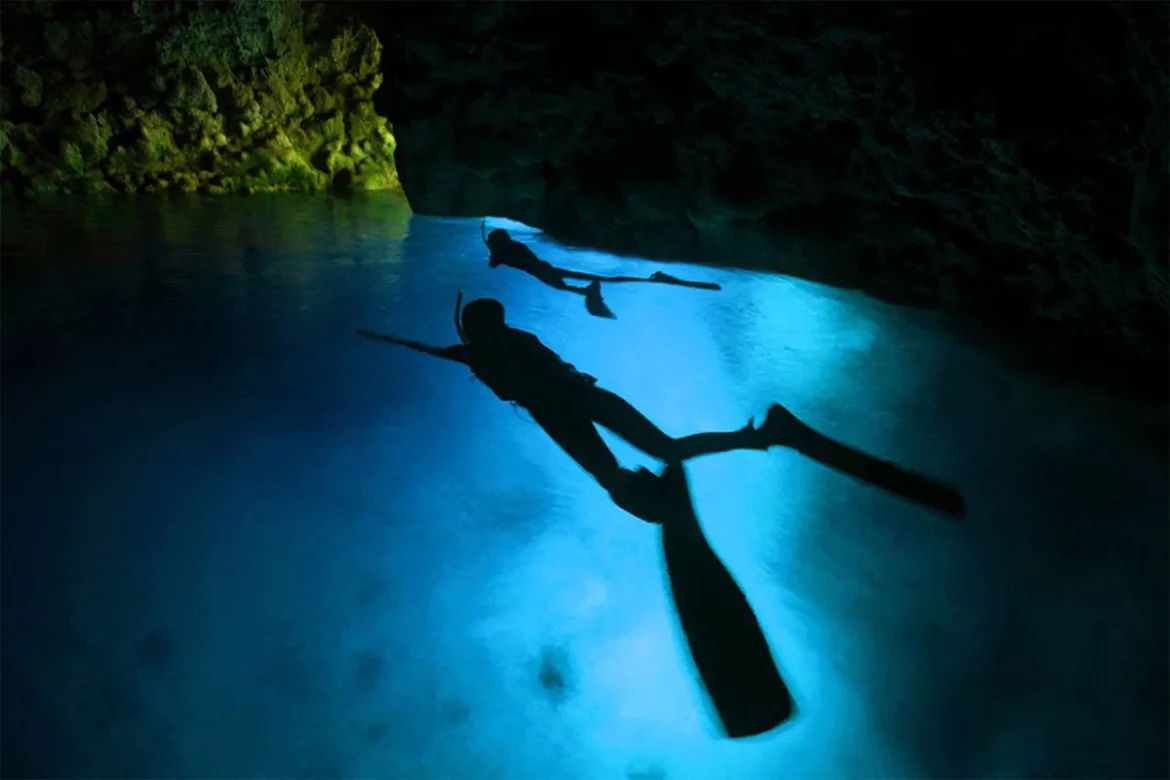
Blue Cave Okinawa snorkeling is worth booking if you want an accessible first marine activity, dramatic blue light and plenty of fish without committing to a full-day boat trip. It is less rewarding if you expect an empty natural cave or assume that a confirmed reservation guarantees entry regardless of the sea.
The most important decision is not simply which operator has the lowest advertised price. You need to choose between shore and boat entry, check the participant restrictions, understand what happens in bad weather and confirm how you will reach the meeting point. These details affect the experience far more than small differences between tour prices.
For most first-time visitors, a guided boat-entry snorkeling tour is the easiest option. Shore entry can be cheaper and gives direct access from Cape Maeda, but it involves a long stairway, can be affected by official stair closures and is uncomfortable for travelers carrying equipment, young children or anyone with limited mobility.

Blue Cave Okinawa quick facts
| Question | Practical answer |
|---|---|
| Where is it? | At Cape Maeda in Onna Village on the west coast of Okinawa Main Island |
| Is there an admission ticket? | No separate cave admission ticket; visitors pay for tours, equipment, transport and optional facilities |
| Best for | First-time snorkelers, couples, families and travelers staying in central Okinawa |
| Typical time required | Allow about three hours for briefing, changing, transport to the water and snorkeling |
| Can non-swimmers join? | Some guided plans accept non-swimmers using life jackets and flotation support, but comfort in open water still matters |
| Is advance booking needed? | Recommended for summer, weekends, private groups, English-speaking guides and child-specific plans |
| Does rain cancel tours? | Not necessarily; wind, waves, visibility and official access restrictions are more important |
| Is the cave guaranteed? | No; an operator may cancel, reschedule or use another snorkeling site when conditions are unsafe |
| Best transport | Rental car, hotel pickup or taxi from an Onna Village resort |
What is the Blue Cave in Okinawa?
The Blue Cave is a marine cave beneath the limestone cliffs of Cape Maeda. Light entering the cave reflects through the water and across the seabed, producing the luminous blue appearance seen in photographs.
What first-time visitors often misunderstand is that this is not a sightseeing cave entered while remaining dry. Visitors reach the area by swimming or diving. Boat-entry tours take you close to the cave, but you still enter the water and swim with the guide.
The cave itself is only part of the experience. Much of a snorkeling tour is spent outside the cave looking at fish and the surrounding reef. On a crowded day, the marine life outside can be more enjoyable than the brief period inside the illuminated section.
Is Blue Cave Okinawa worth visiting?
It is most worthwhile for travelers who have never snorkeled in Okinawa, want a short activity between sightseeing stops or prefer a guided experience with equipment included. The enclosed cave creates a more distinctive memory than ordinary beach snorkeling, while the shallow-water format offered by many operators is approachable for beginners.
This may not be worth it if you are already joining a full-day Kerama Islands snorkeling trip, dislike crowded water or want a quiet wildlife-focused experience. The Blue Cave is one of Okinawa’s best-known marine sites, not an isolated secret. During busy periods, several groups can enter at similar times.
It is also not a dependable activity for a rigid itinerary. Sea conditions can change and the final decision belongs to the facility staff, boat captain or tour operator. Travelers with only one free morning should be comfortable with the possibility of an alternative reef location.
Do you need a tour?
Independent snorkeling may be permitted when the Cape Maeda stairs are fully open, but it is not the best option for an inexperienced visitor. The official facility requires snorkelers to wear a life jacket or buoyancy belt, and access may change to guided-entry only or close completely.
A guided tour normally provides the mask, snorkel, fins, life jacket, wetsuit when required, safety briefing and in-water assistance. Many plans also include photographs or video. The guide’s main value is not pointing at fish; it is managing equipment, assessing conditions and controlling the group in a busy cave environment.
Experienced snorkelers using their own equipment may prefer independent entry on a calm day, but they must still follow the official access status. Never enter through a closed stairway or assume that other swimmers in the water mean conditions are suitable.
Boat entry or shore entry: which should you choose?
| Factor | Boat-entry tour | Shore-entry tour |
|---|---|---|
| Physical effort | Avoids the long Cape Maeda stairway, although you may need to climb a boat ladder | Requires descending and climbing the stairs while wearing or carrying equipment |
| Meeting point | Usually a dive shop, harbor or designated tour base | Often Cape Maeda or a nearby shop |
| Parking | Some operators provide their own parking | Cape Maeda parking can become busy during peak periods |
| Young children | Usually easier when using a specialist family operator | The stairs and shore movement can be tiring |
| Older travelers | Usually preferable, subject to operator age and health rules | Less suitable for knee, balance or stamina limitations |
| Sea closure response | The captain may use an alternative site, but the cave is not guaranteed | Cannot use the Cape Maeda stair entrance when it is officially closed |
| Experience | Short boat ride adds to the activity | Direct and simple on a calm day |
Choose boat entry if your group includes young children, anyone uncomfortable with stairs or travelers who want the operator to manage parking, changing facilities and access from a private base.
Choose shore entry if everyone is physically comfortable with the steps, you are staying close to Cape Maeda and you are willing to accept a greater risk that stair restrictions affect the exact plan.
A current Klook boat-course listing includes a boat approach, multilingual support, photographs and video, operator parking and shower facilities. It is a practical option when the Cape Maeda stairs are the main concern, although unsafe sea conditions can still result in a different snorkeling location.
Which Blue Cave snorkeling tour should you book?
For most first-time international visitors
Choose a tour that explicitly confirms an English-speaking instructor rather than assuming basic English will be available. Check whether the language applies to the safety briefing, the entire activity or only booking support.
A useful general option is a listing with Chinese and English instructors, GoPro photography and a choice between shared and private-group arrangements. The shared tour is usually sufficient for confident adults, while a private group is more appropriate for nervous swimmers or families who need a slower pace.
For families with babies or preschool children
Do not assume that every “family-friendly” tour accepts toddlers. Many normal snorkeling plans begin around school age. Specialist child programs may use a flotation ring or viewing aid for very young children rather than expecting them to breathe through a snorkel.
One current boat-course listing is specifically marketed for children aged one and above and operates as a family-oriented program. Parents must still check height, weight, wetsuit availability, health conditions and how the child will enter the water before paying.
For travelers without a rental car
Look for a product with a confirmed pickup arrangement rather than booking the activity first and solving transportation later. A transfer described as “Onna Village pickup” may cover only a defined list of hotels.
One current package offers complimentary transfers from selected hotels near its departure port and optional paid shared transportation from parts of Naha and Chatan. Its standard snorkeling option lists an age range of 6–59, demonstrating why the eligibility section must be checked before purchase.
For private groups
A private tour makes sense when one participant is anxious, the family has mixed swimming ability or you need the guide to concentrate on one child. It does not make the cave private. Other operators can still be inside at the same time.
Before paying extra, confirm whether “private” refers to the in-water instructor, the boat, the transfer vehicle or all three. These are not the same benefit.
When is Klook more useful than booking directly?
| Booking situation | More practical choice | Reason |
|---|---|---|
| Standard beginner tour with English support | Klook can be practical | Language, duration, inclusions and cancellation terms can be compared in one place |
| Family needing a specific child age | Compare on Klook, then confirm with operator | The listing helps identify suitable programs, but equipment and child readiness need direct confirmation |
| Participant aged 60 or above | Direct operator contact first | Upper age limits, medical certificates and approval rules differ |
| Pregnancy or significant medical history | Direct operator contact | Do not rely on a generic booking form for medical eligibility |
| Same-day booking during unsettled weather | Direct operator contact may be clearer | The operator can explain the likely alternative site and current meeting arrangement |
| Normal parking or facility use only | Pay at Cape Maeda | There is no reason to book a separate ticket for the public facility |
How to get to Blue Cave Okinawa

By rental car from Naha Airport
Driving is the most flexible option. The official Cape Maeda information gives a journey of approximately one hour from Naha Airport, although Route 58 traffic can extend the trip.
Enter the full destination as Cape Maeda, 469-1 Maeda, Onna Village. The official navigation map code is 206 062 685*85.
Cape Maeda has approximately 180 standard vehicle spaces and designated accessible parking. The ordinary vehicle charge is ¥100 for the first hour and another ¥100 for each additional hour. Carry coins or small-denomination notes because the payment equipment does not accept every Japanese banknote.
A rental car is especially useful when you plan to combine the activity with Ryukyu Mura, Cape Zanpa, Yomitan pottery areas, Cape Manzamo or an Onna Village hotel.
By bus from Naha Airport
The official access information lists bus route 120 from Naha Airport to Kuraha bus stop, followed by an approximately 20-minute walk. In practice, public transport is less attractive than the timetable suggests.
The final walk adds exposure to heat and rain, and you may be carrying swimwear, towels and personal belongings. It is also unsuitable for travelers who expect a bus to stop beside the changing rooms.
Allow substantial buffer time for traffic. Do not book a tightly timed tour based only on the scheduled bus arrival. Confirm the operator’s late-arrival policy before relying on public transport.
By airport limousine bus to an Onna Village hotel
An airport limousine bus can be useful for reaching selected resort hotels, but it is not a direct Blue Cave transfer. You will still need a taxi, hotel pickup or a separate meeting arrangement.
This option works best when you are staying in Onna Village for several nights and book a snorkeling operator that collects guests from your hotel.
By taxi
A taxi is realistic from nearby Onna Village, Yomitan or a Route 58 resort. From central Naha it can become expensive, particularly if you also need a return journey.
Ask the operator whether the meeting point is Cape Maeda, a harbor or its shop. “Blue Cave tour” does not identify one universal pickup location.
Cape Maeda parking and facility hours in 2026
| Facility | Current practical information |
|---|---|
| Management office | 08:30–17:30 |
| Parking, April–November | 07:00–19:00 |
| Parking, December–March | 07:00–18:00 |
| Showers and lockers | 07:00–18:30 |
| Hot-water shower | ¥200 |
| Coin locker | ¥100 |
| Hair dryer | ¥100 |
Do not leave belongings in a Cape Maeda locker past 18:30. The current notice states that the shower-room entrance closes and items inside cannot be retrieved afterward.

How sea conditions and closures work
The official Cape Maeda page publishes a same-day status for the stairs leading to the water. Depending on conditions, access may be open, limited to visitors accompanied by a diving company or instructor, or closed completely.
A closed stairway does not automatically mean every boat in Onna Village is cancelled. A boat operator may depart from a different location and select another protected reef. Conversely, a boat departing successfully does not mean the Blue Cave itself is accessible.
Always distinguish between these three outcomes:
- The tour operates and enters the Blue Cave.
- The tour operates at a different snorkeling site.
- The entire activity is cancelled or rescheduled.
Read the product’s bad-weather policy before booking. Some travelers are satisfied with an alternative coral-and-fish location; others are booking specifically for the cave and would prefer to reschedule.
Check the official Cape Maeda swimming information and then follow the operator’s final instructions. The operator may make its decision later than the facility status update because conditions can change during the day.
Does rain cancel Blue Cave snorkeling?
Rain alone does not necessarily cancel snorkeling or remove the blue effect. The cave’s appearance comes from light passing through the entrance and reflecting through the water, so it can still appear blue under cloudier skies.
Wind direction, wave height, swell and underwater conditions are more important. A bright sunny day can still be unsuitable if waves are entering the Cape Maeda coastline.
Do not cancel your own reservation simply because the weather app shows rain. Wait for the operator’s instruction unless the cancellation terms explicitly allow you to change the booking.
Best time to visit Blue Cave Okinawa
Best time of day
The first morning departure is generally the most practical choice for avoiding the heaviest tour traffic and reducing the risk of parking delays. Mid-morning and the period around lunchtime are easier for most visitors to schedule, which is exactly why they can become busy.
An early departure also leaves the rest of the day free for sightseeing. However, do not choose an extremely early tour if your family will be tired, rushed or unable to eat beforehand. A calm child on a later private tour is better than an exhausted child on the first departure.
Later-afternoon sessions can be quieter, but check the operator’s changing-room arrangements and ensure you finish before facility and locker closing times.
Best season
Blue Cave tours operate across the year, subject to sea conditions. Summer offers warm water but also the highest demand, stronger sun and greater parking pressure. Spring and autumn can balance comfortable temperatures with smaller crowds.
Winter tours may provide wetsuits, but strong seasonal winds can affect west-coast access. Travelers visiting outside summer should choose an operator that clearly explains its alternative-site policy rather than assuming the cave will be available every day.
What happens on a Blue Cave snorkeling tour?
- Check in at the dive shop, harbor or Cape Maeda meeting point.
- Complete participant and medical information.
- Change into swimwear, wetsuit and snorkeling equipment.
- Receive instruction on mask use, breathing, fins and guide signals.
- Travel to the entry point by boat or walk to the Cape Maeda stairs.
- Enter the water with a life jacket or other buoyancy equipment.
- Follow the guide toward the cave and nearby fish-viewing area.
- Return to the boat or shore, change and receive photographs if included.
A tour advertised as three hours does not mean three hours inside the water. Check-in, changing, safety instruction and transportation account for much of the schedule. This is normal and should not be interpreted as lost tour time.

Snorkeling or introductory scuba diving?
| Consideration | Snorkeling | Introductory scuba diving |
|---|---|---|
| Previous experience | Usually suitable for beginners | No license may be required, but a longer briefing is necessary |
| Position in water | Mostly at the surface | Underwater with breathing equipment |
| Age limits | Vary widely by operator | Usually stricter and commonly begins at an older age |
| Medical screening | Required by many operators | More restrictive |
| Flying afterward | No scuba no-fly interval | A no-fly interval applies; never schedule it immediately before departure |
| Best for | Families, nervous beginners and short itineraries | Travelers who specifically want an underwater diving experience |
Snorkeling is the better first choice for most readers of this guide. Trial diving adds equipment, medical restrictions and post-dive flight considerations. It should not be selected merely because the product photographs look more dramatic.
If you choose introductory scuba, follow the operator’s stated no-fly interval. Do not schedule a dive on the same day as a flight.
Can non-swimmers join?
Some operators accept participants who cannot swim because a life jacket provides buoyancy and the guide can tow a flotation device. This does not mean the experience is suitable for everyone.
A participant must still tolerate seawater on the face, breathe through a snorkel, remain calm near other swimmers and follow instructions. Someone with severe water anxiety may be safer watching from Cape Maeda’s viewpoint or choosing a different activity.
A private instructor can reduce pressure, but it cannot remove waves, boat movement or the enclosed appearance of the cave.
Is Blue Cave suitable for children?
Yes, but the correct tour matters. Standard plans may impose minimum ages of six or seven, while specialist programs use flotation aids for younger children. Never book the adult package and assume the operator will improvise on arrival.
Ask these questions before paying:
- What is the minimum age for this exact package?
- Will the child use a normal mask and snorkel or a flotation ring?
- Is a child-size wetsuit available?
- Is the group private?
- Does the child need to be toilet trained?
- What happens if the child refuses to enter the water?
- Does the boat have shade?
- Can one parent remain out of the water?
Boat entry is usually easier for families because it avoids the Cape Maeda stairway. However, very young children may find the boat noise, wetsuit and open water unfamiliar. Explain the activity before arrival rather than presenting it as a surprise.
Is it suitable for older travelers?
Possibly, but operator limits matter more than general fitness claims. Some standard packages stop at age 59, while other operators accept older participants after health confirmation or a medical certificate.
Boat entry removes the long shore stairway, but participants may still need to step onto a moving boat, sit low, wear a wetsuit and climb a ladder. Anyone with knee, hip, balance, heart, lung or ear concerns should contact the operator before booking.
For a mixed-age family, a private boat tour with written eligibility confirmation is more sensible than choosing the cheapest shared shore-entry plan.
Health restrictions to check before booking
Operators commonly screen for conditions involving the heart, lungs, brain, ears, blood pressure, asthma, epilepsy and recent surgery. Pregnancy is normally excluded from snorkeling and diving packages.
Do not conceal a condition because you have already paid. A participant rejected during the on-site health check may not receive a refund if the condition was covered by the published restrictions.
Also avoid alcohol before the activity and arrive rested. Seasickness medication should be taken only in accordance with its instructions and personal medical advice.
What to bring
- Swimwear worn under your clothes
- Towel
- Change of clothes and underwear
- Water-resistant sunscreen
- Rash guard if not using a full wetsuit
- Drinking water
- Hair tie for long hair
- Small amount of Japanese cash
- Motion-sickness preparation for boat tours
- Glasses case or contact-lens supplies
- Any medical form requested by the operator
Leave valuables at your hotel when possible. A waterproof phone pouch is not a substitute for an operator’s underwater camera system, and loose phones should not be carried into the cave.
Environmental and safety rules

- Wear the required life jacket or buoyancy equipment.
- Do not enter when the official stairs are closed.
- Do not jump from the cave walls or surrounding cliffs.
- Do not stand on, kick or hold coral.
- Do not chase or touch marine animals.
- Keep fins horizontal and away from the reef.
- Stay with the guide and group.
- Do not block the cave entrance while taking photographs.
- Follow the operator’s instructions even if another group is behaving differently.
How long should you allow?
Reserve approximately three hours for the activity itself. Add travel time separately.
| Starting point | Recommended total time block |
|---|---|
| Onna Village resort | About half a day including transfers and showering |
| Chatan or American Village | At least half a day |
| Central Naha by rental car | Five to six hours including driving and buffer time |
| Naha by public bus | Most of a day once waiting and the final walk are included |
Do not schedule another reservation immediately after the listed finish time. Changing, photograph delivery, traffic and late boat returns can extend the activity.
Suggested Blue Cave itineraries
Easy half-day from an Onna Village hotel
- Early breakfast
- Morning boat-entry snorkeling tour
- Return to hotel for shower or rest
- Lunch in the Maeganeku or Onna resort area
- Cape Manzamo or hotel beach in the afternoon
This is the least stressful plan for families and first-time snorkelers.
Day trip from Naha by rental car
- Leave Naha early
- Join a morning Blue Cave tour
- Lunch near Onna or Yomitan
- Visit Ryukyu Mura
- Stop at Cape Zanpa or American Village on the return journey
Ryukyu Mura is a practical follow-up because it is close to the Cape Maeda area and provides a land-based activity if the sea tour is tiring or the weather becomes unsettled.
Rain-flexible family itinerary
- Keep the snorkeling booking in the morning unless the operator cancels
- Use Ryukyu Mura or a craft experience as the afternoon plan
- Avoid committing to a distant northern attraction on the same day
- Return to the hotel early if children become cold or tired
Nearby attractions worth combining
Ryukyu Mura
A reconstructed cultural village with traditional buildings, performances and craft experiences. It is one of the easiest combinations because it is close to Cape Maeda and does not require another long drive.
Cape Zanpa
A coastal headland northwest of Cape Maeda. It works well for a scenic drive but should remain optional if the snorkeling tour finishes late.
Yomitan pottery areas
Suitable for travelers interested in Okinawan ceramics and slower local sightseeing. Shops and workshops have individual opening days, so select one or two rather than driving without a plan.
Cape Manzamo
A dramatic coastal viewpoint farther north in Onna Village. It fits a west-coast itinerary, particularly for travelers staying at an Onna resort.
American Village
A practical evening stop when returning toward Chatan or Naha. It offers restaurants and sunset views without requiring another timed attraction booking.
Where to stay
Staying in Onna Village is the most convenient choice for an early tour. It reduces the risk of Route 58 traffic and makes hotel pickup more likely, although each operator serves only selected properties.
Chatan is a useful compromise for travelers who want restaurants and evening entertainment while remaining closer to Cape Maeda than central Naha.
Naha is suitable when Blue Cave is only one day of a city-based trip, but allow a large transport buffer. Do not choose the first tour of the morning unless you have a rental car or confirmed pickup.
Common mistakes to avoid
- Booking a shore-entry tour without realizing there is a long stairway
- Assuming a boat tour guarantees the Blue Cave
- Choosing a tour before checking age and health limits
- Assuming “family-friendly” means toddlers are accepted
- Taking an airport limousine bus and expecting it to stop at Cape Maeda
- Arriving at Cape Maeda at a peak time without parking buffer
- Cancelling personally because of rain before hearing from the operator
- Ignoring the alternative-site policy
- Leaving belongings in the locker after the facility closes
- Parking along local roads
- Booking trial scuba on a flight day
- Planning a long northern Okinawa itinerary immediately after snorkeling
Blue Cave Okinawa snorkeling FAQ
Is Blue Cave Okinawa free?
There is no separate admission ticket for the natural cave. Costs come from a guided tour, equipment, transportation, parking and optional shower or locker use.
Can I enter Blue Cave without a guide?
Independent access may be possible when the Cape Maeda stairs are fully open, but beginners should use a guide. On some days access is restricted to visitors accompanied by an instructor, and on unsafe days the stairs are closed.
Should I choose a boat or shore tour?
Choose a boat tour for easier physical access, young children or older travelers. Choose shore entry only when everyone is comfortable with stairs and accepts the possibility of stair-related cancellation.
Is Blue Cave suitable for non-swimmers?
Some guided tours accept non-swimmers using life jackets and flotation support. The participant must still remain calm in open water and follow breathing instructions.
Can a one-year-old join?
Only certain specialist programs accept children that young. These may use a flotation device rather than conventional snorkeling. Check the exact package instead of relying on general Blue Cave advice.
Can travelers over 60 join?
Some operators impose an upper limit of 59, while others assess older participants individually. Contact the operator before booking and ask whether a medical certificate is required.
Will the tour be cancelled if it rains?
Not necessarily. Sea state, wind, waves and official access restrictions are more important than rain alone.
What happens if the Blue Cave is closed?
The operator may cancel, reschedule or visit another reef. Read the alternative-site and refund policy before paying.
What is the best time of day?
The first morning departure usually offers the best combination of smaller crowds, easier parking and a full afternoon for sightseeing.
How far is Blue Cave from Naha Airport?
The official estimate is approximately one hour by car, but traffic can make the journey longer. Public bus travel takes significantly more time and includes a final walk.
Can I visit Blue Cave and Churaumi Aquarium on the same day?
It is technically possible by car, but not recommended for most families. The aquarium is much farther north, and snorkeling already requires preparation and recovery time. Pair Blue Cave with Ryukyu Mura, Cape Zanpa or another central-west attraction instead.
Are photographs included?
Many tours include digital photographs, but the number, format and delivery method differ. Confirm whether video, GoPro footage, downloads and waterproof-camera rental are actually included.
Final verdict
Blue Cave Okinawa snorkeling is an excellent first marine activity when you choose the tour around your group rather than around the lowest headline price. A boat-entry program is the most practical default for families, beginners and travelers who want to avoid the Cape Maeda stairs.
Book ahead when you require English support, a private guide, hotel pickup or a specialist child package. Contact the operator directly when age, mobility, equipment sizing or medical eligibility is uncertain.
Most importantly, treat entry to the cave as weather-dependent. A confirmed booking secures a tour arrangement; it does not overrule the sea.