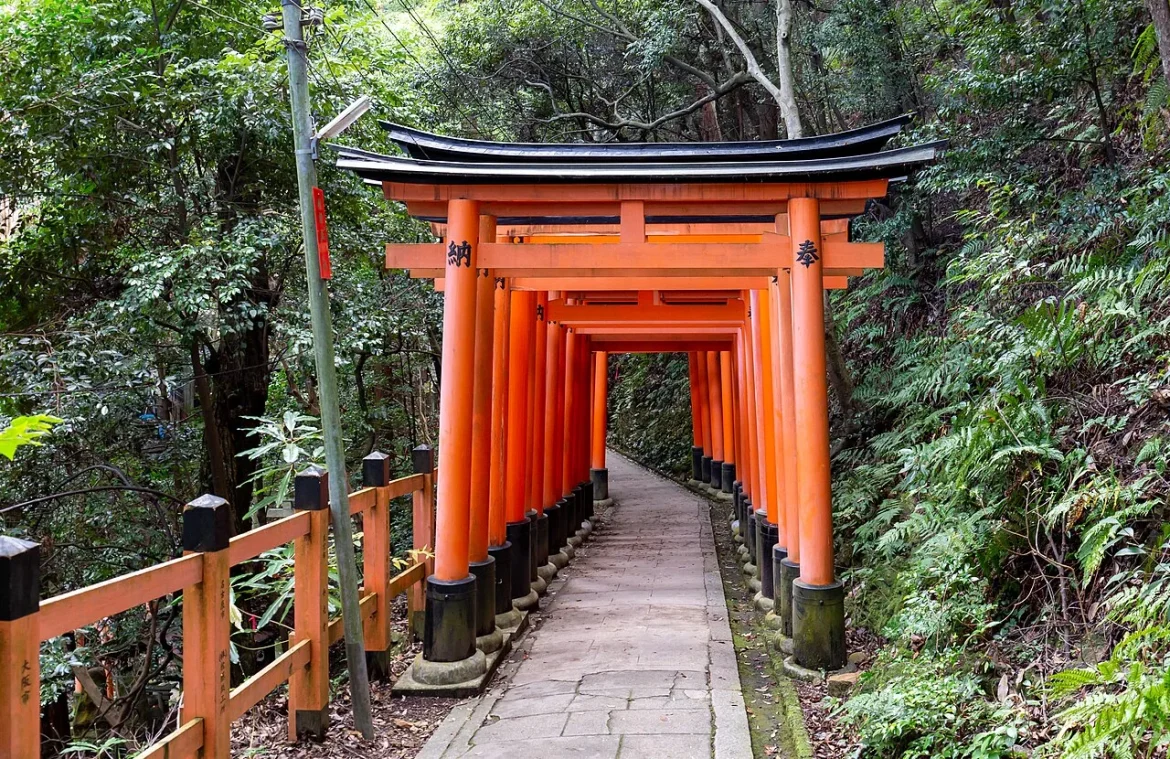
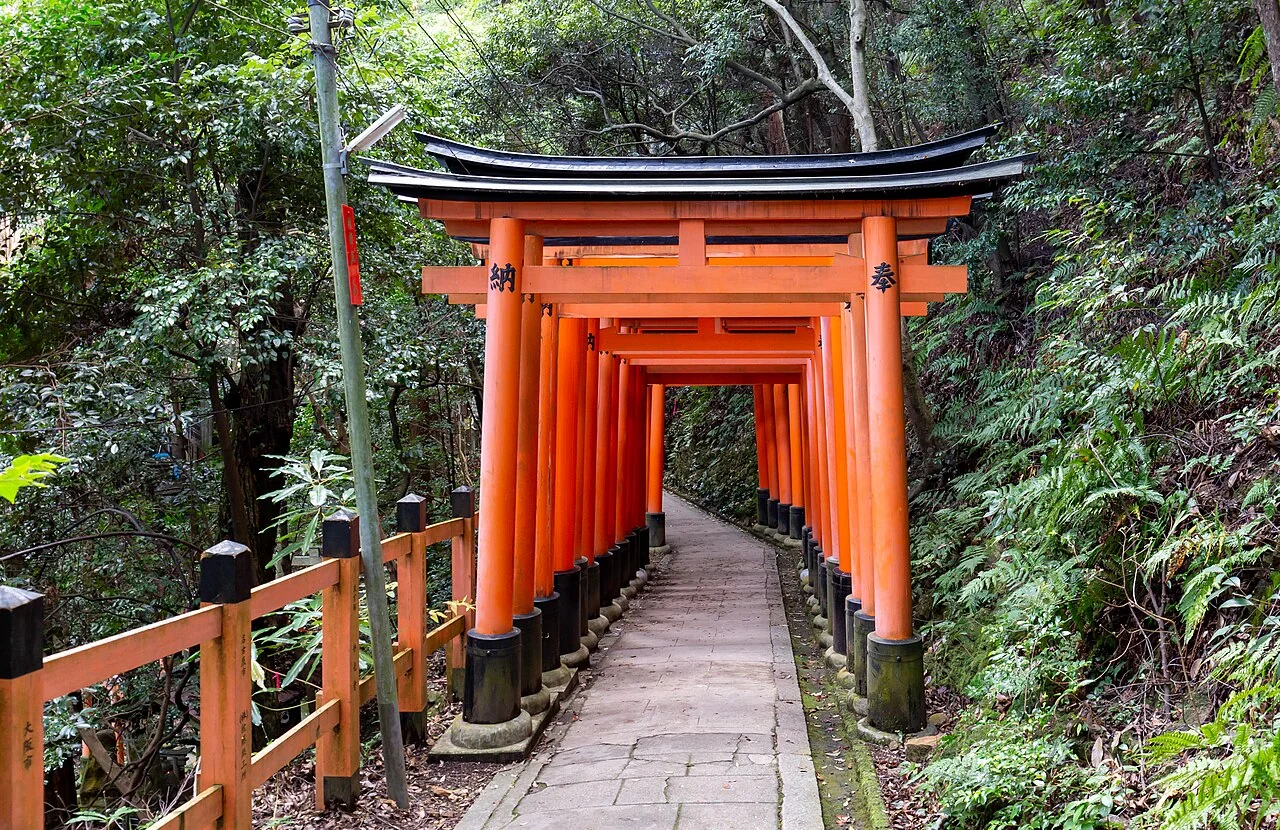
Fushimi Inari Taisha is Kyoto’s most recognisable Shinto shrine, known for the long corridors of vermilion torii gates climbing through the forested slopes of Mount Inari. The shrine was founded in 711 and serves as the head shrine of the thousands of Inari shrines found throughout Japan.
It is worth visiting, but not because every traveller needs to reach the summit. The most important decision is how far to climb. A short visit to the main shrine, Senbon Torii and Okusha Hohaisho delivers the classic Fushimi Inari experience in around one hour, while a climb to Yotsutsuji provides a more satisfying hike and a broad view over southern Kyoto. Completing the entire summit circuit normally requires substantially more time and energy.
The lower shrine precinct is beside JR Inari Station, making this one of Kyoto’s easiest major landmarks to reach. From the March 2026 timetable revision, all rapid trains on the JR Nara Line also stop at Inari. Advice stating that visitors must use only local trains is now outdated.
Standard entry is free, no admission reservation is required and the grounds are generally accessible throughout the day and night. However, “open all night” does not mean that shops, shrine offices and staffed facilities operate continuously. The mountain route can also close temporarily after typhoons, fallen trees or other serious weather conditions.
For a first visit, arrive early, walk through the main shrine before entering Senbon Torii and decide at Okusha whether to turn back, continue to Yotsutsuji or commit to the summit loop. Visitors who would like more explanation without joining a scheduled group can use the Fushimi Inari Taisha audio guide while exploring independently.
Fushimi Inari fits easily into a broader Kyoto trip. The Kyoto travel guide can help you decide which districts to combine rather than crossing the city repeatedly.

Is Fushimi Inari Taisha Worth Visiting?
| Question | Practical answer |
|---|---|
| Is it worth visiting? | Yes, especially for a first Kyoto trip, but you do not need to complete the summit circuit to appreciate it. |
| Best suited to | First-time Kyoto visitors, photographers, walkers, shrine enthusiasts and travellers seeking an early-morning activity. |
| Who may prefer to skip it? | Visitors who dislike crowds, repeated stair climbing or heavily photographed landmarks may prefer a quieter Kyoto shrine. |
| Admission | Standard shrine and mountain access is free. |
| Reservation | No reservation is required for an independent visit. |
| Suggested duration | About 60–90 minutes for the lower highlights, 1.5–2 hours to Yotsutsuji and back, or 2.5–3 hours for the full circuit. |
| Transport difficulty | Easy. JR Inari Station faces the shrine, while Keihan Fushimi-inari Station is around five minutes away on foot. |
| Main highlight | The transition from the busy lower torii passages to the quieter shrine-lined forest higher on Mount Inari. |
| Main disadvantage | The lower route becomes extremely busy during the middle of the day. |
| Children | The lower route suits most families; the full summit circuit may be tiring for younger children. |
| Older travellers | A base-only or Okusha visit works well. The upper mountain route requires sustained climbing. |
| Wheelchair access | The lower precinct provides a meaningful visit, but the mountain route is not step-free. |
| Best time | Within the first two hours after sunrise, or later in the afternoon if an early start is impossible. |
| Overnight stay required? | No. Fushimi Inari is an easy trip from central Kyoto and possible as a day trip from Osaka. |
Editor’s recommendation: prioritise Fushimi Inari if this is your first Kyoto visit, but set a realistic turnaround point. For most visitors, the best balance is to walk beyond Okusha and continue as far as Yotsutsuji rather than forcing a complete summit circuit simply to say it was completed.
Visitors with limited time can experience the main shrine and Senbon Torii in under 90 minutes. Those hoping for empty gates at midday, a dramatic summit panorama or a completely step-free mountain walk are likely to be disappointed.
Independent shrine entry is free. A guided walk is an optional service, not an admission requirement; compare its language, meeting time and route before booking.
Fushimi Inari Taisha Essential Information
| Item | Details |
|---|---|
| Official name | Fushimi Inari Taisha |
| Japanese name | 伏見稲荷大社 |
| Address | 68 Fukakusa Yabunouchi-cho, Fushimi-ku, Kyoto |
| Standard admission | Free |
| Reservation | Not required for an independent visit |
| General access | The shrine grounds are generally accessible throughout the day and night; staffed services operate during daytime hours. |
| Recommended duration | 45 minutes to 3 hours, depending on the turnaround point |
| Nearest JR station | JR Inari Station on the Nara Line |
| Nearest Keihan station | Fushimi-inari Station, KH34 |
| Main physical challenge | Long sections of steps and continuous climbing on Mount Inari |
| Parking | Limited and frequently congested; public transport is strongly preferable |
| Standard visit status | Ordinary public visit; follow current notices and any local restrictions |
Grounds, Staffed Services and JR Access
The grounds have no routine closing time, but prayer reception is 08:30–16:30 and the amulet counter is 08:00–18:00. Special-day adjustments may apply. Buildings and restricted areas are not open for unrestricted interior access. Check staffed service hours.
Plan the ordinary visit around the public shrine precinct, Senbon Torii and the signed mountain route. Temporary restrictions can change the route, particularly after severe weather, so check on-site notices before climbing.
When severe weather affects Kyoto, do not assume that around-the-clock access guarantees that the mountain trail will remain open. Check the shrine’s latest announcements before making a night hike or travelling immediately after a typhoon.
All JR Nara Line Rapid Trains Now Stop at Inari
JR West’s 2026 timetable-revision notice confirms that all Nara Line rapid services now stop at Inari following the March 14 timetable change.
From the March 2026 timetable revision, all rapid services on the JR Nara Line stop at Inari Station. This is an important improvement for visitors travelling from Kyoto Station, Uji or Nara.
Older guides sometimes instruct travellers to avoid rapid trains because they previously passed through Inari. That restriction no longer applies under the current timetable. You should still confirm that the departure display lists Inari, particularly during temporary timetable changes.
Tickets, Reservations, Tours and Passes
There is no standard Fushimi Inari admission ticket. Visitors can worship in the public shrine precinct, walk through Senbon Torii and follow the permitted Mount Inari route without paying an entrance fee. This does not allow entry inside the restricted Honden or other shrine buildings.
For an ordinary independent visit, buying a ticket through a third-party platform is therefore unnecessary. Paid bookings become relevant only when you want a guide, traditional clothing, organised transportation or a broader Kyoto sightseeing package.
| Option | What it includes | Best suited to | Main advantage | Main limitation |
|---|---|---|---|---|
| Independent visit | Free access to the shrine and mountain route | Most travellers | Complete flexibility and no admission cost | Limited explanation unless you research the shrine beforehand |
| Audio guide | App-based commentary | Independent visitors seeking cultural context | Self-paced; check the selected listing | No in-person assistance |
| Early-morning guided tour | Scheduled walk with a guide | First-time visitors interested in history and symbolism | Earlier timing and stronger cultural explanation | Fixed meeting time and route |
| Keihan sightseeing pass | Eligible Keihan Railway journeys | Osaka-based visitors or travellers making several Keihan trips | Can simplify multiple journeys | Not worthwhile for one short trip and does not cover JR |
| Kimono rental | Traditional clothing and dressing assistance | Lower-shrine photography | Shop close to the shrine | Not practical for a full mountain hike |
| Kyoto sightseeing tour | Transport and several Kyoto attractions | Visitors with limited planning time | Avoids arranging several cross-city transfers | Usually allows less time at Fushimi Inari |
Is a Guided Tour Worth Booking?
A guide is worthwhile when you want to understand why the torii were donated, what the fox statues represent and how the mountain’s smaller worship sites fit into Inari belief. Without context, many visitors pass through the gates, take photographs and leave without understanding the shrine itself.
An early-morning Fushimi Inari guided tour is particularly useful for a first visit when cultural explanation matters more than setting your own hiking pace.
Check Early-Morning Fushimi Inari Tour Dates
Best Time to Visit Fushimi Inari Taisha
| Time | Crowds | Advantages | Disadvantages | Recommendation |
|---|---|---|---|---|
| First two hours after sunrise | Lowest at the lower gates | Cooler conditions, softer light and fewer tour groups | Many shops and services are not yet open | Best overall choice |
| Early morning | Moderate and increasing | Good compromise between atmosphere and operating shops | Senbon Torii can already become busy | Good for most visitors |
| Late morning to early afternoon | Highest | More shops and food options are usually open; individual hours vary | Crowded lower paths and frequent photography bottlenecks | Avoid when empty photographs are important |
| Late afternoon | Usually decreasing | Better atmosphere and fewer large groups | Less daylight for the complete summit circuit | Good for an Okusha or Yotsutsuji visit |
| After dark | Low | Quiet and atmospheric | Darker paths, closed shops and less staff presence | Best for confident visitors already familiar with the route |
The most reliable crowd-avoidance strategy is to arrive before the main sightseeing groups. This matters most at Romon, the main sanctuary and the first Senbon Torii passages. The path generally becomes quieter as you climb because many visitors turn around near Okusha.
Late afternoon is the second-best option, particularly if you only intend to visit the lower shrine or Yotsutsuji. Allow sufficient daylight for the descent, especially after rain.
Is Fushimi Inari Worth Visiting at Night?
The shrine can feel dramatically quieter after dark, and the illuminated lower precinct has a completely different atmosphere. Nevertheless, a night visit is not automatically better.
Many shops and staffed services will be closed, some upper paths are dim, route signs are easier to miss and fewer people are present to provide assistance. First-time visitors, solo travellers uncomfortable with dark forest paths and anyone with limited mobility should experience the mountain during daylight first.
How Far Should You Climb?
Do not begin the hike assuming that the summit is the only worthwhile destination. Choose a route based on your available time, fitness and interest.
| Turnaround point | Approximate total visit | What you experience | Best suited to |
|---|---|---|---|
| Main shrine and first torii gates | 30–45 minutes | Romon, main sanctuary and the beginning of Senbon Torii | Visitors with very limited time or mobility |
| Okusha Hohaisho | 60–90 minutes | Senbon Torii, inner worship area and Omokaruishi stones | Most short first-time visits |
| Yotsutsuji | 1.5–2 hours | Longer forest climb, quieter torii and broad city views | Visitors wanting a meaningful hike without the full circuit |
| Mount Inari summit circuit | 2.5–3 hours | Upper shrines, stone altars, forest paths and the complete sacred mountain route | Walkers interested in the mountain’s spiritual landscape |
Base and Senbon Torii
This route provides the familiar postcard imagery with minimal climbing. It is suitable when Fushimi Inari is one stop in a crowded Kyoto day or when someone in the group cannot manage a prolonged uphill walk.
Okusha Hohaisho
Okusha is reached after passing through the main Senbon Torii passages. It contains the Omokaruishi stone lanterns, where visitors make a wish and lift a stone finial. Tradition holds that a stone feeling lighter than expected is a favourable sign.
This is the best turnaround point for a compact first visit because it includes the shrine’s most recognisable gates and a meaningful worship location beyond the main buildings.
Yotsutsuji
Yotsutsuji is the best goal for travellers who want both a hike and an open view. It is often more satisfying than the summit for visitors primarily interested in scenery.
The climb becomes steeper after Okusha, but the route passes smaller shrines, tea houses and increasingly quiet torii corridors. At Yotsutsuji, the path divides around the upper mountain circuit.
The Mount Inari Summit
Mount Inari rises to 233 metres. Reaching the summit is spiritually and historically meaningful, but it does not provide the route’s most dramatic panoramic view. The summit area is surrounded by trees and shrine structures rather than an open observation deck.
Complete the circuit because you want to experience the sacred mountain, upper worship sites and quieter forest—not because you expect a sweeping summit panorama.
Correct First-Time Route
Use the shrine and mountain-route map to locate the lower precinct, Okusha and upper route before choosing a turnaround point. For rail arrival, see the shrine’s station-access guide.
- Arrive at JR Inari Station or Keihan Fushimi-inari Station.
- Walk through the main approach and enter through the large Romon Gate.
- Visit the main sanctuary before heading directly to the torii route.
- Follow the signs to Senbon Torii.
- Walk through the two parallel gate passages without blocking other visitors.
- Reach Okusha Hohaisho and try the Omokaruishi stones if the area is not congested.
- Decide whether to return, continue to Yotsutsuji or complete the summit circuit.
- If continuing, follow the signed route through the smaller shrines and forested torii passages.
- Pause at Yotsutsuji before deciding whether the upper loop is worth the additional climb.
- Return to the lower approach for food rather than carrying an elaborate meal onto the mountain.
The biggest mistake is rushing directly to Senbon Torii and ignoring the main sanctuary. Fushimi Inari is an active shrine rather than a purpose-built photography attraction, and the religious buildings provide the context for the gates on the mountain.
Main Highlights
Romon Gate
The monumental Romon Gate creates the formal entrance to the shrine precinct. It dates to 1589 and is associated with Toyotomi Hideyoshi. Visit it before the lower courtyard becomes crowded, as the approach quickly fills with arriving groups.
Main Sanctuary
The current main sanctuary was rebuilt in 1499 after earlier structures were destroyed during the Onin War. It is designated an Important Cultural Property and remains the religious centre of the visit.
Pause here before entering the mountain route. Walking straight to the torii gates removes the gates from the shrine tradition that gives them meaning.
Senbon Torii
Senbon Torii refers to the densely packed vermilion gates on the lower mountain route. The practice of donating torii became established during the Edo period, with each gate representing an offering connected to gratitude or a fulfilled wish.
The narrow passages are shared walking routes. Take photographs efficiently and move aside when checking a camera or phone.
Okusha Hohaisho and Omokaruishi
Okusha stands beyond the main Senbon Torii corridor and looks towards Mount Inari. Its Omokaruishi stones are among the shrine’s most popular interactive traditions.
Queues can form around the lanterns. Do not block the surrounding worship space while waiting or photographing another person’s attempt.
Fox Statues
Foxes are regarded as messengers of Inari rather than as the deity itself. Statues around the shrine may hold keys, scrolls, rice sheaves or symbolic objects connected with prosperity, harvests and protection.
Yotsutsuji Viewpoint
Yotsutsuji provides one of the route’s most useful open views over southern Kyoto. It is also a practical rest and decision point before the upper loop.
Visitors who have already found the climb tiring should turn around here. The remaining summit circuit adds spiritual sites and forest walking, but not a substantially better city view.
Upper Shrines and Otsuka Stones
The upper mountain contains numerous worship sites and thousands of engraved stone altars known as otsuka. This is where Fushimi Inari begins to feel less like a famous tourist landmark and more like an extensive sacred landscape.
Walking, Stairs and Physical Difficulty
Access from the station to the lower shrine is easy, but the Mount Inari route should not be described as entirely easy. Beyond Okusha, visitors encounter long stairways, repeated climbs, stone paving and uneven sections.
- The route to the main sanctuary is short and manageable for most visitors.
- The first Senbon Torii section involves limited climbing but can be difficult to navigate when crowded.
- The climb from Okusha towards Yotsutsuji is sustained and noticeably more demanding.
- The upper circuit includes repeated ascents and descents rather than one simple climb followed by one descent.
- Stone surfaces can become slippery during and after rain.
- Summer humidity makes the climb substantially harder than the elevation alone suggests.
- Descending repeated steps can be uncomfortable for travellers with knee problems.
Wear secure walking shoes. Sandals, smooth-soled fashion footwear and traditional geta or zori are unsuitable for the complete mountain circuit.
Large suitcases are particularly inconvenient because of the narrow passages and stairs. Leave them at your hotel or use a station locker before entering the shrine.
Families, Older Travellers and Accessibility
Families with Children
Fushimi Inari can work very well for families because admission is free and the route can be shortened at any point. Children often enjoy the torii tunnels, fox statues and Omokaruishi tradition.
For younger children, plan a main sanctuary–Senbon Torii–Okusha route rather than promising the summit. The upper path can become repetitive and tiring, particularly during hot weather.
A stroller is useful around the station and parts of the lower precinct but becomes impractical once the route reaches extended stairs. Do not leave a stroller unattended outside designated locations. A baby carrier is more useful for families intending to climb beyond the lower torii passages.
Older Travellers
Older travellers do not need to climb Mount Inari to have a worthwhile visit. A lower route including Romon, the main sanctuary, Senbon Torii and possibly Okusha contains the shrine’s most famous features.
Visitors concerned about knees or balance should turn around before the sustained climb beyond Okusha. Descending wet stone steps may be more difficult than climbing them.
Travellers with Limited Mobility
The lower shrine precinct provides the most accessible part of Fushimi Inari. A visitor who cannot climb the mountain can still see the main approach, Romon, shrine buildings and an initial torii experience.
The mountain route is not step-free, and wheelchair users should not plan on completing Senbon Torii, Yotsutsuji or the summit circuit as a continuous accessible route.
Keihan Fushimi-inari Station has an accessible route and wheelchair-accessible toilet. JR Inari is closer to the shrine entrance, so the better station depends on the traveller’s origin and specific mobility needs.
How to Get to Fushimi Inari Taisha
| Starting point | Recommended route | Final access | Best suited to |
|---|---|---|---|
| Kyoto Station | JR Nara Line to Inari Station | The shrine approach is directly opposite the station | Fastest and simplest route from Kyoto Station |
| Gion or central Kyoto | Keihan Railway to Fushimi-inari Station | Approximately five minutes on foot | Visitors staying near Gion-Shijo or Sanjo |
| Osaka | Keihan Railway from Yodoyabashi or Kyobashi, using a service that stops at Fushimi-inari | Approximately five minutes on foot | Osaka-based day trippers |
| Uji | JR Nara Line to Inari or Keihan with the appropriate connection | Directly outside JR Inari or a short walk from Keihan | Travellers combining Fushimi Inari and Uji |
| Nara | JR Nara Line to Inari | The shrine is opposite the station | Visitors combining a short shrine visit with Nara |
| Kansai International Airport | Travel to Kyoto Station, then transfer to the JR Nara Line | Exit at Inari Station | Travellers reaching Kyoto directly from the airport |
| By car | Drive to the shrine area | Limited visitor parking may be congested or redirected | Only travellers with a wider driving itinerary |
Kyoto Station to Fushimi Inari
Follow signs for the JR Nara Line at Kyoto Station and take a train stopping at Inari. The journey normally takes roughly five to ten minutes, depending on the service and waiting time.
From March 2026, both local and rapid Nara Line services stop at Inari. Exit the station and cross towards the shrine approach; there is no complicated final bus or long walk.
Gion and Downtown Kyoto to Fushimi Inari
From Gion-Shijo, Sanjo or another Keihan station, take a service shown as stopping at Fushimi-inari, station KH34. The shrine is approximately five minutes away on foot.
This route is often smoother than returning to Kyoto Station simply to use JR. It also works well when continuing to another location along the Keihan corridor.
Osaka to Fushimi Inari
Keihan Railway provides a practical route from Yodoyabashi and Kyobashi. Depending on the train category and timetable, you may need to change to a stopping service before Fushimi-inari.
Travellers making several Keihan journeys can compare the Kyoto and Osaka Sightseeing Pass by Keihan Railway. It is not automatically economical for one return journey, so compare the pass price against your complete day’s route.
Check Keihan Kyoto and Osaka Pass Options
For more route comparisons, see the Osaka to Kyoto transportation guide.
Kansai International Airport to Fushimi Inari
The smoothest public-transport route is usually to travel from Kansai International Airport to Kyoto Station, leave large luggage at the hotel or in storage, and then transfer to the JR Nara Line for Inari.
Visiting directly with a full-size suitcase is technically possible but not recommended. The lower precinct can be busy, while the mountain paths contain stairs and narrow sections.
The Kansai Airport to Kyoto transportation guide compares the main airport routes.
Should You Drive?
Driving is unnecessary for most visitors. The two railway stations are convenient, while shrine parking can become heavily congested and may be redirected to an overflow area.
A car makes sense only when Fushimi Inari is one part of a broader itinerary to places that are difficult to reach by rail. Do not drive merely to avoid the short station walk.
Half-Day and Full-Day Itineraries
Early-Morning Half-Day Route
- 07:00: Arrive at JR Inari or Keihan Fushimi-inari.
- 07:00–07:20: Visit Romon and the main sanctuary.
- 07:20–07:45: Walk through Senbon Torii to Okusha.
- 07:45–08:30: Continue towards Yotsutsuji.
- 08:30–08:45: Rest and enjoy the view.
- 08:45–09:30: Descend to the lower shrine.
- 09:30 onward: Eat near the approach or continue to Tofukuji, Gion or central Kyoto.
This is the best itinerary for most active first-time visitors. It includes the iconic gates, a meaningful section of the mountain and a view without consuming the entire day.
Short Family Route
- Arrive early but after breakfast.
- Visit Romon and the main sanctuary.
- Walk through the first Senbon Torii passages.
- Continue to Okusha if the children remain comfortable.
- Return before the sustained upper climb.
- Have lunch or a snack near the approach.
Allow approximately 60–90 minutes, including rests and photographs. Avoid setting the summit as a family target unless the children already enjoy long stair-based walks.
Full-Day Fushimi Inari and Uji Route
- Early morning: Fushimi Inari to Yotsutsuji or the summit.
- Late morning: Return to JR Inari Station.
- Midday: Take the JR Nara Line towards Uji.
- Afternoon: Visit Byodoin, walk beside the river and explore Uji’s tea shops.
- Evening: Return to Kyoto.
This combination is geographically efficient because both destinations lie along the southern Kyoto railway corridor. It is considerably smoother than crossing to Arashiyama or Kinkakuji immediately after the hike.
Kyoto Highlights Tour Alternative
A coach tour is useful when you want to see Fushimi Inari together with several major Kyoto landmarks but do not want to manage city buses and railway transfers. The trade-off is that the shrine stop may be limited to the lower area rather than a long Mount Inari hike.
Check the selected package carefully because meeting points, included attractions and time at each location can vary.
Check Kyoto Highlights Day-Tour Availability
Nearby Attractions and Logical Combinations
| Combination | Does it work? | Recommended order | Practical judgement |
|---|---|---|---|
| Fushimi Inari and Tofukuji | Yes | Fushimi Inari early, then Tofukuji | Easy southern Kyoto combination, especially during autumn |
| Fushimi Inari and Uji | Yes | Fushimi Inari early, Uji after lunch | One of the smoothest full-day combinations |
| Fushimi Inari and Gion | Yes | Shrine early, Gion and Higashiyama later | Convenient using Keihan Railway |
| Fushimi Inari and Fushimi sake district | Yes | Shrine in the morning, sake district later | Do not assume the sake district is directly beside the shrine; another train journey is required |
| Fushimi Inari and Nara | Possible | Short shrine visit first, Nara for most of the day | Works only if you do not complete a leisurely summit hike |
| Fushimi Inari and Arashiyama | Technically possible | Fushimi Inari very early, Arashiyama later | Requires crossing Kyoto and creates a rushed day |
Fushimi Inari and Nara
Fushimi Inari can be combined with Nara because both are served by the JR Nara Line. Keep the shrine visit to approximately one hour if you want enough time for Nara Park, Todaiji and the central historic area.
The Kyoto to Nara transportation guide explains the main route choices.
Fushimi Inari and Gion
Keihan Railway makes this combination straightforward. Visit Fushimi Inari in the morning, return to the Keihan line and travel north to Gion-Shijo for Yasaka Shrine, Hanamikoji and the Higashiyama area.
Fushimi Inari and Tofukuji
Tofukuji is a logical nearby addition, particularly during autumn foliage season. It belongs after Fushimi Inari because the shrine benefits more from an early arrival.
Photography and Kimono Planning
Read the shrine visitor rules before visiting. Restricted buildings, wildlife feeding, ordinary pets, commercial photography and costumes are subject to specific prohibitions; necessary assistance animals are excepted from the pet rule.
The easiest way to photograph quieter torii passages is not to wait indefinitely at the first Senbon Torii entrance. Continue walking. The lower bottleneck receives the most visitors, while the route gradually becomes less congested higher on the mountain.
- Arrive shortly after sunrise for the quietest lower precinct.
- Use the direction and repetition of the gates rather than standing in the centre of the path.
- Move aside before reviewing photographs.
- Do not block narrow passages for staged portraits.
- Do not use drones.
- Avoid photographing people engaged in private worship without permission.
Is Kimono Rental a Good Idea?
Kimono rental works well for photographs around Romon, the main sanctuary and the lower Senbon Torii passages. It is much less practical for a Yotsutsuji or summit hike because traditional footwear offers less support on repeated stone steps.
A nearby rental can also be useful when it includes clothing storage, allowing you to leave unsuitable bags before entering the shrine.
Check Fushimi Inari Kimono Rental Options
Seasonal Planning
Spring
Fushimi Inari is not primarily a cherry-blossom destination. The torii, forest and shrine architecture remain the main reasons to visit. If cherry blossoms are your priority, combine the shrine with a dedicated blossom location rather than expecting a continuous sakura landscape on Mount Inari.
For a spring itinerary, pair the shrine with a dedicated blossom-viewing location rather than expecting continuous cherry trees along the mountain path.
Summer
Summer heat and humidity make the mountain considerably more demanding. Start early, carry water and avoid committing to the summit solely because the route appears short on a map.
Take breaks in designated rest areas. Eating or drinking while blocking a path is not appropriate, and waste should be carried out when no suitable bin is available.
Autumn
Cooler weather makes the full circuit more comfortable. Fushimi Inari has areas of seasonal colour, but it should not be treated as a conventional large-scale autumn-leaf garden.
Tofukuji is the more logical foliage-focused addition. Visit Fushimi Inari first because its lower paths become congested earlier.
Winter
Winter mornings can provide clear air and quieter paths. Stone steps may become slippery after frost, rain or occasional snow, so secure footwear remains important.
Rain and Severe Weather
Light rain can create atmospheric photographs and reduce crowds, but wet stone becomes slippery. A typhoon or serious storm may cause the shrine to restrict access to Mount Inari while leaving the lower precinct open.
Do not begin a night hike immediately after severe weather without checking current shrine announcements.
New Year
Fushimi Inari is one of Kyoto’s most important New Year worship destinations. Crowd conditions are completely different from an ordinary visit, with intense congestion, crowd-control measures and busy railway services.
Visitors seeking a quiet torii walk should avoid the main New Year worship period.
Food and Dining
The approach to Fushimi Inari contains restaurants, snack shops and souvenir stores. Inari sushi and kitsune udon are natural choices because fried tofu is closely associated with popular fox imagery around Inari worship.
The best time to eat is after completing the climb. A large meal before the summit route can make the stair sections uncomfortable, while carrying food through crowded torii passages is inconvenient.
Food purchased from the approach should be consumed in an appropriate area. The shrine’s visitor rules prohibit eating and drinking while walking or standing outside designated locations.
The Fushimi sake district is not immediately adjacent to Fushimi Inari Taisha. It is a separate destination farther south around stations such as Chushojima and Momoyama. Allow additional transport time rather than treating it as a five-minute extension of the shrine visit.
Do You Need to Stay Overnight?
An overnight stay near Fushimi Inari is not necessary. The shrine is so close to Kyoto Station and the Keihan corridor that most visitors should choose accommodation according to their complete Kyoto itinerary.
Stay Near Kyoto Station When:
- You want the simplest early JR journey to Inari.
- You are arriving by Shinkansen or airport train.
- You have several day trips outside Kyoto.
- You need convenient luggage storage before hotel check-in.
Travellers arriving from Tokyo can use the Tokyo to Kyoto by Shinkansen guide to compare train and ticket options.
Stay Near Gion or Downtown Kyoto When:
- You prefer Keihan Railway access.
- You want to combine Fushimi Inari with Gion, Kiyomizudera or central dining.
- Evening atmosphere is more important than immediate Shinkansen access.
Stay in Osaka When:
A day trip from Osaka is realistic, especially from accommodation near the Keihan line. However, staying in Kyoto makes a very early arrival easier and avoids spending the first part of the morning travelling between cities.
First-Time Mistakes to Avoid
- Following outdated “local train only” advice. All JR Nara Line rapid services now stop at Inari under the March 2026 timetable.
- Going directly to Senbon Torii. Visit Romon and the main sanctuary first so the gates are experienced as part of an active shrine.
- Assuming the summit has the best view. Yotsutsuji provides a more open city view than the forested summit.
- Arriving around midday for empty photographs. This is usually the busiest period at the lower gates.
- Promising the summit to young children. Keep the turnaround point flexible and reassess at Okusha or Yotsutsuji.
- Bringing a large suitcase. The stairs, crowds and narrow paths make luggage inconvenient.
- Wearing kimono footwear for the full circuit. Traditional clothing is better suited to the lower shrine and photography route.
- Blocking the torii path. Take photographs quickly and step aside before reviewing them.
- Eating while walking. Use designated areas and respect the shrine’s visitor rules.
- Combining too many distant Kyoto districts. Fushimi Inari, Arashiyama and northern Kyoto create an inefficient cross-city itinerary.
- Underestimating the descent. Repeated downward steps can be difficult for travellers with knee problems.
- Assuming all facilities operate overnight. The grounds may remain accessible, but shops and staffed services close.
- Ignoring severe-weather updates. The mountain route may close even when the lower shrine remains open.
Fushimi Inari Taisha FAQ
Is Fushimi Inari Taisha free?
Yes. Standard access to the shrine precinct, Senbon Torii and Mount Inari route is free.
Do I need to reserve Fushimi Inari in advance?
No reservation is required for an independent visit. Advance booking is only relevant for an optional tour, kimono rental or organised experience.
Is Fushimi Inari open 24 hours?
The grounds are generally accessible throughout the day and night, but shops, shrine offices and staffed facilities operate during limited daytime hours.
Can the mountain route close?
Yes. Typhoons, fallen trees, slippery paths or other safety concerns can lead to temporary restrictions even when the lower shrine remains open.
How long should I spend at Fushimi Inari?
Allow around one hour for the lower highlights, 1.5–2 hours for Yotsutsuji and approximately 2.5–3 hours for the complete summit circuit.
Do I need to reach the summit?
No. Senbon Torii and Okusha provide the classic shrine experience, while Yotsutsuji is a better goal when you want a view.
Where is the best view?
Yotsutsuji provides a more open view over southern Kyoto than the forested summit.
What is the best time to visit?
Arrive within the first two hours after sunrise for the quietest lower paths and most comfortable walking conditions.
Is Fushimi Inari crowded all day?
The lower shrine is busiest from late morning through early afternoon. The path generally becomes quieter above Okusha.
Do JR rapid trains stop at Inari?
Yes. From the March 2026 timetable revision, all rapid services on the JR Nara Line stop at Inari Station.
Which station is best for Fushimi Inari?
JR Inari is best from Kyoto Station because it faces the shrine. Keihan Fushimi-inari is often better from Gion, downtown Kyoto or Osaka.
How far is Fushimi Inari from Kyoto Station?
The JR Nara Line journey is normally around five to ten minutes, followed by almost no final walk because the shrine approach is opposite Inari Station.
Can I visit Fushimi Inari at night?
Yes, but first-time visitors should generally choose daylight. Upper paths are darker, shops are closed and fewer staff or visitors are present.
Is Fushimi Inari suitable for children?
Yes, particularly the main sanctuary–Senbon Torii–Okusha route. The full circuit may be tiring for younger children.
Can I use a stroller?
A stroller is manageable around parts of the lower precinct but impractical on the stair-heavy mountain route. Use only designated stroller-parking locations.
Is Fushimi Inari suitable for older travellers?
Yes, provided the route is shortened. The lower shrine and first torii passages remain worthwhile without completing the mountain climb.
Is Fushimi Inari wheelchair accessible?
The lower precinct offers a meaningful visit, but the mountain route is not continuously step-free and cannot be completed by wheelchair.
Are there many stairs?
Yes, especially beyond Okusha. The route to Yotsutsuji and the summit involves sustained stair climbing and repeated elevation changes.
Can I bring luggage?
Small day bags are fine, but large suitcases should be left at a hotel or station locker before entering the shrine.
Is parking available?
Visitor parking exists but becomes heavily congested. Rail is easier and more reliable for most travellers.
Can I eat on the mountain?
Use designated areas. Eating or drinking while walking or standing outside permitted locations is prohibited by the shrine’s visitor rules.
Is kimono rental suitable for Fushimi Inari?
Yes for the lower shrine and photography route. It is not recommended for a complete summit hike.
Is a guided tour necessary?
No, but a guide adds valuable explanation about Inari worship, torii donations, fox symbolism and the mountain’s smaller shrines.
Does a Keihan pass cover the JR train from Kyoto Station?
No. A Keihan pass applies to eligible Keihan Railway journeys, not the JR Nara Line.
Can I combine Fushimi Inari and Nara in one day?
Yes, provided Fushimi Inari is a short morning visit. A complete summit hike leaves considerably less time for Nara.
Can I combine Fushimi Inari and Uji?
Yes. This is one of the smoothest combinations because both destinations are in southern Kyoto and connected by the JR Nara Line.
Final Recommendation
Fushimi Inari Taisha deserves a place in most first-time Kyoto itineraries. Its appeal is not limited to the famous lower torii tunnels; the route gradually changes from a busy landmark into a quieter sacred mountain filled with small shrines and stone altars.
For most visitors, the best plan is to arrive early and walk to Yotsutsuji. This provides the main sanctuary, Senbon Torii, Okusha, a genuine uphill walk and an open view without requiring the entire summit circuit.
Complete the summit only when you enjoy walking and want to experience the upper spiritual landscape. Do not climb solely for a panoramic summit photograph, because Yotsutsuji provides the more satisfying view.
Use JR from Kyoto Station and Keihan from Gion, central Kyoto or Osaka. Remember that all JR Nara Line rapid trains now stop at Inari following the March 2026 timetable revision.
No admission ticket or standard reservation is necessary. An independent visit is the best choice for travellers who want flexibility, while an early guided tour adds value for visitors who care about history, symbolism and shrine etiquette.
Families and older travellers should treat Okusha as a successful destination rather than a halfway failure. The lower route contains the shrine’s defining scenery, and turning around before the steep upper climb does not make the visit incomplete.
Above all, arrive with enough time to look beyond the most photographed gate. Visiting the main sanctuary, respecting active worship and choosing a realistic mountain route will make Fushimi Inari considerably more rewarding than a rushed photograph-and-departure stop.