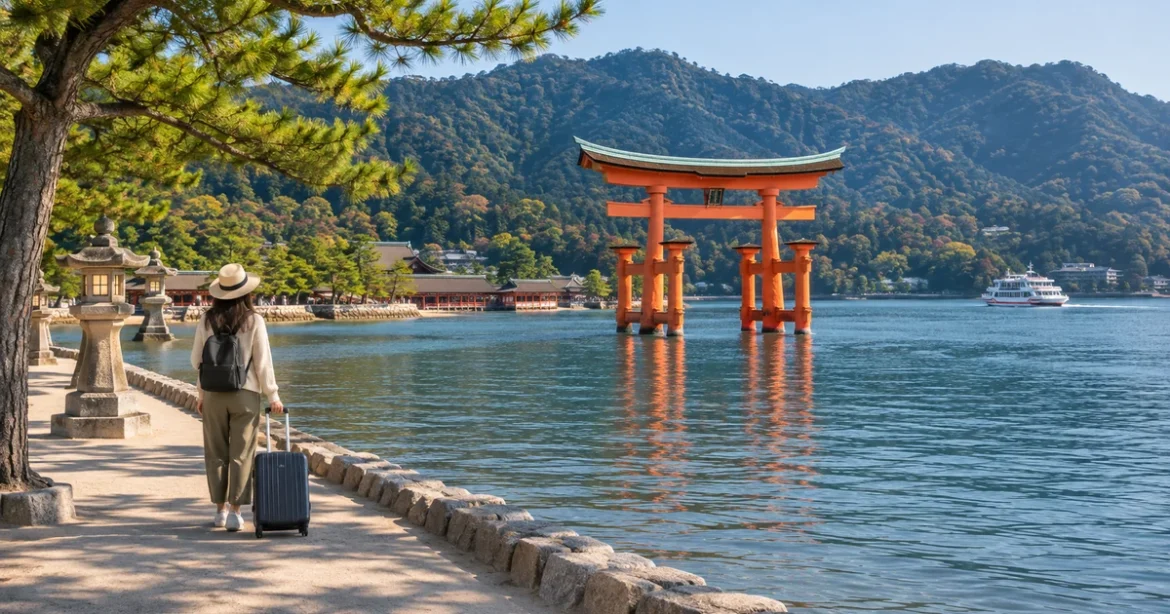
The fastest way from Hiroshima Airport to Miyajima is not always the same. Travellers arriving during the morning may be able to reserve the direct shared taxi to Miyajimaguchi, while afternoon and evening arrivals will normally find the Hiroshima Station, JR and ferry route more dependable.
The most important point is that Miyajimaguchi and Miyajima are not the same place. Miyajimaguchi is the mainland ferry terminal. Even the so-called direct airport service finishes there, so you must still walk to the pier, cross by ferry and then walk from Miyajima Ferry Terminal to the main waterfront sights.
For a first visit, reserve the direct service when its departure is comfortably later than your flight arrival and you want to reach the island as quickly as possible. Otherwise, take the airport limousine bus to Hiroshima Station and follow the regular JR route described in our Hiroshima to Miyajima transport guide.
Do not choose the direct service simply because it is labelled “direct”. It costs considerably more than travelling through Hiroshima Station, has only nine seats, offers no child discount and does not provide child seats. Its real advantages are fewer transfers, a shorter journey and useful luggage support.
If your flight lands late in the day, travelling only as far as Hiroshima city may produce a better trip. You can leave luggage at your hotel, eat properly and visit Miyajima early the following morning rather than paying for transport to arrive after the main sightseeing period.

Hiroshima Airport to Miyajima: Quick Verdict
| Question | Practical answer |
|---|---|
| Fastest scheduled route | Reserved shared taxi to Miyajimaguchi, followed by the ferry |
| Best route for most afternoon arrivals | Airport limousine bus to Hiroshima Station, JR to Miyajimaguchi and ferry |
| Cheapest practical route | Airport bus to Shiraichi Station, JR to Miyajimaguchi and ferry, when connections are favourable |
| Best with large luggage | Direct shared taxi if its luggage locker or participating hotel-delivery service suits your plans |
| Best with young children | Regular limousine bus and JR route, especially when a child seat is essential |
| Best for an afternoon or evening flight | Travel through Hiroshima Station or stay in Hiroshima overnight |
| Minimum sensible Miyajima visit | About three hours on the island for the shrine waterfront and shopping streets |
| Best full-day plan | Arrive in the morning and allow six to eight hours if adding Daishoin or Mount Misen |
Optional guided sightseeing below is not an airport transfer. Confirm the departure city and meeting time before booking.
Route Comparison
| Route | Approximate total time to Miyajima Island | Approximate adult cost | Transfers | Best for | Main drawback |
|---|---|---|---|---|---|
| Direct shared taxi to Miyajimaguchi | About 1 hour 20 minutes to 1 hour 40 minutes | ¥4,200 online, including ferry and visitor tax | Ferry only | Morning arrivals, luggage, simpler transfers | Limited departures and only nine seats |
| Via Hiroshima Station | About 1 hour 45 minutes to 2 hours 15 minutes | About ¥2,220 | Airport bus, JR and ferry | Most travellers, especially later arrivals | More transfers and possible highway delays |
| Via Shiraichi Station | Often around 2 hours | Airport bus, JR fare, ferry and visitor tax | Local bus, JR and ferry | Budget travellers with light luggage | Less forgiving connections and a longer local train journey |
| Rental car to Miyajimaguchi | Depends heavily on traffic and parking | Rental, fuel, tolls and parking | Car and ferry | Travellers continuing through rural Hiroshima | Poor value for this journey alone |
Times in the table include a reasonable transfer allowance but cannot guarantee a particular ferry. Highway congestion, flight delays and missed connections can lengthen the journey.
Option 1: Direct Shared Taxi to Miyajimaguchi
The direct service is a small shared vehicle rather than a full-size airport coach. It runs from Hiroshima Airport to the transport area immediately outside the Miyajimaguchi ferry terminals and normally takes approximately 60 minutes.
At the time of the 2026 update, the published airport departures were concentrated between 08:45 and 12:10. The operator issues timetables in limited date periods, so confirm the schedule for your actual travel date rather than assuming these times operate permanently.
Direct-Service Fare
| Booking method | Fare to Miyajimaguchi | Ferry and visitor tax | Approximate total to Miyajima Island |
|---|---|---|---|
| Online reservation | ¥3,900 | ¥300 | ¥4,200 |
| Standard fare | ¥4,000 | ¥300 | ¥4,300 |
Adults and children pay the same shared-taxi fare. The vehicle does not provide child seats, so families who require one should use another arrangement.
How to Reserve
Reservations are accepted until 30 minutes before departure, but waiting until the last moment is risky because the vehicle has only nine seats. Reserve through the Hiroshima Airport–Miyajimaguchi booking page as soon as your flight schedule is firm.
Same-day travel may be possible when seats remain, but it should not be treated as a walk-up airport bus. Weekend, holiday and peak-season services can fill before arrival.
Where to Board
The shared taxi uses platform 2 outside Hiroshima Airport. Allow approximately 15 to 20 minutes after a domestic flight for disembarkation, baggage collection and walking to the stop. International arrivals should allow more time for immigration and customs.
Do not reserve a departure that leaves only a few minutes after the scheduled landing time. A minor flight delay, a remote aircraft stand or slow baggage delivery may be enough to miss it.
What Happens if the Flight Is Delayed?
The service may wait briefly for a delayed flight, but it cannot remain indefinitely when other passengers are booked. The operator advises affected passengers to make contact before cancelling. Depending on the delay and booking conditions, transfer to another departure or a refund may be possible.
Keep the booking confirmation and operator contact details accessible during the flight. Do not rely on being able to resolve the problem after the vehicle has already departed.
Where the Direct Service Actually Ends
The vehicle stops near the Miyajimaguchi ferry area, beside Hiroden Miyajimaguchi Station and the ferry-terminal roundabout. It does not board the ferry and does not enter Miyajima Island.
From the stop, follow signs to either JR Miyajima Ferry or Miyajima Matsudai Kisen. The walk is short, but you still need time to purchase or tap for the ferry, pay the visitor tax and wait for the next departure.
Who Should Choose the Direct Service?
- Morning arrivals: It is especially valuable when a flight reaches Hiroshima early enough to connect without stress.
- Travellers with luggage: Fewer transfers mean less lifting and less risk of blocking commuter trains with suitcases.
- Older travellers: It removes the bus-to-JR transfer at Hiroshima Station.
- First-time visitors: The route is easier to understand than changing transport in central Hiroshima.
- Travellers staying near Miyajimaguchi: The service may stop near selected mainland hotels.
Who Should Not Choose It?
- Late arrivals: The published airport departures may have finished before the flight lands.
- Families needing child seats: Child seats are not supplied.
- Budget travellers: The regular route through Hiroshima Station costs substantially less.
- Groups larger than nine: The vehicle cannot accommodate a large party together.
- Travellers staying in Hiroshima city first: There is little reason to travel west to Miyajimaguchi and then return to the city.
Direct-Service Luggage Options
The direct route’s most useful feature is not merely its journey time. Passengers may use a dedicated luggage locker at the etto commercial complex in Miyajimaguchi. The published internal locker dimensions are approximately 34.6 × 48.2 × 77.4 centimetres, so oversized luggage may not fit.
The operator also offers complimentary delivery to participating hotels in Hiroshima city and selected mainland Miyajimaguchi accommodation. Tell the driver on the travel day if you intend to use the service and confirm that your hotel is on the current eligible list.
This can make an arrival-day visit much easier: leave the airport on the direct service, send the suitcase to the hotel and board the ferry with only a day bag. Do not assume delivery is available to every ryokan on Miyajima Island.
Option 2: Hiroshima Airport to Miyajima via Hiroshima Station
This is the most reliable route for most travellers because airport limousine buses and JR trains run far more frequently than the direct shared taxi.
The complete sequence is:
Hiroshima Airport → Hiroshima Station Shinkansen Gate → JR Sanyo Main Line → Miyajimaguchi Station → ferry terminal → Miyajima Ferry Terminal → waterfront attractions
Step 1: Airport Limousine Bus to Hiroshima Station
Take the limousine bus marked for Hiroshima Station and alight at the Shinkansen Gate. The scheduled journey is approximately 45 to 50 minutes, although road congestion can make it longer.
| Passenger | One-way fare |
|---|---|
| Adult | ¥1,500 |
| Child | ¥750 |
Seats are not normally reserved. During busy periods, a departure may fill, so do not design a tightly timed JR connection around the first possible airport bus.
Nationwide transport IC cards are accepted, along with other payment methods supported by the operator. For broader city-transport planning, see our Hiroshima transportation guide.
Why Hiroshima Station Is Better Than Hiroshima Bus Center
Some airport buses go to Hiroshima Bus Center, but Hiroshima Station is usually the better transfer point for Miyajima. From the station, the JR Sanyo Main Line runs directly to Miyajimaguchi without changing trains.
From Hiroshima Bus Center, you would need to reach a streetcar stop, take the much slower Hiroden service or travel back towards a JR station. The Bus Center is useful when your hotel is in central Hiroshima, but it is not the most efficient same-day airport-to-Miyajima interchange.
Step 2: JR Hiroshima Station to Miyajimaguchi
At Hiroshima Station, follow signs for the conventional JR lines rather than the Shinkansen platforms. Take a westbound Sanyo Main Line train stopping at Miyajimaguchi.
The JR journey normally takes approximately 25 to 28 minutes and costs ¥420 one way. Check the destination display because not every westbound service necessarily follows the same stopping pattern.
A transport pass is only valuable when it covers enough additional travel. Buying a regional pass solely for this airport-to-Miyajima journey is rarely economical. Compare wider options in the Hiroshima transport pass guide.
Step 3: Walk to the Ferry Terminal
From JR Miyajimaguchi Station, follow the signed route towards the waterfront. The walk to the ferry terminals normally takes about five to six minutes.
The station area has been redeveloped, and the step-free route allows travellers with wheelchairs or rolling luggage to reach the ferry area without using stairs. Allow extra time when the crossing is crowded or when you need to buy a visitor-tax ticket.
Step 4: Ferry to Miyajima
Two operators serve the route:
- JR Miyajima Ferry
- Miyajima Matsudai Kisen
Both take approximately ten minutes. For an ordinary independent visit, use whichever has the more convenient next departure unless a rail pass or combined ticket gives you a reason to choose one operator.
Miyajima Ferry Fare and Visitor Tax
| Charge | Adult | Child |
|---|---|---|
| One-way passenger ferry | ¥200 | ¥100 |
| Miyajima Visitor Tax when entering the island | ¥100 | ¥100 when applicable |
| Typical inbound total | ¥300 | Depends on age and exemption conditions |
The visitor tax is charged when travelling to Miyajima. Preschool children are generally exempt, while pass holders may still need to pay the tax separately even when the ferry fare itself is covered.
Foot passengers do not normally need to reserve an ordinary ferry. Services operate frequently during the main part of the day, but checking the date-specific timetable remains sensible for early-morning and late-evening travel.
Which Ferry Gives the Better Torii View?
Selected daytime JR ferry departures follow a route that provides a closer offshore perspective of the Great Torii. When that route is operating, sit or stand on the right side when facing the direction of travel from Miyajimaguchi.
This should not determine your entire airport transfer. Waiting a long time for a particular ferry is rarely worthwhile when the torii can also be viewed from the island waterfront.
The Final Walk Is Part of the Journey
Arriving at Miyajima Ferry Terminal does not mean you have reached Itsukushima Shrine. The waterfront walk to the shrine area takes approximately ten minutes without long stops.
In practice, many first-time visitors take longer because the route passes deer, shops, food stalls and waterfront photography positions. With suitcases, children or heavy crowds, allow 15 to 20 minutes.
The ground around the ferry terminal and main waterfront is generally manageable, but the day becomes much more physically demanding if you continue to Daishoin, Momijidani Park, the ropeway or Mount Misen.
Option 3: The Budget Route via Shiraichi Station
A local bus connects Hiroshima Airport with JR Shiraichi Station. The airport-to-station section takes approximately 15 minutes and costs ¥490 for an adult or ¥250 for a child.
From Shiraichi, take the JR Sanyo Main Line west towards Miyajimaguchi. Depending on the timetable, you may need to change trains or wait for a through service.
This route can be cheaper than travelling through Hiroshima Station because Shiraichi lies east of the city and avoids the detour into central Hiroshima. However, the saving comes with disadvantages:
- The local airport bus is less intuitive for first-time visitors.
- The JR section is longer.
- Connections are less forgiving when a flight is delayed.
- Managing large luggage on local transport is inconvenient.
- There are fewer services than on the main Hiroshima Station airport route.
Use the Shiraichi route when saving money matters, you are travelling in daylight, your luggage is manageable and the connection shown for your date is straightforward. It is not the best default recommendation after a long international journey.
Which Route Should You Take by Arrival Time?
| Airport arrival situation | Recommended decision |
|---|---|
| Early-morning arrival with at least 45 minutes before a direct departure | Reserve the direct shared taxi |
| Morning arrival but direct service is full | Use Hiroshima Station or check the Shiraichi connection |
| Arrival close to the last direct departure | Use the regular Hiroshima Station route unless travelling without checked luggage |
| Early-afternoon arrival | Travel through Hiroshima Station; expect a limited half-day visit |
| Late-afternoon arrival | Consider staying in Hiroshima, Miyajimaguchi or Miyajima overnight |
| Evening arrival | Do not plan major same-day sightseeing; concentrate on reaching the hotel |
A flight’s scheduled landing time is not the time you leave the terminal. Add time for disembarkation, baggage collection, immigration when applicable and walking to the transport stop.
Can You Visit Miyajima on the Day You Land?
Yes, but the answer depends more on arrival time than on distance.
Arrival Before Late Morning
A morning arrival can support a rewarding half-day or nearly full-day visit. The direct shared taxi is particularly useful because it avoids travelling into Hiroshima city first.
Arrival Around Lunchtime
A lunchtime arrival may still allow the shrine waterfront, Omotesando shopping street and an early dinner. Mount Misen is usually too ambitious unless daylight, ropeway operating hours and your energy level all align.
Arrival in Mid-Afternoon
Technically possible, but often not recommended. By the time you collect luggage, travel to Miyajimaguchi and cross the water, major facilities may be approaching closing time.
Arrival in the Evening
Treat the evening as a transfer rather than a sightseeing opportunity. Staying in Hiroshima city normally gives the widest choice of restaurants, transport and accommodation. Staying on Miyajima can still be worthwhile when your ryokan accepts the planned arrival time and dinner arrangements have been confirmed.
Suggested Arrival-Day Itineraries
Fast Half-Day Route
| Stage | Suggested time |
|---|---|
| Hiroshima Airport to Miyajimaguchi | 60 minutes by direct shared taxi |
| Ferry and arrival | 20 to 30 minutes including waiting |
| Walk to Itsukushima Shrine waterfront | 10 to 20 minutes |
| Itsukushima Shrine and waterfront | 60 to 90 minutes |
| Omotesando and local food | 60 to 90 minutes |
| Return ferry | Allow buffer for the chosen onward journey |
This route suits travellers arriving early enough to reach Miyajima by early afternoon. It avoids the mountain and keeps the day manageable after a flight.
Complete One-Day Miyajima Route
For a fuller island visit, use this sequence:
Miyajima Ferry Terminal → Itsukushima Shrine → Daishoin → Momijidani Park → ropeway or Mount Misen → Omotesando → ferry
Allow six to eight hours on the island. Mount Misen adds steep walking, uneven surfaces and dependence on the ropeway timetable. It should not be treated as a small extension to the waterfront visit.
Our Miyajima attractions and itinerary guide explains how to divide time between the shrine, mountain, food streets and quieter parts of the island.
City-First Overnight Plan
This is the better sequence after a late arrival:
- Take the airport limousine bus to Hiroshima Station.
- Check in near Hiroshima Station or central Hiroshima.
- Visit Miyajima early the following morning.
- Combine the island with Peace Memorial Park only when you have a complete day.
Travellers who prefer not to manage several transport stages independently can compare a Hiroshima and Miyajima guided bus tour departing from the city.
Families Travelling from Hiroshima Airport
For families, the direct shared taxi reduces transfers but has two significant disadvantages: children pay the adult fare, and child seats are not provided.
The regular route through Hiroshima Station offers a child fare on the airport limousine bus and JR. It also provides more flexibility when children need a meal, toilet break or rest before continuing.
Some airport limousine services on the Hiroshima Station route use wheelchair-lift vehicles. These operate only on selected departures and require advance telephone reservation under the current arrangement.
Once on Miyajima, a stroller is practical around the ferry terminal, main shopping streets and much of the waterfront. It becomes less useful for Daishoin, steep side streets and Mount Misen.
Advice for Older Travellers and Limited Mobility
The easiest sequence is the direct shared taxi, step-free ferry-terminal access and a waterfront-only visit. This removes the transfer inside Hiroshima Station and avoids the steep mountain sections.
The route from JR Miyajimaguchi Station to the ferry terminal can be completed step-free. The ferries also provide accessible passenger areas and toilets, although assistance may be useful during crowded boarding periods.
On Miyajima, the ferry-terminal district and approach to Itsukushima Shrine are substantially easier than Daishoin or Mount Misen. A traveller can still have a worthwhile visit without attempting the mountain.
Do not underestimate the cumulative distance. Airport terminals, Hiroshima Station platforms, ferry waiting areas and island sightseeing can together create a long walking day even when no individual section appears difficult.
Should You Drive from Hiroshima Airport?
Driving can be useful when Miyajima is one stop in a wider Chugoku road trip, particularly when continuing to destinations poorly served by rail. It is rarely the most economical choice for Miyajima alone.
The practical approach is to drive to Miyajimaguchi, leave the vehicle on the mainland and cross as a foot passenger. Parking around the ferry terminal can fill during weekends, public holidays, autumn foliage and major events.
Taking a car onto Miyajima is generally unnecessary. Roads are narrow, parking is limited and daytime restrictions may affect driving in the main sightseeing district.
When comparing driving with public transport, include rental charges, fuel, expressway tolls, parking and the time spent finding a space. A direct shared taxi may be cheaper for one or two travellers, while a rental car becomes more defensible for a family continuing to several rural destinations.
Where to Leave Large Luggage
A large suitcase is one of the strongest reasons not to travel straight to Miyajima without a plan. The ferry itself is manageable, but moving through crowded shopping lanes and sightseeing areas with luggage is inconvenient.
The practical choices are:
- Use the direct service’s dedicated Miyajimaguchi locker when the bag fits.
- Use the direct service’s participating hotel-delivery arrangement.
- Leave luggage at Hiroshima Station before continuing by JR.
- Check in at a Hiroshima hotel and visit Miyajima the following day.
- Confirm baggage storage directly with Miyajima accommodation before arrival.
Do not assume an island ryokan can collect luggage from the airport or mainland ferry terminal. Such services vary by property and usually require prior arrangements.
Do Rail Passes Cover the Journey?
A nationwide or regional JR pass may cover the JR train between Hiroshima and Miyajimaguchi and the JR-operated ferry, depending on the exact pass conditions. It does not normally cover the airport limousine bus to Hiroshima Station.
The Miyajima Visitor Tax remains a separate charge in situations where the transport fare is covered by a pass. Follow the ferry operator’s instructions for pass holders before entering the boarding gate.
Do not buy a broad regional pass for this single journey. It becomes worthwhile only when the itinerary includes enough additional long-distance JR travel, such as Okayama, Kurashiki, Onomichi, Iwakuni or Fukuoka.
Food Planning on an Arrival Day
Miyajima is associated with oysters, anago-meshi grilled conger eel and momiji manju cakes. Miyajimaguchi also has well-known anago-meshi restaurants, making it a useful meal stop before or after the ferry.
Do not arrive late and assume every island restaurant remains open into the evening. Many visitor-focused businesses close earlier than restaurants in central Hiroshima.
After a morning flight, eat either at Miyajimaguchi before boarding or on Omotesando after visiting the shrine. After a late flight, eating in Hiroshima city is normally more dependable.
Where Should You Stay?
Stay Near Hiroshima Station
This is the most practical choice for late arrivals, early departures and travellers combining Miyajima with Peace Memorial Park. It provides direct airport-bus access and a simple JR journey the next morning.
Stay in Central Hiroshima
Choose the city centre when restaurants, nightlife and access to the Peace Memorial Park matter more than the easiest airport connection. Be prepared to travel to a JR station or use another city-to-Miyajima route.
Stay at Miyajimaguchi
Miyajimaguchi works well when you want an early ferry without paying island-ryokan prices. It is especially useful after using the direct airport service but arriving too late for a full visit.
Stay on Miyajima
An island stay is worthwhile for a ryokan experience, quiet evening streets and early-morning waterfront views. Confirm dinner and check-in deadlines before committing to a late airport transfer.
Compare the practical advantages of each district in our Hiroshima accommodation guide.
Can Hiroshima and Miyajima Fit into One Day?
Yes, but not after every flight. A complete Hiroshima and Miyajima sightseeing day works best when you are already staying in the region and can begin early.
A realistic sequence is:
Morning at Peace Memorial Park → early lunch → afternoon on Miyajima → return after sunset or dinner
Reversing the order can be better during hot weather or when the tide, shrine visit or Mount Misen is your priority. Visit Miyajima early, then spend the late afternoon in Hiroshima city.
Trying to combine the airport arrival, Peace Memorial Museum, Atomic Bomb Dome, Itsukushima Shrine and Mount Misen in one day is too rushed for most travellers.
For other workable combinations, see the best day trips from Hiroshima.
Organised Tour or Independent Travel?
| Travel style | Best choice | Reason |
|---|---|---|
| Landing and travelling directly to Miyajima | Independent transport | Current city-based tours do not collect travellers from the airport |
| Staying in Hiroshima and visiting the next day | Independent route or guided tour | Both become practical from the city |
| First visit with limited planning time | Guided Hiroshima and Miyajima tour | Removes transport and sequencing decisions |
| Travellers wanting Mount Misen flexibility | Independent route | Many group tours allocate limited free time |
| Private group or older family members | Private guide or charter | Pace and stops can be adjusted |
A second city-based option combines major Hiroshima and Miyajima sights in one organised day. Check the meeting point carefully because this is not an airport pickup.
First-Time Mistakes to Avoid
- Confusing Miyajimaguchi with Miyajima: Every mainland route still requires a ferry.
- Expecting the direct service all day: Current airport departures are concentrated in the morning.
- Treating it as a normal airport bus: It is a nine-seat shared taxi and should be reserved.
- Booking too close to the flight arrival: Landing time does not include baggage collection.
- Ignoring the child-seat issue: The direct vehicle does not provide one.
- Expecting a child discount: Children pay the same direct-service fare as adults.
- Using an outdated limousine-bus fare: The current adult fare to Hiroshima Station is ¥1,500.
- Forgetting the visitor tax: Entering Miyajima adds ¥100 to the ferry journey.
- Choosing Hiroshima Bus Center for a same-day island transfer: Hiroshima Station provides the simpler JR connection.
- Taking large luggage onto the island: Store it, send it to a hotel or check in first.
- Assuming the ferry terminal is beside the shrine: Allow another ten minutes or more on foot.
- Adding Mount Misen to a late half-day: The mountain requires substantial time and physical effort.
- Driving onto the island unnecessarily: Parking and road access are restrictive.
- Planning every connection with no buffer: Flights, highway traffic and crowded ferries can all cause delays.
- Arriving late without checking restaurant hours: Island dining choices narrow earlier than in Hiroshima city.
Frequently Asked Questions
Is there a direct bus from Hiroshima Airport to Miyajima?
There is a reservation-based shared taxi to Miyajimaguchi, not directly to Miyajima Island. You must still take the ferry.
How long does the direct route take?
The vehicle takes approximately 60 minutes to Miyajimaguchi. Including the walk, ferry wait and crossing, allow roughly 1 hour 20 minutes to 1 hour 40 minutes to reach the island.
How much is the direct service?
The current online fare is ¥3,900, while the standard fare is ¥4,000. Add the ferry fare and Miyajima Visitor Tax.
Do I need to reserve the direct service?
Yes. Same-day seats may occasionally be available, but the vehicle holds only nine passengers and should be booked in advance.
How much connection time should I allow after landing?
Allow at least 15 to 20 minutes after a domestic arrival without complications, and more when collecting checked luggage. International arrivals require a larger buffer.
What happens if my flight is delayed?
Contact the operator immediately. The vehicle may wait briefly, but a long delay can cause you to miss the departure.
Does the direct service provide child seats?
No. Families requiring a child seat should make another transport arrangement.
Is there a child fare on the direct service?
No. Adults and children pay the same fare.
What is the cheapest route?
The Shiraichi Station route can be cheapest when the bus and JR connections align. The Hiroshima Station route is easier and more frequent.
How much is the regular route through Hiroshima Station?
The base adult cost is approximately ¥2,220: ¥1,500 for the airport bus, ¥420 for JR, ¥200 for the ferry and ¥100 for the visitor tax.
How long does the Hiroshima Station route take?
Allow approximately 1 hour 45 minutes to 2 hours 15 minutes, depending on traffic and connection times.
Should I use Hiroshima Station or Hiroshima Bus Center?
Use Hiroshima Station when continuing directly to Miyajima. Its JR connection to Miyajimaguchi is faster and simpler.
How long is the ferry?
The crossing takes approximately ten minutes.
Do I need to reserve the ferry?
Ordinary foot passengers generally do not need a reservation.
Can I use a Japan Rail Pass?
An eligible JR pass may cover the JR train and JR-operated ferry, but not the airport limousine bus. The visitor tax may remain payable separately.
How far is Miyajimaguchi Station from the ferry?
The signed walk normally takes about five to six minutes.
How far is the shrine from Miyajima Ferry Terminal?
Allow approximately ten minutes without stops or 15 to 20 minutes when the waterfront is crowded.
Can I take a suitcase onto the ferry?
Yes, but sightseeing with a large suitcase is inconvenient. Use storage, hotel delivery or a city hotel whenever possible.
Is the route wheelchair accessible?
The principal route between JR Miyajimaguchi Station and the ferry can be completed step-free, and accessible ferry facilities are available. Selected airport buses require advance arrangement for lift access.
Is Miyajima stroller friendly?
The ferry-terminal district, shopping streets and main waterfront are manageable. Daishoin and Mount Misen are considerably less stroller friendly.
Can I visit Miyajima after an afternoon flight?
An early-afternoon arrival may allow a short waterfront visit. A late-afternoon arrival is better handled with an overnight stay.
Should I stay in Hiroshima or Miyajima?
Stay in Hiroshima for transport flexibility and dining. Stay on Miyajima for a ryokan experience and quieter evening atmosphere.
Should I rent a car?
Not for this journey alone. Renting becomes worthwhile when Miyajima is part of a broader regional road trip.
Can I drive onto Miyajima?
Vehicle ferries exist, but most sightseers should park at Miyajimaguchi and cross as foot passengers.
Is there a Klook airport transfer directly to Miyajima?
No verified Klook product currently covers the complete Hiroshima Airport–Miyajima journey. Use the official shared taxi or regular public transport.
Final Booking Comparison
Reserve the official shared taxi when your flight arrives in time, the departure has adequate buffer and reducing transfers matters more than minimising cost.
Use the Hiroshima Station route when arriving later, travelling with children who need discounted fares, staying in Hiroshima city or wanting the flexibility of frequent departures.
Use the Shiraichi route only when the timetable is favourable and the saving justifies a less intuitive journey.
Guided tours become relevant after staying in Hiroshima, not as substitutes for the airport transfer. They are best for travellers who want Peace Memorial Park and Miyajima arranged in one day without managing each connection.
Final Verdict
Hiroshima Airport to Miyajima is straightforward once you stop looking for one universal route. The direct shared taxi is the fastest and easiest choice for a compatible morning flight, but its limited timetable means it cannot serve every traveller.
The route through Hiroshima Station is the dependable default. It takes longer and requires more transfers, but it operates throughout a much wider part of the day and costs substantially less.
What first-time visitors most often misunderstand is that every route finishes on the mainland before the ferry. Include the crossing, visitor tax and final walk when calculating both time and cost.
With an early arrival, allow at least three hours on Miyajima for the waterfront, shrine area and shopping streets. Allow six to eight hours when adding Daishoin or Mount Misen.
After a late arrival, staying in Hiroshima or near Miyajimaguchi usually creates a better trip than racing to the island near closing time. For broader planning, use our Hiroshima travel guide to organise the city, Miyajima and nearby destinations in a realistic sequence.