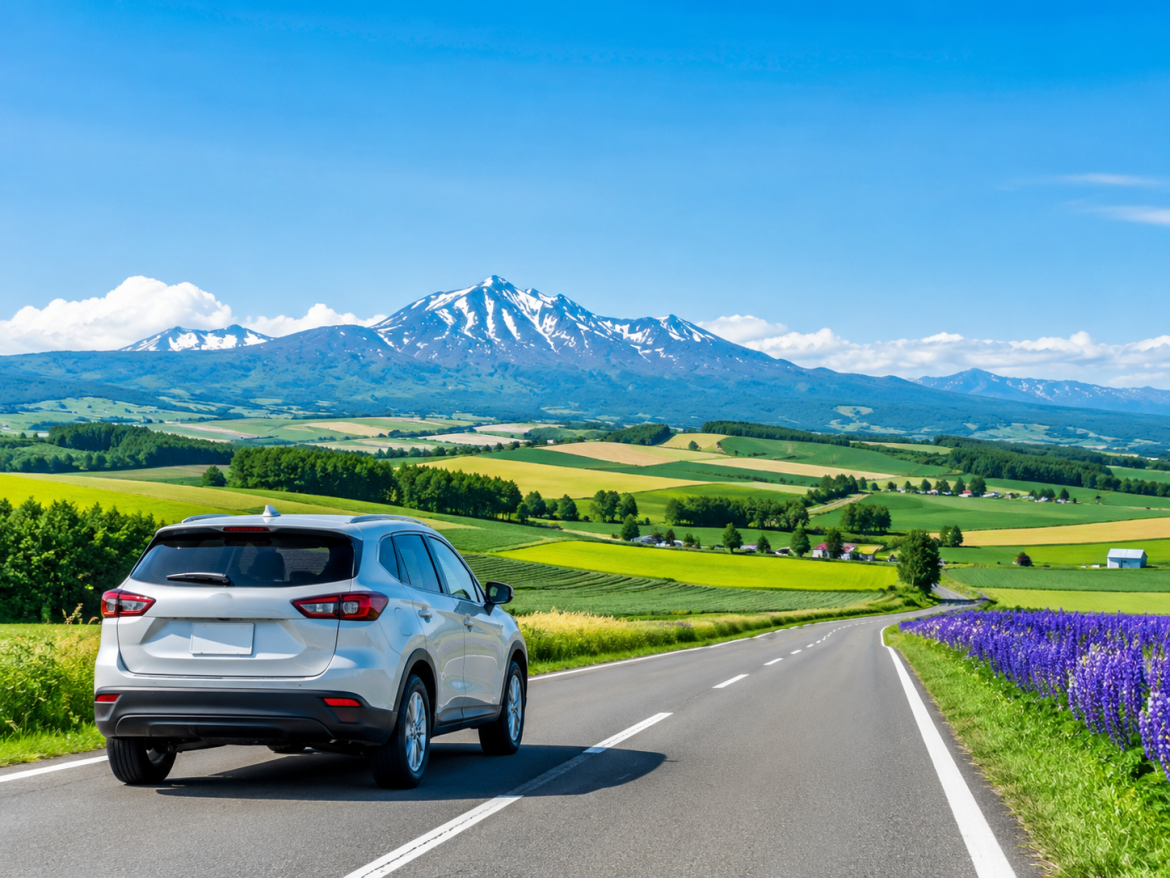
Renting a car can completely change a Hokkaido trip. It gives you direct access to flower fields, lakes, onsen towns, scenic roads, rural restaurants and viewpoints that are inconvenient or impossible to combine efficiently by public transport.
However, a rental car is not automatically the best choice for every day. Central Sapporo, Otaru and Hakodate are usually easier without one, while long cross-island routes can turn a holiday into several exhausting driving days.
The first misunderstanding occurs immediately after landing. At New Chitose Airport, you normally check in at a terminal counter or meeting point and then take a rental-company shuttle to an off-airport office in Chitose. Immigration, luggage collection, the shuttle and rental formalities can make the process considerably longer than simply walking to an airport car park.
Insurance also deserves more attention than the headline rental price. Collision damage waiver, the vehicle excess and non-operation charges are separate concepts, and the cheapest booking may leave the driver exposed to substantial charges after even a minor accident.
For a first Hokkaido road trip, the easiest strategy is often to use trains and local transport for city sightseeing, then rent only for the rural section. Travellers planning a winter journey should be more cautious: snow tyres and four-wheel drive help, but they do not replace experience on ice, during heavy snowfall or in a whiteout.
Before choosing a pickup location, compare the regional route, flight times, luggage, child seats and the rental office’s operating hours. Travellers arriving through New Chitose can also consult the New Chitose Airport car rental guide for additional branch-specific planning.

Is Renting a Car in Hokkaido Worth It?
For rural Hokkaido, a car is frequently worth the cost. The value comes from connecting several dispersed stops in one day rather than simply travelling faster between two major stations.
It is particularly useful for Biei countryside viewpoints, rural Furano, Lake Shikotsu, Lake Toya, Niseko outside the ski-bus network, eastern Hokkaido national parks and accommodation located away from railway stations.
It is less useful when the itinerary is limited to central Sapporo, an Otaru day trip by train or central Hakodate. In these areas, parking, one-way streets and hotel parking charges can create more work without improving the visit.
| Decision factor | Practical judgement |
|---|---|
| Is it worth renting? | Yes for rural or multi-stop routes; usually no for city-only sightseeing |
| Typical rental duration | Three to seven days for one regional road-trip section |
| Main advantage | Flexible access to countryside stops, onsen hotels and scenic routes |
| Main challenge | Long distances, insurance decisions, winter conditions and return-day timing |
| Transport difficulty | Moderate in summer; potentially difficult or unsuitable for inexperienced winter drivers |
| Family suitability | Very good when the correct child seat and luggage capacity are booked |
| Elderly traveller suitability | Good with short daily distances, an easy-entry vehicle and limited hotel changes |
| Overnight stays | Essential for regional touring; long drives should not be treated as day trips |
| Best season for first-time drivers | Late spring to autumn, outside severe weather periods |
| Who should skip it? | City-only visitors, nervous left-side drivers and travellers without snow-driving experience in winter |
Who will benefit most?
A rental suits travellers who value countryside scenery, regional food, small onsen towns and flexible photo stops. It is also useful for families carrying a stroller or travellers staying in rural accommodation that provides parking.
Who may prefer public transport?
Visitors spending most of the trip in Sapporo, Otaru and Hakodate may find trains, trams and buses easier. Public transport is also the safer choice when only one person can drive, the flight arrives late, or the driver has never handled snow and ice.
Hokkaido Car Rental Guide 2026: Latest Rules and Planning Changes
The basic legal process remains straightforward, but several current details affect the best booking strategy.
| Current point | What travellers need to know |
|---|---|
| International permit | Most eligible international visitors need an IDP issued under the 1949 Geneva Convention |
| Designated foreign licences | Licences from Switzerland, Germany, France, Belgium, Monaco and Taiwan may be used with an authorised Japanese translation |
| New Chitose pickup | Vehicles are normally collected at an off-airport Chitose office after a shuttle transfer |
| HEP duration | The current published Hokkaido Expressway Pass range begins at four consecutive days |
| Child seats | A child restraint is legally required for children under six |
| Winter equipment | Do not assume every displayed rate includes the same tyre, four-wheel-drive or safety package |
| Klook availability | Live rental comparison pages are available for major Hokkaido pickup areas, subject to date and vehicle inventory |
The point many visitors underestimate is that rental availability is highly seasonal. Compact automatic cars may be plentiful on ordinary dates but disappear during summer flower season, autumn weekends, ski season and Japanese holiday periods.
One-way rentals also require early planning. A company may operate in both Sapporo and Hakodate but still restrict which vehicle classes can be returned between those branches. Never build the flight itinerary around a one-way rental until the booking confirmation shows the correct return office.
Documents You Need to Rent and Drive
Prepare the legal documents before paying for a non-refundable booking. A rental company cannot solve an invalid international driving permit at the counter.
For visitors using an eligible international driving permit
- Original passport
- Original domestic driving licence
- Original international driving permit issued under the 1949 Geneva Convention
- Rental confirmation
- Payment card accepted by the supplier
A photocopy, mobile image or digital driving permit should not be treated as a substitute for the required original documents.
For designated foreign licences
Drivers holding qualifying licences issued by Switzerland, Germany, France, Belgium, Monaco or Taiwan may generally drive using the original licence together with an authorised Japanese translation. The translation must come from an organisation accepted under Japanese rules.
Do not rely on an older blog that includes additional countries. Confirm the applicable licence route with Japan’s official authorities and the selected rental company before departure.
The deciding factor is where the licence was issued, not your passport nationality. A translation alone does not authorise other foreign licences. Check the National Police Agency’s licence rules before booking; a 1968 Vienna Convention permit is not a substitute for the required 1949 format.
For short-term visitors, the permitted driving period is limited by the applicable one-year-from-entry rule and the document’s own expiry, whichever comes first. Special re-entry rules apply to residents of Japan, so a short trip abroad does not necessarily restart the clock. Keep evidence of your landing date and ask the rental office to check your documents beforehand. See JAF’s translation and validity guidance.
Register every driver
Every person who may drive should present the required documents and be registered with the rental company. Allowing an unregistered traveller to drive can create serious insurance and liability problems.
Age and supplier conditions
The legal driving age in Japan is 18, but individual suppliers may impose their own conditions relating to age, licence history, premium vehicles or insurance. Check the specific booking conditions rather than assuming every company follows identical rules.
Where to Pick Up a Hokkaido Rental Car
The best pickup point is not necessarily the airport where the trip begins. Choose the office that removes unnecessary city driving and positions the vehicle at the start of the rural route.
| Pickup area | Best suited to | Main advantage | Main drawback |
|---|---|---|---|
| New Chitose Airport area | Lake Shikotsu, Noboribetsu, Lake Toya, Niseko and immediate road trips | Start rural travel without entering central Sapporo | Off-airport shuttle and rental processing add time |
| Central Sapporo | Travellers sightseeing in Sapporo first | Avoid paying for unused city days and hotel parking | Driving out of the city can be stressful during busy periods |
| Asahikawa Airport or station | Biei, Furano, Daisetsuzan and northern-central Hokkaido | Reduces the long transfer from New Chitose | Flights and vehicle inventory may be more limited |
| Hakodate Airport or station | Hakodate, Onuma and southern Hokkaido | Avoids a long drive from Sapporo | Not efficient for central or eastern Hokkaido routes |
| Memanbetsu Airport | Abashiri, Shiretoko and the Okhotsk area | Best gateway for north-eastern Hokkaido | One-way choices may be restricted |
| Kushiro Airport | Kushiro Wetlands, Lake Akan and Lake Mashu | Avoids crossing the island by road | Weather can disrupt ambitious winter plans |
| Obihiro Airport | Tokachi, eastern Furano approaches and agricultural areas | Useful for a focused Tokachi route | Less convenient for Sapporo-only itineraries |
Renting from New Chitose Airport
Choose Chitose when you intend to drive immediately toward Lake Shikotsu, Noboribetsu, Lake Toya or Niseko. It avoids entering central Sapporo merely to collect a vehicle.
Renting from central Sapporo
Choose Sapporo when the first two or three days are devoted to the city and Otaru. Travel from the airport by train or bus, complete the city portion, then collect the vehicle on the morning you leave for rural Hokkaido.
The New Chitose Airport to Sapporo transport guide can help compare the non-driving arrival options. For branch planning, see the separate Sapporo car rental guide.
Using a regional airport
Hokkaido is large enough that a domestic flight can save an entire driving day. A traveller focused on Shiretoko should consider Memanbetsu rather than driving from Sapporo, while Biei and Daisetsuzan are naturally paired with Asahikawa.
Live rates vary by date, branch and vehicle class. Compare the total price only after adding the required insurance, child seats, winter equipment, ETC card and one-way fee.
How to Choose the Right Rental Company and Car
There is no single best rental company for every itinerary. A familiar national operator may offer a broader branch network and easier one-way returns, while a regional or online supplier may provide a lower rate for a simple round-trip rental.
Compare the complete booking
Check these points before choosing:
- Exact pickup and return office
- Office operating hours
- Airport shuttle arrangements
- Automatic or manual transmission
- Vehicle class rather than an unguaranteed example model
- Winter tyre and four-wheel-drive inclusion
- Collision damage waiver and excess
- Non-operation charge protection
- Roadside assistance
- Child-seat availability
- ETC card and HEP eligibility
- One-way return fee
- Cancellation and late-arrival rules
Choose by luggage capacity, not seat count
| Vehicle type | Best for | Important limitation |
|---|---|---|
| Kei or mini car | One or two light travellers on short non-winter routes | Limited luggage space and less comfortable for long expressway days |
| Compact car | One or two travellers with normal luggage | May not fit multiple large suitcases |
| Standard sedan or wagon | Two to four travellers with moderate luggage | Check boot shape before assuming all bags will fit |
| Compact MPV | Families, child seats and several medium bags | Rear luggage space can shrink when every seat is occupied |
| Large minivan | Four to six travellers with child seats or substantial luggage | Higher cost, wider body and more difficult urban parking |
| SUV or 4WD vehicle | Experienced drivers on winter or rural routes | Four-wheel drive does not prevent skidding or shorten stopping distance |
A vehicle advertised for seven or eight occupants rarely carries the same number of travellers plus full-size luggage. Families should count the child seat, stroller and winter clothing before selecting the smallest possible class.
Navigation and language support
Many vehicles include built-in navigation, but map data and English interfaces vary. A phone-based map can be easier for searching hotels and restaurants, provided it is mounted legally and operated without handling the phone while driving.
Save the rental office, hotels, fuel stations and major stops before leaving an area with reliable reception. Japanese telephone numbers and map codes can still be useful when a built-in navigation unit cannot find an English place name.
Rental Cost, Insurance, CDW and NOC
The displayed daily rate is only the beginning of the calculation. Compare the final amount for the same vehicle class, insurance level, accessories and return conditions.
Costs that may be added
- Collision damage waiver or excess waiver
- Non-operation charge protection
- Child or infant seat
- ETC card rental
- Hokkaido Expressway Pass
- Four-wheel-drive specification
- Winter equipment
- One-way return fee
- Additional driver fee, where applicable
- Fuel
- Expressway tolls
- Hotel and attraction parking
Collision damage waiver
Collision damage waiver commonly reduces or removes the renter’s responsibility for specified vehicle and property deductibles. The exact exclusions vary. Tyres, wheels, lost keys, interior damage, incorrect refuelling, off-road use and violations of the rental agreement may not be covered.
Non-operation charge
A non-operation charge compensates the rental company for the period during which a damaged or heavily soiled vehicle cannot be rented. It is not automatically eliminated merely because collision damage waiver was purchased.
Look for a protection package that explicitly addresses both the accident deductible and the non-operation charge. Do not assume that a product labelled “full coverage” by a booking platform is identical to the rental company’s own waiver; it may operate as reimbursement after the traveller first pays the supplier.
For a supplier example, Nippon Rent-A-Car’s official FAQ explains CDW, NOC, its optional waiver and accident reporting. Check the terms of your actual reservation; similarly named packages are not interchangeable.
Recommended protection level
For most international visitors, our recommendation is to select the supplier’s clearest high-protection option covering the principal deductible and non-operation charge. The additional cost is usually easier to budget than an uncertain liability after a minor collision.
What to do after an accident
- Stop safely and prevent further danger.
- Call 119 if anyone is injured or emergency assistance is needed.
- Call the police on 110, even when the damage appears minor.
- Contact the rental company and follow its instructions.
- Do not privately settle the incident without the required reports.
- Keep photographs, reports and receipts required by the insurer or booking platform.
Failing to report an accident properly can invalidate protection that would otherwise apply.
ETC Cards and the Hokkaido Expressway Pass
An ETC card allows compatible toll gates to charge expressway tolls electronically. It reduces the need to handle cash and is particularly useful on a route with repeated expressway journeys.
The ETC card and Hokkaido Expressway Pass are not the same product. An ETC card records toll use. HEP is a fixed-price expressway plan available through participating rental offices to eligible international visitors.
Current Hokkaido Expressway Pass prices
| Duration | Standard vehicle | Light vehicle |
|---|---|---|
| 4 days | ¥7,700 | ¥6,200 |
| 5 days | ¥9,600 | ¥7,700 |
| 6 days | ¥11,600 | ¥9,300 |
| 7 days | ¥13,500 | ¥10,800 |
| 8 days | ¥15,400 | ¥12,300 |
The vehicle rental and ETC card fees are separate. The published plan cannot simply be extended halfway through the rental, so confirm the required period when collecting the car.
These are consecutive calendar days, not rolling 24-hour periods. Eligibility also includes qualifying Japanese nationals with permanent overseas residency. Confirm both offices can handle the plan, that your expressway vehicle class qualifies and that an ETC card is reserved. Use the official HEP coverage map and price chart to check the actual interchanges; parking and roads outside its coverage are not included.
When HEP can save money
HEP becomes more attractive when the route uses several long expressway sectors. For example, the published ordinary toll between New Chitose and Asahikawa is approximately ¥4,810 each way for a standard vehicle. A return journey alone can therefore exceed the four-day HEP standard-car price before any additional covered journeys.
When HEP is unnecessary
A New Chitose–Sapporo return journey has a published ordinary toll of approximately ¥1,430 each way when using the relevant expressway route. Buying a four-day pass solely for this transfer would normally cost more than paying the ordinary tolls.
The same caution applies to itineraries that mainly use local roads or remain in one area. Do not buy HEP simply because it sounds convenient.
How to decide
- List every planned expressway segment.
- Check whether each road is covered by the current HEP map.
- Add the ordinary tolls for the complete route.
- Compare the result with the HEP price for the exact rental period.
- Confirm that the rental office participates and can provide an ETC card.
HEP is currently published for four to eight consecutive days. Longer rentals may require a different arrangement or separate plan periods, subject to the participating office’s conditions.
New Chitose Airport Pickup and Return: The Real Route
New Chitose is Hokkaido’s busiest gateway, but the rental process is not a direct terminal kerbside handover.
The shuttle process below describes conventional staffed rentals. The airport also lists unmanned rental and car-sharing services using designated parking areas, with different collection procedures. Check the official counter, parking maps and walking directions and your exact booking instructions rather than assuming every product uses the same route.
Arrival and pickup route
- Complete immigration and collect checked luggage.
- Go to the rental counter, transport counter or supplier meeting point shown in the booking instructions.
- Register for the rental-company shuttle.
- Travel by shuttle to the company’s Chitose office.
- Present every driver’s original documents.
- Confirm insurance, ETC, HEP, child seats and winter equipment.
- Inspect the vehicle and photograph existing marks.
- Check the fuel type, controls, navigation and return instructions.
- Begin driving only after the group and luggage are safely arranged.
Allow approximately 60 to 90 minutes after reaching the rental counter under ordinary conditions. Peak travel dates, multiple arriving flights, winter weather and a busy shuttle queue can make the process longer.
A late-evening arrival is not a good time to begin a long drive to Furano, Niseko or Lake Toya. Staying near Chitose or travelling to Sapporo without a car can be safer and less stressful.
Return route
- Refuel according to the rental agreement.
- Drive to the off-airport return office, not directly to the passenger terminal.
- Complete the vehicle inspection and settle fuel, toll or ETC charges.
- Unload all luggage and check the cabin carefully.
- Take the rental-company shuttle to the correct terminal.
- Proceed to airline check-in and security.
How early should you return?
Work backwards from the time your airline asks you to reach the terminal, then add refuelling, return inspection, toll settlement, waiting and the shuttle journey. If the airline asks for terminal arrival three hours before departure, the rental return must be earlier still. Snow, holidays and early flights may justify returning the car the previous evening.
This is a planning buffer rather than a universal rental-company rule. Always follow the airline’s check-in deadline and the supplier’s office instructions.
Airport pickup or Sapporo pickup?
Collect at New Chitose when the first destination is rural and the flight arrives early enough for a comfortable drive. Collect in Sapporo when the itinerary begins with city sightseeing or when the arrival is late.
Winter Driving in Hokkaido: Should You Do It?
Winter driving requires an honest assessment rather than an optimistic assumption that snow tyres and four-wheel drive will make every route safe.
Who should not drive?
Choose trains, buses, organised transfers or a car with a professional driver when:
- You have never driven on packed snow or ice.
- You are already uncomfortable with left-side driving.
- Your route depends on night driving through rural or mountain areas.
- Only one driver will handle several long days.
- The itinerary leaves no room to cancel or change a route.
- You expect four-wheel drive to prevent skidding.
- You are unfamiliar with whiteout conditions.
Snow tyres versus four-wheel drive
Winter tyres are the essential contact point between the vehicle and the road. Four-wheel drive can improve traction when accelerating or climbing, but it does not remove the risk of sliding and does not reduce the braking distance created by ice.
Verify the exact booking rather than relying on a general statement that Hokkaido rentals are winter-equipped. Check whether winter tyres and four-wheel drive are included, optional or unavailable for the selected class and branch.
One specific example is Nippon Rent-A-Car’s published winter policy: for Hokkaido pickups from November 1, 2026 to April 20, 2027, winter tyres and 4WD are standard and a ¥660-per-day winter-season fee applies, capped at ten days for rentals of up to one month. This does not describe every supplier or imply that winter equipment is free. Snow and ice can also occur outside a supplier’s standard-equipment dates.
Practical winter rules
Check Hokkaido Development Bureau road restrictions and its illustrated winter-driving guide (PDF) before setting off. Ask which snow brush, scraper and other equipment is supplied; do not assume chains can be rented or fitted to your chosen vehicle. Cancel or reroute when roads close or visibility makes travel unsafe.
- Drive in daylight whenever possible.
- Use major roads rather than navigation shortcuts.
- Increase following distance substantially.
- Brake, steer and accelerate gently.
- Expect bridges, shaded sections and junctions to be icy.
- Keep the fuel tank comfortably above empty.
- Clear snow from lights, windows, mirrors and the roof.
- Do not continue merely because the hotel is prepaid.
- Check official road and weather information before departure.
What to do in a whiteout
When visibility collapses, continuing blindly can be more dangerous than stopping. Move to a safe location away from the traffic lane where possible, activate the hazard lights and contact assistance if necessary.
If snow accumulates around a stationary vehicle, keep the exhaust outlet clear to reduce carbon-monoxide risk. Do not stop in a place where the vehicle can be struck by following traffic.
Winter family accommodation
Families planning a ski trip should compare driving with direct resort buses and transfer services. The Hokkaido family ski accommodation guide can help identify resorts where staying on-site reduces the need for daily winter driving.
Driving Time, Parking, Fuel and Daily Planning
Map applications often show a theoretical driving time that excludes rest stops, photography, congestion, refuelling and weather. Build the itinerary around the real day rather than the fastest displayed route.
Reasonable daily driving
For a sightseeing day in ordinary non-winter conditions, two to four hours behind the wheel is a comfortable planning range for many visitors. Once the route exceeds five hours of driving, it becomes primarily a transfer day.
In winter, reduce the distance and protect the daylight hours. A route that is reasonable in summer may be unsuitable after heavy snowfall.
Useful planning estimates
| Route | Broad planning range | Decision advice |
|---|---|---|
| New Chitose to central Sapporo | About 1 hour, excluding pickup and congestion | Train or bus is often easier for city-first itineraries |
| New Chitose to Lake Shikotsu | About 1 hour | Suitable for a short first rural stop after an early arrival |
| New Chitose to Noboribetsu | About 1.5 hours | Practical first-night destination when arrival is not late |
| New Chitose to Furano | About 2 to 2.5 hours | Add stops and seasonal congestion; avoid after a late flight |
| Sapporo to Asahikawa | About 2 hours | Expressway use can make HEP relevant on a longer loop |
| Sapporo to Hakodate | About 4 to 5 hours | Better treated as a relocation day or replaced by rail |
These are broad itinerary estimates in reasonable conditions, not guaranteed journey times. Construction, traffic, rain, snow and stops can alter them substantially.
Fuel strategy
Refuel before entering a long rural section and before returning the vehicle. Some countryside fuel stations close earlier than urban stations, and long expressway stretches may not have frequent service areas.
Confirm whether the vehicle takes regular petrol, premium petrol or diesel. Misfuelling can cause major damage and may be excluded from the protection plan.
Parking strategy
Do not assume every hotel provides free parking. Central Sapporo and Hakodate hotels may charge separately, use mechanical parking or impose size limits. Rural hotels are more likely to include parking, but advance notice may still be required.
At popular seasonal attractions, the main parking area may fill early. Arriving before the busiest tour-bus period often provides a more relaxed experience than adding more destinations to the day.
Families, Children and Elderly Travellers
Families with children
Children under six must use an appropriate child restraint. Reserve the correct infant, child or junior seat in advance because airport branches can run out during peak periods.
The child seat occupies a full seating position and changes how much luggage fits. A family of four with two child seats, a stroller and four large suitcases will often need a larger vehicle than a standard five-seat compact.
Plan a break approximately every 60 to 90 minutes with young children. Roadside stations, service areas and larger sightseeing facilities are more reliable than hoping to find a suitable stop on an isolated road.
Bring drinks, snacks, tissues and a small rubbish bag. Rural restaurants may close between meal periods or finish service earlier than expected.
Elderly travellers
An easy-entry compact MPV can be more comfortable than a low sedan or a high step into a large SUV. Confirm whether the passenger can enter the selected vehicle without assistance.
Reduce daily hotel changes and avoid combining a long drive with several attractions. Staying two nights in one regional base often provides a better experience than packing and unpacking every morning.
A taxi should not be treated as a guaranteed emergency alternative in a remote area. Keep the itinerary conservative enough that the driver can stop or shorten the day when the group becomes tired.
Alcohol and local dining
Japan enforces strict drink-driving rules. The designated driver should avoid alcohol completely. This matters at breweries, wineries, whisky distilleries and onsen hotels where dinner packages commonly include alcoholic drinks.
Recommended Hokkaido Self-Drive Itineraries
The routes and clock times below are sample plans for favourable non-winter conditions, not guaranteed journey times or year-round road access. Choose fewer stops in autumn, and treat snow-season plans separately. Check seasonal mountain-road closures, attraction opening dates and daylight. For the Furano–Tokachi circuit, stay in Furano on Day 5 and make Day 6 the transfer to Tokachi; if the return flight is early, spend the final night near Chitose instead.
Half-day route: New Chitose Airport and Lake Shikotsu
Best for: An early arrival, non-winter conditions and travellers staying in Chitose or continuing to a nearby onsen.
- 10:00 – Complete rental pickup in Chitose
- 11:00 – Reach Lake Shikotsu
- 11:15–13:00 – Lakeside walk and lunch
- 13:00–14:00 – Optional scenic or onsen stop
- 14:00–15:00 – Continue to Chitose or return the vehicle
This route is technically possible after a morning flight but should not be attempted after a late arrival, severe weather or a tiring overnight journey.
Full-day route: Asahikawa, Biei and Furano
Best for: Flower season, countryside scenery and travellers already staying in Asahikawa or Furano.
- 08:00 – Collect the car in Asahikawa
- 09:00 – Begin the Biei countryside route
- 10:30 – Visit one or two selected viewpoints
- 12:00 – Lunch in Biei or Furano
- 13:30 – Visit one major Furano attraction
- 16:00 – Begin the return journey
- 17:30–18:00 – Return to Asahikawa
Do not attempt every famous Biei and Furano attraction in one day. Choose a limited number based on the season and parking conditions.
The Asahikawa car rental guide provides additional pickup planning for this region.
Five-day route: Chitose, Noboribetsu, Lake Toya and Niseko
Best for: A first road trip focused on onsen, lakes and south-western Hokkaido.
- Day 1: New Chitose Airport to Noboribetsu; stay overnight
- Day 2: Noboribetsu sightseeing, then Lake Toya; stay by the lake
- Day 3: Lake Toya to Niseko with selected scenic stops
- Day 4: Niseko to Otaru or Sapporo; return the car before city sightseeing where practical
- Day 5: Sapporo by public transport
For more route detail, compare the separate Sapporo to Noboribetsu guide and Sapporo to Lake Toya guide.
Seven-day route: Sapporo, Asahikawa, Biei, Furano and Tokachi
Best for: Travellers who want a central Hokkaido circuit without forcing eastern Hokkaido into the same week.
- Days 1–2: Sapporo without a rental car
- Day 3: Collect in Sapporo and drive to Asahikawa
- Day 4: Biei countryside and Asahikawa overnight
- Day 5: Furano and overnight in Furano or Tokachi
- Day 6: Tokachi countryside and local food
- Day 7: Return toward New Chitose with a generous flight buffer
Southern Hokkaido route
Hakodate and Onuma work well as a separate regional trip. Avoid adding Hakodate to a short Sapporo–Furano itinerary merely because both are in Hokkaido.
Use the Hakodate car rental guide when planning a southern pickup.
Eastern Hokkaido route
Shiretoko, Abashiri, Lake Akan, Lake Mashu and Kushiro should normally be approached through Memanbetsu, Kushiro or another regional airport. They are not sensible additions to a short New Chitose road trip.
A focused eastern route of five to seven days is more comfortable than spending two days crossing the island simply to collect famous place names.
Food and Accommodation Strategy for a Road Trip
Eat by region
A self-drive route makes regional food easier to include:
- Sapporo: soup curry, miso ramen and jingisukan
- Otaru and Hakodate: seafood and sushi
- Asahikawa: Asahikawa ramen
- Biei and Furano: dairy products, vegetables and seasonal produce
- Tokachi: butadon and agricultural products
- Eastern Hokkaido: seafood, dairy and local lake dishes
Do not assume a roadside facility will provide a full dinner late in the evening. Rural restaurants may close early, finish ingredients or require a reservation.
Choose hotels around the driving route
Stay near the next morning’s first attraction rather than repeatedly returning to Sapporo. Rural accommodation can reduce backtracking and make sunrise or early-morning visits much easier.
In central Sapporo, a station-area hotel plus a later rental pickup is often more practical than paying for a car and parking throughout the city portion. Compare areas and transport in the Sapporo accommodation guide.
For Biei and Furano touring, an overnight stay reduces the pressure to drive back after sunset. The Furano accommodation guide can help compare convenient regional bases.
Check the parking conditions before booking
- Is parking free or charged per night?
- Is advance reservation required?
- Does a mechanical garage impose height or width limits?
- Can the vehicle leave and re-enter?
- Is winter access steep or difficult?
- Does the hotel expect guests to move the vehicle by a certain time?
Do not build a route around late-night check-in
Some rural hotels and ryokan require dinner guests to arrive by a specified time. Missing that deadline can mean losing dinner or creating difficulty for the property. Confirm the latest arrival time and call the hotel when delays occur.
Common Hokkaido Car Rental Mistakes
- Booking before confirming the driving documents: An invalid permit cannot be corrected at the rental counter.
- Assuming the car is waiting outside the airport terminal: New Chitose pickup usually includes a shuttle to an off-site office.
- Renting during several central Sapporo days: The car may remain parked while the traveller pays rental and hotel parking fees.
- Choosing by passenger capacity alone: Child seats, strollers and suitcases may not fit even when the seat count is sufficient.
- Confusing CDW with NOC protection: Waiving the accident deductible does not necessarily eliminate the non-operation charge.
- Buying HEP without calculating the tolls: A four-day pass can cost more than a short airport–Sapporo route.
- Forgetting to reserve an ETC card: HEP and electronic toll convenience depend on the correct equipment and rental arrangement.
- Returning directly to the passenger terminal: The vehicle normally goes back to the rental office before a shuttle transfer.
- Leaving no flight buffer: Refuelling, inspection, toll settlement and the shuttle all take time.
- Assuming one-way return is always available: Branch networks, vehicle classes and fees vary by company.
- Planning too many regions: Sapporo, Hakodate and Shiretoko do not form a comfortable short road trip.
- Trusting the fastest navigation route in winter: A minor road may be slower, unploughed or unsuitable despite appearing shorter.
- Believing 4WD prevents winter accidents: It assists traction but cannot cancel the effects of speed, ice or braking distance.
- Waiting until nearly empty to refuel: Rural and expressway fuel availability can be limited.
- Failing to report minor damage: Protection can depend on obtaining a police report and notifying the rental company correctly.
- Driving after alcohol: The designated driver should not drink at all.
Hokkaido Car Rental Guide 2026 Frequently Asked Questions
1. Is renting a car in Hokkaido worth it?
Yes for rural, scenic and multi-stop routes. It is usually unnecessary for an itinerary limited to central Sapporo, Otaru and central Hakodate.
2. Do I need a car in Sapporo?
No for ordinary city sightseeing. Trains, subways, trams and walking are generally easier than parking and driving in the centre.
3. What documents do international visitors need?
Most visitors need their passport, original domestic driving licence and an original 1949 Geneva Convention international driving permit. Designated licences may instead require an authorised Japanese translation.
4. Does Japan accept a 1968 Vienna Convention IDP?
Do not rely on a Vienna Convention permit. Japan’s standard short-term visitor arrangement is based on an international driving permit issued under the 1949 Geneva Convention.
5. Can I drive with a Taiwanese or German licence?
Qualifying licence holders from Taiwan, Germany, Switzerland, France, Belgium and Monaco may generally use the original licence with an authorised Japanese translation instead of a Geneva Convention IDP.
6. What is the minimum driving age?
The legal driving age is 18, although individual rental companies may impose additional age, licence-history or vehicle-class conditions.
7. Is New Chitose Airport the best pickup location?
It is best when the road trip starts immediately toward a rural destination. Central Sapporo is better when the first part of the trip is devoted to city sightseeing.
8. Is the rental car collected inside New Chitose Airport?
Conventional staffed rentals normally use a terminal counter or meeting point and a shuttle to an off-airport office. Unmanned rental and car-sharing products can use designated airport parking areas; follow the booked service’s instructions.
9. How long does New Chitose rental pickup take?
Allow roughly 60 to 90 minutes after reaching the counter in ordinary conditions. Peak dates, winter weather and shuttle queues can extend the process.
10. How early should I return the car before an international flight?
Use the airline’s requested terminal-arrival time, then allow additional time before that for refuelling, rental return and the shuttle. A single two-and-a-half-to-three-hour rental-office target is not sufficient for every international flight.
11. Are child seats required?
Yes. Children under six must use an appropriate child restraint. Reserve the seat in advance and include it when calculating passenger and luggage space.
12. Do I need four-wheel drive?
Not for an ordinary summer city-and-highway route. It can improve winter traction, but it does not shorten braking distance or make an inexperienced snow driver safe.
13. Are snow tyres automatically included in winter?
They are commonly provided by Hokkaido suppliers during winter, but the exact inclusion period and vehicle specification must be confirmed in the booking conditions.
14. Should a first-time snow driver rent in winter?
Usually not. Trains, buses, resort transfers or a professional driver are safer when the traveller has no genuine experience with ice, heavy snow and limited visibility.
15. What is the difference between CDW and NOC?
CDW normally addresses specified accident deductibles. NOC is a separate charge for the period when the vehicle cannot be rented after damage or severe soiling.
16. Do I need an ETC card?
It is not legally required, but it makes expressway toll payment easier and is generally necessary when using the Hokkaido Expressway Pass.
17. Is the Hokkaido Expressway Pass worth buying?
It can save money on a multi-day route with several long expressway journeys. It is usually unnecessary for a short rental or a simple airport–Sapporo return trip.
18. What is the shortest current HEP period?
The current published HEP price chart begins at four consecutive days.
19. Can I return the car in a different Hokkaido city?
Often, but not automatically. Availability, eligible branches, vehicle classes and one-way fees vary by company and date.
20. Can a Hokkaido rental car be returned outside Hokkaido?
Some suppliers allow selected Hokkaido–Honshu returns. For example, Nippon Rent-A-Car’s one-way rules include ferry and other travel expenses in addition to the distance-based fee. This is not universal availability: confirm the exact offices, vehicle class and ferry permission before committing.
21. Which car size is best for a family of four?
A compact MPV or larger class is often more practical when the group has child seats, a stroller and several suitcases. Confirm luggage capacity rather than relying on seat count.
22. What should I do after a rental-car accident?
Stop safely, call emergency services when needed, report the incident to police on 110 and contact the rental company. Complete the required reports even when the damage appears minor.
23. Must I refill the fuel tank?
Most rentals require a full-tank return or another specified fuel arrangement. Follow the contract and keep the refuelling receipt when requested.
24. How much driving should I plan each day?
Two to four hours of wheel time is a comfortable target for many sightseeing days. More than five hours usually turns the day into a transfer rather than a relaxed itinerary.
25. Can I book Hokkaido car rental through Klook?
Yes. Active comparison pages are available for Hokkaido, Chitose, Sapporo, Asahikawa and Hakodate. Compare the final rate, protection, vehicle class and branch conditions before booking.
Hokkaido Car Rental Guide 2026 Summary
Renting a car is worth considering when the itinerary includes rural Hokkaido, multiple countryside stops or accommodation away from major stations. It is not necessary for every day of a city-focused trip.
For most first-time visitors, the strongest plan is to complete Sapporo and Otaru sightseeing without a vehicle, then collect a car for the regional road-trip section. New Chitose pickup is better when the first destination is Lake Shikotsu, Noboribetsu, Lake Toya or Niseko.
Prepare the original passport, domestic licence and correct international permit or Japanese translation before departure. Every potential driver should be registered with the rental company.
Choose the vehicle according to luggage, child seats and winter equipment rather than passenger count alone. Compare insurance carefully because CDW, the deductible and non-operation charges are not interchangeable.
HEP is most useful for a multi-day itinerary with several long expressway journeys. Its current published options begin at four days, so calculate the ordinary tolls before adding it.
Winter driving should be reserved for travellers with genuine snow-and-ice experience. Snow tyres and four-wheel drive assist the vehicle, but neither can compensate for excessive speed, poor visibility or an overambitious route.
Keep daily distances conservative, stay overnight near the next region and use Asahikawa, Hakodate, Memanbetsu, Kushiro or Obihiro airports when they remove an unnecessary cross-island drive. The best Hokkaido road trip is not the one covering the most kilometres; it is the one that leaves enough time to stop and experience each region.