
Japan Autumn Leaves Forecast 2026: The Short Answer
JMC’s second forecast was released on 1 October 2026, with the next release planned for early November. City sample-tree dates do not guarantee peak colour at an individual attraction.
The current Japan autumn leaves forecast 2026 points to a season that is around normal or later than normal across much of the country. But there is no single nationwide “peak date.” Mountain areas turn first, lowland cities turn later, and yellow ginkgo and red maple can reach their main colour at different times even within the same city.
The second national forecast was released on October 1, 2026. Among major cities, red maple is forecast around November 28 in Tokyo, December 4 in Osaka and December 11 in Kyoto. Yellow ginkgo is forecast earlier in those cities: around November 26 in Tokyo, November 24 in Osaka and November 27 in Kyoto.
Those dates should be used as planning anchors, not as guarantees for every park or temple. Elevation, tree species, exposure and local weather can move an individual location noticeably earlier or later.
Best planning rule: choose your region according to your travel dates, then keep at least one foliage day flexible. If lowland colour is late, move higher or farther north. If your mountain destination is already past peak, move downhill or south.
Japan Autumn Leaves Forecast 2026: 1 October Edition
The Japan Meteorological Corporation publishes separate forecasts for red foliage, mainly maple, and yellow foliage, mainly ginkgo. Its forecast dates follow observation standards used by the Japan Meteorological Agency: they represent the predicted first day when most of the relevant representative tree has turned red or yellow.
That distinction matters. A forecast date for Kyoto does not mean every Kyoto temple will look identical on that day, and it does not mean the colour lasts for only one day.
Swipe to compare →
| City | Red maple forecast | Yellow ginkgo forecast |
|---|---|---|
| Sapporo | November 4 | November 3 |
| Aomori | November 13 | November 5 |
| Sendai | November 24 | November 29 |
| Tokyo | November 28 | November 26 |
| Kanazawa | November 30 | November 10 |
| Nagano | November 21 | November 14 |
| Nagoya | December 2 | November 17 |
| Kyoto | December 11 | November 27 |
| Osaka | December 4 | November 24 |
| Wakayama | December 12 | November 26 |
| Hiroshima | November 28 | November 21 |
| Kochi | December 9 | November 16 |
| Fukuoka | December 7 | November 28 |
| Kagoshima | December 10 | November 27 |
Forecast basis: the second Japan Meteorological Corporation forecast released October 1, 2026. Forecasts can change as temperatures and observed foliage conditions develop. Check the latest Japan Meteorological Corporation autumn foliage forecast before making a foliage-critical day trip.
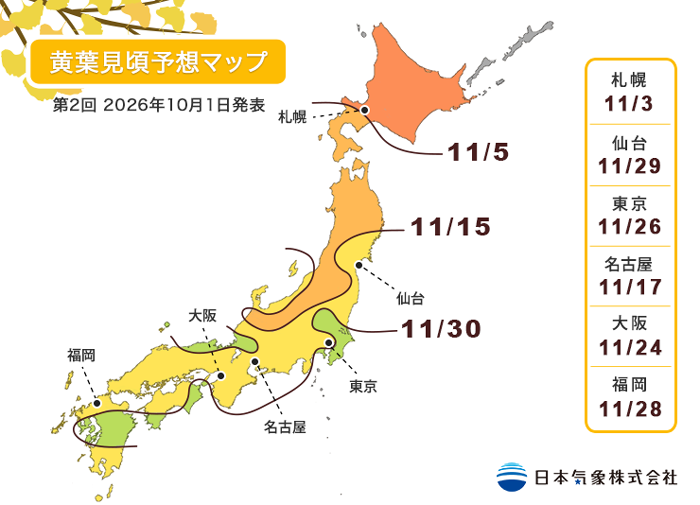
Japan yellow-ginkgo forecast map
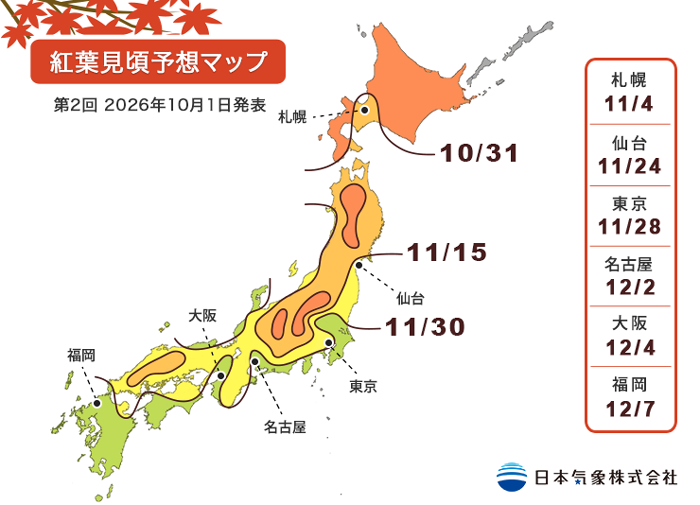
Read the red-leaf and yellow-leaf maps separately: maple and ginkgo follow different timelines. The side boxes give representative city-tree dates; the coloured bands show broad seasonal progression. Neither is a guarantee for every garden or mountain altitude. Choose the region first, then plan the day from recent local conditions and transport.
Maple vs Ginkgo: Do Not Plan Them as the Same Season
Searches for “Japan autumn leaves” often combine two visually different stages of the season.
- Ginkgo: bright yellow foliage, commonly seen on city avenues, in parks and around large urban spaces.
- Maple: red, orange and mixed crimson foliage associated with many gardens, temples, mountain valleys and traditional autumn scenes.
Ginkgo often colours before maple because the two respond differently to temperature, but it is not an absolute rule at every location. Sendai in the current city forecast is one example where the representative ginkgo date is later than the representative maple date.
This is why a traveller arriving in Kyoto or Osaka in late November should not automatically conclude that the season is “too early” simply because some maple-heavy gardens are not yet at their strongest. Ginkgo and earlier-changing trees may already be providing good colour elsewhere.
Where Should You Go for Autumn Leaves by Travel Period?
Swipe to compare →
| Your travel period | Best area to investigate first | Main risk | Fallback |
|---|---|---|---|
| Late September | Highest elevations in Hokkaido and the Japanese Alps | Lowland cities are far too early | Move higher rather than south |
| Early to mid-October | Hokkaido, Tohoku and high mountain areas | Famous Tokyo/Kyoto foliage is still green | Choose elevation-based routes |
| Late October | Tohoku, Nikko, Fuji highlands, Japanese Alps and other cooler elevations | City forecasts may still be weeks away | Use mountain day trips from major cities |
| Early to mid-November | Mountain and intermediate-elevation central Japan; later northern areas | Tokyo/Kyoto lowlands may still be developing | Move uphill or use regional day trips |
| Late November | Tokyo, Hiroshima and many central/western city destinations | Some high-elevation foliage may already be over | Move into lower city gardens |
| Early December | Kyoto, Osaka, Nagoya, Fukuoka and other later lowland locations | Northern and mountain colour may be finished | Prioritise low elevation and maple-heavy sites |
| Mid-December | Selected late western or southern locations only | Many famous foliage locations may be past peak | Do not build an entire trip around foliage alone |
These are routing principles rather than promises for a particular attraction. Before travelling to a mountain, valley, garden or temple, check the location’s own current foliage report if one is available.
How to Read a Japan Autumn Foliage Forecast Correctly
1. Start with geography, not the city name
Autumn colour moves broadly from colder areas to warmer ones and from high elevation to low elevation. Two destinations in the same prefecture can therefore be at very different stages.
For example, Fuji-area foliage can make sense while central Tokyo is still relatively early. If Mount Fuji is part of your route, use the Kawaguchiko Fuji View Guide to decide whether a lake-based day trip fits your itinerary.
2. Treat the city date as an anchor, not a one-day event
The national forecast uses representative trees. Real sightseeing locations contain different tree species and microclimates, so a garden can develop before or after the city’s headline date.
A useful planning model is therefore:
- national forecast for the broad region;
- local forecast for the actual destination;
- current photos or official foliage status shortly before travel;
- day-of weather and transport conditions before departure.
3. Separate maple-heavy and ginkgo-heavy destinations
If your itinerary contains both, you have more flexibility than somebody chasing only deep-red maple. A yellow ginkgo avenue may be excellent while a nearby maple garden is still transitioning.
4. Recheck after every major forecast update
The October 1 forecast is the second seasonal outlook, not the final word. Temperature patterns during October and November can shift the timing.
If your accommodation is already booked, you usually do not need to rebuild the entire trip after every revision. Change the foliage day before changing the whole route.
What the Current Forecast Means for Tokyo
Tokyo’s current city forecast puts representative yellow ginkgo around November 26 and representative red maple around November 28.
For travellers, the more useful point is that Tokyo contains large elevation differences between the city centre and surrounding day-trip areas. If central Tokyo is still early, a cooler or higher destination outside the core may be a better foliage day than waiting in a city garden.
Conversely, once higher mountain areas have passed their strongest colour, Tokyo’s lower parks and gardens may still be developing.
What the Current Forecast Means for Kyoto
Kyoto’s current representative maple forecast is relatively late, around December 11, while the representative ginkgo forecast is around November 27.
This does not mean that Kyoto has no autumn colour before December 11. Different temples, garden exposures, elevations and tree mixtures can change at different times.
The practical implication is to avoid building a late-November Kyoto itinerary around one supposedly exact peak day. Use several neighbourhoods and different tree types, then check actual conditions immediately before each foliage-focused visit.
If Kiyomizu-dera is part of your route, see the Kiyomizu-dera Temple Guide for access and seasonal planning rather than treating the national city forecast as attraction-specific timing.
What the Current Forecast Means for Osaka
Osaka’s representative ginkgo forecast is around November 24, while red maple is forecast around December 4.
This makes late November potentially more useful for travellers interested in mixed urban colour than for travellers whose only goal is fully red maple.
If Osaka is combined with Kyoto, avoid assuming the two cities will peak simultaneously. Keep the most foliage-sensitive sightseeing day movable between the two if your transport and reservations allow it.
What the Current Forecast Means for Hiroshima
Hiroshima’s current city forecast places yellow ginkgo around November 21 and red maple around November 28.
Because Hiroshima itineraries often mix the city with Miyajima and more rural day trips, local timing matters more than the headline city date. The Hiroshima Autumn Leaves Guide helps compare the actual locations, access and route choices.
What If Your Trip Is Too Early?
Do not immediately abandon autumn foliage. Change one of these variables first:
- Go north. Colder regions generally progress earlier.
- Go higher. Mountain foliage can be well ahead of nearby lowlands.
- Look for ginkgo. In many cities it develops before representative maple.
- Move the foliage day later within your trip. Even two or three days can improve conditions during an active transition.
From Tokyo, Fuji and Hakone can provide useful alternatives because elevation creates a different seasonal timeline from the city centre. For Hakone planning, see the Lake Ashi Hakone Guide.
What If Your Trip Is Too Late?
If a mountain location is already losing leaves, reverse the strategy:
- move downhill;
- move south;
- choose sheltered city gardens;
- look for later-changing maple rather than relying only on earlier foliage;
- treat fallen leaves as part of the scenery rather than chasing only fully attached foliage.
The least productive strategy is usually travelling several hours to a famous location based only on an old seasonal average when current reports show the colour has already moved elsewhere.
How Much Flexibility Should You Build Into an Autumn Trip?
You do not need a completely unbooked itinerary. Autumn is popular, and keeping every hotel night flexible can be impractical.
A better structure is:
- Fix: international flights and main hotel bases;
- Usually fix: long-distance transport when your dates fall in a busy period;
- Keep flexible: one or two foliage-focused day trips;
- Delay until closer to travel: weather-sensitive mountain outings where possible;
- Prepare backups: one higher/cooler and one lower/warmer alternative.
This allows you to react to the forecast without turning a normal Japan trip into a daily rebooking exercise.
Do You Need to Book Autumn Foliage Attractions?
The foliage itself does not require a reservation, but autumn can increase demand for transport, accommodation and seasonal events.
Never assume that an illumination, special opening or reservation system returns on identical dates every year. Check the attraction’s official website for your exact visit date before committing your route.
Likewise, avoid booking a remote foliage tour solely because its advertising uses autumn photography. Confirm the location, operating date and what happens if foliage timing or weather does not match expectations.
What Should You Wear for Autumn Leaves in Japan?
There is no single Japan autumn outfit because the foliage season spans high mountains, northern regions and relatively mild lowland cities.
For a city-based late-autumn trip, layers are more useful than one very heavy item: a base layer, mid-layer and outer layer can handle warmer afternoons and cooler mornings.
For mountain or high-elevation foliage, treat the weather as a separate environment from Tokyo, Kyoto or Osaka. Wind, shade and elevation can make conditions significantly colder. Check the destination weather forecast immediately before leaving and carry suitable rain protection and footwear.
Common Forecast Mistakes to Avoid
- Using an average as this year’s forecast. Historical timing is useful for choosing a travel month, but it is not a current forecast.
- Calling one city date the peak of every attraction. It is a representative forecast reference.
- Ignoring elevation. This is one of the biggest reasons two nearby locations differ.
- Tracking only maple. Ginkgo can substantially extend your useful autumn-colour options.
- Booking every day around one forecast issued months earlier. Recheck as the trip approaches.
- Confusing good foliage with good photography weather. Peak leaves do not guarantee clear skies, calm wind or Mount Fuji visibility.
Read three different dates before using a foliage map
Separate the forecast’s publication date, its predicted colour date and the date a local photograph or condition report was made. For booking a broad region, the first two are useful. In the final few days before travel, a newer, correctly located condition report can be more relevant than an older forecast screenshot.
The JMC seasonal release links its original red- and yellow-leaf maps and location forecasts. Use destination and altitude information for a mountain outing rather than transferring the nearest city’s date to the trail.
Once the region is chosen, use the existing Tokyo, Kyoto and Osaka foliage guides for access and routes. Plan your access, walking route and stops around your arrival station and available time.
Japan Autumn Leaves Forecast 2026 FAQ
When is the best time to see autumn leaves in Japan in 2026?
There is no single best week nationwide. High mountains and northern Japan develop earlier, while Tokyo, Kyoto, Osaka and other lowland cities are generally later. Under the second national forecast, late November into early December is particularly relevant to the major Tokyo–Kyoto–Osaka corridor, while October is more suitable for many northern and high-elevation areas.
When will autumn leaves peak in Tokyo in 2026?
The second national forecast puts Tokyo’s representative red-maple date around November 28 and representative yellow-ginkgo date around November 26. Individual parks and gardens can differ, so check current local conditions before visiting.
When will autumn leaves peak in Kyoto in 2026?
The current representative red-maple forecast for Kyoto is around December 11, while yellow ginkgo is around November 27. These are city forecast reference dates, not guarantees that every Kyoto temple reaches peak colour on those exact days.
Is Japan’s autumn foliage late this year?
The second forecast expects many locations to be around normal or later than normal, with autumn temperatures expected to remain relatively high in many areas. The size of any delay varies by region and tree type, so “late everywhere” would be too simplistic.
Do ginkgo leaves turn before maple leaves in Japan?
Often, but not universally. Ginkgo generally colours at somewhat warmer temperatures and is earlier than maple in many of the current city forecasts. Local species and conditions can reverse the order, so use separate forecasts rather than assuming a fixed gap.
Is October or November better for autumn leaves in Japan?
October is better suited to many mountain areas, Hokkaido and northern destinations. November opens far more options across central Japan and eventually the major lowland cities. Travellers focused specifically on Tokyo, Kyoto and Osaka should generally think later than travellers visiting Tohoku or the Japanese Alps.
Can the Japan autumn leaves forecast change?
Yes. Foliage development depends strongly on temperature, so forecasts are revised as the season progresses. Use an early forecast to choose your broad route, then recheck shortly before any foliage-critical day trip.
Do illumination dates identify the best leaf colour?
No. They are operator schedules. Leaf colour responds to weather and species, so check both the event arrangements and actual foliage.
Does a red-leaf photograph prove the current conditions?
Only if its date and location are relevant. A historical photograph helps show the setting but is not a live 2026 report.
Can I use the nearest city’s forecast for a mountain?
Not directly. Check the actual destination, altitude and current conditions, then verify road and transport operation separately.
When is the next forecast release?
JMC’s second forecast schedules the next release for early November. A planned release is not an already published new forecast.
What makes a useful base for a one-day foliage outing?
A city with several reachable alternatives at different elevations or with different tree types gives you room to react. Choose among them from current conditions rather than fixing one attraction months ahead.
Who Should Travel Where?
Travelling in October: build the foliage part of your trip around colder northern regions or higher elevations rather than forcing Tokyo or Kyoto into the plan.
Travelling in early to mid-November: favour flexible routes through mountains, Fuji areas, central Japan and later northern locations, while treating big-city foliage as a bonus rather than a certainty.
Travelling in late November: Tokyo, Hiroshima and parts of Kansai become much more logical, but keep mountain alternatives only if current reports still support them.
Travelling in early December: lowland Kyoto, Osaka and other later western destinations deserve more attention than northern mountains.
If autumn foliage is the main reason for your trip: do not choose one famous city and one exact “peak date.” Build a route with at least two elevations or two regions, follow both maple and ginkgo forecasts, and move the foliage day when the next forecast update gives you better information.