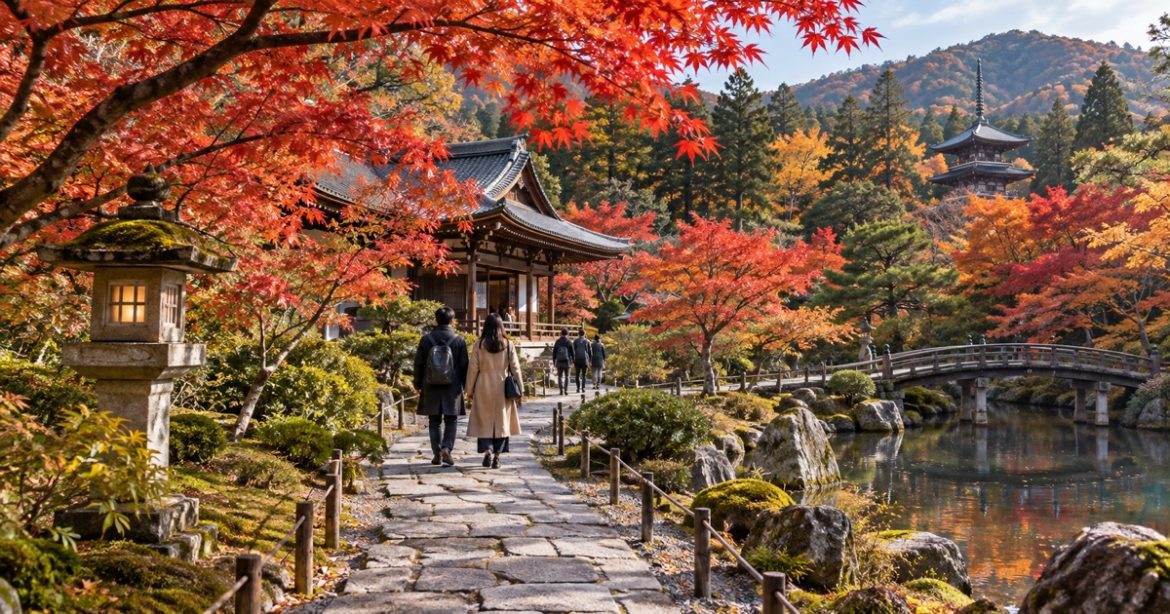

Japan in November: the quick answer
November is an excellent month for Japan if you want cool sightseeing weather, autumn scenery and evenings that increasingly include seasonal illuminations. The catch is that there is no single nationwide foliage peak. Northern Japan and high elevations can already be moving into early winter, while Tokyo, Kyoto, Osaka and warmer lowland cities may not reach their strongest maple colour until late November or even December.
For a first trip, you normally do not need to replace the classic Tokyo–Kyoto–Osaka route with a specialist foliage itinerary. Instead, choose your dates and destinations according to how far autumn has progressed, start popular outdoor sights earlier, keep one flexible foliage day, and pack for colder mornings and evenings.
| Travel plan | November fit | Main decision |
|---|---|---|
| Tokyo + Kyoto + Osaka | Excellent | Late November generally gives autumn a stronger role, but current 2026 forecasts should be checked again before departure. |
| Hokkaido | Good for Hokkaido, not necessarily for peak foliage | Pack for late-autumn or early-winter conditions rather than assuming November still means classic red leaves. |
| Japanese Alps / mountain areas | Highly date-sensitive | Elevation matters. Some high routes may be beyond peak foliage or entering winter conditions. |
| Kyushu | Very good | Milder temperatures and later seasonal progression can work well for a second-half-of-November trip. |
| Okinawa | Good for warm-weather travel | Choose it for subtropical weather and island travel, not for classic Japanese autumn foliage. |
What Japan is like in November
November sits at the point where Japan stops having one broadly similar autumn climate and becomes several different trips at once. Sapporo is approaching winter, Tokyo and Kansai are in cool autumn weather, and Okinawa remains considerably warmer.
Japan’s autumn colour also moves geographically. Cooler and higher places turn first, followed by lower elevations and warmer regions. This means a famous mountain destination can be past its strongest colour while a city several hundred kilometres south is still mostly green.
That distinction matters even more in 2026. The first nationwide forecast from Japan Meteorological Corporation, released in September 2026, expects many locations to reach red or yellow foliage around average timing or later. A further forecast update is expected in early October 2026, so anyone travelling specifically for autumn colour should check the latest forecast again shortly before departure.
For broader seasonal context, see the official JNTO November travel guide and the Japan Meteorological Corporation autumn forecast.
Japan weather in November: how cold is it?
The table below uses Japan Meteorological Agency 1991–2020 climate normals. These numbers describe long-term average conditions; they are not a weather forecast for your travel dates.
| Destination | Average high | Mean | Average low | Practical interpretation |
|---|---|---|---|---|
| Sapporo | 8.7°C | 5.2°C | 1.6°C | Cold enough to plan as late autumn moving toward winter. |
| Tokyo | 16.7°C | 12.5°C | 8.8°C | Comfortable for walking in the daytime; colder after sunset. |
| Kyoto | 17.3°C | 12.5°C | 8.4°C | Good sightseeing temperatures, but early temple visits and night illuminations can feel cold. |
| Osaka | 17.8°C | 13.8°C | 10.2°C | Cool autumn conditions with relatively mild city afternoons. |
| Fukuoka | 18.2°C | 14.2°C | 10.6°C | Milder than Tokyo and Kyoto but still firmly autumnal. |
| Naha | 25.0°C | 22.5°C | 20.4°C | A completely different subtropical November wardrobe. |
The key planning lesson is not the exact average temperature. It is the range between regions and between afternoon and evening. A suitcase that works perfectly for Osaka can be inadequate if the same itinerary adds Sapporo or a high-elevation day trip.
You can check the underlying long-term data on the Japan Meteorological Agency climate normals page.
What to wear in Japan in November
Layers are more useful than one very heavy outfit for most mainland city itineraries. Trains, department stores and restaurants are heated, while gardens, temple approaches and evening illuminations can keep you outdoors for long periods.
| Route | Useful November clothing | Extra consideration |
|---|---|---|
| Tokyo / Kyoto / Osaka | Long sleeves, knit or fleece layer, light-to-medium jacket | Add a warmer layer for early mornings and long evenings outdoors. |
| Hokkaido | Warm coat, insulating layers, closed shoes | Check snow and surface conditions before departure. |
| Japanese Alps / mountain areas | Warmer outerwear and footwear with useful grip | Conditions may be considerably colder than the nearby city. |
| Kyushu cities | Autumn layers and a light-to-medium jacket | Inland and elevated destinations can be much cooler. |
| Okinawa | Light clothing plus a light outer layer | Do not pack according to Tokyo temperatures. |
Comfortable walking shoes matter more in November than many packing lists suggest. Kyoto temple districts, gardens, large stations and foliage day trips can turn a normal sightseeing day into many kilometres of walking.
Japan fall foliage in November 2026: where is the season likely to be?
The most important thing to understand about autumn leaves in Japan is that a forecast date for one city is not the guaranteed best day for every attraction in that city. Elevation, tree species, exposure and local weather can produce different timing even within the same destination.
Japan Meteorological Corporation’s first 2026 forecast uses sample-tree observation standards and publishes separate estimates for red maple and yellow ginkgo. The following red-leaf dates are therefore best treated as planning anchors rather than fixed peak-tourism dates.
| City | First JMC 2026 red-leaf forecast | What it means for a November trip |
|---|---|---|
| Sapporo | November 7 | Early November remains relevant, but Hokkaido is already transitioning toward winter. |
| Sendai | November 25 | November can work well, with timing varying between city and surrounding higher terrain. |
| Nagano | November 21 | Useful for lower elevations; many mountain locations turn earlier. |
| Tokyo | November 29 | Late November is the stronger planning window if central-city maple colour is important. |
| Kanazawa | November 30 | Late November into early December deserves particular attention. |
| Kyoto | December 11 | The first forecast is later than many travellers expect; do not assume every Kyoto maple will peak in mid-November. |
| Osaka | December 4 | Late November can still be excellent, but the current forecast suggests some city maples may continue improving into December. |
| Hiroshima | November 28 | Late November is currently the key forecast period. |
Yellow ginkgo can also turn on a different schedule from red maple. In the first 2026 JMC forecast, yellow-leaf dates are earlier than red maple in several major cities, including Tokyo, Kyoto and Osaka. That is why a trip does not need one perfect “peak foliage date” to look autumnal.
Early, mid or late November: which part of the month is better?
Early November
Early November works particularly well when your main priority is normal sightseeing with some autumn atmosphere rather than guaranteed peak colour in the classic cities.
Some colder or higher destinations may already have strong foliage or may be moving beyond it. Central Tokyo, Kyoto and Osaka, meanwhile, can still be developing colour.
Culture Day on November 3 is a national holiday. It is not a nationwide tourist shutdown, but accommodation, leisure attractions and popular day-trip transport can face extra domestic demand around holiday dates.
Mid-November
Mid-November provides a useful compromise for travellers combining regions. Autumn is increasingly visible across central Japan, temperatures are comfortable for long walking days, and some mountain-to-city combinations can still work if the forecast is checked carefully.
The trade-off is that famous foliage destinations begin attracting more visitors. Build mornings around the outdoor place that matters most instead of saving every garden or temple for the afternoon.
Late November
Late November is the period to watch most closely for Tokyo and many lower-elevation destinations under the first 2026 foliage forecast.
It is also one of the busiest parts of Kyoto’s autumn travel season. If Kyoto is essential, staying in the city rather than repeatedly commuting from Osaka can make early starts and evening visits much easier.
Labor Thanksgiving Day falls on November 23. Check how the date interacts with your actual itinerary and accommodation availability rather than treating it like an ordinary weekday.
Tokyo in November
Tokyo is particularly easy to enjoy in November because you do not need a foliage-only itinerary. Gardens, parks, shrine approaches and ginkgo-lined streets can be added to normal sightseeing routes.
The first 2026 JMC forecast currently places Tokyo’s red-leaf reference date on November 29 and its yellow-leaf reference date slightly earlier. Travellers visiting in the first half of the month should therefore avoid assuming that every central park will already look like a late-autumn photograph.
Build the trip around neighbourhoods first and seasonal scenery second. The Todolist Japan Tokyo guide explains how to group Asakusa, Ueno, central Tokyo, Shibuya and Shinjuku without crossing the city unnecessarily.
If early-November foliage is a major priority, a regional day trip can sometimes make more sense than chasing colour between central Tokyo parks. Compare the options in the best day trips from Tokyo guide.
Kyoto in November
Kyoto deserves the most careful November planning because autumn demand can affect accommodation, buses, pedestrian routes and evening temple visits at the same time.
The September 2026 JMC forecast currently places Kyoto’s red-maple reference date in December, while yellow ginkgo is forecast earlier. That does not mean Kyoto has no autumn colour during November. It means travellers should not reduce the whole city to one supposed mid-November peak.
Geography matters more. Arashiyama, Higashiyama, northern temple areas and central Kyoto should not be crossed repeatedly in one day. See the Todolist Japan Kyoto travel guide for the full area-by-area route.
For 2026, Kiyomizu-dera has confirmed autumn special night viewing from November 21 to 30. If an evening opening is important to your itinerary, always check the temple’s official night-viewing page again before travelling because annual special-opening conditions can change.
Do not plan three famous evening illuminations on one night. Entrance queues, darkness, cold weather and slow pedestrian movement mean one major evening site plus dinner is often a much more realistic plan.
Osaka in November
Osaka is a strong November base for travellers who want comfortable city sightseeing, food and straightforward rail access to the rest of Kansai.
The first 2026 JMC forecast places Osaka’s red-maple reference date in early December, so late-November travellers should not be surprised if some city locations are still developing colour.
Midosuji Illumination 2026 is currently scheduled to begin on November 3 and continue through December. Because the illuminated avenue runs through central Osaka, it is easy to add after dinner without sacrificing a full sightseeing day.
Use the Osaka travel guide to choose between Namba, Umeda and other bases. If Kyoto will occupy only one day, Osaka can remain convenient. If Kyoto occupies several consecutive autumn days, moving to Kyoto usually creates easier mornings and evenings.
Hokkaido and northern Japan in November
November in Hokkaido should be planned as a transition toward winter rather than simply a colder version of Kyoto.
Sapporo’s long-term November average is only 5.2°C, with an average daily low of 1.6°C. Mountain and inland conditions can be colder, and snow can affect individual travel dates.
Visit Hokkaido because you want Hokkaido: food, cities, onsen, early winter atmosphere or specific regional experiences. Do not choose it solely because November is labelled “autumn” elsewhere in Japan.
Kanazawa, Nagano and the Japanese Alps
This is where elevation becomes more important than the name of the nearest city.
The first 2026 JMC forecast currently places the city reference dates for red leaves around November 21 in Nagano and November 30 in Kanazawa. Mountain locations can turn much earlier than those city observations, and some seasonal mountain transport may already be ending or operating under colder conditions.
For city-level planning in Ishikawa, use the Kanazawa travel guide. Travellers using Matsumoto as a regional base can also use the Matsumoto Castle guide rather than trying to turn this month guide into a full Alps itinerary.
Do not commit to a high-altitude detour only from a generic “Japan autumn leaves” calendar. Confirm the exact elevation, transport operating period and weather conditions for the place you intend to visit.
Kyushu and Okinawa in November
Kyushu is useful when you want a milder trip and do not need the earliest foliage. Fukuoka’s November climate normal is considerably warmer than Sapporo, and many southern or low-elevation areas progress later through autumn.
Okinawa is different again. Naha’s long-term November mean is 22.5°C. It is better viewed as a warm subtropical extension to a Japan trip than as an autumn-leaf destination.
A Tokyo–Kyoto–Okinawa itinerary therefore needs two wardrobes rather than one slightly warmer jacket.
November illuminations: autumn light-ups and early winter lights
November contains two different types of evening experience:
- Autumn foliage illuminations at temples, gardens and historic sites.
- Winter or Christmas illuminations in major commercial districts.
They should not be planned in the same way. Temple night openings often have specific admission windows, limited dates and heavy pedestrian demand. Urban winter illuminations are generally easier to add after dinner or on the way back to the hotel.
Confirmed examples currently include:
- Kiyomizu-dera autumn night viewing from November 21–30 2026.
- Midosuji Illumination in Osaka beginning November 3 2026.
- Marunouchi Illumination in Tokyo beginning November 12 2026 and continuing into winter.
These dates were confirmed from current official or official-tourism information during preparation of this draft, but seasonal events can still be revised. Recheck the organiser before structuring a non-refundable booking around an illumination.
How crowded is Japan in November?
November is not uniformly crowded across the whole country. The pressure is concentrated by place, weekend, holiday and foliage timing.
Kyoto temple districts, famous gardens, foliage trains and scenic day trips can be extremely busy even when another part of the same city feels normal. Tokyo absorbs visitors more easily because its attractions are dispersed across a huge metropolitan area.
A practical November crowd strategy is:
- Put the outdoor attraction you care about most first in the day.
- Avoid crossing Kyoto repeatedly between distant foliage districts.
- Book accommodation early when Kyoto is a fixed late-November destination.
- Keep at least one flexible half-day if foliage is a major objective.
- Use railway routes where possible instead of assuming a bus is always the easiest option in busy Kyoto.
- Do not schedule every dinner, illumination and scenic attraction at fixed times on the same day.
What should be booked before a November Japan trip?
You do not need reservations for every part of a Japan itinerary, but November rewards booking the things that are expensive or difficult to replace.
- Accommodation: especially Kyoto, popular onsen destinations and small regional towns during foliage periods.
- Limited-capacity scenic transport: book when a particular train or seat is essential to the itinerary.
- Timed attractions: reserve only when you genuinely want that attraction rather than filling every day with fixed slots.
- Special night events: check whether admission is standard walk-up, timed or advance reservation.
- Intercity reserved seats: useful when travelling at a fixed time on a busy holiday or weekend, although ordinary November travel does not require reserving every train weeks in advance.
Local trains, metros and normal city sightseeing should remain flexible where possible. Autumn colour and weather do not always cooperate with a schedule built entirely from non-changeable bookings.
How to build a November Japan itinerary
First-time trip: Tokyo, Kyoto and Osaka
Keep the classic route. November does not require replacing it with a nationwide foliage chase.
A practical sequence is:
- Tokyo: three to five full days, with one garden or seasonal walk integrated into normal neighbourhood sightseeing.
- Kyoto: three full days if temples and autumn scenery are priorities.
- Osaka: two to three days for food, city districts and a different evening atmosphere.
If your dates fall in early November, accept that central-city foliage may be less advanced and consider one cooler or higher day trip only if autumn leaves are a major goal.
Late-November foliage-focused trip
Choose fewer bases and spend longer in them. Tokyo plus Kyoto, or Tokyo plus Kansai, is often more effective than changing hotels every night to chase one forecast date.
Use the latest foliage report shortly before travel to decide which park, garden or regional day trip gets your flexible day.
November trip without foliage as the main goal
This is arguably the easiest use of the month. Build the itinerary around food, neighbourhoods, museums, historic sites and onsen, then let autumn colour appear naturally around those experiences.
You will be much less vulnerable to a forecast shifting by several days.
What can go wrong with a November Japan trip?
Assuming every city peaks in November
Current 2026 forecasts illustrate why that assumption fails. Some lower-elevation destinations can reach their strongest red colour around the end of November or in December.
Using one temperature for the whole country
Sapporo and Naha differ by more than 17°C in November mean temperature according to JMA climate normals. Pack by route, not by month name.
Planning mountains from a city forecast
A Nagano city forecast does not tell you the condition at every elevation in the Japanese Alps.
Making Kyoto too rigid
Autumn pedestrian traffic, buses and evening openings make tight attraction-to-attraction scheduling fragile. Group sights geographically and allow more time than the map suggests.
Ignoring how early it gets cold
Even if the afternoon feels comfortable, night illuminations involve standing outdoors after temperatures have dropped. Carry the evening layer rather than leaving it at the hotel.
Japan in November FAQs
Is November a good time to visit Japan?
Yes for travellers who enjoy cool sightseeing weather, autumn scenery and seasonal evening events. It is particularly strong for Tokyo, Kyoto, Osaka and many parts of central and western Japan, but exact foliage timing varies by year and location.
Is Japan cold in November?
It depends on the region. Tokyo, Kyoto and Osaka are cool rather than deep-winter cold on long-term averages, while Sapporo is already much colder. Okinawa remains warm. Mountain areas can be significantly colder than nearby cities.
Does it snow in Japan in November?
Snow is possible in northern Japan and high elevations, while ordinary November snow is not something a Tokyo–Kyoto–Osaka traveller should assume. Check an actual weather forecast and local transport conditions shortly before any mountain or northern journey.
What should I wear in Tokyo and Kyoto in November?
For most travellers, long sleeves, a knit or fleece layer and a light-to-medium jacket work well, with an additional warm layer for early mornings and evening illuminations. Comfortable walking shoes are essential.
When are autumn leaves best in Japan in November?
There is no nationwide peak. Northern and high-elevation locations turn earlier, while many major lowland cities become more relevant later. The first 2026 JMC forecast currently places Tokyo’s red-leaf reference date at the end of November and Kyoto and Osaka later still. Check the next forecast update before travelling.
Is Kyoto crowded in November?
Popular temple districts and foliage locations can become very busy, especially later in the month and around weekends or holidays. Staying in Kyoto, starting early and grouping attractions geographically are more useful than trying to visit every famous autumn spot.
Are there illuminations in Japan in November?
Yes. November overlaps autumn foliage light-ups and the start of many winter illumination seasons. Confirmed 2026 examples include Kiyomizu-dera’s autumn night viewing, Osaka’s Midosuji Illumination and Tokyo’s Marunouchi Illumination.
Is early or late November better for Japan?
Choose early November if normal sightseeing matters more than city-centre peak foliage or if you are targeting an earlier-changing region. Choose late November if Tokyo and lower-elevation autumn colour are priorities, accepting that Kyoto and Osaka foliage may continue into December depending on the year.
Who should visit Japan in November?
Choose November if you want a walking-heavy city trip, autumn atmosphere, temples and gardens, onsen, seasonal evenings and cooler weather without building the entire holiday around snow.
For a first visit, Tokyo–Kyoto–Osaka remains the most dependable route. In early November, treat foliage as a bonus unless you deliberately add a cooler or higher destination. In late November, let autumn become a larger part of Tokyo and Kansai, but keep watching the current forecast rather than booking around an old average date.
Choose Hokkaido for late-autumn and early-winter atmosphere rather than guaranteed foliage. Choose Kyushu for milder weather and later seasonal progression. Choose Okinawa when warm subtropical travel matters more than autumn colour.
The best November itinerary is therefore not the one that collects the most famous red-leaf spots. It is the one that matches your dates to the correct region, leaves enough flexibility for the weather and foliage you actually get, and uses Japan’s normal city itinerary as the foundation rather than abandoning it for one predicted peak day.