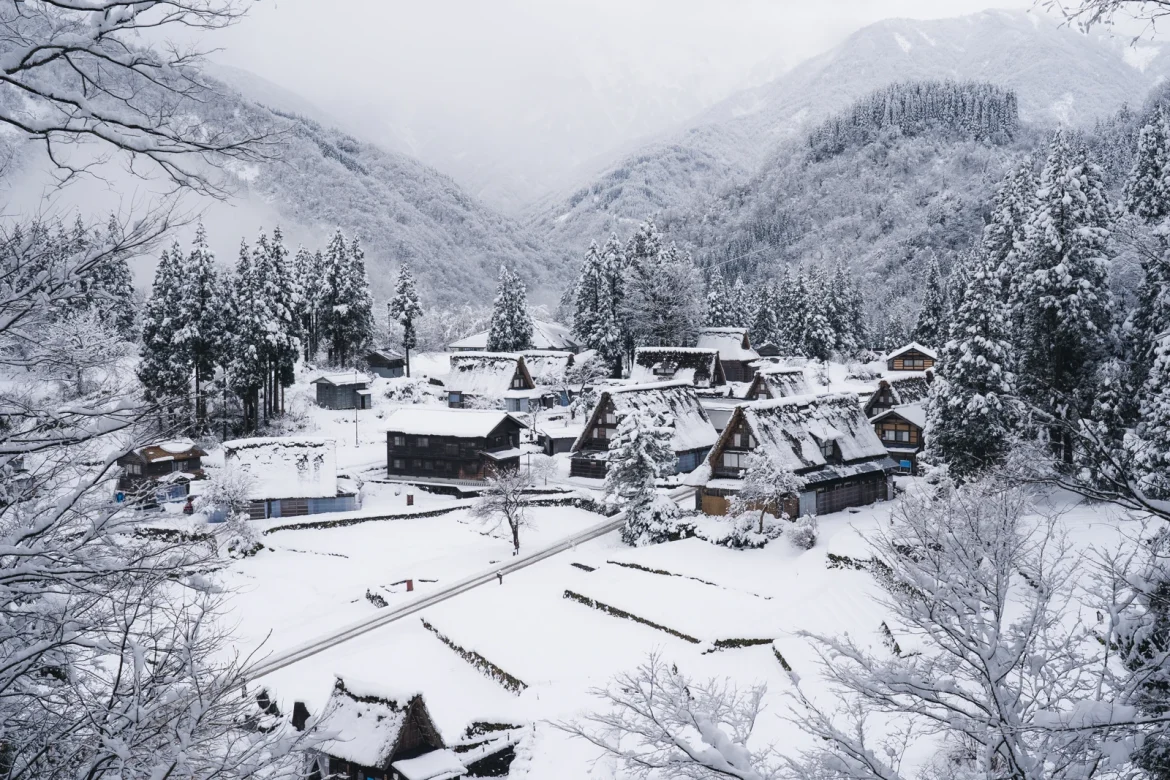
For a trip from Kanazawa to Gokayama, choose your village before choosing your bus. Ainokura and Suganuma are separate settlements with different stops. A direct bus works well for Suganuma from April to November; for Ainokura or both villages, compare connections through Johana or Shin-Takaoka.
In winter, plan around the World Heritage Bus. The seasonal Kanazawa highway bus does not stop at Gokayama Suganuma from December to March. Neither village has a railway station, so a train journey always needs a bus connection for the final stretch.
This guide covers a Gokayama day trip from Kanazawa, including fares, reservations, passes and a workable two-village itinerary. For the rest of your stay, see our Kanazawa travel guide.

Kanazawa to Gokayama: which route should you take?
| Route | Best for | Travel time | Booking and seasonal limits |
|---|---|---|---|
| Direct highway bus to Gokayama Suganuma | Suganuma only, with no transfer | About 60 minutes from Kanazawa Station | Reservation required; selected departures only, April–November |
| Nanto–Kanazawa Line to Johana, then World Heritage Bus | A lower-cost all-bus route to Ainokura and Suganuma | About 61 minutes to Johana, then 23 minutes to Ainokura-guchi or 38 minutes to Suganuma, plus the connection | No reservation on the first bus; some World Heritage Bus seats can be reserved |
| Shinkansen to Shin-Takaoka, then World Heritage Bus | A straightforward route to either or both villages | About 15 minutes by train, then 63 minutes to Ainokura-guchi or 78 minutes to Suganuma, plus the connection | Check the train and bus together; the bus operates year-round, subject to disruption |
| Rental car | A group wanting flexible stops | Depends on the village, traffic and weather | Allow for tolls, fuel and village parking; winter driving needs appropriate equipment and experience |
| Day tour from Kanazawa | Travellers who prefer transport arranged for them | Depends on the tour | Book a package that explicitly includes the Gokayama stop you want |
For two villages, the simplest route to understand is Shin-Takaoka or Johana → Ainokura-guchi → Suganuma → the same transfer hub. The fastest first leg does not always produce the easiest day: check the journey home before booking the outward trip.
Ainokura, Suganuma and Shirakawa-go: get the stops right
Ainokura: get off at Ainokura-guchi
Ainokura-guchi (相倉口) is the World Heritage Bus stop for Ainokura. Allow about five minutes to walk into the village, plus extra time for the uphill viewpoint walk. Build both the walk in and the walk back into your sightseeing window.
Suganuma: the local and highway bus stops are different
The World Heritage Bus stop named Suganuma (菅沼) is about a one-minute walk down to the village. The highway bus from Kanazawa uses Gokayama Suganuma (五箇山菅沼), shown separately on the official map near the Gokayama Interchange approach. Do not apply the local stop’s one-minute walk to the highway bus, or assume a transfer means waiting at the same pole.
Open the official Gokayama village map to locate Ainokura-guchi, Suganuma and Gokayama Suganuma before you travel. The map is useful for orientation; use the operator’s current pages for fares and timetables. Its older parking-price label is superseded by the map page’s ¥1,000 notice.
Shirakawa-go is a separate destination farther along the route. If that is where you intend to go, use our Kanazawa to Shirakawa-go transport guide and Shirakawa-go visitor guide rather than substituting its stop for Gokayama.
Option 1: direct Kanazawa–Suganuma highway bus
Selected Hokutetsu services leave Kanazawa Station West Exit, bus stop 4, and reach Gokayama Suganuma in about one hour. Seats must be reserved. The adult one-way fare is ¥2,200 for travel through 30 November 2026.
Hokutetsu has announced a fare of ¥2,300 from 1 December 2026. That fare change does not create a winter stop: Gokayama Suganuma remains an April–November stop under the published operating pattern. For a later season, check the current highway-bus timetable and booking links alongside the dated fare-change notice.
This is the convenient choice for Suganuma alone during the operating season. It does not go to Ainokura, and not every bus advertised for Shirakawa-go or Takayama stops at Gokayama.
Check the boarding restrictions and return trip
At Gokayama Suganuma, the bus from Kanazawa allows passengers to get off; the bus towards Kanazawa allows passengers to board. You cannot use this highway service for an onward ride from Gokayama to Shirakawa-go, or to arrive in Gokayama from Shirakawa-go. Use the World Heritage Bus for those local journeys.
Reserve the return service as well as the outward one. If you add Ainokura after arriving at Suganuma, allow for the walk between the highway and local stops and plan each connection separately.
Option 2: travel through Johana on the Nanto–Kanazawa Line
The Nanto–Kanazawa Line leaves Kanazawa Station West Exit, bus stop 2. Take a service that calls at Johana Station (城端駅前), then change to a World Heritage Bus towards Shirakawa-go. The first bus costs ¥910 one way and does not require a reservation.
From Johana, adult single fares are ¥780 to Ainokura-guchi and ¥1,200 to Suganuma. The ride between Ainokura-guchi and Suganuma costs ¥610. This makes the route worth considering when the bus connections suit your day.
Not every Nanto–Kanazawa bus calls at Johana
The line runs six return trips a day, but the published timetable has only three Kanazawa departures calling at Johana: 08:20, 09:20 and 12:10. In the other direction, Johana departures for Kanazawa are 14:30, 15:40 and 16:40. Check the operator’s Nanto–Kanazawa timetable before choosing a connection.
The waiting time matters as much as the driving time. For example, the 08:20 bus reaches Johana at 09:21, after the 09:05 World Heritage Bus has left; the next southbound departure is 10:30. That is a 69-minute wait, not an immediate connection. The worked itinerary below accounts for it.
Option 3: Shinkansen to Shin-Takaoka, then World Heritage Bus
Take a Hokuriku Shinkansen service that stops at Shin-Takaoka, then board the World Heritage Bus from bus stop 4. The train ride from Kanazawa takes about 15 minutes. The current bus timetable allows about 63 minutes to Ainokura-guchi and 78 minutes to Suganuma.
This route keeps the village visits on one bus line. It is particularly useful if you already hold a pass covering the train journey, or if the Nanto–Kanazawa connections leave too much waiting time. Train fares are additional to the local bus tickets and bus passes described below.
There is also a slower rail approach to Takaoka Station using the IR Ishikawa Railway and Ainokaze Toyama Railway, then the World Heritage Bus from bus stop 7. Takaoka and Shin-Takaoka are different stations: choose the right one when checking train arrival and bus departure times.
If Kanazawa is part of a longer trip from the capital, our Tokyo to Kanazawa guide explains the long-distance journey.
Do you need to reserve the World Heritage Bus?
You can still board without a reservation, subject to available space. The operator also offers 16 reservable seats per departure on eligible sections; seats that have not been reserved become unreserved seats. The service is therefore neither reservation-only nor entirely unreservable.
- Reservations open one month before travel and close the day before.
- You cannot make a new seat reservation on the day of travel.
- One booking can cover up to six passengers.
- Complete payment by the booking deadline or the reservation is cancelled.
- Reservations apply to the main sections offered in the booking system; do not assume every short hop can be booked.
For peak autumn dates, holidays or a group, a reserved ticket may be useful if the journey is available. If you travel unreserved, arrive early and leave room for disruption in your return plan.
A Free Ticket is not a reserved seat
The operator states that commuter tickets, multiple-ride tickets and Free Tickets cannot be combined with its reserved-seat bookings. Do not buy a Free Ticket and then pay for a separate reservation assuming it is a seat supplement. Choose the appropriate ticketing method using the official World Heritage Bus page and reservation rules.
Fares and passes: calculate your actual route
These are adult fare references. Bus-only passes do not include the train from Kanazawa to Shin-Takaoka or the separate Hokutetsu highway bus.
| Ticket | Adult price | Validity and coverage | When it is useful |
|---|---|---|---|
| Nanto–Kanazawa Free Pass | ¥1,800 | 2 days from issue; Nanto–Kanazawa Line | Travel around Johana, Fukumitsu and Inami; World Heritage Bus fares remain separate |
| Nanto–Kanazawa + World Heritage Bus Free Pass | ¥4,300 | 3 days from issue; both bus lines | Kanazawa–Johana return plus village hopping |
| Gokayama Free Ticket | ¥2,800 | 2 days from first use; World Heritage Bus between Takaoka/Shin-Takaoka and Sasara-kan-mae | Both Ainokura and Suganuma from Takaoka or Shin-Takaoka |
| Gokayama–Shirakawa-go Free Ticket | ¥4,000 | 2 days from first use; World Heritage Bus between Takaoka/Shin-Takaoka and Shirakawa-go | A trip that actually continues to Shirakawa-go |
Two useful break-even examples
From Shin-Takaoka, a circuit of Ainokura-guchi → Suganuma → Shin-Takaoka costs ¥1,100 + ¥610 + ¥1,300 = ¥3,010 in individual bus fares. The ¥2,800 Gokayama Free Ticket saves ¥210 on that pattern. By contrast, a simple Shin-Takaoka–Suganuma return costs ¥2,600, so two single tickets are cheaper if you make no other bus journeys.
From Kanazawa via Johana, the two-village circuit costs ¥910 + ¥780 + ¥610 + ¥1,200 + ¥910 = ¥4,410. The ¥4,300 combined pass saves ¥110. This is a modest saving for one day; its wider coverage becomes more useful if you also explore Nanto during the valid period.
Check the Nanto pass sales information and the World Heritage Bus ticket page. The Nanto passes are not sold on the bus. If using an early departure, arrange the pass beforehand rather than assuming a station counter will already be open.
Already holding a regional rail pass?
The Takayama–Hokuriku Area Tourist Pass specifically includes the World Heritage Bus between Shin-Takaoka and Shirakawa-go, as well as the relevant Hokuriku Shinkansen section. Check your pass’s validity before buying another local ticket. Its bus coverage stops at Shin-Takaoka, so do not extend that entitlement to the Takaoka Station segment. Other JR passes have different conditions; a rail pass does not automatically cover every bus in this guide. Bus seat-booking rules also remain separate from rail-seat reservations.
A realistic day trip visiting both Ainokura and Suganuma
Both villages fit into a day from Kanazawa without adding Shirakawa-go. The following all-bus example uses the currently published daily timetables. It leaves time in each village and a 35-minute connection at Johana on the way home.
| Time | Journey or visit | Planning note |
|---|---|---|
| 08:20–09:21 | Kanazawa West Exit → Johana Station | Nanto–Kanazawa Line, bus stop 2 |
| 09:21–10:30 | Wait at Johana | A 69-minute connection; keep an eye on departure time if leaving the station area |
| 10:30–10:53 | Johana → Ainokura-guchi | World Heritage Bus towards Shirakawa-go |
| 10:53–12:13 | Visit Ainokura | About 80 minutes between buses, including the walk in and back |
| 12:13–12:28 | Ainokura-guchi → Suganuma | World Heritage Bus towards Shirakawa-go |
| 12:28–14:21 | Visit Suganuma and take a lunch break | About 1 hour 50 minutes; check individual restaurant opening days |
| 14:21–15:05 | Suganuma → Johana | World Heritage Bus towards Takaoka |
| 15:40–16:45 | Johana → Kanazawa West Exit | 35-minute connection at Johana |
If you want longer in Ainokura, the 08:25 World Heritage Bus from Shin-Takaoka reaches Ainokura-guchi at 09:28. You can then use the same 12:13 village-to-village bus and return from Suganuma at 14:21, reaching Shin-Takaoka at 15:45. Choose a train from Kanazawa that allows time to find the bus stop.
These are timetable examples, not guaranteed connections. The operator currently omits several suspended services from its timetable; do not add an extra bus from an older screenshot. Recheck both operator pages for your date and avoid leaving the villages on your last possible connection when you have a flight or long-distance train later that day.
Kanazawa’s official Gokayama day-trip itinerary includes additional sightseeing around Kaminashi and is described as about 11½ hours. That is one longer model course, not a minimum time required to visit just Ainokura and Suganuma.
Walking, luggage and village visits
Ainokura’s approach takes longer than Suganuma’s local-bus approach. Allow extra time for photos, slopes, snow and the return walk to the road. A short walk on a map does not establish step-free access; travellers with mobility needs should check the route and bus arrangements with the operators before booking.
The local tourism office lists lockers at Ainokura-guchi and beside Ainokura’s parking-area office, and at the Suganuma stop on the side for buses towards Ainokura and Takaoka. Capacity is limited, and the highway stop is a different location. Do not base your day on finding an empty large locker on arrival.
If returning to the same Kanazawa hotel, leave your main suitcase there if luggage storage is available. Carry the items needed for the day. Hokutetsu coaches have overhead storage and an underfloor luggage compartment, but passengers load their own bags and restrictions apply to oversized items. Keep valuables with you and check the operator’s luggage rules.
The villages are living communities. Stay on visitor routes, avoid entering private yards and follow local photography notices. Allow at least an hour in Suganuma rather than treating it only as a quick bus-transfer photo stop.
Winter travel: what changes from December to March?

The direct highway-bus stop at Gokayama Suganuma is unavailable in December–March. Use Johana or Shin-Takaoka and the World Heritage Bus instead, checking the current operating notice before departure. Snow, heavy rain and road closures can disrupt mountain transport, so leave a generous margin before onward journeys.
Wear footwear suited to snow and ice and keep the plan simple if conditions are poor. Local visitor information lists Suganuma as closed on 31 December and 1 January; a bus operating that day does not mean the village is open for a normal sightseeing visit.
Is renting a car from Kanazawa worthwhile?
A car gives you control over the time spent in each village and can be convenient for several people sharing the cost. Compare the total rental, tolls, fuel and parking with the bus fares, rather than comparing only the headline rental price.
Suganuma is near Gokayama Interchange. Use the designated visitor parking; the conservation contribution is ¥1,000 for a regular or kei car. Access from the parking area differs from the local bus stop: the tourism office describes either a roughly seven-minute walk along the road or an approximately five-minute route using the elevator.
Winter requires a different decision. Gokayama’s seasonal advice calls for winter tyres and highlights four-wheel drive in deep-snow months. Appropriate equipment cannot replace experience on icy mountain roads. If you are unfamiliar with those conditions, public transport is the more sensible starting point.
For practical rental planning, see our Kanazawa car-rental guide (Traditional Chinese).
Would a day tour be easier?
A tour removes the need to coordinate separate bus timetables, but check the actual village and package. Tours labelled “Gokayama” may visit Ainokura, Suganuma or another stop in the region, and often combine the area with Shirakawa-go or Takayama.
The Klook listing below offers separate Shirakawa-go–Gokayama and Shirakawa-go–Hida Takayama options. Choose the Gokayama package if that is your priority, then confirm its exact stops and time allowed. Do not assume every option includes both Gokayama villages.
You can also compare the existing KKday tour from Kanazawa combining Gokayama, Shirakawa-go and Hida Takayama. For an unhurried visit to both Ainokura and Suganuma, independent travel is usually easier to tailor.
Stay in Kanazawa or overnight in Gokayama?
For a day trip, staying in Kanazawa keeps luggage and onward travel simple. You return to the same base and retain more flexibility if transport is delayed. Our Kanazawa hotel guide and family-friendly Kanazawa hotels are available in Traditional Chinese.
Choose an overnight stay in Gokayama if staying in the village is part of the experience you want, rather than merely to solve a bus connection. Confirm dinner arrangements, check-in time and the last suitable bus with the accommodation. A village stay also needs a separate plan for the following morning.
Common planning mistakes
- Booking a bus to Shirakawa-go when the intended destination is Gokayama.
- Assuming the direct Kanazawa bus visits Ainokura or stops at Suganuma in winter.
- Confusing Gokayama Suganuma highway stop with the World Heritage Bus stop named Suganuma.
- Choosing a Nanto–Kanazawa departure that skips Johana.
- Buying a larger pass without adding up the actual journeys, or assuming a pass reserves a seat.
- Using an old timetable containing suspended buses.
- Taking a large suitcase without a confirmed storage plan.
Kanazawa to Gokayama FAQ
What is the easiest way to reach Ainokura from Kanazawa?
Travel to Shin-Takaoka by a stopping Hokuriku Shinkansen service, then take the World Heritage Bus to Ainokura-guchi. The all-bus route via Johana can cost less, but needs closer attention to connections.
Can I visit both villages without a car?
Yes. The World Heritage Bus connects Ainokura-guchi and Suganuma in about 15 minutes southbound. Choose the between-villages bus and return journey before setting your sightseeing times.
Can I use the direct bus in both directions?
Yes, on selected reserved services during the April–November stopping season. You can arrive from Kanazawa and board a return service towards Kanazawa at Gokayama Suganuma. The same stop does not support travel between Gokayama and Shirakawa-go on that highway service.
Do I need a pass for a single-village trip?
Not necessarily. For example, Shin-Takaoka–Suganuma return costs ¥2,600 in single bus fares, below the ¥2,800 Gokayama Free Ticket. A second village or extra stops may change the calculation.
Can I reserve World Heritage Bus seats on the day?
No. Advance reservations close the day before travel. Unreserved travel remains possible when space is available.
Should I add Shirakawa-go to the same day?
Only if it fits the pace you want and all connections work. Ainokura and Suganuma make a complete Gokayama day trip. Adding another destination reduces time in the villages and can make the return less forgiving.
Which route would we choose?
For Suganuma alone in April–November, start with the reserved direct bus and book the return. For both villages, choose between the all-bus route via Johana and the train-plus-bus route via Shin-Takaoka according to connection times and any pass you already hold. In winter, use the World Heritage Bus approach and leave more flexibility for weather.
The useful planning sequence is simple: choose the village, identify the correct stop, secure the return journey, then compare tickets. That gives you time to enjoy Gokayama rather than spending the day chasing the next bus.