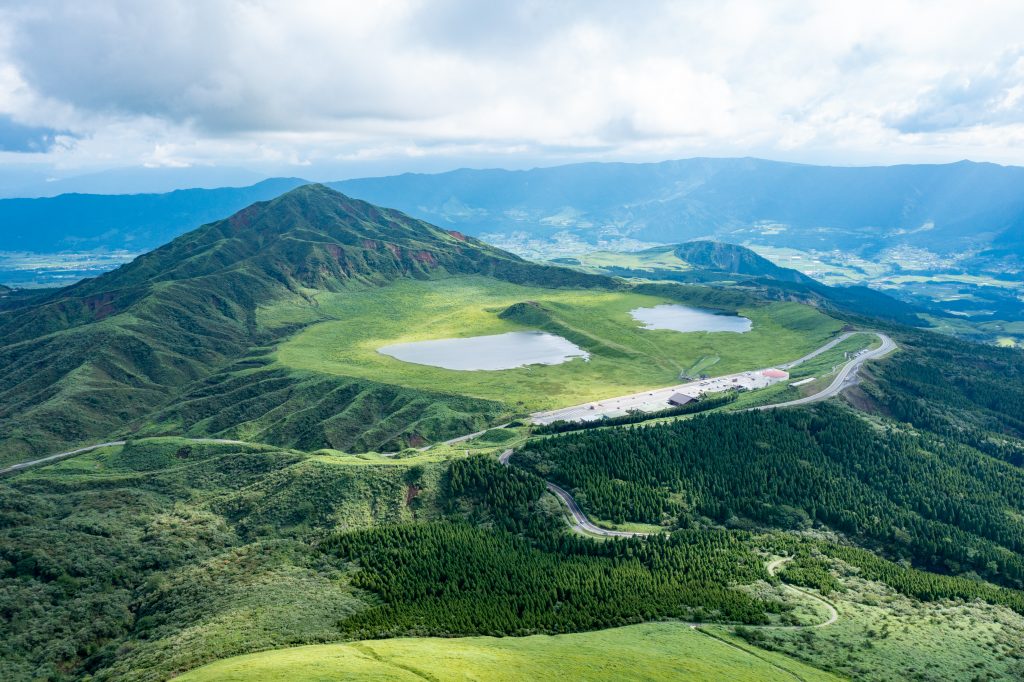
Kumamoto Airport is much closer to Mount Aso than central Kumamoto, but that does not automatically make the journey easy. The road journey takes about an hour, while public transport depends on a small number of well-timed buses. A flight arriving at the wrong time can turn a simple route into several connections and a long wait.
For travellers arriving early enough, the most efficient car-free option is often an Aso sightseeing bus with Kumamoto Airport pickup. It removes the transfer at Aso Station and visits Daikanbo, Aso Shrine and Kusasenri in one day.
The normal direct public bus from Kumamoto Airport to Kusasenri and Aso Sanjo Terminal is currently suspended through 31 August 2026 because of the Kumamoto-area earthquake. Service from 1 September 2026 has not yet been confirmed. Travellers visiting during the suspension should connect through Aso Station, use a sightseeing tour, rent a car or arrange a private vehicle.
There is another important limitation: Nakadake Crater is currently closed under volcanic alert level 2. This does not mean the entire Aso region is closed. Kusasenri, the Aso Volcano Museum area, Aso Shrine, Daikanbo and the wider caldera remain the main reasons to visit.
For a first visit, think of Kusasenri—not Aso Station—as the primary mountain destination. Aso Station is the transport gateway in the caldera. From there, another bus is needed to climb to Kusasenri and Aso Sanjo Terminal.

Kumamoto Airport to Mount Aso: Quick Answer
| Traveller situation | Best option | Why |
|---|---|---|
| Direct bus operating and flight arrives early | Direct airport–Kusasenri bus | No transfer and the lowest-effort ordinary public route |
| Direct bus suspended | Airport bus to Aso Station, then Aso Mountain Line | The simplest independent public-transport replacement |
| First visit without a car | Aso Round Bus Tour | Includes Daikanbo, Aso Shrine and Kusasenri without arranging connections |
| Two to four travellers with luggage | Rental car or private charter | Better luggage handling and freedom to change the route |
| Flight arrives after late morning | Stay overnight or drive | Public transport may leave too little sightseeing time |
| Continuing to Kurokawa Onsen | Private transfer with Aso stops | Avoids returning to the airport or Aso Station |
Current Transport and Volcano Status
Current transport warning: The direct Kumamoto Airport–Kusasenri–Aso Sanjo Terminal service is suspended through 31 August 2026. Operation after that date remains undecided.
Current crater warning: Nakadake Crater is closed under volcanic alert level 2. Entry within approximately one kilometre of the crater is prohibited.
What remains visitable: Kusasenri and destinations outside the restricted crater zone remain the realistic focus of an Aso sightseeing day, subject to road, weather and transport conditions.
The direct bus suspension and crater closure are separate issues. Even after the direct airport bus resumes, the crater may remain closed. Likewise, Kusasenri can still be worth visiting even when the crater itself is inaccessible.
Check the operator’s same-day status before leaving the airport. A booking confirmation or journey-planning app may still display a normal timetable during a temporary suspension.
Is Mount Aso Worth Visiting from Kumamoto Airport?
| Question | Editor’s verdict |
|---|---|
| Is it worth visiting? | Yes, especially for open landscapes, volcanic scenery and a countryside contrast to Japan’s major cities. |
| Is it still worth going while the crater is closed? | Yes if Kusasenri, the caldera, Daikanbo and Aso Shrine interest you. No if the crater is your only reason for travelling. |
| Recommended duration | At least five to seven sightseeing hours, excluding airport formalities. |
| Main difficulty | Low-frequency transport and connections rather than physical walking. |
| Best for | Landscape travellers, photographers, road-trip visitors and families comfortable with outdoor weather. |
| May disappoint | Travellers expecting one compact attraction or guaranteed crater access. |
| Families | Suitable, but a tour or car is easier than several public-transport transfers. |
| Older travellers | Kusasenri can be enjoyed with limited walking, although grass and uneven ground require care. |
| Best transport | Tour or car for flexibility; direct bus when operating and timed with the flight. |
| Overnight needed? | Not essential after an early arrival, but useful after a late flight or when continuing to Kurokawa Onsen. |
The strongest reason to visit is the scale of the landscape. Kusasenri is a broad grassland inside an active volcanic environment rather than a single observation deck. Weather, clouds and seasonal colour strongly influence the experience.
This may not be worth the effort if your flight arrives around midday, you must return to Kumamoto Airport the same evening and you are relying entirely on public transport. In that situation, an overnight stay or a different arrival-day plan is safer.
What “Mount Aso” Means on a Transport Timetable
First-time visitors often assume that a ticket to Aso Station reaches the main volcanic sightseeing area. It does not.
| Place | What it is | What to expect |
|---|---|---|
| Aso Station | Railway and bus gateway inside the caldera | Restaurants, local facilities and transfers, but not the summit scenery |
| Kusasenri Aso Volcano Museum | Main grassland and museum stop | The best general sightseeing stop during the crater closure |
| Aso Sanjo Terminal | Upper mountain transport terminal | Not the crater itself; onward crater access is separate when permitted |
| Nakadake Crater | Active crater viewing area | Currently inside the restricted zone and closed |
| Daikanbo | Caldera viewpoint on the northern rim | Not served by the ordinary Aso Station–mountain bus; easier by tour or car |
During the current crater closure, Kusasenri is usually a more useful destination than continuing to Aso Sanjo Terminal merely because it sounds closer to the summit.
Transport Options Compared
| Option | Approximate practical time | Transfers | Best for | Main drawback |
|---|---|---|---|---|
| Direct airport–mountain bus | About 1 hour 3 minutes to Kusasenri | None | Independent travellers arriving early | Normally only one through service and currently suspended |
| Airport bus to Aso Station + mountain bus | Roughly 2 to 3 hours including the wait | One | Current public-transport alternative | Connection is not guaranteed |
| Airport Liner + JR + mountain bus | Usually 2.5 to 4 hours depending on connections | Two | Travellers whose timings do not match the Aso Station bus | Most complicated route |
| Aso sightseeing bus | Full-day programme | None after pickup | First-time visitors and solo travellers | Fixed itinerary and limited luggage space |
| Rental car | About one hour to the mountain area under normal conditions | None | Flexible itineraries and onward travel | Weather, mountain roads and driving responsibility |
| Private charter | About one hour to Aso, then flexible touring | None | Families, older travellers and groups | Higher total cost |
Option 1: Direct Bus from Kumamoto Airport to Kusasenri
When operating, the direct bus is the easiest ordinary public-transport route. It boards at Kumamoto Airport bus stop 3 and travels uphill without requiring a change at Aso Station.
Normal published schedule
| Stop | Outbound | Return |
|---|---|---|
| Kumamoto Airport | 10:29 | 17:10 arrival |
| Kusasenri Aso Volcano Museum | 11:32 | 16:07 |
| Aso Sanjo Terminal | 11:39 | 16:00 |
The published one-way fare is ¥1,700 to Kusasenri and ¥1,800 to Aso Sanjo Terminal.
This schedule works only when your flight lands early enough to collect luggage, complete arrival formalities and reach the bus stop without rushing. For a domestic arrival, allow a meaningful buffer rather than planning around the aircraft’s scheduled landing time. International arrivals require even more time.
The return timetable creates another limitation. You must finish at Kusasenri by late afternoon, and road congestion may affect the airport arrival. Do not rely on the 17:10 scheduled arrival for a flight with a short check-in margin.
Reservation advice
The through service is normally reservable, and an empty seat may sometimes be available without advance booking. Reserving is the sensible approach because there is only one useful airport-to-mountain departure under the published timetable.
Do not make a reservation until the operating company confirms that service has resumed for your date.
Option 2: Kumamoto Airport to Aso Station, Then Mountain Bus
This is the most practical independent route while the direct mountain service is suspended.
- Board a bus from Kumamoto Airport to Aso Station.
- Get off at Aso Station, not at an earlier hotel or roadside stop.
- Check the departure board for the Aso Mountain Line.
- Board the bus for Kusasenri and Aso Sanjo Terminal.
- Get off at Kusasenri Aso Volcano Museum for the grassland and museum area.
The airport lists the journey to Aso Station at approximately one hour with a published fare of ¥1,500 on relevant intercity services. Service patterns and reservation rules differ, so confirm the exact bus rather than assuming every Aso-bound coach accepts walk-up passengers.
From Aso Station, the Aso Mountain Line takes approximately 35 minutes to the upper terminus. The published fare to Kusasenri or Aso Sanjo Terminal is ¥1,000 one way.
The connection is the real problem
The Aso Mountain Line does not guarantee connections from JR trains or other buses. It is reservation-free and first-come. During weekends, holidays and foliage periods, a full bus may mean waiting for the next departure.
Build at least one later mountain-bus departure into your plan. An itinerary that works only if every flight, bus and luggage belt runs exactly on time is not a reliable itinerary.
Which stop should you use?
During the crater closure, get off at Kusasenri unless you have a specific reason to continue to Aso Sanjo Terminal. Kusasenri provides the grassland, mountain views, museum, food and toilets in one area.
Option 3: Airport Liner, JR Train and Mountain Bus
The Airport Liner connects Kumamoto Airport with Higo-Ozu Station in approximately 15 minutes. It costs ¥200, operates daily and does not require a reservation.
The complete route is:
Kumamoto Airport → Airport Liner → Higo-Ozu Station → JR Hohi Main Line → Aso Station → Aso Mountain Line → Kusasenri
This is useful when no direct airport-to-Aso Station bus fits your arrival. It is not usually the easiest choice because it creates two connections before reaching Kusasenri.
Airport Liner boarding and payment
The Airport Liner uses the airport’s ground-transport area and links to Higo-Ozu Station. The service is no longer free. Pay the ¥200 fare using the current payment method shown at the airport or station.
JR ticket and pass coverage
The JR segment between Higo-Ozu and Aso Station can be covered by an eligible JR pass. The Airport Liner and Aso Mountain Line bus are separate services and are not covered merely because part of the journey uses JR.
A rail pass rarely makes financial sense for this journey alone. Travellers also visiting Fukuoka, Beppu, Nagasaki or other Kyushu cities can compare broader coverage in the Kyushu Rail Pass guide.
For visitors arriving from northern Kyushu rather than flying directly to Kumamoto, the Fukuoka to Kumamoto transport guide explains the main city-to-city options.
Option 4: Aso Round Bus from Kumamoto Airport
The sightseeing bus is often the strongest car-free choice for a first visit because it solves more than the airport transfer.
The current itinerary includes major Aso destinations such as:
- Daikanbo viewpoint
- Aso Shrine and its approach
- Kusasenri
- The crater area only when access is legally and operationally permitted
While the crater road is closed, the operator currently extends the visit at Kusasenri rather than promising crater access.
Who should choose the tour?
- Solo travellers who would otherwise pay for several separate tickets
- First-time visitors who want both Daikanbo and Kusasenri
- Travellers uncomfortable reading several Japanese timetables
- Visitors who do not want to drive mountain roads
- People arriving early enough to meet the airport pickup
Who should not choose it?
- Travellers with a late-arriving flight
- Visitors carrying large suitcases without confirming storage
- People wanting long hikes or unrestricted photography time
- Travellers who need to reach a flight immediately after the tour
The operator warns that buses may have little or no large-luggage storage and that road delays can affect the finishing time. Store or forward bulky baggage before joining whenever possible.
Option 5: Renting a Car at Kumamoto Airport
A rental car is the most flexible way to travel from Kumamoto Airport to Mount Aso. Under normal road conditions, the mountain sightseeing area is approximately one hour away.
Driving becomes especially useful when you want to combine:
- Kusasenri
- Daikanbo
- Aso Shrine
- Shirakawa Spring
- Takachiho
- Kurokawa Onsen
- An overnight stay elsewhere in Kyushu
Daikanbo is the most important advantage. Ordinary public transport from Aso Station focuses on the mountain route and does not provide a convenient sightseeing connection to the northern caldera rim.

When not to rent a car
Do not choose a rental car merely because the route looks short. Mountain fog, heavy rain, snow, ice and unfamiliar road signs can make the journey stressful. Winter drivers should book an appropriately equipped vehicle and confirm road conditions.
Drivers must also consider parking, fuel, insurance, the international driving permit rules that apply to their licence and the need to return the vehicle within office hours.
Readers planning a broader self-drive trip can also use the practical booking points in the Fukuoka and Kyushu car-rental guide.
Option 6: Taxi or Private Charter
A taxi can take you directly from the airport to the Mount Aso area, but waiting time and onward sightseeing quickly increase the cost. A pre-arranged private charter is usually more useful than a one-way taxi if you want to visit several locations.
A private vehicle is most suitable for:
- Three or more adults sharing the cost
- Families with young children
- Older travellers who need shorter walks
- Groups carrying several suitcases
- Travellers continuing to another hotel rather than returning to the airport
- People who want a flexible weather-dependent route
A current Kumamoto private-car charter offers airport or hotel pickup and vehicle sizes suitable for small families or larger groups. Confirm the exact luggage capacity and requested Aso route before booking.
Which Ticket or Pass Should You Buy?
| Trip type | Recommended purchase | What to avoid |
|---|---|---|
| Direct airport bus after service resumes | Reserve the through bus for the correct date | Depending on a walk-up seat when only one useful service operates |
| Airport to Aso Station, then mountain bus | Buy each bus ticket separately | Assuming the second bus will wait for the first |
| Airport Liner and JR | ¥200 Liner fare plus JR ticket and mountain-bus fare | Buying a regional rail pass for this journey alone |
| Several JR journeys across Kyushu | Compare a JR Kyushu pass with individual fares | Assuming buses to Kusasenri are included |
| First-time full-day sightseeing | Airport-pickup sightseeing bus | Combining several separate fares without checking waiting times |
| Family or luggage-heavy group | Rental car or quoted private charter | Booking a small vehicle without declaring baggage |
Mount Aso’s open landscapes do not require one general admission ticket. Costs arise from transport, parking, the museum, horse riding and other optional activities.
Buying a regional transport pass is unnecessary unless its covered journeys extend well beyond this single airport-to-Aso trip.
What to Do While Nakadake Crater Is Closed
The crater closure changes the itinerary, but it does not remove the main landscape experience.
1. Spend longer at Kusasenri
Walk only as far across the grassland as the weather and your footwear allow. The paved roadside facilities are easy to reach, but the grass can be wet, muddy or uneven.
2. Visit the Aso Volcano Museum
The museum provides context for the caldera, volcanic activity and landscape. It is particularly useful in poor visibility or when crater access is restricted.
3. Add Daikanbo
Daikanbo provides a broad view across the caldera towards the Aso Five Peaks. It is easiest by tour or car and is difficult to add to a public-bus trip through Aso Station.
4. Visit Aso Shrine and Monzenmachi
Aso Shrine and the approach provide a cultural stop, restaurants and local snacks. This combination works naturally on an organised tour or driving itinerary.

Correct First-Time Route from the Airport
Best route when the direct bus is operating
Airport arrivals hall → bus stop 3 → direct mountain bus → Kusasenri → museum and grassland → return from Kusasenri
Do not remain on the bus to Aso Sanjo Terminal merely because it is the final stop. During the crater closure, Kusasenri is generally the more useful place to spend your time.
Best independent route during the suspension
Airport arrivals hall → Aso-bound bus → Aso Station → check return timetable → Aso Mountain Line → Kusasenri → return to Aso Station → onward hotel or airport
Photograph or save the return timetable before boarding uphill. Mobile reception and battery life should not be your only return plan.
Best route for a first-time full-day visit
Airport pickup → Daikanbo → Aso Shrine and lunch → Kusasenri → airport or Aso Station drop-off
This route gives a more complete understanding of the caldera than travelling directly to Kusasenri and back.
Walking and Physical Difficulty
The transport journey is more difficult than the basic Kusasenri walking route.
At Kusasenri
- The roadside museum, restaurants and viewpoints require only short walks.
- The grassland itself is uneven and may be muddy.
- There is little shelter once you leave the roadside facilities.
- Wind can be strong even when the airport is warm.
- Summer heat and ultraviolet exposure can be intense.
- Winter snow or ice can make ordinary footwear unsuitable.
At Aso Station
The bus transfer is physically straightforward, but travellers may need to wait outdoors or manage luggage between services. Keep enough time for the toilet, ticket information and locating the correct bus queue.
At the crater
The crater is currently inaccessible. When it eventually reopens, Aso Sanjo Terminal should still not be treated as the crater entrance itself; visitors must follow the operating arrangement in force at that time.
Travelling with Children
Mount Aso can be rewarding for children who enjoy open spaces, animals and dramatic landscapes. The difficulty is keeping a low-frequency transport day comfortable.
A tour or car is usually better when travelling with preschool children because it reduces waiting and allows the group to respond to rain, tiredness or toilet needs.
Strollers are practical around paved roadside facilities but less useful across the grassland. A child carrier is more flexible on wet or uneven ground.
Bring an additional layer even in warmer months. Temperatures and wind exposure at Kusasenri can feel different from conditions at Kumamoto Airport.
Travelling with Older Visitors
Older travellers do not need to cross the entire grassland to enjoy Kusasenri. Views are available close to the parking and bus-stop area.
The main concerns are:
- Standing while waiting for a first-come bus
- Uneven grass
- Strong wind
- Heat or cold exposure
- Limited flexibility after missing a return service
A private charter provides the easiest experience for visitors with reduced stamina because the vehicle can remain nearby and the itinerary can be shortened.
What to Do with Large Luggage
Do not assume every mountain bus or sightseeing vehicle has space for a full-size suitcase.
The safest choices are:
- Send luggage to the next hotel using a delivery service
- Store it at the airport when returning there later
- Leave it at an Aso-area hotel before sightseeing
- Reserve a private vehicle after confirming luggage capacity
- Ask the sightseeing-bus operator before booking
Carrying a suitcase onto the grassland is impractical, and attempting a tight bus connection while handling several bags creates unnecessary risk.
Best Time of Day to Visit
| Time | Advantages | Disadvantages |
|---|---|---|
| Early morning | Quieter roads and softer light | Difficult without a car or overnight stay |
| Late morning | Matches the normal direct bus and sightseeing tours | Popular arrival period |
| Midday | Restaurants and facilities are operating | Harsh light, heat and larger crowds |
| Afternoon | Potentially attractive directional light | Return buses become the controlling factor |
| Late afternoon | Quieter landscape | Not practical for airport day-trippers without a car |
Public-transport visitors should prioritise the timetable over ideal photography light. Missing the last practical return service is a larger problem than arriving during the busiest part of the day.
Seasonal Conditions
Spring
The grass may still look brown early in the season. Do not expect summer-green scenery simply because temperatures at lower elevations feel mild.
Summer
The landscape is usually at its greenest, but heat, strong sun, sudden rain and thunderstorms are possible. Carry water and sun protection.
Autumn
Clearer air and seasonal colour can make this a rewarding period. Weekends and foliage periods may bring heavier road traffic and fuller buses.
Winter
Snow and frost can transform the landscape but complicate driving and walking. Confirm winter tyres, road conditions and bus operation before committing to the trip.
Rain and fog
Fog can remove the distant mountain view that makes Kusasenri special. The volcano museum and Aso Shrine become more valuable alternatives on a poor-visibility day.
Half-Day Itinerary from Kumamoto Airport
A half-day visit works only with a car, private vehicle or a perfectly timed direct bus after service resumes.
Suggested route
- 09:00–10:00: Collect vehicle or prepare for transport
- 10:00–11:00: Travel to Kusasenri
- 11:00–13:00: Kusasenri and museum area
- 13:00–14:00: Lunch
- 14:00–15:00: Return towards airport or accommodation
Do not add Daikanbo and Aso Shrine to this half-day unless you have a private vehicle and accept a brief visit at each location.
Complete One-Day Itinerary
Best car or tour itinerary
- Morning: Depart Kumamoto Airport
- Late morning: Daikanbo viewpoint
- Lunch: Aso Shrine or Monzenmachi area
- Early afternoon: Aso Shrine
- Mid-afternoon: Kusasenri and Aso Volcano Museum
- Late afternoon: Travel to Aso accommodation, Kurokawa Onsen or the airport
This order provides a wide caldera view before entering the mountain landscape. It also places Kusasenri later, when the light may be less harsh, although road and tour schedules take priority.
Independent public-transport itinerary
- Morning: Airport bus to Aso Station
- Transfer: Aso Mountain Line to Kusasenri
- Late morning to afternoon: Kusasenri, museum and lunch
- Mid-afternoon: Return to Aso Station
- Late afternoon: Continue to an Aso hotel or return towards the airport
Do not add Daikanbo to this version. Public transport makes the detour too time-consuming for a reliable airport-arrival day.
Combining Mount Aso with Nearby Destinations
Mount Aso and Aso Shrine
This is an excellent one-day combination by tour or car. Visit Aso Shrine around lunchtime because the approach has more food choices than the exposed mountain area.
Mount Aso and Daikanbo
This is the strongest landscape combination. Driving or joining an organised tour is considerably more practical than attempting separate local transport.
Mount Aso and Kurokawa Onsen
This works best as a one-way journey with an overnight stay. Trying to visit Aso, continue to Kurokawa and return to Kumamoto Airport on the same day creates unnecessary backtracking.
A current Kumamoto Airport to Kurokawa Onsen private transfer with optional Aso sightseeing is suitable for travellers who want the journey itself to become their sightseeing day.
For additional route planning, see the Fukuoka to Kurokawa Onsen transport guide.
Mount Aso and Kumamoto city
Combining a full Aso day with Kumamoto Castle is possible only if the city visit is brief or scheduled on another day. Travelling from the airport into Kumamoto city first and then back towards Aso is inefficient.
Food near Mount Aso
Kusasenri has restaurants and casual food near the museum and parking area, but opening hours and queues can limit choice.
Useful local foods may include:
- Akaushi beef
- Takana rice
- Milk and dairy desserts
- Local soba
- Seasonal vegetables
For a tour or driving itinerary, the Aso Shrine approach is a better lunch stop because it offers more variety and allows time to walk through Monzenmachi.
Public-transport travellers should not plan a long restaurant meal immediately before the return bus. Buy a simple meal earlier if the timetable is tight.
Where to Stay
Near Aso Station
Best for travellers using JR and the mountain bus. It reduces the risk of missing a morning connection and works well when arriving after the last practical sightseeing departure.
Uchinomaki Onsen
Best for an Aso-area hot-spring stay with access to the caldera. A car or hotel transport is helpful because accommodation is spread across the area.
Kurokawa Onsen
Best for travellers continuing north after Aso. It offers a stronger onsen atmosphere but should not be treated as a convenient base for repeated public-transport trips to Kusasenri.
Kumamoto city
Best when Aso is a separate day trip and the traveller also wants Kumamoto Castle, shopping and a wider hotel choice. It is less efficient for an airport-arrival day because the city lies in the opposite direction.
Is an overnight stay necessary?
No, provided your flight arrives early, your transport is confirmed and you do not need to return for an early evening flight.
An overnight stay becomes worthwhile when:
- Your flight arrives after late morning
- You want sunrise or early-morning scenery
- You are continuing to Kurokawa Onsen or Beppu
- You want to avoid building the trip around one return bus
- Your group includes young children or older travellers
Travellers planning a longer Kyushu itinerary can also compare options in the best day trips from Fukuoka guide.
First-Time Mistakes to Avoid
- Assuming Aso Station is the mountain summit. It is the lower transport gateway, and another bus is required.
- Using the normal direct-bus timetable during the suspension. Check the dated operating notice, not only a route-planning result.
- Expecting several direct airport departures. The normal published through service has only one useful airport departure.
- Booking a flight connection around the scheduled bus arrival. Mountain traffic and weather can cause delays.
- Assuming the Airport Liner is still free. It now costs ¥200.
- Expecting the Aso Mountain Line to wait for a delayed train or bus. Connections are not guaranteed.
- Assuming the mountain bus can be reserved. It is normally first-come and capacity-limited.
- Taking large luggage without checking storage. Some sightseeing buses have limited baggage space.
- Skipping Mount Aso solely because the crater is closed. Kusasenri, Daikanbo and the caldera remain worthwhile.
- Travelling only for the crater without checking the alert level. Crater access can change independently of other attractions.
- Trying to add Daikanbo to a short public-transport itinerary. It is much easier by tour or car.
- Arriving at Kusasenri without warm or waterproof layers. Mountain weather may differ from airport conditions.
- Planning a long lunch before the final practical bus. The next departure may be much later or unavailable.
- Using a regional rail pass as though it covers every vehicle. Airport and mountain buses remain separate.
- Planning Mount Aso after a midday arrival. The available sightseeing window may be too short to justify the journey.
Frequently Asked Questions
Is there a direct bus from Kumamoto Airport to Mount Aso?
Yes under the normal timetable, but the service is suspended through 31 August 2026. Operation from 1 September 2026 has not yet been confirmed.
How long does the direct bus take?
The normal published journey takes approximately 1 hour 3 minutes to Kusasenri and 1 hour 10 minutes to Aso Sanjo Terminal.
How much is the direct bus?
The published one-way fare is ¥1,700 to Kusasenri and ¥1,800 to Aso Sanjo Terminal.
Where does the direct bus leave from?
It normally leaves from bus stop 3 outside Kumamoto Airport.
Do I need to reserve the direct bus?
Advance reservation is recommended because the normal timetable offers only one useful through departure from the airport.
What is the best alternative while it is suspended?
Take an Aso-bound bus from the airport to Aso Station and change to the Aso Mountain Line for Kusasenri.
Can I take a train directly from Kumamoto Airport?
No. Use the Airport Liner to Higo-Ozu Station, then take JR to Aso Station and change to the mountain bus.
Is the Airport Liner free?
No. The current fare is ¥200 per person.
How long does the Airport Liner take?
Approximately 15 minutes between Kumamoto Airport and Higo-Ozu Station.
Is Aso Station at Mount Aso?
It is inside the Aso caldera but not at Kusasenri or the crater. Another bus is required to reach the mountain sightseeing area.
How much is the bus from Aso Station to Kusasenri?
The published one-way fare is ¥1,000.
Can I reserve the Aso Mountain Line?
No. It normally operates on a first-come, capacity-limited basis.
Is Nakadake Crater open?
No. The crater is currently closed under volcanic alert level 2, with entry prohibited within approximately one kilometre.
Is Kusasenri open?
Kusasenri remains the main practical mountain destination outside the crater exclusion zone, subject to same-day weather, road and transport conditions.
Is Mount Aso still worth visiting without the crater?
Yes for Kusasenri, Daikanbo, the caldera scenery and Aso Shrine. Travellers interested only in looking directly into the crater should postpone or change expectations.
Can I visit Mount Aso after a midday flight?
It is not recommended by public transport. A rental car, private vehicle or overnight stay is more realistic.
Can I bring a suitcase on the sightseeing bus?
Do not assume space is available. Confirm with the operator before booking or arrange storage or luggage delivery.
Is Mount Aso suitable for children?
Yes, but a car or organised tour reduces waiting and makes weather changes easier to manage.
Is it suitable for older travellers?
Yes. Kusasenri can be viewed with limited walking, although uneven grass, wind and standing for buses may be difficult.
Is a JR Kyushu Rail Pass useful?
Only when you are taking several additional JR journeys. It does not cover the Airport Liner or ordinary mountain buses.
Can I visit Daikanbo by ordinary mountain bus?
Not conveniently. Daikanbo is better reached by sightseeing tour, rental car or private charter.
Can Mount Aso and Kurokawa Onsen fit into one day?
Yes by car or private transfer, especially when staying overnight in Kurokawa. The combination is difficult using separate public transport after an airport arrival.
How much time should I spend at Kusasenri?
Allow around two to three hours for the grassland, museum area, photographs and a meal. Allow more if you want a relaxed walk.
Should I stay overnight in Aso?
Stay overnight when arriving late, relying on public transport, continuing to Kurokawa or wanting early-morning scenery.
Final Verdict
Kumamoto Airport is geographically well placed for Mount Aso, but the journey works best only when the transport schedule matches your flight.
After the direct bus resumes, it will again be the simplest low-cost route for travellers who arrive before its single useful departure. Reserve the seat and leave a generous airport-arrival buffer.
During the current suspension, connect through Aso Station or use an airport-pickup sightseeing bus. The bus connection is cheaper, while the tour provides a much more complete first visit by adding Daikanbo and Aso Shrine.
Renting a car is the strongest choice for travellers continuing around Kyushu, but it should not be treated casually in fog, winter weather or heavy rain. A private charter is more comfortable for families, older travellers and groups with luggage.
The crater closure should change your expectations rather than automatically cancel the trip. Kusasenri, the scale of the caldera and the view from Daikanbo remain the core experience.
For most first-time visitors arriving early at Kumamoto Airport, allow a complete day rather than trying to fit Mount Aso into a rushed half-day. If the flight arrives after late morning, stay overnight or move the visit to the following day.