2027 planning update — checked 30 September 2026: The organizer states that the festival is held annually on 2 and 3 August. The 2026 event has ended; the detailed 2027 ticket rules, programme and special transport arrangements have not yet been announced. All 2026 prices, ticket periods, schedules and package examples below are historical references, not confirmed 2027 availability. Do not book a package unless its departure year, valid viewing ticket and return transport have been confirmed.
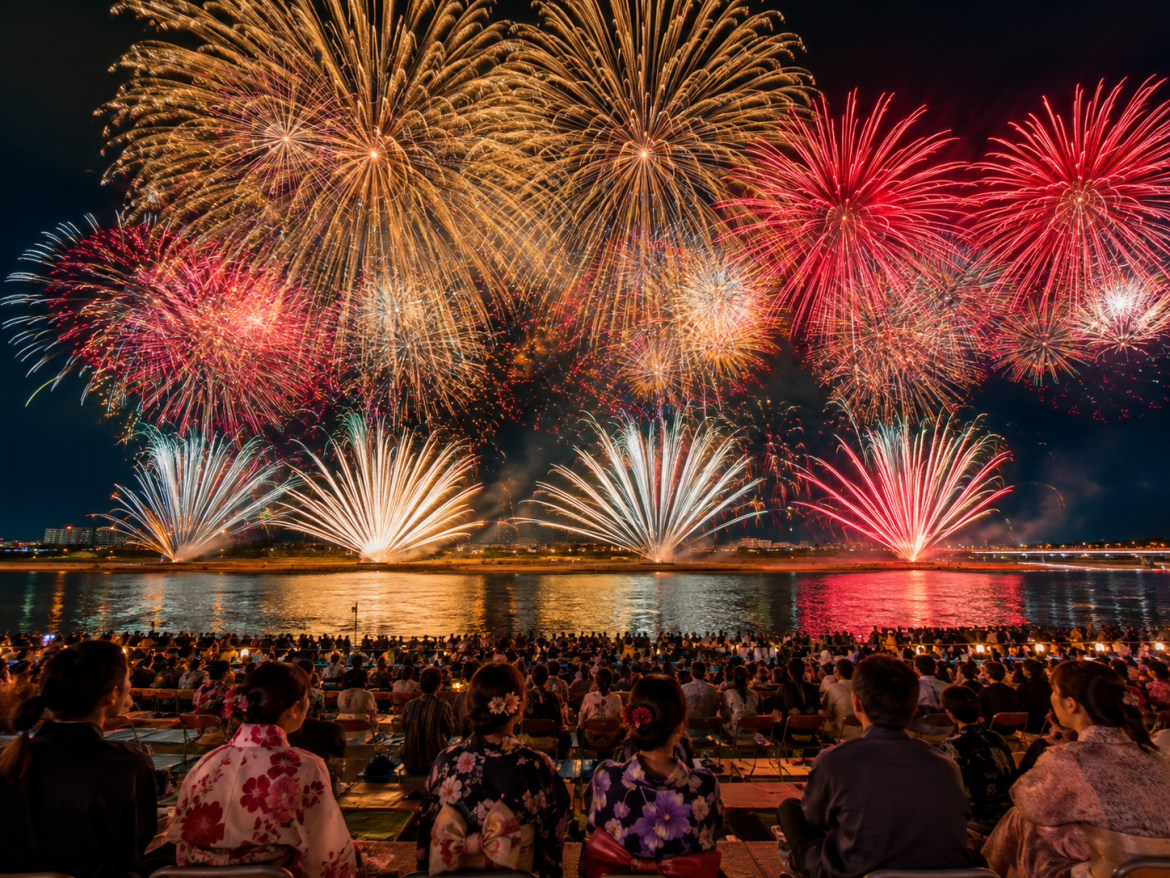
If you can attend only one major fireworks festival in Japan, the Nagaoka Fireworks Festival deserves to be near the top of the list. Its appeal is not simply the size of individual shells. The broad Shinano River launch area allows fireworks to stretch across an enormous section of the night sky, creating a sense of scale that is difficult to understand from photographs or online videos.
The signature Phoenix recovery fireworks, the giant Sanjakudama shells and the Kome Hyappyo sequence of 100 shakudama shells make Nagaoka one of the most distinctive summer events in Japan. Phoenix is particularly impressive because the display expands horizontally across the river rather than concentrating every launch at one point.
Nagaoka is also one of the Japanese fireworks festivals that requires the most advance planning. The difficult questions are usually not whether the fireworks are worth seeing, but how to obtain a legitimate viewing ticket, whether to choose A Venue or B Venue, where to stay when central Nagaoka is full and how to leave after hundreds of thousands of spectators begin moving at the same time.
For the completed 2026 event, official ticket allocations became difficult to obtain well before the festival. When direct official options are unavailable, a package that clearly includes both a viewing seat and transport may be more practical than attempting to assemble the trip independently. One example is the Tokyo Nagaoka Fireworks Full-Day Tour with Seating, which combines Tokyo transport with a reserved viewing arrangement.
The main recommendation for a first independent visit is straightforward: take JR to Nagaoka, prioritise A Venue on the station side of the river and stay overnight in Nagaoka or Niigata. If Phoenix is your main reason for attending, choose a seat downstream of Ote Bridge. If Sanjakudama is the priority, look toward the area upstream of Chosei Bridge.
Do not treat the event as an ordinary two-hour evening activity. Reserve the entire afternoon and night, minimise other sightseeing on the same day and make the return journey part of the plan before buying any non-refundable ticket.
Klook.com

Is the Nagaoka Fireworks Festival Worth Visiting?
| Planning question | Editor’s conclusion |
|---|---|
| Is it worth a dedicated trip? | Yes. It is especially worthwhile for travellers who value large-scale fireworks, music synchronisation, photography or Japanese summer-event atmosphere. |
| Annual dates | August 2 and August 3. |
| Fireworks start time | The official programme begins at approximately 19:20. |
| Time to reserve | Keep the full afternoon and evening free rather than planning only for the fireworks period. |
| Best venue for a first visit | A Venue is normally the most practical option for travellers arriving by JR or Shinkansen. |
| Best area for Phoenix | Downstream of Ote Bridge, including dedicated Phoenix seat categories. |
| Best area for Sanjakudama | Upstream of Chosei Bridge. |
| Free official seating | No. The latest official viewing venues operated as paid-ticket areas. |
| Same-day ticket sales | Do not expect same-day admission to be available. |
| Best suited to | Fireworks enthusiasts, couples, photographers, repeat Japan visitors and travellers who can plan well in advance. |
| Less suitable for | Travellers without tickets, visitors unable to walk for an extended period or anyone requiring an easy same-night return to Tokyo. |
| Rain policy | Light rain normally does not stop the display, but river conditions, high winds or severe weather can affect operations. |
| Overnight stay | Strongly recommended for families, older travellers and first-time visitors. |
The most important expectation to adjust is that Nagaoka is not a festival where you arrive shortly before sunset, watch from any available riverbank space and leave quickly. The normal walk from Nagaoka Station to A Venue is already around 30 minutes, and movement becomes much slower as crowds increase.
The most comfortable plan is to arrive in the early or mid-afternoon, store large luggage, eat a proper meal, purchase water and snacks and then walk toward the correct entrance before the busiest arrival period.
Editor’s practical advice: do not build the return journey around an ordinary Google Maps estimate. The unpredictable parts are the slow riverbank exit, controlled road crossings, queueing routes into Nagaoka Station and the availability of reserved train seats. Staying in Nagaoka or Niigata, using a late organised bus or joining a package with return transport is usually safer than depending entirely on the final Tokyo-bound train.
Nagaoka Fireworks Festival Essential Information
| Item | Details |
|---|---|
| Official Japanese name | 長岡まつり大花火大会 |
| English name | Nagaoka Fireworks Festival |
| Annual dates | August 2 and August 3 |
| Programme start | Approximately 19:20 |
| Venue | Shinano River riverbanks, Nagaoka, Niigata Prefecture |
| Main station | JR Nagaoka Station |
| Nagaoka Station to A Venue | Approximately 30 minutes on foot under normal conditions; longer during the festival |
| Admission | Valid paid viewing ticket required for the official venue |
| Recommended arrival | Mid-afternoon |
| Recommended time commitment | One full afternoon and evening |
| Official website | Nagaoka Fireworks official website |
The festival has a deeper meaning than a conventional entertainment-focused fireworks show. Nagaoka’s celebrations are connected to remembrance of the devastating air raid of August 1, 1945, post-war reconstruction and hopes for peace.
The Phoenix recovery fireworks later became associated with recovery following the 2004 Chuetsu earthquake. Understanding this background gives programmes such as Shiragiku and Phoenix greater emotional weight.
2026 Nagaoka Fireworks Tickets: How the Official System Works
Nagaoka Fireworks should not be approached as an event where arriving early allows you to claim an official free riverside position. The main viewing venues operate with paid admission, and visitors without valid tickets cannot use venue aisles or open spaces as unofficial viewing areas.
The 2026 general ticket allocation used an advance lottery. After the primary allocation sold out, the secondary lottery was not conducted because there was insufficient remaining inventory.
| Ticket stage | Typical timing | What international visitors should understand |
|---|---|---|
| Nagaoka resident presale | April | Separate application period intended for eligible local residents. |
| General primary lottery | Late May to early June | Main public application opportunity; highly competitive. |
| Secondary lottery | Late June when inventory remains | Not guaranteed to take place. |
| Official resale | Usually July | Eligibility and residence conditions may restrict international visitors. |
| Same-day sale | Not normally offered | Do not travel to the venue without confirmed admission. |
Important Official Lottery Rules
The general lottery is not first come, first served. Applications follow the official conditions for household limits, preferred dates and seat categories.
When a successful application is automatically charged to the registered credit card, cancelling after the application period may not be possible. Read the annual payment conditions before applying for several expensive seat categories.
Elementary-school-age visitors and older generally require their own ticket. Conditions for preschool children depend on whether the child occupies separate space, so families should check the exact seat rules before applying.
The organiser may also use registered ticket-holder information or identification checks. Do not buy a ticket from an unknown social-media account or unauthorised resale platform simply because official inventory has sold out.
What Can Overseas Visitors Do After Official Tickets Sell Out?
The most practical alternative is a legitimate package that explicitly states that a paid viewing seat is included. Do not assume that every product using the words “Nagaoka Fireworks” includes official admission.
The Nagaoka Fireworks Festival one-day and two-day tour offers several package types, including paid viewing seats and, on selected options, transport and accommodation.
Another option is the Nagaoka Fireworks Festival ticket and transportation package. Check the selectable package carefully because seat location, departure point, guide language and included services may differ.
Klook also lists a Nagaoka Fireworks transport, reserved-seat and yukata package. The unusual URL wording is generated by the booking platform, so use the product title and selectable options rather than judging the activity by the URL slug.
Nagaoka Fireworks Seat Guide: A Venue vs B Venue
Do not choose a riverbank only by asking which side provides the most impressive view. Start with the question: “How will I reach this seat and where do I need to go after the fireworks?”
A Venue is on the right bank of the Shinano River, on the JR Nagaoka Station side. B Venue is on the left bank, closer to the Nagaoka Interchange side.
Ote Bridge and Chosei Bridge are subject to event-related traffic and pedestrian controls. Buying a seat on the wrong side of the river is not something that can always be solved by casually walking across after the display.
| Comparison | A Venue | B Venue |
|---|---|---|
| Best suited to | JR and Shinkansen travellers | Tour buses, designated shuttles and drivers with confirmed parking |
| Access from Nagaoka Station | Approximately 30 minutes on foot under normal conditions | Longer and less convenient from the station |
| First independent visit | Usually the easiest option | Choose only when the transport arrangement clearly serves B Venue |
| Phoenix seat options | Several dedicated Phoenix categories | Possible views, but compare the exact package and seat location |
| Main disadvantage | Extremely heavy station-bound pedestrian traffic after the show | Difficult return to Nagaoka Station without arranged transport |
Travellers arriving independently by Shinkansen should normally prioritise A Venue. B Venue is more suitable when an organised tour, official shuttle or reserved parking arrangement handles the left-bank access.
Latest Reference Seat Prices
The following prices illustrate the positioning of recent official seat categories. Future prices may change, so use the new annual ticket page before applying.
| Seat category | Latest reference price | Best suited to |
|---|---|---|
| A Venue chair seat | ¥5,000 per person | First-time JR travellers wanting an assigned chair |
| A Venue Phoenix Area | ¥4,000 per person | Visitors placing Phoenix above every other programme |
| A Venue Phoenix chair | ¥5,000 per person | Couples and visitors wanting a chair near the Phoenix viewing zone |
| A Venue Phoenix table | ¥7,000 per person | Visitors wanting more space or wheelchair-compatible seating |
| A Venue Sanjakudama chair | ¥5,000 per person | Visitors prioritising giant Sanjakudama shells |
| A Venue camera area | ¥12,000 per space for up to two people | Serious tripod photographers |
| B Venue chair seat | ¥5,000 per person | Tour, shuttle or reserved-parking users |
| B Venue camera area | ¥12,000 per space for up to two people | Photographers choosing the left-bank angle |
A tour package may cost far more than the official seat price because it also includes transport, a guide, parking, hotel accommodation or an overnight return journey. Compare the included services rather than comparing only the headline prices.
Where Is the Best Place to Watch Phoenix?
The most central seat is not automatically the best seat for every Nagaoka programme. Phoenix, Sanjakudama and the main starmine displays use different parts of the launch area.
Phoenix is best viewed from the area downstream of Ote Bridge. The programme is built around an extremely wide horizontal formation rather than one single giant burst.
Being too close to one launch section may increase the sound and brightness but make the complete formation harder to see. This is particularly important for photographers using anything narrower than an ultra-wide lens.
| Main priority | Recommended area | Seat strategy |
|---|---|---|
| Phoenix recovery fireworks | Downstream of Ote Bridge | Prioritise Phoenix Area, Phoenix Chair or Phoenix Table categories |
| Sanjakudama | Upstream of Chosei Bridge | Choose a Sanjakudama-oriented seat |
| Central starmine programmes | Between Chosei Bridge and Ote Bridge | Best compromise for a balanced first visit |
| Full photographic composition | Official A or B camera area | Select according to lens, wind direction and intended subject |
There is no single seat that perfectly optimises Phoenix, Sanjakudama, the central programmes, photography, comfort and station access. Decide which element matters most before applying.
Three Nagaoka Fireworks Programmes You Should Not Miss
Phoenix Recovery Fireworks
Phoenix is the festival’s most recognisable programme and the main reason many international visitors travel specifically to Nagaoka.
Multiple launch points create a formation stretching across roughly two kilometres of the riverbank. When the gold fireworks expand in synchronisation with music, the human eye often needs to move from side to side to absorb the full display.
Phoenix has traditionally appeared later in the evening. Check the final programme and complete any toilet or food run well before its scheduled start.
Sanjakudama
Sanjakudama is about physical scale rather than density. The shell rises high above the river and opens into an enormous sphere that can dominate the visible sky.
From a sufficiently close seat, the low-frequency impact can be felt through the body. Visitors prioritising Sanjakudama should look toward the area upstream of Chosei Bridge, while accepting that this may not provide the widest Phoenix composition.
Kome Hyappyo and the 100-Shakudama Finale
The Kome Hyappyo sequence and 100 consecutive shakudama shells provide a strong conclusion to the evening. If transport arrangements allow, it is worth staying until the final programme rather than leaving automatically after Phoenix.
Leaving early may be necessary for visitors with a fixed train, children who are exhausted or travellers with limited mobility. For everyone else, the small amount of time saved may not justify missing the finale.
How to Get to Nagaoka Fireworks from Tokyo
The fastest independent route is the Joetsu Shinkansen from Tokyo or Ueno to JR Nagaoka Station. Direct services normally take approximately one hour and forty minutes, although the exact time varies by train.
The outward journey is straightforward. The return journey is the difficult part because the festival ends after 21:00, the walk back to the station becomes congested and popular reserved trains may sell out.
Travellers who prefer an English-language booking interface can compare Tokyo to Nagaoka Shinkansen tickets. Search the exact date and confirm whether the displayed service stops at Nagaoka.
Book an outward train that reaches Nagaoka by early or mid-afternoon. For the return, use the annual JR event timetable rather than an ordinary weekday schedule.
Tokyo Bus Tour Alternative
When independent tickets or return trains are difficult to secure, the Tokyo Nagaoka Fireworks Full-Day Group Tour can simplify transport and event access.
The advantage is that travellers do not need to fight for space on the Shinkansen after the display. The disadvantage is the duration: the itinerary can extend through the night, and traffic controls may delay the bus for several hours before it can leave the parking area.
A bus tour reduces planning difficulty but does not eliminate walking. Some packages require around 30 minutes of walking between the official bus parking area and the viewing section.
How to Get There from Niigata Station
Niigata Station is the most practical accommodation base when central Nagaoka hotels are unavailable. It has a much larger supply of hotels, restaurants and late-night services.
The Joetsu Shinkansen provides the fastest connection between Niigata and Nagaoka. Conventional JR services may also operate, but the Shinkansen is normally more useful on the festival date when time and crowd management matter.
The main advantage is that the post-event journey is much shorter than returning to Tokyo. The main disadvantage is that you still need to queue for Nagaoka Station and secure a suitable Niigata-bound train.
How to Get There from Niigata Airport
The practical public-transport route is:
- Take the airport bus from Niigata Airport to Niigata Station.
- Transfer to the Joetsu Shinkansen or another suitable JR service.
- Arrive at Nagaoka Station.
- Store large luggage before walking to the venue.
- Use the Oteguchi side and follow the official A Venue pedestrian signs.
Do not rely on an old page suggesting a convenient direct Nagaoka airport bus. Airport routes can be suspended or revised, so check the current Niigata Airport access page before travelling.
Nagaoka Station to the Fireworks Venue
JR Nagaoka Station to A Venue normally requires approximately 30 minutes on foot. During the festival, the journey can take longer because spectators are moving along the same controlled routes.
Use the Oteguchi side of Nagaoka Station and follow the official event signs. Do not choose an ordinary map route that conflicts with the annual pedestrian-control plan.
Taxis and local buses are not necessarily faster. Road restrictions and congestion may make walking more reliable, particularly during the afternoon arrival period.
After the display, taxis should not be treated as a primary exit strategy. Demand is extremely high and the vehicle may be trapped in the same road congestion as every other driver.
Is the JR East Pass Worth Buying?
The JR East Pass can make sense when the festival forms part of a wider regional itinerary involving Tokyo, Niigata, Echigo-Yuzawa, Nagano, Sendai or other covered destinations.
It is not automatically good value for one Tokyo–Nagaoka return trip. Calculate the total cost of all long-distance journeys before purchasing.
| Itinerary | Recommendation |
|---|---|
| Tokyo to Nagaoka and back only | Compare individual Shinkansen tickets first. |
| Tokyo, Nagaoka, Niigata and another long-distance destination | The JR East Pass may provide better value. |
| Tokyo city sightseeing plus Nagaoka only | A regional pass may still cost more than the tickets used. |
| Flexible Niigata or Echigo-Yuzawa accommodation | A pass can make itinerary changes easier. |
| Festival-night reserved seating | A pass does not guarantee that a popular train has available reserved seats. |
Even when the pass covers the route, reserve any necessary train seat as early as possible. Fare coverage and seat availability are separate issues.
Should You Drive to the Nagaoka Fireworks Festival?
Driving is not recommended as the easiest option for a first visit. Festival traffic is much more severe than ordinary weekend congestion.
The official organiser has recorded a case in which a 4.4-kilometre road section that normally takes around seven minutes required more than three hours after the display. One traffic light can create an exceptionally long queue.
Official temporary parking is not a casual arrive-and-pay system. Some facilities require an advance reservation connected to a valid viewing ticket and use a designated shuttle or park-and-ride arrangement.
Before driving, confirm:
- Your exact viewing venue
- The correct official parking area for that venue
- Whether a parking reservation is required
- The shuttle operating times
- The annual traffic-restriction map
- Recommended alternative motorway interchanges
- How long you may need to wait before the roads begin moving
Do not drive toward the Nagaoka Interchange after the display simply because it is the closest interchange on the map. A longer route to another interchange may be significantly faster.
Nagaoka Fireworks Crowd Dispersal: The Hardest Part of the Trip
The programme ending does not mean that you will be standing on the Nagaoka Station platform 30 minutes later.
The return requires:
- Leaving the assigned viewing section
- Joining the controlled riverbank pedestrian flow
- Walking approximately 30 minutes or more
- Waiting at controlled road crossings
- Entering the station through the designated queue
- Reaching the correct platform
| Return plan | Advantage | Main disadvantage | Best suited to |
|---|---|---|---|
| Stay near Nagaoka Station | No second train journey after reaching the city centre | Hotels sell out extremely early | Families, older travellers and first-time visitors |
| Stay near Niigata Station | Larger hotel supply and a shorter journey than Tokyo | Still requires entering crowded Nagaoka Station | Most independent international visitors |
| Stay in Echigo-Yuzawa | Combines fireworks with an onsen stay | Depends on a suitable late Shinkansen | Couples and two-day itineraries |
| Use a late highway bus | Can leave after the first wave of crowds | Requires a confirmed late-night waiting and boarding plan | Experienced travellers with sufficient stamina |
| Join a Tokyo bus tour | Transport and meeting instructions are integrated | Return may be during the early morning | Visitors without suitable train or hotel arrangements |
Do not base the strategy on running toward the station after the final shell. Dense crowds, dark paths and controlled crossings make rushing unsafe and often ineffective.
Prepare Before the Final Programmes
- Use the toilet before the final part of the programme.
- Save offline screenshots of tickets, hotel details and meeting points.
- Agree on a physical meeting place in case the group becomes separated.
- Carry a small torch or keep a phone light accessible.
- Do not leave large luggage at a distant collection point.
- Know which programme you are willing to miss when a fixed connection is essential.
What Time Should You Arrive?
For a first visit, arrive in Nagaoka during the early afternoon. The benefit is not securing a better assigned seat. It is avoiding the worst arrival congestion and giving yourself enough time to eat, buy supplies, locate the entrance and use the toilet.
| Time | Recommended plan |
|---|---|
| 13:00–14:00 | Arrive in Nagaoka, store large luggage and eat lunch. |
| 14:00–15:30 | Explore Nagaoka Station, Otedori or Aore Nagaoka. |
| 15:30–16:30 | Buy water, food, rain protection and final supplies. |
| 16:30–17:30 | Walk toward the correct venue entrance. |
| 17:30–19:00 | Locate the seat, eat and use the toilet. |
| Approximately 19:20 | Fireworks programme begins. |
| Later evening | Phoenix, Sanjakudama and the main finale programmes. |
| After the finale | Follow official crowd routes rather than an ordinary map shortcut. |
Independent Day Trip or Organised Tour?
| Option | What it solves | Main limitation | Best suited to |
|---|---|---|---|
| Independent Shinkansen trip | Maximum flexibility and direct access to A Venue | You must obtain a seat, hotel and return train separately | Experienced Japan travellers |
| Tokyo full-day tour with seating | Combines transport and viewing admission | Very long itinerary and limited flexibility | First-time visitors who cannot obtain official tickets |
| One-day package meeting at Nagaoka | Provides admission while allowing independent rail travel | You still manage the return train and hotel | Visitors who can reach Nagaoka but need a seat |
| Two-day tour | Combines ticket, transport and accommodation | Higher price and a fixed second-day itinerary | Families and visitors wanting the least stressful arrangement |
| Transfer-only tour | Provides transport | May not include official reserved seating | Only travellers who already understand the viewing arrangement |
A package should clearly state whether it includes:
- An official paid viewing seat
- A Venue or B Venue
- A chair, cushion, sheet or group area
- Round-trip transport
- Hotel accommodation
- Meals
- A tour guide
- A return time or estimated arrival window
Do not use the activity title alone. Open the selectable package and read the inclusions.
Recommended Nagaoka Fireworks Itineraries
Standard Independent One-Day Plan
This route works best for travellers staying in Nagaoka or Niigata.
| Time | Plan |
|---|---|
| Morning | Travel from Tokyo, Niigata or Echigo-Yuzawa without adding a distant attraction. |
| 13:00–14:00 | Arrive at Nagaoka and store luggage. |
| 14:00–15:00 | Eat a proper lunch near the station. |
| 15:00–16:30 | Buy water, snacks and rain protection. |
| 16:30–17:30 | Walk to A Venue and locate the seat. |
| 17:30–19:00 | Rest and use the toilet before the queue peaks. |
| 19:20 onward | Watch the complete fireworks programme. |
| After the show | Walk to the prearranged hotel or confirmed train. |
Two-Day Nagaoka and Niigata Plan
Day one: Reach Nagaoka around midday, eat in the city centre, attend the fireworks and stay in Nagaoka or Niigata.
Day two: Sleep later, explore central Niigata, eat seafood around the Bandai area or continue to another Niigata destination.
This is the best general arrangement for families and first-time visitors because it removes the pressure of reaching Tokyo immediately after the display.
Two-Day Fireworks and Onsen Plan
Use Echigo-Yuzawa as a hot-spring base and combine the fireworks with an onsen stay. This option is attractive for couples but depends on the actual event-night Shinkansen timetable.
Organised Two-Day Tour
Travellers who prefer to combine Nagaoka with another regional destination can compare the Nagaoka Fireworks and Togakushi Shrine two-day tour.
This type of itinerary can solve the hotel problem, but it is less flexible than staying independently in Niigata. Check the overnight property, room conditions, meal inclusion and second-day walking requirements.
Nagaoka Fireworks Photography and Tripod Rules
Nagaoka is an outstanding photography event, but owning a tripod does not give a visitor permission to move outside the assigned area.
In a general viewing seat, the tripod must remain within the ticket holder’s own space and must not obstruct the view of spectators behind. Do not set up in a walkway, staircase or unoccupied area.
When photography is the main purpose of the trip, an official camera area is the most responsible choice.
| Photography subject | Recommended approach | Main issue |
|---|---|---|
| Full Phoenix formation | Use a wide or ultra-wide lens from an appropriate downstream position | Being too close may prevent the entire formation fitting in the frame |
| Sanjakudama | Allow significant vertical space above the launch point | The shell may open beyond the top of the composition |
| Complete programme | Reserve an A Venue or B Venue camera area | General seats have limited tripod space |
| Phone photography | Reduce exposure and keep the phone near your own line of sight | Holding a phone high obstructs other spectators |
Wind direction also affects photography. Smoke can drift toward an otherwise excellent seat and obscure part of the display, so no position guarantees perfect photographs every year.
Rain, Postponement and Cancellation
Light rain does not normally cancel the Nagaoka Fireworks Festival. Do not abandon the trip solely because the forecast shows intermittent rain.
The event may be postponed or cancelled when flooding, high river levels, strong winds, a typhoon or another safety issue makes launching unsafe.
Operational decisions and refund arrangements can change each year. Check the official announcement, the tour operator’s cancellation policy and the terms attached to the exact viewing ticket.
A lightweight raincoat is more useful than an umbrella while seated. An open umbrella can obstruct the view of spectators behind and may be restricted by an organised tour.
Useful Wet-Weather Items
- Compact raincoat or poncho
- Waterproof phone pouch
- Quick-drying clothing
- Shoes suitable for wet soil and gravel
- Small towel
- Plastic bag for wet items
- Ground cover only when appropriate for the seat category
Is Nagaoka Fireworks Suitable for Families?
Families can attend, but the festival should not be treated as an easy child-friendly evening activity.
The main difficulties are:
- Hot afternoon weather
- A long walk from the station
- Very large crowds
- Toilet queues
- The loud sound of giant shells
- A late finish
- A slow return journey
Families should prioritise assigned chair or table seating, child-appropriate hearing protection and accommodation in Nagaoka or Niigata.
A stroller may be useful earlier in the day but difficult on crowded grass, gravel and sloping riverbank surfaces. Do not assume that every pedestrian route will be easy to manoeuvre.
Is It Suitable for Older Travellers?
Older travellers who can comfortably walk for at least 30 minutes may still enjoy the event, but the seat and hotel decisions become more important.
Prioritise:
- A Venue rather than a complicated cross-river route
- A chair or table seat
- Nearby toilets
- Accommodation in Nagaoka or Niigata
- An early arrival
- A plan that does not depend on sprinting for a train
Leaving before the final programme can be sensible when mobility or fatigue is a concern. Make the decision deliberately rather than waiting until the crowd begins moving.
Wheelchair Access and Limited Mobility
Recent editions have offered dedicated wheelchair and disability seating, along with some chair and table categories that can accommodate wheelchair users.
Not every wheelchair-compatible seat includes accessible parking. Before applying, confirm:
- Whether parking is included
- How many companions may enter
- Whether documentation is required
- The surface between the entrance and the seat
- The distance from the accessible drop-off point
- The nearest accessible toilet
- Whether assistance is required
The main fireworks remain visible without moving around the entire venue, so the experience can still be worthwhile when the correct seat and transport arrangement are secured.
Nearby Attractions to Combine with Nagaoka Fireworks
Do not fill the festival day with distant Niigata attractions. The safest combinations are close to Nagaoka Station or on the same side of the river as the viewing seat.
| Attraction | Why it works | Best timing |
|---|---|---|
| Aore Nagaoka | Close to Nagaoka Station and useful for a short arrival-day visit | 30–60 minutes after arrival |
| Nagaoka Station and Otedori | Best area for lunch, supplies and city-centre atmosphere | Early to mid-afternoon |
| Kawai Tsuginosuke Memorial Museum | Useful for travellers interested in local history | Earlier in the day |
| Yamamoto Isoroku Memorial Museum | Another central option for history-focused visitors | Do not schedule close to venue-entry time |
| Nagaoka Fireworks Museum | Explains the city’s relationship with fireworks | Previous day, following day or a B Venue driving itinerary |
| Echigo Hillside Park | Useful for a wider self-drive itinerary | Separate day rather than immediately before the fireworks |
Do not attempt a rushed Kiyotsu Gorge or distant mountain excursion on the same afternoon. A delayed bus or train could cause you to miss the event entrance period.
Food, Drinks and Supplies
Nagaoka Station and Otedori are the most practical areas for food and supplies before entering A Venue.
Eat a full lunch and buy a simple evening meal before walking to the river. Festival stalls contribute to the atmosphere but should not be your only food plan.
Regional dishes to look for include:
- Nagaoka ginger-shoyu ramen
- Tochio aburaage
- Niigata rice
- Seafood from the Sea of Japan
- Local sake
- Niigata rice crackers
Do not spend so long queueing for a famous restaurant that you reach the venue during the busiest arrival period.
Where to Stay for Nagaoka Fireworks
Central Nagaoka is the most convenient answer and the hardest one to book. Rooms can become unavailable extremely early, and some properties may introduce special festival-night conditions.
| Accommodation base | Best suited to | Main advantage | Main limitation |
|---|---|---|---|
| Nagaoka Station | Families, older travellers and first-time visitors | No second train journey after reaching the city centre | Very limited availability |
| Niigata Station | Most independent visitors | Larger hotel and restaurant supply | Still requires a post-event train |
| Echigo-Yuzawa | Couples and onsen itineraries | Combines fireworks with a hot-spring trip | Depends on a suitable late train |
| Tokyo or Ueno | Visitors unwilling to change hotels | Largest accommodation supply | Most stressful same-night return |
| Organised two-day package | Travellers wanting transport, admission and hotel in one booking | Solves several difficult reservations | Fixed itinerary and higher price |
First Choice: Nagaoka Station
If you find a reasonably priced cancellable room near Nagaoka Station, reserving it early is normally worthwhile. After the fireworks, you need only complete the walk back to the city centre.
Best Alternative: Niigata Station
Niigata Station is the strongest backup. It offers more hotels, restaurants and onward transport than a smaller station chosen solely because it appears close on the railway map.
Most Atmospheric Alternative: Echigo-Yuzawa
Echigo-Yuzawa creates a more enjoyable two-day trip for couples. Confirm the event-night railway schedule before booking a non-refundable onsen property.
Organised Accommodation Package
The two-day Klook options are useful when Nagaoka hotels are unavailable and the traveller does not want to arrange a late train independently. Some packages combine guaranteed viewing seats, transport, a hotel and a second-day stop such as Karuizawa.
Do Not Plan the Trip This Way
Do Not Travel Without a Ticket
The official venue is not a free riverside space. Do not expect to enter an aisle, empty section or access path without valid admission.
Do Not Choose B Venue When You Depend on Nagaoka Station
B Venue can work well for an organised bus or reserved parking arrangement, but it is not the easiest choice for an independent JR visitor.
Do Not Expect One Seat to Be Best for Every Programme
Phoenix, Sanjakudama and the central programmes favour different parts of the river.
Do Not Underestimate the Return Journey
A scheduled finish after 21:00 does not mean you can reach a train platform 30 minutes later.
Do Not Buy a Rail Pass Without Calculating the Whole Itinerary
A JR East Pass is useful for multiple long-distance journeys, not automatically for one return trip.
Do Not Bring a Large Suitcase to the Riverbank
Grass, soil, gravel, crowded paths and compact seating make large luggage impractical.
Do Not Drive Without Reserved Parking
Temporary car parks, shuttle systems and venue sides require advance coordination.
Do Not Leave Toilet Planning Until Phoenix
Even hundreds of temporary toilets cannot prevent queues immediately before the most popular programme.
Do Not Use a Tripod Outside Your Seat
Do not move into aisles, stairways or someone else’s area to obtain a better photograph.
Do Not Assume Every Tour Includes an Official Seat
A transfer-only product is not equivalent to a package containing recognised paid viewing admission.
Nagaoka Fireworks Klook Tickets, Tours and Transport
Tokyo Nagaoka Fireworks Full-Day Tour with Seating
The Tokyo Nagaoka Fireworks Full-Day Tour with Seating is one of the clearest solutions for travellers who cannot obtain an official ticket independently.
Its main value is that it combines a viewing arrangement with return transport. It is particularly suitable for visitors staying in Tokyo who do not want to depend on the crowded event-night Shinkansen.
The journey is still physically demanding. Expect a long day, walking between the bus parking area and the venue and a late or early-morning return to Tokyo.
Nagaoka Fireworks One-Day and Two-Day Tour
The Nagaoka Fireworks one-day and two-day tour is more flexible because selected packages can include a Nagaoka meeting option, Tokyo transport or overnight accommodation.
The two-day package is particularly useful when the traveller wants to solve the ticket, transport and hotel problems in one booking.
Nagaoka Fireworks Tickets and Transportation
The Nagaoka Fireworks tickets and transportation package targets travellers who need both admission and organised access.
Check which city the package departs from, whether the guide speaks English and which official viewing area is included.
Transport, Reserved Seating and Yukata Package
The Nagaoka Fireworks transport and yukata package adds a festival clothing experience to transport and reserved seating.
This is most useful for visitors who want the atmosphere of wearing a yukata but do not want to arrange rental, dressing and ticket collection separately.
Tokyo Nagaoka Full-Day Group Tour
The Tokyo Nagaoka full-day group tour is another option for visitors who prefer a guided Tokyo departure.
Traffic around the official bus parking area can delay the return substantially. Do not schedule a flight, morning tour or important appointment immediately after the expected Tokyo arrival.
JR East Pass
The JR East Pass is best for travellers combining Nagaoka with several other covered destinations.
It does not replace the festival ticket and does not solve station crowding, but it can make a multi-city rail itinerary easier to manage.
Nagaoka Fireworks Packing List
- Valid viewing ticket and booking confirmation
- Phone and power bank
- Offline screenshots of hotel and transport details
- Raincoat
- Drinking water
- Simple food and snacks
- Hat and sun protection
- Small towel
- Insect repellent
- Wet wipes
- Small torch or headlamp
- Comfortable walking shoes
- Hearing protection for sound-sensitive children
- Seat cushion or ground protection when appropriate for the seat category
Do not delay toilet use simply because the organiser provides many temporary facilities. Arriving early and using the toilet before the busiest part of the programme can improve the entire evening.
Nagaoka Fireworks Festival FAQ
When is the Nagaoka Fireworks Festival held?
The festival is held on August 2 and August 3 every year rather than on a changing weekend.
What time do the fireworks begin?
The official programme normally begins at approximately 19:20. Check the final programme for the current edition.
Can I watch without a ticket?
Do not depend on that plan. The official viewing venues operate as paid-ticket areas, and venue aisles cannot be used as unofficial free viewing spaces.
Are tickets sold on the day?
Same-day official ticket sales should not be expected. Secure admission before travelling.
What should I do if official tickets have sold out?
Look for an authorised package that explicitly includes a paid viewing seat. Do not buy from an unknown social-media reseller.
Is A Venue or B Venue better?
A Venue is normally better for independent JR travellers. B Venue is more suitable for organised buses, shuttles or drivers with confirmed parking.
Where is the best place to watch Phoenix?
The recommended area is downstream of Ote Bridge, including the dedicated Phoenix seat categories.
Where is the best place to watch Sanjakudama?
The preferred area is upstream of Chosei Bridge.
How long does it take to walk from Nagaoka Station?
The normal walk to A Venue is around 30 minutes, but it can take longer in festival crowds.
Can I return to Tokyo after the fireworks?
It may be possible when a suitable train operates, but it should not be assumed. Account for the riverbank exit and station queue before booking.
Where should I stay if Nagaoka hotels are full?
Niigata Station is the most practical alternative. Echigo-Yuzawa is attractive for an onsen itinerary when the late train works.
Is the festival suitable for children?
Yes for families prepared for loud fireworks, heat, long walking and a late finish. Chair seating and nearby accommodation are strongly recommended.
Do children need tickets?
Elementary-school-age visitors and older generally need their own ticket. Check the current conditions for preschool children and separate seating space.
Is the festival suitable for older travellers?
It can be, provided the visitor can manage substantial walking and has a comfortable seat and realistic accommodation plan.
Are wheelchair viewing areas available?
Recent editions have offered dedicated wheelchair and disability seating. Application, companion and parking conditions vary by category.
Can I use a tripod?
Yes within your own assigned space and below a height that obstructs others. Serious photographers should apply for an official camera area.
Does the event continue in the rain?
Light rain normally does not stop the display. Severe weather, strong winds or unsafe river conditions may cause postponement or cancellation.
Should I bring an umbrella?
A raincoat is more practical because an open umbrella may obstruct the view of spectators behind.
Should I drive?
Only with a valid ticket, reserved parking and the latest traffic plan. Public transport is easier for most international visitors.
Is a bus tour better than travelling independently?
A tour is better when it includes an official seat and solves the return journey. Independent travel provides more flexibility when all reservations are already secured.
Does every Nagaoka tour include a viewing seat?
No. Check the exact package inclusions. Some products may provide transport without guaranteed official reserved seating.
Is a JR East Pass worth buying?
It is worthwhile only when the wider itinerary includes several covered long-distance journeys.
Can I bring large luggage?
It is better to store large luggage before walking to the riverbank. Suitcases are difficult to manage on gravel, grass and crowded paths.
How early should I arrive?
Arrive in Nagaoka during the early or mid-afternoon. This leaves enough time for lunch, supplies, walking and toilet queues.
Should I leave immediately after Phoenix?
Only when protecting a fixed connection or assisting a tired traveller is more important than seeing the remaining programmes.
Klook.com
Final Recommendation
The Nagaoka Fireworks Festival is worth a dedicated journey for travellers who want to experience Japanese fireworks at a scale that a conventional urban display cannot reproduce.
Phoenix is the defining highlight, but it should not be confused with Sanjakudama. Choose a downstream Phoenix area for the widest formation, an upstream Sanjakudama seat for the largest individual shells or a central area for a balanced first visit.
The strongest independent arrangement is the Joetsu Shinkansen to Nagaoka, an A Venue ticket, arrival during the afternoon and accommodation in Nagaoka or Niigata.
When official admission, hotels or return trains are no longer practical, an organised package can significantly improve the trip. The most useful products are those that explicitly combine a paid viewing seat with transport, rather than those that merely deliver visitors to the Nagaoka area.
The Tokyo Nagaoka Fireworks Full-Day Tour with Seating is particularly suitable for visitors staying in Tokyo, while the one-day and two-day Nagaoka Fireworks tour is better for travellers who want a choice between local assembly, Tokyo transport and accommodation.
Families, older travellers and visitors with limited mobility should spend more on the correct seat and accommodation rather than choosing the cheapest possible arrangement. A chair, the correct riverbank and a hotel that does not require an impossible late-night transfer can change the entire experience.
Once the ticket, venue side, return journey and hotel are secured, Nagaoka stops being an exhausting logistical challenge and becomes one of the most memorable summer nights available in Japan.