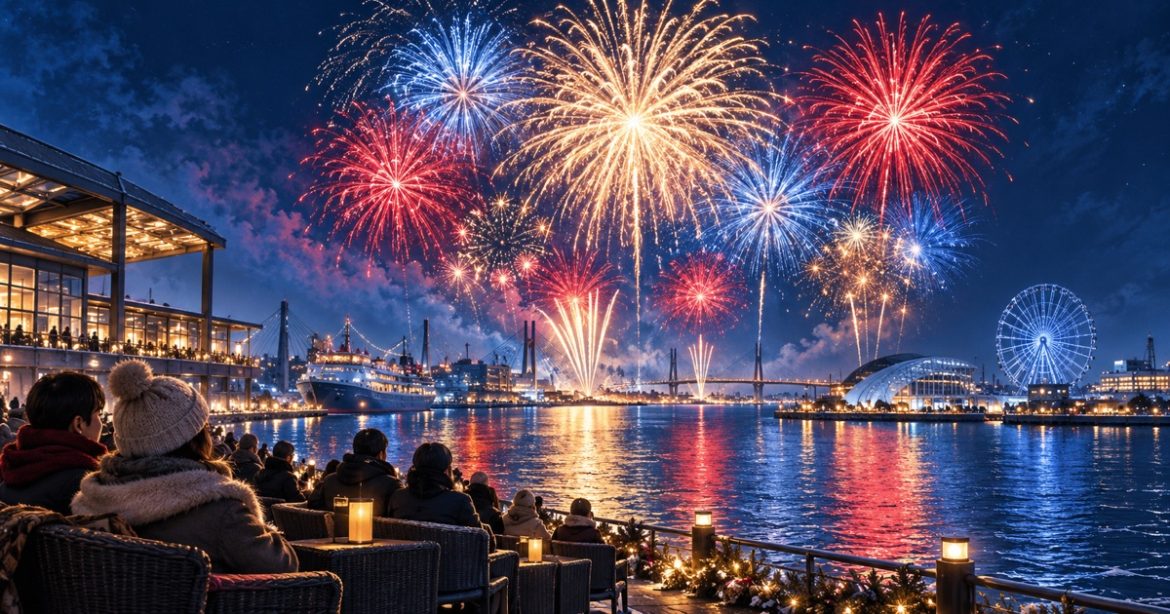
If your original plan was to head to Nagoya Port and find a free spot to watch fireworks, ISOGAI Fireworks Theater requires a different mindset. This is not a typical summer riverside fireworks festival. It is a winter theatrical production in which fireworks are synchronised with music, narration and an original story, and the official viewing venue consists entirely of paid individual sponsorship seats. You cannot enter the viewing area without an event ticket.
The 2026 event is scheduled for December 26 at Nagoya Port Garden Pier, with gates due to open at 17:00, the performance running from 18:30 to 19:15. Rain or snow does not normally stop the event; severe weather moves it to December 27. The main things to arrange in advance are therefore your seat, transport and cold-weather clothing.

ISOGAI Fireworks Theater 2026: quick verdict
| Planning point | What to know |
|---|---|
| Event date | December 26 2026 |
| Time | Gates 17:00; performance scheduled for 18:30–19:15 |
| Venue | Nagoya Port Garden Pier area |
| Free to attend? | No. The official venue consists entirely of paid individual sponsorship seats, and a ticket is required |
| Main attraction | “Dramatic Hanabi,” combining fireworks with music, narration and an original story |
| Easiest access | About a five-minute walk from Exit 3 of Nagoyako Station on the Meiko Subway Line |
| Driving | There is no dedicated event parking for fireworks spectators; public transport should be used |
| Rain or snow | Held in rain or snow; postponed to the following day in severe weather |
| Suggested arrival | For most travellers, aim to be around Nagoya Port at about 17:00 rather than leaving central Nagoya after 18:00 |
| Essential preparation | Event ticket, wind-resistant warm coat, gloves and scarf; if rain is forecast, bring rainwear rather than planning to use an umbrella while watching |
Best suited to: travellers who enjoy fireworks choreographed to music, couples planning a winter evening, photographers, anyone who has already experienced conventional summer fireworks festivals, or visitors who will already be in Nagoya in late December.
Less suitable for: anyone who simply wants to see a few fireworks from a free distant viewpoint, travellers uninterested in the music and storytelling element, or those with an extremely early and inflexible intercity departure the next morning. Much of the event’s appeal comes from experiencing the fireworks together with the venue sound and narrative, so seeing flashes in the sky from far away is not equivalent to attending the complete performance.
Event details: a 45-minute theatrical fireworks performance
| Event | BERITA presents ISOGAI Fireworks Theater in Nagoya Port |
|---|---|
| Date | December 26 2026 |
| Gates open | Scheduled for 17:00 |
| Performance | Scheduled for 18:30–19:15 |
| Venue | Nagoya Port Garden Pier area |
| Main fireworks producer | Isogai Fireworks of Okazaki, Aichi Prefecture |
| Format | A theatrical fireworks performance synchronising music, fireworks, narration and story |
| Rain | Held in rain or snow |
| Severe weather | Postponed to December 27; cancellation remains possible if severe weather continues the following day |
| Parking | No dedicated parking is provided for fireworks spectators |
One important difference with ISOGAI is that the organiser does not promote the event by its number of fireworks and has not published a total launch count. The central concept is the way Isogai Fireworks synchronises different fireworks with the pacing of music, narration and the story. It therefore makes little sense to judge this event by the “tens of thousands of fireworks equals a major show” standard often applied to summer festivals.
If this is your first visit to Nagoya Port, see our Nagoya Port Aquarium guide for an overview of the Garden Pier area. The aquarium, harbour attractions and fireworks venue are concentrated within the same waterfront district, making it easy to combine daytime sightseeing with the evening performance.
Which ISOGAI Fireworks ticket should you choose?
The official venue is divided between reserved seats in the pier block and the Observation C Area. The useful question is not simply which ticket costs the most, but what your group actually needs.
| Seat type | 2026 official price | Format | Best for |
|---|---|---|---|
| Pair Seat | ¥50,000 for two | Two-person reclining chair | Anniversaries, couples and travellers prioritising comfort |
| G Seat | ¥13,850 per person | Front row with a wider chair | Those prioritising front-facing impact and a front-row position |
| SS Seat | ¥9,680 per person | Chair seating in rows 2–3 | Travellers who want to sit close without paying for the highest-priced category |
| S Seat | ¥5,890 per person | Reserved chair seating from row 4 onward | First-time visitors, families and groups looking for a balanced option |
| Observation C Area | ¥5,890 per person | Grassy areas including sloped ground; choose your own position within the area; no chairs | Photography, travellers happy to sit on a ground mat and those valuing framing flexibility |
For a first visit: if your priority is simply to watch the complete performance comfortably, S seats are the easiest option to understand. You do not need a ground mat or have to manage sitting on grass, and you can experience the venue sound directly.
If you want to sit closer: the main value of SS and G seats is their location and additional space. That does not mean large aerial fireworks cannot be seen from farther back. With fireworks, being as close as possible is not automatically preferable for everyone; some viewers may prefer a slightly more distant position to take in the wider composition.
For photography: the biggest advantage of Observation C is that the official rules allow a tripod to be used while seated. Standing tripods, stepladders, platforms and personal chairs are not permitted. You are not assigned a physical chair; after entering according to your numbered admission order, you choose a position within the designated grassy area. Bring an appropriate ground mat and stronger cold-weather protection.
Tripods cannot be used in the Pair, G, SS or S seats in the pier block. Handheld equipment or monopods must be kept at a height that does not obstruct other spectators.
Do not judge ticket availability from an old article. Seat categories can sell out as sales progress, and seats exhausted during an advance-sales phase may not necessarily return for general sale. Check the live status on the official ticket page before buying.
How to reach Nagoya Port: Nagoyako Station is the key stop
The nearest station is Nagoyako Station on the Nagoya Municipal Subway Meiko Line. The organiser recommends Exit 3, from which Garden Pier is normally about a five-minute walk.
First-time visitors can easily confuse the Meiko Line with the loop-shaped Meijo Line on Nagoya subway maps. A simpler way to think about the journey is:
- Staying in Kanayama: take the Meiko Line directly towards Nagoyako. It is one of the simplest bases for this event.
- Staying in Sakae: use the Meijo/Meiko Line network towards the port and check the train’s destination before boarding.
- Staying around Nagoya Station: you need to transfer onto a route connecting with the Meiko Line; there is no direct JR train from Nagoya Station to the venue.
Travellers arriving through Chubu Centrair International Airport can also refer to our Chubu Airport to Nagoya transport guide. If the fireworks are a major part of your trip, Kanayama is particularly practical because it has Meitetsu connections towards the airport and direct Meiko Line access towards Nagoya Port.
What time should you arrive?
A reserved seat does not mean you should arrive at the last minute. The organiser specifically warns that crowds concentrate before the performance and that arriving too late can mean missing the 18:30 start.
A more practical plan is:
- Before 16:30: useful for families with young children, older travellers, first-time visitors to Nagoya Port, or anyone who wants time for toilets and locating the entrance.
- Around 17:00: the most comfortable target. Once the gates open, you still have roughly 90 minutes to find your seat, use the facilities and have something simple to eat.
- After 17:30: still possible, but congestion on transport and at the entrance becomes more of a concern.
- After 18:00: not a good normal arrival target. Queues on subway platforms, at station exits or on the entrance route could easily cause you to miss the start of a performance lasting only 45 minutes.
Observation C ticket holders with numbered admission should also watch for the detailed early-entry procedure to be announced by the organiser. The current plan is for admission to begin about 30 minutes earlier than general entry, but the exact entrance and procedure should be checked again before travelling.
Leaving after 19:15 is the real transport challenge
The performance is scheduled to finish at 19:15, but that does not mean you will be on a subway train by 19:20. A large number of spectators will move from Garden Pier towards Nagoyako Station at the same time, and Nagoyako is the terminus of the Meiko Line, so departing crowds become heavily concentrated.
Three approaches are more realistic:
- If you are not in a rush: follow staff directions and leave gradually, accepting that you may need to wait at the station entrance or on the platform.
- With children or older relatives: do not treat rushing to the station immediately as your only option. Use the toilet, adjust clothing and assess the crowd before leaving rather than forcing the whole family into the busiest flow.
- If travelling to another city that night: when returning to Osaka, Tokyo, Kyoto or elsewhere, allow substantial buffer time for queues at Nagoyako Station, the subway journey and walking through the large Nagoya Station complex. Do not book a Shinkansen connection that works only on paper under normal conditions.
If you are not leaving Nagoya until the following day, the post-event journey becomes much less stressful. For dinner ideas, see our Nagoya food guide. Returning to Kanayama, Sakae or Nagoya Station before eating will generally give you more options than searching around the port after the event.
Families, older travellers and accessibility
With young children
One preschool child may attend free with one accompanying adult if the child sits on the adult’s lap and does not use a separate seat. A ticket is required if the child needs their own seat. Families should remember that the 45-minute performance is only one part of the evening: there is also outdoor waiting time, and late December nights in Nagoya are cold.
For most families with young children, S or SS seats with physical chairs are simpler than Observation C. Although Observation C is priced similarly to an S seat, it requires sitting on grass and bringing a mat, while the cold ground and the need to repeatedly get up can make it more awkward in winter.
If you are spending the entire day around the port, visit Nagoya Port Aquarium during the day and move to the fireworks venue towards evening rather than waiting outside in the cold all afternoon.
With older travellers
Chair seating is again generally easier than the grassy Observation C Area. Arriving early also matters. The normal walk from Nagoyako Station to Garden Pier is short, but event-day crowds can reduce walking speed and toilet queues may take additional time.
Wheelchair users and travellers with limited mobility
The currently published ticket information does not provide complete details for 2026 wheelchair spaces, companion ticketing or designated entrances. Travellers requiring accessible viewing should therefore not rely on the general seating chart alone. Contact the organiser before purchasing to confirm the appropriate ticket category, entry procedure and arrangements for companions.
If you are travelling with children or older relatives, you can also browse our Nagoya family hotel guide. For a fireworks-focused itinerary, Kanayama or another well-connected central base can be more practical than saving money on accommodation that requires multiple daily transfers.
How cold is Nagoya Port in late December?
Japan Meteorological Agency 1991–2020 climate normals indicate that around December 26, Nagoya has a mean daily temperature of roughly 6°C, with an average daytime high around 10°C and average low around 2°C. These figures are not a forecast for the 2026 event day, but they make one point clear: this is no longer weather in which an ordinary light autumn jacket will necessarily feel comfortable while sitting outdoors.
The fireworks are also watched beside the harbour. Even when the measured air temperature is not exceptionally low, sitting still for an extended period and exposure to waterfront wind can make conditions feel significantly colder.
Useful items include:
- A thick coat or down jacket with good wind resistance;
- A warm base layer plus an insulating mid-layer that can be removed once you enter the subway or another indoor space;
- Gloves and a scarf;
- Thick socks and well-covered footwear;
- Disposable hand warmers as an extra layer of comfort, rather than your only cold-weather protection;
- For Observation C, a ground mat with meaningful insulation rather than an extremely thin sheet.
Rain and snow: the event still goes ahead
The official rule is that the event will proceed in ordinary rain or snow. Do not assume that a normal rain forecast means automatic cancellation.
During the performance, the organiser asks spectators to avoid umbrellas that obstruct the view of people behind them, so bring a raincoat or other waterproof clothing instead. Wet winter conditions can feel considerably harsher than dry cold, so water-resistant footwear and outer layers are also useful.
The organiser normally announces whether the event will proceed around noon on the event day through its website and social channels. In genuinely severe weather, the performance is postponed to December 27.
What happens if the event moves to December 27?
For international visitors, the awkward part of a postponement is not simply “coming back tomorrow.” Hotels, Shinkansen tickets and flights are often already fixed.
Lowest-risk plan: stay in Nagoya on both the nights of December 26 and 27, and leave on December 28. This gives you a complete backup evening if the performance is postponed.
Manageable plan: remain in Nagoya on the night of December 27 but keep the daytime schedule flexible, using shopping or city sightseeing that can be moved around if necessary.
Highest-risk plan: leave Aichi on the morning of December 27, or travel to another city immediately after the December 26 fireworks. If the event is postponed, this effectively means giving up your chance to attend.
If Ghibli Park is also part of your trip, see our Ghibli Park guide. Attractions requiring date-specific reservations are poor choices for a December 27 weather backup; keep something more flexible in Nagoya itself for that day instead.
What should you do during the day?
Nagoya Port Aquarium + ISOGAI Fireworks
This is the most natural full-day combination. Reach Nagoya Port Aquarium in the morning or around midday, explore the main exhibits, then eat and rest before moving to the fireworks entrance.
The major advantage is that you do not need to travel back from Sakae or Nagoya Station during the pre-event rush. This is particularly convenient for families.
Atsuta or Kanayama + Nagoya Port
If you are staying in Kanayama or sightseeing around Atsuta in the morning, returning to Kanayama and then taking the Meiko Line to Nagoya Port is also straightforward. What is less sensible is planning a distant suburban attraction for the afternoon and assuming you will definitely make it back to the port before 17:30.
Avoid combining a full LEGOLAND day with the fireworks
LEGOLAND is within the broader Nagoya Port area, but Kinjofuto and Garden Pier are not neighbouring attractions that you can simply walk between. They also use different rail systems. For the layout and transport details, see our Nagoya to LEGOLAND transport guide.
With children, spending a full day at LEGOLAND and then rushing to Garden Pier in the evening adds considerable travel and energy costs. Pairing the aquarium with the fireworks is much simpler.
Eight common mistakes to avoid
- Assuming port fireworks must have a free official viewing area: the official event venue requires a ticket throughout.
- Comparing only the number of fireworks: ISOGAI does not publish a total launch count; the concept is based on synchronising fireworks with music, narration and story.
- Arriving at the last minute because you have a reserved seat: congestion around the station and entrance can still make you late.
- Treating Observation C like a normal seated section: it is a grassy area without chairs, and you need your own ground mat.
- Buying a standard seat for photography and then bringing a tripod: tripods are not permitted in the pier block.
- Bringing a large umbrella for rain: umbrellas should not be used during viewing when they obstruct spectators behind you; bring rainwear instead.
- Driving to the port and planning to find event parking: there is no dedicated fireworks-spectator parking.
- Planning a tight connection after the show: a 19:15 finish does not mean you will have left Nagoyako Station by 19:20.
Nagoya Port ISOGAI Fireworks Theater FAQ
Q: When is ISOGAI Fireworks Theater 2026?
A: The event is scheduled for December 26, with gates opening at 17:00, the performance starting at 18:30 and finishing at 19:15.
Q: Is ISOGAI Fireworks Theater free?
A: No. The official venue consists entirely of paid individual sponsorship seats, and you cannot enter the viewing area without an event ticket.
Q: Which seat is best for a first visit?
A: If you want the simplest and most comfortable way to watch the complete performance, start by comparing S seats. Consider SS or G if sitting closer matters more. Observation C is most relevant if photography is your priority and you are happy to sit on grass.
Q: What is the difference between Observation C and an S seat?
A: S is a reserved chair seat. Observation C gives you a choice of position within a designated grassy area, with no chair provided. You need a ground mat, but a tripod may be used while seated in accordance with the rules.
Q: Do children need tickets?
A: One preschool child may attend free with one accompanying adult if the child sits on the adult’s lap and does not occupy a separate seat. A ticket is required if the child needs their own seat.
Q: What is the nearest station?
A: Nagoyako Station on the Meiko Subway Line. The organiser recommends Exit 3, from which Garden Pier is normally about a five-minute walk.
Q: What time should I arrive at Nagoya Port?
A: If you are unfamiliar with the venue or travelling with children or older relatives, aim to reach the port at around 16:30–17:00. Even with a reserved seat, do not make 18:20 your normal arrival plan.
Q: Is the event cancelled if it rains?
A: Ordinary rain and snow do not cancel the event. Severe weather causes postponement to December 27.
Q: Can I use an umbrella while watching?
A: It is better not to. The organiser asks spectators to avoid umbrellas that block the view of people behind them, so bring rainwear instead.
Q: Can I drive to the event?
A: The organiser does not provide dedicated event parking for fireworks spectators and asks visitors to use public transport such as the subway.
Q: Is it easy to catch the subway after the fireworks?
A: The route itself is straightforward, but a large number of spectators head towards Nagoyako Station at the same time after the show. Allow time for queues and platform waiting, and do not calculate a Shinkansen connection using only normal off-event journey times.
Q: Is ISOGAI Fireworks Theater worth a special trip to Nagoya?
A: If you want a complete performance built around fireworks, music, narration and an original story, it offers something meaningfully different from a conventional summer fireworks festival and can justify reserving a winter evening in Nagoya. If your goal is simply to watch fireworks for free from a distance, it is not designed around that experience.
Final decision: are you willing to reserve an evening for the full show?
First visit and want the simplest plan: choose an S seat, arrive at about 17:00 and stay in Nagoya that night.
Couples or anniversary trips: if the budget allows, compare the front-row and pair-seat options, but check live official availability rather than relying on an older article.
Photography: start with Observation C, confirm the numbered-entry procedure for 2026, then bring an appropriate ground mat and full winter protection.
Families and older travellers: prioritise physical chair seating and consider spending the daytime at Nagoya Port Aquarium to avoid a cross-city rush in the early evening.
Inflexible itineraries: if you absolutely must leave Nagoya early on December 27, accept that severe-weather postponement could mean missing the event completely. If ISOGAI is one of the main reasons for your trip, keeping yourself in Nagoya through the evening of December 27 gives you the strongest backup.
ISOGAI Fireworks Theater is not an event that works especially well with a “we’ll figure it out on the day” approach. Tickets, late-December cold, the post-show crowd at Nagoyako Station and the possibility of a next-day postponement are all worth considering when you book accommodation and onward transport. Plan those details properly and this becomes more than a fireworks display you happen to see during a trip: it becomes a complete winter evening programme in Nagoya.