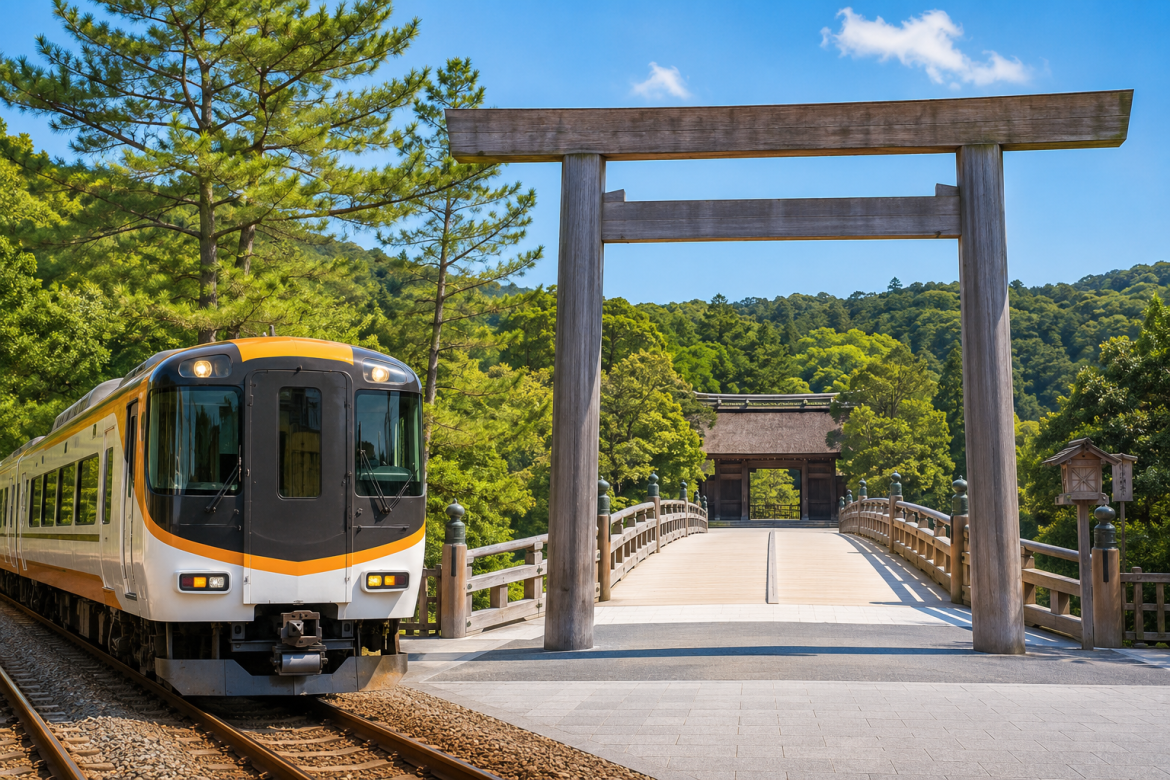

Nagoya to Ise Grand Shrine: start with Iseshi and the two shrine areas
Travelling from Nagoya to Ise Grand Shrine is straightforward once you understand one important detail: Ise Grand Shrine is not a single compact attraction beside one railway station.
The two principal sanctuaries, Geku and Naiku, are several kilometres apart. Geku, the Outer Shrine, is close to Iseshi Station, while Naiku, the Inner Shrine, is reached by local bus. Okage Yokocho and the historic Oharai-machi shopping street are beside Naiku rather than Geku.
For most first-time visitors, the easiest route is to take a Kintetsu Limited Express train from Kintetsu Nagoya Station to Iseshi Station, walk to Geku, take a bus from Geku-mae to Naiku-mae, visit Naiku, eat and shop around Okage Yokocho, and then return by bus to Iseshi or Ujiyamada Station.
The complete trip is possible as a day trip from Nagoya. However, it should be treated as a full-day excursion rather than a half-day add-on. Return rail travel takes close to three hours in total, while the shrines, local buses, walking routes and Okage Yokocho require another six to eight hours.
Since April 1, 2026, CAN Bus no longer serves Iseshi Station. Use the current route from Isuzugawa for Futami and Toba connections; regular shrine buses still connect Iseshi, Geku and Naiku. Check current Naiku-mae boarding signs when returning.
If you are building a longer Chubu itinerary, use the complete Nagoya travel guide to decide which day should be reserved for Ise. Staying near Nagoya Station makes the early departure significantly easier than travelling across the city from a distant hotel.
Nagoya to Ise Grand Shrine: Quick Recommendation
| Traveller | Best option | Why |
|---|---|---|
| First-time visitor | Kintetsu Limited Express to Iseshi | Direct, reserved seating and the easiest access to Geku |
| Budget traveller | Kintetsu Express | Lower fare without a Limited Express surcharge |
| Traveller staying beside JR Nagoya Station | JR Rapid Mie | Direct service from the JR side of Nagoya Station |
| Two adults using JR for a return trip | Compare the four-ticket Rapid Mie discount product | Four one-way tickets can cover two adults travelling both ways |
| Family with young children | Kintetsu Limited Express or organised bus tour | Reserved seating and fewer stressful transfers |
| Older visitors | Kintetsu Limited Express | A guaranteed seat is usually worth more than the lowest fare |
| Visitor adding Meoto Iwa | Organised day tour or carefully timed independent route | Local transport is less frequent than the Geku–Naiku bus |
| Visitor adding Toba Aquarium | Two-day itinerary or transport-efficient tour | The aquarium deserves at least three to four hours |
Bookable Klook Options at a Glance
The strongest booking option for independent travellers is the Kintetsu Nagoya to Iseshi Limited Express ticket. Select Kintetsu Nagoya and Iseshi for this route, and check whether the chosen package includes both the base fare and limited-express ticket.
Travellers who do not want to manage trains and local buses can compare the Nagoya Ise Grand Shrine and Meoto Iwa bus tour. Families may prefer the Ise Grand Shrine, Toba Aquarium and Meoto Iwa day tour.
| Klook product | Best for | Main limitation |
|---|---|---|
| Kintetsu Nagoya–Iseshi Limited Express ticket | Independent travellers wanting a direct reserved-seat train | Local Ise buses are handled separately |
| Ise Grand Shrine and Meoto Iwa bus tour | First-time visitors wanting Geku, Naiku and Meoto Iwa | Fixed departure and sightseeing times |
| Ise Grand Shrine and Toba Aquarium tour | Families and marine-life visitors | Less time for a deep shrine visit |
| Small-group Ise and Mikimoto Pearl Island tour | Small groups wanting more comfortable road transport | Some attraction admission may be separate depending on the package |
| Ise Grand Shrine cultural experience | Independent travellers wanting an English explanation | Meeting point is in Ise, not Nagoya |
Is a Day Trip from Nagoya to Ise Grand Shrine Worth It?
| Question | Practical answer |
|---|---|
| Is it worth visiting? | Yes for travellers interested in Japanese history, Shinto culture, traditional streets and regional food |
| Admission fee | Free for ordinary visits to Geku and Naiku |
| Recommended duration | One full day from Nagoya |
| Time in Ise | Approximately six to eight hours |
| Main highlight | The complete Geku–Naiku pilgrimage route rather than one individual building |
| Main difficulty | Coordinating two shrine areas, local buses, walking and shop closing times |
| Suitable for children | Yes, particularly school-age children; gravel paths are harder with a stroller |
| Suitable for older visitors | Yes, with reserved-seat trains, a reduced walking route and regular breaks |
| Overnight stay required | No for Geku, Naiku and Okage Yokocho; yes if adding Toba, Shima or an early-morning visit |
Ise is especially worthwhile for travellers who want to experience a quieter and more ceremonial side of Japan than the major sightseeing districts of Tokyo, Osaka or Kyoto. Much of the appeal comes from walking through forested grounds, crossing Uji Bridge and following a centuries-old order of worship.
It may be less rewarding for visitors expecting an ornate temple complex, a large museum or an attraction filled with entertainment. The principal sanctuary buildings are deliberately restrained, and photography is restricted near the innermost sacred areas.
If only one day is available, Ise Grand Shrine is worth prioritising over combining a rushed Ise morning with an afternoon of central Nagoya sightseeing. Trying to do both usually results in an unnecessarily early start and very little time at Okage Yokocho.
Current Access and Construction Updates
Locate the Current Naiku-mae Boarding Point
Use the current Mie Kotsu service notices and stop maps when leaving Naiku. Temporary roadworks can change boarding positions; follow the destination and bay signs on the day rather than an old saved photograph.
CAN Bus No Longer Serves Iseshi Station
From April 1 2026, CAN Bus services on the Ise side begin at Isuzugawa Station and no longer run through Iseshi Station.
This change matters mainly to travellers continuing towards Futami, Meoto Iwa and Toba. It does not prevent visitors from travelling between Geku and Naiku, because the regular Geku–Naiku and Ise city bus routes continue to serve the main shrine areas.
If an older itinerary tells you to leave Iseshi Station and board CAN Bus directly to Meoto Iwa, check the current timetable before following it.
Ise Grand Shrine Is Not Completely Closed
Preparatory events connected with the next Shikinen Sengu rebuilding cycle do not mean that the whole shrine is closed to ordinary visitors.
Individual paths may occasionally be restricted for ceremonies, maintenance or major events, but general visits to Geku and Naiku continue unless a specific official notice states otherwise.
Understand the Geography Before Booking a Train
| Place | Best station or bus stop | Final access |
|---|---|---|
| Geku, the Outer Shrine | Iseshi Station | Approximately five minutes on foot from the south or JR side |
| Geku alternative access | Ujiyamada Station | Approximately ten minutes on foot |
| Naiku, the Inner Shrine | Naiku-mae bus stop | A few minutes to Uji Bridge, then approximately 20 minutes to the main sanctuary |
| Okage Yokocho | Naiku-mae bus stop | Located along the Oharai-machi approach outside Naiku |
| Isuzugawa Station | Closest railway station to Naiku | Still approximately 25 to 35 minutes on foot, so a bus or taxi is usually better |
The customary sequence is Geku first and Naiku second, although the shrine does not make this a compulsory rule. Iseshi Station is therefore the most logical first station for a complete first visit.
Going directly to Isuzugawa Station can work for travellers who intentionally want to visit only Naiku and Okage Yokocho. It is not the best default route simply because the station appears closest on a map.
Nagoya to Ise Grand Shrine Transport Comparison
| Transport | Typical travel time | Typical one-way cost | Seat arrangement | Best for |
|---|---|---|---|---|
| Kintetsu Limited Express | Approximately 80 to 90 minutes | ¥3,080: ¥1,740 base fare + ¥1,340 standard limited-express charge | Reserved seats only | Most first-time visitors |
| Kintetsu Express | Approximately 100 to 120 minutes | ¥1,740 base fare to Iseshi | Non-reserved commuter-style seating | Budget travellers |
| JR Rapid Mie | Approximately 90 minutes | About ¥2,040 before optional seat charges | Non-reserved and limited reserved seating | JR-based travellers |
| Rental car | Approximately two hours in normal traffic | Rental, fuel, expressway and parking costs | Private vehicle | Travellers continuing to rural Mie or Shima |
| Organised day tour | Full-day itinerary | Varies by tour | Coach or small vehicle | Families, older visitors and multi-stop routes |
Travel times and fares depend on the exact train, date and seat type. Always check the live timetable rather than selecting a route based only on an old sample departure.
Option 1: Kintetsu Limited Express — Best for Most Visitors
Kintetsu Limited Express trains connect Kintetsu Nagoya Station with Iseshi, Ujiyamada, Toba and other Ise-Shima destinations. Many departures reach Iseshi without a transfer, although the exact stopping pattern varies.
Every seat on a Kintetsu Limited Express train is reserved. You need both the basic railway fare and a Limited Express ticket. Buying only one of these does not give you a valid complete journey.
For the Klook train product below, select the exact departure, arrival and seat option, and read its redemption conditions. A limited-express-only option still needs a separate base-fare ticket.
Why Kintetsu Limited Express Is Usually Best
- Many services are direct.
- A reserved seat is guaranteed.
- The train is more comfortable with children, older visitors or luggage.
- Iseshi Station provides the easiest start for Geku.
- Returning from either Iseshi or Ujiyamada can be convenient.
- Online seat booking reduces uncertainty on weekends and holidays.
What Can Go Wrong
- Travellers buy only the Limited Express supplement and forget the basic fare.
- Travellers tap an IC card for the basic fare but assume it also includes a reserved seat.
- Travellers book Isuzugawa because it appears closest to Naiku and accidentally skip Geku.
- Travellers choose a return train that leaves too soon after the shops at Okage Yokocho.
Iseshi Station or Ujiyamada Station?
For the standard Geku-first route, get off at Iseshi Station. Leave from the south or JR side and follow signs towards Geku.
Ujiyamada Station is also practical. It is around ten minutes on foot from Geku and has a distinctive historic station building. Some return services may be easier from Ujiyamada, especially if the bus from Naiku reaches it at a convenient time.
Shimakaze: choose it for the train experience
The sightseeing limited express Shimakaze also links Nagoya with Iseshi, Ujiyamada and Ise-Shima. It needs the base fare, a limited-express ticket and its special-car supplement; private compartments have a further room charge and group-size rules. A standard limited-express reservation is not a Shimakaze booking.
Check the Nagoya service calendar before arranging the day around it. Its usual non-running day is Thursday, subject to the published calendar. The fixed sightseeing departure is less flexible than the regular limited expresses for an early Geku visit. Treat it as part of the outing, especially on an overnight Ise-Shima trip, and secure seats before buying other time-dependent activities.
Option 2: Kintetsu Express — Cheapest Regular Train Option
Kintetsu Express trains use the same general railway network but do not require a Limited Express surcharge. This reduces the fare considerably.
The disadvantage is that these are not reserved-seat sightseeing trains. Services can be busy, seating is not guaranteed and some journeys require a transfer at Ise-Nakagawa.
Kintetsu Express is most suitable when:
- Your priority is the lowest practical rail fare.
- You are travelling with a small day bag.
- You are comfortable using ordinary Japanese commuter trains.
- You do not mind a journey that may take 20 to 40 minutes longer.
It is less suitable for older visitors, families with sleeping children, travellers carrying large luggage or anyone who strongly prefers a guaranteed seat.
A useful compromise is to take a cheaper Express train in the morning and reserve a Limited Express seat for the return journey, when you are more likely to be tired.
Option 3: JR Rapid Mie
JR Rapid Mie services run from JR Nagoya Station to Iseshi and Toba. The journey to Iseshi generally takes around 90 minutes and does not normally require a transfer.
This route is convenient for travellers whose hotel, Shinkansen arrival platform or existing rail itinerary is firmly based around JR Nagoya Station.
Does the Nationwide Japan Rail Pass Cover Rapid Mie?
Rapid Mie uses the privately operated Ise Railway between Kawarada and Tsu. A nationwide Japan Rail Pass does not automatically cover this private section.
Pass holders generally need to pay an additional fare for the Ise Railway segment. The Kawarada–Tsu ordinary fare is ¥520 each way; this private segment is additional when using the nationwide pass.
This means that “JR train” does not equal “fully covered by the JR Pass” on this route.
When JR Rapid Mie Makes Sense
- You are already at the JR side of Nagoya Station.
- You are connecting from a Shinkansen and do not want to locate Kintetsu.
- You are travelling with another adult and can use an applicable four-ticket discount product efficiently.
- You are continuing to Toba on the same railway route.
When It Does Not Make Sense
- You assume the nationwide JR Pass removes every additional payment.
- You want a guaranteed reserved seat without paying or booking separately.
- The Kintetsu timetable offers a substantially more convenient departure.
Two adults: compare the four-ticket product
JR Central’s Rapid Mie Tokudane four-ticket set costs ¥5,040 for Nagoya city–Iseshi: ¥1,260 per one-way coupon when all four are used. Two adults making a return journey can use one set, bringing each person’s rail return to ¥2,520. This can be cheaper than two ordinary Kintetsu express fares.
The coupons are valid for one month beginning on the purchase date and cover ordinary non-reserved seating; reserved seating requires the additional ticket. Intermediate exits end that coupon’s remaining journey. Buy the full set only if you can use all four: a solo traveler making one return does not receive the advertised per-coupon value in cash.
Which Rail Pass or Local Bus Ticket Should You Buy?
Kintetsu Rail Pass
Kintetsu Rail Pass products can be useful for broader itineraries covering combinations of Nagoya, Ise-Shima, Osaka, Kyoto and Nara.
However, the pass itself generally covers the basic Kintetsu fare rather than automatically including every Limited Express reservation. Travellers must check whether a separate Limited Express ticket is still required for the selected train.
For a simple Nagoya–Ise return trip, compare the total pass price plus supplements against two ordinary Kintetsu tickets before purchasing.
Ise Local Bus Day Pass
The ordinary adult fare from Geku-mae to Naiku-mae is currently ¥520. A second journey from Naiku back to Iseshi or Ujiyamada is also normally required.
If you use only these two bus journeys, paying individual fares may cost less than a sightseeing bus day pass.
A local bus pass becomes more useful when your itinerary includes additional rides to places such as Futami, Meoto Iwa or Toba.
Who Does Not Need a Pass?
- Travellers buying a direct Kintetsu ticket and taking only two local buses
- Visitors joining a bus tour from Nagoya
- Travellers taking taxis between shrine areas
- Visitors spending most of the day walking around one area
Ise Jingu pilgrimage digital ticket: a different product from the Rail Pass
The Tokai-origin pilgrimage digital ticket costs ¥6,700 adult or ¥3,300 child. It combines a return limited-express journey with three-day travel in the specified Ise-Shima rail and Ise/Futami/Asama bus areas. Buy before the travel day: same-day purchase is not allowed. Complete the included limited-express seat-exchange process.
A Nagoya–Iseshi standard limited-express return is ¥6,160. Add two ¥520 shrine-area bus rides and the example total is ¥7,200, so this particular itinerary saves ¥500 with the digital package. An ordinary-express or discounted JR itinerary produces a different comparison. The bus entitlement does not cover all the way to Toba on CAN Bus, and premium trains still need the relevant supplements.
The three-day label does not permit repeated returns to Nagoya: using the return ticket and exiting at the permitted home-area station ends the digital ticket, including unused benefits. Its Meitetsu connecting gate at Nagoya is not supported; follow the specified digital-ticket gate instructions.
Kintetsu Rail Pass 5day and 5day plus
The 5day pass costs ¥4,900 adult and covers the specified Kintetsu/Iga railway network. The 5day plus costs ¥6,700 and adds designated bus coverage. Both need separate limited-express tickets. They are visitor products with purchase/eligibility conditions, and neither should be confused with the pilgrimage ticket just because one price is identical.
A basic Nagoya–Iseshi return is only ¥3,480. The ¥4,900 rail pass therefore needs additional useful travel, such as continuing to Osaka, Kyoto or Nara, to justify its price. Do not count journeys you would not otherwise make as savings.
Ise-Kumano-Wakayama Area Tourist Pass
This five-day regional pass costs ¥16,500 adult and is designed for a broader trip through the Kii Peninsula. Its defined coverage includes the Ise Railway segment used by Rapid Mie, unlike the nationwide Japan Rail Pass. It can be useful for Kumano, Shingu, Kii-Katsuura, Shirahama or Wakayama, but is excessive for a standalone Ise day trip. Check visitor eligibility, covered bus routes and reserved-seat allowances.
Local Michikusa bus tickets
Mie Kotsu’s Ise-Toba Michikusa ticket is ¥1,300 adult/¥650 child for one day or ¥1,900/¥950 for two days. Two ¥520 shrine rides total ¥1,040, below the adult one-day fare. More travel towards Futami or Toba can change the calculation; check the current coverage map and any attraction benefit you will actually use.
A Traditional First-Time Visiting Order
Step 1: Arrive at Iseshi Station
After arriving, follow signs towards the south or JR side and Geku. Iseshi is shared by JR and Kintetsu, so do not assume every exit leads directly to the shrine.
The walk from the appropriate side of the station to Geku takes approximately five minutes.
Step 2: Visit Geku
Allow 40 to 60 minutes for a first visit. The main sanctuary can be reached more quickly, but additional time is needed for the approach, secondary sanctuaries and quiet forest paths.
Geku is associated with Toyouke Omikami, the deity responsible for food, clothing and shelter and for providing sacred food to Amaterasu Omikami.
Step 3: Take the Bus from Geku-mae to Naiku-mae
Return to the Geku-mae bus area and board a service for Naiku-mae. The ride generally takes around 15 to 20 minutes, although congestion can increase travel time.
The current ordinary adult fare is ¥520. Weekends, public holidays and major shrine dates may produce queues, so allow extra time instead of planning a connection to the minute.
Step 4: Cross Uji Bridge and Visit Naiku
Naiku begins at Uji Bridge. Crossing the bridge places visitors inside the sacred forested grounds, but the principal sanctuary is still approximately 20 minutes away on foot.
The route includes gravel, broad paths and some stone steps. Allow 60 to 90 minutes for a comfortable first visit.
Step 5: Visit Oharai-machi and Okage Yokocho
After completing the shrine visit, walk through Oharai-machi and Okage Yokocho for lunch, snacks and local shopping.
This order is better than shopping first because it avoids carrying food and purchases through the shrine. It also preserves the traditional Geku–Naiku sequence.
Step 6: Return to Iseshi or Ujiyamada Station
Take a local bus from Naiku-mae towards Iseshi Station or Ujiyamada Station. Follow current destination and boarding-bay signs at Naiku-mae.
Compare both stations when choosing a return train. Ujiyamada may provide a convenient departure, while Iseshi is simpler if your ticket is already booked from that station.
Ise Grand Shrine Basic Information
| Information | Geku | Naiku |
|---|---|---|
| Formal name | Toyouke Daijingu | Kotai Jingu |
| Address | 279 Toyokawa-cho, Ise, Mie | 1 Ujitachi-cho, Ise, Mie |
| Admission | Free | Free |
| Ordinary reservation | Not required | Not required |
| January–April | 5:00–18:00 | 5:00–18:00 |
| May–August | 5:00–19:00 | 5:00–19:00 |
| September | 5:00–18:00 | 5:00–18:00 |
| October–December | 5:00–17:00 | 5:00–17:00 |
| Nearest practical access | Iseshi Station | Naiku-mae bus stop |
| Entrance to principal sanctuary | Approximately ten minutes | Approximately 20 minutes |
Special New Year arrangements, major ceremonies and temporary restrictions can change normal visiting access. Arriving before the final visiting time does not mean there will be enough time to walk to the principal sanctuary and return.
Best Time to Visit
| Time | Conditions | Recommendation |
|---|---|---|
| 5:00–8:00 | Quietest shrine atmosphere; most shops are closed | Best for overnight visitors staying in Ise |
| 9:00–10:30 | Day-trippers begin arriving but crowds are manageable | Best period for most Nagoya day trips |
| 11:00–14:00 | Peak group-tour and lunch period | Expect queues at buses and restaurants |
| 14:00–16:00 | Some tour groups begin leaving | Good for shopping, but watch winter closing times |
| Near closing time | Quieter shrine grounds but shops may already be closed | Not recommended for a first complete visit |
A practical Nagoya day trip should aim to reach Iseshi at approximately 9:00. This provides enough time for Geku before the midday crowds become strongest at Naiku and Okage Yokocho.
Early-morning Naiku visits are especially atmospheric, but the first trains from Nagoya are usually too late for the quietest period. Stay in Ise if sunrise, winter light or an almost empty Uji Bridge is a priority.
Walking Distance and Physical Difficulty
Ise Grand Shrine is not a mountain hike, but the day involves more walking than many first-time visitors expect.
- Iseshi Station to Geku: approximately five minutes
- Geku entrance to the principal sanctuary: approximately ten minutes
- Naiku-mae bus stop to Uji Bridge: a few minutes
- Uji Bridge to the principal sanctuary: approximately 20 minutes
- Oharai-machi: approximately 800 metres
A complete visit can involve several hours of walking and standing once secondary shrines, food stops and bus queues are included.
Many shrine paths are gravel rather than smooth pavement. This creates additional resistance for strollers, manual wheelchairs and rolling luggage. Rain can also produce puddles and slippery stone surfaces.
There are stone steps close to the principal sanctuaries. Travellers with limited mobility may need to stop at an accessible point rather than follow every visitor to the final level.
Visiting with Children
Ise Grand Shrine works best for school-age children who can walk for sustained periods and understand that the grounds are places of worship rather than a theme park.
Babies and toddlers can visit, but parents should expect:
- Gravel paths that make strollers harder to push
- Stone steps near important sanctuary areas
- Long gaps between convenient rest stops
- Busy buses during weekends
- Restaurant queues at lunchtime
Bring a baby carrier even when using a stroller. Do not combine a complete Geku–Naiku route with several additional attractions unless the child is comfortable with long travel days.
Families planning more time in Aichi can use the Nagoya family attractions guide to separate active sightseeing days from the quieter cultural visit to Ise.
Visiting with Older Travellers
Older visitors can enjoy Ise Grand Shrine, but the route should be planned around comfort rather than the maximum number of sights.
The most helpful adjustments are:
- Reserve Kintetsu Limited Express seats in both directions.
- Visit only the principal sanctuary and selected secondary areas.
- Avoid the hottest part of summer afternoons.
- Use Okage Yokocho as a meal and rest stop.
- Do not add Toba Aquarium, Meoto Iwa and Shima on the same day.
- Consider a bus tour if repeated transfers are difficult.
The organised tour below includes transport from Nagoya and visits Meoto Iwa, Geku, Naiku and the shopping street. It suits visitors who prefer not to navigate the railway station and local bus system independently.
Accessibility and Wheelchairs
Wheelchair users can access substantial portions of both Geku and Naiku, and accessible toilets are available. Suitable wheelchairs may be borrowed near the entrances, subject to availability.
However, gravel paths, slopes and the stone steps at the principal sanctuary mean that the experience is not completely step-free from beginning to end.
A companion is strongly recommended for manual wheelchair users. Visitors should also allow more time than the standard walking estimates.
Where to Leave Large Luggage
Do not drag a large suitcase through Geku, Naiku or Oharai-machi. The gravel is difficult for suitcase wheels, and crowded shrine paths are not designed for large luggage.
The most reliable approach is to leave large bags at your Nagoya hotel or in a Nagoya Station locker and travel with a small day bag.
Choosing accommodation close to the railway complex is especially useful for an early Ise departure. Compare areas and properties in the Nagoya hotel guide. Families needing larger rooms can also consult the Nagoya family hotel guide.
Chubu Centrair Airport to Ise Grand Shrine
Route via Nagoya Station
The easiest airport route to understand is:
Chubu Centrair International Airport → Meitetsu Nagoya Station → walk to Kintetsu Nagoya Station → Kintetsu Limited Express → Iseshi Station.
Meitetsu Nagoya, Kintetsu Nagoya and JR Nagoya are part of the same large station district, but they do not share one set of platforms. Allow at least 15 to 20 minutes to walk between operators, locate the entrance and buy or activate the next ticket.
The following Klook ticket covers the Meitetsu airport railway between Centrair and Nagoya. It does not include the onward Kintetsu journey to Ise, which must be booked separately.
Including airport processing, waiting and the Nagoya transfer, allow roughly three hours from Centrair to the Ise shrine area.
Arriving at the airport after midday and attempting a same-day return visit to Ise is not recommended. Stay in Nagoya first or travel to an Ise hotel and visit the shrine the following morning.
Route via the Tsu Airport Ferry
A high-speed ferry connects Centrair with Tsu Nagisamachi. From there, travellers continue by bus to Tsu Station and then by Kintetsu to Ise.
This route can be attractive for travellers staying in Mie, but it involves a ferry, bus and train. It is less flexible when ferry times do not match the flight or when marine conditions disrupt services.
For most first-time international visitors, travelling through Nagoya Station is easier to understand.
Driving from Nagoya to Ise Grand Shrine
Driving usually takes around two hours in ordinary traffic, excluding rest stops. Total costs include car rental, fuel, expressway tolls and parking.
Driving is most useful when the itinerary continues to places that are less convenient by public transport, such as rural coastal areas, Shima accommodation or several dispersed attractions.
For only Geku, Naiku and Okage Yokocho, the train is usually easier because:
- Parking near Naiku can fill quickly.
- Traffic becomes heavy on weekends and holidays.
- New Year and major events may bring road restrictions.
- Park-and-bus-ride arrangements may replace direct access.
- The driver cannot relax during the return journey.
Travellers considering a wider road trip can review the rental-car advice linked from the Nagoya itinerary guide before deciding whether a car is worthwhile.
Recommended Half-Day Route
A half-day visit is technically possible, but it normally means skipping Geku. It should be considered a Naiku highlights trip rather than a complete Ise pilgrimage.
| Time | Plan |
|---|---|
| 07:30 | Depart from Kintetsu Nagoya |
| 09:00 | Arrive in the Ise area and transfer towards Naiku |
| 09:30–11:00 | Uji Bridge, Isuzu River and Naiku |
| 11:00–12:30 | Oharai-machi, Okage Yokocho and early lunch |
| 12:30–13:15 | Bus to Ujiyamada or Iseshi Station |
| Approximately 15:00 | Return to Nagoya |
This route works for repeat visitors or travellers specifically interested in Naiku. First-time visitors with a full day should include Geku.
Recommended Full-Day Itinerary
| Time | Activity | Planning note |
|---|---|---|
| 07:30–08:00 | Depart from Kintetsu Nagoya Station | Reserve the train in advance on busy dates |
| 09:00–09:30 | Arrive at Iseshi Station | Use the Geku or south-side exit |
| 09:30–10:30 | Visit Geku | Allow 40 to 60 minutes |
| 10:30–11:00 | Bus from Geku-mae to Naiku-mae | Add queue time on weekends |
| 11:00–12:30 | Visit Naiku | The principal sanctuary is around 20 minutes from Uji Bridge |
| 12:30–14:30 | Lunch and shopping at Okage Yokocho | Popular restaurants may have queues |
| 14:30–15:15 | Optional Sarutahiko Shrine or additional shopping | Skip this if travelling with tired children or older visitors |
| 15:15–16:00 | Bus to Ujiyamada or Iseshi Station | Check the current boarding bay and destination |
| 16:30–17:30 | Return train to Nagoya | Reserve a seat for the most comfortable return |
Add an English Cultural Experience
Independent travel offers the most flexibility, but visitors without knowledge of Shinto customs may leave without understanding the symbolism of Uji Bridge, purification, the visiting order or the restrained architecture.
A short English cultural experience is a useful compromise between fully independent sightseeing and spending the whole day on an organised coach tour. Check the selected cultural-experience package for its available language, start time and meeting point in Ise.
Allow enough transfer time between Iseshi Station and the meeting point. Do not book a session immediately after the scheduled train arrival.
Nearby Attractions and Realistic Combinations
Sarutahiko Shrine
Sarutahiko Shrine is one of the easiest additions because it is located in the general Naiku and Isuzugawa area.
Allow approximately 20 to 30 minutes. It fits into a full Ise day without requiring a major railway detour.
Meoto Iwa and Futami Okitama Shrine
Meoto Iwa is possible on the same day, but it requires another bus or railway connection and a walk to the coast.
A realistic independent itinerary must either shorten Geku, reduce shopping time or depart Nagoya very early. Local transport to Futami is less frequent than the core Geku–Naiku bus route.
The easier solution for first-time visitors is a day tour that handles Nagoya transport, Meoto Iwa, both main shrine areas and Okage Yokocho.
Toba Aquarium
Toba Aquarium deserves at least three to four hours, particularly for visitors who want to see the dugong, sea otter area and scheduled animal programmes.
Read the complete Toba Aquarium guide before combining it with Ise. The aquarium is not a quick one-hour indoor stop.
Families with only one available day can consider a transport-efficient tour. The trade-off is that shrine and aquarium time will both be more controlled than on an independent overnight itinerary.
Mikimoto Pearl Island
Mikimoto Pearl Island is close to Toba Station and introduces the history of cultured pearls, pearl jewellery and traditional ama diving demonstrations.
It is easier to combine with Ise than Shima Spain Village, but the day is still long. A small-group vehicle can reduce the time lost to railway and bus connections.
The tour below is suitable for visitors who value smaller-group road transport and want to choose between Toba-area attractions.
Shima Spain Village
Do not combine a complete Ise Grand Shrine visit with Shima Spain Village in one day. The theme park requires its own day, and it is located farther south in the Shima area.
A better plan is:
- Day 1: Nagoya → Geku → Naiku → Okage Yokocho → overnight in Ise, Toba or Shima
- Day 2: Shima Spain Village → return to Nagoya or continue through Kansai
Use the Shima Spain Village guide to compare transport, ticketing and family facilities.
Seasonal Planning
Spring
Temperatures are comfortable, but weekends and holiday periods can be crowded. Cherry blossoms are not the only reason to visit; fresh greenery around the shrine paths is equally attractive.
Summer
Summer brings longer shrine hours but also heat and humidity. The forest provides some shade, yet the walk from Uji Bridge to the principal sanctuary can still be tiring.
Carry water, take breaks and avoid walking from Isuzugawa Station to Naiku during the hottest part of the day.
Autumn
Autumn provides comfortable walking conditions. The shrine is not designed as a conventional enclosed autumn-leaf garden, but the forest atmosphere and seasonal food make it a pleasant time to visit.
Winter
Winter has earlier closing times, making a late departure from Nagoya less practical. The main advantage is the possibility of clearer air and, on selected dates, sunrise aligned with Uji Bridge and the torii gate.
Sunrise photography generally requires an overnight stay because Nagoya trains do not arrive early enough for the quietest period.
Rainy Days
The shrine remains meaningful in light rain, and the forest can feel especially atmospheric. However, gravel paths develop puddles and stone surfaces can become slippery.
Use waterproof shoes and compact rain protection. Avoid bringing rolling luggage, and allow more time for stroller or wheelchair movement.
What to Eat Around Ise Grand Shrine
Ise Udon
Ise udon uses unusually thick, soft noodles with a dark soy-based sauce. The texture is intentionally softer than Sanuki udon and should not be judged by the same standards.
It is one of the easiest lunches to fit into Okage Yokocho after visiting Naiku.
Akafuku Mochi
Akafuku is Ise’s best-known sweet, made with soft mochi and smooth red-bean paste. It works well as a short rest with tea after the shrine visit.
Tekone Sushi
Tekone sushi combines marinated fish with seasoned rice and is one of the more substantial regional meals available in Ise-Shima.
Matsusaka Beef and Seafood
Mie is known for Matsusaka beef and seafood from the Ise-Shima coast. Popular restaurants can require significant waiting time, so do not sacrifice the entire shrine schedule for one famous dining room.
Street snacks are enjoyable, but families and older travellers should still choose one restaurant with seating rather than relying exclusively on food eaten while walking.
Do You Need to Stay Overnight?
An overnight stay is unnecessary when the itinerary consists of Geku, Naiku and Okage Yokocho. An early departure from Nagoya and a late-afternoon return work well.
Stay overnight when:
- You want to visit Naiku before the day-trip crowds.
- You want to photograph sunrise at Uji Bridge.
- You plan to visit Toba Aquarium properly.
- You want to include Meoto Iwa without rushing.
- You are continuing to Shima Spain Village or Kashikojima.
- You are travelling with older relatives who need a slower pace.
- You want to visit several secondary shrines.
Stay near Iseshi or Ujiyamada for the easiest railway access. Stay in Toba for the aquarium, seafood and coastal attractions. Stay in Shima when the following day includes Shima Spain Village, Kashikojima or a resort hotel.
Independent Travel or Organised Tour?
| Factor | Independent travel | Organised tour |
|---|---|---|
| Schedule | Flexible | Fixed |
| Geku and Naiku time | Adjustable | Limited by the itinerary |
| Train and bus research | Required | Minimal |
| Restaurant choice | Flexible | Controlled by meeting times |
| Adding Meoto Iwa | Requires timetable planning | Usually easy when included |
| Adding Toba | Better over two days | Possible in one long day |
| Families and older travellers | Flexible pace but more transfers | Fewer transfers but fixed walking time |
| Cost | Usually lower | Higher but includes road transport and coordination |
Choose independent travel when your priority is a complete Geku–Naiku visit, slow photography, food flexibility or collecting shrine stamps.
Choose a tour when your priority is seeing several geographically separated attractions without understanding the local rail and bus system.
Private charter for a dispersed itinerary
A private vehicle is most useful when the day includes places that are awkward to connect by local transport or when transfers are difficult for your group. Request an itinerary-specific quote covering Nagoya pickup, passenger and luggage capacity, driving hours, tolls, parking and overtime. A general Nagoya charter listing does not guarantee that Ise is inside every package’s included area. Keep enough time at each shrine rather than adding distant stops simply because a car is available.
First-Time Mistakes to Avoid
- Treating Geku and Naiku as one complex: They are several kilometres apart and require a bus, taxi or long walk.
- Booking Isuzugawa simply because it looks closest: Naiku is still approximately 25 to 35 minutes away on foot.
- Using an old CAN Bus itinerary: CAN Bus no longer runs through Iseshi Station.
- Missing one part of the Kintetsu ticket: Limited Express passengers need both a basic fare and the Limited Express reservation.
- Assuming every Kintetsu Rail Pass includes Limited Express seats: Check whether the supplement must be purchased separately.
- Assuming Rapid Mie is fully covered by a nationwide JR Pass: The train uses a privately operated section.
- Buying a bus day pass for only two journeys: Individual fares may cost less.
- Dragging a suitcase through the shrine: Gravel paths are unsuitable for large rolling luggage.
- Arriving at Naiku near closing time: The principal sanctuary is still around 20 minutes from Uji Bridge.
- Leaving Okage Yokocho until evening: Many shops close earlier than the shrine’s summer visiting time.
- Using an outdated Naiku-mae boarding map: Check the current operator stop map and destination signs before joining a queue.
- Combining Ise, Toba Aquarium and Shima Spain Village: Each major area deserves more time than a single day allows.
Nagoya to Ise Grand Shrine FAQ
Can I visit Ise Grand Shrine as a day trip from Nagoya?
Yes. Leave Nagoya in the early morning, spend six to eight hours in Ise and return in the late afternoon or early evening.
What is the easiest route from Nagoya?
Take a Kintetsu Limited Express from Kintetsu Nagoya Station to Iseshi Station, walk to Geku and then take a bus to Naiku.
What is the fastest train?
Kintetsu Limited Express is generally the fastest and most convenient option, taking approximately 80 to 90 minutes.
What is the cheapest train?
Kintetsu Express is usually the cheapest regular rail option, but it takes longer and does not guarantee a seat.
Should I use Kintetsu or JR?
Choose Kintetsu for reserved seating and the easiest first-time route. Choose JR Rapid Mie when staying beside JR Nagoya Station or when a suitable JR fare product works for your group.
Can I book the Nagoya–Iseshi train through Klook?
Yes. Klook currently lists a Kintetsu Limited Express product with Kintetsu Nagoya and Iseshi as selectable stations.
Does a Kintetsu Limited Express ticket include the basic fare?
Not always. Kintetsu ticketing distinguishes between the basic fare and the Limited Express reservation, so confirm exactly what the selected product includes.
Does the nationwide Japan Rail Pass fully cover Rapid Mie?
No. Rapid Mie uses the private Ise Railway between Kawarada and Tsu, so an additional payment is generally required.
Which station should I use for Geku?
Use Iseshi Station for the shortest and simplest walk. Ujiyamada Station is also practical.
Which station should I use for Naiku?
The practical access point is Naiku-mae bus stop. Isuzugawa is the nearest railway station, but it is not immediately beside the shrine.
How far is Isuzugawa Station from Naiku?
Walking generally takes approximately 25 to 35 minutes. Most visitors should use a bus or taxi.
Can I walk from Geku to Naiku?
It is technically possible, but the distance is several kilometres. A 15-to-20-minute bus ride is more practical.
How much is the bus from Geku to Naiku?
The current ordinary adult fare is ¥520 each way.
Is a local bus day pass worthwhile?
Not necessarily for only two rides. It becomes more useful when adding Futami, Meoto Iwa, Toba or several additional bus journeys.
Is Ise Grand Shrine free?
Yes. Ordinary visits to both Geku and Naiku are free.
Do I need to reserve admission?
No timed reservation is required for an ordinary visit. Formal prayer services and special experiences follow separate procedures.
Should I visit Geku or Naiku first?
Visit Geku first and Naiku second. This is the traditional order and the easiest route from Iseshi Station.
How long should I spend at Ise Grand Shrine?
Allow 40 to 60 minutes for Geku, 60 to 90 minutes for Naiku and 90 to 120 minutes for Okage Yokocho.
How much walking is involved?
A full visit includes several kilometres of walking, gravel paths, standing and some stone steps.
Can I use a stroller?
Yes on many main paths, but gravel creates resistance and some sanctuary areas have steps. Bring a baby carrier as a backup.
Is Ise Grand Shrine suitable for older visitors?
Yes. Use reserved-seat trains, shorten the secondary shrine route and avoid adding too many distant attractions.
Is the shrine wheelchair accessible?
Large portions are accessible, and wheelchairs may be available near the entrances. Gravel and stone steps mean that not every final section is fully step-free.
Can I bring large luggage?
It is strongly discouraged. Leave suitcases at your hotel or Nagoya Station.
Is Ise Grand Shrine worth visiting in the rain?
Yes. The forest atmosphere can be beautiful, but gravel paths become wet and stone surfaces may be slippery.
Can I visit Toba Aquarium on the same day?
Yes, but the itinerary will be rushed. An overnight stay or an organised transport-efficient tour is better.
Can I visit Meoto Iwa on the same day?
Yes. It is more realistic than adding Shima Spain Village, but local transport must be checked carefully.
Do I need to stay overnight in Ise?
No for Geku, Naiku and Okage Yokocho. Stay overnight for early-morning visits, Toba, Meoto Iwa at a relaxed pace or Shima.
Where should I stay for an overnight trip?
Choose Iseshi or Ujiyamada for railway convenience, Toba for the aquarium and seafood, or Shima for resort and theme-park itineraries.
What time should I return to Nagoya?
A train between approximately 16:30 and 18:00 gives most visitors enough time for the main shrine route while avoiding an unnecessarily late arrival.
Are the Naiku-mae bus stops in their usual location?
Check the current Mie Kotsu stop information and follow on-site destination signs. Do not assume an old temporary boarding arrangement still applies.
Final Recommendation
Nagoya to Ise Grand Shrine is one of the most rewarding cultural day trips in central Japan, but only when the itinerary respects the distance between Geku and Naiku.
The best first-time route is Kintetsu Nagoya → Iseshi Station → Geku → local bus → Naiku → Okage Yokocho → local bus → Iseshi or Ujiyamada → Nagoya.
Kintetsu Limited Express is the strongest option for most visitors because it combines a direct journey with reserved seating. Kintetsu Express is better for a strict budget, while JR Rapid Mie is useful for travellers already committed to the JR side of Nagoya Station.
Bookable Kintetsu Nagoya–Iseshi tickets are now available through Klook, making it possible to reserve the core journey rather than only an optional sightseeing tour.
Allow one full day and six to eight hours in Ise. Do not underestimate the walk from Uji Bridge to the principal sanctuary, the gravel paths or the fact that Okage Yokocho shops close earlier than the shrine in summer.
Only add Meoto Iwa when the timetable remains comfortable. Add Toba Aquarium through a two-day route or an organised tour, and keep Shima Spain Village for a separate day.
Families, older travellers and visitors uncomfortable with Japanese transport may gain more from a Nagoya bus tour. Independent travellers who want a deeper explanation can instead combine the Kintetsu train with a short English cultural experience in Ise.
Official maps and last-return checks
Open the shrine’s official grounds and accessible-route maps before planning your walking time. Use the current CAN Bus timetable for Futami/Toba and the operator’s stop search for the ordinary Geku–Naiku buses. A line on an old tourism map does not prove that today’s bus calls at the same station.
Work backwards from the return train you intend to take, with a buffer for the Naiku bus queue. Check the final usable bus and rail connection for your travel date and hotel destination rather than treating a sample itinerary as a last-service timetable. Winter shrine closing and shop hours normally constrain a first visit long before the last train to Nagoya.