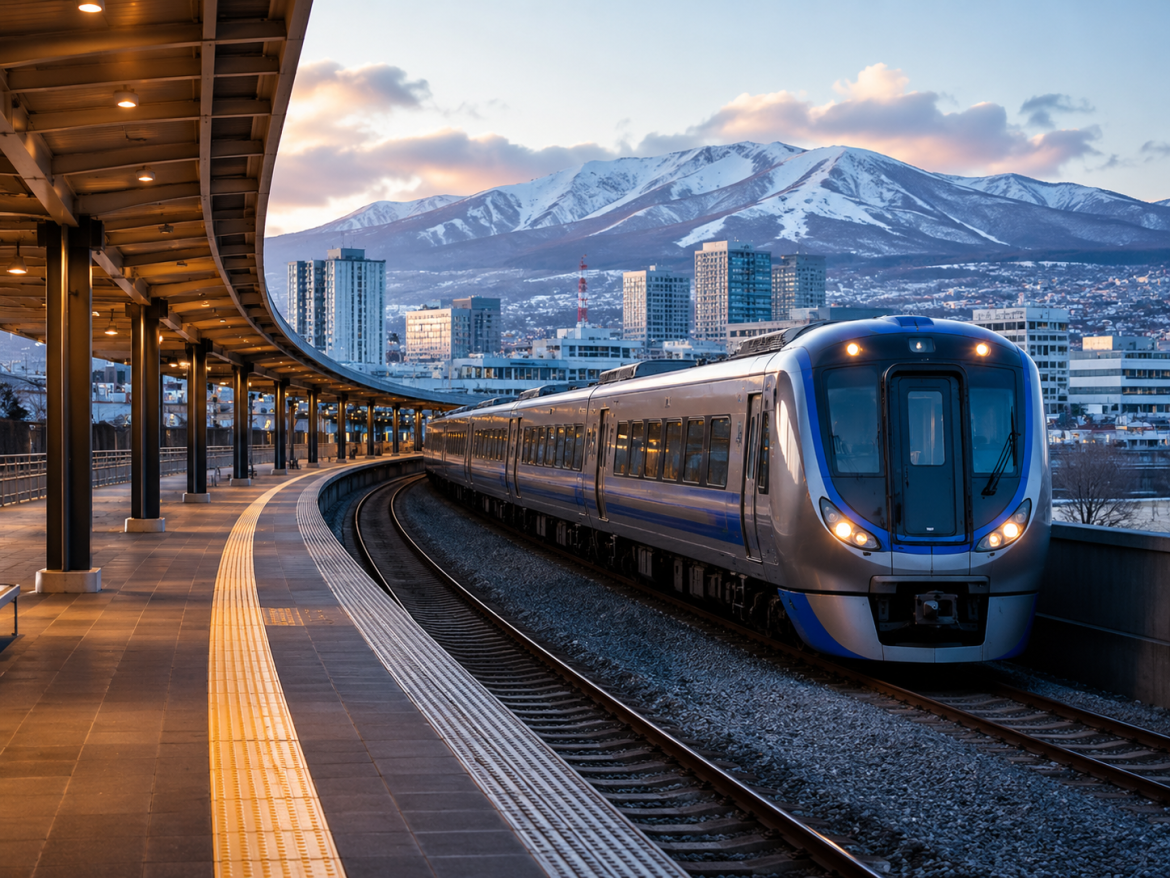
The best way to travel from New Chitose Airport to Sapporo is usually the JR Rapid Airport train. It runs directly from the airport terminal to JR Sapporo Station, takes approximately 33–43 minutes depending on the service and avoids road congestion.
The main exception is when your hotel is near a convenient airport-bus stop in Odori, Susukino or Nakajima Park. The bus takes longer, but it can save you from changing to the subway or carrying luggage through Sapporo Station.
Current fares have changed. The JR basic fare between New Chitose Airport and Sapporo is ¥1,230. A reserved U Seat costs an additional ¥1,000 when bought through the usual station channels, or ¥800 when using the eligible ticketless reserved-seat product. The central Sapporo airport bus now costs ¥1,500 for adults and ¥750 for children.
For most first-time visitors, our recommendation is simple: use a non-reserved Airport train if you are staying around Sapporo Station, and compare the airport bus only when your hotel is close to one of its central stops. Families, groups with several large suitcases and travellers arriving late may find a private transfer more comfortable.
The point many visitors underestimate is that “33 minutes to Sapporo” means the rail journey to JR Sapporo Station, not the total time from aircraft landing to hotel check-in. International arrival procedures, the walk between terminals, waiting for the next train and the final journey to your hotel can easily make the complete transfer 90 minutes or longer.
After checking in, use the Sapporo travel guide to plan your first evening, city itinerary and onward day trips.

New Chitose Airport to Sapporo 2026: Quick Answer
| Planning question | Recommendation |
|---|---|
| Best option for most visitors | JR Rapid Airport train |
| Fastest journey | Approximately 33 minutes on the fastest Airport service |
| Typical Rapid journey | Approximately 37 minutes |
| JR basic fare | ¥1,230 one way |
| Reserved U Seat | Basic fare plus ¥1,000, or ¥800 with the eligible ticketless product |
| Airport-bus fare | ¥1,500 adult; ¥750 child to central Sapporo |
| Best for Sapporo Station hotels | JR Rapid Airport |
| Best for Odori or Susukino | Compare direct bus with JR plus subway |
| Best for several large bags | Airport bus, luggage delivery or private transfer |
| Best for families or elderly travellers | Reserved U Seat, direct bus or private transfer |
| Best during normal winter weather | JR train |
| Best after serious disruption | Follow current official rail and bus instructions rather than relying on a fixed backup plan |
The JR train is the most balanced choice because it is fast, frequent and protected from normal road congestion. It is not automatically the easiest option for every hotel, however. A traveller staying beside a Nakajima Park bus stop may have an easier door-to-door journey by bus than by taking the train, transferring to the subway and walking through snow.
Airport transfer availability is searched by flight, date, hotel address and passenger/luggage count; this is not a fixed-price train ticket. Check whether child seats, waiting time, late-arrival charges and hotel coverage are included.
New Chitose Airport to Sapporo Transport Options Compared
| Transport | Approximate journey | Typical cost | Main advantage | Main disadvantage | Best suited to |
|---|---|---|---|---|---|
| JR Airport train | 33–43 minutes to JR Sapporo Station | ¥1,230 | Fastest and most predictable | May require a subway, taxi or walk after Sapporo Station | Most first-time visitors |
| JR Airport train with U Seat | 33–43 minutes | ¥1,230 plus reserved-seat charge | Guaranteed seat and more comfortable journey | Costs substantially more than a non-reserved seat | Families, elderly travellers and busy travel periods |
| Airport bus | Usually about 70–90 minutes to central Sapporo | ¥1,500 | Serves several city-centre stops | Traffic and snow can cause delays | Hotels near a bus stop |
| Taxi | Often 50–70 minutes | Usually well over ¥10,000, with tolls or surcharges depending on the service | Direct to the hotel | Expensive for one or two passengers | Groups, late arrivals and substantial luggage |
| Pre-booked private transfer | Often 50–70 minutes | Varies by vehicle, time and destination | Driver meeting and known vehicle capacity | Advance booking and cancellation rules | Families, ski luggage and larger groups |
| Rental car | Approximately 50–70 minutes after collection | Rental, fuel, tolls and parking | Useful for a wider Hokkaido road trip | Collection time, city parking and winter driving | Travellers continuing outside Sapporo |
Do not choose purely by the advertised journey time. Add the final stage from Sapporo Station or the bus stop to your actual hotel. A direct bus that stops three minutes from your accommodation can be more convenient than a faster train followed by a crowded subway transfer.
JR Rapid Airport Train from New Chitose Airport to Sapporo
Route and journey time
Airport trains run directly from JR New Chitose Airport Station to JR Sapporo Station. Depending on the service, important stops may include Minami-Chitose, Chitose, Eniwa, Kitahiroshima and Shin-Sapporo.
The fastest advertised Airport journey takes approximately 33 minutes. A standard Rapid service commonly takes about 37 minutes, while a Semi-Rapid service may take around 43 minutes. All are direct, so there is normally no reason to wait for a later train simply to save a few minutes.
During the main daytime period, Airport trains normally depart approximately every ten minutes. The exact mixture includes Special Rapid, Rapid and Semi-Rapid services.
JR fare
The adult basic fare from New Chitose Airport to Sapporo is ¥1,230. A child fare normally applies to children aged 6–11, while younger-child rules depend on whether a separate seat or ticket is required.
The basic fare covers travel in a non-reserved car. You do not need to reserve a seat and can board any suitable Airport departure after entering the gates.
Which cars are non-reserved?
The usual six-car Airport formation has non-reserved seating in Cars 1–3 and 5–6. Car 4 is the reserved U Seat car.
Check the electronic platform display because formations and boarding positions can change. Do not enter Car 4 without the required reserved-seat ticket, even when it appears to have empty seats.
Is the U Seat worth paying for?
The U Seat is worth considering when you want a guaranteed seat, are travelling with an elderly relative, have young children, are carrying ski equipment or are arriving during a peak holiday period.
The ordinary reserved-seat charge is ¥1,000 in addition to the ¥1,230 basic fare. An eligible ticketless reservation through JR-EAST Train Reservation costs ¥800. Therefore, the total adult cost is normally ¥2,230 with the standard reserved-seat charge or ¥2,030 with the ticketless reserved-seat option.
A reserved-seat e-ticket does not replace the basic fare. You must still tap a compatible IC card or use a separate basic-fare ticket to enter and leave the station.
For a normal weekday journey outside a busy period, most travellers do not need to pay for the U Seat. New Chitose Airport is the starting station, so joining the boarding queue early often gives you a reasonable chance of finding a non-reserved seat.
Using Suica, Kitaca, PASMO or ICOCA
Compatible nationwide transport IC cards can be used for the basic fare. Tap the card at New Chitose Airport Station and tap out at Sapporo Station.
Make sure the card has sufficient stored value before entering. The automatic gates do not reserve a seat and do not cover the U Seat supplement.
Buying a paper ticket
Paper basic-fare tickets are available from the ticket machines near the gates. Reserved seats can be purchased from designated machines, the staffed counter or the official online reservation system.
Queues at machines and staffed counters can become long after several flights arrive together. Travellers using a non-reserved seat can normally save time by tapping an IC card instead.
You can use Klook to compare advance Airport train products for this route. This may suit travellers who prefer arranging transport before departure, but tapping an IC card is usually simpler for a standard non-reserved journey.
For the station sequence, carriage layout and luggage guidance, use JR Hokkaido’s official Airport train route and boarding guide. A U Seat reserves a seat, not unlimited luggage capacity.
How to Find New Chitose Airport Station and Board the Train
From a domestic arrival
- Collect your baggage and enter the public arrivals area.
- Follow signs for “JR Train” or “JR Line.”
- Move toward the central part of the Domestic Terminal.
- Use the lift, escalator or stairs to descend to B1F.
- Find the ticket machines, JR Information Desk and ticket gates.
- Check the next Sapporo-bound Airport departure and platform.
The station is directly below the Domestic Terminal, so the route is indoors. Most domestic passengers can reach the gates within approximately 5–10 minutes after entering the public arrivals area, although the distance depends on the arrival gate and baggage carousel.
From an international arrival
- Complete immigration, collect checked baggage and clear customs.
- Enter the International Terminal public arrivals lobby.
- Follow signs toward the Domestic Terminal and JR station.
- Use the connecting corridor and moving walkways.
- Continue into the Domestic Terminal.
- Descend to B1F and enter JR New Chitose Airport Station.
Allow approximately 10–15 minutes for the terminal walk after clearing customs, and longer if you have children, mobility limitations or several bags. Do not reserve a train that departs immediately after the scheduled flight arrival time.
At the platform
Check the train number, destination and car markings on the electronic display. Some Airport trains continue beyond Sapporo to Otaru, but they still stop at Sapporo.
Join the queue for Cars 1–3 or 5–6 if you do not have a reservation. Travellers with a U Seat reservation should locate the Car 4 boarding position.
After arriving at JR Sapporo Station
JR Sapporo Station and Subway Sapporo Station are connected but are not the same set of platforms or ticket gates. Follow signs for your hotel exit, the Namboku Line, the Toho Line, taxis or the underground pedestrian network.
Do not choose an exit only because it appears first. Sapporo Station is large, and using the wrong north, south, east or west exit can add a long outdoor walk.
Airport Bus from New Chitose Airport to Sapporo
Current fare and journey time
The airport bus to central Sapporo costs ¥1,500 for adults and ¥750 for children. The same central fare applies to major stops such as Sapporo Station, Odori Park, Susukino and Nakajima Park.
A normal journey generally takes around 70–90 minutes, depending on the route and stop. Traffic congestion, roadworks, snow and multiple city stops can make the journey longer.
Where to board
Central Sapporo services normally use Domestic Terminal platforms 14 and 22 and International Terminal platform 84. Check the display and timetable for your exact service because two bus companies operate the corridor.
The domestic bus counter is on the first floor of the Domestic Terminal. International passengers can use the transportation information facilities in the International Terminal.
How to pay
Chuo Bus accepts cash, applicable bus tickets, supported transport IC cards and contactless credit cards. Hokuto Kotsu accepts cash, contactless credit cards and PayPay, but does not accept Suica or other transport IC cards. Check the operator before boarding and keep Japanese cash available. See Hokuto’s boarding and payment guide.
When the bus is better than the train
Choose the bus when your hotel is within a short walk of a bus stop and would otherwise require a train-to-subway transfer. This is particularly relevant around Susukino and Nakajima Park.
The luggage compartment also makes the bus attractive when you have a large suitcase, subject to the operator’s limits and available hold space. You avoid carrying them through the JR concourse and down to the subway.
When the bus is not the best choice
Do not choose the bus when you have a tight schedule, are connecting to another JR train or need a predictable arrival time. The bus is also less reliable during severe winter road conditions.
Before boarding, confirm that the bus actually stops near your hotel. “Sapporo city centre” is a large area, and a stop in Odori may still be inconvenient for accommodation on the far side of Susukino.
Choose the branch, not just “Sapporo”
The regular central route serves Minami 3-jo Susukino, Sapporo Station and the western Odori hotel corridor. Keio Plaza is served by selected departures only. Nakajima Park belongs to the limited direct-route timetable: the published summer schedule lists ANA-side departures at 14:10 and 16:10, with international boarding six minutes later. If those do not fit, use JR and the Namboku Line rather than waiting hours.
Compare the regular central-route stops and fares with the Nakajima Park direct route. International passengers can board at their own terminal; there is no need to walk to the domestic building for a bus. Use the airport’s official boarding maps.
Reservations and luggage
These airport buses are non-reserved: queue for your departure. A prepaid ticket does not guarantee a place, and a full bus may mean waiting for the next one. Tell staff your destination when placing a suitcase in the luggage hold, and keep valuables and power banks with you.
Chuo’s accepted hold baggage must weigh under 30 kg, occupy under 0.25 cubic metres and be shorter than 2 metres; it can still be refused if there is no space. Check the Chuo baggage rules or Hokuto route rules and service notices for oversized equipment and your actual operator. A normal city-centre service listing does not override a dated cancellation notice.
Taxi, Private Transfer and Luggage Delivery
Regular taxi
A regular taxi offers direct travel from the terminal to your hotel. The drive commonly takes around 50–70 minutes in ordinary conditions, but congestion and snow can increase the journey time.
The fare is usually well above ¥10,000 and may include expressway tolls, late-night charges or vehicle-size differences. It is difficult to justify for one passenger, but the per-person cost becomes more reasonable for a group.
Pre-booked private transfer
A private transfer is more useful than an ordinary taxi when you need a larger vehicle, child-seat arrangements, ski-equipment capacity, flight monitoring or a driver meeting service.
Check the vehicle’s passenger and luggage limits carefully. A car advertised for five passengers may not accommodate five travellers plus five large suitcases.
Luggage delivery to a Sapporo hotel
Luggage delivery can be better value than upgrading the whole group to a private transfer. It is particularly useful when you arrive before hotel check-in and want to explore the city without dragging suitcases through snow.
Confirm the airport drop-off deadline, eligible hotels, same-day or next-day delivery conditions and prohibited items before booking. Keep medicines, passports, valuables and everything needed for the first night in hand luggage.
Rental Car from New Chitose Airport to Sapporo
Renting a car solely to travel from New Chitose Airport to central Sapporo is rarely worthwhile. Sapporo has good public transport, city-centre parking adds cost, and the airport train is normally faster than completing rental formalities and driving into the city.
Airport rental-car counters usually arrange a shuttle to an off-terminal depot. Allow time for the shuttle, documentation, vehicle inspection and explanations. For planning, allow at least 30–60 minutes for collection, and more when queues or shuttles are slow; this is not an operator guarantee.
A rental car makes more sense when you will leave the airport for Lake Shikotsu, Noboribetsu, Lake Toya, Furano or another destination without first staying in central Sapporo.
Travellers unfamiliar with compacted snow, black ice and reduced winter visibility should not make their first Hokkaido drive an evening airport-to-Sapporo journey. Use the train and collect a car later in the trip instead.
A detailed comparison of rental companies, shuttle arrangements and insurance is available in the New Chitose Airport car-rental guide in Traditional Chinese.
Best Transfer by Sapporo Hotel Area
| Hotel area | Recommended transfer | Why | Main caution |
|---|---|---|---|
| Sapporo Station | JR Airport train | Direct and fastest | Confirm the correct station exit |
| Odori | JR plus subway, or direct airport bus | Both can work depending on the hotel | Bus is slower; JR requires a final transfer or walk |
| Susukino | Direct bus if the stop is close; otherwise JR plus Namboku Line | Bus can remove the subway transfer | Road delays can be substantial |
| Nakajima Park | Limited direct bus when timings fit; otherwise JR plus subway | Useful direct access with luggage | Regular central-route buses do not all reach Nakajima Park |
| Shin-Sapporo | JR Airport train | Direct Airport services stop at Shin-Sapporo | Do not continue unnecessarily to central Sapporo |
| Otaru | Direct Airport train when available | Some services continue through Sapporo to Otaru | Check the destination before boarding |
| Jozankei | JR to Sapporo plus an onward connection, or private transfer | Jozankei is outside central Sapporo | The airport–Jozankei direct bus is suspended; verify any future restart with Hokuto |
Sapporo Station
The JR train is the obvious choice. Hotels south and west of the station can often be reached through underground passages, reducing exposure to rain or snow.
Odori
Take the JR train to Sapporo and transfer to the subway for one stop, use a short taxi, or walk through the underground pedestrian passage. Compare this with a direct airport bus before travelling.
Susukino
A direct bus can be easier when the stop is close to your hotel. The rail alternative is JR to Sapporo followed by the Namboku Line to Susukino.
Nakajima Park
Only the limited direct-route departures list Nakajima Park. The regular central route follows different hotel stops, so compare the actual departure with JR plus the Namboku Line rather than assuming every city-centre bus reaches the park.
Before choosing accommodation, compare station access and first-day logistics in the Sapporo hotel guide in Traditional Chinese.
Do You Need a JR Hokkaido Rail Pass?
Do not buy a rail pass only for the New Chitose Airport–Sapporo journey. A ¥1,230 individual fare is far below the price of any multi-day regional pass.
The Sapporo–Noboribetsu Area Pass is more relevant when your four-day route includes the airport, Sapporo, Otaru and Noboribetsu. The Sapporo–Furano Area Pass can be worthwhile for an intensive route covering the airport, Sapporo, Otaru, Furano, Biei and Asahikawa.
The full Hokkaido Rail Pass is intended for substantial long-distance travel. It becomes more competitive when the itinerary includes destinations such as Hakodate, Kushiro, Abashiri or Wakkanai rather than only Sapporo and Otaru.
Calculate the individual fares for your confirmed itinerary before buying. Also remember that the regional passes do not cover the Sapporo subway or streetcar.
Check the official pass areas, eligibility and exchange rules before buying. JR currently allows non-Japanese passport holders to use these regional passes and requires the original valid passport. A pass must cover your whole route and travel dates; obtain a seat reservation for the U Seat.
Winter Travel and Disruption Strategy
Under normal winter conditions, the JR Airport train remains our preferred option. It avoids motorway congestion and allows you to remain indoors from the terminal to the station.
Severe snowfall can still delay or suspend both trains and buses. Do not assume that the bus is automatically operating when the railway stops; road services may face their own cancellations or route changes.
What to do when the Rapid Airport is delayed
- Check JR Hokkaido’s current operation information.
- Read airport information screens and listen to announcements.
- Check the two airport-bus operators rather than relying on an old timetable.
- Assess whether waiting is safer than joining a long bus or taxi queue.
- Keep food, water, medication and warm clothing accessible.
Official alternative through Chitose
A slower contingency is a local bus from the airport to Chitose Station, followed by the local Chitose Line toward Fukuzumi Subway Station and the subway onward. The city’s official local-bus timetable shows these separate routes; check connections and current service status before attempting it.
This route is slow, may involve waiting and should not replace the normal Airport train or direct airport bus. It is useful only when official information confirms that the relevant local buses are operating.
Winter luggage advice
Use wheeled luggage that can be lifted when necessary. Snow, slush and uneven pavements make oversized cases difficult after leaving the station.
Travellers staying more than a few minutes from a station should consider a taxi for the final city section or send the largest bag directly to the hotel.
Late-Night Arrivals and Early-Morning Departures
Late arrival at New Chitose Airport
Do not plan around the scheduled landing time alone. A delayed flight, baggage collection and an international-terminal walk can cause you to miss the final train or bus.
JR currently advertises a 23:21 Special Rapid Airport departure from New Chitose Airport for Teine via Sapporo. It does not continue to Otaru and departs on time even if flights are delayed. Check your travel date through the airport-to-Sapporo timetable linked on the official JR Airport page; do not rely on an old 22:53 last-train time.
When your flight is scheduled to arrive close to the last services, consider pre-booking a transfer or reserving an airport or Chitose hotel. A night near the airport can be cheaper and less stressful than an emergency long-distance taxi.
Early flight from New Chitose Airport
For an early morning flight, work backwards from the required check-in time rather than choosing the first train automatically. The earliest rail or bus arrival may not provide enough time for baggage drop and security.
Staying near New Chitose Airport or Chitose Station is sensible for very early departures. Travellers staying in Sapporo should consider an airport bus, pre-booked transfer or moving to an airport-area hotel for the final night.
Last bus and return-direction traps
On the published regular central-route summer timetable, the final bus leaves the ANA side at 22:55 and the International Terminal at 22:59. It skips the JAL-side boarding stop and is not the Nakajima Park direct service. Other hotel branches finish earlier. Read the column all the way to your intended stop; a late departure from the airport is not proof that it serves your hotel.
For an early flight, open the Sapporo-to-airport timetable, check the first arrival at the airport and add the walk to the correct terminal. Do not reverse the airport-to-city timetable or treat arrival at the domestic building as arrival at an international check-in desk. Return bus boarding locations may also differ from your arrival stop.
In winter, an extra one or two hours is a planning buffer, not a guarantee against major disruption. Check JR’s live service information and the bus operators before leaving the hotel. A booked airport-area hotel or transfer is a more dependable fallback than assuming an extra late service will be added.
Recommended Arrival-Day Itineraries
Early arrival: airport to central Sapporo sightseeing
| Approximate time | Plan |
|---|---|
| 09:00 | Arrive at New Chitose Airport |
| 10:00–10:30 | Clear arrival procedures and reach the JR station |
| 10:30–11:15 | Airport train to Sapporo |
| 11:30 | Leave luggage at the hotel |
| 12:00 | Lunch near Sapporo Station or Odori |
| 13:30–17:00 | Former Hokkaido Government Office area, Clock Tower and Odori Park |
| Evening | Tanukikoji and Susukino |
Afternoon arrival: relaxed first evening
Take the next suitable Airport train rather than waiting for a particular express. Check in, eat near the hotel and limit sightseeing to one compact area such as Sapporo Station–Odori or Tanukikoji–Susukino.
Family arrival plan
Use a U Seat or direct bus, leave luggage at the hotel and avoid placing a timed attraction immediately after the flight. Children often need food, toilets and rest before beginning city sightseeing.
Continue directly to Otaru
Some Airport trains continue through Sapporo to Otaru. When your first accommodation is in Otaru, check whether the next departure is direct before planning a change at Sapporo.
For the onward journey and return options, see the Sapporo to Otaru transport guide in Traditional Chinese.
Where to Stay for Airport Access
Sapporo Station
Sapporo Station is the most convenient base for first-time visitors, airport journeys and JR day trips. It is the safest choice when you plan to visit Otaru, Asahikawa or other rail-accessible destinations.
Odori
Odori provides a better balance between transport, sightseeing and dining. Airport access involves a direct bus, a one-stop subway journey from Sapporo or an underground walk.
Susukino
Susukino is best for restaurants and nightlife. It works well when the hotel is close to an airport-bus stop, but travellers using JR must add a subway transfer.
Nakajima Park
Nakajima Park often provides quieter surroundings and larger hotels. A suitable direct bus can help, but Nakajima Park departures are limited. Outside those times, use JR plus the Namboku Line or a final taxi.
Airport or Chitose hotel
Stay near the airport when you have a very early departure, a late scheduled arrival or a winter itinerary with little margin for disruption. This is a practical transport decision rather than a sightseeing recommendation.
Common New Chitose Airport to Sapporo Mistakes
- Using an old fare. The JR basic fare is now ¥1,230, and the central airport bus is ¥1,500.
- Assuming the U Seat is included. The reserved-seat charge is additional to the basic fare.
- Entering Car 4 without a reservation. Car 4 is normally the reserved U Seat car.
- Booking a train immediately after an international arrival. Immigration, baggage and the terminal walk are unpredictable.
- Waiting for the fastest train. A later Special Rapid may save less time than you lose waiting.
- Choosing JR without checking the hotel location. A direct bus may be easier for Susukino or Nakajima Park.
- Choosing the bus only because it handles luggage. Winter road delays can outweigh that convenience.
- Confusing JR Sapporo Station with Subway Sapporo Station. Reaching the subway requires an additional indoor walk.
- Using the wrong Sapporo Station exit. This can create an unnecessary outdoor walk in snow.
- Assuming a taxi has a low airport flat fare. The distance is substantial and tolls or surcharges may apply.
- Renting a car only for central Sapporo. Collection time and parking usually remove the advantage.
- Buying a rail pass for one airport ride. An individual ticket is much cheaper.
- Relying on one transport mode during a snow disruption. Trains, buses and roads can all be affected differently.
- Sending every bag through luggage delivery. Keep documents, valuables, medication and overnight essentials with you.
- Planning a fixed lunch or attraction immediately after landing. Arrival and baggage delays can quickly make the booking unrealistic.
New Chitose Airport to Sapporo 2026 Frequently Asked Questions
1. What is the best way to get from New Chitose Airport to Sapporo?
The JR Airport train is best for most travellers. It is direct, normally takes about 33–43 minutes and is not affected by ordinary road congestion.
2. How much is the train from New Chitose Airport to Sapporo?
The adult basic fare is ¥1,230 one way. A reserved U Seat costs extra.
3. How long does the Rapid Airport train take?
The fastest advertised journey is approximately 33 minutes. Standard Rapid services commonly take about 37 minutes, while Semi-Rapid services may take around 43 minutes.
4. Is the U Seat worth buying?
It is worthwhile for travellers who need a guaranteed seat, particularly families, elderly visitors and passengers carrying substantial luggage. Most other travellers can use a non-reserved car.
5. Can I use Suica, PASMO or ICOCA?
Yes. Compatible nationwide IC cards can be used for the ¥1,230 basic fare. They do not automatically include the U Seat reservation.
6. Where is New Chitose Airport JR Station?
The station is on B1F below the Domestic Terminal. International passengers must follow the connecting route toward the Domestic Terminal before descending to the station.
7. How much is the airport bus to central Sapporo?
The current central fare is ¥1,500 for adults and ¥750 for children.
8. Is the bus or train better for Susukino?
Use the bus when it stops close to your hotel and you prefer avoiding a subway transfer. Use JR when speed and predictable timing are more important.
9. What happens if my flight arrives after the last train?
A taxi, pre-booked transfer or airport-area hotel may be needed. Do not assume a bus runs after the last train: the regular central-route summer timetable ends before the advertised 23:21 JR departure. Check the exact date, terminal and destination before flying.
10. Is the JR train reliable in winter?
It is normally the preferred winter option, but severe snow can still cause delays or suspensions. Check official operation information on the day.
11. Is there enough luggage space on the Rapid Airport train?
Space is available but can fill during busy periods. Keep luggage compact, avoid blocking doors and consider the U Seat, bus or luggage delivery when carrying several large items.
12. Which transport is best for children or elderly travellers?
A reserved U Seat, direct airport bus or private transfer usually provides the easiest journey. Choose according to the hotel location and walking required after arrival.
13. How much is a taxi from New Chitose Airport to Sapporo?
The total is usually well above ¥10,000 and varies by destination, traffic, vehicle, tolls and time of day. Confirm the estimate or fixed fare before departure.
14. Does the JR Hokkaido Rail Pass cover the airport train?
Yes, the relevant JR Hokkaido passes cover the Airport train within their valid area and period; reserve a seat before using the U Seat. A pass is not economical for only one airport transfer.
15. Can I travel directly from New Chitose Airport to Otaru?
Yes. Some Airport trains continue through Sapporo to Otaru. Check the destination display because not every departure operates through to Otaru.
Final Recommendation
For most first-time visitors, take the next suitable JR Airport train from New Chitose Airport to Sapporo. Use a compatible IC card, board a non-reserved car and avoid waiting for a slightly faster departure.
Pay for the U Seat when a guaranteed seat meaningfully improves the journey: travelling with elderly relatives, young children, ski equipment or several large bags. Remember that the reserved-seat charge is separate from the ¥1,230 basic fare.
Compare the airport bus when staying around Odori, Susukino or Nakajima Park. It is slower and more exposed to traffic, but a stop near the hotel can remove a difficult station and subway transfer.
A private transfer is most valuable for groups, late arrivals and travellers with specialist luggage. Luggage delivery can be a more economical solution when the real problem is carrying bags rather than transporting passengers.
Do not rent a car only to reach central Sapporo. Collect one at the airport only when the wider itinerary immediately continues outside the city and every driver is comfortable with the seasonal road conditions.
Allow at least 90 minutes from an uncomplicated domestic arrival to reaching a central Sapporo hotel, and longer after an international flight. In winter, maintain additional time and avoid placing a non-refundable reservation immediately after landing.
The final choice should follow your hotel location: JR for Sapporo Station, a comparison of JR and bus for Odori or Susukino, and the limited direct bus for Nakajima Park only when its departure fits your arrival.