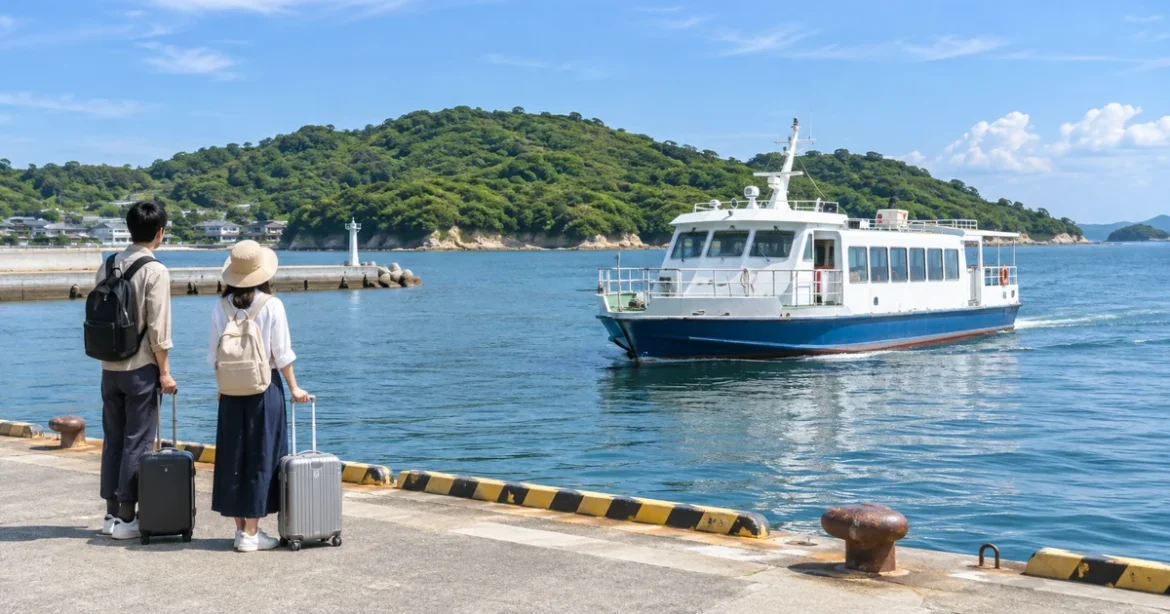
The best route from Okayama Airport to Naoshima is airport limousine bus to Okayama Station → JR Uno Line to Uno Station → walk to Uno Port → ferry to Miyanoura Port. The moving time is less than two hours, but most travellers should allow approximately two hours 15 minutes to three hours because the buses, trains and ferries do not operate as one coordinated through-service.
For most solo travellers and couples, the airport bus is the sensible first step. Families, larger groups or travellers carrying several full-size suitcases can compare a private transfer from Okayama Airport to the Okayama Station area. Be aware that this transfer ends in Okayama City and does not take passengers all the way to Uno Port.
What first-time visitors often misunderstand is that reaching the island is not the end of the journey. Miyanoura Port is on Naoshima, but most major museums are in another part of the island. After disembarking, you may still need a town bus, a transfer to a free museum-area shuttle, a bicycle or a pre-arranged tour.
Naoshima is worth visiting after an early flight, especially if you stay overnight. It becomes a weak arrival-day plan when your flight lands near midday, because museum hours are short and transport waiting time can consume much of the afternoon. On a late arrival, staying near Okayama Station or Uno Port and taking an early ferry the following morning is usually the better decision.
If Naoshima forms part of a wider western Japan itinerary, compare the time required with the routes and day-trip ideas in the Hiroshima travel guide. Naoshima deserves most of a day rather than being treated as a quick stop between Okayama and another city.

Okayama Airport to Naoshima: Quick Route Summary
| Stage | Typical time | Current fare | Important detail |
|---|---|---|---|
| Okayama Airport → Okayama Station | About 30 minutes | ¥1,000 adult; ¥500 child | Board at airport bus stop 2 and arrive at Okayama Station West Exit stop 21 |
| Transfer inside Okayama Station | Allow 10–20 minutes | — | The airport bus arrives on the west side; follow signs to the JR platforms |
| Okayama Station → Uno Station | About 50–60 minutes | Regular JR fare | Some departures may require a connection; check the exact train before boarding |
| Uno Station → Uno Port | About 3–5 minutes on foot | Free | Do not confuse the regular ferry terminal with the separate passenger-boat pier |
| Uno Port → Miyanoura Port | About 20 minutes | ¥370 adult; ¥190 child | No reservations; regular boarding is first-come, first-served |
| Miyanoura Port → Honmura or museum area | Varies | Town bus ¥100 adult; ¥50 child | Change at Tsutsuji-so for the free museum-area shuttle |
Realistic total time: allow approximately two hours 15 minutes to three hours from the airport terminal to Miyanoura Port. A poorly timed connection can make the journey longer.
Best arrival port for most first-time visitors: Miyanoura Port.
Best plan after a late flight: stay in Okayama or Uno and travel to Naoshima the next morning.
Is It Worth Travelling Directly from Okayama Airport?
| Situation | Verdict | Why |
|---|---|---|
| Flight arrives early in the morning | Worth continuing | You may still have most of the afternoon, particularly if you stay overnight |
| Flight arrives during mid-morning | Possible with a focused plan | Reserve one major museum and avoid trying to cover the whole island |
| Flight arrives around midday | Usually better to stay overnight | Three onward connections leave limited museum time |
| Flight arrives in the afternoon | Do not plan a museum day | Continue only if you already have accommodation on Naoshima |
| Travelling with large suitcases | Possible but inconvenient | Island buses and lockers have limited capacity |
| Travelling with young children | Possible with a simple itinerary | Avoid multiple museums, long waits and an immediate return journey |
| Group includes older travellers | Consider a tour or taxi-based plan | The main difficulty is the chain of transfers and hilly island transport |
The journey is worth making directly when the objective is to reach an island hotel, enjoy an evening near Miyanoura or begin sightseeing early the following morning. It is less rewarding when travellers expect to land, complete several transfers and still see Chichu Art Museum, Honmura and the Benesse museum area before closing.
Step 1: Okayama Airport to Okayama Station
The airport limousine bus is the best option for most travellers. It provides a direct connection from Okayama Airport to Okayama Station without an intermediate transfer.
Where to board
- Use bus stop 2 outside Okayama Airport.
- The journey takes approximately 30 minutes under normal conditions.
- The current one-way fare is ¥1,000 for adults and ¥500 for children.
- Major Japanese transport IC cards, including Suica, PASMO and ICOCA, are accepted.
- The bus arrives at Okayama Station West Exit bus stop 21.
Do not choose a short train connection at Okayama Station based only on the scheduled bus arrival. Airport buses can be delayed by traffic, baggage collection may take longer than expected and the walk from the west-side bus terminal to the correct JR platform takes time.
Allow at least 15 minutes between the scheduled bus arrival and JR departure. Travellers carrying several suitcases, using lifts or buying tickets should allow 20 minutes or more.
Airport bus or private transfer?
| Option | Best for | Main advantage | Main disadvantage |
|---|---|---|---|
| Airport limousine bus | Most travellers | Direct, inexpensive and accepts IC cards | Fixed timetable and possible traffic delays |
| Private airport transfer | Families, groups and heavy luggage | Door-to-door service to the Okayama Station area | Much more expensive and does not continue to Uno |
| Ordinary taxi | Unplanned late arrival | Available without learning the bus system | Expensive for a journey that the airport bus handles efficiently |
| Rental car | Longer Okayama road trip | Useful for rural destinations before or after Naoshima | The car adds little value on an art-island visit and requires ferry or mainland parking planning |
Step 2: Transfer at Okayama Station
The airport bus terminates at the West Exit side of Okayama Station. Enter the station building and follow the signs for the JR conventional-line gates rather than the Shinkansen gates.
At the ticket machine or staffed counter, purchase a ticket to Uno unless you are using a valid JR pass or IC card accepted for the journey. Check the departure board carefully. Depending on the timetable, the most practical route may be a direct local train or a journey requiring a transfer before Uno.
How much connection time should you allow?
- 10 minutes: possible only without luggage, with a ticket or IC card ready and no bus delay
- 15–20 minutes: sensible for most travellers
- 25–30 minutes: better for families, older travellers or groups buying tickets
Missing a train is not disastrous, but it may also cause you to miss the intended ferry. Check the complete chain to Miyanoura rather than choosing the first train that merely reaches Uno.
Step 3: Okayama Station to Uno Station
Take the JR Uno Line towards Uno. The railway journey normally takes approximately 50 to 60 minutes, depending on the departure and whether a connection is required.
Uno is the final mainland rail gateway for the most frequent ferry route to Naoshima. Do not get off early simply because another station appears closer to the coast on a map.
Does a JR pass cover this section?
A valid JR pass covering the relevant JR West area may cover the railway journey between Okayama and Uno. It does not automatically cover:
- The Okayama Airport limousine bus
- The Uno–Naoshima ferry
- Naoshima Town Bus
- Museum admission
- Bicycle rental
Do not buy an expensive regional pass only for the Okayama–Uno local train. A pass becomes worth comparing when the wider itinerary includes longer journeys towards Hiroshima, Osaka or other JR West destinations. The Hiroshima transport pass guide explains how to judge regional coverage rather than assuming every boat and airport bus is included.
Step 4: Uno Station to Uno Port
Uno Port is approximately three to five minutes on foot from Uno Station. Leave the station and follow signs towards the ferry terminal and waterfront.
The walk is short and mostly straightforward, but do not plan a two-minute transfer. You still need to identify the correct terminal, purchase a ticket and join the boarding queue.
How early should you reach the port?
- Ordinary weekday: aim for at least 15 minutes before departure
- Weekend or holiday: allow 20–30 minutes
- Festival or major art-event period: arrive substantially earlier
- Travelling with a bicycle or vehicle: allow additional time
The regular ferry does not accept passenger reservations. Being present at Uno Port does not guarantee that you can walk straight aboard at the final minute.
Regular ferry versus passenger boat
The regular ferry and passenger boat are not interchangeable in every practical sense.
| Service | Journey | Payment and boarding | Best for |
|---|---|---|---|
| Regular ferry | Uno → Miyanoura | Buy a ticket at the main ferry terminal | Most travellers, luggage, bicycles and first visits |
| Passenger boat to Miyanoura | Uno → Miyanoura | Cash payment; separate boarding arrangements may apply | Specific late or timetable-dependent journeys |
| Passenger boat to Honmura | Uno → Honmura | Cash payment and fewer departures | Travellers staying in Honmura or beginning with the Art House Project |
Late passenger boats use a pier separate from the regular ferry ticket counter. Check the official Shikoku Kisen map instead of arriving at the ordinary terminal immediately before departure.
Step 5: Uno Port to Miyanoura Port
The regular ferry from Uno to Miyanoura takes approximately 20 minutes. The current one-way fare is ¥370 for adults and ¥190 for children aged 6–12.
Buying the standard ticket directly at Uno Port is sufficient; there is no practical reason to use a third-party platform for this ordinary ferry ticket.
The crossing is short, but weather and sea conditions can cause delays or suspension. Check the operator’s notice on the day when strong wind or severe weather is forecast.
Can you reserve the ferry?
No. Ordinary passenger reservations are not accepted. Travellers board on a first-come basis, which makes an adequate connection buffer particularly important on busy dates.
Can you bring a bicycle?
Yes, bicycles can be carried on the regular ferry for an additional charge. Passenger boats do not provide the same bicycle option, so cyclists should plan around ferry departures.
Should You Arrive at Miyanoura Port or Honmura Port?
| Arrival port | Choose it when | Advantages | Disadvantages |
|---|---|---|---|
| Miyanoura Port | It is your first visit or you need onward buses | More frequent services, lockers, visitor facilities, Red Pumpkin and town buses | Not beside the Art House Project |
| Honmura Port | You are staying in Honmura or beginning with the Art House Project | Convenient for Honmura village | Far fewer departures and less useful for a general first-time arrival |
Editor’s verdict: choose Miyanoura Port unless your accommodation or confirmed itinerary gives you a specific reason to use Honmura. The higher service frequency and better transport connections outweigh the small amount of island travel saved by arriving in Honmura.
What to Do After Arriving at Miyanoura Port
Miyanoura Port is the main transport hub rather than the entrance to every museum. From the port, the Naoshima Town Bus runs through Honmura to Tsutsuji-so.
At Tsutsuji-so, passengers can transfer to the free Benesse Art Site Naoshima shuttle serving the southern museum area. The shuttle and town bus are separate services, so allow time for the transfer.
Important return-journey warning
There is no direct town bus from Chichu Art Museum to Miyanoura Port. Travellers generally need to return through the museum-area transport system and change back to the town bus route. Do not leave Chichu shortly before your intended ferry and assume one bus will take you directly to the port.
Local bus fare
- Adult: ¥100 per ride
- Child: ¥50 per ride
- Pay according to the current onboard instructions
Island buses are small and can become crowded. Large suitcases create difficulty for both the traveller and other passengers.
Naoshima with Luggage
The best strategy is to avoid taking full-size luggage onto Naoshima unless you are staying overnight and your accommodation can receive it.
Practical luggage choices
- Leave large luggage at an Okayama hotel and travel with a day bag.
- Use station storage before travelling to Uno.
- Send luggage to the next mainland hotel using a delivery service.
- Ask your Naoshima accommodation whether it offers port collection or luggage delivery.
- Use Miyanoura Port lockers only as a backup, not as the entire plan on a busy date.
Miyanoura Port currently provides a limited number of large, medium and small lockers. They are useful for cabin-size bags, but availability is not guaranteed.
Current Museum Reservations and Opening Considerations
Transport planning should be built around the museum you care about most. Do not reach the island first and then decide whether timed admission is available.
Chichu Art Museum
- Normal opening: generally 10:00–17:00
- Normal last admission: 16:00
- Closed on Mondays, with holiday-calendar exceptions
- Date-and-time reservation strongly recommended
- Weekday online ticket: ¥2,500
- Weekday on-site ticket: ¥2,800
- Weekend and holiday online ticket: ¥2,700
- Weekend and holiday on-site ticket: ¥3,000
- Visitors aged 15 and under: free
Temporary extended opening may apply on selected August 2026 dates. Check the official calendar before selecting a ferry around the usual closing time.
Naoshima New Museum
- Opening: generally 10:00–16:30
- Last admission: 16:00
- Closed on Mondays, with holiday-calendar exceptions
- Online ticket: ¥1,500
- On-site ticket: ¥1,700
- Visitors aged 15 and under: free
The museum is scheduled to close from 24 November to 12 December 2026 for an exhibition change. This does not mean Naoshima is completely closed, but it removes one major stop from a short itinerary.
Should you book before flying?
Book Chichu Art Museum before the travel date once your flight and ferry plan are stable. Leave enough margin that a modest airport or train delay will not cause you to miss the entry time.
For other facilities, online purchase can reduce uncertainty, but do not build an inflexible schedule containing too many admissions. Naoshima works better when there is time to move between the landscape, villages and museums.
Best Route by Traveller Type
| Traveller | Recommended route | Reason |
|---|---|---|
| Solo traveller | Airport bus → JR → ferry → town bus | Lowest practical cost and no need for a private vehicle |
| Couple | Public transport; reserve one major museum | Private transfers rarely save enough time to justify the price |
| Family with children | Airport transfer or bus → overnight stay → simple island day | Avoids combining flight fatigue with several museums |
| Group of four or more | Compare airport transfer and private island tour | Shared private costs may become more reasonable |
| Older travellers | Public transport to Uno, then private guided vehicle on Naoshima | Reduces hills, crowded buses and repeated transfers |
| Large-luggage traveller | Store or forward luggage before Uno | Island buses and lockers are not designed for unlimited large bags |
| Late arrival | Stay in Okayama or Uno | Protects the next day’s museum time |
Private Tours from Uno: Are They Worth It?
A private island tour does not remove the journey from Okayama Airport to Uno, but it can simplify the part of the day after reaching the port. This is most valuable for groups, older travellers and visitors who want several sites without relying on small local buses.
The verified Naoshima private day tour from Uno includes an English-speaking guide, private transport on the island and admission to selected facilities. Check the exact package inclusions because Chichu Art Museum is not automatically included in every Naoshima tour.
This option is convenient rather than inexpensive. Independent public transport remains the better choice for travellers who are comfortable reading timetables and limiting the day to two or three areas.
Naoshima by Bicycle or E-Bike
An e-bike provides more flexibility than the town bus, but Naoshima is not completely flat. Ordinary bicycles can be tiring on the routes between Miyanoura, Honmura and the southern museum area.
A guided Naoshima cycling or public-bus tour from Uno is most suitable for active travellers who want help with route planning. The product may switch from bicycles to public transport when rental bicycles are unavailable during crowded periods.
Reserve an e-bike in advance during weekends, holidays and major art-event periods. Do not assume that a suitable bicycle will remain available after a late arrival.
Okayama Airport Arrival-Time Planner
| Airport arrival | Recommended plan | What is realistic |
|---|---|---|
| Before approximately 09:00 | Continue to Naoshima | One major museum plus Miyanoura or Honmura; overnight strongly improves the trip |
| 09:00–11:00 | Continue only with a focused itinerary | Reserve one timed museum and avoid a same-day return deadline |
| 11:00–14:00 | Continue for an overnight stay | Port area, village walk or one late-opening facility |
| After 14:00 | Stay in Okayama or Uno | Use the evening for dinner and begin the island journey early next morning |
These are planning guidelines rather than guaranteed connection times. Always check the timetable for your exact flight date.
Half-Day Naoshima Itinerary After an Early Flight
This route is possible only when the flight, airport bus, train and ferry connect well.
| Approximate stage | Plan |
|---|---|
| Morning | Okayama Airport → Okayama Station → Uno Port |
| Late morning or early afternoon | Ferry to Miyanoura Port and store small luggage if necessary |
| Early afternoon | Red Pumpkin and Miyanoura waterfront |
| Afternoon | One pre-booked museum or Honmura Art House Project |
| Late afternoon | Return to accommodation on Naoshima |
Do not attempt Chichu Art Museum, Benesse House Museum, the Art House Project, Naoshima New Museum and both port areas in the same arrival afternoon.
Recommended Full-Day Naoshima Itinerary
The stronger itinerary begins after staying in Uno or Naoshima the previous night.
| Time | Plan |
|---|---|
| Early morning | Uno Port → Miyanoura Port |
| Morning | Town bus to Honmura; Art House Project and village streets |
| Lunch | Eat in Honmura before travelling south |
| Early afternoon | Tsutsuji-so transfer and Benesse museum area |
| Mid-afternoon | Pre-booked Chichu Art Museum admission |
| Late afternoon | Return towards Miyanoura with a generous ferry buffer |
Reverse the order when the only available Chichu admission is in the morning. The reservation should determine the sequence rather than forcing the museum into an unsuitable gap.
Family Itinerary
For families, use a slower sequence:
- Stay in Uno or Naoshima the previous night.
- Take a morning ferry without rushing from the airport.
- Spend time around Miyanoura and the waterfront.
- Choose either Honmura or the southern museum area, not both.
- Return before children become tired and buses become crowded.
A stroller is manageable on the ferry and around the port, but the island includes slopes, narrow areas and transport transfers. A carrier may be more practical for toddlers during a museum-focused day.
Naoshima for Older Travellers
Older travellers can enjoy Naoshima, but the route should minimise standing, hills and uncertain bus connections.
- Stay in Uno or Naoshima rather than attempting a same-day airport round trip.
- Use lifts within Okayama Station where necessary and allow extra transfer time.
- Choose Miyanoura Port for its facilities and more frequent services.
- Consider a private island vehicle or guided tour.
- Limit the itinerary to one museum zone and one village.
- Avoid carrying luggage between ports and museums.
The ferry crossing itself is not the most difficult part. The cumulative effect of airport baggage collection, the station transfer, waiting at Uno and moving around the hilly island causes more fatigue.
Should You Stay in Okayama, Uno or Naoshima?
| Area | Best for | Advantages | Disadvantages |
|---|---|---|---|
| Okayama Station | Late flights and wider regional trips | Most hotels, restaurants, luggage services and rail connections | Requires the full Uno journey next morning |
| Uno Port | Early ferry and practical one-night stop | Walkable to the terminal and removes the JR connection from sightseeing day | Smaller choice of evening facilities |
| Miyanoura | First-time Naoshima overnight | Port facilities, buses and evening island atmosphere | Accommodation can sell out |
| Honmura | Art House Project and village atmosphere | Quiet setting close to Honmura sights | Fewer direct boats and less convenient for first arrival |
| Benesse museum area | Art-focused stay and slower experience | Close to major southern facilities | Usually the most expensive choice and less convenient for spontaneous dining |
Best practical answer: stay in Uno after a late airport arrival, or stay on Naoshima when the budget and availability permit. Staying near Okayama Station is better when the trip also includes Kurashiki, Hiroshima or other regional destinations.
What to Do When You Arrive Too Late for Naoshima
Do not force the ferry journey merely because accommodation was originally planned elsewhere. A late arrival can be turned into a useful Okayama evening.
Okayama Castle is a practical city attraction when opening hours and your arrival time align. A verified Okayama Castle mobile admission ticket is available, although buying directly is also straightforward.
Another option is to eat near Okayama Station, sleep early and travel to Uno before the main museum crowds the following morning.
Can Naoshima Be Combined with Hiroshima or Miyajima?
Naoshima and Hiroshima can fit into the same regional itinerary, but not into a relaxed single day. Travel through Okayama and give Naoshima a separate day.
Travellers choosing between the two islands should note that Naoshima is art- and architecture-focused, while Miyajima offers shrines, historic streets, Mount Misen and a more conventional sightseeing route. See the Hiroshima to Miyajima transport guide for the alternative ferry experience.
A sensible western Japan sequence is:
- Day 1: Okayama or Kurashiki
- Day 2: Naoshima
- Day 3: Travel to Hiroshima
- Day 4: Hiroshima city
- Day 5: Miyajima
For other realistic regional additions, compare the best day trips from Hiroshima. Naoshima should replace another full-day excursion rather than being added on top of an already crowded schedule.
Travellers continuing west can also review where to stay in Hiroshima before choosing whether to sleep near Okayama Station, Hiroshima Station or an island port.
Food Planning on Naoshima
Do not assume that island restaurants operate as late or as frequently as restaurants around Okayama Station.
- Eat breakfast before boarding an early ferry.
- Plan lunch near the area you will visit at midday.
- Honmura has useful lunch options, but popular small restaurants may fill.
- Carry water, especially in summer.
- Do not depend on museum cafés as the only possible meal.
- Reserve dinner when staying at accommodation with limited nearby alternatives.
Travellers arriving after lunch should eat on the mainland if the connection schedule leaves little spare time.
First-Time Mistakes to Avoid
- Adding only the vehicle journey times. Waiting and walking can add an hour or more to the route.
- Choosing a tight train after the airport bus. Traffic, baggage collection and the station walk make short connections risky.
- Assuming every Uno service leaves from the regular ferry terminal. Passenger boats may use a separate pier.
- Trying to reserve the ordinary ferry. Regular passenger boarding is first-come, first-served.
- Arriving at the ferry one or two minutes before departure. You still need to buy a ticket and board.
- Taking the Honmura passenger boat without checking the return schedule. Honmura has far fewer direct services than Miyanoura.
- Assuming Miyanoura Port is beside Chichu Art Museum. Further island transport is required.
- Leaving Chichu immediately before a ferry. There is no single direct town bus from the museum to Miyanoura Port.
- Taking large luggage onto local buses. Vehicles and port lockers have limited capacity.
- Visiting on Monday without checking the museum calendar. Many major facilities close on Mondays or the following day when Monday is a holiday.
- Waiting until arrival to reserve Chichu Art Museum. Timed slots may no longer match the transport plan.
- Buying a JR pass for the complete route. The airport bus, ferry and island bus are separate from ordinary JR coverage.
- Planning a full island day after a midday flight. The journey may leave only a short period before last admission.
- Assuming bicycles are always available. E-bikes can sell out during busy periods.
- Using an old fare from a blog. Check the airport and ferry operators rather than relying on archived prices.
Frequently Asked Questions
What is the best way to get from Okayama Airport to Naoshima?
Take the airport limousine bus to Okayama Station, the JR Uno Line to Uno Station, walk to Uno Port and take the ferry to Miyanoura Port.
How long does Okayama Airport to Naoshima take?
Allow approximately two hours 15 minutes to three hours to reach Miyanoura Port. A poor connection or traffic delay can make it longer.
How much is the airport bus to Okayama Station?
The currently listed one-way fare is ¥1,000 for adults and ¥500 for children.
Where does the airport bus depart?
Use bus stop 2 outside Okayama Airport. The bus arrives at Okayama Station West Exit stop 21.
Can I use Suica or ICOCA on the airport bus?
Yes. Major Japanese transport IC cards are accepted on the airport limousine bus.
How long is the train from Okayama to Uno?
Allow approximately 50 to 60 minutes, depending on the departure and any required connection.
How far is Uno Station from Uno Port?
The regular ferry terminal is approximately three to five minutes on foot from Uno Station.
How much is the Uno to Naoshima ferry?
The current one-way fare is ¥370 for adults and ¥190 for children aged 6–12.
Can I reserve the Uno to Naoshima ferry?
No. Ordinary passenger reservations are not accepted, so arrive with enough time to buy a ticket and queue.
How long is the ferry crossing?
The regular Uno–Miyanoura crossing takes approximately 20 minutes.
Should I take the ferry to Miyanoura or Honmura?
Choose Miyanoura for a first visit. It has more frequent transport, lockers, visitor facilities and better island bus connections.
Can I pay for the passenger boat by card?
Do not depend on card payment. Official passenger-boat guidance specifies cash payment.
Does a JR Pass cover the ferry?
No. A JR pass may cover the eligible railway section to Uno, but the Uno–Naoshima ferry is operated separately.
Can I visit Naoshima after a midday flight?
You can reach the island, but meaningful museum time will be limited. Continue for an overnight stay rather than trying to complete a day trip.
What should I do with large luggage?
Leave it at a mainland hotel, use station storage or forward it to the next accommodation. Treat Miyanoura lockers only as a backup.
Is Naoshima suitable for children?
Yes, when the itinerary is simple. Choose one museum area, avoid excessive transfers and consider staying overnight.
Is Naoshima suitable for older travellers?
Yes, but a private island vehicle or limited itinerary is preferable for anyone who finds hills, standing or repeated bus transfers difficult.
Do I need to reserve Chichu Art Museum?
Advance date-and-time booking is strongly recommended. Do not schedule a tight admission immediately after the expected ferry arrival.
Are Naoshima museums open on Monday?
Many major facilities are normally closed on Monday, subject to holiday-calendar exceptions. Check each facility rather than assuming the entire island follows one schedule.
Can weather cancel the ferry?
Yes. Strong wind and poor sea conditions can cause delays or suspension. Check the ferry operator’s notice on the travel day.
Is a private airport transfer worth booking?
It can be worthwhile for a family or group carrying several suitcases. Solo travellers and couples will usually find the airport bus more economical.
Does the private airport transfer go to Uno Port?
No. The verified product serves Okayama Airport and the Okayama Station or city-hotel area. You must continue separately to Uno.
Is a Naoshima private tour worth the price?
It is most useful for groups, older travellers and visitors prioritising several sites. Independent buses and bicycles are better for budget travellers.
Should I stay in Uno or Naoshima?
Stay in Uno when arriving late and taking an early ferry. Stay on Naoshima for the quieter evening atmosphere and the strongest full-day experience.
Final Verdict
The best Okayama Airport to Naoshima route is the airport limousine bus to Okayama Station, JR to Uno, a short walk to Uno Port and the ferry to Miyanoura.
The journey is straightforward when viewed as four separate stages. It becomes stressful only when travellers book tight connections or expect flight arrival, three mainland transfers and a complete museum itinerary to fit into one afternoon.
Allow at least two hours 15 minutes and preferably closer to three hours between leaving the airport terminal and reaching Miyanoura Port. Add more time on weekends, holidays and major art-event dates.
Choose Miyanoura for a first visit, reserve Chichu Art Museum before travelling and carry only a day bag whenever possible.
The public-transport route is best for most solo travellers and couples. Families and larger groups should compare a private airport transfer for the first segment or a guided vehicle after reaching Uno, while recognising that neither is essential for an independent visit.
After an early flight, continue to Naoshima and stay overnight. After a late-morning or afternoon flight, sleep in Okayama or Uno and begin the island journey the following morning. That one decision will usually improve the Naoshima experience more than any transport shortcut.