2027 summer competition update — checked 30 September 2026: The organizer has not yet announced the next summer competition date, ticket sales, programme or special trains. The 98th competition on 29 August 2026 has ended. All dated ticket periods, seat prices, special trains and package examples below refer to 2026, not confirmed 2027 availability. The summer competition is a different event from the spring and autumn chapters; do not transfer their dates to this guide.
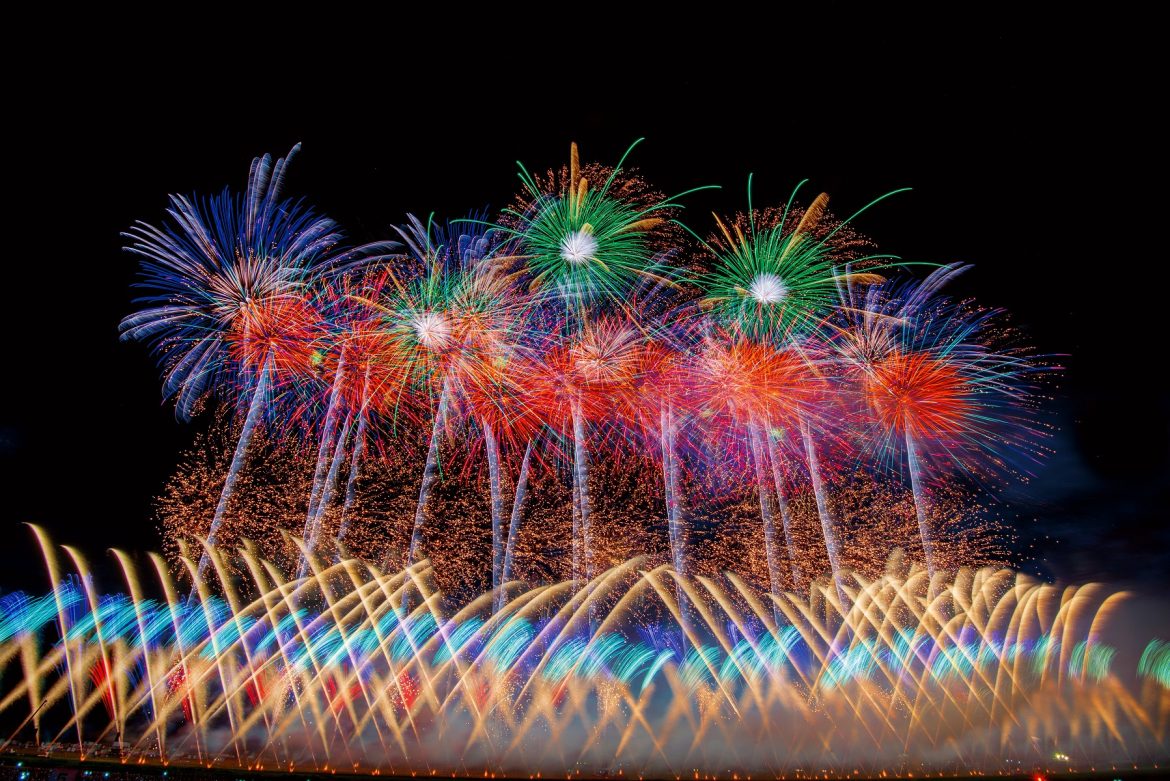
Omagari Fireworks Festival is worth the journey for travellers who want to watch fireworks as a judged art form rather than as a short summer finale. The summer event is a national competition in which professional pyrotechnicians present technically demanding shells and creative sequences, including Japan’s unusual daytime-fireworks category.
The main obstacle is not deciding whether the display will be impressive. It is coordinating a paid ticket, the 2 km walk from Omagari Station, an evening finish at 9:30 PM and a return train that leaves enough time for the post-show crowd. A poorly planned visit can end with an expensive seat being missed, an impossibly tight connection or an overnight wait far from the booked hotel.
For a first visit, the most practical plan is to reserve a seat and accommodation before building the rest of the itinerary. Travellers purchasing from outside Japan should compare the remaining official options with Klook’s viewing-ticket packages, particularly the round-trip bus from Morioka. Travellers already able to use Japanese ticketing channels usually obtain more seat choice by purchasing directly during the official sales period.
Editor’s verdict: Go for the complete competition experience, including the daytime programme, but treat it as an overnight trip. It is not a relaxed spontaneous festival and it is not a sensible full-show day trip from Tokyo.

Omagari Fireworks Festival 2026 at a Glance
| Item | 2026 historical information |
|---|---|
| Official event | The 98th National Fireworks Competition |
| Date | Saturday, 29 August 2026 |
| Gates | Scheduled to open at 3:00 PM |
| Daytime fireworks | 5:10 PM–6:00 PM |
| Evening fireworks | 7:00 PM–9:30 PM |
| Venue | Omagari Hanabi Park, Omono Riverbank, Daisen City, Akita Prefecture |
| Nearest station | JR Omagari Station |
| Final walk | Approximately 2 km or 30 minutes in normal festival conditions |
| Viewing area | All areas inside the venue are paid and reserved |
| Programme scale | 28 participating companies and approximately 18,000 shells |
| Food | Festival stalls are scheduled to operate |
| Official information | Omagari Hanabi event overview |
Is Omagari Fireworks Festival Worth Visiting?
It is most rewarding for travellers who appreciate the design, timing and precision of individual fireworks. Unlike a display built mainly around one continuous soundtrack, Omagari lets spectators compare entries from different pyrotechnic companies before watching the larger special programmes.
The daytime competition is a major reason to arrive early. Coloured smoke, shape and density replace night-time light as the primary visual elements. Travellers who enter only for the evening programme miss an important feature that distinguishes Omagari from most other Japanese fireworks events.
The event is less suitable for travellers who dislike dense crowds, need to return to Tokyo that night, have not secured a viewing ticket, or cannot manage a long outdoor day followed by a congested 2 km walk. The show itself is exceptional, but the overall trip requires more effort than an urban fireworks display beside a major transport hub.

Omagari Fireworks Tickets: No Free Viewing Area
What first-time visitors most often misunderstand is that the official venue does not contain a free viewing zone. A distant glimpse may be possible from elsewhere in the city, but that is not equivalent to entering Omagari Hanabi Park or watching the competition from an authorised seat.
Elementary-school-age children and older require tickets. A younger child may enter with an accompanying guardian without a separate ticket only when the child does not require an individual seat.
Official prices are charged per seating area rather than per guest. A four-person area costs the same whether it is occupied by one person or four, so the apparent value changes considerably with group size.
Official Seat Types and Prices
| Seat | Capacity | Official price | Cost per person when full | Best suited to | Main trade-off |
|---|---|---|---|---|---|
| Platinum Pair | 2 | ¥70,000 per area | ¥35,000 | Couples prioritising comfort, an elevated platform, table and private restroom | Very high price |
| Deluxe Table | 4 | ¥50,000 per area | ¥12,500 | Families or groups wanting more personal space | Expensive when not filled |
| Table | 4 | ¥38,000 per area | ¥9,500 | Groups and older travellers who prefer a table | Less floor space than the deluxe area |
| Embankment Box | 4 | ¥30,000 per area | ¥7,500 | Groups comfortable using bench seating | Located on a slope |
| Leisure Sheet | 4 | ¥15,000 per area | ¥3,750 | Budget-conscious groups able to sit near ground level | Less comfortable for knees, backs and long waits |
| Pair Bench | 2 | ¥13,000 per area | ¥6,500 | Couples wanting a straightforward reserved bench | Limited personal space |
| Chair | 1 | ¥8,000 | ¥8,000 | Solo travellers and visitors who want a normal chair | No table or additional allocated area |
| Photographer A | 1 | ¥25,000 | ¥25,000 | Serious photographers wanting the highest photographer position | Premium price |
| Photographer B | 1 | ¥18,000 | ¥18,000 | Photographers balancing height and price | Lower position than A |
| Photographer C | 1 | ¥13,000 | ¥13,000 | Photographers seeking the least expensive tripod-permitted option | Lowest of the designated photographer positions |
Which Omagari Seat Should You Choose?
Solo traveller: A chair seat is the least complicated option. Booking a multi-person space alone is permitted, but the full area price still applies.
Couple: The pair bench is the practical standard choice. The Platinum Pair area makes sense only when the elevated platform, table and private restroom are important enough to justify the considerably higher price.
Family of three or four: The leisure-sheet area has the lowest full-capacity cost, but it is not automatically the best family option. A table seat may be easier with meals and children, while an ordinary chair or table arrangement is generally better for relatives who find floor-level seating uncomfortable.
Older travellers: Avoid choosing purely by the lowest per-person cost. A chair or table is usually preferable to a leisure sheet, and the sloping embankment box can be awkward for people with balance or knee problems.
Photographer: Select a photographer seat when a tripod or monopod is essential. Large photography equipment is prohibited in ordinary seating areas, while the designated photographer zones specifically permit it.
How to Buy Omagari Fireworks Tickets
Official Online and In-Person Sales
For the 2026 competition, the first official online period ran from 12 to 23 June. A second period was scheduled from 21 to 31 July only for remaining inventory. Tickets were sold through Lawson Ticket and e+, with photographer seats handled through Lawson.
The separate official in-person sale took place at Hikario Square on 5 July. It was first come, first served and cash only, with no choice of exact seat location. This was not a same-day festival ticket counter.
The standard official periods have therefore passed. Do not travel to Omagari expecting to obtain an ordinary ticket at the gate. The organiser’s 2026 guidance also states that official purchases cannot be completed from overseas.
Official seat details and any subsequent announcements should be checked on the official summer ticket page.
When Klook Is the More Practical Option
Klook currently lists a summer Omagari viewing product with two broad access formats: a guided one-way walk from Omagari Station or a round-trip bus from Morioka Station. This is most useful for an international visitor who cannot use the official overseas-purchase route, or for someone who wants the viewing arrangement and Morioka transport handled together.
Before paying, open the individual package details and confirm the exact seat category, meeting location, meeting time, return destination, luggage conditions and cancellation policy. Do not assume that every package includes the same seat or transport.
Check Omagari Fireworks Tickets on Klook
Official Ticket or Klook: Which Should You Choose?
| Booking route | Choose it when | Main advantage | Check carefully |
|---|---|---|---|
| Official Lawson or e+ | You can purchase in Japan during the stated sales period and want a specific official seat category | Widest direct choice of seat types | Delivery method, Japanese purchasing requirements and additional fees |
| Official in-person sale | You are in Omagari on the designated July sale date | Direct official purchase | Cash only, no exact seat choice and not available on the event date |
| Klook guided-walk package | You need an overseas-friendly booking route and can arrange your own return train | Viewing ticket combined with help travelling from Omagari Station | Seat type and whether the guide is one way only |
| Klook Morioka bus package | You are staying in Morioka and want to avoid competing for a late Omagari train | Viewing arrangement and round-trip transport in one booking | Meeting time, final return time, bus location and cancellation terms |
Refund and Postponement Rules
Official tickets cannot be cancelled or refunded for personal reasons. If the event is postponed, the same ticket remains valid for the rescheduled date. A refund is provided only if the event is cancelled under the organiser’s announced procedure; a shortened programme or partial change does not automatically qualify.
This matters for overseas travellers with fixed flights and hotels. A flexible accommodation booking can be more valuable than saving a small amount on a non-refundable room.
How to Reach Omagari Fireworks Festival
Omagari Station to the Actual Venue
JR Omagari Station is the nearest rail station. The official estimate is approximately 2 km and 30 minutes on foot to the centre of the viewing venue.
Thirty minutes should be treated as the normal directional estimate, not a promise for the return journey. Before the event, people are spread across several hours. After 9:30 PM, spectators leave at roughly the same time, paths narrow, and access around the station is controlled. The same distance can therefore take considerably longer.
Follow the designated pedestrian route and venue signs rather than relying only on a map pin. The riverside park is extensive, and reaching the edge of the event zone is not the same as reaching the entrance or block printed on the ticket.
From Tokyo
The Akita Shinkansen provides direct trains between Tokyo and Omagari. JR East’s 2026 special timetable includes an 8:52 AM departure from Tokyo scheduled to reach Omagari at 12:45 PM, which provides a sensible buffer for lunch, the station walk and the 3:00 PM gate opening.
A later special departure at 1:44 PM is scheduled to reach Omagari at 5:08 PM. That arrival is after the daytime programme has begun and leaves no realistic buffer for the 2 km walk. It is not the right train for visitors seeking the full competition.
Returning to Tokyo after staying until the 9:30 PM finish is not a practical same-night plan. Late special trains primarily terminate at Morioka, Sendai or Akita, and the station walk plus crowd control makes tight onward connections risky. Book an overnight base in Tohoku.
From Sendai
A special Komachi service is scheduled to leave Sendai at 11:13 AM and reach Omagari at 1:13 PM. This is a practical same-day arrival when the reserved train and event seat have already been secured.
The 10:19 PM special return to Sendai reaches the city shortly before midnight, but it departs only 49 minutes after the scheduled finale. Because the normal station walk itself is approximately 30 minutes before post-show congestion is considered, relying on this service while staying for every final sequence is aggressive. Leave the viewing area before the end or choose a later overnight strategy rather than assuming the connection will work.
From Morioka
Morioka is one of the most useful hotel bases because it has a larger accommodation supply, direct Akita Shinkansen services and additional Tazawako Line trains.
Special Komachi arrivals include services scheduled to reach Omagari at 3:02 PM and 4:09 PM. The earlier one is much better for entering calmly. A 4:09 PM arrival leaves only about one hour before the daytime fireworks begin, including the station exit and 2 km walk.
After the event, special departures toward Morioka are scheduled at several times, including 10:46 PM, 11:28 PM and after midnight. Later trains reduce connection pressure, although the station queue still requires substantial time.
Klook’s Morioka round-trip bus package is relevant for travellers who prefer not to build their evening around the railway queue. Confirm the bus meeting point and actual return schedule before booking.
View the Morioka Bus and Ticket Packages
From Akita City
Akita City offers a good balance of hotels and direct festival trains. Extra Komachi and local services operate in both directions.
For arrival, choose a train reaching Omagari no later than mid-afternoon. For the return, services at 10:28 PM and later provide more breathing room than trains leaving during or immediately after the show. The 11:15 PM Komachi is a more conservative target than the 10:28 PM service, although no particular train can eliminate the post-show crowd.
From Yokote
Yokote is geographically closer than Akita or Morioka and has numerous additional local trains on the festival date. It can be an efficient base when a suitable hotel is available.
The weakness is smaller accommodation inventory. Rooms can disappear long before travellers begin comparing transport. Reserve the hotel first, then select a late enough return train rather than assuming any departure shortly after 9:30 PM will be reachable.
Important Special-Train Ticket Restrictions
Several 2026 festival services do not work like an ordinary mobile Shinkansen booking:
- Komachi 311, 313, 364, 368 and 370 do not accept the Shinkansen e-ticket or Ekinet Q-Ticket. Reservations made through Ekinet must be issued as paper tickets before travel.
- Komachi 365, 367, 374, 376 and 378 cannot be reserved through Ekinet and must be purchased from a staffed ticket counter or reserved-seat ticket machine.
- The Kitakami Line festival specials were withdrawn following heavy-rain damage. Do not build the itinerary around those services.
Use the JR East Omagari information (check the event year) and reconfirm the selected train before travel.
Is a JR East Pass Worth Buying?
A JR East Pass can cover Akita Shinkansen and other eligible JR East journeys, but it should not be purchased automatically for one Omagari round trip.
The pass becomes more logical when Omagari is part of a five- or ten-day Tohoku route involving several long-distance journeys, such as Tokyo, Sendai, Morioka, Akita and Aomori. Compare the pass price with the actual point-to-point itinerary before paying.
A pass also does not remove the need for reserved seats, and it does not override the special ticketing restrictions applied to particular festival trains. Reserve the chosen Shinkansen services as early as the pass and booking rules permit.
Check JR East Pass Options on Klook
Driving, Parking and Road Restrictions
Driving directly to the riverside venue is not recommended. Routes 13 and 105, Omagari Interchange and the city centre experience extensive restrictions and severe congestion. Official guidance warns that congestion can continue until approximately 2:00–3:00 AM.
Some car parks inside the controlled zone do not allow vehicles to leave until midnight. A space that appears close to the venue can therefore result in a slower departure than parking outside Omagari and travelling in by train.
Daisen City recommends park-and-ride using car parks around municipal branch offices and nearby railway stations. The sensible choice is a car park located in the direction of the hotel or onward route, not necessarily the one with the shortest map distance to the fireworks.
Consult the current Daisen City traffic map and parking information before setting out. Private parking arrangements should be verified individually rather than assumed from an old festival map.
Do Local Buses Run on the Festival Date?
Do not plan to avoid the station walk by using Omagari’s ordinary city buses. The city circular bus routes are suspended throughout the festival date. Some community services are also suspended, while others follow altered routes that omit stops around the event area.
Other regional and highway buses may also be diverted or cancelled. The train-and-walk route or a pre-booked organised bus package is more dependable than attempting to improvise a local bus connection on arrival.
A Realistic Omagari Festival-Day Itinerary
| Time | Recommended plan | Reason |
|---|---|---|
| By 12:30–1:30 PM | Reach Omagari or the booked hotel base | Allows for delayed trains, food and ticket preparation |
| 1:30–2:30 PM | Buy drinks and food before entering the densest part of the route | Queues near the venue increase later |
| Around 2:30 PM | Begin walking from Omagari Station | Provides time to find the correct entrance and seating block |
| From 3:00 PM | Enter when gates open and settle into the reserved area | Avoids rushing immediately before the daytime competition |
| 5:10–6:00 PM | Watch the daytime fireworks | A distinctive part of the Omagari competition |
| 6:00–7:00 PM | Eat, use the toilets and prepare rain or warm layers | Queues become harder to manage during the evening programme |
| 7:00–9:30 PM | Watch the evening competition and special displays | Main night programme |
| After 9:30 PM | Follow controlled pedestrian routes and allow substantial station time | The ordinary 30-minute walk will not represent peak exit conditions |
| Late evening | Use a conservatively timed train or the booked Morioka bus | Avoids relying on an unrealistic 40–60 minute exit |
Arriving after 4:00 PM is technically possible on some trains, but it removes the margin needed for the station exit, food, venue entry and seating search. For a trip that has already required expensive tickets and accommodation, saving one or two hours earlier in the day is a poor trade.
What to Watch During the Competition
Daytime Fireworks
Daytime entries use coloured smoke rather than darkness to reveal their form. Each competing company launches five No. 5 shells. The visual effect is subtler than the evening programme, so pay attention to the clarity, balance and persistence of the coloured patterns rather than expecting night-time brightness.
Traditional No. 10 Shells
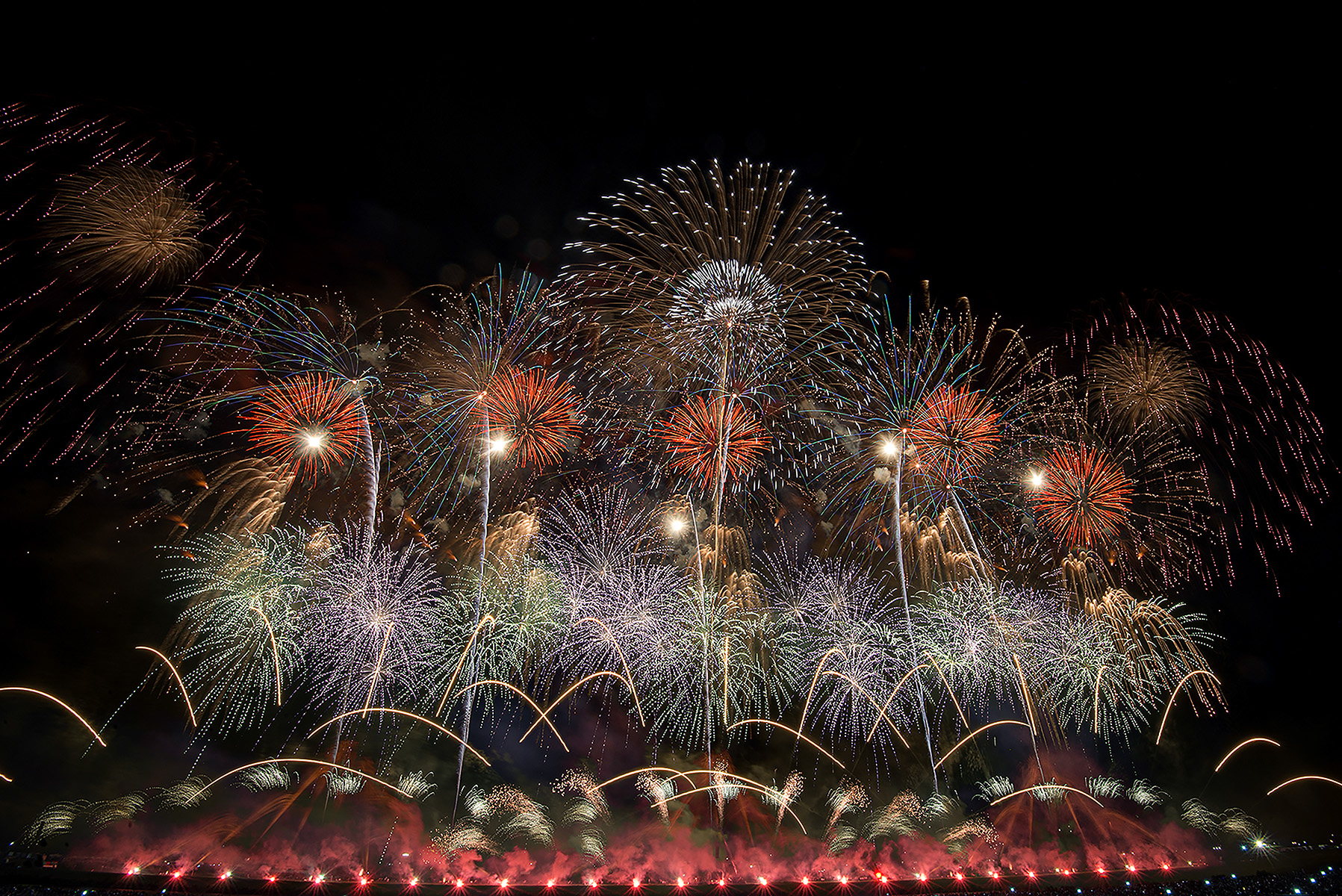
The evening competition tests the precision of large spherical shells. Their symmetry, layered centres, colour transitions and timing reveal differences that are difficult to appreciate at a shorter urban display.
Freestyle and Creative Fireworks
Freestyle entries allow pyrotechnicians to depart from the traditional sphere and create more experimental forms. The creative programme combines fireworks, rhythm and wider sequences, giving each company a recognisable artistic identity.
The Competition Sponsor Display
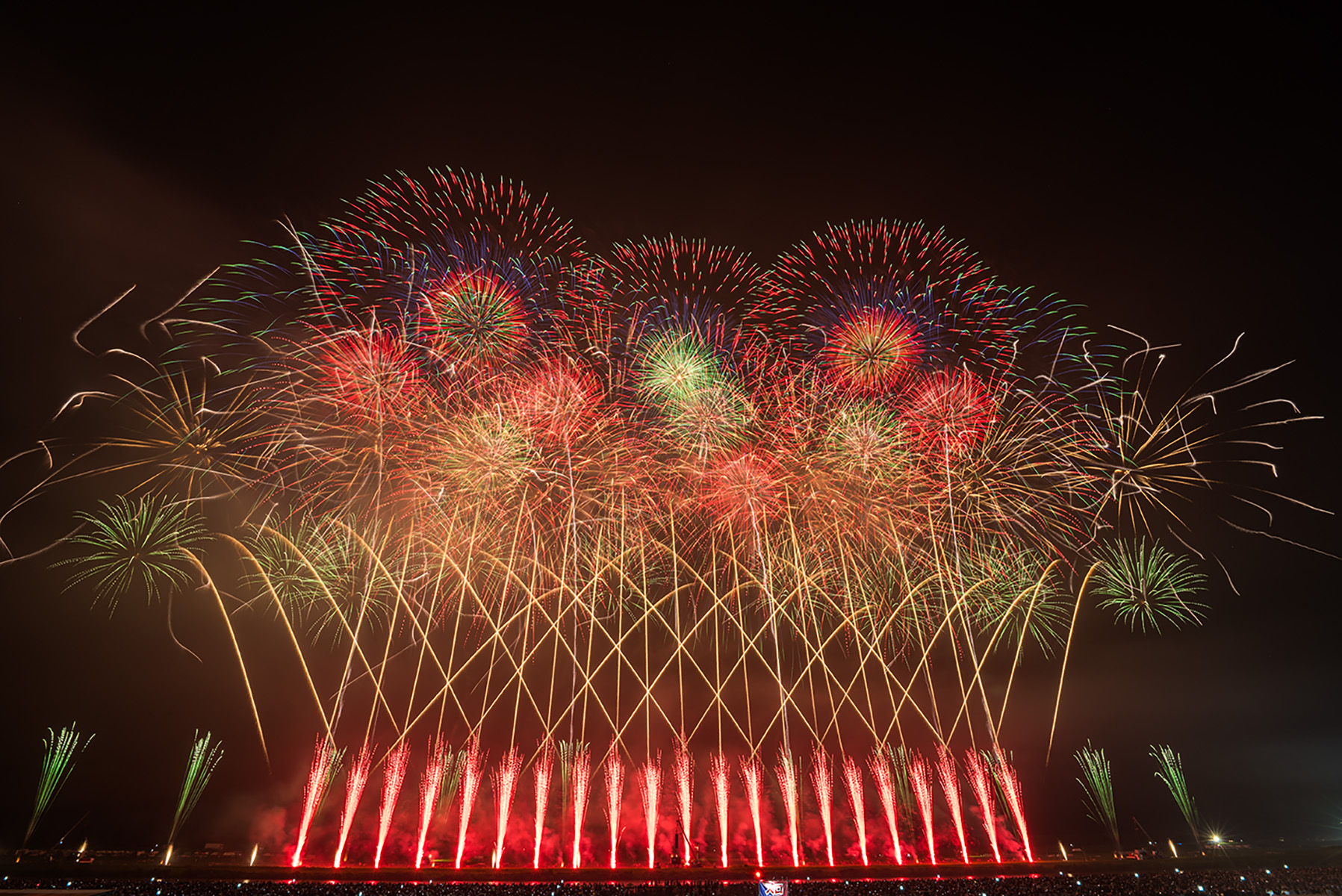
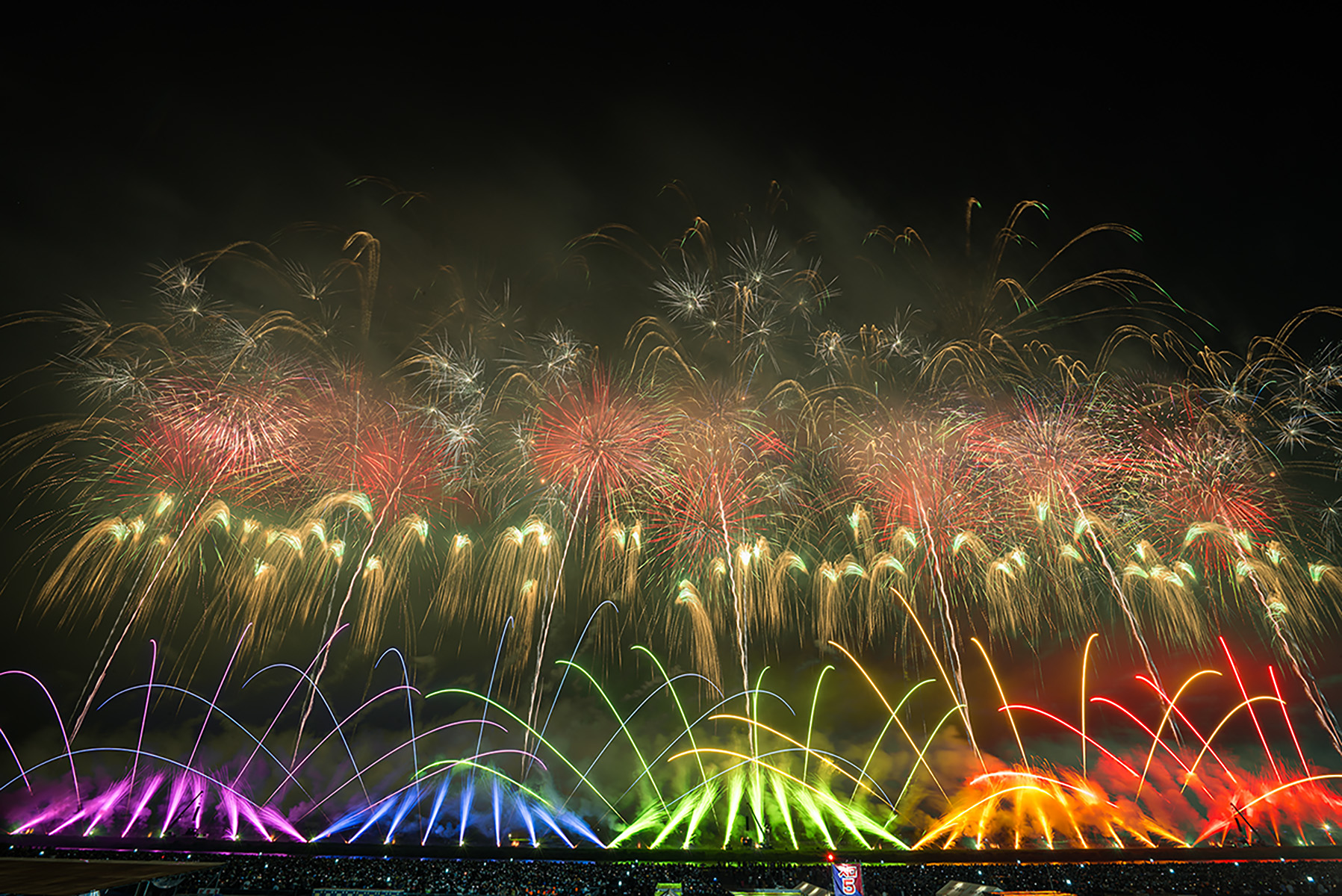
The large organiser-produced display is one of the emotional peaks of the evening. Its scale makes the riverside venue particularly rewarding: effects can stretch across a broad launch line instead of appearing from a single compact barge or launch point.
Families, Older Travellers and Accessibility
Visiting with Children
School-age children who enjoy fireworks can find Omagari memorable, but families should plan for heat, noise, toilet queues, a long seated period and a late return. Hearing protection is sensible for young children because the riverside seating is close enough for the sound to be physically powerful.
A leisure-sheet area gives children space within the allocated section, but adults must be comfortable sitting low for several hours. A table seat can be easier for meals and organisation. Bring enough drinks and familiar snacks rather than depending entirely on festival-stall queues.
Travelling with a toddler is possible but demanding. The official guide does not explicitly classify ordinary strollers, yet dense pedestrian routes and uneven or muddy ground can make one difficult to use. Avoid bringing a wagon or cart, both of which are prohibited.
Older Travellers
The event is suitable for an active older traveller who can walk at least 4 km across the arrival and return journeys and remain outdoors for most of the afternoon and evening. The more difficult section is the post-show walk, when the pace is controlled by the crowd.
Choose a chair or table seat rather than a leisure sheet, allow a late return train, and consider Morioka bus transport when the package details provide a more manageable journey. Do not select the closest car park on the assumption that it guarantees an early departure.
Wheelchair Users
The summer competition provides dedicated wheelchair seating through a separate advance application. For the 2026 event, the application period was 27 May–10 June. This makes last-minute wheelchair-seat planning unrealistic.
Accessible seating does not remove the need to plan transport through a very crowded city. Contact the organiser before committing to the journey if assistance, accessible toilets or a particular arrival route is essential.
Weather, Rain and Cancellation
Light rain does not automatically cancel the event. Weather, river conditions and venue recovery requirements determine whether the competition proceeds, is postponed or is rescheduled.
Do not rely on an umbrella inside the viewing area. An open umbrella blocks other spectators and is discouraged during the programme. Bring a properly fitted rain jacket or poncho, waterproof protection for belongings and footwear that can cope with wet or muddy ground.
Official tickets remain valid when the event is postponed. Personal travel losses, such as an unused hotel or transport booking, are separate from the event-ticket policy. Flexible accommodation and a backup day therefore have real value when the forecast is uncertain.
Check the organiser’s website, official app and social accounts on the travel date rather than relying on an old weather article.
What to Bring
- Printed or correctly stored event ticket
- Reserved-train ticket, including any required paper issue
- Rain jacket or poncho
- Waterproof bag or covers for valuables
- Drinking water and heat protection
- Portable battery
- Small towel and wet wipes
- Insect repellent
- Hearing protection for children
- Toilet paper and tissues
- Comfortable shoes that can become dirty
- A light layer for the late-night return
The toilet-paper point is not a generic festival suggestion. Temporary toilets at the summer competition do not provide it, so visitors are specifically advised to bring their own.
Avoid wearing delicate clothing. Firework residue or dye can fall onto the audience area, while rain can make the riverbank dirty. Chairs and tables are also prohibited unless the selected seat category specifically permits them within its allocated space.
Photography Advice
A smartphone or handheld camera can be used from an ordinary seat as long as it does not obstruct neighbouring spectators. A large tripod or monopod requires a designated photographer seat.
For a full fireworks arc, use a wide lens and include enough empty sky above the launch line. Omagari sequences can spread much farther horizontally than expected, so framing too tightly before the first large display is a common mistake.
Protect the camera from rain and condensation, and practise changing settings without brightening the screen excessively. Remember that photographers still face the same station walk and late transport problem; a heavy equipment case will slow the exit.

Where to Stay for Omagari Fireworks Festival
| Base | Why choose it | Main drawback | Best for |
|---|---|---|---|
| Omagari | Closest to the venue and no intercity return after the show | Very limited availability and rooms disappear early | Travellers booking far in advance |
| Yokote | Short regional journey with numerous additional festival trains | Smaller accommodation supply | Visitors prioritising the shortest practical rail return |
| Akita City | Broader hotel choice and direct Shinkansen or local services | Late trains and a longer return than Yokote | Travellers continuing around Akita Prefecture |
| Morioka | Large hotel supply, Shinkansen connections and a Klook round-trip bus option | Longer journey and potentially very late return | International visitors and wider Tohoku itineraries |
| Kakunodate or Tazawako | Can be combined with a scenic Akita itinerary | Fewer rooms and crowded late trains | Two- or three-day regional trips |
| Sendai | Large city with extensive accommodation | The direct late train leaves too soon after the finale for a relaxed exit | Visitors prepared to leave the display early |
Reserve the hotel before purchasing non-refundable long-distance transport. Hotels close to Omagari commonly fill months ahead, and even official event-accommodation schemes can close applications well before August.
The most balanced choice for many overseas visitors is Morioka, especially when a round-trip bus package remains available. Yokote is more efficient geographically but offers less hotel inventory. Akita City works well for travellers continuing toward the Oga Peninsula or northern Akita.
Nearby Attractions and a Two-Day Itinerary
Hanabi-Amu Fireworks Museum
Hanabi-Amu, the Fireworks Tradition and Culture Preservation Museum, is approximately a ten-minute walk from Omagari Station. Admission is free, and the normal fireworks exhibition area operates from 9:00 AM to 5:00 PM.
However, the museum is not available for ordinary visits on the National Fireworks Competition date. Visit on the previous or following day rather than adding it to the festival schedule. Current details are available on the museum visitor page.
Kakunodate and Lake Tazawa
Kakunodate’s samurai district and Lake Tazawa fit naturally into a wider Akita itinerary, but they should not be squeezed into the afternoon before Omagari. The festival already occupies the full day once transport, entrance and the late exit are included.
Recommended Two-Day Sequence
Day one: Travel to the chosen hotel base in the morning, leave luggage, reach Omagari by early afternoon, enter after 3:00 PM, watch both competitions and return on a conservatively timed train or organised bus.
Day two: Visit Hanabi-Amu if returning through Omagari, or continue to Kakunodate, Lake Tazawa, Akita City or Morioka depending on the hotel base.
This sequence is less rushed than attempting sightseeing, hotel check-in, ticket collection and the fireworks on the same afternoon.
Common Mistakes to Avoid
- Assuming the venue is free: all official viewing areas require tickets.
- Arriving without a ticket: the official in-person sale was held in July, not at the gate.
- Taking a train that reaches Omagari after 4:00 PM: the 2 km walk and entrance search leave little margin before the daytime programme.
- Choosing the first return train shown: some departures occur before the 9:30 PM finish or too soon afterwards.
- Expecting a 30-minute return walk: that estimate does not include the full post-show crowd.
- Booking Tokyo as the same-night destination: a full-show return is generally impractical.
- Assuming every special train accepts mobile tickets: several require paper issue or a different booking channel.
- Planning to use the Kitakami Line specials: those services have been withdrawn.
- Using city buses as a backup: circular services are suspended on the festival date.
- Driving to the closest car park: restricted-zone vehicles may be unable to leave until midnight.
- Buying a leisure sheet solely because it is inexpensive: it may be uncomfortable for a long outdoor programme.
- Bringing a tripod to a normal seat: large supports are limited to photographer seating.
- Forgetting toilet paper: the summer temporary toilets do not supply it.
- Planning Hanabi-Amu on the event date: the museum is unavailable for ordinary visits that day.
Recommended Booking Combinations
Independent Traveller Already in Japan
Choose an official chair, pair or group seat during the stated sale period, reserve a late JR service and stay in Yokote, Akita or Morioka. Direct purchase is preferable when the exact official seat category matters more than English-language booking support.
Overseas Traveller Staying in Morioka
Compare Klook’s round-trip bus and viewing-ticket package with the cost and availability of separate tickets and JR transport. The package is most useful when it removes both the overseas-purchase barrier and the need to compete for a post-show train.
Wider Tohoku Rail Itinerary
Use an official or Klook event ticket, stay in Morioka or Akita, and calculate whether a five- or ten-day JR East Pass is justified by the complete route. The pass is intended for multiple intercity journeys, not merely for avoiding a single Omagari fare.
Family or Older-Traveller Group
Prioritise a table or chair arrangement and a return time with a generous buffer. Consider the Morioka bus package when the meeting and return arrangements are suitable. The cheapest seating and earliest train are rarely the easiest combination for this group.
Frequently Asked Questions
Is Omagari Fireworks Festival free?
No. Every viewing area inside Omagari Hanabi Park requires a paid ticket. Do not rely on older English guides describing the summer competition as free.
When is Omagari Fireworks Festival 2026?
The 98th National Fireworks Competition is scheduled for Saturday, 29 August 2026. Daytime fireworks run from 5:10 PM to 6:00 PM and the evening competition from 7:00 PM to 9:30 PM.
Can international visitors buy official tickets from overseas?
The organiser currently states that its official tickets cannot be purchased from overseas. Klook’s Omagari product may provide an alternative when the selected 2026 package remains available.
Can I buy a ticket at the venue on the event date?
Do not expect event-day sales. The official in-person sale was held separately on 5 July 2026, while the online periods ended before August.
How far is the venue from Omagari Station?
The official distance is approximately 2 km, normally described as a 30-minute walk. Allow substantially longer after the finale because of crowd control and station queues.
Can I visit from Tokyo as a day trip?
You can reach the event from Tokyo on the same day, but returning to Tokyo after watching the full programme is not practical. Stay overnight in Yokote, Akita, Morioka or another city on the special-train network.
Which seat is best for a first-time visitor?
A chair seat is the simplest choice for one person, while a pair bench suits most couples. Groups should compare a leisure sheet with table seating based on comfort rather than price alone.
Is the festival suitable for young children?
It can suit school-age children who tolerate loud noise, heat, crowds and a late return. Toddlers require considerably more preparation because the journey includes a long outdoor wait and crowded walking routes.
Can I bring a tripod?
A large tripod or monopod is permitted only in the designated photographer seating. It is prohibited in ordinary viewing areas.
What happens if it rains?
Light rain does not automatically stop the event. Bring rainwear rather than an umbrella. The competition may be postponed when weather or river conditions make the venue unsafe.
Should I drive?
Train travel or park-and-ride is more practical. Central roads are restricted, severe congestion can continue into the early morning, and some nearby car parks cannot be exited until midnight.
Are there trains after the fireworks?
Yes. JR East operates numerous special trains toward Morioka, Akita, Yokote and other destinations. Select a service that leaves enough time for the post-show walk, and check whether the particular train requires a paper ticket.
Is the Klook Morioka bus package worth considering?
It makes sense when you are staying in Morioka, cannot use the official overseas ticket route, or want to avoid the post-show train queue. Confirm the seat type, meeting point, return time and cancellation terms for the selected package.
Final Verdict
Omagari Fireworks Festival 2026 is one of Japan’s most rewarding fireworks journeys when it is planned as a complete regional trip. The combination of daytime fireworks, judged night-time entries and wide-scale special displays offers more artistic variety than a conventional city festival.
The trip succeeds or fails on logistics. Secure a legitimate paid seat, arrive before mid-afternoon, stay overnight in a city served by late transport and avoid choosing a return departure that assumes an empty 30-minute walk to Omagari Station.
For travellers able to purchase directly in Japan, the official ticket channels provide the widest seat choice. For overseas visitors or travellers based in Morioka, Klook’s viewing-ticket and bus options can solve a genuine booking or transport problem, provided the exact package conditions are checked before payment.
[1]: https://www.omagari-hanabi.com/guide “https://www.omagari-hanabi.com/guide”[2]: https://www.omagari-hanabi.com/en/access “https://www.omagari-hanabi.com/en/access”
[3]: https://www.omagari-hanabi.com/en/tickets/summer “https://www.omagari-hanabi.com/en/tickets/summer”
[4]: https://www.omagari-hanabi.com/en/overview/summer “https://www.omagari-hanabi.com/en/overview/summer”
[5]: https://www.klook.com/en-SG/activity/194167-omagari-fireworks-viewing-ticket/ “https://www.klook.com/en-SG/activity/194167-omagari-fireworks-viewing-ticket/”
[6]: https://www.jreast.co.jp/press/2026/akita_j/20260717_a01.pdf “https://www.jreast.co.jp/press/2026/akita_j/20260717_a01.pdf”
[7]: https://www.city.daisen.lg.jp/archive/contents-10273 “https://www.city.daisen.lg.jp/archive/contents-10273”
[8]: https://www.city.daisen.lg.jp/archive/p20260626101419 “https://www.city.daisen.lg.jp/archive/p20260626101419”
[9]: https://daisen-public.lgwan.torapants.net/open-data/dataset/3885a2f0-344b-4914-b248-a9f120977c97 “https://daisen-public.lgwan.torapants.net/open-data/dataset/3885a2f0-344b-4914-b248-a9f120977c97”