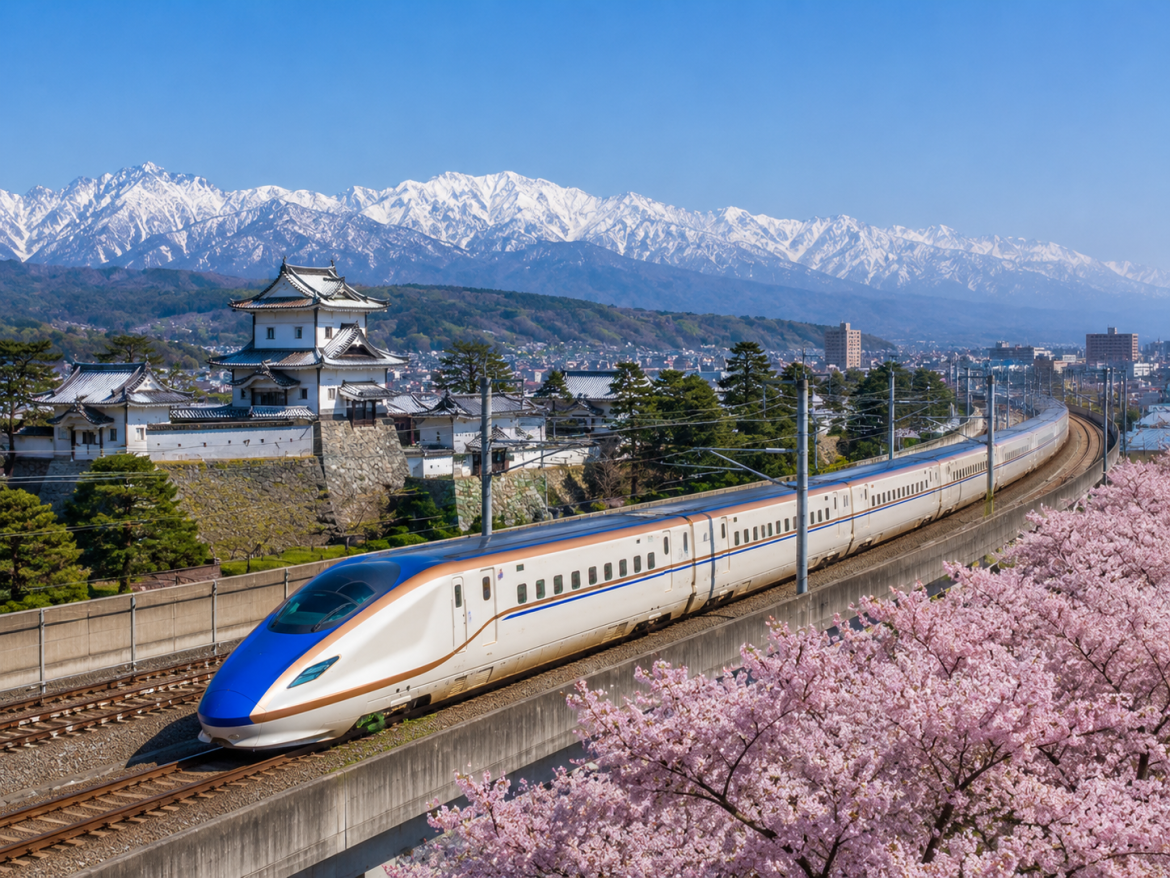
The fastest way to travel from Osaka to Kanazawa is by limited express train and Hokuriku Shinkansen. The journey is comfortable and can take approximately 2 hours 10 minutes on the best connections, making Kanazawa a realistic addition to a Kansai itinerary.
The most important change for first-time visitors is that Thunderbird trains no longer continue directly from Osaka to Kanazawa. You now travel from Osaka or Shin-Osaka to Tsuruga on the Thunderbird, transfer inside Tsuruga Station, and continue to Kanazawa on the Hokuriku Shinkansen.
The transfer is designed as part of the regular route and is not especially difficult for most travelers. However, a short connection can feel rushed if you are carrying several suitcases, traveling with a stroller or accompanying someone who walks slowly. Choosing the right departure and ticket is therefore more important than simply selecting the shortest journey shown by a route-planning app.
For most first-time visitors, the best option is a reserved rail ticket from Osaka or Shin-Osaka to Kanazawa. A highway bus is cheaper but takes considerably longer. Driving makes sense mainly when Kanazawa is part of a wider road trip through Fukui, the Noto area or rural Hokuriku.
Before choosing your departure station, see the Osaka transportation guide. Travelers spending several days in the city can also use the Osaka travel guide to decide whether Kanazawa fits better at the beginning or end of the Kansai portion of the trip.

Osaka to Kanazawa: Quick Recommendation
| Question | Practical Answer |
|---|---|
| Is Kanazawa worth adding to an Osaka trip? | Yes, especially for travelers interested in traditional districts, gardens, seafood, samurai history and regional crafts. |
| Best transport | Thunderbird to Tsuruga, then Hokuriku Shinkansen to Kanazawa. |
| Fastest journey | Approximately 2 hours 10 minutes on the best connections; allow up to around 2 hours 40 minutes for many practical departures. |
| Regular reserved fare | Usually around ¥9,400–¥9,800, depending on the train and booking conditions. |
| Cheaper visitor ticket | The HOKURIKU One-way Ticket can reduce the adult fare to ¥8,000 for eligible foreign visitors. |
| Cheapest rail option | An advance e5489 ticketless fare may be cheaper, but it requires correct IC-card registration and advance booking. |
| Cheapest simple option | Highway bus, normally around ¥2,500–¥6,800 (West Japan JR Bus daytime four-row seats) for many daytime services. |
| Transfer required? | Yes. One transfer at Tsuruga is required for the standard rail route. |
| Reservation required? | Thunderbird uses reserved seating, so secure a seat before boarding. |
| Suitable as a day trip? | Technically possible, but rushed. One night in Kanazawa is strongly recommended. |
| Suitable for children? | Yes, but choose a connection with sufficient transfer time and avoid carrying too much luggage. |
| Suitable for senior travelers? | Generally yes. A 15–25 minute connection is more comfortable than the shortest scheduled transfer. |
| Best pass for a round trip | JR Kansai-Hokuriku Area Pass, when combined with additional covered rail travel. |
| Pass to compare for continuing to Tokyo | Hokuriku Arch Pass, particularly for an Osaka–Kanazawa–Tokyo open-jaw itinerary. |
Is Kanazawa Worth Visiting from Osaka?
Kanazawa is worth adding if you want a destination that feels different from Osaka and Kyoto without requiring a domestic flight. Its main attractions include Kenrokuen Garden, Kanazawa Castle Park, Higashi Chaya District, Omicho Market, the Nagamachi samurai district and several museums within a relatively compact urban area.
It is especially suitable for travelers who enjoy traditional streets, landscaped gardens, seafood, Japanese crafts and slower city exploration. Kanazawa also works well as a gateway to Shirakawa-go, Toyama and the wider Hokuriku region.
Travelers whose itinerary already includes only two or three days in Kansai may prefer to keep their time in Osaka and Kyoto. Although the train is fast, a same-day round trip consumes more than four hours in intercity travel before local buses and sightseeing are included.
For a balanced trip, stay at least one night. Arrive before lunch, explore the market and central districts in the afternoon, then visit Kenrokuen and the castle area the following morning.
The Important Route Change: There Is No Direct Thunderbird to Kanazawa
Many older guides describe a direct Thunderbird limited express from Osaka to Kanazawa. That information is outdated.
The current standard route is:
Osaka Station or Shin-Osaka Station → Thunderbird limited express → Tsuruga Station → Hokuriku Shinkansen → Kanazawa Station
The transfer at Tsuruga is now part of the normal Osaka–Kanazawa journey. Train schedules are usually coordinated, and station signs direct passengers between the limited express and Shinkansen areas.
The shortest transfer may be approximately eight to ten minutes. That is normally enough for an able-bodied traveler carrying a small suitcase, but it is not the only connection available. Families, senior travelers and passengers with several bags should select a schedule with approximately 15–25 minutes at Tsuruga.
Transport Comparison: Train, Bus or Car?
| Method | Typical Time | Typical Cost | Transfers | Best For | Main Drawback |
|---|---|---|---|---|---|
| Thunderbird + Hokuriku Shinkansen | About 2 hours 10–40 minutes | About ¥9,400–¥9,800 regular fare | One at Tsuruga | Most visitors, short trips and comfortable travel | More expensive than the bus |
| HOKURIKU One-way Ticket | Same train journey | ¥8,000 adult | One at Tsuruga | Eligible foreign visitors making a one-way journey | Must be arranged through an eligible overseas channel before entering Japan |
| Advance e5489 ticketless fare | Same train journey | Reference total from about ¥6,710 | One at Tsuruga | Travelers comfortable with Japanese rail booking systems and IC-card registration | More complicated conditions |
| Daytime highway bus | About 5.5–6.5 hours | Often about ¥2,500–¥6,800 (West Japan JR Bus daytime four-row seats) | Usually direct | Budget travelers with flexible schedules | Traffic delays and a long seated journey |
| Overnight bus | About 7 hours or longer | Varies by seat and date | Usually direct | Travelers trying to save a hotel night | Poor sleep and very early arrival |
| Local trains | Usually 4.5–6 hours or longer | Can vary | Several | Rail enthusiasts using a specific pass | Slow and inconvenient with luggage |
| Rental car | Allow around 4–5 hours, longer in congestion | Tolls, fuel and rental fee | None | Groups and regional road trips | Parking, winter conditions and driver fatigue |
Fastest Route: Thunderbird and Hokuriku Shinkansen
Step 1: Board the Thunderbird in Osaka
Travelers staying in Umeda should board at JR Osaka Station. Travelers staying near Shin-Osaka should board there rather than returning to Osaka Station.
Check the departure board for a Thunderbird service bound for Tsuruga. Because the train uses reserved seating, confirm your train number, carriage and seat before going to the platform.
Step 2: Travel from Osaka to Tsuruga
The Thunderbird journey from Osaka to Tsuruga takes approximately 1 hour 20 minutes on a typical coordinated connection. The train also stops at Shin-Osaka and Kyoto, so travelers already staying in Kyoto should board there instead of traveling back to Osaka.
Passengers planning a Kansai side trip before Kanazawa can compare the route with the Osaka to Kyoto transportation guide.
Step 3: Transfer at Tsuruga Station
After leaving the Thunderbird, follow signs for the Hokuriku Shinkansen transfer. The transfer remains inside the station, so you do not need to exit to the street or find another building.
The limited express and Shinkansen platforms are on different levels. Escalators and elevators are available, but reaching an elevator may take longer than following the main escalator route.
At the transfer gate:
- When using multiple paper tickets, insert the required tickets together as instructed.
- When using an IC-card and ticket combination, follow the gate instructions for your specific ticket arrangement.
- Do not exit through the normal street-facing ticket gate unless your ticket requires it.
- Keep every ticket returned by the gate until the journey is complete.
Step 4: Board the Hokuriku Shinkansen
Continue from Tsuruga to Kanazawa on the Hokuriku Shinkansen. Depending on the connection, the train may be a Tsurugi, Hakutaka or Kagayaki service.
The Shinkansen portion commonly takes approximately 40–50 minutes. Check the destination, train number and reserved-seat carriage rather than relying only on the train name.
Step 5: Arrive at Kanazawa Station
Kanazawa Station is the city’s main transport hub, but it is not directly beside Kenrokuen or Higashi Chaya District. Allow another 10–20 minutes for a local bus journey, waiting time and walking.
Most sightseeing buses leave from the Kenrokuen Exit, also known as the east side. Some highway buses use the Kanazawa Port Gate on the west side, so do not assume every arrival uses the same exit.
How Difficult Is the Tsuruga Transfer?
For most independent travelers, the transfer is straightforward. The railway has been designed around passengers changing between the Thunderbird and the Hokuriku Shinkansen, and English signage is available.
The difficulty comes from speed rather than navigation. A short scheduled transfer may require passengers to leave the train promptly, follow the main flow, pass the transfer gate and reach the correct Shinkansen carriage without stopping.
| Traveler Type | Suggested Transfer Time | Reason |
|---|---|---|
| Solo traveler with a backpack | About 8–12 minutes may be manageable | Easy to follow the main passenger flow |
| Traveler with one wheeled suitcase | About 12–15 minutes | Allows time for gates and platform movement |
| Family with children | About 15–20 minutes | Children may need the washroom or walk more slowly |
| Stroller user | About 20–25 minutes | Elevator access may add walking and waiting time |
| Senior traveler | About 20–25 minutes | Avoids pressure on escalators and long corridors |
| Several large suitcases | At least 20 minutes | Boarding and moving between levels take longer |
Do not deliberately choose the shortest connection simply to save ten minutes overall. A slightly longer transfer usually produces a more comfortable journey without materially changing the sightseeing schedule.
The suggested longer margins above are comfort recommendations, not a railway guarantee. For step-free travel, ask JR to arrange assistance and a suitable connection. Use JR West’s Tsuruga transfer map and guide: conventional limited expresses use the lower level, the transfer gates are on the middle level, and Shinkansen platforms are above. Stay inside the transfer route. If an incoming train is delayed, ask staff about the connection rather than assuming the onward train must wait.
Osaka to Kanazawa Train Tickets and Reservations
Regular Reserved Ticket
A regular reserved-seat journey normally costs approximately ¥9,400–¥9,800. The precise amount depends on the train, reservation conditions and any fare revisions.
This is the easiest arrangement for travelers who:
- Want to buy at a JR station after arriving in Japan
- Do not qualify for a visitor-only discount ticket
- Need flexibility regarding the travel date
- Want staff assistance at a ticket office
Ask for one complete journey from Osaka or Shin-Osaka to Kanazawa. Do not buy the Thunderbird and Shinkansen portions separately unless there is a specific reason.
HOKURIKU One-way Ticket
The HOKURIKU One-way Ticket costs ¥8,000 for an adult and ¥4,000 for a child between Osaka City and Kanazawa. It covers the relevant Thunderbird and Hokuriku Shinkansen journey and can represent a useful saving over the regular reserved fare.
However, it is not a universal tourist ticket. It is intended for eligible foreign-passport holders entering Japan with Temporary Visitor status and must be purchased through an eligible overseas sales channel before entering Japan. It is not normally something to leave until arrival in Osaka.
This ticket is best for a traveler making a one-way journey from Osaka to Kanazawa without needing unlimited regional travel. It does not allow sightseeing stopovers along the route; exiting midway generally ends the remaining validity.
The Klook rail product below is designed for travel between Osaka or Kyoto and Kanazawa and includes the Tsuruga connection. Check the package conditions and redemption procedure for your travel date before booking.
e5489 North/Kansai Ticketless Fare
JR West’s ticketless products may reduce the Osaka–Kanazawa fare. A current reference total for the standard ticketless arrangement is approximately ¥8,500, while a seven-day advance product can reduce the reference total to approximately ¥6,710.
The lower figure is attractive, but this option is not automatically the best choice for every overseas visitor. It may require:
- An e5489 online reservation
- A registered transport IC card
- Sufficient IC-card balance for the required base-fare portion
- Purchase by the specified advance deadline
- Correct understanding of which part is ticketless and which part is paid by IC card
Choose it when you are comfortable using JR West’s booking system and your travel date is fixed. For a first visit with several passengers, the visitor one-way ticket or a regular complete ticket may be easier to manage.
You can also check Osaka to Kanazawa train schedules and ticket options before deciding between a single ticket and a multi-day pass.
How Early Should You Reserve?
JR reservations generally open one month before departure at 10:00 Japan time. You do not need to book immediately for an ordinary weekday, but advance reservation is sensible for:
- Japanese public holidays
- Friday evenings
- Sunday afternoons and evenings
- Cherry blossom and autumn foliage periods
- New Year travel
- Groups wanting adjacent seats
- Travelers with a fixed onward bus or hotel check-in plan
Compare complete fares, not just the online supplement
Use roughly ¥9,400–¥9,800 only as a budget allowance for ordinary reserved tickets; obtain the current full fare for your date and seat arrangement when booking. JR West lists the standard Hokuriku–Kansai Ticketless product at ¥6,190 plus ¥2,310 Osaka–Tsuruga base fare, totaling ¥8,500. Early7 is ¥4,400 plus that ¥2,310, totaling ¥6,710. Register an eligible IC card for each traveler and load enough balance for the conventional-line fare. These are JR West products, distinct from JR East’s retired Tokudane1/14 discounts.
Early7 requires purchase by seven days before departure and is currently published for travel through March 31, 2027. Consult the official Early7 conditions, including changes, cancellation and ticket collection, before committing to a fixed train.
Which JR Pass Is Best?
JR Kansai-Hokuriku Area Pass
The seven-day JR Kansai-Hokuriku Area Pass costs ¥19,000 for an adult and ¥9,500 for a child. It covers reserved seats on the Thunderbird and the eligible Hokuriku Shinkansen section, along with other JR services in the designated Kansai and Hokuriku area.
The pass is not necessary for a single Osaka-to-Kanazawa trip. It becomes more useful when your itinerary includes several covered journeys, such as:
- Osaka → Kanazawa → Osaka
- Osaka → Kanazawa → Toyama → Kansai
- Kyoto → Kanazawa → Fukui → Osaka
- Kansai Airport → Osaka or Kyoto → Kanazawa → Kansai Airport
Because a regular Osaka–Kanazawa round trip can approach the pass price, even one or two additional covered journeys may make the pass worthwhile. Always compare the exact routes rather than buying it only because it has “Hokuriku” in the name.
Hokuriku Arch Pass
The seven-day Hokuriku Arch Pass costs ¥35,000 for an adult and ¥17,500 for a child following its 2026 price revision. It links the Kansai region with Tokyo through the Hokuriku corridor.
This pass is most relevant for an itinerary such as:
Osaka or Kyoto → Kanazawa → Toyama → Nagano → Tokyo
It is usually poor value for a simple Osaka–Kanazawa round trip. Its strength is avoiding a return to Kansai while covering an onward journey to Tokyo through Hokuriku.
Travelers comparing an open-jaw itinerary can also review the Tokyo to Osaka transportation guide to understand the alternative Tokaido Shinkansen route.
Nationwide Japan Rail Pass
The nationwide Japan Rail Pass covers the JR route between Osaka and Kanazawa, including the Thunderbird and eligible Hokuriku Shinkansen services.
However, buying a nationwide pass solely for Osaka to Kanazawa is not economical. It should be considered only when the same trip also includes several long-distance journeys in other regions.
Hokuriku Area Pass
The Hokuriku Area Pass is useful for local travel after reaching the Hokuriku region, but it does not cover the full Osaka-to-Tsuruga portion. It is not a complete Osaka-to-Kanazawa ticket.
Pass boundaries and a realistic break-even check
The Kansai-Hokuriku Area Pass reaches Joetsu-Myoko on the Hokuriku Shinkansen, not Tokyo. It excludes the Tokaido Shinkansen, Osaka Metro and highway buses. It requires a foreign passport and Temporary Visitor status. Its limited third-party railway exceptions do not make every former JR local line free.
Compare the ¥19,000 pass with the fares you can actually buy: two eligible ¥8,000 one-way tickets total ¥16,000, and two available Early7 journeys total ¥13,420. Add only covered journeys you genuinely plan to make. Likewise, Osaka–Kanazawa–Tokyo can suit the ¥35,000 Arch Pass geographically but still cost less on individual tickets. The pass does not include Shirakawa-go buses or Kanazawa’s Loop Bus.
For a Kanazawa–Shirakawa-go–Takayama–Nagoya loop, compare the Takayama-Hokuriku Area Tourist Pass and its specific covered buses instead. For travel extending to Hiroshima or Hakata, the JR-WEST All Area Pass is a separate comparison. The nationwide ordinary seven-day JR PASS costs ¥50,000 on the official Reservation website; overseas-agent sales are ¥53,000 from October 1, 2026.
Where to Board in Osaka
From Umeda or Osaka Station
Board the Thunderbird directly at JR Osaka Station. This is the simplest option for travelers staying around Umeda, Kitashinchi, Osaka Station City or nearby business hotels.
Osaka Station is large, so arrive approximately 20–30 minutes before departure if you need to collect tickets, buy food or find the correct platform.
From Shin-Osaka
Board the Thunderbird directly at Shin-Osaka. There is no reason to travel south to Osaka Station and then return north on the same limited express route.
Shin-Osaka is particularly convenient for travelers arriving from another city by Shinkansen or staying near the station for an early departure.
From Namba or Shinsaibashi
For the train, take the Osaka Metro Midosuji Line to Umeda or Shin-Osaka. Umeda is closer, but Shin-Osaka may be easier for some travelers because the transfer from the subway to JR platforms can feel more direct than navigating the Osaka–Umeda station complex.
For the highway bus, Namba OCAT may be more convenient than traveling to Osaka Station. Confirm the exact terminal because not every Kanazawa bus departs from OCAT.
From Tennoji
Travel by JR or Osaka Metro to Osaka Station or Shin-Osaka, then board the Thunderbird. Allow enough time to move from the local platform to the limited express platform.
From Universal Studios Japan
Travel from Universal City to Osaka Station by JR, usually changing at Nishikujo, then board the Thunderbird. Avoid booking a very tight connection after a full day at the theme park.
Kansai Airport to Kanazawa
The most convenient rail route from Kansai International Airport is generally:
Kansai Airport → Haruka limited express → Shin-Osaka → Thunderbird → Tsuruga → Hokuriku Shinkansen → Kanazawa
The total journey usually takes approximately 3.5–4 hours depending on connections. Shin-Osaka is often easier than transferring through Osaka Station because the Haruka and Thunderbird both serve Shin-Osaka and you avoid navigating between the Umeda station buildings.
Do not book a short connection immediately after an international flight. Immigration, baggage collection and flight delays are unpredictable. Allow a substantial buffer or stay in Osaka for the first night.
Highway Bus from Osaka to Kanazawa
A highway bus is the main budget alternative to the train. Daytime journeys commonly take approximately 5.5–6.5 hours, while overnight services may take seven hours or longer.
Fares vary according to:
- Travel date
- Daytime or overnight departure
- Four-row or three-row seating
- Reclining and privacy features
- Refund and change conditions
- How early the ticket is booked
Budget daytime seats may be available around ¥2,500–¥6,800 (West Japan JR Bus daytime four-row seats), while more comfortable overnight seats can cost considerably more.
Possible Osaka Departure Terminals
Depending on the operator and service, buses may depart from:
- Osaka Station JR Expressway Bus Terminal
- Higashi-Umeda
- Namba OCAT
- Kintetsu Uehommachi
- Kyoto Station Hachijo Exit on services that continue through Kyoto
Do not search only for “Osaka bus terminal.” Confirm the full terminal name, boarding bay and departure time shown on the actual reservation.
Kanazawa Arrival Point
Most intercity buses arrive around Kanazawa Station, but the exact side of the station may differ. Some use the Kanazawa Port Gate on the west side rather than the Kenrokuen Exit used by many sightseeing buses.
Who Should Take the Bus?
The bus suits:
- Solo budget travelers
- Travelers with no fixed arrival-day reservation
- Passengers who prefer a direct ride over a train transfer
- Travelers using an overnight service to reduce accommodation costs
It is less suitable for families with restless children, passengers prone to motion sickness, travelers arriving for a timed museum reservation, and anyone who finds prolonged sitting uncomfortable.
Check the dated West Japan JR Bus route timetable and fare calendar; the linked timetable is the Osaka-bound direction, so select the reverse direction when leaving Osaka. The price ranges above are planning examples, not a guaranteed minimum or upper limit.
Should You Take Local Trains?
It is technically possible to travel using slower regional trains, but the journey normally requires several transfers and takes much longer than the Thunderbird–Shinkansen route.
Local trains make sense mainly for a rail enthusiast, a traveler using a pass with a specific objective, or someone deliberately stopping in places such as Hikone, Nagahama, Tsuruga or Fukui.
For ordinary point-to-point travel, the modest fare saving is usually not worth the inconvenience. The cheapest advance ticketless limited-express fare may also be competitive with a complicated local-train itinerary.
Driving from Osaka to Kanazawa
Driving takes around 4–5 hours as a planning allowance, with more time for traffic, breaks and winter conditions. A common expressway route connects the Osaka area with the Hokuriku region via the Maibara direction.
A rental car is useful when:
- Three or four travelers can share the cost
- The trip includes rural Fukui or Ishikawa
- You plan to visit places poorly served by public transport
- You want to continue into the Noto region
- You are carrying specialist equipment or substantial luggage
Driving is not necessary for a city-only Kanazawa visit. Parking near popular districts may be inconvenient, and the central sights are better explored by bus and on foot.
Winter driving requires particular caution. Snow, ice, reduced visibility and temporary expressway restrictions can significantly change the journey. Travelers without winter-driving experience should use the train.
Private transfers and rail-inclusive day tours
A cross-region private transfer needs a specific Osaka-to-Kanazawa quote. A normal Osaka city charter listing is not proof that this journey is included. Confirm the total for tolls, parking, overtime, luggage capacity and any return-to-base charge. A larger family group may value hotel-to-hotel travel, but a couple will normally find rail substantially more practical.
Some Kanazawa and Shirakawa-go tours offer optional rail access from Kansai. Check whether you travel independently by train to a Kanazawa meeting point, the exact included tickets and the return-train arrangements. Do not assume a guide accompanies you from Osaka or that an ordinary Kanazawa-departure tour includes the Osaka rail journey. Staying in Kanazawa before a local tour gives more breathing room.
Arriving at Kanazawa Station: The Last Part of the Journey
Kanazawa Station is approximately two kilometres from the main sightseeing area. Do not assume that leaving the train means you have reached Kenrokuen or the castle.
After arrival, most first-time visitors should head toward the Kenrokuen Exit on the east side. From there, local buses serve Omicho Market, Kanazawa Castle, Kenrokuen, Higashi Chaya District and other central areas.
Central bus fares are generally inexpensive, and a local one-day bus pass may be useful if you plan several rides. Walking from the station to Omicho Market is possible, but continuing on foot to Kenrokuen and Higashi Chaya District can create an unnecessarily tiring first day with luggage.
Leave large suitcases at your hotel or a station locker before sightseeing. For attraction planning, see the complete Kanazawa travel guide.
The Loop Bus leaves east-side bay 7; the adult single fare is ¥220 and the city day pass is ¥800, so four covered ¥220 rides exceed the pass price. Use the official Kanazawa bus map to group sights. Buy the pass before boarding the Loop Bus. The Loop accepts nationwide transport IC cards, but check payment on other local services separately.
Best Departure Time from Osaka
| Departure Period | Advantages | Disadvantages | Best For |
|---|---|---|---|
| Early morning | Reach Kanazawa before lunch and preserve most of the day | Busy Osaka commuter period and an early hotel departure | One-night trips and full sightseeing days |
| Mid-morning | More relaxed breakfast and station transfer | Arrival may be after lunch | Travelers staying two nights |
| Early afternoon | Useful after a final Osaka morning | Limited sightseeing time after arrival | Travelers checking directly into a Kanazawa hotel |
| Evening | Avoids using daytime sightseeing hours | Fewer local attractions and restaurants remain open after arrival | Travelers whose hotel is near Kanazawa Station |
| Late evening | Maximizes the Osaka day | Higher risk if a connection is missed and limited local transport after arrival | Experienced travelers with flexible plans |
For a first visit, leave Osaka between approximately 7:00 and 9:00. This normally allows enough time to leave luggage, eat lunch and explore Omicho Market, Higashi Chaya District or the castle area.
For an evening trip, search Osaka all the way to Kanazawa, not just the last Thunderbird to Tsuruga. The final useful connection depends on both trains and your travel date. After an international flight, allow time for entry formalities and ticket collection; a late Kansai Airport landing is a reason to sleep in Osaka. For the return, reserve an earlier viable train if you must catch a flight the next morning.
Physical Difficulty, Luggage and Accessibility
Walking Distance
The intercity journey itself does not involve outdoor walking between stations. The main physical demand is moving between platforms and levels at Tsuruga.
Large Luggage
Large luggage is manageable, but avoid carrying more than one substantial suitcase per person. Keep bags clear of aisles and doors, and board early enough to store them without delaying other passengers.
Do not assume that every train will have unlimited large-luggage space beside your seat. Smaller bags that fit overhead are easier.
Strollers
A stroller can be used through the stations, and elevators are available. Nevertheless, the elevator route may take longer than the main escalator flow. Select a longer Tsuruga connection and be prepared to fold the stroller when boarding a crowded train.
Wheelchair Users
Major JR stations on this route provide accessible facilities. Passengers requiring boarding assistance should arrange support with JR in advance and avoid the shortest transfer. Staff may recommend a specific connection to allow enough time between trains.
Senior Travelers
The train remains the most comfortable choice for most senior travelers. Reserve seats, choose a longer transfer, and avoid an itinerary that goes directly from the train into several hours of walking around Kenrokuen and the historic districts.
Traveling with Children
The route is generally family-friendly because both main trains have reserved seating and onboard washrooms. The journey is also short enough to be manageable for most school-age children.
Parents should pay attention to:
- Allowing extra transfer time at Tsuruga
- Buying food and drinks before boarding
- Keeping tickets for every family member organized
- Avoiding separate adult and child booking arrangements
- Using the washroom before the transfer
- Not overpacking the stroller basket
Children aged six to eleven generally use a child fare. Younger children may travel free under normal JR conditions when they do not occupy a separate reserved seat, but a child ticket is required when a dedicated reserved seat is needed.
Can You Visit Kanazawa as a Day Trip from Osaka?
Yes, but it is not the best way to experience the city.
Even with the fastest trains, the round trip requires at least approximately 4 hours 20 minutes of intercity travel. After adding hotel-to-station travel in Osaka, the Tsuruga transfers and local buses in Kanazawa, total transport time can approach five to six hours.
Realistic Osaka to Kanazawa Day Trip
07:00–07:30: Depart central Osaka
09:30–10:00: Arrive at Kanazawa Station and travel to Omicho Market
10:15–11:30: Omicho Market and early lunch
11:45–14:00: Kanazawa Castle Park and Kenrokuen
14:15–15:30: Higashi Chaya District
15:45–16:30: Return to Kanazawa Station and buy food or souvenirs
17:00–17:30: Depart Kanazawa
19:30–20:00: Arrive in Osaka
This route covers the main highlights but leaves little room for museums, craft experiences or a relaxed meal. A delay in the morning can affect the entire schedule.
Who Should Avoid the Day Trip?
- Families with preschool children
- Senior travelers who need regular rest
- Travelers wanting to visit the 21st Century Museum
- Food-focused travelers planning a long seafood lunch
- Photographers waiting for evening light
- Visitors combining Kanazawa with Shirakawa-go
Recommended One-Night Kanazawa Itinerary
Day 1: Osaka to Kanazawa and Eastern Districts
07:30–08:30: Depart Osaka or Shin-Osaka
10:00–11:00: Arrive, leave luggage and travel to Omicho Market
11:00–12:30: Market lunch
13:00–14:30: Higashi Chaya District
15:00–16:30: 21st Century Museum or a craft experience
17:00 onward: Check in and eat a relaxed Kanazawa dinner
Day 2: Garden, Castle and Samurai District
08:00–09:30: Kenrokuen before the largest daytime crowds
09:30–11:00: Kanazawa Castle Park
11:30–13:00: Lunch
13:15–14:30: Nagamachi Samurai District
15:00 onward: Return to Kanazawa Station and continue to Osaka, Toyama or Tokyo
This itinerary is more realistic than trying to combine every major sight in a single afternoon.
Combining Kanazawa with Other Destinations
Kanazawa and Shirakawa-go
Kanazawa is one of the main gateways to Shirakawa-go. Highway buses connect the city with the village, but popular departures can sell out during weekends, snow season and autumn foliage periods.
Do not attempt Osaka → Kanazawa → Shirakawa-go → Osaka in one day. A more practical route is:
Day 1: Osaka → Kanazawa sightseeing and overnight stay
Day 2: Kanazawa → Shirakawa-go → Takayama or return to Kanazawa
See the Kanazawa to Shirakawa-go transportation guide and the Shirakawa-go travel guide before booking the bus.
Kanazawa and Fukui
Fukui lies along the same Hokuriku corridor and can be included before or after Kanazawa. This combination is more suitable for a multi-day rail pass than a simple one-way ticket.
Keep at least half a day for a specific Fukui attraction rather than stopping only to justify the pass.
Kanazawa and Toyama
Toyama is easily reached by Hokuriku Shinkansen. The combination is suitable for travelers continuing toward Tateyama, Kurobe Gorge or the Nagano region.
A night in each city is preferable when visiting mountain attractions because seasonal transport schedules may not align with a late departure from Osaka.
Osaka to Kanazawa to Tokyo
This is a geographically natural use of the Hokuriku route, although the Arch Pass still needs a fare comparison. It avoids returning to Osaka and creates a geographically logical journey through central Japan.
Allow at least two nights in Kanazawa if the trip also includes a Shirakawa-go excursion.
Kanazawa Food to Plan Around the Journey
Kanazawa is known for seafood from the Sea of Japan, seasonal crab, sushi, kaisendon seafood bowls, nodoguro, jibuni and wagashi sweets.
Omicho Market
Omicho Market is convenient after a morning arrival from Osaka. It works best for an early lunch, before the most popular seafood restaurants develop long queues or begin selling out of specific items.
The market should not be treated as a late-evening dining area. Many shops focus on daytime trade.
Kanazawa Station
The station complex is convenient for dinner before a return train and for travelers arriving after central market hours. It also offers regional food and souvenir shopping without requiring another bus journey.
Higashi Chaya District
This district is better for tea, sweets and light refreshments than for relying on an improvised full dinner. Some businesses close earlier than restaurants around the station or Katamachi.
Where Should You Stay in Kanazawa?
Near Kanazawa Station
Best for:
- One-night stays
- Early trains or Shirakawa-go buses
- Travelers with large luggage
- Late arrival from Osaka
The disadvantage is that you will normally use a bus to reach the main historical districts.
Near Omicho Market
Best for travelers who want a central location between the station and the castle area. It offers convenient daytime food access and reduces the distance to several central attractions.
Katamachi or Korinbo
Best for restaurants, nightlife and walking access to the castle, Kenrokuen and Nagamachi areas. It is less convenient for an early intercity departure with large luggage.
Do You Need to Stay Overnight?
You do not strictly need to stay overnight, but one night changes the trip from a transport-heavy excursion into a more satisfying city visit. Stay two nights when adding Shirakawa-go, a major museum visit or a craft experience.
Seasonal Considerations
Spring
Cherry blossom periods bring heavy demand to both Osaka and Kanazawa. Reserve intercity seats and hotels early, especially around weekends.
Summer
The trains are air-conditioned, but Kanazawa sightseeing involves considerable outdoor walking. Leave Osaka early and avoid placing Kenrokuen, the castle and Higashi Chaya District entirely in the hottest part of the afternoon.
Autumn
Autumn foliage increases demand for Kanazawa, Kyoto and Hokuriku trains. The same rail journey may be noticeably busier even when no special event is taking place.
Winter
Kanazawa is attractive in snow, but severe weather can affect trains, buses and roads. Keep the itinerary flexible and avoid scheduling an international flight immediately after the return journey.
Winter is the least suitable season for inexperienced drivers because road conditions can change rapidly.
Rainy Days
Rail travel remains the most reliable practical choice. In Kanazawa, combine shorter outdoor visits with museums, craft facilities, the station complex and covered shopping areas.
First Visit: Do Not Make These Mistakes
- Do not expect a direct Thunderbird to Kanazawa. The standard route requires a transfer at Tsuruga.
- Do not choose a short connection without considering luggage. Eight or ten minutes may be enough on paper but uncomfortable with children or several bags.
- Do not board Thunderbird without confirming your reserved seat. It is not a normal unreserved commuter train.
- Do not buy a nationwide JR Pass only for Osaka and Kanazawa. A regional pass or one-way ticket is normally more appropriate.
- Do not buy the Hokuriku Area Pass expecting it to cover the full Osaka journey. Its coverage begins within the Hokuriku region.
- Do not use an e5489 ticketless fare without understanding the IC-card portion. The cheapest product may involve separate base-fare handling.
- Do not travel from Shin-Osaka back to Osaka Station merely to board the train. Thunderbird serves Shin-Osaka.
- Do not assume every highway bus leaves from the same Osaka terminal. Check whether your service uses Osaka Station, Namba OCAT, Uehommachi or another stop.
- Do not expect Kanazawa Station to be beside Kenrokuen. Another local bus ride is normally required.
- Do not drag large luggage through the sightseeing districts. Leave it at the hotel or station first.
- Do not combine Kanazawa and Shirakawa-go with an Osaka day trip. The result is too dependent on perfect connections.
- Do not book the last convenient return train unless missing it would have no serious consequence. Evening alternatives are more limited than urban commuter services.
Frequently Asked Questions
Is there a direct train from Osaka to Kanazawa?
No. The standard route requires a transfer from the Thunderbird limited express to the Hokuriku Shinkansen at Tsuruga Station.
What is the fastest way from Osaka to Kanazawa?
Take the Thunderbird from Osaka or Shin-Osaka to Tsuruga, then transfer to the Hokuriku Shinkansen for Kanazawa.
How long does Osaka to Kanazawa take?
The fastest coordinated connections take approximately 2 hours 10 minutes. Many practical journeys take approximately 2 hours 20–40 minutes.
How much is the Osaka to Kanazawa train?
A regular reserved journey is generally around ¥9,400–¥9,800. Eligible visitor tickets and advance ticketless products may reduce the fare.
Is the Tsuruga transfer difficult?
No for most travelers. It takes place inside the station and has clear signs, but a short connection can feel rushed with luggage, children or reduced mobility.
How much transfer time should I allow at Tsuruga?
Approximately 10–15 minutes is normally comfortable for a traveler with light luggage. Allow 20–25 minutes for a family, stroller, wheelchair assistance or several suitcases.
Does Thunderbird have unreserved seats?
Thunderbird uses reserved seating. Reserve your seat before boarding.
Can I use an ICOCA card for the whole journey?
Not as a simple tap-in and tap-out trip in the same way as an urban commuter journey. Certain ticketless products use an IC card for specified fare portions, but the booking arrangement must be set up correctly.
When can I reserve the train?
JR reservations generally open one month before departure at 10:00 Japan time.
Does the Japan Rail Pass cover Osaka to Kanazawa?
Yes, the nationwide Japan Rail Pass covers the relevant JR trains. It is rarely worthwhile when this is your only major intercity trip.
Is the Kansai-Hokuriku Area Pass worth it?
It can be worthwhile for an Osaka–Kanazawa round trip plus additional travel in Kansai or Hokuriku. It is unnecessary for one one-way journey.
Is the Hokuriku Arch Pass worth it?
It is most useful for an Osaka–Kanazawa–Tokyo itinerary. It is usually poor value for a simple Osaka–Kanazawa return trip.
What is the cheapest way from Osaka to Kanazawa?
A highway bus is normally the cheapest simple option. An advance e5489 ticketless rail fare can also be highly competitive when its conditions are met.
How long is the highway bus?
Many daytime buses require approximately 5.5–6.5 hours. Overnight services may take seven hours or longer.
Where does the bus leave in Osaka?
The terminal depends on the operator. Possible stops include Osaka Station, Higashi-Umeda, Namba OCAT and Kintetsu Uehommachi.
Can I travel from Namba directly?
Some highway buses depart from Namba OCAT. For the train, use the Osaka Metro Midosuji Line to Umeda or Shin-Osaka.
How do I travel from Kansai Airport to Kanazawa?
Take the Haruka limited express to Shin-Osaka, then Thunderbird to Tsuruga and the Hokuriku Shinkansen to Kanazawa.
Can Osaka to Kanazawa be a day trip?
Yes, but it is rushed. You will spend at least around four hours twenty minutes on intercity trains before local transport is included. One night is strongly recommended.
Is the route suitable with a stroller?
Yes. Elevators are available, but choose a longer transfer at Tsuruga because the elevator route can take additional time.
Is the route suitable for senior travelers?
Yes. Reserve seats and allow approximately 20–25 minutes at Tsuruga rather than selecting the shortest connection.
Can I bring a large suitcase?
Yes, but keep the amount of luggage manageable. Avoid blocking aisles and allow additional boarding and transfer time.
Which side of Kanazawa Station should I use?
The Kenrokuen Exit on the east side is most useful for sightseeing buses. Some highway buses arrive on the Kanazawa Port Gate side, so check your arrival information.
How far is Kanazawa Station from Kenrokuen?
Kenrokuen is not directly beside the station. Allow approximately 10–20 minutes for a bus journey, waiting and walking.
Should I stay near Kanazawa Station?
Stay near the station for a one-night visit, an early bus to Shirakawa-go or substantial luggage. Stay around Korinbo or Katamachi for better evening dining and easier walking to central sights.
Can winter weather disrupt the route?
Yes. Heavy snow and strong weather systems can affect trains, buses and roads. Avoid scheduling an inflexible flight connection immediately after the journey.
Osaka to Kanazawa Transportation Summary
Kanazawa is a worthwhile addition to an Osaka itinerary when you can stay at least one night. The city provides a different experience from Kansai, combining traditional districts, one of Japan’s best-known gardens, regional crafts and excellent seafood.
The best transport for most travelers is the Thunderbird limited express from Osaka or Shin-Osaka to Tsuruga, followed by the Hokuriku Shinkansen to Kanazawa. The fastest connections take approximately 2 hours 10 minutes, while many realistic schedules take closer to 2 hours 20–40 minutes.
The most common mistake is following an old guide that describes a direct Thunderbird to Kanazawa. Build the journey around the mandatory Tsuruga transfer and choose a longer connection when traveling with children, senior relatives, a stroller or several suitcases.
A regular reserved ticket is the easiest flexible option. The ¥8,000 HOKURIKU One-way Ticket is attractive for eligible overseas visitors making a one-way journey, while e5489 advance ticketless products can cost less but require more careful booking and IC-card handling.
The Kansai-Hokuriku Area Pass is most useful for a return trip with additional regional travel. The Hokuriku Arch Pass is better for travelers continuing from Kanazawa toward Tokyo rather than returning to Osaka.
Use a highway bus when price matters more than time. Choose the train when you have only one or two nights, a fixed arrival-day schedule, children, senior travelers or a strong preference for comfort.
For the most balanced first visit, leave Osaka in the early morning, spend one night in Kanazawa, visit Omicho Market and Higashi Chaya District on the first day, then see Kenrokuen, Kanazawa Castle and Nagamachi before continuing the journey.