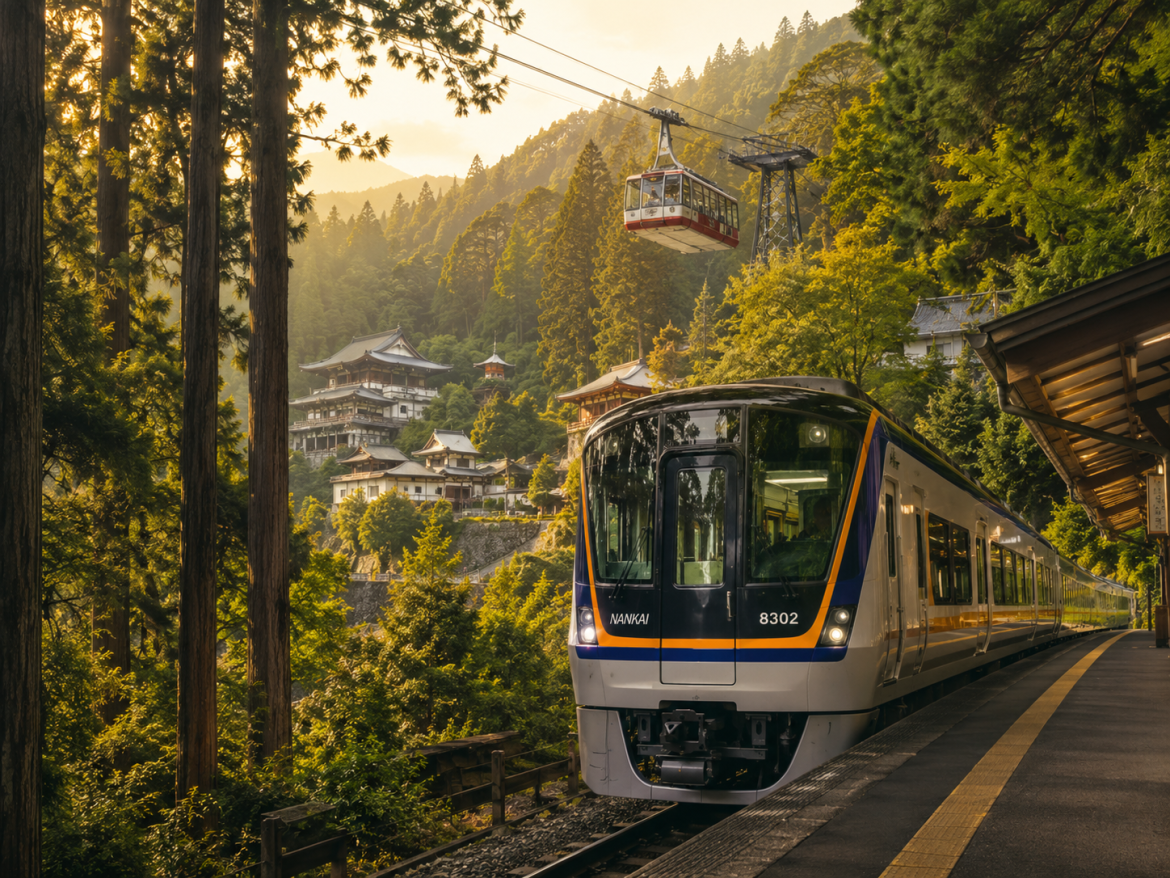
Koyasan is one of the most rewarding cultural trips from Osaka, but the journey is easier to misunderstand than its distance suggests. The railway journey involves a private railway, a possible change at Hashimoto, a cable car and finally a local bus. Reaching Koyasan Station does not mean that you have reached the temples.
For most first-time visitors, the most practical route starts at Nankai Namba Station. An ordinary Nankai train is the sensible budget choice, Limited Express Koya removes the usual Hashimoto transfer, and GRAN TENKU turns the journey itself into part of the experience. The Koyasan World Heritage Ticket can still make sense, but its revised price means that it should no longer be purchased without comparing how many local buses you will actually use.
A same-day return from Osaka is realistic when you leave early and focus on Okunoin, Kongobuji and Danjo Garan. An overnight temple stay is more rewarding when morning prayers, Buddhist vegetarian meals or a quieter evening in the sacred town are central to your reason for visiting.

Osaka to Koyasan: Quick Answer
| Question | Practical answer |
|---|---|
| Best departure station | Nankai Namba Station |
| Usual route | Nankai Namba → Hashimoto if required → Gokurakubashi → cable car → Koyasan Station → local bus |
| Typical total journey | Allow roughly two hours to reach central Koyasan, depending on the train and connections |
| Cheapest approach | Ordinary Nankai trains plus individual bus fares when you expect to use very few buses |
| Easiest independent approach | World Heritage Digital Ticket with the outward Limited Express option |
| Most comfortable rail option | Limited Express Koya or GRAN TENKU with a reserved seat |
| Best for a day trip | Leave Osaka early and limit the route to two or three principal areas |
| Best for cultural depth | Stay overnight at a temple lodging |
| JR Pass coverage | The main Nankai route and Koyasan buses are not covered |
Editor’s Verdict: Is Koyasan Worth Visiting from Osaka?
Koyasan is worth the journey when you are interested in Buddhist culture, historic temple architecture, forested pilgrimage routes or a quieter contrast to central Osaka and Kyoto. Okunoin is not simply another temple stop: the cedar-lined approach, historic memorials and religious atmosphere make the journey feel distinct from an ordinary city sightseeing day.
It may not be worth using one of your limited Osaka days when you dislike long transport days, have little interest in religious sites, need a fully step-free attraction or want a schedule centred on shopping and nightlife. Door to door, a Koyasan day trip can occupy 11 to 13 hours once Osaka transfers, waiting time, local buses, meals and walking are included.
If your Japan itinerary is still taking shape, use the Osaka travel guide to compare Koyasan with city attractions before assigning it a full day.
The Station Mistake That Causes the Most Confusion
The recommended train leaves from Nankai Namba Station. This is not the same station as Osaka-Namba on the Kintetsu and Hanshin lines, and it is not JR Namba.
- Nankai Namba: the station needed for the Nankai Koya Line
- Osaka-Namba: used mainly by Kintetsu and Hanshin services
- JR Namba: a separate JR station near OCAT
- Osaka or Umeda: a different district north of Namba
The stations are within the wider Namba area, but walking between the wrong platforms while searching for a morning train can cost enough time to break a carefully planned connection.
When using a route-planning app, confirm that the departure station is labelled Nankai Namba or that the selected train is on the Nankai Koya Line.
Osaka to Koyasan Route Step by Step
Step 1: Reach Nankai Namba Station
Travellers staying in Namba can normally walk to the station. From Umeda or Shin-Osaka, the Osaka Metro Midosuji Line is usually the simplest connection to Namba. From Tennoji, either use the Midosuji Line to Namba or travel to Shin-Imamiya and change to Nankai there.
Nankai Namba is the best starting point when you want the widest choice of trains, a clear first boarding point and access to reserved services.
Step 2: Take the Nankai Koya Line
There are three useful types of service:
- Ordinary express or rapid-express trains
- Limited Express Koya
- GRAN TENKU sightseeing train
Many ordinary trains require a change at Hashimoto. Limited Express Koya and GRAN TENKU operate through to Gokurakubashi on their scheduled services.
Step 3: Change at Hashimoto When Required
On an ordinary service, the onward mountain train may depart from the same platform or a nearby platform, but this should never be assumed. Follow the signs for Gokurakubashi and check the departure board.
The trains beyond Hashimoto are smaller and the route becomes more mountainous. During busy autumn weekends, the final train sections can feel much more crowded than the first part of the journey.
Step 4: Transfer to the Cable Car at Gokurakubashi
Gokurakubashi is the railway terminal below Koyasan. Transfer here to the cable car for Koyasan Station. Connections are normally planned around arriving trains, but delays or seasonal schedules can change waiting time.
The cable-car journey is short, steep and included in Nankai fares issued through to Koyasan Station.
Step 5: Take a Bus from Koyasan Station
This is the final section that many first-time visitors overlook. Koyasan Station sits on the mountainside, outside the central temple district. Do not plan to walk into town from the station.
Use a Nankai Rinkan bus or taxi. Bus destinations include the central Senjuinbashi area, Daimon and the eastern Okunoin area. Check the stop name carefully because different routes do not all continue to the same final destination.
The official English bus search is available at Nankai Rinkan Bus.
Which Train Should You Choose?
| Train | Reservation | Main advantage | Main disadvantage | Best suited to |
|---|---|---|---|---|
| Ordinary express or rapid express | Not required | Lowest rail cost and flexible departure times | Often requires a Hashimoto transfer and has no guaranteed seat | Budget travellers and flexible itineraries |
| Limited Express Koya | Required | Reserved seating and direct travel to Gokurakubashi | Limited departures and an additional surcharge | Day-trippers who value a simpler morning journey |
| GRAN TENKU | Required | Premium sightseeing experience with scenic seating | Higher cost, restricted operating days and limited departure choices | Rail enthusiasts, couples and repeat visitors |
Ordinary Nankai Trains
The ordinary train is the sensible choice when price matters more than having a reserved seat. The regular one-way fare from Namba to Koyasan Station is JPY 1,430, making the basic round trip JPY 2,860 before local bus travel.
Ordinary trains are also more flexible if you have not fixed your return time. The trade-off is the probable Hashimoto transfer and the possibility of standing during busy periods.
Limited Express Koya
Use the official Koya train page for the current surcharge and reservation link. The outbound timetable and return timetable distinguish Koya through services from Rinkan services requiring a change at Hashimoto. Selected departures marked Note 1 do not operate December 1–29 or January 4 through the end of February; this is a reduced seasonal schedule, not a closure of the whole Koya Line.
Limited Express Koya has fully reserved seating and operates between Namba and Gokurakubashi. The adult limited-express surcharge is JPY 1,100 when bought through the normal sales channels. Nankai’s ticketless service reduces the listed surcharge by JPY 150.
This surcharge is additional to the ordinary fare unless you buy a package that explicitly includes the outward Limited Express ticket.
Limited Express Koya is most useful on the outbound journey. A reserved morning seat reduces uncertainty, removes the usual Hashimoto change and helps you reach Koyasan with more energy for walking. On the return trip, an ordinary train provides more flexibility if your sightseeing ends earlier or later than expected.
Buying the limited-express ticket on board adds JPY 300, so reserve before boarding whenever possible.
GRAN TENKU
Book the specific seat category through the official GRAN TENKU reservation page. Standard seat sales open 30 days before travel, counting the travel day; meal-inclusive and group-sofa plans have different deadlines. The old Hashimoto–Gokurakubashi Tenku ended regular service on March 20, 2026, so its booking instructions are no longer the right guide.
GRAN TENKU is a premium sightseeing train linking Namba and Gokurakubashi in approximately 90 minutes. Its regular schedule excludes Wednesdays and the second and fourth Thursdays, with adjustments when those dates are public holidays.
The standard Relax Seat and Wide View Seat ticket is a limited-express or reserved-seat component. A separate base-fare ticket to Koyasan is still required. Do not buy the seat product and assume it covers the entire journey unless the selected package explicitly says that the base fare is included.
Choose GRAN TENKU because you want the train experience, not because it is the simplest or least expensive way to reach Koyasan. Limited Express Koya is usually the more straightforward premium transport choice for an ordinary day trip.
Koyasan Ticket and Pass Comparison
| Option from Namba | Current adult price | What it covers | Best use |
|---|---|---|---|
| Ordinary return fare | JPY 2,860 | Train and cable car to Koyasan Station | Visitors using few local buses |
| Official World Heritage Digital Ticket | JPY 3,980 | Return train, two-day Koyasan bus pass and specified discount coupons | Visitors using several local buses or staying overnight |
| Digital Ticket with outward Limited Express | JPY 4,910 | Digital pass benefits plus an outward Limited Express Koya seat | First-time day-trippers wanting a simpler journey |
| Paper World Heritage Ticket | JPY 4,210 | Return train, two-day bus travel and specified coupons | Travellers who prefer physical tickets |
| Paper ticket with outward Limited Express | JPY 5,200 | Paper pass benefits plus outward Limited Express Koya | Visitors without a compatible smartphone |
| Ordinary return plus one-day bus pass | JPY 4,360 | Return train and unlimited Koyasan buses for one calendar day | Visitors wanting bus flexibility without a digital package |
Is the Koyasan World Heritage Ticket Still Worth It?
The pass is no longer an automatic purchase for every visitor.
An ordinary Namba–Koyasan return costs JPY 2,860. The official digital pass costs JPY 3,980, leaving a difference of JPY 1,120. The pass becomes easier to justify when your individual bus fares would exceed that difference, when you want the included admission discounts or when you will use the buses across two days.
Another useful comparison is the one-day Koyasan bus pass. Buying the JPY 2,860 ordinary railway return plus the JPY 1,500 bus pass totals JPY 4,360. In that comparison, the JPY 3,980 digital World Heritage Ticket is the more economical package.
The pass usually makes sense when:
- You will take a bus from Koyasan Station to Okunoin
- You will later travel between Okunoin, central Koyasan and Daimon
- You want the freedom to board buses without calculating every fare
- You are staying overnight and will use buses on two consecutive days
- You will use some of the listed temple or museum discounts
Pay-as-you-go may be better when:
- You will take only one bus into town and one bus back
- You intend to walk almost entirely within central Koyasan
- You are starting from a station where the package saving is small
- You are using another regional pass that already covers the relevant railway
- Your phone cannot reliably display and activate a digital ticket
Official Digital Ticket or Klook?
The official digital product permits same-day purchase until 15:00, whereas the linked Klook option is labeled for use from the following day. Do not transfer one seller’s activation rules to another. Its two-day bus coverage excludes the Tateri, Koya-Ryujin and Kyoto-Koyasan lines. The paper-ticket page explains the alternative if you do not want to rely on a phone.
The official Nankai product clearly includes a return journey to Koyasan Station, two consecutive days of bus use on the covered Koyasan routes and specified discount coupons.
The current Klook listing advertises the return train ticket and two-day Koyasan bus pass. It does not present the attraction-coupon benefits as clearly as Nankai’s direct page, and its purchase-validity wording differs. Check the package details shown for your travel date rather than assuming that every official benefit is included.
The Klook listing also currently offers adult tickets only. Families should compare this with Nankai’s official digital ticket, which publishes a child fare but does not sell child tickets on their own.
Booking through Klook is practical when you prefer to keep transport products in one travel account or use Klook’s customer-support system. Buying directly from Nankai is more practical when you want the clearest official description of discounts, ticket activation and limited-express conditions.
Digital Ticket Warning
The official digital ticket must be displayed on a compatible smartphone and scanned at designated QR gates. Keep the phone charged throughout both journeys. If the device is lost, damaged or unable to display the ticket after activation, reissue and refund options are restricted.
A paper ticket is less elegant but may be the safer choice for travellers using an older phone, travelling without mobile data or helping an older companion who is uncomfortable managing QR tickets.
Does KANSAI RAILWAY PASS LITE Help?
Only when it fits a wider private-rail itinerary. The current adult price is ¥5,200 for two consecutive days or ¥6,500 for three. Its covered Nankai railway and Koyasan cable-car route can help, but local buses and limited-express reserved-seat supplements are extra. It also excludes JR, Kyoto Municipal Subway, Randen and the Keihan Otsu lines. Check the official area map rather than treating it as a universal Kansai transport pass.
The October 2026–March 2027 edition must be activated within three months of purchase and no later than March 31, 2027; the final validity dates are April 1 or April 2 according to the two- or three-day version. A simple Koyasan return with local buses is usually better compared with the dedicated World Heritage Ticket first.
Does the Japan Rail Pass Cover Osaka to Koyasan?
No. The practical route is operated by Nankai Railway, and local transport in Koyasan is operated by Nankai Rinkan Bus. The Japan Rail Pass does not cover the principal journey.
Trying to maximise JR use usually creates a less direct route and does not remove the need to pay for the final Nankai section. For most visitors, starting directly from Nankai Namba is more sensible.
How to Use the Buses in Koyasan
Open the official Koyasan Station layout and accessibility guide before arrival. Work backward from the last useful bus at your final sightseeing stop, then check its cable-car and train connection. The last train listed at Koyasan Station is not a guarantee that a late bus from Okunoin will get you there.
Koyasan is a temple town rather than a single attraction. Its principal areas are spread from Daimon in the west to Okunoin in the east.
The central Senjuinbashi area is useful for Kongobuji, restaurants and onward buses. Danjo Garan lies west of the centre. Okunoin lies east of the centre and requires a separate bus ride or a substantial walk.
Useful bus destinations
- Senjuinbashi: central Koyasan, tourist information and access to Kongobuji
- Okunoin-guchi or Ichinohashi area: start of the traditional approach
- Okunoin-mae or Nakanohashi area: shorter approach to the inner sacred area
- Daimon: western gateway of Koyasan
Route names and stop patterns can change by departure. Check the bus display rather than boarding solely because a bus says “Koyasan.”
When paying an individual fare, follow the bus operator’s boarding and payment instructions. A pass removes the need to calculate each fare but must still be shown or scanned as directed.
Which Okunoin Entrance Should You Use?
The traditional approach starts at Ichinohashi. The forested path from this entrance to Kobo Daishi’s mausoleum area is approximately two kilometres. This is the most atmospheric route, but it requires more time and walking.
Choose the Ichinohashi route when:
- Okunoin is the main reason for your trip
- You are comfortable walking several kilometres
- You want the full cedar-forest and historic-cemetery experience
- You can arrive early enough not to rush
Choose the shorter Nakanohashi approach when:
- You have limited walking stamina
- You are travelling with young children
- Your group includes older visitors
- Rain, snow or heat makes a long walk impractical
- You need to fit Okunoin into a compact day trip
The shorter route still reaches the most sacred inner area, but it omits much of the historic approach. It is a sensible compromise rather than an inferior visit.
Photography is restricted beyond Gobyobashi and within other sacred interior areas. Follow posted signs and put the camera away before entering prohibited sections.
A Realistic Koyasan Day Trip from Osaka
This route prioritises the three most important areas without repeatedly crossing the town.
| Approximate time | Plan | Planning note |
|---|---|---|
| 07:00–08:00 | Depart Nankai Namba | Earlier is better, especially with an ordinary train |
| 09:00–10:00 | Arrive at Koyasan Station and take a bus east | Do not spend the morning walking west from the station |
| 10:00–12:00 | Visit Okunoin | Allow more time for the full Ichinohashi approach |
| 12:00–13:00 | Lunch in central Koyasan | Do not delay lunch until late afternoon |
| 13:00–14:00 | Kongobuji | Check current viewing restrictions before buying admission |
| 14:00–15:30 | Danjo Garan, Kondo and Konpon Daito | Paid interiors generally close before the outdoor grounds |
| 15:30–16:00 | Daimon if time and energy permit | Use the bus if walking stamina is limited |
| 16:00–17:00 | Return towards Koyasan Station | Build in a buffer for the bus and cable-car connection |
| Evening | Return to Osaka | Check the complete connection before leaving the final site |
Why Start with Okunoin?
Okunoin requires the most walking and is the site most affected by fading daylight, fatigue and weather. Visiting it first protects the main purpose of the trip. Kongobuji and Danjo Garan are closer together and easier to shorten later if necessary.
Do Not Add Too Many Extra Stops
Reihokan Museum, Tokugawa Mausoleum, Daishi Kyokai, multiple temple interiors and Daimon can all be worthwhile, but trying to include all of them in one Osaka day trip usually reduces the time available at Okunoin.
A better first visit consists of:
- Okunoin
- Lunch
- Kongobuji
- Danjo Garan
- Daimon only when time remains
Major Site Admission and Opening Information
The official temple admission table and Reihokan visitor information are the best references for opening hours and age categories. Budget for the interiors you actually want to enter, rather than assuming a transport pass includes admission.
| Site | Current admission | General hours | Planning point |
|---|---|---|---|
| Okunoin approach | Free | Outdoor route remains accessible, while halls have set hours | Torodo Hall normally opens 06:00–17:00 |
| Kongobuji | JPY 1,000 for junior-high-school age and above; JPY 300 for primary-school children | 08:30–17:00; reception closes 16:30 | Temporary exhibitions can affect which paintings are visible |
| Kondo | JPY 500 for junior-high-school age and above | 08:30–17:00; reception closes 16:30 | Religious services may temporarily restrict the interior |
| Konpon Daito | JPY 500 for junior-high-school age and above | 08:30–17:00; reception closes 16:30 | Outdoor views are possible without paying for the interior |
| Tokugawa Mausoleum | JPY 200 for junior-high-school age and above | 09:00–16:30; reception closes 16:10 | Less practical on a short first visit |
| Reihokan Museum | JPY 1,300 adult; JPY 800 high-school or university student; JPY 600 primary or junior-high-school student | 09:00–17:00; final admission 30 minutes before closing | Useful in rain or for visitors interested in Buddhist art |
Opening conditions can change for ceremonies, exhibitions and maintenance. Check the official Kongobuji notices before travelling.
Is the JPY 2,500 Common Admission Ticket Worth Buying?
The common internal-admission ticket covers five specified experiences: Kongobuji, Kondo, Konpon Daito, Tokugawa Mausoleum and the jukai precepts ceremony at Daishi Kyokai.
Buying these separately would cost more than the combined ticket, but it is worthwhile only when you genuinely intend to use most of the inclusions. It does not automatically belong in a standard day-trip budget.
For a first-time day trip focused on Okunoin, Kongobuji and Danjo Garan, separate admission to Kongobuji, Kondo and Konpon Daito totals JPY 2,000. The common ticket costs more unless you also attend the ceremony or visit Tokugawa Mausoleum.
Reihokan Museum is not one of the five inclusions listed on the current official common-ticket table.
Check Ceremony and Exhibition Restrictions Before Buying Admission
Kongobuji publishes dated restrictions for ceremonies and exhibitions. Check the official current notices for your travel day before buying the common admission ticket; restrictions at one hall do not mean the entire temple town is closed. The July and August 2026 notices sometimes quoted in older itineraries have ended and should not be treated as current closures.
Day Trip or Overnight Temple Stay?
| Choose a day trip when | Choose an overnight stay when |
|---|---|
| You have limited nights in Kansai | You want morning prayers or meditation |
| You mainly want Okunoin and Danjo Garan | You want a Buddhist vegetarian dinner and breakfast |
| You are comfortable with a long transport day | You prefer a slower walking pace |
| You are staying near Namba | You want to visit Okunoin in the quieter evening or early morning |
| You do not need a temple-lodging experience | The temple stay is a central reason for visiting |
A day trip shows the principal sacred areas. An overnight stay changes the character of the visit by giving you access to quieter hours, temple routines and a less hurried pace.
Temple lodging is not a conventional luxury hotel experience. Rooms may use futons and shared facilities, meals follow fixed times, and evening or morning schedules can be strict. Book because you value the religious and cultural setting, not because you expect an ordinary resort stay.
The official Koyasan Shukubo Association booking site publishes participating temple lodgings and current availability.
Is Koyasan Suitable for Families?
Koyasan works best for school-age children who are comfortable with trains, buses and several kilometres of walking. The cable car, forest and unusual temple setting provide variety, but younger children may lose interest during long religious-site visits.
For families with young children
- Use Limited Express Koya for a guaranteed outbound seat
- Choose the shorter Okunoin approach
- Use buses rather than walking from east to west across town
- Plan an early lunch
- Limit paid interiors to one or two
- Avoid bringing a large stroller if possible
Stone paving, gravel, tree roots and steps make parts of Okunoin inconvenient for a stroller. A compact carrier can be more practical for a toddler, provided the adult carrying it is comfortable with the distance.
Advice for Older Travellers and Limited Mobility
Koyasan Station itself has barrier-free facilities including an elevator, accessible restroom and wheelchairs. Kongobuji and other facilities also maintain a limited number of borrowed wheelchairs.
This does not make the whole destination step-free. Outdoor wheelchairs are not universally available, and Okunoin includes uneven stone, gravel, roots and extended walking.
A lower-walking itinerary
- Take a reserved train from Namba
- Use the bus from Koyasan Station to the shorter Okunoin approach
- Return by bus to Senjuinbashi
- Visit Kongobuji
- Walk or take a short taxi or bus to Danjo Garan
- Skip Daimon unless energy remains
For a group with serious mobility limitations, a private guide or vehicle may be more useful than purchasing several transport passes. Confirm vehicle access, walking distances and wheelchair handling directly with the operator before booking.
Guided Tour or Independent Travel?
Independent travel is better when:
- You are comfortable using Japanese trains
- You want the full Okunoin approach
- You prefer to choose your own lunch
- You may stay overnight
- You want control over how long you spend at each temple
A guided day tour is better when:
- You do not want to manage several transfers
- You want cultural explanations rather than only visual sightseeing
- You are travelling in a family or small group
- Your Osaka time is limited and you need a fixed return
- You prefer a driver or organised meeting point
The currently listed Koyasan UNESCO Site and Hidden Gems tour departs from Osaka and offers English among its language choices. Its listed itinerary may include religious experiences and locations outside the standard independent route. It also involves considerable walking and stairs, so it should not be treated as a low-mobility solution.
Check the selected date carefully. Meeting point, stops, meal arrangements and admission inclusions may vary by package.
Private Guide in Koyasan
A private four-hour walking guide is useful when you are travelling independently to Koyasan but want help interpreting its history and religious practices after arrival. The current product begins in the Koyasan area rather than providing transport from Osaka.
This makes sense for an overnight visitor or a group that has already purchased its train tickets. It does not replace the Osaka–Koyasan railway journey.
Driving, Private Charters and a Longer Wakayama Trip
A rental car is most useful for a group staying overnight or continuing to places that are awkward to connect by public transport. It is less useful for a simple temple-town day trip because you still need to park and walk. Check mountain-road conditions, parking at the lodging and winter tire requirements before committing to the drive; snow and ice change the calculation for an inexperienced mountain driver.
A private charter removes the driving but not the need to plan. Ask whether the quoted hours cover the full Osaka return, whether tolls and parking are included, and how much walking remains at Okunoin and the temples. Compare the total group cost with individual train tickets. A private walking guide in Koyasan is a different product and does not include the road journey from Osaka.
Add Kudoyama only with enough time
Kudoyama and Jison-in suit travelers interested in the mountain’s pilgrimage history. Pair them with an overnight Koyasan stay, or carefully plan a separate visit, rather than sacrificing the main temple town to fit a rushed same-day detour. A return transport ticket is not automatically valid for unlimited intermediate station exits.
Continue to Wakayama City on day two
After a temple stay, a second day can be built around Wakayama City, Kimiidera or Kuroshio Market, but choose a compact plan and price the actual onward route. The Koyasan World Heritage Ticket is a return product tied to its departure station; it is not a general pass for all of Wakayama or the Kumano region. Shirahama and the Kumano Kodo deserve additional days.
Travelling from Kansai Airport to Koyasan
For a more direct connection, compare changing from the Nankai Airport Line to the Koya Line at Tengachaya instead of riding all the way into Namba and back out. Namba is convenient if you need luggage storage, have accommodation there or want to board at the departure terminal. Check which trains stop at Tengachaya and buy any reserved seat for the station where you actually board.
The cleanest airport route is:
- Kansai Airport to Nankai Namba
- Nankai Namba to Gokurakubashi
- Cable car to Koyasan Station
- Bus to your temple or sightseeing area
Nankai’s Rapi:t offers reserved seats between Kansai Airport and Namba. The ordinary Airport Express is less expensive but uses commuter-style seating and does not provide the same reserved-seat experience.
For complete airport options, read the Kansai Airport to Osaka transport guide.
Travelling directly from an international flight to a Koyasan temple stay is technically possible, but not recommended unless the flight lands early. Immigration delays, luggage collection and multiple railway connections create a real risk of missing a temple’s fixed dinner or check-in time.
What to Do with Luggage
Do not bring large suitcases on a Koyasan day trip. Space is limited on local buses, and dragging luggage over temple approaches makes the visit unnecessarily tiring.
Better options include:
- Leave luggage at your Osaka hotel
- Use a locker at a major Osaka station
- Send large bags to your next city and carry an overnight bag
- Confirm luggage storage with your temple before arrival
If changing hotels on the same day, luggage forwarding is usually more practical than taking a large suitcase through Hashimoto, the cable car and a local bus.
Best Time to Visit Koyasan
Spring
Spring brings comfortable walking conditions, although Koyasan is colder than central Osaka. Flowering dates occur later at the higher elevation, so do not assume that Osaka and Koyasan will have identical conditions.
Summer
Koyasan is generally cooler than Osaka, making it an appealing escape from city heat. Rain and humidity remain possible, and religious events can restrict access to individual halls.
Autumn
Autumn is one of the most attractive periods, with coloured foliage around Danjo Garan, Kongobuji and the temple town. It is also a high-demand period for trains, temple lodgings and roads. Reserve a morning seat and accommodation earlier than you would for an ordinary weekday.
Winter
Snow and ice can transform the atmosphere but make stone paths more difficult. Wear shoes with reliable grip, allow extra connection time and check operating notices before leaving Osaka.
Visiting Koyasan in Rain
Light rain can add atmosphere to Okunoin, but wet stone and roots become slippery. A waterproof jacket is easier than managing a large umbrella through narrow paths and busy buses.
A rain-adjusted route can include:
- The shorter Okunoin approach
- Kongobuji
- Reihokan Museum
- Brief outdoor views at Danjo Garan
Heavy rain, wind or winter weather can affect mountain transport. Check the Nankai service status and Koyasan bus information before departure.
Food and Lunch Planning
Koyasan is associated with shojin ryori, the Buddhist vegetarian cuisine served by temple lodgings and specialist restaurants. Other local foods include goma-dofu sesame tofu and koya-dofu freeze-dried tofu.
Do not wait until late afternoon for lunch. Many restaurants operate around daytime sightseeing hours rather than Osaka’s late urban dining pattern. Eating between Okunoin and Kongobuji is generally more efficient than leaving lunch until after Danjo Garan.
Temple-stay dinners follow a fixed schedule. Confirm the required arrival time and tell the lodging about dietary restrictions well in advance. Do not assume that a Buddhist vegetarian kitchen can automatically accommodate every allergy.
Where to Stay in Osaka for a Koyasan Day Trip
Tengachaya can also work well because it is a Nankai Koya Line stop; confirm the chosen service calls there. From Tennoji, compare reaching Shin-Imamiya rather than automatically crossing Osaka to Namba. Balance hotel location against the number of early-morning transfers your group can comfortably manage.
Namba is the most practical base because the journey begins at Nankai Namba Station. Staying within walking distance reduces the chance of missing an early train and makes the late return easier.
Shin-Imamiya is another practical departure point on the Nankai Koya Line, though the surrounding hotel choice and atmosphere differ from central Namba.
Umeda and Shin-Osaka remain workable, but add an Osaka Metro journey before and after the Koyasan trip. Review the main districts in the Osaka travel guide before choosing accommodation.
Common Osaka-to-Koyasan Mistakes
1. Going to Osaka-Namba instead of Nankai Namba
Check the railway company, not only the word “Namba.”
2. Assuming Koyasan Station is beside the temples
A bus or taxi is still required after the cable car.
3. Buying the World Heritage Ticket without comparing bus use
The current price is most attractive when you use several buses, stay two days or use its discounts.
4. Boarding Limited Express Koya without a reserved-seat ticket
The base fare alone is not sufficient.
5. Buying a GRAN TENKU seat without the base fare
Standard reserved-seat products require a separate boarding ticket.
6. Trying to visit every paid attraction
Okunoin, Kongobuji and Danjo Garan already fill a meaningful first visit.
7. Starting the full Okunoin walk too late
Complete the longest outdoor section before fatigue and fading daylight become problems.
8. Bringing a large suitcase
The cable car and local buses are designed for transport, not a comfortable sightseeing day with heavy baggage.
9. Assuming every Klook and official package has identical benefits
Compare child eligibility, attraction coupons, activation and cancellation conditions.
10. Checking only the last train from Koyasan Station
You must also reach the station by bus and connect through the cable car and Gokurakubashi. Plan the entire chain.
Koyasan or Another Osaka Day Trip?
Choose Koyasan for religious culture, forests, slower sightseeing and a journey that feels separate from urban Kansai.
Choose Nara when you want easier transport, a shorter day and a mixture of temples, parkland and family-friendly sightseeing. See the Osaka to Nara transport guide.
Choose Kyoto when your priority is a wider selection of famous temples, shopping districts and evening dining, accepting that the most popular areas are generally busier. See the Osaka to Kyoto transport guide.
Frequently Asked Questions
What is the easiest way to travel from Osaka to Koyasan?
Take Limited Express Koya from Nankai Namba to Gokurakubashi, transfer to the cable car and then take a bus from Koyasan Station. This reduces the usual Hashimoto transfer but requires a reserved-seat surcharge.
What is the cheapest way to reach Koyasan?
Use ordinary Nankai express or rapid-express trains and pay individual local bus fares. This is most economical when you expect to take very few buses in Koyasan.
How long does Osaka to Koyasan take?
Allow approximately two hours from Nankai Namba to central Koyasan. The exact time depends on the train, Hashimoto transfer, cable-car connection and local bus.
Can I visit Koyasan as a day trip from Osaka?
Yes. Leave early and focus on Okunoin, Kongobuji and Danjo Garan. A day trip becomes rushed when you add several museums, ceremonies and distant temples.
Is one night in Koyasan worth it?
Yes when you want morning prayers, Buddhist vegetarian meals, a quieter Okunoin visit or more cultural immersion. It is not necessary when your priority is only the main sightseeing sites.
Is the Koyasan World Heritage Ticket worth buying?
It is generally worthwhile when you use several Koyasan buses, buy a one-day bus pass otherwise, stay overnight or use the listed discounts. Paying separately may be cheaper when you use only two buses.
Does the World Heritage Ticket include Limited Express Koya?
The standard ticket does not include the limited-express surcharge. A more expensive package includes an outward Limited Express Koya ticket. Read the selected product name carefully.
Does GRAN TENKU include the base train fare?
Standard Relax Seat and Wide View Seat products require a separate base-fare ticket. Premium group seating may use a different fare structure, so check the selected package.
Can I walk from Koyasan Station to the temples?
Do not plan to walk from the station. Use the local bus or a taxi to reach the temple town.
How much walking is required at Okunoin?
The traditional approach from Ichinohashi is approximately two kilometres to the mausoleum area, before accounting for the return or onward route. A shorter approach is available from the eastern bus-stop area.
Is Koyasan suitable for a stroller?
Central roads and some facilities are manageable, but stone paving, gravel, roots and steps make Okunoin difficult. A compact stroller or carrier is more practical than a large travel system.
Is Koyasan wheelchair accessible?
Some stations and buildings provide accessible facilities, but the destination as a whole is not fully step-free. Uneven outdoor paths make advance route planning essential.
Can I use an IC card such as ICOCA?
IC-card acceptance may help with ordinary railway and bus fares, but it does not replace a reserved Limited Express Koya or GRAN TENKU ticket. Confirm the current acceptance conditions for the exact service.
Do I need to reserve in advance?
Ordinary trains do not require reservations. Limited Express Koya and GRAN TENKU require reserved-seat tickets. Temple lodgings and organised tours should be reserved in advance, especially in autumn and on weekends.
What time should I leave Osaka?
A departure between approximately 07:00 and 08:00 gives a first-time day-tripper a much safer schedule. Leaving after 09:00 substantially reduces the time available for the full Okunoin approach.
Can I travel from Kansai Airport to Koyasan on the same day?
Yes, but it is risky after a later international arrival. Stay in Namba first when immigration delays could cause you to miss a temple’s fixed check-in or dinner time.
Final Planning Checklist
- Confirm that your departure station is Nankai Namba
- Check whether the chosen train requires a Hashimoto transfer
- Reserve Limited Express Koya or GRAN TENKU when using either service
- Confirm whether your product includes the base fare
- Compare the World Heritage Ticket with your expected bus use
- Charge the phone used for a digital ticket
- Check current Kongobuji viewing restrictions
- Choose the full or shorter Okunoin route before arrival
- Check the complete return connection, including the local bus
- Leave large luggage in Osaka or forward it
- Carry an extra layer because Koyasan is cooler than central Osaka
- Wear shoes suitable for wet stone and forest paths
Final Verdict
The most balanced first-time plan is an early departure from Nankai Namba, an outward Limited Express Koya seat, the cable car and a bus directly towards Okunoin. Continue to Kongobuji and Danjo Garan after lunch, then return by ordinary train if you want flexibility.
Buy the World Heritage Digital Ticket when you expect to use several Koyasan buses or stay overnight. Pay ordinary fares when your route requires only minimal bus travel. Choose GRAN TENKU for the railway experience, and choose an organised tour only when guidance or avoiding independent transfers adds meaningful value for your group.
Koyasan is technically possible as a compact sightseeing trip, but it is most rewarding when you resist the temptation to collect every attraction and instead leave enough time for the forest, the sacred approach and the atmosphere that makes the destination different from Osaka’s easier day trips.