
Sagamiko Illumillion 2026–Next Year: First Decide Whether You Want the Rides
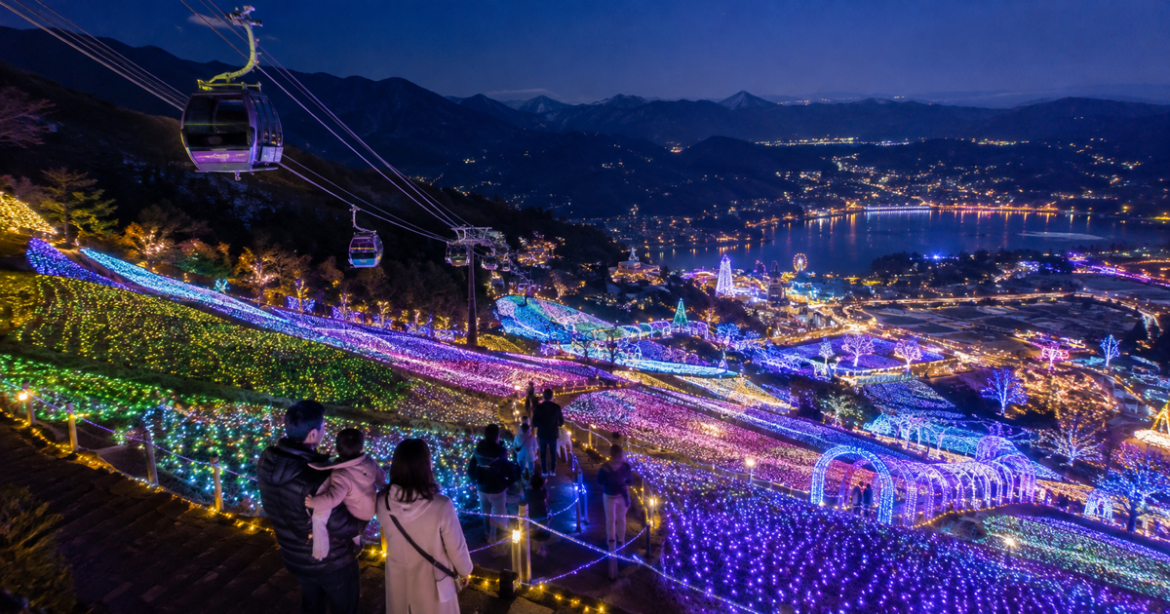
Sagamiko Illumillion (さがみ湖イルミリオン) is held at Sagamiko MORI MORI in Sagamihara, Kanagawa. Unlike flat, city-centre illuminations such as Marunouchi or Roppongi, this event uses the amusement park’s natural slopes and elevation changes to combine around six million lights with a Pair Lift, Ferris wheel and nighttime attractions. The most common first-time mistake is checking only the “lights start at 16:00” information without first thinking through tickets, hills and the bus back.
The official season has been announced for November 14 2026 to May 9 of the following year. After April 5, it is generally scheduled to operate only on Saturdays, Sundays and Japanese public holidays. The illuminations begin gradually after 16:00 as daylight fades, while the season’s event page lists standard nighttime hours of 16:00–21:00, with final admission 30 minutes before closing. At the time of this update, the regular operating calendar has not yet published every date across the entire winter season, so always reconfirm closure dates and the day’s actual opening and closing times before travelling.
| Item | Published for 2026–Next Year | Recheck Before Your Visit |
|---|---|---|
| Season | November 14 2026–May 9 of the following year | Individual closure dates and special operating days |
| Illumination | Lights come on gradually after 16:00 as daylight fades | Actual lighting and closing times on your date |
| Night operation | Current event page lists 16:00–21:00 | Hours may change by month |
| Season theme | 「可哀想に!ギラギラサーカス団」 collaboration plus the new 「オトイルミ」 experience | Collaboration areas, food, merchandise and show details are still being announced |
| Buses | Regular routes operate toward Sagamiko Station and Hashimoto | Winter extra services, direct buses and final departure times |
What Time Should You Enter? Looking at the Lights, Blue-Hour Photos and Rides Need Different Plans
If you only want the illuminations: there is no strong reason to arrive as early as 14:00. Entering around 15:30–16:00 is more practical. You can use the restroom, buy anything you need and photograph the park before complete darkness, then watch the lights gradually appear after 16:00. One advantage of Sagamiko Illumillion is its layered hillside scenery: during blue hour, the deep-blue sky can preserve more detail in the Ferris wheel, mountain silhouettes and illuminated slopes than a completely black sky.
If you want photos from sunset through full darkness: begin in the lower illumination zones, then move toward the Rainbow Pair Lift once the lights are on. This avoids rushing straight to the summit and missing the transition as the lower light displays change from partially illuminated to fully lit.
If you want to use the amusement rides: the Night Free Pass allows entry from 14:00. That matters because the park warns that around 20 attractions finish daytime operation at approximately 16:00, and queues may close even earlier when waiting times are long. In practice, 14:00–16:00 is the key window for using daytime rides before switching your focus to the illuminations and nighttime attractions after 16:00.
Sagamiko Illumillion Tickets: You Do Not Necessarily Need a Night Free Pass Just to See the Lights
For this season, the official ticket structure includes regular admission, an all-day Free Pass and a Night Free Pass. On standard B-price days, adult admission is 2,000 yen and admission for children or visitors aged 65 and over is 1,300 yen. The Night Free Pass costs 3,000 yen for adults and 2,400 yen for children or seniors. On high-season C-price days, adult admission is 2,400 yen and admission for children or seniors is 1,700 yen, while the Night Free Pass is 3,400 yen for adults and 2,800 yen for children or seniors. The all-day Free Pass costs 4,700 yen for adults and 3,700 yen for children or seniors. Admission fees apply from age three.
The most important detail is that the Rainbow Pair Lift becomes free to ride from 16:00. If your goal is simply to see the illuminations and reach the upper area for the night view, you do not automatically need a Night Free Pass. At the same time, a Night Free Pass does not mean every attraction is available all evening. Some attractions cost extra, while many daytime rides finish at around 16:00.
| Your Plan | Ticket to Consider | Why |
|---|---|---|
| Illuminations only + free Pair Lift after 16:00 | Admission ticket | The simplest option without paying for rides you will not use |
| One ride costing around 700–800 yen | Compare admission + one ride ticket first | On a standard day, 2,000 + 800 = 2,800 yen, still below the 3,000-yen Night Free Pass |
| Two or more eligible rides around 800 yen each | Night Free Pass will often make more sense | Standard adult admission plus two 800-yen rides already reaches 3,600 yen |
| Already spending the day at the amusement park | Continue using your existing admission or Free Pass | The official information says daytime park guests can stay for the illuminations without a separate illumination entry fee |
If you prefer buying an electronic ticket in advance, KKday currently has a Sagamiko MORI MORI page offering admission, Free Pass and Night Free Pass options. Check the official operating calendar and price category for your exact date before purchasing.
Check Sagamiko MORI MORI admission and passes on KKday
2026 Season Highlights: The New Collaboration Is Announced, but Do Not Plan Around Last Season’s Characters
The official collaboration for this season is 「可哀想に!ギラギラサーカス団 in さがみ湖イルミリオン」, featuring character-themed illumination and photo areas including おぱんちゅうさぎ (Opanchu Usagi) and んぽちゃむ (Npochamu). Collaboration food and merchandise have also been previewed. However, the official announcement states that further details will be released progressively, so it is reasonable to include the collaboration area in your plan but not to assume a particular menu item, product or limited attraction will be available on your exact date.
The main illumination area currently lists zones including the Welcome Plaza, Field of Light, Sea of Light, Rainbow Pair Lift, Great Tunnel of Light, Forest of Light, Paddington Town illuminations and Bridge of Light. This season also introduces 「オトイルミ」, combining music, video and illumination effects. Exact performance details should be checked against subsequent official announcements.
Suggested Illumination Route: Start on Lower Ground, Then Go Uphill
The biggest planning difference at Sagamiko Illumillion is the elevation change. The route below is not an official one-way course; it is a practical sequence based on the park’s terrain and currently announced illumination areas.
- Entrance / Welcome Plaza: photograph the entrance illumination and confirm the day’s closing time and your return bus.
- Field of Light and Sea of Light: shoot wider views shortly after 16:00 while some blue remains in the sky.
- Rainbow Pair Lift: it becomes free after 16:00 and lets you avoid the most strenuous uphill section on foot.
- Summit area: choose the Ferris wheel or Aozora Pedal for a higher night view, or simply enjoy the lights from the upper area without adding a ride.
- After descending, visit the Great Tunnel of Light and Forest of Light: the colours become more concentrated after full darkness and work well for portraits and close-up illumination photos.
- Paddington Town / collaboration area: leave character photos, food and souvenir shopping until later, then return toward the exit.
If you are travelling with someone who has knee pain, a small child or a stroller, do not interpret short-looking distances on the map as flat walking. In its FAQ, the park describes the walking route required when a wheelchair user cannot take the Pair Lift as a steep slope comparable to an intermediate ski run. That gives a useful indication of how demanding movement between the lower and upper areas can be.
Rainbow Pair Lift, Ferris Wheel or Aozora Pedal: Which Gives the Best High-Level Night View?
Rainbow Pair Lift: its biggest advantage is that it is free after 16:00, and the illuminated lift itself is one of Sagamiko Illumillion’s signature scenes. If your priority is getting uphill for the lights rather than riding attractions, a regular admission ticket can already cover the essential experience.
お山のかんらんしゃ Ferris wheel: this sits near the summit at roughly 420 metres above sea level. One rotation takes about 13 minutes, a single ride costs 700 yen and it is included in the Free Pass. In clear daytime weather, Mount Fuji may be visible. It can stop in strong winds, although the official attraction information indicates that it can operate in rain.
青空ペダル Aozora Pedal: located at about 370 metres above sea level, this is a two-person pedal-powered elevated cycle attraction with a track of around 175 metres. In winter it becomes part of the nighttime light experience. A single ride costs 800 yen and the Free Pass can be used. It does not operate in rain, and the park prohibits handled selfie sticks while riding. Phone holders with neck straps are provided.
マジカルウェーブ Magical Wave: this colourful slide is approximately 100 metres long with an elevation difference of about 15 metres. A single ride costs 800 yen and the Free Pass is accepted. It does not run in rain. If your visit falls on a wet day, the practical value of a Night Free Pass may therefore be lower because some headline nighttime attractions will not operate.
Getting There via Sagamiko Station: Easy on the Way In, but the Real Risk Is the Journey Back
The most straightforward public-transport route is to take the JR Chuo Main Line to Sagamiko Station, then transfer to a Kanagawa Chuo Kotsu bus. The park lists the regular route as a bus from Sagamiko Station bound for Mikage (三ヶ木), taking about eight minutes to the 「さがみ湖 MORI MORI 前」 stop. JR East also publishes Chuo Main Line departure information from Sagamiko Station toward Hachioji and Shinjuku.
The most important winter warning is this: do not treat extra buses published for a previous illumination season as the final bus for your visit. As of September 1 2026, the park’s direct-bus page for the current season was still marked Coming Soon. Winter supplements, Christmas or weekend services and the final return departure should therefore be checked against Kanachu’s timetable for your actual travel date.
Who Should Use the Hashimoto Route?
The park also lists access from Hashimoto Station. From JR Yokohama Line or Keio Line Hashimoto Station, take a bus to Mikage, then transfer to a bus toward Sagamiko Station and get off at 「さがみ湖 MORI MORI 前」. The park gives a total bus travel time of about 50 minutes. Its advantage is not speed compared with Sagamiko Station; it is more useful if you are already staying around Hashimoto, Tama or the western side of the Keio Line.
For a Shinjuku day trip, most travellers will still want to compare the JR Chuo Line route via Sagamiko Station first. You can also use our Tokyo day-trip guide and Tokyo area travel guide when deciding where Sagamiko fits. It makes far more sense as a western Tokyo excursion than something to squeeze into the same day as Asakusa or Odaiba.
Driving to Sagamiko Illumillion: Reaching the Park Is Easy, but Weekend Exit Traffic Needs Planning
The official driving references are approximately seven minutes from Sagamiko-Higashi Exit on the Chuo Expressway when coming from Tokyo or Saitama; about 15 minutes from Sagamihara IC or 20 minutes from Takaosan IC on the Ken-O Expressway when coming from Yokohama; and about 10 minutes from Sagamiko IC when coming from Yamanashi. The park also explicitly warns that surrounding roads can become congested on weekends and recommends public transport.
Current standard-car parking charges are 1,000–1,500 yen on weekdays and 1,500–2,000 yen on Saturdays, Sundays, public holidays and designated dates. Which winter dates attract the higher parking charge depends on the season’s operating calendar. If you exit the car park and return, you will be charged again. The park currently offers free parking when using Sagamiko Onsen Ururi on the same day, but you need to keep your parking ticket and complete the procedure at the onsen counter.
If your itinerary already includes driving around western Tokyo, see our Tokyo to Mount Takao transport guide for the general direction west of Shinjuku. Sagamiko and Mount Takao may look close on a map, but in winter it is better not to overfill one day with two destinations that both involve substantial walking.
Sample Scenario 1: Two Adults Who Only Want the Lights May Not Need a Night Free Pass
Sample itinerary scenario: two adults visit on a standard B-price day and only want the illuminations, the free Rainbow Pair Lift after 16:00 and one paid Ferris wheel ride. Two admission tickets cost 4,000 yen in total, plus 1,400 yen for two Ferris wheel rides, for a total of 5,400 yen. Two Night Free Passes would cost 6,000 yen. In this situation, the more inclusive ticket is not automatically better value. What matters is how many eligible rides you will actually use. If each person adds a second 800-yen-level attraction, the Night Free Pass starts becoming more advantageous.
Sample Scenario 2: Buying a Night Free Pass but Arriving at 16:30 Is an Easy Way to Feel You Bought the Wrong Ticket
Common combined scenario: a family buys Night Free Passes assuming that a “night ticket” means they should arrive in the evening, so they reach the park at 16:30. The problem is that the official guidance states that around 20 daytime attractions finish at approximately 16:00, and queue entry may close earlier when waits are long. A better plan is to enter at 14:00, prioritise daytime rides from 14:00–16:00, then switch to the illuminations, free Pair Lift and attractions that genuinely operate at night. That is how to use both sides of the Night Free Pass.
Sample Scenario 3: On a Tokyo Day Trip, Do Not Treat the 21:00 Closing Time as Your Departure Time
Sample itinerary scenario: two travellers leave Shinjuku in the afternoon, take JR to Sagamiko Station and then ride the bus for about eight minutes to the park. The standard illumination hours run until 21:00, which can make it look safe to stay until closing. However, this season’s winter extra services and final bus times still need to be confirmed by date. The safer approach is to check Kanachu’s return timetable when you reach Sagamiko Station and aim for the second-to-last bus or an earlier departure. If services are sparse that evening, it is better to skip one final photo zone than to make your entire return to Tokyo depend on the last bus.
Rain, Snow and Cold Weather: The Illuminations Continue in Rain, but the Rides May Not
The official information states that Sagamiko Illumillion continues in rainy weather, so light rain does not automatically mean the event is cancelled. Attractions are a separate issue. Aozora Pedal and Magical Wave are explicitly marked as unavailable in rain. The Ferris wheel can operate in rain but may stop in strong winds. Kanachu timetable notices also warn that typhoons or snow accumulation can affect bus services.
Prepare for a winter evening on an outdoor hillside rather than a casual walk through central Tokyo. A warm outer layer, gloves, a wind-resistant hat or neck warmer and footwear with decent grip are more useful than dressing purely for photos. Rain or snow makes the slopes and footing more important than at a flat urban illumination. Before leaving, check the park’s attraction status, bus notices and weather conditions rather than looking only at whether the illumination event itself has been cancelled.
Families, Seniors and Wheelchairs: The Pair Lift Restrictions Matter More Than They First Appear
Families: admission charges apply from age three. Strollers can currently be rented near the entrance for 1,000 yen each, subject to availability. Strollers may be taken on the Pair Lift, but they must be folded, and one adult may carry no more than one stroller. Nappies are sold inside the park. Baby food and formula are not sold, although the nursing room has a kettle and restaurant staff can provide hot water for preparing formula.
Seniors: the main issue to manage is elevation change rather than the total amount of time spent looking at lights. For visitors who can safely use the lift, taking the free Pair Lift uphill after 16:00 can substantially reduce steep walking. If anyone in the group has concerns about knees, balance or tolerance for cold weather, it is better to shorten the summit section than to treat every illumination zone as mandatory.
Wheelchairs: the official FAQ clearly states that wheelchairs cannot be taken on the Pair Lift. The alternative is a walking route whose gradient is described as comparable to an intermediate ski slope. This is not simply a case of a wheelchair-accessible attraction with a slightly longer path. Anyone hoping to reach the summit area in a wheelchair should contact the park before visiting to confirm the workable route and assistance available that day. Accessible restrooms are shown on the park map, but whether a full summit round trip is realistic will still depend on individual mobility.
Food and Supplies: Do Not Leave Dinner Until the Last Minute
The illumination page currently lists food including curry rice, hamburger steak, pasta and miso ramen, and the park also has dining locations such as Wild Dining. The official FAQ allows visitors to bring packed meals into the park, but they cannot be eaten inside restaurants and should instead be consumed at outdoor benches or similar areas.
On a winter evening with children or older travellers, a more reliable plan is to stop for a meal or hot drink around 17:00–18:00, then continue with the lights. Avoid reaching the time of your return bus while simultaneously trying to find dinner, a restroom and the exit.
For payment, the admission counter, restaurants and shops accept various credit cards and transport IC cards. Some attraction ticket machines, however, still rely mainly on cash or support IC payment only in certain cases. If you are not using a pass, carrying a small amount of cash remains useful.
Sagamiko Illumillion Photography: Shoot the Sky First, Then the Light Displays
For more layered photographs, avoid pushing your phone exposure to maximum brightness during the first round. Shortly after 16:00, preserve some of the deep-blue sky while the lights are coming on. Once it is fully dark, move on to the tunnel, character areas and close-up light displays. The Rainbow Pair Lift works especially well for photographs of illuminated lines stretching up and down the hillside, while the Ferris wheel gives a better sense of the park’s overall elevation.
When riding Aozora Pedal, the park prohibits handled selfie sticks and provides phone holders with neck straps. Follow staff instructions for any other camera equipment. In rain or strong wind, do not extend a phone or camera beyond the safe boundary of an attraction just to get a shot. If you mainly want a city-style illumination with less climbing, compare it with our Roppongi illumination guide. If you want to separate winter night scenery from a daytime Mount Fuji trip, see our Lake Kawaguchiko winter fireworks guide.
Should You Stay Nearby? PICA Sagamiko Is the Most Direct Option if You Do Not Want to Chase the Last Bus
The park FAQ points to the on-site PICA Sagamiko, which offers campsites, tents, dome-style accommodation, cottages and trailers. Some plans may also be packaged with amusement-park passes or the hot spring. It is not a conventional station-area business hotel, but its main advantage is obvious: you do not have to connect the end of your illumination visit with the final bus.
If next-day JR access and a broader choice of restaurants matter more, you can instead consider staying around larger stations such as Hachioji or Hashimoto and plan the trip according to the actual bus timetable for your date.
On the other hand, if you are based in Shinjuku and everyone in your group is comfortable walking and transferring trains later in the evening, there is usually no need to move hotels just for Sagamiko Illumillion. It works well as a western Tokyo day trip. If you would prefer an easier Kanagawa evening trip, compare it with our Tokyo to Yokohama transport guide.
8 Common Sagamiko Illumillion Planning Mistakes
- Assuming 16:00 illumination means you cannot enter before 16:00: regular admission follows the park’s opening hours, while the Night Free Pass allows entry from 14:00.
- Choosing tickets by name instead of calculating your actual plan: if you only want the lights and the free Pair Lift, regular admission may be enough.
- Buying a Night Free Pass but arriving after 16:00: this can mean missing many daytime attractions.
- Treating the park like a flat urban illumination: the summit area involves meaningful slopes, so plan more conservatively than you would for a city-centre light display.
- Planning around last season’s collaboration: this season has changed to 「可哀想に!ギラギラサーカス団」, with additional details still being announced.
- Copying an old final-bus time from the internet: winter supplementary services can change each season, so check Kanachu for your date.
- Seeing “held in rain” and assuming all rides will operate: some major nighttime attractions stop in wet weather.
- Driving and waiting until park closing before leaving: the park itself warns about weekend congestion on surrounding roads, so exit traffic also needs to be included in your return plan.
How to Finalise Your Sagamiko Illumillion Plan: Tickets, Slopes and the Journey Home
For a first visit to Sagamiko Illumillion, the safest planning order is not to begin with photo spots. Start with three decisions: first, decide whether you only want the illuminations or expect to use at least two rides; second, consider whether everyone in your group can handle the hills and whether the free Pair Lift after 16:00 will be important for reducing uphill walking; third, check the Kanachu return bus and JR connection for your exact date before buying tickets.
Couples or groups of adults who mainly want the illuminations can reasonably arrive around 15:30–16:00 and use regular admission plus the free Pair Lift. Families hoping to use several attractions can make better use of a Night Free Pass by entering from 14:00 and combining daytime and evening rides. Groups travelling with seniors, wheelchair users or anyone who needs a slower pace should put the practical question of getting safely up and down the hillside ahead of the number of illumination zones they manage to see.
With those three decisions made in advance, Sagamiko works much better as a complete winter night trip from Tokyo rather than an evening that ends with everyone suddenly racing for the last bus.