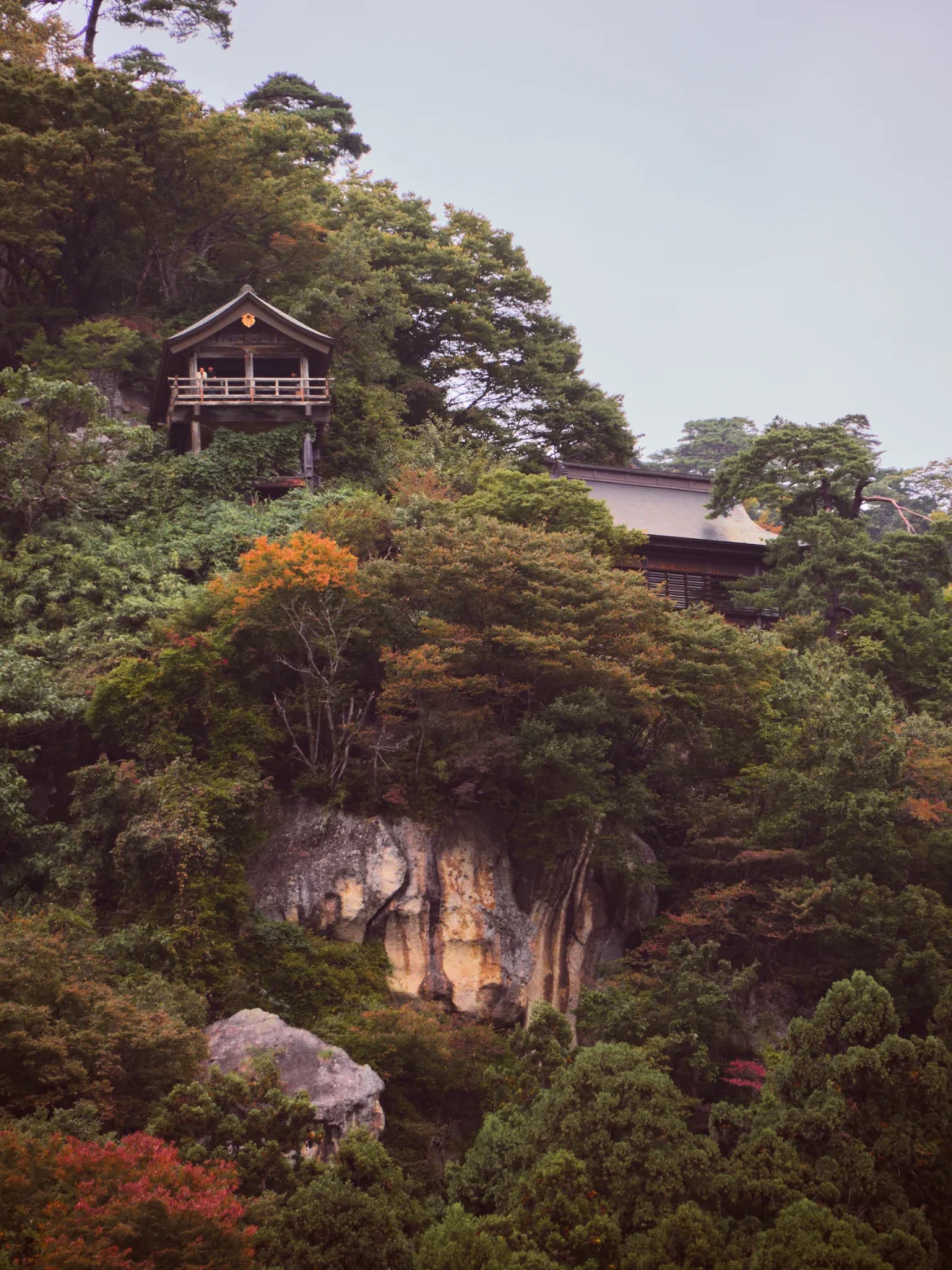
The easiest way to get from Sendai to Yamadera is a direct JR Senzan Line train. Choose a train bound for Yamagata that stops at Yamadera: services terminating at Ayashi or Sakunami do not take you all the way there. You do not need to travel to Yamagata first and double back.
Allow roughly 60–75 minutes on the train, followed by about 10 minutes on foot to the temple approach. Reaching Yamadera Station is only the start of the visit: the full climb through Risshakuji, usually called Yamadera, involves 1,015 stone steps. For the upper temples, Godaido viewpoint and the walk back to the station, leave around 2.5–3 hours at Yamadera itself.
| What to plan | Sendai to Yamadera at a glance |
|---|---|
| Best public transport | JR Senzan Line toward Yamagata, getting off at Yamadera |
| Transfers | None on a suitable through train |
| Journey time | Usually about 60–75 minutes; check the specific service |
| Frequency | Approximately one through train an hour during the day, with uneven gaps |
| Adult one-way fare | ¥910 with a paper ticket or ¥902 with Suica |
| Seat reservation | Not needed for the regular local and rapid trains |
| Station to temple approach | Allow about 10 minutes on foot |
| Temple visit | 1,015 steps; allow about 1.5–2 hours for the climb and descent, plus station walks and breaks |
| Large luggage | Leave it in Sendai if possible; Yamadera Station has lockers but space is not guaranteed |
| Easiest second destination | Yamagata city |
| Yamadera plus Ginzan Onsen | A more demanding public-transport day; a tour can simplify the connections |
You do not need a tour just to visit Yamadera. The direct train is straightforward and gives you control over how long to spend on the mountain. A tour becomes more useful when you want to fit both Yamadera and Ginzan Onsen into one day from Sendai.

Taking the JR Senzan Line from Sendai to Yamadera
At Sendai Station, follow the signs for the JR Senzan Line, then check the destination and stopping stations on the departure display. The line serves both Sendai’s suburbs and the route across the mountains into Yamagata Prefecture, so its frequent suburban departures can make the service look more frequent than it is for Yamadera.
| Destination on the display | Direct to Yamadera? | What it means |
|---|---|---|
| Yamagata / 山形 | Yes, on services calling at Yamadera | The usual choice; both regular local and rapid trains serve the route |
| Ayashi / 愛子 | No | Terminates in the Sendai suburbs before the mountain section |
| Sakunami / 作並 | No | Terminates before Yamadera |
| A named sightseeing train | Check individually | May run only on selected dates and require a reserved seat |
For an ordinary day trip, plan around the regular local and rapid services. These do not require a seat reservation or a limited-express supplement. A rapid train is not automatically the best choice: a local service leaving sooner may fit your visit better. Named sightseeing trains such as Irodori SATONO have separate operating dates and reservation requirements.
Check both the Sendai departure timetable and the Yamadera return timetable before leaving. Select the correct weekday or weekend/holiday schedule. Saving a return option before starting the climb is much easier than hurrying down the steps to catch a train.
Does the train take 50 minutes or over an hour?
Some tourism information describes the journey as approximately 50 minutes. That is too tight a planning assumption for many regular trains. The current timetable puts typical through journeys at around 60–75 minutes, with some services taking longer. Use the time for your actual departure rather than treating a general travel estimate as a guaranteed journey time.
The same applies to frequency. “About hourly” is a useful description of daytime through services, not a promise of a train every 60 minutes. Missing one can leave a substantial wait even when several Senzan Line trains to Ayashi depart in between.
Train fares, Suica and rail passes
How much does Sendai to Yamadera cost?
For a regular local or rapid train, the adult one-way fare is ¥910 with a paper ticket or ¥902 when paying with Suica. The two train journeys therefore cost ¥1,820 or ¥1,804 respectively. These are the fares following JR East’s 14 March 2026 fare revision; temple admission is separate.
Buy an ordinary ticket at Sendai Station or use a sufficiently charged IC card. There is no need to book a regular train days in advance. If you already have a rail pass valid for this route and date, use the pass according to its instructions rather than tapping in with Suica and being charged separately.
Can you use Suica at Yamadera?
Yes. Sendai and Yamadera are within JR East’s Sendai Suica area, so you can tap in at Sendai and tap out at Yamadera for this journey. Check your balance before leaving Sendai; do not leave topping up until you are rushing for a train at a smaller station.
This does not mean one IC journey can cover any combination of cities in Tohoku. JR East’s Suica area rules require ordinary stored-value train travel to stay within a single compatible area. Check longer onward journeys separately, and buy the appropriate ticket in advance when crossing an area boundary.
Is the Sendai Marugoto Pass worth buying?
The Sendai Marugoto Pass costs ¥2,930 for adults and ¥1,470 for children aged 6–11, and is valid for two consecutive days. Its specified network includes the train from Sendai to Yamadera, the Sendai Airport Access Line and various local services.
A Sendai–Yamadera return alone does not justify the adult pass: two paper-ticket journeys cost ¥1,820, leaving ¥1,110 to make up through other covered trips. Add up your actual airport, city and Matsushima journeys over the same two days, rather than buying simply because Yamadera is included.
There is an important boundary if you continue sightseeing: Yamadera is the western limit of the pass on the Senzan Line. Travel beyond it to Yamagata city requires a separate fare. Check the official pass route map before building a larger itinerary around the ticket.
What about the JR EAST PASS?
The broader JR EAST PASS is for a different kind of trip, such as combining Tokyo, Sendai and Aomori (Traditional Chinese guide). The old Tohoku-area pass stopped sales on 13 March 2026. The current unified JR EAST PASS covers JR East’s network and specified partner lines, with adult prices of ¥35,000 for five consecutive days or ¥50,000 for ten.
It is not a sensible purchase for one Yamadera outing alone. If you are planning a longer rail trip, compare the whole itinerary and check passport eligibility and current conditions. Our JR EAST PASS planning guide (Traditional Chinese) provides further trip-planning context.
From Yamadera Station to the temple and its 1,015 steps

Yamadera Station is in the valley, not at the upper temples. Follow the local signs through the village toward Risshakuji’s temple approach. Official descriptions put the walk at about 5–10 minutes depending on the point being described; allowing 10 minutes is a practical starting point.
From the lower approach, the complete ascent has 1,015 stone steps. Along the way are the lower temple buildings and monuments, Niomon Gate and the upper precincts. Oku-no-in and Godaido are distinct stops: leave time for both if the upper temples and the valley view are the reason for your visit.
The Yamadera Tourism Association’s local map (Japanese PDF) helps you place the station, village and temple buildings before you set off. It is particularly useful for seeing why arriving by train is not the same as arriving at the viewpoint.
| Part of the visit | Time to allow |
|---|---|
| Station to the temple approach | About 10 minutes each way |
| Climb, upper temples and descent | About 1.5–2 hours at a comfortable sightseeing pace |
| Tickets, photographs and breaks | At least another 30 minutes if you want an unhurried visit |
| Arrival at the station to being ready for the next train | About 2.5–3 hours overall; longer with a meal or slow walking |
The 2.5–3-hour allowance is an itinerary recommendation, not a temple rule. It gives you room for the station walks, the climb, a stop at Godaido and a reasonable margin before your return train. Wet steps, snow, crowds and frequent rest stops can all lengthen the visit.
Temple admission and cash
Admission to the mountain temple route is ¥500 for adults and junior-high-school students or older, and ¥200 for younger children aged four and above. Payment is cash only. Being able to use Suica on the train does not remove the need to bring cash for the temple.
Visiting with children or people who find stairs difficult
The train ride is simple; the stair climb is the deciding factor. The upper route is not step-free and is unsuitable for a stroller or wheelchair. Do not treat it as a level temple visit if anyone in your group has difficulty with sustained stair climbing or descending.
With young children, allow for breaks on both the way up and the way down. If the full climb is unrealistic, plan a shorter visit around the village and lower area instead of making the upper viewpoint a requirement. A tour changes the transport arrangements, not the number of steps.
Opening hours, autumn timing and winter conditions
Plan around Risshakuji’s own published visiting hours. In particular, October and November finish earlier than the spring and summer schedule.
| Season | Published visiting hours | Planning advice |
|---|---|---|
| April–September | 08:00–16:00 | Start well before the end of visiting hours so you can complete the descent |
| October–November | 08:00–15:30 | Do not rely on the longer summer schedule for an autumn afternoon visit |
| December–March | 08:30–15:00; gates close at 16:00 | Weather may bring an earlier closure |
The published winter schedule means Yamadera is not routinely closed for the entire winter. It does not guarantee that the full route will be accessible in every weather condition. Put the temple in the earlier part of the day, check current temple notices and JR East’s Tohoku service information, and leave room to change your plan.
What shoes should you wear?
In dry, snow-free conditions, comfortable walking shoes with good grip are a reasonable choice. The stone steps still deserve care, especially on the descent or after rain. Carry water and avoid a schedule that makes you rush.
Winter is different. Yamagata can have deep snow, and Japan Tourism Agency guidance for Yamadera in winter specifically calls for clothing and footwear suited to the cold and snow. Waterproof winter footwear with reliable traction is a much better choice than smooth-soled everyday shoes. If the steps are unsafe for your footwear or ability, shorten the visit or turn back.
Luggage storage at Yamadera Station
Yamagata’s official tourism information lists coin lockers at Yamadera Station. They can be useful for a day bag, but their availability should not be treated as a guarantee, especially for a large suitcase. Do not plan to wheel luggage up the temple steps.
If you are returning to Sendai, leaving your main bag at your hotel or in storage at Sendai Station is usually easier. Our Sendai hotel guide (Traditional Chinese) can help if you want a station-area base for this and other day trips.
If you are checking out and continuing elsewhere afterward, decide where your luggage will go before choosing the trains. Storage that requires you to return to Sendai may cancel out the benefit of continuing toward Yamagata.
How to plan a Yamadera day trip from Sendai
Option A: Yamadera on its own
For a first visit, this is the easiest plan: take a morning through train from Sendai, walk up to the temple, visit the upper precincts and Godaido, then return to the village for a break before the train home. Allow a half-day to most of a day, depending on your pace and meal stops.
There is no need to fill the afternoon just because the outing is called a day trip. Extra time is useful for photographs, autumn crowds or winter conditions. You can use the rest of the day for plans in our Sendai travel guide (Traditional Chinese).
Option B: Yamadera and Yamagata city
Yamagata is the most natural second stop. After visiting the temple, continue in the same direction on the Senzan Line to Yamagata Station, roughly another 20 minutes away depending on the train. Have lunch or explore the city, then return to Sendai later.
The sequence is Sendai → Yamadera → Yamagata → Sendai. Going to Yamagata first is unnecessary if the temple is your main destination, and it uses up the earlier visiting hours. Check the onward and return trains, and remember that the Sendai Marugoto Pass does not cover the section beyond Yamadera.
Option C: Yamadera and Ginzan Onsen
Both are in Yamagata Prefecture, but Ginzan Onsen is not a quick extra stop beside Yamadera. After the temple, a public-transport itinerary needs further rail travel toward Oishida and a bus connection to Ginzan Onsen, followed by a workable route back to Sendai.
Check the Hanagasa Bus timetable from Oishida before committing. The regular bus fare is ¥1,000 one way for an adult; carry cash, and note the operator’s ¥1,000-note exchange limitation. The timetable has gaps, winter weather can cause delays, and seasonal traffic measures need to be checked for the way you are arriving. The operator currently identifies its regular route buses as exempt from the separate entry-ticket system.
If Ginzan Onsen is optional, give it another day. If both places are essential and you only have one day, compare the roughly ten-hour Sendai departures below. They combine Yamadera, a stop around Tendo Onsen and Ginzan Onsen, avoiding the need to coordinate every rail and bus connection yourself.
Read the selected package carefully: an English booking page does not mean English guiding is included. The linked products list Chinese or Japanese/Mandarin service rather than a guaranteed English-speaking guide. Check the meeting point, temple admission, time at each stop and cancellation conditions for your date.
A tour is a trade-off. It simplifies transport but fixes the pace and can change its stops because of weather or traffic. If you want a long, unhurried temple visit, take the train. For a two-day plan, our Yamagata and Tendo alternatives to staying in Ginzan Onsen (Traditional Chinese) may help you choose a base.
Is it worth driving from Sendai to Yamadera?
For a simple Sendai–Yamadera–Sendai trip, renting a car usually adds work rather than removing it. The train is direct, and driving does not eliminate the climb. You would still need to find parking and deal with road conditions.
Paid parking is available around Yamadera, so a car can make sense if it is already part of a wider Yamagata road trip, you are travelling with a group, or your other stops are awkward by rail. In winter, assess your snow-driving experience and the rental vehicle’s equipment carefully. The Sendai car rental guide (Traditional Chinese) covers station and airport pickup options for a broader trip.
Seven mistakes to avoid
- Boarding any Senzan Line train. Check that it continues beyond Ayashi and Sakunami and calls at Yamadera.
- Planning every journey around a 50-minute estimate. Use the actual train time and allow roughly an hour or more.
- Counting only the train ride. Add the station walk, the stone steps and the descent.
- Arriving without cash. The temple admission fee is paid in cash even if you use Suica on the train.
- Assuming a large locker will be free. Store a suitcase in Sendai when the itinerary allows it.
- Starting too late in autumn or winter. October–November visiting hours end at 15:30, and winter conditions can shorten the day further.
- Treating Ginzan Onsen as an easy nearby add-on. Work backward from the bus and return connections before combining the two.
Should you combine Yamadera and Matsushima?
They are two popular day trips from Sendai, but they lie in different directions. Yamadera already needs time for the climb and careful train planning. For most first-time visitors, separate days make for a more enjoyable trip.
With two or three nights in Sendai, give one day to Yamadera, perhaps with Yamagata, and another to Matsushima. The Sendai to Matsushima transport guide (Traditional Chinese) explains the station choices and rail routes for the coastal outing.
Sendai to Yamadera FAQ
Is there a direct train?
Yes. Regular local and rapid Senzan Line services run from Sendai through Yamadera toward Yamagata. Choose one that calls at Yamadera; trains ending at Ayashi or Sakunami do not reach it.
How often do trains run?
Through services are roughly hourly during the day, with uneven intervals. Check the dated timetable, including the return direction, rather than relying on the much more frequent departures for Sendai’s suburbs.
Can I use Suica for the whole day?
You can use it for the Sendai–Yamadera train journey, but temple admission requires cash. A separate onward bus or journey outside the Suica area must be checked on its own terms.
How long is the walk from Yamadera Station?
Allow about 10 minutes to reach the temple approach. That does not include the climb to the upper temples and viewpoint.
Do I have to climb all 1,015 steps?
The full upper-temple visit involves the long stone staircase. You can choose a shorter outing around the village and lower area, but it will not include the same upper views.
Is Yamadera open in winter?
The temple publishes winter visiting hours of 08:30–15:00, with gates closing at 16:00. Weather can bring earlier closure, so check conditions and train operations before travelling.
Are there lockers at Yamadera Station?
Yes, but neither an empty locker nor space for a large suitcase is guaranteed. If returning to Sendai, leaving your main luggage there is the simpler plan.
Can I visit Yamagata or Ginzan Onsen afterward?
Yamagata city is a straightforward extension along the same railway. Ginzan Onsen needs more rail travel and a bus connection, so it calls for a full timetable check or a suitable tour rather than a spontaneous detour.
The best way to plan the journey
For Yamadera alone, take a direct Senzan Line train and keep the rest of the day flexible. The useful decisions are which through train to catch, how much time your group needs on the stairs, and which return train leaves a comfortable margin.
Allow around 2.5–3 hours at Yamadera before adding another destination. Yamagata city is the easiest extension; Ginzan Onsen is better treated as a separate day unless you have carefully checked the connections or selected a tour that suits you. In autumn and winter, an early start is more valuable than squeezing in one more stop.