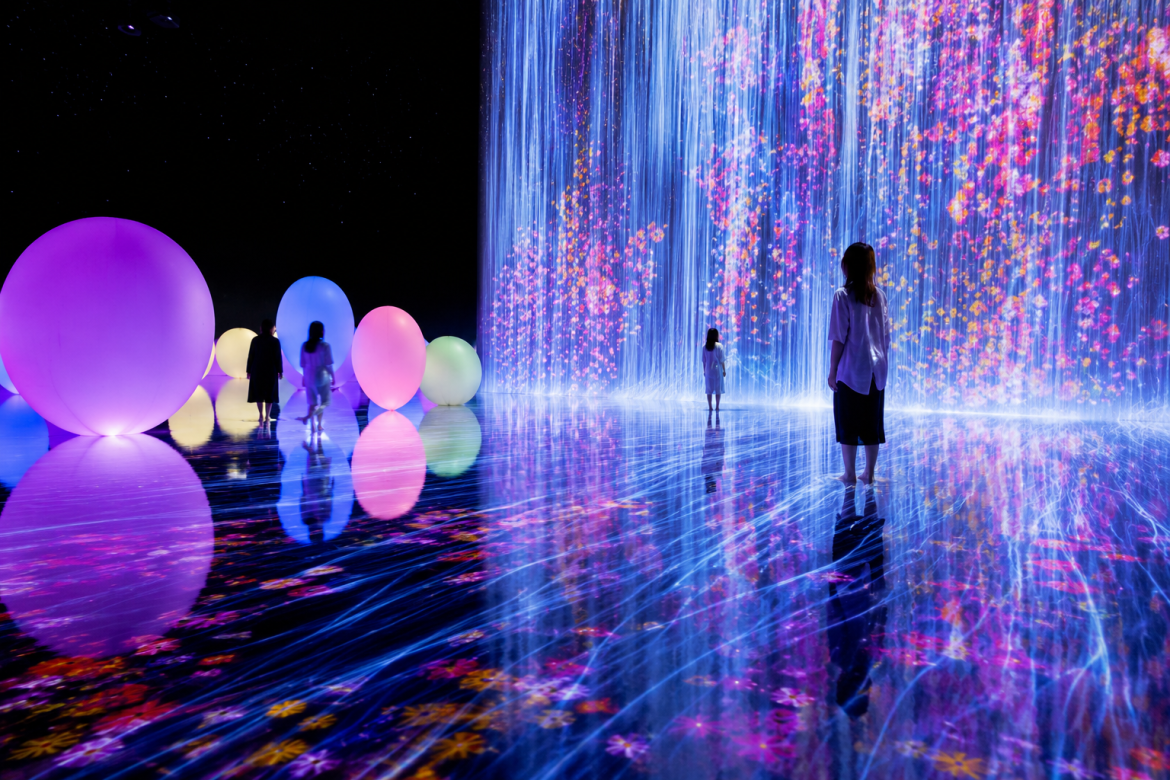
teamLab Planets Tokyo is an immersive digital-art museum in Toyosu where visitors walk barefoot through water, mirrored rooms, responsive light installations and living gardens. Unlike a conventional gallery, the experience is physical: the floor changes beneath you, projections react to movement, flowers surround your body and some rooms are entered through knee-deep water.
It is worth visiting for travellers who enjoy sensory art, unusual photography and experiences that feel completely different from a traditional museum. It works particularly well for first-time Tokyo visitors, couples, families with school-age children and anyone already planning a Toyosu or Odaiba day. It is less suitable for visitors who strongly dislike darkness, flashing light, wet feet, mirrored floors, unstable surfaces or crowded interactive spaces.
The most important planning point is that teamLab Planets is now much larger than the version described in many older travel guides. The current museum includes the expanded Forest and Future Park areas as well as the Water and Garden areas, so a realistic visit normally takes around 2.5 to 4 hours rather than a rushed 60 to 90 minutes.
Admission is timed, and there is no conventional walk-up ticket counter at the venue. Reserving a slot before travelling to Toyosu is the safest approach. Visitors who prefer an English booking interface can check the current packages and selectable times for a teamLab Planets Tokyo admission ticket.
For a first visit, choose a weekday opening slot or a later-afternoon entry, travel to Shin-Toyosu Station, wear trousers or shorts that can be rolled above the knee, and avoid placing another timed attraction immediately afterward. The museum controls the order of some sections, so it is better to experience it slowly than to treat it as a quick photo stop.
Travellers still choosing between Tokyo’s two major teamLab museums should also read this teamLab Planets versus teamLab Borderless comparison. Planets is generally the more physical and water-based experience, while Borderless suits visitors who prefer a larger maze-like digital-art environment without the same barefoot route.

Is teamLab Planets Tokyo Worth Visiting?
| Question | Practical answer |
|---|---|
| Is it worth visiting? | Yes for travellers who want a highly immersive, physical and photogenic experience rather than a conventional art museum. |
| Best suited to | First-time Tokyo visitors, couples, families with school-age children, digital-art fans and travellers planning Toyosu or Odaiba. |
| Who may prefer to skip it? | Visitors uncomfortable with water, darkness, flashing light, mirrored floors, sensory stimulation or unstable walking surfaces. |
| Ticket requirement | A dated entry ticket is required. Advance online booking is strongly recommended because there is no normal ticket counter at the venue. |
| Recommended duration | Allow 2.5–4 hours. Add more time if visiting with children, joining artwork queues or eating afterward. |
| Transport difficulty | Easy from Shin-Toyosu Station. Moderate from central Tokyo because most journeys require a transfer or a ten-minute walk from Toyosu Station. |
| Main highlight | The combination of barefoot water rooms, infinite mirrored light and living flower installations. |
| Main disadvantage | Crowds can weaken the sense of immersion, and several rooms may be uncomfortable for visitors with sensory or mobility concerns. |
| Children | Enjoyable for many children, but adults must supervise closely. Strollers cannot enter, and spare clothes are useful. |
| Older travellers | Possible with a slower pace and detour routes, but water, slopes, soft floors and low-light spaces should not be underestimated. |
| Wheelchair access | Available with important limitations. Some works require detours, designated viewpoints or transfer to a special water wheelchair. |
| Overnight stay | Not necessary solely for the museum. Staying in Toyosu is useful only when combining an early market visit or several Tokyo Bay attractions. |
| Best time | Weekday opening time for lower crowds, or late afternoon for a smoother Toyosu and waterfront itinerary. |
Editor’s recommendation: prioritize teamLab Planets when the physical sensation of moving through the artwork is part of the appeal. Do not book it simply because it is famous. Visitors expecting a quiet gallery, a completely step-free route or an effortless visit in formal clothing may enjoy another Tokyo museum more.
For a one-day Tokyo itinerary, the museum deserves a half-day rather than a narrow 90-minute gap. The expanded experience is now substantial enough to become the main attraction of a Toyosu and Odaiba day.
Opening Hours and the Expanded Museum
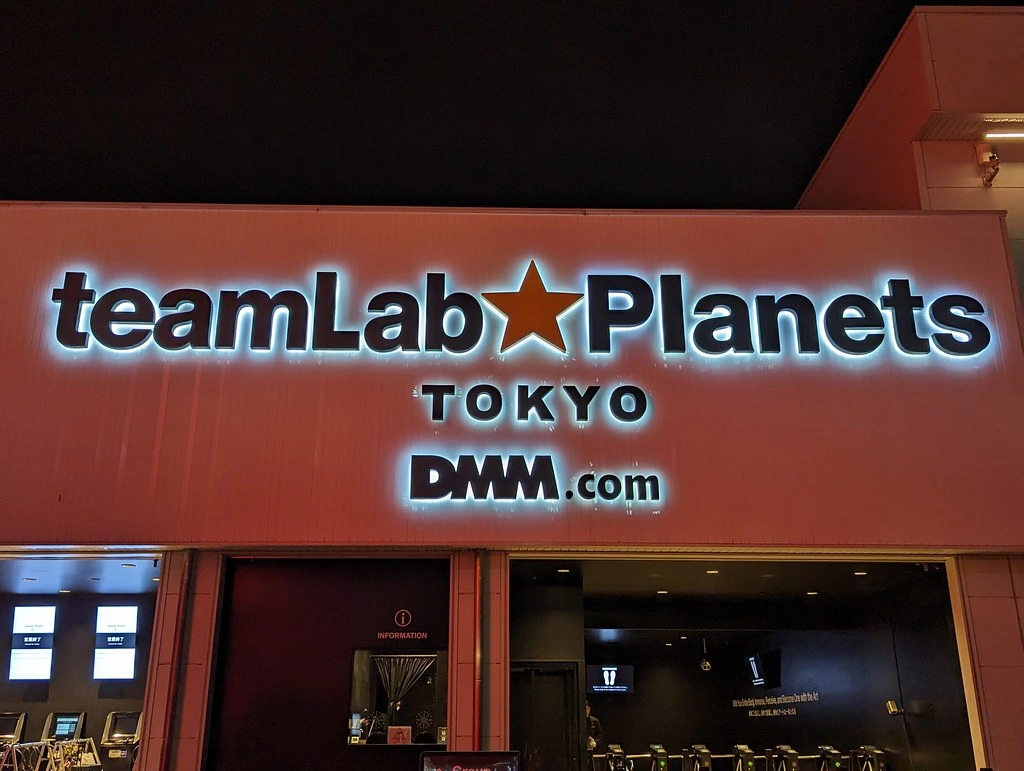
teamLab Planets is currently open, including the Water, Garden, Forest and Future Park areas. The expansion added more than 20 artworks and changed the practical time needed for a visit. Any itinerary based on the older, smaller museum should be adjusted.
The operating schedule generally extends from morning until 22:00, with final admission one hour before closing. However, opening times, available entry slots and closure dates vary. Check the actual calendar attached to your selected ticket date instead of relying on a fixed timetable copied from an older article.
There is no standard on-site ticket counter or vending machine. Buy a dated ticket online before arriving. A QR code is used for admission, so keep the booking email accessible and make sure your phone has enough battery.
teamLab Planets is a limited-term exhibition rather than a permanent national museum. Travellers planning far in advance should confirm that reservations have opened for their intended date before organising flights or accommodation around the attraction.
Essential teamLab Planets Information
| Item | Current practical information |
|---|---|
| Official name | teamLab Planets TOKYO DMM |
| Address | 6-1-16 Toyosu, Koto-ku, Tokyo 135-0061 |
| Adult ticket | From ¥3,800 for visitors aged 18 or older; prices may vary by date |
| Junior-high and high-school ticket | ¥2,800 |
| Child ticket | ¥1,500 for ages 4–12 |
| Young children | Free for children aged 3 or younger |
| Disability-discount ticket | From ¥1,900 for eligible visitors; accompanying-person conditions should be checked during booking |
| Premium Pass | ¥12,000 for visitors aged 4 or older |
| Opening schedule | Generally morning to 22:00, subject to the selected date |
| Final admission | One hour before closing |
| Recommended duration | 2.5–4 hours |
| Nearest station | Shin-Toyosu Station on the Yurikamome Line |
| Best exit | North Exit at Shin-Toyosu Station |
| Alternative station | Toyosu Station Exit 7, followed by an approximately ten-minute walk |
| Parking | No dedicated museum car park |
| Re-entry | Not permitted |
| Lockers | Free lockers measuring approximately 23 × 34 × 37 centimetres |
| Strollers | Cannot enter the exhibition; outdoor stroller storage is provided |
| Wi-Fi | Free Wi-Fi is available |
teamLab Planets Tickets, Reservations and Passes
Standard Timed Admission
The standard timed ticket is the right choice for most visitors. You select a date and an entry window, then present the QR code at the entrance. A timed ticket controls arrival, but it does not guarantee that every artwork will be empty or that there will be no outdoor admission line.
Visitors buying through the official ticket store may normally change an eligible reservation before the stated deadline, subject to availability and the official change limit. Standard official tickets are not refundable. Klook tickets and other third-party bookings may have stricter no-change and no-refund conditions, so read the selected package terms before paying.
Is the Premium Pass Worth It?
The Premium Pass allows entry at a flexible time on the selected date and avoids joining the normal admission queue. It does not provide re-entry, and it does not skip queues that form inside individual artworks.
At ¥12,000, it is difficult to justify for a normal sightseeing day. It makes the most sense for travellers with an unpredictable schedule, a short stop in Tokyo, a private guide or a business itinerary where missing a narrow time slot would create a larger problem than the price difference.
Admission Plus Tokyo Subway 24-Hour Ticket
For the linked Klook museum-and-subway bundle, preschool children aged 4–6 need separate museum child admission. Do not interpret transport-ticket age conditions as free museum entry.
The admission-and-subway bundle combines a teamLab Planets ticket with unlimited Tokyo Metro and Toei Subway travel for 24 hours after the transport ticket is activated. It can be useful when the same itinerary includes areas such as Ginza, Shinjuku, Asakusa or central Tokyo.
The important limitation is that the Yurikamome Line is not part of the Tokyo Subway Ticket. To avoid paying a separate Yurikamome fare, travel by subway to Toyosu Station and walk approximately ten minutes from Exit 7.
Compare the current conditions for the teamLab Planets admission and Tokyo Subway 24-hour ticket before deciding. The bundle is useful only when the subway portion matches the rest of your day.
Klook Pass Greater Tokyo
The linked Klook Pass Greater Tokyo lists Planets as a Premium/add-on option rather than a standard attraction. Price the required add-on and secure its reservation before judging savings.
A multi-attraction pass is worth considering only when its current selected option explicitly includes the attractions you will use. Confirm whether Planets is included, requires a paid add-on, and has an available reservation before comparing the total against separate tickets.
Compare the Klook Pass Greater Tokyo options as a comparison starting point, not a guarantee of current Planets admission.
Which Ticket Should You Choose?
| Booking option | Best suited to | Main advantage | Main limitation | Recommendation |
|---|---|---|---|---|
| Standard official timed ticket | Visitors who value the official change rules | Direct booking and eligible time-slot changes | No standard refund; popular slots can sell out | Best all-round choice when the official store has your preferred time |
| Klook timed ticket | Travellers who prefer Klook’s interface or are combining other bookings | Convenient English booking and several package types | Selected packages may be non-changeable and non-refundable | Useful after checking the exact package conditions |
| Premium Pass | Visitors with unpredictable arrival times | Flexible entry on the selected date and no normal admission queue | High price and no queue-skipping inside | Not necessary for most travellers |
| Admission plus subway ticket | Visitors making several Metro or Toei Subway journeys | Combines admission and city transport | Does not cover Yurikamome | Good when walking from Toyosu Station fits the itinerary |
| Multi-attraction pass | Travellers booking several eligible paid attractions | One pass can simplify a full Tokyo itinerary | Planets is a Premium/add-on choice; reservation availability varies | Calculate value from confirmed attractions before purchasing |
Best Time to Visit teamLab Planets
| Entry period | Crowd expectation | Advantages | Disadvantages |
|---|---|---|---|
| First weekday slot | Usually the lowest practical crowd level | Cleaner photographs, cooler journey and more energy for physical artworks | Requires an early start; Toyosu dining may not yet be fully open |
| Late weekday morning | Moderate | Easy to combine with an early Toyosu Market breakfast | School groups and tourists may already be inside |
| Weekend midday | Often busy | Convenient for a relaxed schedule | More waiting inside and less control over photographs |
| Late afternoon | Moderate to busy depending on the date | Works well after Toyosu lunch and before an Odaiba evening | Delays can affect the next reservation |
| Evening | Varies | Atmospheric outdoor garden experience and easy connection to Tokyo night activities | Families with young children may become tired; final transport and dinner timing need attention |
| Near final admission | Sometimes lower, but unpredictable | Can fit a late-arrival itinerary | Limited recovery time if transport is delayed, and the museum may feel rushed |
The best general strategy is the first available weekday slot. Allow extra travel time to locate the entrance and organise your group, then join the admission line at the time shown on your ticket.
Do not arrive extremely early expecting immediate admission. Entry remains tied to the reserved window. Equally, do not treat the final admission time as the best arrival time merely because the museum closes later; the expanded experience deserves several hours.
How to Get to teamLab Planets Tokyo
From Shin-Toyosu Station
- Take the Yurikamome Line to Shin-Toyosu Station.
- Leave through the ticket gates.
- Turn right and use the North Exit.
- Continue along the pavement toward the museum entrance.
- The walk takes approximately one minute.
This is the easiest route for first-time visitors, families and older travellers because it minimises outdoor walking.
From Toyosu Station
- Take the Tokyo Metro Yurakucho Line to Toyosu Station.
- Use Exit 7.
- Follow the route beneath and alongside the elevated Yurikamome tracks.
- Continue toward Shin-Toyosu and teamLab Planets.
- Allow approximately ten minutes for the walk.
This option is useful when using a Tokyo Subway Ticket because it avoids paying separately for Yurikamome. The route is straightforward, but summer heat, rain and luggage can make the walk less attractive than it appears on a map.
From Tokyo Station
The smoothest rail route is usually:
- Take the JR Yamanote Line from Tokyo Station to Yurakucho.
- Transfer to the Tokyo Metro Yurakucho Line for Toyosu.
- Either walk approximately ten minutes from Toyosu Exit 7 or take Yurikamome one stop to Shin-Toyosu.
- Use Shin-Toyosu North Exit for the shortest final walk.
The train movements themselves are short, but station walking and transfer time mean the complete journey should not be planned as a 15-minute trip.
From Ginza
The linked shuttle product is one-way. Select the correct direction and arrange each leg separately if you need a return journey.
From Ginza-itchome Station, take the Yurakucho Line to Toyosu, then walk from Exit 7 or transfer to Yurikamome for Shin-Toyosu.
A direct GINZA SIX to teamLab Planets shuttle bus is also available for selected departures. It is convenient for visitors staying near central Ginza who prefer a single boarding point, but road congestion means rail is safer when your admission slot is tight.
From Shinjuku
Take the Toei Shinjuku Line to Ichigaya, transfer to the Tokyo Metro Yurakucho Line for Toyosu, then walk from Exit 7 or continue one stop on Yurikamome to Shin-Toyosu. Allow extra time at Ichigaya because the transfer involves station walking.
From Asakusa
One simple route is the Toei Asakusa Line to Shimbashi, followed by the Yurikamome Line to Shin-Toyosu. The Yurikamome portion is longer than a central-Tokyo subway journey, but it avoids a more complicated final transfer and gives elevated views of the Tokyo Bay area.
From Haneda Airport
Take the Tokyo Monorail to Hamamatsucho, transfer to JR for Shimbashi, then take Yurikamome to Shin-Toyosu. Travellers arriving with large suitcases should first leave their luggage at the hotel or a major-station locker.
For a broader comparison of railway, bus, taxi and transfer options after landing, see the Haneda Airport to Tokyo transportation guide.
From Narita Airport
A practical rail route uses the Keisei Skyliner to Nippori, the JR Yamanote Line to Yurakucho, the Yurakucho Line to Toyosu and either the final walk or Yurikamome connection.
This is a long sequence for an arrival-day attraction. Read the Narita Airport to Tokyo transportation guide, leave luggage at your accommodation and avoid reserving a non-changeable museum slot too close to the flight’s scheduled arrival.
Driving and Parking
teamLab Planets has no dedicated car park. A limited weekday parking service may be available through Urban Dock LaLaport Toyosu under specific redemption conditions, but this should be treated as a supplementary benefit rather than the main access plan.
Public transport is normally easier. Event traffic, shopping-centre parking procedures and the lack of direct museum parking can remove any time saved by driving.
What to Wear at teamLab Planets
Choose Clothes That Can Get Wet
Visitors remove their shoes and socks before entering the Water area. Water can reach approximately knee height on an adult, depending on the room and the visitor’s height.
The safest clothing choices are:
- Shorts
- Quick-drying trousers
- Trousers that roll securely above the knee
- Comfortable underwear that will not become visible in mirrored floors
- Easy-to-remove footwear
Avoid tight trousers that cannot be rolled up, long hems that drag through water and clothing that becomes transparent when wet.
Skirts, Wide Trousers and Mirrored Floors
Several artworks use highly reflective flooring. Short skirts and very wide trousers can reveal more than expected from low camera angles or floor reflections. Free rental shorts are available in a broad size range, but dressing appropriately from the start is easier.
Footwear for the Forest Area
The Water artworks are experienced barefoot, but the expanded Forest and Future Park areas contain more active surfaces and are explored with suitable footwear. Wear comfortable shoes rather than heels. Follow staff instructions when changing between barefoot and shoe-based sections.
What Should Children Wear?
Young children may sit, splash or stumble into deeper water than expected. Bring a full change of clothing, including underwear and socks. Adults should not assume that rolling up a child’s trousers will be enough.
Lockers, Luggage and Strollers
Free Lockers
Free lockers are available after entry, with internal dimensions of approximately 23 centimetres wide, 34 centimetres deep and 37 centimetres high. They are suitable for shoes, coats, handbags and small daypacks, but not full-size suitcases.
Large Suitcases
Oversized baggage is placed in the stroller-storage area and secured with a wire lock. This is less convenient than a staffed cloakroom and is not a good reason to bring airport luggage to the museum.
Leave large suitcases at your hotel, a station locker or a luggage-storage service before travelling to Toyosu. The museum is much easier when your group carries only essential items.
Strollers
Strollers cannot enter the exhibition. They must be left in the designated outdoor stroller area and secured with the provided wire lock.
A baby carrier is therefore more useful than a stroller inside. Families should also consider whether carrying a sleeping child for several hours will be realistic.
The Correct First-Time Route
The exact order can change with crowd-control arrangements, but the smoothest first-visit mindset is:
- Arrive and confirm the correct admission line.
- Scan the QR ticket and enter the preparation area.
- Remove shoes and socks.
- Place footwear, bags and unsuitable clothing in a locker.
- Follow the Water-area route without rushing between rooms.
- Continue through the Garden installations.
- Change footwear when directed for the Forest and Future Park areas.
- Spend extra time in the interactive spaces rather than treating them as children-only zones.
- Visit the open-air area and food facilities after completing the main route, subject to current venue flow.
The biggest mistake is trying to identify the shortest path to a famous room. teamLab Planets is designed as a sequence of changing physical sensations. Skipping quickly between photo locations weakens the experience and makes the ticket feel more expensive than it should.
Main teamLab Planets Highlights
Drawing on the Water Surface Created by the Dance of Koi and People
For the koi water artwork, an inseam below 40 cm means a child cannot enter independently. They may participate when carried or in a baby carrier with a guardian aged 18 or older. This artwork-specific condition is separate from ticket age bands.
Visitors walk through warm water while projected koi move around their legs and change when they encounter people. This room demonstrates the central Planets concept: the artwork is not a fixed video but an environment altered by the bodies inside it.
Move slowly and allow the surface to settle. Fast walking creates splashes and makes photography more difficult for everyone nearby.
The Infinite Crystal Universe
Thousands of points of light form a seemingly endless three-dimensional space. Mirrors multiply the installation in every direction, making it one of the museum’s strongest visual moments.
The room is more impressive when visitors stop moving and watch the light sequence develop instead of leaving after the first photograph.
Floating Flower Garden
Living orchids rise and descend around visitors, creating narrow pathways that change continuously. The garden feels intimate because the flowers are not merely projected onto walls; they occupy the same physical space as the visitor.
Entry may be controlled to protect the plants and preserve the movement of the installation. A short wait is worthwhile.
Moss Garden of Resonating Microcosms
Reflective forms respond to contact and environmental conditions in an outdoor moss garden. The appearance changes with daylight, weather and evening illumination.
This is one reason a late-afternoon visit can be appealing: visitors may experience the garden during changing light rather than only in bright midday conditions.
Catching and Collecting Extinct Forest
This interactive area turns exploration into a learning experience. Visitors use the dedicated Catching and Collecting Extinct Forest app to catch, observe and release extinct animals. Follow the artwork-specific download instructions; it is separate from the general teamLab App used for artwork concepts and Crystal Universe interaction.
It is particularly effective for families because the activity gives children a purpose beyond taking photographs. Adults should install or open the app before entering the busiest part of the room.
Athletics Forest
Athletics Forest explores spatial awareness through climbing, jumping, balancing and movement. It is more physically demanding than the original water route and can become crowded when many families arrive at once.
Do not assume every work is suitable for every age or mobility level. Follow staff directions and use the designated viewing route when participating is uncomfortable.
Future Park
Future Park contains collaborative artworks that change as visitors draw, move and interact. Sketch Umwelt World allows visitor-created images to become part of the shared digital environment.
This area rewards participation. Travellers who only watch from the edge may miss why the expansion materially changed the museum.
Open-Air and Food Area
The exterior area provides a useful transition after the sensory intensity of the museum. It can include fire-based digital work and the UZU dining concept, depending on current access arrangements.
Plan food after the main exhibition rather than before it, and confirm re-entry rules because leaving the museum does not allow a second visit to the galleries.
Walking, Water and Physical Difficulty
teamLab Planets is easier to reach than many Tokyo attractions, but the exhibition itself should not be described as physically effortless.
- The Shin-Toyosu walk is approximately one minute, while the Toyosu Station walk is about ten minutes.
- Visitors move barefoot through water that may reach adult knee height.
- Some surfaces are soft, sloped, uneven or unstable.
- Several spaces are dark and may distort depth perception.
- The Forest area includes active works involving balance, climbing or jumping.
- There are detour routes for visitors who cannot complete a particular room.
- Rest opportunities are more limited than in a conventional gallery with benches in every room.
Older travellers should avoid rushing to keep pace with younger family members. Anyone with knee, balance or foot concerns should speak to staff before entering a difficult work and use the alternative route when offered.
Summer heat mainly affects the journey and outdoor queue rather than the indoor artworks. In heavy rain, the short Shin-Toyosu route is preferable to the walk from Toyosu Station.
Visiting With Children, Older Travellers or Limited Mobility
Families With Children
Children under 13 must enter with a guardian aged 18 or older, with no more than three children per adult including free-entry children. For the koi artwork, check the separate 40 cm inseam rule and carrying/carrier requirement before planning a toddler’s route.
teamLab Planets can be excellent for children who enjoy water, movement, animals and drawing. School-age children are generally able to engage with more of the Forest and Future Park concepts, while toddlers may mainly react to the physical environment.
- Children aged 3 or younger enter free.
- One adult may supervise no more than three children, including children entering free.
- Strollers must remain outside the exhibition.
- Baby carriers are allowed.
- Bring spare clothes for young children.
- Keep children close in dark rooms and around water.
- Do not allow running on wet or reflective surfaces.
- Diaper-changing facilities are available in the women’s restrooms.
- Ask about the first-aid room when urgent breastfeeding space is needed.
Families should choose an early slot, eat afterward and avoid scheduling another strict reservation immediately. Three hours inside can feel much longer when carrying a toddler.
Older Travellers
Older visitors can enjoy the museum, especially the light and flower installations, but the route requires more confidence than a normal art gallery.
The best strategy is to use Shin-Toyosu Station, arrive outside peak periods, tell staff about balance or walking concerns and accept detours instead of forcing every room. A partial route can still provide a worthwhile experience.
Travellers With Limited Mobility
Wheelchair access is available, but not every work can be experienced in the same way.
- Wheelchair tire covers are required for visitors using their own chair.
- The inclined waterfall installation is not accessible by wheelchair.
- Some water works require transfer to a special water wheelchair.
- Staff cannot push the special water wheelchair, so a companion is needed.
- Several Athletics Forest and Future Park works are available only from designated viewing areas or cannot be experienced while seated.
- Accessible toilets are available.
- Detour routes can bypass unsuitable rooms.
Contacting the venue before the visit is sensible when a specific artwork is the main reason for booking. Accessibility does not mean that every room offers an identical route.
Sensory and Medical Considerations
The museum contains darkness, intense light, flashing effects, enclosed environments, heights and changing surfaces. Visitors with photosensitivity, severe claustrophobia, fear of darkness or balance conditions should review the current venue warnings before buying a non-refundable ticket.
Half-Day teamLab Planets Itinerary
Opening-Time Visit
| Time | Plan |
|---|---|
| 07:30–08:00 | Travel to Shin-Toyosu and arrive before the booked slot |
| 08:00–11:00 | Experience the Water, Garden, Forest and Future Park areas |
| 11:00–12:00 | Eat near the museum or continue to Toyosu Market and Senkyaku Banrai |
| 12:00 onward | Return to central Tokyo or continue to Odaiba |
This is the best itinerary for lower crowds and families. It leaves enough flexibility if the museum takes longer than expected.
Late-Afternoon Visit
| Time | Plan |
|---|---|
| 12:00–13:30 | Lunch in Toyosu or Ginza |
| 14:00–17:00 | Visit teamLab Planets |
| 17:00–18:00 | Food or a short waterfront break |
| 18:00 onward | Ride Yurikamome to Odaiba for shopping, waterfront views or dinner |
This version works well for couples and visitors who want to continue into a Tokyo evening. See the Tokyo night activities guide for ideas after leaving the bay area.
Full-Day Toyosu and Odaiba Itinerary
- Start early at Toyosu Market if watching market activity or eating sushi is important.
- Walk through Senkyaku Banrai after the market areas open.
- Reserve teamLab Planets for late morning or early afternoon.
- Allow approximately three hours inside.
- Take Yurikamome from Shin-Toyosu toward Odaiba.
- Choose one major Odaiba activity rather than several distant attractions.
- Finish with waterfront views, shopping or dinner.
The sequence matters. Toyosu Market belongs in the morning, while teamLab Planets is flexible enough for late morning or afternoon. Reversing the order can mean reaching market restaurants after their busiest or most useful period.
Do not add teamLab Borderless in Azabudai Hills to the same day unless digital art is the sole purpose of the trip. The museums are in different parts of Tokyo, and rushing both reduces the value of each ticket.
For wider planning, use the Tokyo travel guide and the guide to the best things to do in Tokyo to decide which paid attraction deserves the rest of the day.
Nearby Attractions and Logical Combinations
For a slower family day, follow Planets with lunch at LaLaport Toyosu. SMALL WORLDS is an optional additional indoor attraction; a Toyosu hot-spring visit is another separate paid activity. Choose one rather than trying to fit both after a long museum visit.
Toyosu Market and Senkyaku Banrai
This is the most natural combination. Visit the market first if seafood breakfast, auctions or morning activity is the priority, then reserve teamLab Planets for later in the morning.
Senkyaku Banrai provides food, shopping and hot-spring facilities near the market. It is particularly useful after teamLab when the group needs a meal and does not want another long transfer.
Odaiba
Odaiba is easy to reach on Yurikamome and works well after a teamLab visit. Choose one or two areas rather than trying to cover every shopping centre, museum and viewpoint.
Families can combine teamLab with an indoor Odaiba attraction, while couples may prefer the waterfront near sunset. Public transport is easier than driving because parking and moving between complexes consume time.
Ginza and Tsukiji
Ginza is a practical base before or after teamLab, especially when using the direct shuttle or Yurakucho Line. Tsukiji Outer Market is better visited early, before travelling to Toyosu.
Do not plan a late teamLab morning followed by a leisurely Tsukiji lunch and assume every market shop will remain open. The better sequence is Tsukiji first, teamLab second.
teamLab Borderless
Borderless is not a nearby attraction, but it is the main alternative considered by travellers. Planets offers water, barefoot movement and a more directed route. Borderless offers a larger exploratory environment in Azabudai Hills.
Choose one when the itinerary is already crowded. Visiting both is worthwhile mainly for serious teamLab fans or travellers spending several days in Tokyo.
Food and Dining Around teamLab Planets
Do not depend on a large meal immediately before entering. The water, slopes and active Forest spaces are more comfortable when visitors have eaten lightly.
After the museum, the main dining choices are:
- UZU and the venue’s current food area for the most direct option
- Senkyaku Banrai for seafood, Japanese snacks and a broader choice
- Toyosu Market for a morning or lunchtime seafood meal
- LaLaport Toyosu for family-friendly restaurants and indoor shopping
- Odaiba for dinner after continuing along the Yurikamome Line
- Ginza for a higher-end evening meal after returning to central Tokyo
Restaurants associated with markets may close earlier than central-city dining areas. For an evening museum visit, eat beforehand or plan dinner in Odaiba, Ginza or near your hotel.
Do You Need to Stay Near teamLab Planets?
An overnight stay is not necessary for teamLab Planets alone. The museum is easy to visit from Ginza, Tokyo Station, Shimbashi and many other central districts.
Staying in Toyosu becomes useful when:
- You have the earliest admission slot
- You want to visit Toyosu Market at dawn or early morning
- You are travelling with young children and want a short return journey
- Your itinerary focuses on Odaiba and Tokyo Bay
- You prefer modern waterfront hotels to a central nightlife district
Ginza is the stronger all-round base for travellers combining teamLab with central Tokyo dining and shopping. Shimbashi is practical for direct Yurikamome access, while Tokyo Station is better for travellers using the Shinkansen during the same trip.
First-Time Mistakes to Avoid
1. Arriving Without a Dated Ticket
There is no normal ticket counter. Reserve online before travelling to Toyosu.
2. Using an Old 60-Minute Visit Estimate
The museum has expanded. Allow 2.5–4 hours rather than building a tight itinerary around the former layout.
3. Wearing Clothes That Cannot Be Rolled Up
Water can reach adult knee height. Long or tight trousers quickly become inconvenient.
4. Wearing a Short Skirt Without Considering Mirrored Floors
Reflections and low camera angles can expose underwear. Use rental shorts or choose more suitable clothing.
5. Bringing a Full-Size Suitcase
The free lockers are small. Oversized luggage uses a wire-lock area rather than a staffed cloakroom.
6. Assuming Strollers Can Enter
Strollers must remain outside. Bring a baby carrier and consider the physical effort of carrying a child.
7. Buying a Subway Bundle and Expecting It to Cover Yurikamome
The Tokyo Subway Ticket covers Tokyo Metro and Toei Subway, not Yurikamome. Walk from Toyosu Station or pay the separate fare.
8. Assuming the Premium Pass Skips Every Queue
It improves admission flexibility but does not remove queues inside popular artworks.
9. Scheduling Another Timed Attraction Immediately Afterward
Crowds and interaction time are unpredictable. Leave at least one hour of flexibility after the expected finish.
10. Visiting Directly From the Airport With Luggage
Flight delays, transfers and storage make this a risky use of a non-refundable time slot.
11. Ignoring Mobility or Sensory Warnings
Water, dark spaces, flashing light and unstable floors are central to the experience. Use detours and speak to staff when needed.
12. Trying to Combine Planets and Borderless in a Rushed Day
The two museums are not next to each other. Choose one or place them on separate days unless digital art is your main Tokyo priority.
teamLab Planets Tokyo FAQ
How much is teamLab Planets admission?
Adult tickets currently begin at ¥3,800. Junior-high and high-school tickets are ¥2,800, while children aged 4–12 pay ¥1,500. Date-based pricing may apply.
Do children aged 3 or younger need a ticket?
They enter free, but they still count toward the rule limiting one supervising adult to three children.
Can I buy a ticket at the entrance?
Do not rely on doing so. There is no conventional on-site ticket counter or vending machine, so obtain a dated online ticket before arrival.
Do teamLab Planets tickets sell out?
Popular weekend, holiday and convenient daytime slots can become unavailable. Book once your Tokyo itinerary is reasonably fixed.
Can I change my ticket time?
Eligible official Entrance Pass tickets can be changed up to three times, at least two hours before the admission start time. Premium Pass tickets also allow up to three eligible changes, with a deadline of 08:30 on the visit date. Exclusions include coupon tickets, partial changes to an order and sold-out replacement slots. Third-party purchases follow the seller’s conditions.
Can I cancel my ticket?
Standard official tickets are generally non-refundable. Klook and other seller packages may also be non-refundable, so read the package terms before payment.
How early should I arrive?
Reach Shin-Toyosu with a little extra time to find the correct entrance and organise your group, then join the entrance at the time shown on your ticket. Arriving very early does not provide earlier admission.
What happens if I am late?
Late entry may be allowed during the same operating day, but it is not guaranteed to protect the full experience or your preferred crowd level. Arrive on time whenever possible.
How long does teamLab Planets take?
Allow 2.5–4 hours for the expanded museum. A family, photographer or highly interactive visit may take longer.
Do I have to go barefoot?
The Water route requires visitors to remove shoes and socks. Follow staff instructions when moving into sections where suitable footwear is used.
How deep is the water?
Water may reach approximately adult knee height. The relative depth is greater for young children.
Are towels provided?
Towels are provided for drying feet after the water areas. Bring spare clothes for children rather than relying only on a towel.
Can I wear a skirt?
Yes, but mirrored floors may reveal underwear. Wearing shorts underneath or borrowing the venue’s rental shorts is recommended.
Can I bring a stroller?
You can bring it to the venue, but it cannot enter the exhibition. Leave it in the designated stroller-storage area.
Are baby carriers allowed?
Yes. A secure baby carrier is usually more practical than a stroller inside the museum.
Is teamLab Planets suitable for toddlers?
For the koi water artwork, an inseam below 40 cm means a child cannot enter independently. They may participate when carried or in a baby carrier with a guardian aged 18 or older. This artwork-specific condition is separate from ticket age bands.
It can be enjoyable, but toddlers require constant supervision around water, dark rooms and moving visitors. Bring spare clothing and consider the length of the visit.
Is teamLab Planets suitable for older travellers?
Yes when the visitor is comfortable with water and changing surfaces. Use Shin-Toyosu Station, move slowly and accept detour routes when necessary.
Is teamLab Planets wheelchair accessible?
The museum admits wheelchair users, but some artworks require detours, designated viewing positions or transfer to a special water wheelchair with companion assistance.
Can I take large luggage inside?
No. The lockers are designed for small belongings. Oversized luggage is secured separately, so leaving suitcases elsewhere is strongly preferable.
Can I take photographs?
Personal photography is generally part of the experience, but follow current venue rules, avoid blocking pathways and do not use equipment that interferes with other visitors.
Is teamLab Planets good on a rainy day?
Most of the experience is indoors, making it a strong rainy-day choice. Use Shin-Toyosu Station to minimise the outdoor walk.
Is the museum air-conditioned?
The main exhibition is climate-controlled, but the queue and some exterior areas are exposed to outdoor conditions. Dress for the journey as well as the water rooms.
Does the Tokyo Subway Ticket cover Shin-Toyosu?
No. Shin-Toyosu is on Yurikamome. The subway ticket reaches Toyosu Station, from which the museum is approximately a ten-minute walk.
Is the Ginza shuttle better than the train?
It is easier for some Ginza-based travellers, but traffic can cause delays. Rail is more predictable when the reserved entry time is close.
Can I re-enter teamLab Planets?
No. Complete the galleries and collect all belongings before leaving the controlled exhibition area.
Should I visit teamLab Planets or Borderless?
Choose Planets for barefoot water, physical movement and a more directed route. Choose Borderless for a larger exploratory digital environment without the same water-based sequence.
Final Recommendation
teamLab Planets remains one of Tokyo’s most distinctive paid attractions because the visitor does not merely look at the artwork. Water, light, flowers, mirrors and responsive projections change around the body, making the experience more memorable than a conventional screen-based exhibition.
The current expanded museum is worth prioritising for first-time visitors, couples, families with school-age children and digital-art fans. It is not an automatic recommendation for everyone. Visitors who dislike wet feet, darkness, mirrored floors, flashing light or physically unstable spaces should consider teamLab Borderless or a conventional museum instead.
Allow approximately three hours as a realistic baseline. Choose the first weekday slot for lower crowds or a late-afternoon slot when continuing to Odaiba. Use Shin-Toyosu North Exit for the shortest walk, and do not bring airport luggage.
The standard timed ticket is sufficient for most visitors. The Premium Pass is useful only when arrival flexibility is unusually valuable. The admission-and-subway package makes sense when several Tokyo Metro or Toei Subway journeys are already part of the day, but remember that it does not cover Yurikamome.
Wear shorts or trousers that can be rolled securely above the knee, choose comfortable footwear for the active Forest areas and bring a complete change of clothes for young children. Families should use a baby carrier because strollers remain outside.
The strongest half-day plan is an opening-time museum visit followed by Toyosu lunch. The strongest full-day plan starts at Toyosu Market, continues through teamLab Planets and finishes in Odaiba. Avoid adding too many central-Tokyo reservations to the same day.
Advance booking is particularly important for weekends, holidays, family travel and anyone needing a specific entry time. Check the selected date, package conditions and current operating calendar before paying.
Tickets and visitor information: teamLab Planets · Ticket and accessibility rules
Related guides for planning your trip
Plan accommodation, transport and other sightseeing days separately rather than fitting every Tokyo stop around the museum visit.
Other Tokyo Activities for a Separate Day
Other city activities do not include Planets admission. Compare dates, meeting points, tour language and cancellation terms, and plan them for another part of your trip.