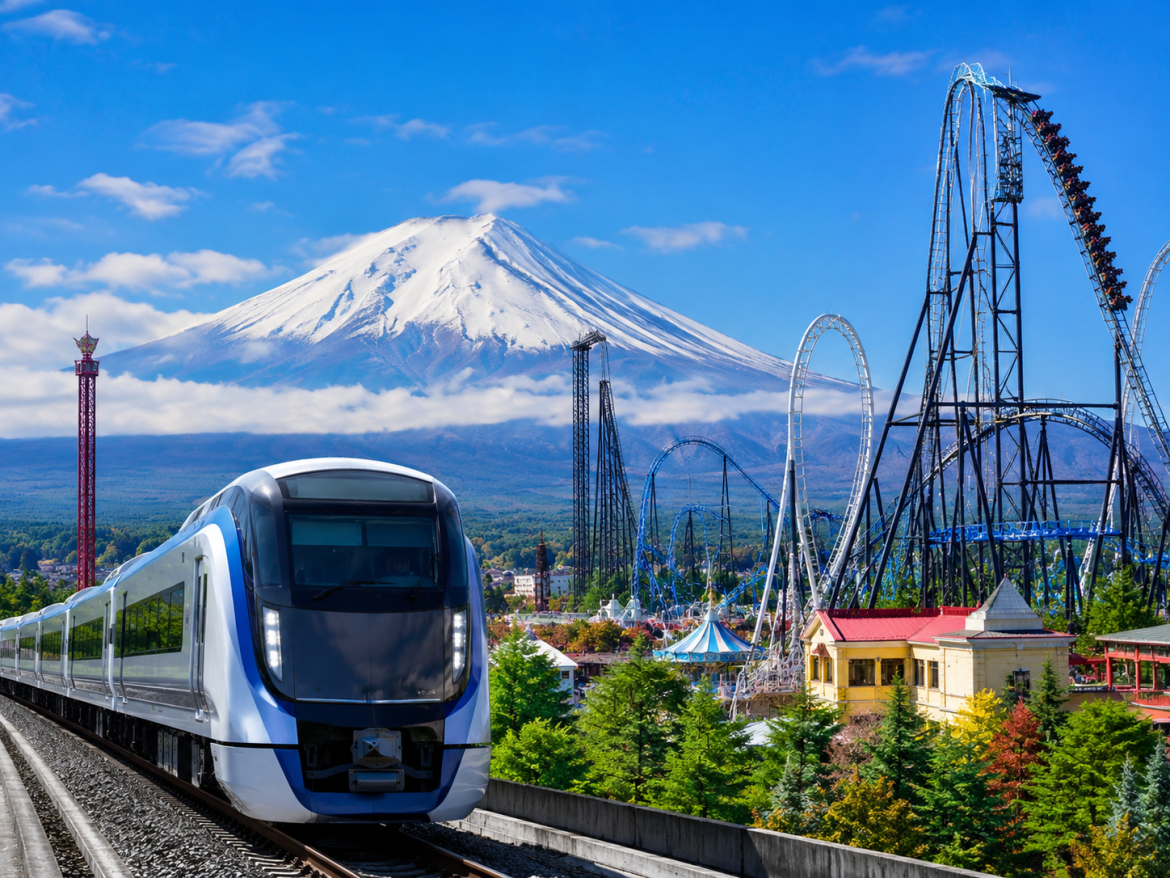
Getting from Tokyo to Fuji-Q Highland is straightforward, but choosing the wrong route can cost you valuable park time. The direct highway bus is normally the cheapest and simplest option, while the Fuji Excursion train is more reliable when weekend traffic, holiday congestion or winter road conditions are a concern.
For most travelers staying around Shinjuku, the decision comes down to two routes: a reserved highway bus from Shinjuku Expressway Bus Terminal or a reserved Fuji Excursion train from JR Shinjuku Station. Both arrive beside Fuji-Q Highland, but they arrive at different entrances.
The highway bus stops directly in front of the first entrance beside Highland Resort Hotel & Spa. The train stops at Fujikyu-Highland Station beside the railway-side entrance. These points are close to the park but are not the same meeting place.
Fuji-Q Highland is free to enter, but the rides are not free. Visitors need a free admission ticket, individual ride tickets or an eligible One-Day Pass. Pass prices vary by date, park hours change throughout the year and individual attractions may close for maintenance, wind, rain or other operating conditions.
A Tokyo day trip is realistic when Fuji-Q Highland is the main destination. Travelers still planning the rest of their stay can use the Tokyo travel guide and the Tokyo day-trip comparison guide to decide whether the park deserves a full day.
Small groups and weekday travelers usually obtain the best balance of price and convenience from the Shinjuku highway bus. Travelers who value punctual arrival more than price should reserve the Fuji Excursion.

Check the fare, entrance and last useful connection
The standard Shinjuku bus fare is ¥2,200, or ¥2,000 with eligible online payment. Shibuya is ¥2,300 standard or ¥2,100 with the specified online payment. Use the official Shinjuku route and booking page and Shibuya fare and timetable sheet; select Fuji-Q Highland as your stop.
The all-JR approach to Otsuki followed by Fujikyu costs ¥2,508 by adult IC fare. A lower-cost rail alternative starts on Keio from Shinjuku, changes at Takao to JR, then at Otsuki to Fujikyu: ¥2,125 by IC. The official rail comparison distinguishes these routes. Extra transfers cost time, and a JR pass does not cover Keio.
The regular Fuji Excursion timetable has its last direct return from Fuji-Q Highland at 17:44. That is not the railway’s last train. Staying until park closing requires a confirmed bus or a checked rail connection through Otsuki, plus time to walk to the correct departure point. Fuji Excursion reservations normally open one month before travel at 10:00 Japan time.
Tokyo to Fuji-Q Highland: 30-Second Answer
| Traveler | Recommended Route | Main Reason |
|---|---|---|
| Most first-time visitors | Shinjuku highway bus | Direct, affordable and easy to understand |
| Weekend or holiday visitors | Fuji Excursion | Avoids expressway congestion |
| Budget traveler avoiding buses | Ordinary trains via Otsuki | Cheaper than the direct limited express |
| Staying near Tokyo Station | Tokyo Station highway bus | Avoids crossing Tokyo during the morning rush |
| Staying near Shibuya | Shibuya highway bus | Convenient departure point despite a longer journey |
| Family with luggage | Direct bus or private transfer | Fewer transfers and less station navigation |
| Using a wider Fuji Five Lakes itinerary | Train or Mt. Fuji Pass | Better flexibility for regional travel |
| Landing at Haneda or Narita | Direct airport bus plus an overnight stay | Airport schedules are usually unsuitable for a full ride-focused day |
For a normal weekday visit, choose an early highway bus. For a Saturday, Sunday or Japanese public holiday, the Fuji Excursion is usually worth considering because arriving late can mean substantially longer queues.
If the only available Fuji Excursion arrives after 11:00, an earlier highway bus may still provide more useful park time.
Check whether your selected ticket package already includes a return bus before buying separate transport. Tickets, scheduled buses and private transfers are different products; choose the transport that fits your party. Verify the Fuji-Q stop, return time, age/height/health rules and ride closures. Priority access is not automatically included.
Is Fuji-Q Highland Worth a Day Trip from Tokyo?
| Worth visiting? | Yes, particularly for roller-coaster fans and travelers who want a complete theme-park day near Mount Fuji |
|---|---|
| Best for | Thrill-ride fans, teenagers, couples, friends and families choosing age-appropriate attractions |
| Can be skipped by | Travelers interested only in quiet Mount Fuji scenery, traditional villages or relaxed lake sightseeing |
| Recommended stay | A complete operating day for major rides; four to five hours for a selective visit |
| Main advantage | Direct access from central Tokyo without needing a car |
| Main difficulty | Ride queues, changing operating conditions and limited return services |
| Family suitability | Good when the day is planned around Thomas Land and suitable family attractions |
| Older travelers | Possible, although a complete day involves considerable standing and walking |
| Need to stay overnight? | No for a normal Tokyo day trip; useful when combining the park with Lake Kawaguchiko |
| Best arrival time | Approximately 20–30 minutes before the scheduled opening time |
Fuji-Q Highland is worth including when the rides are the main purpose of the journey. It is less suitable as a short stop between several Mount Fuji viewpoints because waiting for one major attraction can consume a large part of the day.
Visitors mainly interested in Mount Fuji scenery should compare the park with the routes in the Mount Fuji photo spots and Tokyo day-trip guide.
Fuji-Q Highland Basic Information
| Official name | Fuji-Q Highland |
|---|---|
| Japanese name | 富士急ハイランド |
| Address | 5-6-1 Shin-Nishihara, Fujiyoshida, Yamanashi |
| Admission | Free admission ticket required; rides are charged separately |
| One-Day Pass | Date-dependent pricing |
| Opening hours | Vary by date and season |
| Scheduled closures | Different attractions close on different dates |
| Nearest railway station | Fujikyu-Highland Station |
| Main highway bus stop | Fuji-Q Highland, directly in front of the first entrance |
| Recommended visit | Full day for major rides |
| Large luggage | Better stored at a hotel or transferred to the next accommodation |
Current Opening and Ride-Closure Situation for 2026
Fuji-Q Highland does not use one fixed daily timetable. Opening and closing times change according to the month, weekday, holiday calendar, events and expected demand.
Check the dated closure calendar for your visit. Attractions may close for inspection, maintenance, wind, rain, low temperatures or operational reasons; a closure on one date is not a permanent closure announcement.
A park opening time does not guarantee that every attraction begins operating immediately. Likewise, an attraction queue may close before the published park closing time when the estimated wait extends beyond the end of operations.
Before leaving Tokyo, check three separate items:
- The park’s opening and closing time
- The scheduled attraction closure list
- The live operating status on the morning of the visit
Do not buy a One-Day Pass solely because the park is open. First confirm that the rides most important to you are expected to operate.
Tokyo to Fuji-Q Highland Transport Comparison
| Route | Indicative Time | Adult One-Way Fare | Transfers | Best Feature | Main Risk |
|---|---|---|---|---|---|
| Shinjuku highway bus | About 1 hour 40 minutes | ¥2,200 | None | Best overall value | Traffic delays |
| Fuji Excursion from Shinjuku | About 1 hour 55 minutes | Approximately ¥4,100 | None | Predictable arrival | Reserved seats sell out |
| Ordinary trains via Otsuki | About 2 hours 20 minutes to 3 hours | ¥2,508 by IC fare | At least one | Flexible all-rail alternative | Longer journey and connection gaps |
| Tokyo Station highway bus | Approximately 2 hours | Varies by operator and service | None | Convenient for eastern Tokyo | Traffic and limited seats |
| Shibuya highway bus | About 1 hour 55 minutes to 2 hours 40 minutes, depending on service | ¥2,300 | None | Convenient for Shibuya stays | Longer than Shinjuku |
| Haneda Airport bus | Varies by service | Check the selected departure | None | Avoids transferring in Tokyo | Limited timetable |
| Narita Airport bus | More than 3 hours | ¥6,000 | None | Direct airport connection | Usually too late for a full park day |
Travel times are scheduled estimates rather than guarantees. Highway buses can arrive significantly later during congestion, while trains can also be affected by weather, accidents or operating disruptions.
Option 1: Shinjuku Highway Bus — Best for Most Travelers
The Shinjuku highway bus is the simplest route for most Tokyo visitors. It departs from Shinjuku Expressway Bus Terminal, commonly called Busta Shinjuku, which is directly connected to the New South Exit area of JR Shinjuku Station.
The complete route is:
JR Shinjuku Station → New South Exit → Shinjuku Expressway Bus Terminal → reserved highway bus → Fuji-Q Highland stop → first park entrance
The scheduled journey is approximately 1 hour 40 minutes, and the standard adult fare is ¥2,200 each way. No transfer is required, and the bus stops immediately in front of the first entrance.
Why the Highway Bus Is Usually the Best Choice
- It costs considerably less than the Fuji Excursion.
- There is no transfer at Otsuki.
- You can store normal travel bags in the luggage compartment, subject to operator rules.
- The bus arrives directly beside the first entrance.
- Bus-and-pass packages may reduce the cost of transportation and park admission.
When the Bus Is Not the Best Choice
The bus is less reliable on Saturday mornings, Sunday evenings, Japanese public holidays and major vacation periods. Congestion on the Chuo Expressway can delay arrival and reduce the number of attractions you can complete.
Travelers visiting specifically for FUJIYAMA, Eejanaika, Takabisha or ZOKKON should consider the Fuji Excursion when punctual arrival is more important than saving approximately ¥2,000 each way.
Highway Bus Reservation Advice
Reserve both the outbound and return journeys. Booking only the outbound bus and expecting to choose a return after leaving the park is risky, particularly on weekends.
The individual Klook highway-bus booking is useful when you want direct transportation but do not want to be tied to a combined park-pass package. Confirm that the selected service stops at Fuji-Q Highland rather than only Kawaguchiko Station or Mount Fuji’s fifth station.
Option 2: Fuji Excursion — Best for Reliable Arrival
The Fuji Excursion is a direct limited express train from JR Shinjuku Station to Fujikyu-Highland Station. It continues from the JR Chuo Line onto the private Fujikyu Railway after Otsuki, so passengers remain on the same train.
The complete route is:
JR Shinjuku Station → direct Fuji Excursion → Fujikyu-Highland Station → railway-side park entrance
The journey takes approximately 1 hour 55 minutes. The total one-way cost is around ¥4,100, depending on the exact ticket and booking method.
Why Choose the Fuji Excursion?
- Expressway congestion does not affect the journey.
- The arrival time is easier to predict.
- There is no transfer at Otsuki.
- The railway station is beside the park entrance.
- It is a strong choice for weekends, holidays and peak travel periods.
Fuji Excursion Seat Rules
Fuji Excursion trains do not have normal non-reserved seating. Reserve a specified seat whenever possible.
A seat-unspecified limited express ticket may permit boarding under railway conditions, but it does not guarantee a seat. Standing for most of the trip is a poor way to begin a physically demanding theme-park day.
Tickets normally go on sale one month before travel. Reserve early for Saturdays, Sundays, Japanese holidays, school vacation periods and autumn foliage dates.
What If the Fuji Excursion Is Sold Out?
Use the ordinary rail route through Otsuki. Take a JR Chuo Line train from Shinjuku to Otsuki, then transfer to the Fujikyu Railway for Fujikyu-Highland Station.
A limited express to Otsuki can shorten the journey but requires the correct limited express ticket. Ordinary rapid or local combinations cost less but take longer.
Option 3: Ordinary Trains via Otsuki — Best Flexible Rail Route
The ordinary rail route is useful when the direct Fuji Excursion is sold out or when you want to avoid highway traffic without paying the full direct limited express fare.
The route is:
JR Shinjuku Station → JR Chuo Line to Otsuki Station → Fujikyu Railway → Fujikyu-Highland Station → railway-side entrance
The current adult IC fare from Shinjuku to Fujikyu-Highland Station is ¥2,508. Journey time depends heavily on the JR service and the connection at Otsuki.
Otsuki Transfer Tips
- Follow signs for the Fujikyu Railway rather than leaving the station unnecessarily.
- Avoid itineraries with only a few minutes between trains.
- Check whether the Fujikyu train is an ordinary service or a limited express requiring an extra charge.
- Keep your IC card or paper tickets ready when moving between the JR and private railway sections.
- Check the return connection to Tokyo before boarding at Fujikyu-Highland Station.
This route is cheaper than the direct Fuji Excursion, but it is not always better value when a poor connection adds 30–60 minutes of waiting.
Option 4: Tokyo Station, Shibuya and Other Bus Departures
Shinjuku is not automatically the best departure point. Crossing Tokyo during the morning rush can remove the advantage of using a slightly faster bus.
Tokyo Station
Tokyo Station highway buses are convenient for travelers staying around Marunouchi, Ginza, Nihombashi, Asakusa or eastern central Tokyo.
Check the exact boarding point printed on the ticket. Tokyo Station has several long-distance bus areas, and different operators may use different terminals or nearby buildings.
Shibuya
Shibuya services are useful for travelers staying around Shibuya, Ebisu, Daikanyama or Meguro. The July 2026 timetable has journeys of about 1 hour 55 minutes to 2 hours 40 minutes depending on intermediate stops. The standard adult fare is ¥2,300, or ¥2,100 with eligible online payment.
Do not travel from Shibuya to Shinjuku merely to save ¥100 unless the Shinjuku departure time is substantially better.
Ikebukuro and Other Departure Areas
Seasonal or date-specific services may operate from Ikebukuro, Akihabara, Odaiba and other parts of Tokyo. These routes normally have fewer useful morning departures than Shinjuku.
Choose the departure that produces the earliest realistic park arrival after accounting for travel from your hotel.
How to Get from Haneda Airport to Fuji-Q Highland
The official Haneda route currently uses a temporary timetable effective 1 October 2026; the adult fare is ¥3,300 from Haneda or ¥2,300 from Shinagawa. For Narita, check the official direct-bus route and its dated schedule before deciding where to spend the first night.
Direct buses connect Haneda Airport and the Fuji Five Lakes area, with selected services stopping at Fuji-Q Highland.
The main problem is not the route but the timetable. Direct departures are limited, and a service arriving in the afternoon is too late for a full day focused on major rides.
Travelers landing at Haneda should normally choose one of these plans:
- Take a direct bus to the Fuji-Q or Kawaguchiko area and stay overnight.
- Stay in Tokyo, then use an early bus or train the following morning.
- Use a private transfer when traveling as a larger group with substantial luggage.
Do not reserve a non-refundable park pass based on a scheduled flight arrival. Immigration, baggage collection and flight delays can make the connection impossible.
How to Get from Narita Airport to Fuji-Q Highland
A direct Narita Airport bus is available on selected operating periods. The current adult one-way fare is ¥6,000, and the scheduled journey takes more than three hours.
The service removes the need to transfer through Tokyo, but it normally reaches Fuji-Q Highland too late for a complete park day. It is more suitable for travelers checking into a hotel near Fuji-Q Highland or Lake Kawaguchiko.
Attempting to land at Narita, clear immigration, collect luggage, travel more than three hours and complete a major theme park on the same day is not recommended.
Where Do the Bus and Train Arrive?
Open the official access map before arranging a meeting: highway buses use the terminal beside Highland Resort Hotel & Spa, while trains arrive at the Second Entrance side. Local bus stops are also distinct from the highway terminal. Save your exact return stop rather than a general pin for the park.
One of the most common planning mistakes is treating the railway station and highway bus terminal as the same location.
| Arrival Point | Used By | Location | What to Do |
|---|---|---|---|
| Fuji-Q Highland highway bus stop | Direct buses from Tokyo and airports | In front of the first entrance, close to Highland Resort Hotel & Spa | Walk directly toward the first entrance |
| Fujikyu-Highland Station | Fuji Excursion and Fujikyu Railway trains | Beside the railway-side entrance | Follow the entrance signs beside the station |
Neither arrival requires a long uphill walk. The problem occurs when friends arrange to meet at “Fuji-Q Highland” without specifying the station, bus stop, hotel or entrance.
If you arrive by train, there is normally no reason to walk around the outside of the park to the highway bus terminal before entering.
Fuji-Q Highland Tickets and Reservations
Use the official ticket comparison with the dated opening and ride-closure calendars. Priority admission means earlier entry; it does not automatically mean queue-skipping on every ride. The currently posted priority-admission ticket is not sold for 1 December 2026–5 February 2027, so do not carry an autumn package assumption into winter. A regional Mt. Fuji Pass has its own attraction benefits and is not an unlimited Fuji-Q ride pass.
Fuji-Q Highland does not charge a general admission fee. Visitors can enter using a free admission ticket and purchase individual ride tickets inside the park.
The One-Day Pass covers eligible attractions, but selected special experiences require an additional charge. Prices vary according to the visit date.
| Ticket Category | Current Official Price Range |
|---|---|
| Adult, age 18–64 | ¥6,000–¥7,900 |
| Middle and high school student | ¥5,500–¥7,400 |
| Elementary school student | ¥4,400–¥5,100 |
| Young child, age 1 and above | ¥2,100–¥2,600 |
| Senior, age 65 and above | ¥2,100–¥2,600 |
The correct price is the amount displayed for the selected visit date. Do not rely on an old guide quoting one fixed adult price.
Individual Ride Tickets
The principal roller coasters currently cost ¥2,000 per ride. Several medium-sized attractions cost ¥1,500, while smaller rides have lower individual prices.
Individual tickets make sense when:
- You arrive after lunch.
- You only want one or two attractions.
- Several priority rides are closed.
- You are accompanying children but will not ride yourself.
- You mainly want food, shopping or Mount Fuji views.
When a One-Day Pass Makes Sense
A One-Day Pass usually provides better value when you expect to ride several major and medium-priced attractions. Four ¥2,000 roller-coaster rides already exceed the lower end of the adult pass range.
However, buying a One-Day Pass does not guarantee that every attraction will operate or that you will have enough time to ride everything.
Online Ticket Entry Procedure
Travelers purchasing an online face-recognition pass should register each visitor’s face photograph before arriving.
Travelers holding a QR-issue ticket must normally scan the QR code at an E-TICKETS machine, issue the physical or entry ticket and complete the required entrance procedure.
Families should complete registration before travel. Registering several visitors beside the entrance wastes the least crowded part of the operating day.
Should You Buy a Fuji-Q Bus-and-Pass Package?
A combined package is worth considering when:
- You will travel round trip by highway bus from Tokyo.
- You intend to spend most of the operating day inside the park.
- You expect to ride several eligible attractions.
- You are comfortable with a fixed return time.
- You prefer one booking instead of separate transport and park reservations.
Buy transportation and park admission separately when:
- You will stay overnight.
- You want to continue to Lake Kawaguchiko.
- You plan to return by train.
- You only want a few rides.
- You need maximum return-time flexibility.
The current Klook product includes different selectable combinations, such as a One-Day Pass, selected-attraction access, early admission or roundtrip bus transportation. Read the selected package name carefully before payment.
Which Transport Ticket or Pass Is Best?
The JR TOKYO Wide Pass is ¥16,000 for three consecutive days and includes eligible Fujikyu rail travel, but no park admission or highway bus. The JR EAST PASS, like the nationwide pass, does not cover Fujikyu. If riding Fuji Excursion with the Wide Pass, reserve the seat; selected sightseeing-train seating and products have separate charges.
| Itinerary | Best Choice | Reason |
|---|---|---|
| Enter for photos, food or one ride | Free admission plus individual ride tickets | A full pass may cost more than the rides used |
| Full day focused on rides | One-Day Pass | Simplest option for several eligible attractions |
| Roundtrip bus plus complete park day | Bus-and-pass package | May cost less and require fewer bookings |
| Fuji-Q plus regional sightseeing | Mt. Fuji Pass | May include useful local railway, bus and attraction benefits |
| Wider three-day Kanto railway itinerary | JR Tokyo Wide Pass | Useful when combined with other expensive eligible journeys |
| Standard nationwide Japan Rail Pass | Pay separately beyond Otsuki | The private Fujikyu Railway is not covered |
Mt. Fuji Pass
The Mt. Fuji Pass is designed for regional travel rather than a simple Tokyo–Fuji-Q return journey. It can include Fujikyu Railway services, local buses and selected attractions around the Fuji Five Lakes area.
It is most useful when spending one to three days around Fuji-Q Highland, Lake Kawaguchiko, Lake Yamanakako and nearby attractions.
Do not buy it for a direct Tokyo day trip without calculating which local services and attractions you will actually use. Check the current foreign-traveler eligibility and passport requirements before buying; do not assume it replaces a Fuji-Q One-Day Pass.
JR Tokyo Wide Pass
The JR Tokyo Wide Pass can cover the eligible basic railway journey through Otsuki and along the Fujikyu Railway. It becomes useful when Fuji-Q Highland is one part of a three-day itinerary containing other expensive regional train journeys.
Do not buy it solely for one Fuji-Q Highland return trip without calculating the rest of the itinerary. Additional reservation procedures or charges may apply to selected special trains.
Nationwide Japan Rail Pass
The nationwide Japan Rail Pass covers the eligible JR journey only as far as Otsuki. The private Fujikyu Railway section between Otsuki and Fujikyu-Highland Station requires separate payment.
Do not board the private railway assuming the complete Fuji Excursion journey is included.
Best Departure and Return Times
| Timing | Advantages | Disadvantages | Recommendation |
|---|---|---|---|
| Arrive before opening | Best chance of shorter queues | Requires an early Tokyo departure | Best choice for major roller coasters |
| Arrive around 10:00–11:00 | Less stressful morning | Popular queues may already be long | Suitable for families not focused on headline rides |
| Arrive after lunch | Works for selected attractions | Poor value for the highest-priced One-Day Pass | Use individual ride tickets where practical |
| Leave at closing time | Maximum park time | Return transport may be full | Only with a confirmed reservation |
| Leave before the final service | Provides a backup option | Loses some evening park time | Best for families and first-time visitors |
Aim to reach the correct entrance approximately 20–30 minutes before the scheduled opening time. Park hours vary, so one fixed Tokyo departure time cannot be recommended for every date.
Reserve the return journey before entering. A sold-out evening bus is more difficult to solve than a sold-out morning bus because the remaining rail and bus choices become progressively limited.
Weekday, Weekend and Seasonal Transport Decisions
| Condition | Recommended Option | Reason |
|---|---|---|
| Normal weekday | Shinjuku highway bus | Best balance of price and convenience |
| Saturday morning | Fuji Excursion | Avoids unpredictable road congestion |
| Sunday evening return | Train or confirmed bus with extra time | Traffic returning toward Tokyo can be heavy |
| Japanese public holiday | Fuji Excursion | More predictable than road transport |
| Heavy rain forecast | Reconsider the park date | Outdoor rides may suspend operation |
| Winter snow risk | Train where practical | Reduces road-condition uncertainty |
| Hot summer day | Earliest practical arrival | Reduces afternoon queueing in peak heat |
| Autumn foliage weekend | Train | Mount Fuji area roads and buses can be heavily congested |
Recommended Order After Arriving
The correct first-hour strategy is more important than following one fixed ride list.
Recommended order:
Entrance procedure → check live ride operations → choose the most important operating coaster → complete a second priority attraction → take a late morning break → use smaller or indoor attractions during peak queues → return to priority rides if waits fall → leave for the correct transport terminal
Do not walk across the park automatically toward a famous ride without checking its live operation. Wind or inspection delays may mean another major attraction is the better first choice.
Main Attractions Worth Prioritizing
FUJIYAMA
FUJIYAMA is one of the park’s signature large-scale roller coasters. Its value is not only speed but also the exposed structure and Mount Fuji setting. Ride it early when it is one of your principal reasons for visiting.
Eejanaika
Eejanaika combines track movement with independently rotating seats, creating a much more disorienting experience than a conventional coaster. It is unsuitable for visitors uncomfortable with inversions or unpredictable motion.
Takabisha
Takabisha is known for its steep drop and compressed sequence of launches, inversions and sudden transitions. It is a strong priority for visitors who prefer intense but comparatively compact coaster experiences.
ZOKKON
ZOKKON uses a motorcycle-style riding position and multiple launch elements. Its seating position and theme make it different from the park’s older large coasters.
Super Scary Labyrinth of Fear
The haunted attraction requires a separate charge even for many pass holders. Groups should check the package price and admission procedure before joining the queue.
Thomas Land
Thomas Land is the park’s most practical area for younger children. Families should treat it as a separate priority zone rather than expecting preschool children to wait while adults complete every major coaster.
FUJIYAMA Tower
The tower provides elevated views over the park and surrounding Mount Fuji area. It is a useful alternative when coaster operations are limited or when part of the group does not want thrill rides.
Physical Difficulty, Walking and Weather
Reaching Fuji-Q Highland does not involve a mountain hike. Both the bus stop and railway station are beside an entrance.
The physical difficulty comes from the hours spent inside the park:
- Long periods of standing in queues
- Repeated walking between distant attraction areas
- Outdoor exposure to sun, wind, rain or cold
- Stairs or emergency-evacuation requirements for selected rides
- Carrying bags that cannot be taken onto attractions
A full day can involve substantially more walking than a casual look at the map suggests. Wear supportive shoes and avoid carrying unnecessary items.
Summer
Summer queues can involve prolonged sun exposure. Arrive early, drink regularly and schedule indoor or shaded attractions around the hottest part of the afternoon.
Winter
Winter temperatures around Fujiyoshida are considerably lower than central Tokyo. Low temperatures, snow, ice and wind can affect outdoor attractions.
Rain
The park may remain open in rain, but outdoor roller coasters can stop. A One-Day Pass is not automatically refunded because selected rides close due to weather.
Families with Children
A direct bus is usually the easiest route for parents because it avoids the Otsuki transfer. The Fuji Excursion is preferable when children are likely to struggle with an extended road delay.
Families should choose transportation based on the child’s routine rather than the theoretical fastest journey. A reserved train provides more predictable meal and arrival times, while the direct bus requires less station navigation.
Children under seven must be accompanied by a junior-high-school-age or older visitor. Individual attractions also apply separate age, height and accompaniment rules.
Families planning to stay overnight can compare the Fuji-Q Highland family hotel guide and the Lake Kawaguchiko family hotel guide.
Using a Stroller
A stroller is useful for moving around the park with younger children, but it cannot be taken onto rides. Remove valuables whenever leaving it in a designated stroller area.
Family Route
Recommended family order:
Early arrival → Thomas Land → family lunch before the main rush → selected indoor or character attractions → Ferris wheel or observation experience → early return before children become overtired
Older Travelers and Visitors with Limited Mobility
Older travelers can enter the park without purchasing a full One-Day Pass. This is useful when accompanying family members but not riding major attractions.
The main park areas are reachable without a mountain climb, but a complete visit involves prolonged walking and standing. Rest before fatigue becomes a problem rather than waiting until the final return journey.
Ride access is assessed individually. Some attractions require passengers to:
- Walk independently
- Use stairs
- Maintain a fixed riding posture
- Respond to emergency instructions
- Evacuate without substantial assistance
General wheelchair access to the park does not mean every ride is accessible.
Traveling with Large Luggage
Do not bring a large suitcase into a ride-focused day unless there is no alternative. Store luggage at your Tokyo hotel, transfer it to the next accommodation or leave it at the Fuji-area hotel before entering.
The direct bus removes the Otsuki transfer, but carrying a suitcase still limits movement after arrival. It may also create problems when the return bus stop and onward hotel are in different parts of the area.
A private transfer becomes more reasonable for four to six travelers sharing the cost, particularly when the group has several suitcases, young children or limited mobility.
Travelers needing hotel pickup can compare this Tokyo to Fuji-Q Highland private transfer. Check the pickup area and vehicle capacity before booking.
Driving from Tokyo to Fuji-Q Highland
Drivers normally use the Chuo Expressway toward the Kawaguchiko interchange. In light traffic, the journey can be quicker than public transportation, but weekend congestion can extend it substantially.
Driving Is Best For
- Families carrying substantial luggage
- Groups sharing rental, toll and fuel costs
- Travelers staying around the Fuji Five Lakes
- Visitors combining the park with poorly connected regional attractions
- Travelers continuing elsewhere instead of returning directly to Tokyo
Driving Is Not Ideal For
- Saturday morning departures from central Tokyo
- Sunday evening returns
- Drivers unfamiliar with snow or icy roads
- Visitors expecting to avoid all delays
- Travelers who do not need a vehicle after reaching the park
| Parking | Current Standard Charge |
|---|---|
| Ordinary car, weekday | ¥1,500 |
| Ordinary car, weekend, holiday or busy period | ¥2,000 |
| Motorcycle | Free in the designated main parking arrangement |
Parking prices and locations can change without notice. Busy periods include major vacation seasons, and temporary parking areas may be used when the main lots are full.
Recommended Full-Day Itinerary
| Time | Plan |
|---|---|
| Early morning | Depart Shinjuku by reserved bus or Fuji Excursion |
| 20–30 minutes before opening | Arrive and complete entry procedures |
| Opening to late morning | Prioritize the most important operating coaster |
| Late morning | Complete a second major attraction |
| Before the main lunch rush | Eat or take a short rest |
| Early afternoon | Use medium-wait or indoor attractions |
| Mid-afternoon | Recheck major-ride operations and queues |
| Before departure | Allow sufficient time to reach the correct station or bus stop |
| Evening | Return to Tokyo using the confirmed reservation |
Recommended Half-Day Itinerary
A half-day visit is realistic only when you accept that some major attractions may be missed.
| Time | Plan |
|---|---|
| Morning | Travel from Tokyo or Lake Kawaguchiko |
| Late morning | Enter with an individual-ride plan or selected attraction package |
| Late morning to mid-afternoon | Choose two or three priority attractions |
| Mid-afternoon | Continue to Lake Kawaguchiko or return to Tokyo |
Do not buy the highest-priced One-Day Pass automatically for a late arrival. Compare the rides that can realistically be completed before closing.
Can You Combine Fuji-Q Highland with Lake Kawaguchiko?
Technically yes, but the combination works best for selective riders or overnight visitors. Kawaguchiko Station is only one railway stop from Fujikyu-Highland Station.
| Combination | Can It Be Done? | Recommended Plan |
|---|---|---|
| Fuji-Q plus Kawaguchiko Station area | Yes | Half-day park visit or overnight stay |
| Fuji-Q plus lake sightseeing | Possible but rushed | Stay overnight and use a separate half-day for the lake |
| Chureito Pagoda before Fuji-Q | Possible | Only with an early start and limited photography time |
| Fuji-Q plus Oshino Hakkai | Not recommended for a ride-focused day | Use a second day or a car itinerary |
| Fuji-Q, Kawaguchiko, Chureito and Oshino | Too rushed | Remove at least two destinations |
The Tokyo to Lake Kawaguchiko transportation guide explains the same railway and highway-bus corridor in more detail.
Travelers staying in the region can use the Lake Kawaguchiko travel guide to build a separate lake itinerary rather than forcing every attraction into the Fuji-Q day.
Seasonal Planning
Spring
Spring weekends can be busy because travelers combine Fuji-Q Highland with cherry blossoms around Fujiyoshida and Lake Kawaguchiko. Use the train when road congestion is a concern.
Summer
Summer has longer operating days on selected dates but also heat, thunderstorms and large vacation crowds. Arrive early and keep water accessible.
Autumn
Autumn foliage increases traffic throughout the Fuji Five Lakes region. The Fuji Excursion is generally safer for arrival timing, while buses may face congestion around Kawaguchiko.
Winter
Winter can produce clearer Mount Fuji views but also colder temperatures, snow and stronger weather-related ride restrictions. Check both railway and road conditions.
Rainy Days
A rainy visit is only worthwhile when you are comfortable using indoor, family or non-coaster attractions. Travelers visiting principally for the major roller coasters should consider changing the date where ticket conditions permit.
Food Near and Inside Fuji-Q Highland
Fuji-Q Highland has restaurants, food-court options, fast food, snacks and character dining. Families can use Thomas Restaurant, while general park areas include noodle, curry, pizza, burger and snack choices.
The best meal timing depends on ride queues. A practical plan is to eat before the standard lunch rush or when the priority attractions display long waits.
Regional dishes worth considering include:
- Hoto noodles, a Yamanashi specialty with thick noodles and vegetables
- Yoshida udon, known for firm noodles
- Local fruit desserts and seasonal grape or peach products
- Mount Fuji-themed snacks and sweets
Do not rely on snacks as the only meal for a complete ride-focused day. Hunger and dehydration make long queues substantially more difficult.
Should You Stay Overnight?
You do not need accommodation for a normal Tokyo day trip. Direct morning and evening transportation makes a same-day return practical.
An overnight stay becomes worthwhile when:
- You want to be close to the entrance before opening.
- You are traveling with young children.
- You are arriving from Haneda or Narita Airport.
- You want a separate day around Lake Kawaguchiko.
- You need to avoid an exhausting late return to Tokyo.
- The preferred evening bus or train is unavailable.
Best Area for Ride-Focused Visitors
Stay beside Fuji-Q Highland or around Fujikyu-Highland Station. This minimizes morning travel and makes it easier to reach the entrance before opening.
Best Area for Regional Sightseeing
Stay around Kawaguchiko Station for railway and bus connections. Travelers prioritizing lake and Mount Fuji views can consider lakeside accommodation, but should check hotel shuttle arrangements.
The Lake Kawaguchiko hotel guide compares hotels near the station, lake, onsen areas and Fuji-Q Highland.
First-Time Visit: Do Not Make These Mistakes
- Booking only the outbound bus.
Evening services can sell out. Reserve the return before entering the park. - Assuming the bus always takes 1 hour 40 minutes.
That is a scheduled estimate and does not account for heavy traffic. - Crossing Tokyo unnecessarily.
A Tokyo Station or Shibuya departure may be better than traveling to Shinjuku during rush hour. - Confusing the bus stop with the railway station.
They serve different entrances. Specify the exact meeting point. - Arriving around lunchtime with a full ride list.
Major queues may already be long. - Buying a One-Day Pass without checking closures.
Maintenance and weather can affect the attractions that matter most. - Assuming the nationwide JR Pass covers the complete route.
The Fujikyu Railway section requires separate payment. - Bringing a large suitcase into the park.
Store or transfer luggage whenever possible. - Planning Fuji-Q, Kawaguchiko, Chureito Pagoda and Oshino Hakkai together.
Ride queues make this unrealistic for a genuine park day. - Depending on the final return service.
A missed connection may leave very few alternatives. - Leaving ticket registration until arrival.
Complete face registration or account setup before the morning visit. - Assuming every attraction operates until park closing.
Queues can close early, and attraction hours may differ from park hours.
Tokyo to Fuji-Q Highland FAQ
What is the best way to get from Tokyo to Fuji-Q Highland?
The Shinjuku highway bus is the best overall option for most travelers because it is direct and affordable. Choose the Fuji Excursion when reliable arrival timing is more important than price.
What is the cheapest direct route?
The Shinjuku highway bus is normally the cheapest direct route at ¥2,200 each way.
What is the most reliable route?
The Fuji Excursion is generally the most reliable for arrival timing because it is not affected by Chuo Expressway congestion.
Is there a direct train from Tokyo to Fuji-Q Highland?
Yes. The Fuji Excursion runs directly from Shinjuku to Fujikyu-Highland Station without a transfer at Otsuki.
Do I need to reserve the Fuji Excursion?
Yes. It does not have normal non-reserved seating, and useful morning services can sell out.
Do I need to reserve the highway bus?
Advance reservation is strongly recommended, especially for morning departures, weekends, holidays and evening returns.
How much is the Shinjuku bus?
The current standard adult fare is ¥2,200 each way. Children normally pay the applicable child fare.
How much is the Fuji Excursion?
Allow approximately ¥4,100 each way from Shinjuku. Confirm the final fare when booking.
How long does the journey take?
The highway bus is scheduled for approximately 1 hour 40 minutes. The direct Fuji Excursion takes approximately 1 hour 55 minutes.
Are Fujikyu-Highland Station and the bus stop the same?
No. The railway station is beside the railway-side entrance, while the highway bus stops in front of the first entrance.
How far is the station from the entrance?
Fujikyu-Highland Station is directly beside the railway-side entrance. The walk normally takes only a few minutes.
How far is the highway bus stop from the entrance?
The bus stops directly in front of the first entrance, so no substantial final walk is required.
Can I use Suica or PASMO?
IC cards can be used for applicable ordinary JR and Fujikyu Railway fares. Limited express travel still requires the correct additional ticket.
Can I use the nationwide Japan Rail Pass?
It does not cover the private Fujikyu Railway section beyond Otsuki. Pay separately for that section.
Does the JR Tokyo Wide Pass cover Fuji-Q Highland?
It covers the eligible basic route on the Fujikyu Railway within the pass conditions. Check reservation and additional-charge rules for the selected train.
Is Fuji-Q Highland admission free?
Yes. A free admission ticket is required, but rides need individual tickets or an eligible pass.
How much is the One-Day Pass?
Adult prices currently range from ¥6,000 to ¥7,900 depending on the visit date.
Should I buy a One-Day Pass?
Buy it when you expect to ride several major and medium-priced attractions. Use individual tickets for a short visit or only one or two rides.
Is a bus-and-pass package worth it?
It is often worthwhile for a full-day visit with roundtrip Tokyo transportation. It is less suitable when staying overnight or returning by train.
Can Fuji-Q Highland be visited in half a day?
Yes, but plan only two or three priorities. A half-day is unreliable for completing all major roller coasters.
Is Fuji-Q Highland suitable for young children?
Yes. Thomas Land and family attractions are designed for younger visitors, although each ride has separate age and height conditions.
Is Fuji-Q Highland suitable for older travelers?
Yes for a selective visit. Free admission allows non-riders to enter without purchasing a full pass, but a complete day involves considerable walking and standing.
Can I use a stroller?
Yes around the park. Strollers cannot be taken onto attractions and valuables should not be left unattended.
Can I bring a suitcase?
It is possible, but large suitcases are not recommended. Hotel storage or luggage forwarding is more practical.
Is there a direct bus from Haneda Airport?
Selected direct services operate, but schedules are limited and may arrive too late for a complete park day.
Is there a direct bus from Narita Airport?
Yes during selected operating periods. The journey takes more than three hours and is better for an overnight stay than a same-day park visit.
What happens if it rains?
The park may remain open, but outdoor roller coasters can suspend operation. Check the live operating status before leaving Tokyo.
Can I visit Lake Kawaguchiko on the same day?
Yes with a selective half-day park plan. A complete ride-focused day should not include extensive lake sightseeing.
Should I stay overnight?
An overnight stay is optional for a Tokyo day trip but useful for airport arrivals, young children and combined Lake Kawaguchiko itineraries.
What is the safest return plan?
Reserve the return before entering and avoid relying on the final possible service.
Related Todolist Japan Guides
- Fuji-Q Highland ticket and attraction guide
- Tokyo to Lake Kawaguchiko transportation guide
- Fuji-Q Highland family hotel guide
- Lake Kawaguchiko hotel guide
- Lake Kawaguchiko travel guide
- Mount Fuji photo spots and day-trip guide
- Tokyo travel guide
- Tokyo day-trip comparison guide
Tokyo to Fuji-Q Highland Transportation Summary
Fuji-Q Highland is a practical day trip from Tokyo when the park is the principal purpose of the day. Both direct buses and trains arrive beside a park entrance, so no long final walk or mountain approach is required.
The Shinjuku highway bus is the best-value option for most first-time visitors. It costs ¥2,200 each way, requires no transfer and normally takes approximately 1 hour 40 minutes. Its weakness is traffic rather than route complexity.
The Fuji Excursion is the better choice for weekends, holidays and travelers who cannot afford a delayed arrival. It costs more, but the reserved direct journey offers a more predictable start to the park day.
Ordinary trains through Otsuki are the best fallback when the direct train is sold out or when you want to avoid road transport without paying the full limited express fare.
Reserve the return before entering the park, identify whether you will depart from the first-entrance bus stop or Fujikyu-Highland Station and avoid depending on the final possible service.
For a complete ride-focused visit, arrive before opening and choose a One-Day Pass or suitable bus-and-pass package. For a half-day visit, free admission and individual ride tickets may provide better value.
Do not combine Fuji-Q Highland with every major Mount Fuji attraction in one day. Choose either a complete park experience or a selective visit followed by Lake Kawaguchiko. An overnight stay is the most comfortable solution when both are important.