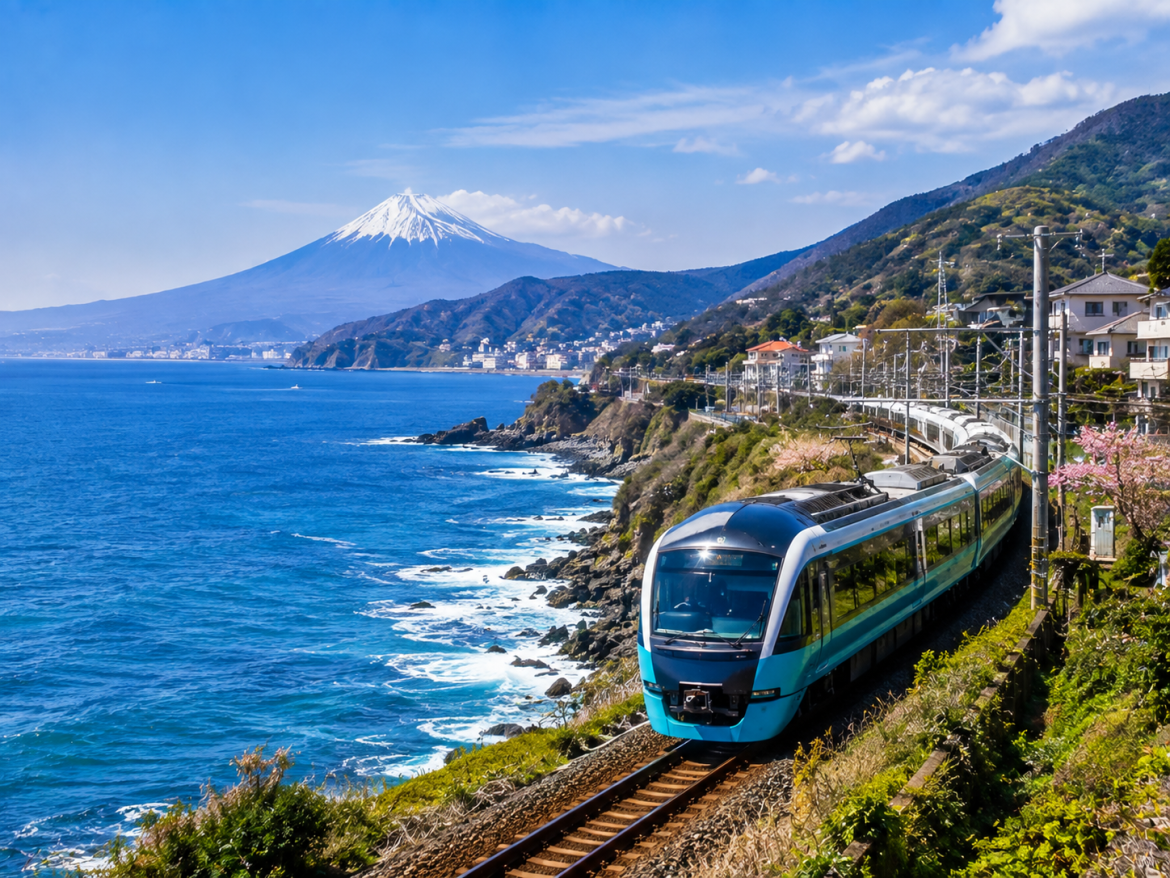

Tokyo to Izu Kogen: Trains, Fares and Local Connections
Izu Kogen is one of the most accessible resort areas on the eastern side of the Izu Peninsula. Travelers visit for the Jogasaki Coast, Mount Omuro, museums, hot-spring hotels and family attractions spread around the highland area.
The easiest way to get from Tokyo to Izu Kogen is a direct Limited Express Odoriko from Tokyo Station. The train continues from the JR network onto the private Izu Kyuko Line and stops at Izu-Kogen Station without requiring a transfer.
The fastest route can be a Tokaido Shinkansen from Tokyo to Atami followed by a local or limited express connection to Izu-Kogen. The lowest-cost realistic route uses conventional JR trains to Atami and then the JR Ito Line and Izu Kyuko Line.
Izu Kogen can be visited as a long day trip, especially when using a morning direct train. However, staying overnight is worthwhile if you want to combine the Jogasaki Coast, Mount Omuro, an onsen and several museums without rushing.
Tokyo to Izu Kogen Transportation: Quick Comparison
| Transportation Option | Best For | Route Overview | Pros | Cons | Editor’s Tip |
|---|---|---|---|---|---|
| Direct Limited Express Odoriko | Easiest overall route | Tokyo Station to Izu-Kogen Station directly in approximately 1 hour 50 minutes to 2 hours 15 minutes. Expect roughly ¥5,550 one way depending on the train and seat. | No transfer, reserved seating and convenient luggage storage areas on many trains. | More expensive than local trains and departures are less frequent. | Choose this route when carrying luggage or traveling with children or seniors. |
| Direct Saphir Odoriko | Most comfortable and scenic journey | Direct premium limited express from Tokyo to Izu-Kogen on selected departures. Travel time is approximately two hours. | Premium seating, large windows and a more relaxed journey. | Higher fare, limited departures and advance reservations are strongly recommended. | Treat the journey as part of the Izu experience rather than simply transportation. |
| Tokaido Shinkansen via Atami | Fastest flexible route | Tokyo to Atami by Shinkansen, then JR Ito Line and Izu Kyuko Line to Izu-Kogen. Allow approximately 1 hour 40 minutes to 2 hours. Typical total cost is around ¥4,840 with separate non-reserved Shinkansen and onward local tickets. | Frequent Tokyo–Atami departures and good schedule flexibility. | Requires a transfer at Atami and sometimes another change at Ito. | Allow at least 10–15 minutes at Atami if traveling with large luggage. |
| Conventional JR Train via Atami | Cheapest train route | Tokyo to Atami by Tokaido Line, then continue through Ito to Izu-Kogen. Allow approximately 2 hours 45 minutes to 3 hours 15 minutes. Fare is generally around ¥3,170. | Lowest regular train fare and no limited express ticket required. | Longer journey, fewer guaranteed seats and possible transfers. | A Green Car on the Tokyo–Atami section can make the journey more comfortable. |
| JR Tokyo Wide Pass Route | Travelers making several regional train trips | Use an ordinary Odoriko or travel through Atami using covered JR and Izu Kyuko services during the pass validity period. | Can cover the Izu Kyuko section and reserved seats on eligible trains. | Usually poor value for a one-way journey or a simple Izu Kogen return trip. | Calculate all planned regional trips before buying the pass. |
| Shinkansen to Atami and Rental Car | Exploring several Izu attractions | Take the Shinkansen to Atami, collect a rental car and drive to Izu Kogen. Allow roughly two to three hours in total before sightseeing stops. | Avoids the longest drive from central Tokyo and provides flexibility within Izu. | Rental costs, parking and weekend congestion must be considered. | This is often more practical than driving from Tokyo when your main goal is exploring the peninsula. |
| Self-Driving from Tokyo | Families, groups and overnight trips | Drive from Tokyo toward Odawara and the eastern Izu Peninsula. Travel normally takes approximately 2.5–3.5 hours before major traffic delays. | Door-to-door convenience and easy access to dispersed attractions. | Traffic, tolls, parking and winding coastal roads. | Avoid departing Tokyo late on a weekend morning. |
| Private Transfer or Car Charter | Large groups and travelers with substantial luggage | Direct pickup in Tokyo and drop-off at an Izu Kogen hotel or attraction. Journey time is traffic-dependent. | Maximum convenience, no transfers and flexible stops. | Significantly more expensive than rail. | Most reasonable when the cost is divided among several travelers. |
Is There a Direct Train, JR Train or Bus from Tokyo to Izu Kogen?
Yes, direct trains operate between Tokyo and Izu-Kogen Station. The main direct service is the Limited Express Odoriko, with selected Saphir Odoriko departures providing a premium alternative.
The service is not entirely operated on JR infrastructure. From Tokyo to Ito, the train uses JR lines. South of Ito, it runs on the privately operated Izu Kyuko Line. This distinction matters when using a JR Pass.
A regular direct highway bus is not the standard or most practical way to travel from central Tokyo to Izu Kogen. Limited or seasonal services may change, so international visitors should normally plan around the train or a private road transfer.
The main station for the destination is Izu-Kogen Station. Do not confuse it with Jogasaki-Kaigan Station, which is one stop farther north and can be useful for some coastal walking routes.
Travelers using the Shinkansen normally transfer at Atami Station. Depending on the timetable, the onward train may continue directly to Izu-Kogen or require another transfer at Ito.
The nationwide Japan Rail Pass covers the JR-operated section but does not fully cover the private Izu Kyuko section. Additional payment is normally required for travel beyond Ito.
The JR Tokyo Wide Pass is more useful because it generally includes the Izu Kyuko Line within its designated coverage area. However, premium Saphir Odoriko seating and certain special services or supplements may not be covered.
Best Departure Area and Where to Stay Before Taking This Route
Tokyo Station
Best for: Direct Odoriko trains and Shinkansen connections through Atami.
Advantages: Tokyo Station offers the widest range of practical departure options. Travelers can choose a direct limited express or use a frequent Tokaido Shinkansen to Atami.
Editor’s tip: Stay near the Marunouchi or Yaesu side when you have an early train, but confirm which side gives the easiest access to your platform.
Shinagawa
Best for: Travelers staying in southern Tokyo or arriving from Haneda Airport.
Advantages: Many Tokaido Shinkansen and limited express services stop at Shinagawa, avoiding the need to travel north to Tokyo Station first.
Editor’s tip: Confirm that your selected Odoriko or Shinkansen stops at Shinagawa before choosing accommodation specifically for the route.
Shinjuku
Best for: Travelers staying in western Tokyo who prefer not to move hotels.
Advantages: Selected Odoriko services may serve Shinjuku, and Tokyo Station is accessible by the JR Chuo Line.
Editor’s tip: Direct Izu services from Shinjuku are less frequent than departures from Tokyo Station. Check the operating pattern for your travel date.
Ueno
Best for: Budget accommodation and travelers arriving from northern Japan.
Advantages: Ueno has straightforward JR access to Tokyo Station and is convenient for travelers using the Tohoku, Joetsu or Hokuriku Shinkansen.
Editor’s tip: Allow extra transfer time at Tokyo Station if carrying large bags during the morning rush.
Tokyo to Izu Kogen Transportation Method 1: Direct Limited Express Odoriko
Route overview
Board the Limited Express Odoriko at Tokyo Station and remain on the train until Izu-Kogen Station. Selected trains also stop at Shinagawa and Yokohama.
The typical journey takes approximately 1 hour 50 minutes to 2 hours 15 minutes. A one-way ordinary reserved-seat journey usually costs roughly ¥5,550, depending on the service and ticket combination.
Odoriko services use JR tracks between Tokyo and Ito before continuing onto the Izu Kyuko Line. Seat reservations are recommended, particularly on weekends, public holidays and during cherry blossom, hydrangea or autumn travel periods.
Who it is best for
This is the best overall route for first-time visitors, families, seniors and travelers with suitcases.
Pros
- No transfer between Tokyo and Izu-Kogen Station
- Reserved seating
- More comfortable than commuter trains
- Simple route for international visitors
Cons
- Higher fare than local trains
- Limited number of departures
- Popular trains may sell out
Editor’s tip
Book a morning train for a day trip. For an overnight stay, a mid-morning departure gives you time to check in and visit one nearby attraction before dinner.
The adult standard fare is ¥3,170 plus the ¥2,380 ordinary reserved-seat supplement: ¥5,550 one way, bought before boarding. Check the operator’s base fares and limited-express supplements. The ordinary Odoriko supplement has no seasonal variation. The general ticketless ¥100 discount ended for purchases after September 30, 2026; named promotions have separate conditions.
Tokyo to Izu Kogen Transportation Method 2: Direct Saphir Odoriko
Route overview
The Saphir Odoriko is a premium limited express operating between the Tokyo area and the Izu Peninsula. Selected services stop at Izu-Kogen Station.
Travel time is normally around two hours, but the timetable and stopping pattern vary by departure. All seats are reserved, and the fare is higher than the regular Odoriko because the train uses premium seating categories.
Who it is best for
This option suits couples, special-occasion trips, rail enthusiasts and travelers who value comfort more than price.
Pros
- Direct journey
- Premium seating and spacious interiors
- Large windows for coastal scenery
- Relaxed start to an Izu resort stay
Cons
- Higher fare
- Limited departure times
- Popular seats require early booking
- Not the best choice for maximizing rail-pass value
Editor’s tip
Check that the chosen Saphir Odoriko stops at Izu-Kogen Station rather than passing through on a different stopping pattern.
Normal-season adult totals from Tokyo are ¥9,430 in Green Car and ¥11,830 in Premium Green, including the base fare. These are different products from ordinary Odoriko; seasonal adjustments apply, and a compartment is priced by occupancy plus a whole-compartment charge. Use the official Saphir fare and booking guide. With a Tokyo Wide Pass, the limited-express and Green charges are still extra, rather than just a small seat-upgrade fee.
Tokyo to Izu Kogen Transportation Method 3: Tokaido Shinkansen via Atami
Route overview
Take a Tokaido Shinkansen from Tokyo or Shinagawa to Atami. At Atami, transfer to a train operating through the JR Ito Line and Izu Kyuko Line toward Izu-Kogen or Izukyu-Shimoda.
The complete journey normally takes approximately 1 hour 40 minutes to 2 hours, depending on the connection at Atami. The typical total fare is around ¥4,840 with separate non-reserved Shinkansen and onward local tickets one way, depending on the Shinkansen seat and onward service.
Some onward trains continue directly from Atami to Izu-Kogen. Other schedules require a transfer at Ito.
Who it is best for
This route suits travelers who want flexible departure times or who have missed the direct Odoriko.
Pros
- Frequent Tokyo–Atami services
- Potentially the fastest route with a good connection
- Easy to combine with a stop in Atami
Cons
- At least one transfer
- Atami Station can be busy
- Onward local trains may have limited luggage space
Editor’s tip
Do not choose a connection with only a few minutes at Atami when carrying luggage. Platform changes can involve stairs, escalators and busy passageways.
The ¥4,840 comparison uses a ¥3,740 Tokyo–Atami non-reserved Shinkansen ticket plus a separate ¥1,100 Atami–Izu-Kogen local-train ticket. It excludes buses and any onward limited-express supplement; through-ticket or promotional products can price differently. Choose Kodama or a Hikari that stops at Atami; Nozomi does not stop there.
Tokyo to Izu Kogen Transportation Method 4: Conventional Trains via Atami
Route overview
Take the JR Tokaido Line from Tokyo to Atami. From Atami, continue toward Ito and Izu-Kogen using the JR Ito Line and Izu Kyuko Line.
The journey generally takes approximately 2 hours 45 minutes to 3 hours 15 minutes. The total one-way fare is usually around ¥3,170 without a limited express supplement.
Depending on the timetable, one or more transfers may be required at Atami or Ito. Seat reservations are not required on ordinary local services.
Who it is best for
This is the most suitable route for budget-conscious travelers who do not mind a longer journey.
Pros
- Lowest realistic regular train fare
- No limited express reservation required
- Flexible departure times
Cons
- Longer travel time
- Seats are not guaranteed
- Commuter trains are less comfortable with large luggage
- More tiring for a same-day return trip
Editor’s tip
Consider using a Green Car between Tokyo and Atami. It adds cost but provides a more spacious seating area without a seat reservation on many Tokaido Line services.
Tokyo to Izu Kogen Transportation Method 5: Shinkansen to Atami and Rental Car
Route overview
Travel from Tokyo to Atami by Tokaido Shinkansen, collect a rental car near Atami Station and drive south toward Izu Kogen.
The train takes approximately 40–50 minutes. The drive from Atami to Izu Kogen typically requires around one hour or longer, depending on coastal traffic.
Rental prices, insurance, fuel and parking vary by vehicle and rental period. Advance booking is recommended for weekends and peak travel seasons.
Who it is best for
This hybrid route is ideal for travelers who want to explore dispersed attractions without driving through central Tokyo.
Pros
- Shorter driving distance
- Easy access to viewpoints, beaches and onsen hotels
- Useful for two-day or three-day Izu itineraries
Cons
- Rental-car paperwork and additional costs
- Weekend congestion around Atami and Ito
- Parking may be limited at smaller attractions
Editor’s tip
Reserve an automatic-transmission vehicle and confirm whether your hotel provides free parking.
Tokyo to Izu Kogen Transportation Method 6: Self-Driving
Route overview
The usual driving route heads southwest from Tokyo toward Odawara before continuing along the eastern side of the Izu Peninsula toward Ito and Izu Kogen.
Without severe congestion, the journey generally takes approximately 2.5–3.5 hours. Weekend traffic around Tokyo, Odawara, Atami and Ito can make the trip considerably longer.
Costs include expressway tolls, fuel and parking. Winter driving conditions are normally milder than in mountainous central Japan, but weather and road closures should still be checked before departure.
Who it is best for
Self-driving works best for families, groups and travelers staying at hotels away from Izu-Kogen Station.
Pros
- Door-to-door transport
- Easy access to Mount Omuro and the Jogasaki Coast
- Convenient for hotels with limited public transportation
Cons
- Heavy weekend traffic
- Tolls, fuel and parking costs
- Winding coastal roads
- Less relaxing for the driver
Editor’s tip
Leave Tokyo early in the morning or travel outside peak weekend periods. A return drive on Sunday afternoon can be particularly slow.
Tokyo to Izu Kogen Transportation Method 7: Private Transfer or Car Charter
Route overview
A private car charter from Tokyo can collect travelers from a Tokyo hotel and provide direct transportation to Izu-Kogen Station, a resort hotel or a sightseeing attraction.
Travel time usually falls within the same broad range as self-driving, approximately 2.5–3.5 hours before major delays. Pricing depends on the vehicle, pickup area, waiting time and number of stops.
Who it is best for
This option is most suitable for larger families, travelers with mobility concerns, groups with substantial luggage and visitors staying at an isolated resort.
Pros
- No station transfers
- Direct hotel-to-hotel transportation
- Flexible rest stops
- Convenient for groups
Cons
- High total cost
- Road congestion still applies
- Advance booking is usually necessary
Editor’s tip
Compare the total group cost rather than the price per vehicle. A charter becomes more reasonable when divided among several passengers.
Tokyo to Izu Kogen Ticket and Pass Comparison
| Ticket / Pass / Activity | Best For | Main Use | Editor’s Tip |
|---|---|---|---|
| Regular Odoriko Ticket | Simple direct journey | Basic fare plus limited express reserved-seat ticket from Tokyo to Izu-Kogen | Book the complete journey to Izu-Kogen rather than buying only the JR section. |
| Saphir Odoriko Ticket | Premium rail experience | Direct premium limited express journey | Reserve early and confirm the seat category before payment. |
| Tokaido Shinkansen Ticket | Flexible and fast travel | Tokyo or Shinagawa to Atami | The onward Izu Kyuko fare is separate unless covered by an eligible pass. |
| Regular Tokaido Line Ticket | Budget travelers | Conventional JR travel from Tokyo to Atami | Allow extra time and avoid rush-hour departures with luggage. |
| JR Tokyo Wide Pass | Multiple regional trips | Eligible JR East services and the Izu Kyuko Line within the coverage area | Usually worthwhile only when combined with additional long-distance trips. |
| Nationwide Japan Rail Pass | Travelers already using a national pass | Covers the JR section toward Ito | Additional payment is normally required for the Izu Kyuko section beyond Ito. |
| Rental Car | Exploring the wider Izu area | Local transportation between attractions and accommodation | Check parking availability and cancellation terms. |
| Private Transfer | Groups and luggage-heavy travel | Direct Tokyo-to-Izu Kogen road transportation | Confirm whether tolls, parking and waiting time are included. |
Is the JR Tokyo Wide Pass Worth It for Tokyo to Izu Kogen?
The JR Tokyo Wide Pass is a consecutive multi-day rail pass designed for eligible international visitors traveling around the wider Tokyo region. Its coverage normally includes eligible JR East services and the Izu Kyuko Line to destinations such as Izu-Kogen.
The pass can be useful because the private railway section south of Ito is included within its designated coverage. It can also cover reserved seats on eligible ordinary limited express services, subject to reservation availability.
The pass does not automatically make every premium train or seat category free. Saphir Odoriko premium accommodation, private compartments and other special products may require additional payment or may not be usable with the pass.
| Travel Plan | Regular Ticket Cost | Pass Cost | Worth It? |
|---|---|---|---|
| One-way Tokyo to Izu Kogen | Approximately ¥5,550 by ordinary Odoriko | Approximately ¥16,000 for three consecutive days | No |
| Tokyo to Izu Kogen return only | Approximately ¥11,100 by ordinary Odoriko | Approximately ¥16,000 for three consecutive days | Usually not, unless convenience matters |
| Izu Kogen return plus another substantial regional trip | Often exceeds the pass price when bought separately | Approximately ¥16,000 for three consecutive days | Potentially yes |
| Local-train return trip only | Approximately ¥6,340 | Approximately ¥16,000 for three consecutive days | No |
Editor’s recommendation: Do not buy the JR Tokyo Wide Pass only for a one-way trip or a budget local-train return journey. It becomes more attractive when you plan to use an Odoriko return trip and add another long regional journey during the pass period.
The official pass costs ¥16,000 for adults and ¥8,000 for ages 6–11, valid on three consecutive days. It covers the Izu Kyuko Line and ordinary Odoriko reserved seats, but not the Tokaido Shinkansen or local buses. Eligibility requires an original non-Japanese passport; this pass is also available to eligible foreign residents, without a Temporary Visitor requirement. An ordinary Odoriko return costs ¥11,100, leaving ¥4,900 of additional covered travel before the adult pass breaks even.
Suggested Tokyo to Izu Kogen Itineraries
Itinerary 1: Classic Day Trip
Best for: First-time visitors who want to see two major Izu Kogen attractions.
Suggested route: Take an early direct Odoriko from Tokyo to Izu-Kogen Station. Continue by local bus or taxi to Mount Omuro and the Izu Shaboten Zoo area. Spend the afternoon around the Jogasaki Coast before returning to Izu-Kogen Station.
Approximate sequence: Morning train, late-morning Mount Omuro, lunch near the highland attractions, afternoon Jogasaki Coast, evening train to Tokyo.
Editor’s tip: Choose no more than two major sightseeing areas. Local buses are useful but not frequent enough for an overpacked schedule.
Itinerary 2: Fastest Flexible Route
Best for: Travelers who cannot match the direct Odoriko timetable.
Suggested route: Take the Tokaido Shinkansen from Tokyo to Atami and connect to Izu-Kogen. Visit the Izu Teddy Bear Museum and one nearby coastal or museum attraction.
Approximate sequence: Morning Shinkansen, late-morning arrival, walking attraction near the station, afternoon local bus trip, return through Atami.
Editor’s tip: Save the return Shinkansen options in advance so you know which Atami connections are realistic.
Itinerary 3: Family-Friendly Route
Best for: Families with younger children.
Suggested route: Use a direct reserved-seat Odoriko. Begin with the Izu Teddy Bear Museum, continue to Izu Granpal Park and return to a family-friendly hotel near Izu-Kogen Station or the main bus corridor.
Approximate sequence: Mid-morning arrival, museum visit, lunch, afternoon theme park, early hotel check-in.
Editor’s tip: Staying overnight is easier than returning to Tokyo after a full afternoon at Izu Granpal Park.
Itinerary 4: Scenic Overnight Route
Best for: Couples, photographers and travelers who prefer a slower pace.
Suggested route: Travel to Atami by Shinkansen, rent a car and continue to the Jogasaki Coast. Stay overnight in Izu Kogen, then visit Mount Omuro and an onsen before returning the vehicle.
Approximate sequence: Day one coastal scenery and hotel stay; day two Mount Omuro, lunch, onsen and return to Tokyo.
Editor’s tip: Book accommodation with parking and avoid scheduling your return drive during the busiest Sunday afternoon period.
When an Organized Day Tour Makes More Sense
A fixed day tour suits a first visit when you want several scattered sights and prefer not to coordinate buses. A private charter offers more control over stops and hotel pickup at a higher group price; confirm tolls, parking, waiting time and vehicle capacity. Self-driving gives the most flexibility but requires you to handle parking and traffic. For a resort stay, a direct train plus a hotel shuttle is usually simpler than joining a Tokyo-return tour.
For more planning ideas, see the Izu day-trip guide, Mount Omuro transport guide and Izu onsen accommodation guide. Keep a day trip to one or two areas; for the coast, zoo, Omuro and a relaxed onsen stay, allow a night on the peninsula.
How to Get from Izu-Kogen Station to Major Attractions
| Destination | How to Get There from Izu-Kogen Station | Best For | Editor’s Tip |
|---|---|---|---|
| Izu Teddy Bear Museum | Approximately 10 minutes on foot, depending on the station exit and walking pace. | Families and rainy days | This is one of the easiest attractions to visit without using a bus. |
| Jogasaki Coast | Take a local Tokai Bus toward the coastal or Izu Oceanic Park area, or use a taxi. Additional walking is required for most viewpoints. | Coastal scenery and hiking | Choose your trailhead before boarding because the coast covers a wide area. |
| Kadowaki Suspension Bridge | Local bus or taxi toward the Jogasaki Coast, followed by a coastal walk. | Photography and short walks | Allow more time than the map suggests because the walking route includes uneven sections. |
| Mount Omuro | Local bus from Izu-Kogen Station toward the Mount Omuro and Izu Shaboten Zoo area. Journey time is commonly around 20–30 minutes. | Panoramic views | The chairlift may stop during strong wind or poor weather. |
| Izu Shaboten Zoo | Use the same general bus corridor as Mount Omuro, then walk from the designated stop. | Families and animal attractions | Mount Omuro and the zoo are practical to combine on the same day. |
| Izu Granpal Park | Take a local bus or taxi from Izu-Kogen Station. Travel commonly takes around 10–20 minutes depending on traffic and the service. | Families and seasonal illumination | Check the final bus if staying for an evening event. |
| Jogasaki-Kaigan Station | Take the Izu Kyuko Line one stop north from Izu-Kogen Station. | Northern coastal walking routes | The station is not directly beside every famous coastal viewpoint. |
| Akazawa Onsen Area | Use a taxi, accommodation shuttle or applicable local service. | Onsen and resort stays | Confirm shuttle arrangements directly with the hotel before arrival. |
Bus Passes, Maps and the Last Connection
The Ito–Izu Kogen two-day Tokai Bus ticket is ¥2,150 for adults or ¥1,080 for children at the standard paper-ticket rate; EMot offers have their own conditions. Compare your actual bus journeys before buying. It does not cover trains, highway buses or the Izu Amagi Resort Shuttle. The paper ticket is valid on the purchase day and the next day.
Open the official bus-area and boarding map alongside the Izu Kyuko rail map. Mount Omuro, the coast and Akazawa use different approaches. Save the last bus from your attraction first, then select the return train. If you miss the direct Odoriko, check the complete local-train connection through Ito and Atami; a late train to Atami alone does not guarantee a connection to Tokyo. Evening illuminations may finish after local buses, so arrange a taxi or hotel pickup rather than assuming a special shuttle exists.
Hotel Shuttles and Coastal Walking
Confirm the pickup exit, reservation requirement, last shuttle and luggage capacity directly with your hotel. Some hillside accommodation is difficult to reach on foot after dark. From Jogasaki-Kaigan Station, allow roughly 30–35 minutes to reach the Kadowaki bridge area, rather than treating the station as a coastal entrance. Travelers with limited mobility may prefer a bus or taxi closer to their chosen trailhead.
Common Mistakes to Avoid
- Confusing Izu-Kogen Station with Jogasaki-Kaigan Station.
- Assuming every Odoriko or Saphir Odoriko stops at Izu-Kogen.
- Buying only a Tokyo–Ito JR ticket and forgetting the private Izu Kyuko section.
- Assuming the nationwide Japan Rail Pass covers the entire journey.
- Choosing a very short transfer at Atami while carrying large luggage.
- Planning too many attractions that are located on different bus routes.
- Relying on late-night local buses without checking the final departure.
- Returning by car toward Tokyo during peak weekend congestion.
- Assuming Izu-Kogen Station is within walking distance of Mount Omuro.
- Visiting as a day trip without reserving a seat on a busy return train.
Tokyo to Izu Kogen: Frequently Asked Questions
1. What is the best way to get from Tokyo to Izu Kogen?
The best option for most international travelers is a direct Limited Express Odoriko from Tokyo Station to Izu-Kogen Station. It avoids transfers and is particularly convenient for travelers with luggage.
2. Is there a direct train from Tokyo to Izu Kogen?
Yes. Selected Limited Express Odoriko and Saphir Odoriko trains operate directly from the Tokyo area to Izu-Kogen Station. Departure times and stopping patterns vary.
3. Is there a direct bus from Tokyo to Izu Kogen?
A regular high-frequency direct highway bus is not the standard option for this route. Train travel is normally faster, easier and more dependable for international visitors.
4. How long does it take to travel from Tokyo to Izu Kogen?
A direct Odoriko normally takes approximately two hours. A well-timed Shinkansen connection through Atami can take around 1 hour 40 minutes to 2 hours. Local trains generally require around three hours.
5. How much does Tokyo to Izu Kogen transportation cost?
A direct ordinary Odoriko generally costs approximately ¥5,550 one way. The Shinkansen route through Atami is commonly around ¥4,840 with separate non-reserved Shinkansen and onward local tickets, while the local-train route is approximately ¥3,170.
6. Can I visit Izu Kogen as a day trip from Tokyo?
Yes, especially when using an early direct Odoriko or a fast Shinkansen connection. Limit the itinerary to one or two sightseeing areas and reserve a suitable return train.
7. Is the JR Tokyo Wide Pass worth it for Izu Kogen?
It is normally not worthwhile for a one-way journey or a local-train return trip. It may offer value when combining an Odoriko return journey with another substantial regional train trip during the pass period.
8. Which station should I use for Izu Kogen?
Use Izu-Kogen Station for the main resort area, buses to Mount Omuro, the Izu Shaboten Zoo area and many local hotels. Jogasaki-Kaigan Station is useful only for certain northern coastal routes.
9. Is self-driving recommended from Tokyo to Izu Kogen?
Driving is useful for groups and multi-day trips, but weekend congestion can be severe. A practical alternative is taking the Shinkansen to Atami and renting a car there.
10. What is the best route for families, seniors and travelers with luggage?
A direct reserved-seat Odoriko is usually the best choice. It avoids transfers at Atami and provides a more comfortable journey than conventional commuter trains.
For a straightforward trip, choose a direct Odoriko and plan the local bus or hotel pickup before booking. Use the Shinkansen when its actual connection works better, and stay overnight if you want both the coast and the highland attractions without rushing.