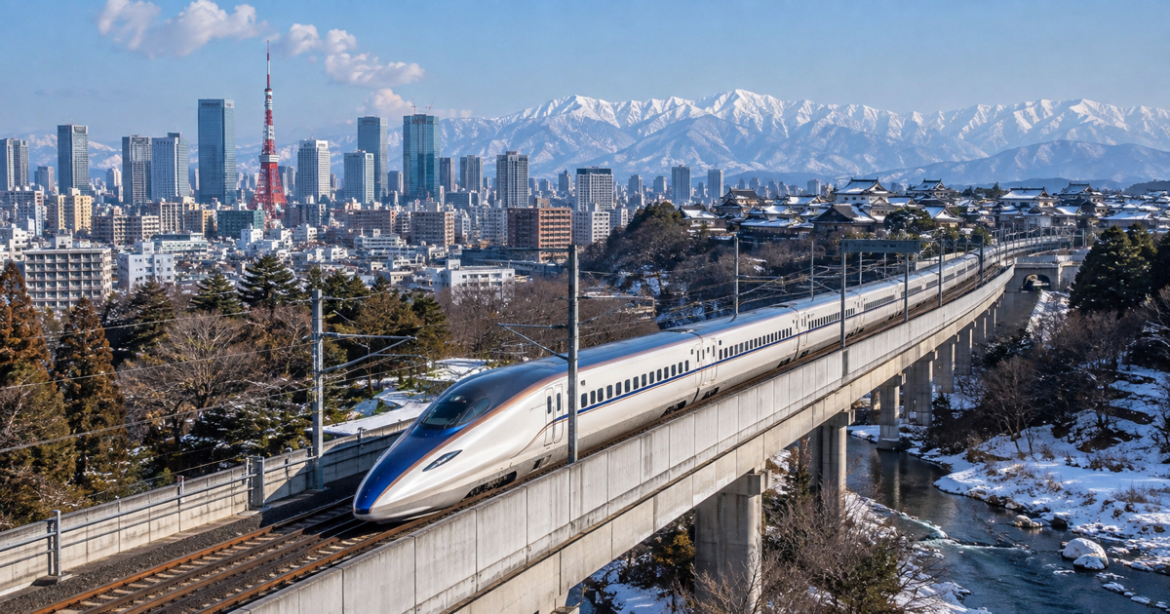
Traveling from Tokyo to Kanazawa is much easier than many first-time visitors expect. The Hokuriku Shinkansen connects Tokyo directly with Kanazawa, making the train the fastest and most convenient choice for most travelers. You do not need to change trains, and the journey takes roughly 2.5 hours on the fastest services.
The main decision is whether to pay for the speed and comfort of the Shinkansen, save money with an overnight highway bus, fly via Komatsu Airport, or include Kanazawa as part of a wider Hokuriku itinerary using the Hokuriku Arch Pass. If you are continuing to Toyama, Fukui, Kyoto, Osaka or the Japanese Alps, the best ticket strategy can be different from a simple Tokyo–Kanazawa one-way trip.
If this is your first trip to the city, see our Kanazawa Travel Guide before deciding how long to stay. Travelers beginning their trip in the capital may also find our Tokyo Travel Guide useful.

Tokyo to Kanazawa Transportation at a Glance
| Transportation Option | Hokuriku Shinkansen Kagayaki |
|---|---|
| Typical Travel Time | About 2.5 hours |
| Best For | Most travelers |
| Advantages | Direct, fastest rail option, comfortable |
| Disadvantages | More expensive than buses; reservation required |
| Editor’s Tip | Best overall choice if time matters. |
| Transportation Option | Hokuriku Shinkansen Hakutaka |
|---|---|
| Typical Travel Time | About 3 hours |
| Best For | Flexible train travelers |
| Advantages | Direct, frequent, some non-reserved seating on many services |
| Disadvantages | More intermediate stops |
| Editor’s Tip | Useful when Kagayaki timing does not suit your itinerary. |
| Transportation Option | Hokuriku Arch Pass |
|---|---|
| Typical Travel Time | Same trains as above |
| Best For | Multi-city rail trips |
| Advantages | Covers substantial travel around Hokuriku and between Tokyo and Kansai |
| Disadvantages | Usually poor value for one simple trip |
| Editor’s Tip | Consider it for Tokyo–Kanazawa–Kyoto/Osaka itineraries. |
| Transportation Option | Overnight Highway Bus |
|---|---|
| Typical Travel Time | Roughly 8–10 hours |
| Best For | Budget travelers |
| Advantages | Can save a hotel night; considerably cheaper |
| Disadvantages | Less comfortable and much slower |
| Editor’s Tip | Choose a better seat class if you struggle to sleep upright. |
| Transportation Option | Flight via Komatsu Airport |
|---|---|
| Typical Travel Time | About 1 hour flight plus transfers |
| Best For | Travelers already at Haneda |
| Advantages | Short flight time |
| Disadvantages | Airport procedures and ground transfer reduce the advantage |
| Editor’s Tip | The Shinkansen is normally easier from central Tokyo. |
| Transportation Option | Self-Driving |
|---|---|
| Typical Travel Time | Allow roughly 7–8 hours or more including breaks |
| Best For | Road trips |
| Advantages | Maximum flexibility for rural stops |
| Disadvantages | Tolls, fuel, parking and weather considerations |
| Editor’s Tip | Better for a wider Hokuriku road trip than a city-to-city transfer. |
| Transportation Option | Private Transfer |
|---|---|
| Typical Travel Time | Traffic dependent |
| Best For | Families and private groups |
| Advantages | Door-to-door, luggage friendly |
| Disadvantages | Very expensive over this distance |
| Editor’s Tip | Only makes sense when convenience outweighs cost. |
Is There a Direct Train from Tokyo to Kanazawa?
Yes. The Hokuriku Shinkansen runs directly from Tokyo Station to Kanazawa Station. No transfer is required, which is why rail is the easiest choice for the majority of international travelers.
The two services most visitors need to understand are Kagayaki and Hakutaka. Kagayaki makes fewer stops and is generally the fastest. Its seats are reserved, so you should secure a seat before boarding. Hakutaka stops at more stations and normally takes longer, but it can provide more departure choices and many services have non-reserved seating.
A nationwide Japan Rail Pass can cover eligible Hokuriku Shinkansen journeys, as can the regional Hokuriku Arch Pass within its valid area. However, having a covered train does not automatically mean buying a pass saves money. Compare the cost of every long-distance journey in your itinerary before purchasing one.
Best Departure Areas in Tokyo
| Departure Area | Tokyo Station |
|---|---|
| Best For | Most travelers |
| Advantages | Main Shinkansen departure point, easy access to food and station services |
| Editor’s Tip | Stay nearby if taking an early train with large luggage. |
| Departure Area | Ueno |
|---|---|
| Best For | Travelers staying in northeast Tokyo |
| Advantages | Many Hokuriku Shinkansen services stop here |
| Editor’s Tip | Avoid backtracking to Tokyo Station if your chosen train stops at Ueno. |
| Departure Area | Shinjuku |
|---|---|
| Best For | Night-bus travelers |
| Advantages | Convenient for some highway-bus departures |
| Editor’s Tip | Check the exact terminal because different operators use different boarding points. |
| Departure Area | Haneda Airport |
|---|---|
| Best For | Domestic-flight connections |
| Advantages | Direct flights to Komatsu Airport |
| Editor’s Tip | Flying makes most sense if you are already connecting through Haneda. |
Omiya and airport arrivals
From Ikebukuro, Akabane or Saitama, compare a local-train connection at Omiya with going to Tokyo or Ueno. Choose the fewest awkward transfers with your luggage, not the shortest Shinkansen segment in isolation. Shinjuku and Shibuya have no direct Hokuriku Shinkansen.
From Narita Airport, the Narita Express to Tokyo or Skyliner to Keisei-Ueno followed by a walk to JR Ueno are practical options. Keisei-Ueno and JR Ueno are separate stations. Check the specific Shinkansen’s Ueno stop before buying. After landing at Haneda, compare traveling into Tokyo for the train with a separately booked Komatsu flight; flight schedules, transfer procedures and baggage collection matter more than the airborne time alone.
A late flight does not guarantee a same-night connection. Search a dated itinerary from the airport through to Kanazawa, allow immigration and baggage time, and keep a Tokyo or airport hotel as the sensible option when the last train is too tight.
Tokyo to Kanazawa Method 1: Kagayaki Shinkansen
Kagayaki is the editor’s recommended route for travelers who want the quickest and simplest journey. Board at Tokyo or Ueno and remain on the same train until Kanazawa. The fastest journeys are around 2.5 hours, making Kanazawa one of the easiest major Hokuriku destinations to combine with Tokyo.
A standard one-way ordinary-class ticket is generally around the ¥14,000–¥15,000 range depending on the train, seat and travel period. Fares and reservation conditions can vary, so confirm the current price when booking.
Best for: first-time visitors, couples, families, senior travelers and anyone with a relatively short Japan itinerary.
Editor’s tip: Kagayaki uses reserved seating. Reserve early if traveling during Japanese holiday periods, weekends with major events, or peak autumn and winter travel dates.
What the quoted fare includes
The normal-season ordinary reserved Shinkansen e-ticket is ¥14,400 from Tokyo to Kanazawa, including the base fare and Shinkansen supplement. A regular paper reserved ticket is about ¥14,600; off-peak and busy-day adjustments can change the total. JR’s official e-ticket fare table distinguishes the departure station and seat type.
Book through JR-EAST Train Reservation, JR-WEST ONLINE TRAIN RESERVATION or a JR ticket office/machine. An e-ticket must be purchased and linked to an eligible transport IC card before travel; ordinary Suica balance alone does not buy a Shinkansen ride. E-tickets do not include the Tokyo city-zone benefit of an eligible paper base-fare ticket, so count hotel-to-station local fares separately.
JR East’s Tokudane1 and Tokudane14 ended for travel after September 30, 2026. Do not budget using an old 14-day advance fare. Special28 and other campaigns have their own eligible routes, dates and seat quotas; use only an offer actually available for your exact journey.
Tokyo to Kanazawa Method 2: Hakutaka Shinkansen
Hakutaka follows the same Hokuriku Shinkansen corridor but stops at more stations. A typical Tokyo–Kanazawa journey is around three hours, although the exact journey time depends on the service.
Hakutaka can be useful when its departure time fits your itinerary better, when Kagayaki is full, or if you want a train serving one of the additional intermediate stations. Many Hakutaka services include non-reserved cars, although train formations and reservation arrangements should always be checked for your departure.
Best for: travelers prioritizing schedule flexibility rather than saving every possible minute.
Tokyo to Kanazawa Method 3: Overnight Highway Bus
Highway buses provide the main budget alternative. Depending on the operator, departure point and seat type, the Kimasshi operator’s published adult calendar bands run from ¥5,600 to ¥11,000; the actual date and available inventory control the quote. Overnight services generally take around eight to ten hours.
The biggest advantage is financial: you may save both on transportation and one night’s accommodation. The trade-off is sleep quality. Even premium bus seats cannot match a hotel bed, and arriving early after limited sleep can affect your first sightseeing day.
Editor’s tip: An overnight bus works best for younger or budget-focused travelers with flexible schedules. If Kanazawa is one of the highlights of your trip, arriving rested on the Shinkansen can be worth the extra money.
For a concrete operator option, the Kimasshi route timetable serves Tokyo, Toyama and Kanazawa. Confirm the boarding point on your ticket: the Tokyo terminal changed to the JR express-bus stop at Yaesu South Exit, while the return uses Nihombashi Exit. An old Yaesu-dori or Asakusa listing is not a substitute for the current stop. Fare ranges are planning examples, not a quote for your date.
Tokyo to Kanazawa Method 4: Flight via Komatsu Airport
Flights operate between Tokyo Haneda Airport and Komatsu Airport, with flight time of roughly one hour. From Komatsu Airport, airport buses connect with Kanazawa, with the ground transfer taking about 40–55 minutes depending on service and traffic.
Despite the short flight, this is not usually faster than the Shinkansen when traveling from central Tokyo. You must add the journey to Haneda, check-in and security time, boarding, baggage collection and the transfer from Komatsu Airport.
Best for: travelers connecting directly from another flight at Haneda, or those who find an unusually convenient airfare and schedule.
The Hokutetsu airport-bus timetable and fares list ¥1,400 for an adult between Komatsu Airport and Kanazawa, with date-specific schedules tied to flights. At Kanazawa, check the west-side airport-bus boarding point. Add waiting time and road delays; do not pair the last airport bus with an inflexible onward train.
Tokyo to Kanazawa Method 5: Self-Driving
Driving from Tokyo to Kanazawa generally needs around 7–8 hours or more once rest stops, city traffic and the exact starting point are included. Expressway tolls, fuel and parking make it difficult to justify renting a car solely for the transfer between two well-connected cities.
A car becomes much more useful if Kanazawa is part of a road trip through places that are less convenient by rail, particularly rural areas of Hokuriku or the Japanese Alps.
Winter deserves extra attention. Snow and icy conditions can affect mountain and Hokuriku roads, so travelers without winter-driving experience may be more comfortable using the Shinkansen.
Ticket and Rail Pass Comparison
| Ticket / Pass | Regular Hokuriku Shinkansen Ticket |
|---|---|
| Best For | One-way or simple return trips |
| Main Use | Tokyo–Kanazawa |
| Editor’s Tip | Usually the simplest purchase when Kanazawa is your only major rail journey. |
| Ticket / Pass | Hokuriku Arch Pass |
|---|---|
| Best For | Tokyo + Hokuriku + Kansai itineraries |
| Main Use | Seven consecutive days of eligible travel in its coverage area |
| Editor’s Tip | Strongest when you continue from Hokuriku toward Kyoto or Osaka. |
| Ticket / Pass | Nationwide Japan Rail Pass |
|---|---|
| Best For | Extensive nationwide train travel |
| Main Use | Multiple long-distance JR journeys |
| Editor’s Tip | Do not buy it solely for Tokyo–Kanazawa. |
| Ticket / Pass | Highway Bus Ticket |
|---|---|
| Best For | Budget travelers |
| Main Use | Direct or overnight bus travel |
| Editor’s Tip | Compare seat type as carefully as price. |
| Ticket / Pass | Domestic Air Ticket |
|---|---|
| Best For | Haneda connections |
| Main Use | Haneda–Komatsu flight |
| Editor’s Tip | Calculate total door-to-door time rather than flight time alone. |
Passes that do not cover the full Tokyo journey
The Tokyo Wide Pass does not reach Kanazawa. Neither the Hokuriku Area Pass nor the Takayama-Hokuriku Area Tourist Pass includes the entire Tokyo–Kanazawa journey. The latter can suit a separate Kanazawa–Shirakawa-go–Takayama–Nagoya itinerary because it includes specified regional buses; those buses are not included in the Arch Pass. Select a pass by its exact rail and bus map.
The nationwide ordinary seven-day JR PASS is ¥50,000 via the official Reservation website, while overseas-agent sales cost ¥53,000 from October 1, 2026. It is not a money-saving purchase for this single corridor.
Is the Hokuriku Arch Pass Worth It for Tokyo to Kanazawa?
The Hokuriku Arch Pass costs ¥35,000 for an adult and is valid for seven consecutive days. It covers eligible JR travel across its designated Tokyo–Hokuriku–Kansai area, including reserved seats on the Hokuriku Shinkansen between Tokyo and Tsuruga.
| Itinerary | Tokyo → Kanazawa only |
|---|---|
| Pass Recommendation | Usually no |
| Reason | A regular one-way ticket costs much less. |
| Itinerary | Tokyo → Kanazawa → Tokyo |
|---|---|
| Pass Recommendation | Usually no |
| Reason | A simple return alone generally does not justify the pass. |
| Itinerary | Tokyo → Nagano → Kanazawa → Tokyo |
|---|---|
| Pass Recommendation | Compare carefully |
| Reason | Extra covered journeys can improve the value. |
| Itinerary | Tokyo → Kanazawa → Fukui → Kyoto/Osaka |
|---|---|
| Pass Recommendation | Potentially yes |
| Reason | This is the type of multi-city itinerary for which the pass becomes much more attractive. |
One important limitation is that the pass is built around the Hokuriku route. It does not cover the Tokaido Shinkansen between Tokyo, Kyoto and Osaka. Buy it because your itinerary genuinely follows the Hokuriku corridor, not simply because you are visiting both Tokyo and Kansai.
A normal-season Tokyo–Kanazawa e-ticket return totals ¥28,800, still ¥6,200 below the ¥35,000 pass. Even Tokyo–Kanazawa–Osaka is roughly ¥14,400 plus ¥9,400, or about ¥23,800 before local journeys. An open-jaw route is convenient geographically, but it does not by itself repay the pass. Count genuine additional covered journeys, such as airport access or extra long-distance returns, and keep them within seven consecutive days.
The Arch Pass requires an eligible foreign passport and Temporary Visitor status. It excludes the Tokaido Shinkansen, Shirakawa-go highway buses and Kanazawa’s Loop Bus; those costs remain separate.
Suggested Tokyo to Kanazawa Itineraries
Itinerary 1: Easy Overnight Trip
Take a morning Kagayaki from Tokyo, leave luggage at your Kanazawa hotel, spend the afternoon around Omicho Market, Kanazawa Castle and Kenrokuen, stay overnight, then explore Higashi Chaya District the following morning.
Itinerary 2: Two-Night Kanazawa Stay
This is the better choice for first-time visitors who dislike rushed sightseeing. Use the first afternoon for central Kanazawa, keep a full second day for neighborhoods and museums, and continue onward on the third morning.
Itinerary 3: Tokyo–Kanazawa–Shirakawa-go
Travel by Shinkansen to Kanazawa, stay at least one night, then take a reserved highway bus toward Shirakawa-go. Our Tokyo to Shirakawa-go Transportation Guide explains the wider route options.
Itinerary 4: Tokyo–Kanazawa–Kyoto/Osaka
This open-jaw route avoids returning to Tokyo and works particularly well for travelers exploring Japan from east to west. Compare regular tickets with the Hokuriku Arch Pass. If continuing toward Kansai, our Osaka to Kanazawa Transportation Guide is useful for understanding the reverse connection.
Rail-inclusive tours and local bus excursions
A Kanazawa and Shirakawa-go tour can simplify rural transport, but check the chosen package rather than the product title alone. Some offers have an optional Tokyo rail component: travelers take the train independently and meet the guide in Kanazawa. A local departure does not automatically include Tokyo tickets, and the tour may not accompany you through the Tokyo station transfer.
For a relaxed plan, arrive in Kanazawa the previous day, take the excursion the next morning and stay a second night. Tours combining Shirakawa-go, Gokayama and Takayama have different routes and finishing times; do not assume every option visits all three. If returning to Tokyo that evening, leave a generous gap before a reserved train and avoid making the final train your only viable connection in snow or holiday traffic.
Train plus a local rental car
Take the Shinkansen to Kanazawa and rent locally for Kaga Onsen, rural Fukui or other less rail-friendly stops. This avoids a long drive out of Tokyo while retaining flexibility outside the city. Confirm winter tyres, one-way return fees, parking and road restrictions. For Kanazawa’s central neighborhoods, the bus and walking are usually easier than finding parking.
A three-day east-to-west route
Tokyo → Toyama → Kanazawa → Fukui → Kyoto or Osaka is a logical direction, but allow time in each city rather than collecting stops to justify a pass. Kaga Onsen needs a local bus or accommodation shuttle after the Shinkansen station; an overnight stay is more rewarding than a brief change of train.
Compare the existing Kanazawa and Shirakawa-go tour options or Kanazawa-departure regional bus excursions, checking the selected option’s meeting point, inclusions and return time. These booking pages may open in Traditional Chinese.
Getting from Kanazawa Station to Major Attractions
| Destination | Omicho Market |
|---|---|
| How to Get There from Kanazawa Station | Local bus, taxi or approximately 15–20 minutes on foot |
| Best For | Food and seafood |
| Editor’s Tip | An easy first stop if you arrive before lunch. |
| Destination | Kanazawa Castle |
|---|---|
| How to Get There from Kanazawa Station | Local bus or taxi |
| Best For | First-time sightseeing |
| Editor’s Tip | Combine with Kenrokuen rather than treating them as separate trips. |
| Destination | Kenrokuen Garden |
|---|---|
| How to Get There from Kanazawa Station | Local bus or taxi |
| Best For | Classic Kanazawa |
| Editor’s Tip | Visit early if you want a quieter garden experience. |
| Destination | Higashi Chaya District |
|---|---|
| How to Get There from Kanazawa Station | Local bus or taxi |
| Best For | Historic streets |
| Editor’s Tip | Large luggage is inconvenient on the narrow sightseeing streets. |
| Destination | 21st Century Museum of Contemporary Art |
|---|---|
| How to Get There from Kanazawa Station | Local bus or taxi |
| Best For | Art and architecture |
| Editor’s Tip | Pair it with Kenrokuen and the castle area. |
Do not assume every Kanazawa city bus accepts exactly the same payment methods. Nationwide IC-card acceptance differs by operator and route, so check the specific service or keep another payment method available.
The Loop Bus uses Kenrokuen Exit bay 7. Adult rides cost ¥220 and the city day pass costs ¥800: four covered rides would cost ¥880 separately. Buy the pass before boarding; it is not sold on the Loop Bus. See the official route map for its covered zones. The Loop Bus accepts nationwide transport IC cards, while other routes should be checked individually.
For Nagamachi, travel toward Korinbo and walk into the samurai district; combine it with Oyama Shrine. For Shirakawa-go, reserve the highway bus and verify the separate intercity boarding bay. For Kaga Onsen, continue by Shinkansen and then local bus or hotel shuttle, rather than expecting the hot-spring districts beside the station.
Traveling with Luggage, Children or Senior Travelers
The Shinkansen is the clear winner for comfort. Tokyo Station and Kanazawa Station have elevators, station facilities and enough space to organize luggage more comfortably than on a highway bus. On the Hokuriku Shinkansen, the luggage storage area does not require a separate reservation; it is not the Tokaido Shinkansen oversized-baggage-seat system. Storage capacity is finite, so keep luggage manageable.
Families should consider staying close to Tokyo Station before an early departure rather than crossing the city during rush hour. At the Kanazawa end, leaving luggage at your accommodation or a station locker before sightseeing is far easier than carrying suitcases through markets and historic districts.
Common Mistakes to Avoid
- Do not assume every Hokuriku Shinkansen has the same stopping pattern.
- Do not board Kagayaki without arranging the appropriate reserved seat.
- Do not buy a nationwide JR Pass just for this single journey.
- Do not buy the Hokuriku Arch Pass without calculating the rest of your itinerary.
- Do not choose a flight based only on the one-hour airborne time.
- Do not plan a Tokyo–Kanazawa day trip unless you are comfortable spending around five hours on trains.
- Do not carry large luggage around Kanazawa’s sightseeing districts if you can store it first.
- If driving in winter, do not underestimate Hokuriku snow and road conditions.
Tokyo to Kanazawa FAQ
What is the best way to get from Tokyo to Kanazawa?
For most travelers, the direct Hokuriku Shinkansen is best. Kagayaki is normally the fastest choice, while Hakutaka offers additional departure options.
Is there a direct Shinkansen from Tokyo to Kanazawa?
Yes. You can travel directly from Tokyo Station to Kanazawa Station without changing trains.
How long does Tokyo to Kanazawa take?
The fastest Kagayaki journeys take roughly 2.5 hours. Hakutaka generally takes closer to three hours because it makes more stops.
How much is the Shinkansen from Tokyo to Kanazawa?
Budget around ¥14,000–¥15,000 one way for ordinary-class travel, depending on the service, seat type and travel period.
Can Kanazawa be visited as a day trip from Tokyo?
It is technically possible, but not ideal. A return journey consumes roughly five hours or more. One or two nights gives you a much better Kanazawa experience.
Is the highway bus worth taking?
Yes for travelers prioritizing price over time and comfort. Overnight buses can also save one night’s accommodation, but sleep quality varies greatly.
Is the Hokuriku Arch Pass worth it?
Usually not for Tokyo–Kanazawa alone. It becomes more compelling when your seven-day itinerary includes additional covered travel through Hokuriku toward Kyoto or Osaka.
Does the Japan Rail Pass cover Tokyo to Kanazawa?
Eligible nationwide JR Pass holders can use covered Hokuriku Shinkansen services according to the pass conditions, but purchasing the pass only for this route is generally poor value.
Is flying faster than taking the Shinkansen?
Usually not from central Tokyo. Once airport transfers, check-in and the Komatsu–Kanazawa ground journey are included, the direct Shinkansen is generally more convenient.
What is best for families or travelers with luggage?
The direct Shinkansen is the easiest option. It minimizes transfers and avoids moving luggage between trains, buses and airports.
Which Tokyo to Kanazawa Route Should You Choose?
For a first visit, take the Hokuriku Shinkansen. Choose Kagayaki when you want the fastest direct trip, or Hakutaka when its schedule is more convenient. Use an overnight bus if keeping costs low is the priority, and consider flying mainly when you are already at Haneda Airport.
The Hokuriku Arch Pass deserves consideration only when Kanazawa is one part of a wider Tokyo–Hokuriku–Kansai rail itinerary. For a straightforward city-to-city journey, an ordinary Shinkansen ticket remains the simplest choice.