
Appi Kogen is worth considering when skiing is the main purpose of your trip: stay near the slopes, allow complete practice days, and choose longer runs as your ability develops. Families booking lessons, first-time visitors to Tohoku’s ski resorts, and intermediate skiers planning several consecutive days can all put it on their shortlist. If you mainly want snow scenery and photographs, check non-ski activities and transport before following a skiing itinerary.
Rental, lesson and some shuttle information is available for 2026–27, while course and ordinary day-ticket information still covers 2025–26. Arrange transport and lessons before committing to accommodation, then check the season, dates and coverage of the pass you actually purchase.

Who should choose Appi Kogen, and how many nights make sense?
If your goal is to learn controlled stopping and turning, separate your arrival, main lesson and departure days. Going straight from a long journey into a lesson leaves little time for boot fitting, ticket collection and finding the meeting point. Two nights with at least one full lesson day is a useful starting point; add another night if you want a second day to practise. This is itinerary advice, not a resort package requirement.
Skiers with basic skills can use Appi as a base for consecutive practice days. Start each morning on a familiar, shorter section to assess the snow and your energy before committing to a longer descent. Groups with widely different abilities need not ski together all day. Agree on a base-area meeting point and lunch time, allowing beginners to take lessons while intermediate skiers practise independently.
If you want to change cities every evening, consider the extra transport and equipment handling. Appi is not a city attraction immediately outside a Shinkansen station. Establish the order of your city stops, then keep the skiing nights together instead of commuting simply to include another hotel location.
Arrange transfers and lessons before buying lift passes
Match the lesson language and date to your accommodation and shuttle eligibility before choosing a room package. Shuttle dates are not a guarantee that every lift will run. Use the older map for orientation, not as a daily opening report.
Choosing runs at Appi: start by understanding the Central Area
Appi has 21 courses across areas including Central, Sailer, Second and Nishimori. These descriptions help you understand the layout; daily notices determine what is open. On your first visit, establish which side your accommodation or meeting point is on before trying to cover the whole mountain.
| Course | Classification and length | Planning consideration |
|---|---|---|
| Shirakaba | Beginner, 1,000 m | Ask your instructor whether it suits that day’s practice |
| Karugamo | Beginner, 1,200 m | Identify the start, finish and way back |
| Yamabato | Beginner, 5,500 m | A long descent needs stamina and sustained speed control |
“Beginner” describes the trail classification, not an assurance that someone wearing ski boots for the first time can descend alone. Fatigue builds on longer routes, and you should not assume convenient rest facilities along the way. After learning to stop, have an instructor assess your turning, awareness of others and lift skills. Consider longer runs once you can maintain control on shorter terrain.
Intermediate skiers linking different areas should identify connecting runs and the route back to their hotel in advance. Do not simply follow a crowd or leave an open run because fresh snow looks tempting. Advanced skiers also need to choose terrain according to snow, visibility and patrol instructions. Ungroomed terrain, tree zones and the resort boundary are separate concepts, not a blanket invitation to explore.
Reading the official map without mistaking it for a current opening report


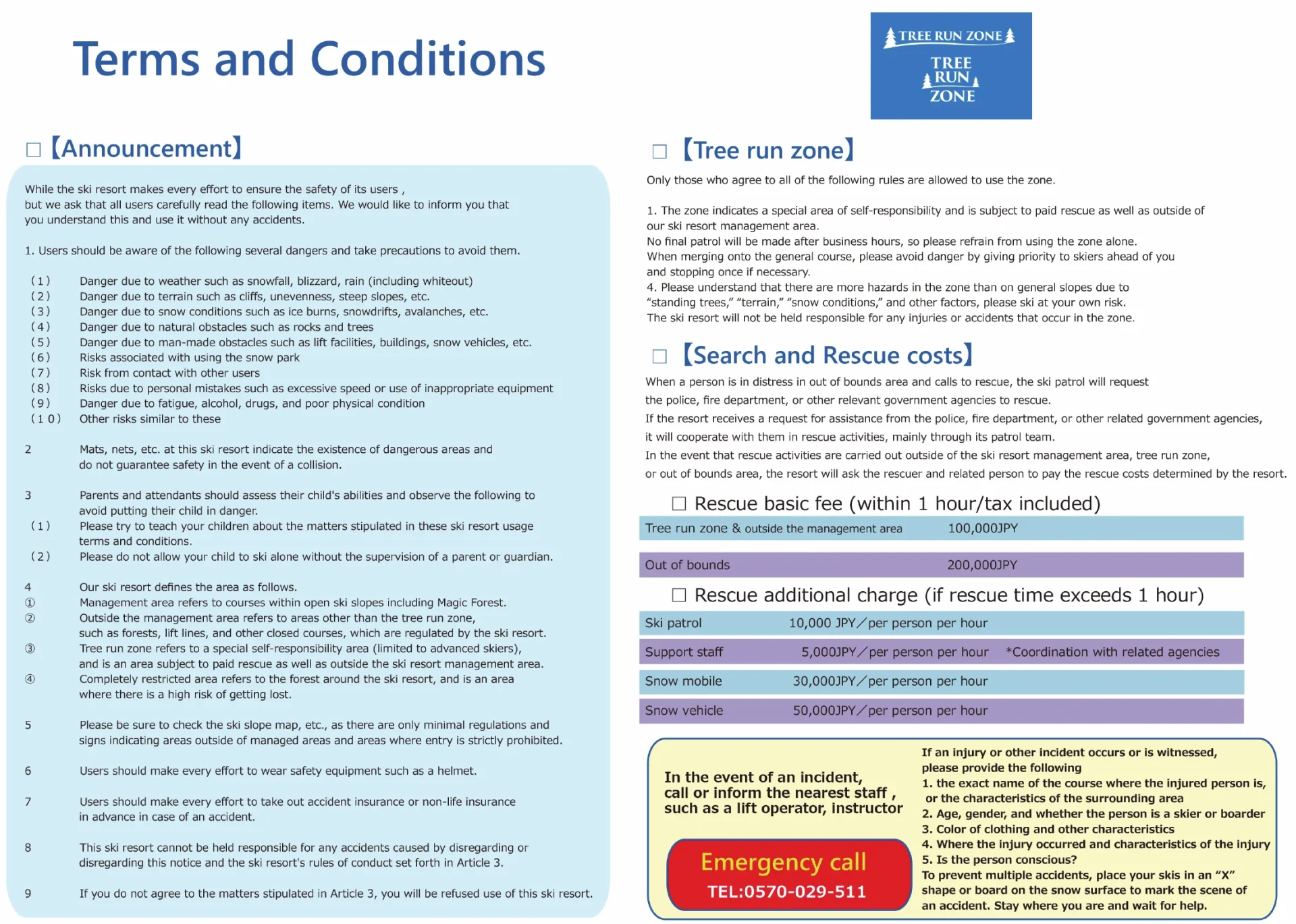
This three-page ski-area boundary and safety PDF is a reference from 2024–25. It helps locate the base, mountain areas and boundaries before travelling. It should not establish which lifts, tree zones or hotel shuttles will operate in 2026–27.
Save the legend and rules pages with the map. Cropping away restricted areas and warnings removes its most important information. On arrival, consult the latest on-site map and locate lesson meeting points, rental collection and return desks, and your final route back. Know how to reach the agreed meeting point even if your phone has no signal.
Getting to Appi from Morioka or Iwate Hanamaki Airport
Morioka: distinguish public buses from hotel-guest charters
There is a 2026–27 charter for eligible hotel guests, departing from Morioka Station’s West Exit, bus stop 26. Its timetable allows approximately 75 minutes. The ordinary public bus’s seasonal operating period, times and fares are still described as being finalized. A visitor staying in Morioka should therefore not assume the hotel charter is an unrestricted day-trip ski bus.
| 2026–27 hotel-guest charter | Adult one way | Ages 4–12 one way | Booking deadline |
|---|---|---|---|
| Morioka Station–Appi | ¥2,000 | ¥1,100 | 23:59 on the previous day |
| Iwate Hanamaki Airport–Appi | ¥3,500 | ¥1,750 | At least four days in advance |
Both routes list December 5, 2026–April 4, 2027. Adult fares apply from age 13; ages 0–3 travel free. An eligible hotel reservation is required, and travel dates must correspond to the stay. Services can fill before the booking deadline. Do not assume that every guesthouse in the Appi area qualifies; ask your accommodation before relying on the service.
Bookings for March 2027 travel open on October 15, 2026. If your date is not yet available, review cancellation terms and alternatives without treating an unfinished hotel or bus booking as a reserved place. Published charter cancellation charges are 30% from seven days before departure until departure, and 100% after departure or for a no-show; recheck the booking page before paying.
Hanamaki Airport: allow separately for arrivals and luggage
The airport charter journey is approximately 90 minutes. That is not the total time from aircraft landing to reaching your room. Allow additional time for arrival formalities, collecting ski bags, finding the stop and weather-related road delays. If the flight and shuttle are close together, check what happens if the flight is delayed before selecting that connection.
Rail travel to Appi Kogen Station is another option to investigate, but a final transfer to the resort remains. The local shuttle timetable is being finalized. Confirm this connection before booking a lesson, rather than only checking the train’s arrival. For travel from Tokyo or other Tohoku cities, compare JR EAST PASS coverage and cost with the actual rail journeys in your itinerary. Check resort transfers separately; holding a JR pass does not establish that a shuttle is included.
Lift tickets and budgeting: compare the whole cost
Ordinary day-ticket information still covers 2025–26. Do not use old BLUE, GOLD or BLACK prices as 2026–27 quotations. Once current tickets are published, compare validity dates, covered lifts, night skiing, consecutive-day requirements, card deposits and refund terms alongside the advertised price.
Beginners should first ask whether a lesson requires a lift ticket, when lift use begins and what tuition includes. If the first day is mainly instruction and basic practice, buying passes on the assumption of full-day skiing every day may be unsuitable. Break accommodation packages into their components too: included ski days, arrival/departure-day validity and named-user restrictions can all affect value.
A complete budget should cover accommodation, return transfers, lift tickets, equipment, lessons, food and insurance. Calculate non-skiing family members separately so they do not receive unwanted passes. When comparing a cheaper off-site hotel with slopeside accommodation, count the daily time spent carrying equipment and waiting for transport. Over several skiing days, convenience can outweigh a lower nightly room rate.
Equipment rental in 2026–27: clothing may be separate
Standard rental options include a standard adult three-piece ski set (skis, boots and poles) or two-piece snowboard set (board and boots) at a regular one-day price of ¥7,000. An adult jacket-and-pants set costs ¥6,000 and a helmet ¥1,500 separately. Check hotel-guest discounts, children’s rates and premium options against your actual selection instead of applying the lowest column to everyone.
For an adult without a hotel discount, those three items total ¥14,500 for one day, before lift tickets, tuition, meals or transport. This calculation illustrates the budget structure, not a requirement to rent everything. Remove items you bring yourself and ensure your own clothing and protective equipment are suitable for skiing.
Advance registration closes at noon two days before use; later applications are handled on site, with payment on site. Registration does not replace a fitting. Address heel movement, pressure on toes and poorly fitting protective equipment when collecting your gear. Prepare base layers, ski socks, waterproof gloves and goggles, checking what you need to buy rather than assuming a “set” supplies everything from head to toe.
Lessons and family planning: confirm the teaching language first
The ski school offers 2026–27 international lesson bookings and lists different lesson formats and ages. Give the school your actual ability, choice of skiing or snowboarding, age and preferred teaching language so it can confirm a suitable arrangement. Chinese availability does not automatically mean Cantonese, and English instruction does not imply Thai or Korean instruction; settle the language before payment.
A private family lesson also needs compatible abilities. A complete beginner and a child who already turns confidently may need different teaching. Sharing only to reduce the per-person cost can make progress awkward. Ask whether breaks count as lesson time, how lateness is handled, where children are collected, and whether lift tickets and equipment cost extra so you can compare like-for-like offers.
For third-party lessons, confirm the actual school or instructor provider, meeting point and available dates, then compare those terms with the official offering. A product page does not establish instructor availability every day in 2026–27, and its display language need not be the teaching language. Treat the lesson as fixed only after receiving a formal confirmation.
Where to stay: work out the daily route to the snow
Slopeside options include ANA Crowne Plaza Resort Appi Kogen and ANA InterContinental Appi Kogen Resort with ski-in/ski-out locations. This can be attractive for several consecutive days, children or anyone wanting midday breaks. Actual ski access still depends on snow and open runs; first-timers may need to walk or follow staff directions to reach a meeting point.
If your budget prioritizes the hotel experience, compare actual dates and cancellation terms for ANA InterContinental Appi Kogen Resort on Trip.com. Do not assume the room price includes passes, transfers or lessons: check the selected package. Transfers currently require InterContinental guests to board and alight at ANA Crowne Plaza, rather than at their own hotel entrance. Allow for that hotel-to-hotel connection.
Smaller inns and guesthouses may suit quieter stays or tighter accommodation budgets. Before booking, ask about ski storage, drying wet clothing, dinner, transfer times and reservation requirements. Morioka can work for a city-focused trip, but daily mountain travel is the trade-off. Use it as a ski base only after confirming current day-trip transport and ensuring the journey will not crowd out lessons or your return connection.
A three-day, two-night plan with one complete skiing day
Day one: arrive, settle in and locate your meeting point
After taking your confirmed transfer, leave luggage and check the next day’s lesson information and rental process. Complete some formalities if time and the provider allow, without assuming equipment can be collected free a day early. Prioritize dinner and rest rather than forcing a full-day pass into arrival day. Record the return bus, hotel checkout and equipment return times together.
Day two: lessons or practice matched to your ability
Beginners can take a lesson, then practise according to the instructor’s advice instead of skiing longer simply to justify the cost. Experienced skiers can warm up on familiar terrain before selecting longer open runs. Agree on lunch before everyone is exhausted. Non-skiing companions should also know where and how to meet rather than waiting outside for an uncertain period.
Day three: a short activity or a straightforward departure
With an early return connection, use the morning for breakfast, packing and returning gear. Consider a shorter ski session only if there is enough margin. The last run should not end just before the bus: changing clothes, retrieving luggage and reaching the stop all take time. For two full skiing days, extending the stay to three nights is usually more comfortable than squeezing the transport days.
Prepare for weather, safety and separate cancellation policies
Mountain wind and snow can affect lifts and roads. Check official operating notices before going out or heading uphill in poor conditions. A prepaid hotel is not a reason to drive an unfamiliar snowy road regardless of conditions. Drivers should confirm winter tyres and equipment with the rental company; those without snow-driving experience should retain public transport or delayed-travel options.
Respect closures and patrol instructions, never follow someone across a rope, and do not use an old map to determine current access. Before buying insurance, check skiing, snowboarding, medical and search-and-rescue coverage together with off-piste exclusions. Ask the insurer about anything unclear. General travel insurance or credit-card cover should not be assumed to cover every snow activity.
Keep separate confirmations for accommodation, transport and lessons, especially each cancellation deadline. If weather disrupts the trip, one cancelled service does not automatically make the others refundable. Recheck dates, names, meeting points and emergency contacts before leaving; that is more useful than buying an upgrade you may never use.
Appi Kogen skiing FAQ
1. Is Appi Kogen suitable for a first ski trip?
It is worth comparing, with an appropriate-language lesson booked first and practice terrain chosen by the instructor. A beginner-rated trail is not permission for a complete beginner to descend alone.
2. Are the 2026–27 ski opening dates confirmed?
Available course information still covers 2025–26. December 5, 2026–April 4, 2027 is the published hotel-shuttle period, not guaranteed operation of every trail or lift.
3. Can anyone take the Morioka hotel-guest charter?
Do not assume so. An eligible hotel reservation and corresponding travel dates are required. Confirm the ordinary public bus separately.
4. Can I book the Hanamaki Airport charter on the day?
The published hotel charter requires booking at least four days ahead, and passengers without reservations cannot board. Ask your accommodation about alternatives if you miss the deadline.
5. Does the train take me directly to the slopes?
No: a final connection remains between Appi Kogen Station and the resort. The local shuttle timetable is still being finalized, so confirm it before booking lessons.
6. How much does a standard adult rental cost?
The 2026–27 regular adult equipment-set price is ¥7,000 per day; clothing is ¥6,000 and a helmet ¥1,500 extra, totalling ¥14,500 for all three. Check hotel discounts, children’s rates and other packages separately.
7. Can I use last season’s lift prices for my budget?
They should not be treated as current quotations. The ordinary ticket page remains labelled 2025–26, so check current-season terms before purchasing.
8. Is the linked official PDF the latest season map?
Its filename and title identify 2024–25, and it has three pages. Use it for general orientation; current on-site notices govern open areas and rules.
9. Is three days and two nights enough?
It allows one full skiing day with transport on the other two. Three nights is a more relaxed choice for two complete lesson or practice days.
10. Do slopeside hotels always include passes and buses?
No. Accommodation, passes, lessons and transport may require separate reservations, and room packages differ. Check each inclusion and cancellation condition.