

Planning Zao Onsen: choose your lesson base before adding snow monsters
Zao Onsen suits travellers who want skiing, a Yamagata hot-spring stay and snow-monster scenery in one trip. For a first visit, the most useful decision is where you will meet your instructor, collect equipment and return to your accommodation. Uwanodai, Nakamori, Yokokura, Omori and Kurohime have different access points. Connections on a map still depend on your ability, open lifts and the time available to return.
Complete beginners should build the first day around a lesson, then choose a rental shop and accommodation close to its meeting point. Skiers who can control speed and link turns comfortably can gradually explore Chuo, Paradise and other sectors according to conditions. If some companions only want to see the snow monsters, organise their sightseeing tickets separately and agree on a meeting time at the base. One ticket does not automatically cover every activity.
2026–2027 season dates and lift prices
The resort plans to open on 12 December 2026, with skiing dependent on snow cover. Spring and final-season pricing periods do not promise that every trail will remain open until their final date. For early-season, April or May visits, confirm that your intended terrain and lesson provider will operate before committing to non-refundable travel.
| Price period | Dates | Adult day pass | Adult/senior 4-hour pass | Child day pass |
|---|---|---|---|---|
| Regular | 19–25 Dec 2026; 4–29 Jan and 1–14 Mar 2027 | ¥8,000 | ¥6,600 | ¥4,000 |
| Peak | 26 Dec 2026–3 Jan 2027; 30 Jan–28 Feb 2027 | ¥9,000 | ¥7,400 | ¥4,500 |
| Spring | 15–31 Mar 2027 | ¥7,000 | ¥5,700 | ¥3,500 |
| Opening/final | Opening to 18 Dec 2026; 1 Apr 2027 to actual closing, no later than 5 May | ¥4,800 | Not listed | ¥2,400 |
These are the resort’s tax-inclusive all-mountain rates. The child category covers junior-high-school age and younger; seniors are 60 or older and must meet the proof-of-age rules. High-school students have separate rates and should not be treated as children. See the official ticket page and 2026–2027 tariff PDF for the full age categories and multi-day prices.
Day pass or four hours?
The adult four-hour pass saves ¥1,400 against a day pass in the regular period, ¥1,600 at peak and ¥1,300 in spring. It is worth comparing if you will genuinely ski briefly, arrive in the afternoon or only practise for part of the day. For a morning lesson followed by afternoon practice, map out rental collection, lunch and breaks before deciding. A lesson described as “half day” does not itself determine your required lift time, and you should not assume the shorter ticket’s clock can be paused.
Resort-issued one-, two- and three-day passes can be used for Uwanodai night skiing on operating nights. Two- and three-day passes are valid on consecutive days. Check the conditions of any third-party bundle separately. The resort’s online ticket process uses a QR code to collect a ticket at a machine; not every supplier voucher provides direct gate entry. You can compare the Zao Onsen lift-ticket listing on Klook, Chinese booking interface, selecting the date, age category, duration and night-ski coverage before buying. A live product listing does not guarantee availability for your chosen day.
Terrain and bases: which area fits your trip?
There are 14 slope areas and 12 courses, with a 40% beginner, 40% intermediate and 20% advanced breakdown. Those figures describe a varied mountain; they do not mean that 80% of it is suitable for someone's first-ever ski day. An individual slope area can contain different grades, and the route back to your accommodation may involve steeper sections or connecting trails.
| Base or sector | Useful role in your plan | Confirm before booking |
|---|---|---|
| Uwanodai | Lesson meetings, base-area practice and scheduled night skiing | Instructor meeting point and Jupeer or other rental-shop location |
| Nakamori/Chuo Ropeway | Equipment and mountain access organised around the Chuo Ropeway base | Whether your lesson meets here and how you will descend |
| Yokokura/Zao Ropeway | Planning for groups combining skiing and snow-monster sightseeing | Separate sightseeing/ski products and where the groups reunite |
| Omori/Kurohime | Driving access or exploration by skiers with established skills | Parking, open connections and return deadlines |
| Chuo/Paradise and upper sectors | Gradually extending your range on open terrain | Visibility, wind, lift closing times and terrain suitability |
Choosing Uwanodai does not make every run there beginner terrain. Choosing Yokokura does not require you to ski its 38-degree wall. Treat the base and the actual practice slope as separate decisions, and ask your instructor to identify appropriate terrain. The resort classifies Zangezaka as intermediate, so reaching Jizo Sancho Station does not establish a continuous easy descent to the village. Use the terrain descriptions and map to match the Japanese names.
New snowboarders should also consider the effort involved in flatter sections and connecting trails. Becoming comfortable with one base and learning reliable stopping and turning before extending your distance usually preserves more energy than chasing multiple sectors. Intermediate and advanced visitors should identify their return route before deciding how far to explore. The last uphill lift time does not mean every connection remains usable until that same moment.
Using the official map: the 2025–2026 edition is an orientation reference
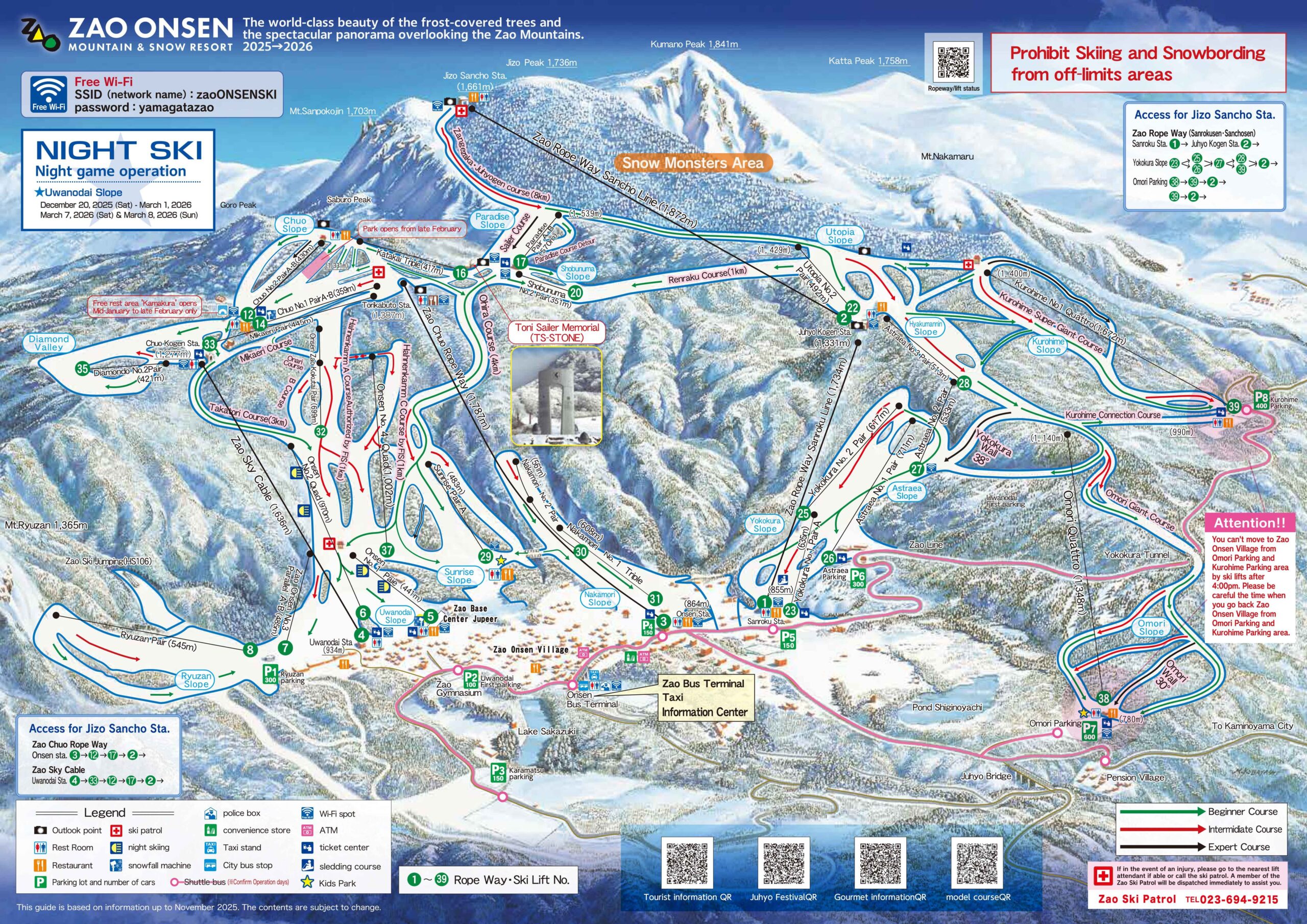
The official download page labels its Japanese, English and Chinese maps “2025.” The English original itself states 2025→2026 and information current to November 2025. Use it to understand base entrances, relative trail positions, lift names and the direction back to the village. Its night-ski dates, parking details and other seasonal information must not be treated as 2026–2027 announcements.
Start by locating three places: your accommodation, equipment-return point and lesson meeting point. Work out how to move between them. Then identify possible lunch or rest areas, and only after that plan cross-mountain skiing. If companions have different abilities, meeting at a clearly identifiable base facility is generally easier than waiting at a complicated trail junction.
Open the originals through the map-download page, then check daily lift and trail status on the travel day. Read the update time attached to the status information, not only the date in the page header. A connection on the map establishes geography, not that it is open, appropriate for your level or usable at every time of day.
Reaching Zao from Yamagata or Sendai
Via Yamagata Station: a straightforward route to understand
Buses leave from stop 1 at JR Yamagata Station to Zao Onsen Bus Terminal, taking approximately 40 minutes. That is a route estimate; allow separately for waiting and winter road delays. From Tokyo, you can take the Yamagata Shinkansen to Yamagata and continue uphill by bus. On arrival at the terminal, you still need to reach your hotel, rental shop and actual lesson entrance. Arriving in Zao is not the same as being ready at the lesson meeting point.
Treat rail travel, bus connections, luggage storage and equipment fitting as one complete arrival block. If a small delay would make you miss a paid lesson, arriving the previous evening or choosing a lesson with a generous arrival buffer is more practical. Work backwards from the return bus to include equipment return and changing clothes, rather than counting only the descent. Use the Yamakō Bus link on the access information to find the timetable for your date.
Sendai and airports: check the new winter’s direct services
From Sendai, consider routes via Yamagata Station as well as any seasonal direct bus. The resort access page still displays the previous winter’s Sendai service and labels 2026–2027 arrangements as being planned. Do not use a 2025–2026 departure time to connect a new winter flight. The airport, Sendai Station and Zao Onsen are different endpoints: check which leg a product includes, whether reservations are required and whether large ski bags are accepted.
Driving: park near the base you actually need
The resort’s designated P2, P4, P5 and P7 car parks charge ¥1,000 per vehicle on weekends and public holidays between 19 December 2026 and 14 March 2027, plus 28 December 2026–3 January 2027. Ordinary weekdays are free. Other free parking has its own conditions; P3, for example, is available only on resort-shuttle operating days. Read the parking arrangements.
Saving a parking fee is rarely useful if it leaves your car on the opposite side from your lesson without a reliable transfer. The 2026–2027 village shuttle arrangements are still being planned and should not be assumed to provide daily transport. Assess winter tyres, road conditions and your own snow-driving ability together. Public transport and a clearly arranged pickup may be easier than attempting unfamiliar mountain roads.
Lessons and rentals: connect the whole day through the meeting point
The resort-approved school list includes schools based around Uwanodai, Chuo Ropeway/Nakamori and Yokokura. Confirm skiing or snowboarding, teaching language, age, ability and group size before comparing fees. Two schools advertising “Zao” can meet in different places, and a translated website does not establish that instructors in that language are available every day.
For Chinese or English instruction, compare the Zao private lesson on Klook, Chinese booking interface. This listing offers Chinese/English options and a minimum age of four. Confirm one-to-one requirements for young children and older learners with the supplier, especially at the age-seven and age-60 boundaries. Equipment, insurance, lift passes, meals and transfers are excluded. Check which dates accept bookings for the new winter before fixing other plans. These are this supplier’s conditions, not rules shared by every school; check the selected option and meeting instructions before paying.
Rental time includes trying on boots, adjusting bindings, changing clothes and queuing. Do not put on ski boots for the first time at the lesson start. Ask the shop to address loose heels, pressure points or incorrect sizing before leaving. Check skis, boots, poles or snowboard bindings separately from outerwear, goggles, gloves and helmets. A “come empty-handed” description does not establish that every personal item or cold-weather accessory is included free.
The rental-shop directory helps narrow the options by Uwanodai, Nakamori, Yokokura and other bases. Ask about collection and return times, overnight storage, sizes, children’s equipment and damage conditions. If the following day’s lesson uses another base, decide how you will move the equipment before arriving rather than discovering the distance between shops on the day.
Families, night skiing and snow monsters
The resort plans free children’s snow-play spaces around Omori, Nakamori and Uwanodai/Sunrise from mid-January to mid-March 2027, subject to snow cover. Free space is not childcare and does not automatically include sleds, lessons, equipment or lifts. Decide whether the child’s main goal is learning to ski or simply playing in snow, then schedule warm-up breaks, lunch and the return to the hotel.
Uwanodai night skiing is planned daily from 19 December 2026 to 28 February 2027, plus 6–7 March, from 17:00 to 21:00. A standalone night ticket costs ¥3,000 for adults and ¥1,500 for children. Even when your daytime pass includes it, consider fatigue, visibility and the snow surface. After a full first lesson day, you do not need another session just to extract maximum ticket value. See the night-ski and family announcements.
Snow-monster sightseeing requires different planning. The Zao Ropeway ticket explanation distinguishes summit sightseeing returns from the uphill service for skiers; a sightseeing return is not an unlimited all-mountain ski pass. Evening snow-monster illumination is also separate from Uwanodai night skiing. The operator explicitly prohibits bringing skis or snowboards and skiing during the illumination visit. See the snow-monster visitor information.
If both skiing and sightseeing matter, use separate sessions or days and keep room to respond to weather. February is typically identified as the peak development period for the snow monsters, but neither natural scenery nor clear skies can be guaranteed. Buying a sightseeing ticket does not ensure summit visibility or ropeway operation.
Accommodation and two practical itineraries
One ski day: keep activities around one base
For a day trip from Yamagata, focus on one meeting base. Collect equipment, change and take the lesson; after lunch, practise in open areas appropriate to your level. Return to the rental shop early enough to complete the return process before the bus. Avoid adding distant sightseeing or a tightly timed snow-monster visit, as transport, queues or weather changes will reduce the time available for skiing.
More experienced skiers planning to cross sectors should identify the route back in the morning, reassess wind and tired legs before lunch and retain an afternoon buffer. The goal is a comfortable ski day, not visiting every place on the map and then missing a connecting lift or the equipment-return deadline.
Two nights: separate arrival, skiing and sightseeing
A two-night stay can use day one for travel, check-in and equipment fitting, day two for a full ski day, and day three for half-day practice or snow-monster sightseeing before leaving. If a clear sightseeing day is the priority, consider switching the second and third days when conditions allow, but understand the change rules for lessons, tickets and accommodation first.
Compare the actual route to your lesson and rental shop before choosing a hotel for its baths, meals or room type. A short straight-line distance may be awkward when carrying equipment on snowy streets. Ask whether a hotel provides transfers, when they operate and which entrance they serve. Check the latest dinner seating if you hope to night ski. For more accommodation planning, see the Zao snow-monster hotel guide, or compare accommodation around Zao Onsen on Trip.com. This is a comparison entry point; confirm room prices, room types and transfers with the selected property.
Final checks before travelling
Read the day’s lift, trail and weather notices, then identify the fixed times in your schedule: lesson start, equipment return, hotel meals and the last bus. Save the return plan on your phone and have an alternative that does not depend on skiing between sectors. Companions should know each other’s base and meeting point rather than relying solely on mobile reception or battery life.
Choose travel insurance covering your intended ski activities and read its rescue and activity restrictions. Follow closures, stop where others can see you without blocking traffic, and reduce your range when tired or when visibility deteriorates. Another person crossing a boundary, or trees and white space shown on a map, does not make that terrain open for skiing.
Zao Onsen skiing FAQ
Is Zao Onsen suitable for complete beginners?
There is suitable introductory terrain, but not every access point or connection is appropriate. Book the lesson first and arrange rentals and accommodation around its base. Do not make skiing from the summit to the village a first-day goal.
When does the 2026–2027 season begin?
The planned opening is 12 December 2026, subject to snow. The tariff’s final-season limit of 5 May 2027 does not guarantee that all trails will operate until that date.
Can I use a day ski pass at night?
Resort-issued all-mountain one- to three-day passes are valid for Uwanodai night skiing on operating nights, with multi-day passes used consecutively. Check the specific third-party product and actual night operation.
Is the snow-monster ropeway ticket a ski pass?
No. The sightseeing return covers specified journeys rather than unlimited mountain skiing. The priority uphill service for skiers also requires a separate ski pass valid that day.
Can I use the 2025–2026 map for the new winter?
Use it to understand relative base and trail positions. Do not treat its older night-ski dates or transport details as 2026–2027 information; check daily lift and trail status separately.
How long does the bus from Yamagata take?
The resort lists approximately 40 minutes from Yamagata Station to Zao Onsen Bus Terminal, excluding waiting, snow delays and the onward journey to your hotel or lesson.
Can I book flights around last winter’s direct Sendai bus timetable?
That is not advisable. The 2026–2027 direct service is still being planned. Obtain a timetable applicable to your travel date before connecting flights.
Do Chinese private lessons include equipment?
It depends on the option. The linked SnowFun private lesson excludes equipment, insurance, lift tickets, meals and transfers. Do not transfer another supplier’s inclusions to this booking.
Does free children’s snow play mean no other budget is needed?
No. Free access refers to the announced play space, not automatically childcare, instruction, equipment or lifts. Choose activities for the child’s age and goals, then price each component.
Can I ski, see the snow monsters and night ski in one day?
It may work for experienced visitors under suitable conditions, but beginners are better choosing a main activity. Lessons, ropeway queues, equipment return and weather all take time; two nights usually make energy and schedule flexibility easier to manage.