
Izu transport: pick a coast before buying a ticket
The Izu Peninsula is not one compact destination. The east coast has a useful rail corridor, central Izu is approached through Mishima and Shuzenji, and the west coast relies much more on road transport. A route that works well for Izu-Kogen can be a poor choice for a night in Toi or Dogashima.
Start with your overnight base and the attraction furthest from a station. Then choose the Tokyo gateway, local connections and any pass. Trying to circle the entire peninsula on a Tokyo day trip leaves little time to enjoy it. For a first visit, one coast or one inland corridor is usually enough.
Which gateway serves your part of Izu?
| Area | Useful gateway | Onward transport | Best planning approach |
|---|---|---|---|
| Atami and Ito | Atami | JR Ito Line; local buses beyond the stations | Combine nearby rail-accessible stops |
| Izu-Kogen, Kawazu and Shimoda | Ito and the Izukyu corridor | Through limited express or local trains, then buses | Choose an east-coast base and group nearby sights |
| Shuzenji and central Izu | Mishima | Izuhakone Railway Sunzu Line to Shuzenji | Allow a separate bus or taxi journey to the onsen town |
| Toi and Dogashima | Shuzenji, or Toi by ferry | Tokai Bus or a rental car | Check both outbound and last return buses before booking |
| Southern coast and Irozaki | Izukyu-Shimoda | Bus, taxi or rental car | Protect the final connection back to Shimoda |
Four ways to travel from Tokyo
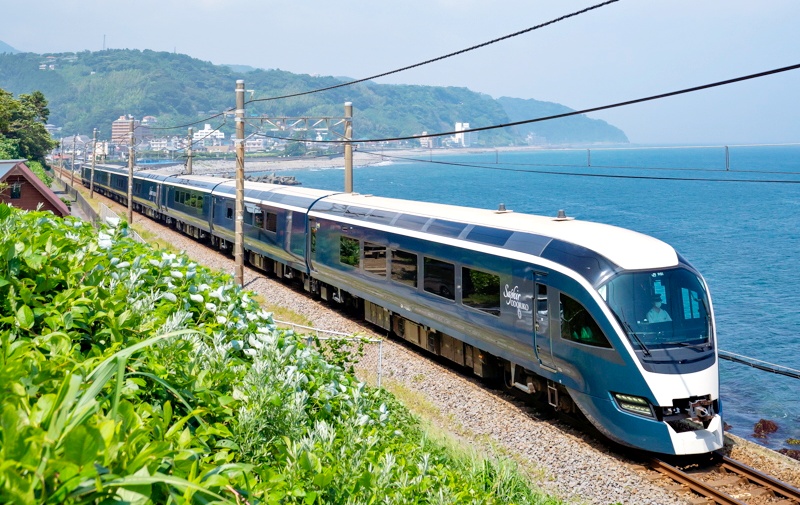
1. Saphir Odoriko: make the train part of the trip
Saphir Odoriko is the premium option for the east-coast journey toward Izukyu-Shimoda. It has Green Car seating throughout, with Premium Green seats and private compartments among the choices. It suits travelers who value the train experience and can organize the day around a specific reserved departure.
Check the official Saphir timetable and ticket guidance for your date, starting station, seating class and food arrangements. Do not use an old “from” fare as a quote for a private compartment. It is not an ordinary reserved seat included at no extra cost with every JR pass. Limited departures also make it a poor fallback when your main aim is simply to reach a hotel quickly.
2. Odoriko: convenient through travel to the east coast
The regular Odoriko is a practical choice for travelers who want fewer changes from Tokyo toward Ito, Izu-Kogen, Kawazu or Izukyu-Shimoda. Selected trains also serve the Shuzenji branch. Check the destination and your reserved car carefully instead of assuming that every Odoriko continues down the same coast.
For a journey to Shimoda, allow roughly two and a half to three hours on the train, depending on the service. Your ticket must cover the base fare and limited-express seating charge over the operators involved. Compare the actual date-specific total with a pass; “a return trip pays for the pass” is not a reliable rule.
3. Tokaido Shinkansen: fast access to a gateway
Use a suitable Kodama or another service that actually stops at Atami or Mishima. Atami is the connection for the JR Ito Line and east coast. Mishima is convenient for the Sunzu Line toward Shuzenji and central or western Izu.
The Shinkansen does not run to Izu-Kogen, Kawazu or Shimoda. Its short Tokyo–gateway time can be attractive, but include the next train, bus and waiting time in your comparison. The JR Tokyo Wide Pass does not cover the Tokaido Shinkansen, even between Tokyo and Atami.
4. Highway bus: compare a confirmed route, not a generic Izu bus
The Mishima Express links Busta Shinjuku with Mishima. From Mishima, continue separately to your Izu destination. Do not assume this ticket includes a direct ride to Shuzenji Onsen or the west coast.
On 9 October 2026, the operator listed an adult standard fare of ¥2,500 and a reservation-discount fare of ¥2,300. A weekend/holiday fare revision is announced for 1 November 2026, so check the travel-date price. The fastest published gateway journey is 110 minutes, but congestion and onward connections can make the complete trip much longer. It is most useful when a lower gateway fare matters more than speed.
Getting around eastern Izu by train
Atami–Ito is the JR Ito Line. Ito–Izukyu-Shimoda is the Izukyu Line. Through trains make the corridor feel continuous, but the distinction matters for passes and fares. Izu-Kogen is a useful base for Mount Omuro and the Jogasaki area; Kawazu serves the town and inland bus connections; Shimoda is the southern rail terminus.
Resort 21 sightseeing-style trains can operate as local services without a special luxury supplement. Their vehicle assignments and operating days should be checked rather than assumed. A scenic local train does not remove the need to plan the bus or walking segment after the station.
For Mount Omuro, use Izu-Kogen and a Tokai Bus toward Shaboten Koen; the station is not at the mountain. For Jogasaki Coast, choose the trailhead first because the final walk can be substantial. Avoid scheduling a coastal walk immediately before the last bus or a tightly timed reserved train.
Central Izu: Mishima, Shuzenji and the mountain bus routes
The Izuhakone Railway Sunzu Line connects Mishima and Shuzenji. Shuzenji Station and Shuzenji Onsen are separate places, so plan the final local bus or taxi connection to your accommodation. The station also functions as a transfer point for road journeys into the mountains and toward the west coast.
For an Amagi or Kawazu route, read the timetable for the actual stops you want, including whether a connection is needed. An attractive line on a peninsula map is not proof of frequent through service. If you want to stop at several rural sights, staying overnight or hiring a car can make more sense than trying to catch every onward bus in one day.
Western Izu: Tokai Bus, Toi and Dogashima
Tokai Bus is the main scheduled bus network for much of Izu, particularly where there is no railway. It is not the only form of public transport: ferries and other operators also matter. Use the official route and timetable search for your exact origin and destination.
A common west-coast approach is Mishima → Shuzenji by train, followed by bus toward Toi and Dogashima. Also compare the direct Nishi-Izu express/rapid buses from Mishima; their limited departures and stopping patterns need checking, and not every service runs via Shuzenji. Treat Dogashima as a west-coast destination rather than a quick side trip from Izu-Kogen. Returning across the peninsula late in the day can be awkward, even when the straight-line distance looks small.
Check the last useful return before the outward journey. Allow time to locate the opposite-direction stop and avoid assuming that a hotel or attraction has late taxi availability. A small bag is easier than a large suitcase on a local bus; on a hotel-change day, arrange baggage storage or a direct transfer where possible.
Suruga Bay Ferry: an alternative western gateway
The Suruga Bay Ferry links Shimizu and Toi. It can fit a Shizuoka-to-western-Izu itinerary and offers a different approach from crossing the peninsula by road. Check the current terminal access, sailing, passenger or vehicle fare and operating notice before committing to a same-day connection. Visibility and sea conditions determine the experience; Mount Fuji views are never guaranteed.
There is an important local connection change from 1 October 2026: Tokai buses no longer enter the Toi ferry terminal. Use the Toi-ko stop on Route 136 and leave a walking and boarding buffer. The official stop-change notice explains the arrangement. Do not follow an older itinerary that assumes the bus and ferry share the same forecourt.
If the ferry is canceled, a land route through Shuzenji and Mishima may be necessary. Avoid placing an inflexible flight or long-distance reservation immediately after the crossing.
Which Izu pass is worth buying?
| Ticket | Coverage and current price context | When it makes sense |
|---|---|---|
| JR Tokyo Wide Pass | ¥16,000 adult; three consecutive days; eligible ordinary-class rail travel including the Izukyu Line | Several substantial covered journeys, not automatically one Izu return |
| Tokai Bus all-line pass | Purchases from 1 October 2026: adult 2-day ¥5,750; 3-day ¥6,550; specified services excluded | Multiple qualifying long bus journeys around the peninsula |
| Local Tokai Bus area pass | Area and validity vary by product | Several rides within one compact sightseeing area |
| Current Izukyu rail tickets | Eligibility and coverage depend on the named product | Repeated east-coast train travel; compare with individual fares |
| Izu Dream Pass | Sales ended on 30 June 2024 | Not a current purchase option |
The JR Tokyo Wide Pass is for qualifying non-Japanese passport holders. Its coverage excludes the Tokaido Shinkansen and the Atami–Shuzenji route. Do not treat Saphir’s premium accommodation as an ordinary reserved-seat inclusion. Add the fares of the journeys you will actually take within the three consecutive days, then compare the pass cost.
The Tokai Bus all-line pass covers eligible local buses, not trains, ferries, highway buses, scheduled sightseeing tours or every contracted/community service. Its dated 1 October 2026 revision takes precedence over the older prices still visible lower on the page. A smaller area pass may be better for a single base.
The former Dream Pass combined specified rail, bus and ferry routes, but its sales ended in 2024. Do not build a current itinerary around its old Kogane, Wasabi or Fujimi versions. For east-coast rail deals, consult Izukyu’s current ticket list; the Izukyu Discovery Pass is specifically for foreign visitors, while other products have their own eligibility and validity rules.
IC cards and practical payment
Tokai Bus lists Suica, PASMO and the other nationwide interoperable transport IC cards for its applicable services. Follow the vehicle’s boarding and alighting instructions and keep sufficient balance. The official IC guidance is more useful than the older blanket warning that rural Tokai buses do not accept cards.
Do not extrapolate one operator’s payment rules to every railway, ferry or special bus. A limited-express ticket, pass activation or reservation is still required where applicable; tapping an IC card alone is not a reserved-seat booking. Carry a modest amount of cash for local purchases and unsupported services.
When renting a car helps
A rental car is most useful for scattered western or southern sights, several rural stops, or accommodation away from the main corridors. Collecting in Mishima or Atami can avoid driving out of central Tokyo, but compare opening hours, luggage capacity, parking and any one-way return fee.
Coastal roads and mountain roads can both be slow. The Izu Skyline is a tolled mountain route, not a universal shortcut to every coast. Choose it according to your destination, weather and driving confidence. Leave room for weekend traffic on the return, and never schedule a car drop-off immediately before a reserved train.
Simple itineraries that respect the network
- East-coast short stay: travel to Ito or Izu-Kogen, spend one day on nearby sights, then continue by rail toward Kawazu or Shimoda if you have another night.
- Central Izu break: enter through Mishima, transfer to Shuzenji, and allow time for the onsen town rather than treating the station as the destination.
- West-coast overnight: travel through Shuzenji to Toi or Dogashima, stay locally, and return by a confirmed bus connection or an operating ferry.
These are route frameworks, not guaranteed same-day connections. Reserve accommodation only after checking how you will reach it and how you will leave the following day.
Izu transport FAQs
Can I travel around Izu without a car?
Yes. The east coast is the easiest rail-based option. Central and western itineraries need more attention to buses, final walking distances and last departures.
Does the Tokyo Wide Pass cover the fastest train to Atami?
It does not cover the Tokaido Shinkansen. Compare a covered conventional-rail route with a separately paid Shinkansen journey.
Is the Dream Pass still available?
No. Sales ended on 30 June 2024. Compare current operator tickets for your actual routes instead.
Which station should I use for Mount Omuro?
Izu-Kogen is a practical bus-transfer station for Shaboten Koen. Allow for the bus journey and the attraction’s operating hours.
Can I see both coasts in one day from Tokyo?
It is a poor first-trip plan by public transport. Choose one area, or add an overnight stay so the day is not dominated by transfers.
A better way to plan Izu
Choose the coast, then the gateway, then the ticket. Through Odoriko services simplify eastern journeys; Mishima and Shuzenji organize central and western travel. Passes are useful only when their covered routes fit your plans, and the final bus or ferry connection deserves as much attention as the train from Tokyo.
More planning resources
Use these related guides and booking pages to arrange the rest of your trip. Related destination guides are in Traditional Chinese.
- Izu travel guide
- Izu onsen hotels
- Things to do in Izu
- Getting to Mount Omuro
- Mount Omuro grass-burning event
- Atami travel guide
- Tokyo travel guide