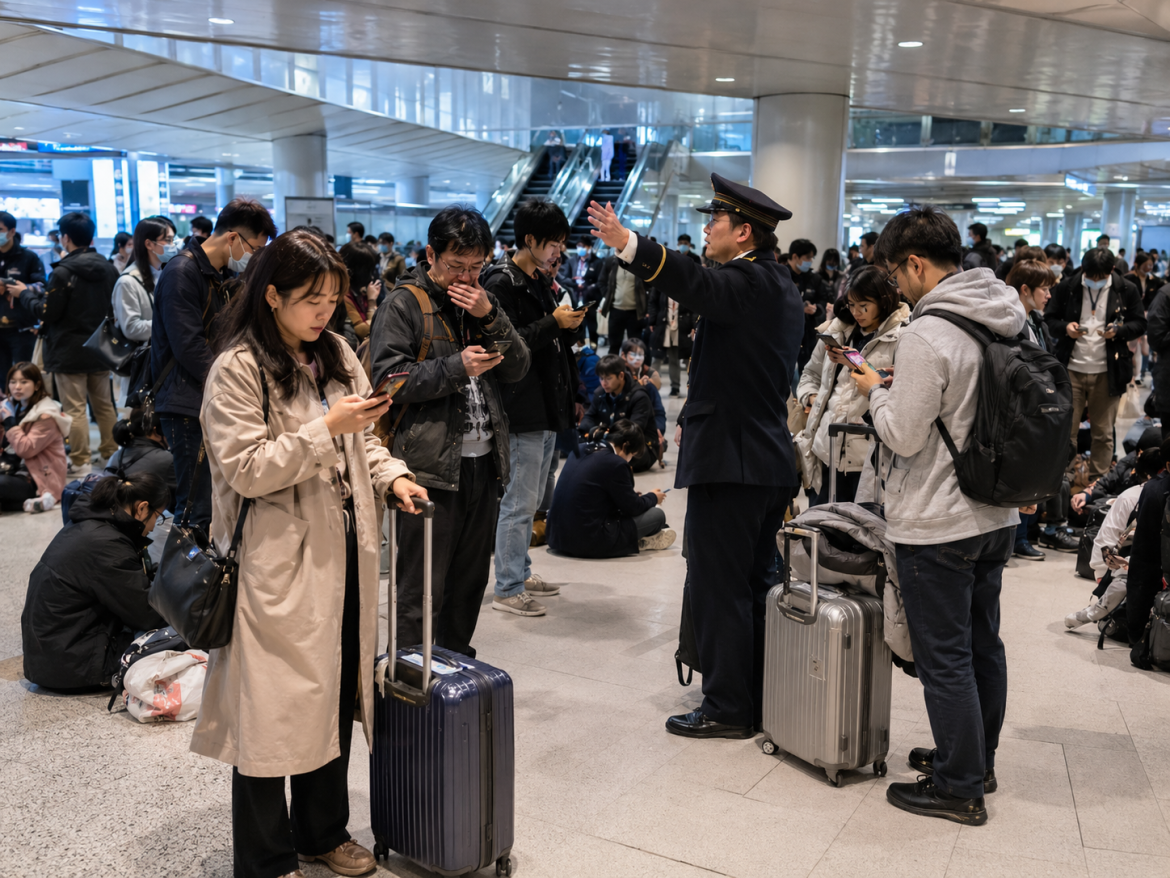

Japan earthquake transport disruption: put safety before the next train
If you feel strong or prolonged shaking near the coast or a river mouth, move immediately to high ground or a designated tsunami evacuation building when you can move safely. Do not wait for a phone alert or stop to check a train timetable. Follow evacuation instructions and stay away from the affected waterfront until authorities say it is safe to return.
Elsewhere, protect yourself from falling objects and follow staff instructions. Once immediate danger has been addressed, check the exact railway, section and station involved before deciding whether to wait, reroute or stay overnight. A train shown in Google Maps may be a scheduled service that is no longer running.
This is an evergreen response guide, not a report that a particular earthquake has occurred or that any route is currently safe or operating. Use the linked official information for the situation at the time of travel.
What to do first
| Situation | Priority | Avoid |
|---|---|---|
| Shaking while on a train or platform | Protect your head, hold a support if standing and follow staff directions | Rushing along the carriage or forcing doors |
| Strong or prolonged shaking near the sea or a river mouth | Immediate tsunami evacuation to high ground or designated refuge | Waiting for a warning, fetching luggage or travelling towards the shore |
| Fire, damage or an evacuation instruction | Follow the local evacuation route and staff guidance | Staying merely because a hotel or station is normally convenient |
| In an area confirmed suitable for waiting | Check official warnings and the relevant transport operator | Moving from crowded station to crowded station on speculation |
| No workable onward journey | Arrange a safe place to stay and contact affected bookings | Using an uncertain reopening estimate as a guaranteed connection |
There is no fixed ten-, thirty- or ninety-minute timetable for these decisions. Conditions and evacuation instructions take priority. Only wait inside a station, hotel or shopping centre if staff permit it and the building and surrounding area are suitable; being indoors alone is not proof of safety.
Read the Japan Meteorological Agency’s tsunami guidance and official waterfront advice before travelling to coastal areas.
Wait, reroute or change the itinerary?
If your route is delayed but still running and your waiting location is suitable, staying with it can avoid unnecessary transfers. If only one section is closed, check whether the remaining services actually connect around it. When parallel routes are also suspended, heading to another major station may achieve nothing.
As evening approaches, work backwards from the last usable connection, not the last advertised train. Cancel nonessential sightseeing before exhausting your options. With children, older travellers or mobility needs, decide earlier whether you need accommodation, assistance or a confirmed vehicle. An international flight adds urgency to contacting the airline; it does not override an evacuation instruction.
Japanese signs that explain what is happening
| Japanese | Meaning | What to check |
|---|---|---|
| 遅延 | Delay | Whether your actual train is still running |
| 運転見合わせ | Service suspended | The affected section; not necessarily cancellation for the entire day |
| 運休 | Cancelled service | Which train or services have been cancelled |
| 一部運休 | Partial cancellations | The trains or sections concerned |
| 折返し運転 | Services turning back | Where trains stop short of their usual destination |
| 運転再開 | Service resumed | Delays, crowding and station-entry restrictions may remain |
| 運転再開見込 | Estimated resumption | An estimate, not a promise |
| 直通運転中止 | Through-running suspended | Separate sections may operate, with a transfer required |
| 振替輸送 | Alternative transport arrangement | Eligible tickets and designated routes; not universal free travel |
| 入場規制 | Entry restrictions | Staff directions and whether you may enter |
| 徐行運転 | Reduced-speed operation | Longer journey times and missed connections |
| 安全確認 | Safety checks | Wait for an operator update rather than guessing a reopening time |
Check official information in the right order
Immediate evacuation comes first. When it is appropriate to check your phone, use JMA earthquake information, local authority instructions and JNTO safe-travel information. Safety tips is useful preparation, but a missing notification is not an all-clear.
Next, identify the operator. JR, a subway and a private railway can report different conditions in the same city. Read the section limits, direction, timestamp and whether the announcement concerns local trains, limited expresses or Shinkansen services. Check whether the destination station is open as well as the line itself.
Only then use a route planner to assemble alternatives. Recheck each leg with its operator and confirm the departure board when you reach the station. The Chinese-language Japan transport app guide explains the roles of Maps, NAVITIME and Jorudan.
Which JR company should you check?
| Region or corridor | Operator | Important distinction |
|---|---|---|
| Hokkaido | JR Hokkaido | Check the airport corridor separately from long-distance services |
| Tokyo, Tohoku, Nagano and Niigata | JR EAST | Conventional lines and Shinkansen have separate categories |
| Tokaido Shinkansen; Tokai conventional lines | JR Central | A Tokyo–Shin-Osaka Shinkansen journey is not a JR EAST service |
| Kansai, western Honshu and relevant Hokuriku sections | JR WEST | Check local, limited-express and Shinkansen information |
| Shikoku | JR Shikoku | Read the exact section and any substitute-service announcement |
| Kyushu | JR Kyushu | Check the specific Shinkansen or conventional route |
Useful starting points are JR EAST train status, JR WEST train status and JR Central Shinkansen information. Chinese readers can use the existing JR EAST Traditional Chinese page and JR WEST Traditional Chinese page. The official railway information portal helps find other operators.
JR EAST’s English status page says it reports anticipated or actual delays exceeding thirty minutes during its stated reporting hours, does not refresh automatically and may differ from actual operations. That is a reporting threshold, not advice to wait thirty minutes after an earthquake. Other operators have their own display rules.
If you are on a Shinkansen or another train
Stay seated if seated; hold a handrail or strap if standing. Keep passages clear and tell the crew promptly if someone is injured or unwell. Do not force doors, climb onto the tracks or attempt to walk through a tunnel because the train has stopped. Follow the crew’s evacuation instructions and use the onboard emergency communication equipment if there is an immediate danger.
The Tokyo Metro earthquake guide explains that staff assess conditions and guide evacuation if a train cannot move. It also warns about falling fixtures. A stopped train between stations is not an invitation for passengers to choose their own trackside exit.
At a Shinkansen station, distinguish cancellation of your particular train from closure of the whole route. Buying another departure on the same suspended section may not help. After reopening, ask whether your original reservation is still valid, must be changed or is subject to a temporary arrangement. Do not occupy the same seat number on a different train without confirmation.
Tickets, rail passes and refunds
Keep the original ticket, reservation number, receipt and relevant operator notice. Before leaving through a staffed gate, ask whether a ticket must be returned to you or endorsed. Do not cancel and rebuy impulsively: discounted tickets, ordinary tickets, passes and agency vouchers have different rules.
| Ticket | Next step |
|---|---|
| Ordinary rail or reserved-seat ticket | Ask the operator how the cancellation or interruption affects it |
| Discount or advance-purchase ticket | Check special disruption handling before voluntary cancellation |
| Rail pass already in use | Check that pass’s terms; a local suspension does not automatically produce a refund |
| Third-party electronic ticket | Check the original seller’s procedure and the railway’s instructions |
| Uncollected exchange voucher | Contact the seller before assuming a station can refund it |
JR EAST’s ticket-change information is a starting point for its tickets, not a rule for every operator or seller. Keep receipts for replacement transport and accommodation if you later make an insurance claim; reimbursement depends on the policy and evidence required.
Subways, through-running and reopening crowds
A suspension of through-running can leave the central subway section operating while trains stop short of their normal private-railway destination. Check both companies and the transfer station. Do not assume either that the entire line is closed or that the other company’s trains are available.
“Service resumed” does not mean immediate access to an uncrowded platform. Follow entry controls and, if staff identify a suitable waiting area, consider letting the crowd ease rather than rushing for the first train. There is no universal twenty- or forty-minute wait that makes travel safe. Do not walk to another station without confirming a safe route and that it is accepting passengers.
The Chinese-language Tokyo transport guide, Kyoto transport guide and Nagoya transport guide explain normal networks; they do not establish disaster-day service.
If your flight is operating but the airport train is not
Check the airline’s actual flight status and check-in instructions, the airport’s terminal information, then the rail, bus and road conditions. Contact the airline early if you may be unable to reach the airport. An open terminal, an operating flight and a usable access route are three separate things.
Haneda
Check Keikyu, Tokyo Monorail and airport buses independently. One suspended rail operator does not prove that the other is available. A private transfer is only worth considering when travel is permitted, the route is usable and the provider confirms the trip and pickup point.
Narita
Compare the actual N’EX, Keisei and bus announcements. A partially operating Keisei line may not provide the connection you need, and a taxi from central Tokyo can be expensive and slow. For a next-day flight, an airport-area hotel may help only if you can safely reach it and the property confirms it can receive you. Do not move towards an affected area just to get closer to the terminal.
Kansai Airport
Check JR, Nankai, the airport and road-access announcements. A road restriction can affect buses and transfers as well as private cars. From Kyoto, a running Nankai service is useful only if you can safely reach its operating network; there is no Nankai station in Kyoto.
These booking links are ordinary travel options, not emergency-response services or assurances of availability. Payment alone does not confirm that a driver can reach you during a disruption.
Taxis, rental cars, buses and walking
Roads can be closed, congested or needed by emergency services. A taxi or confirmed transfer may suit a short permitted journey, but it is not automatically more reliable than rail. Check the operator’s departure confirmation before travelling to a highway-bus stop.
A rail suspension is a poor reason to improvise an unfamiliar cross-country rental-car journey. Road, bridge and tunnel conditions, fuel and the destination all matter. The Chinese-language Japan car-rental guide covers normal preparation, not permission to drive through a disaster area.
For a non-evacuation walk to accommodation, confirm the route is short, passable and appropriate for your group. Do not attempt hours of walking with bags because a taxi queue looks long. Necessary evacuation is different: follow local guidance immediately, including where to go and which routes to avoid.
When staying overnight is the better choice
Consider accommodation early if there is no credible onward connection, several transport modes are affected, station access is restricted or the group is becoming exhausted. Confirm the property is operating and the route there is suitable before moving. If ordinary accommodation is unavailable, ask staff or local authorities about designated temporary-stay facilities.
A hotel is not automatically safe after an earthquake. If you are already staying somewhere, follow its evacuation instructions and ask about permitted waiting, late checkout or luggage storage only once safety has been assessed. A cheaper room several stations away is not a bargain if you cannot reach it.
Advice for families and travellers needing assistance
Keep children together and away from platform edges and moving crowds. Carry essential water, food, nappies and contact information securely, and avoid balancing a child on a suitcase while moving. Cancel sightseeing rather than forcing an exhausting replacement journey.
Tell station or airport staff about wheelchair access, essential medication or other assistance needs. Lifts may be out of service after an inspection shutdown. Ask about an accessible waiting location with seating and toilets; do not assume the app’s transfer is manageable. Seek immediate medical help when needed rather than waiting for transport to resume.
Where you are changes the next step
- On a platform: stay clear of the edge, glass and overhead fixtures; follow the staff’s designated route.
- In a hotel: follow safety instructions first, then discuss whether staying or waiting is permitted.
- In a shop or attraction: staff may direct evacuation or controlled waiting; do not assume all exits are usable.
- At an airport: follow terminal instructions and the airline’s rebooking process. A cancelled flight does not mean city transport is operating.
Keep your phone useful
Save your hotel address and phone number, booking references, emergency contacts and essential travel documents securely before departure. A charged power bank, concise text messages and fewer unnecessary refreshes can help preserve battery. Keep private identity and medical information protected rather than displaying it publicly.
An eSIM requires a compatible, unlocked device and usable local coverage; it cannot guarantee connectivity during a disaster. Set up a suitable plan before travel where its activation terms allow. If the network fails, use staff instructions, station screens and announcements instead of waiting for an app to load.
Five examples of how to think through disruption
These are hypothetical planning examples, not current service reports.
- If a Tokyo subway is suspended but a relevant JR service is confirmed operating, compare a simpler JR journey with a safe final walk rather than trying to copy the original route exactly.
- If the Tokaido Shinkansen is suspended before your Tokyo–Osaka trip, do not go to an airport on speculation. Confirm an actual alternative or consider a permitted local stay. See the normal Tokyo–Osaka options and Tokyo accommodation areas in Chinese.
- If you are in Kyoto with a Kansai Airport flight, verify the whole route to any operating JR, Nankai or bus service, not just the airport end.
- If N’EX is suspended and Keisei is partially operating, establish which trains reach the airport and how much extra time you need, while contacting the airline.
- If the New Chitose airport rail service is suspended, check the actual bus service and road conditions; do not assume road capacity can absorb all rail passengers.
Normal destination-planning guides include Tokyo, Osaka, Kyoto, Kansai, Hokkaido, Tohoku, Nagano and Kyushu. Use them after current safety and transport conditions are established.
Questions travellers ask after a suspension
How long until trains restart?
There is no universal duration. Inspections and damage determine the outcome; an estimated restart can change. A blank status page is not proof of normal service.
Can I use another railway for free?
Only if the announced alternative-transport arrangement covers your ticket and route. Ask staff before tapping an IC card or buying a replacement ticket.
Can I use the same reserved seat on the next train?
Not automatically. Keep the booking and ask the operator what applies after the cancellation or change.
Should I wait in the station with children or older relatives?
Only in an area staff permit and that suits the group’s needs. If there is no workable onward journey, ask about appropriate accommodation or temporary-stay facilities rather than waiting indefinitely at the gates.
Who can help visitors?
The JNTO Japan Visitor Hotline is 050-3816-2787 within Japan and operates around the clock in English, Chinese and Korean. For an emergency, call 110 for police or 119 for fire or ambulance. Give your location clearly; the visitor hotline does not replace emergency dispatch.
A safer plan is one you can change
During an earthquake disruption, immediate safety, evacuation instructions and the actual operator’s information come before the itinerary. Preserve tickets and booking evidence, confirm each replacement journey, and be ready to stop travelling for the day. For future Japan trip preparation, save the official sources and essential details before you need them.