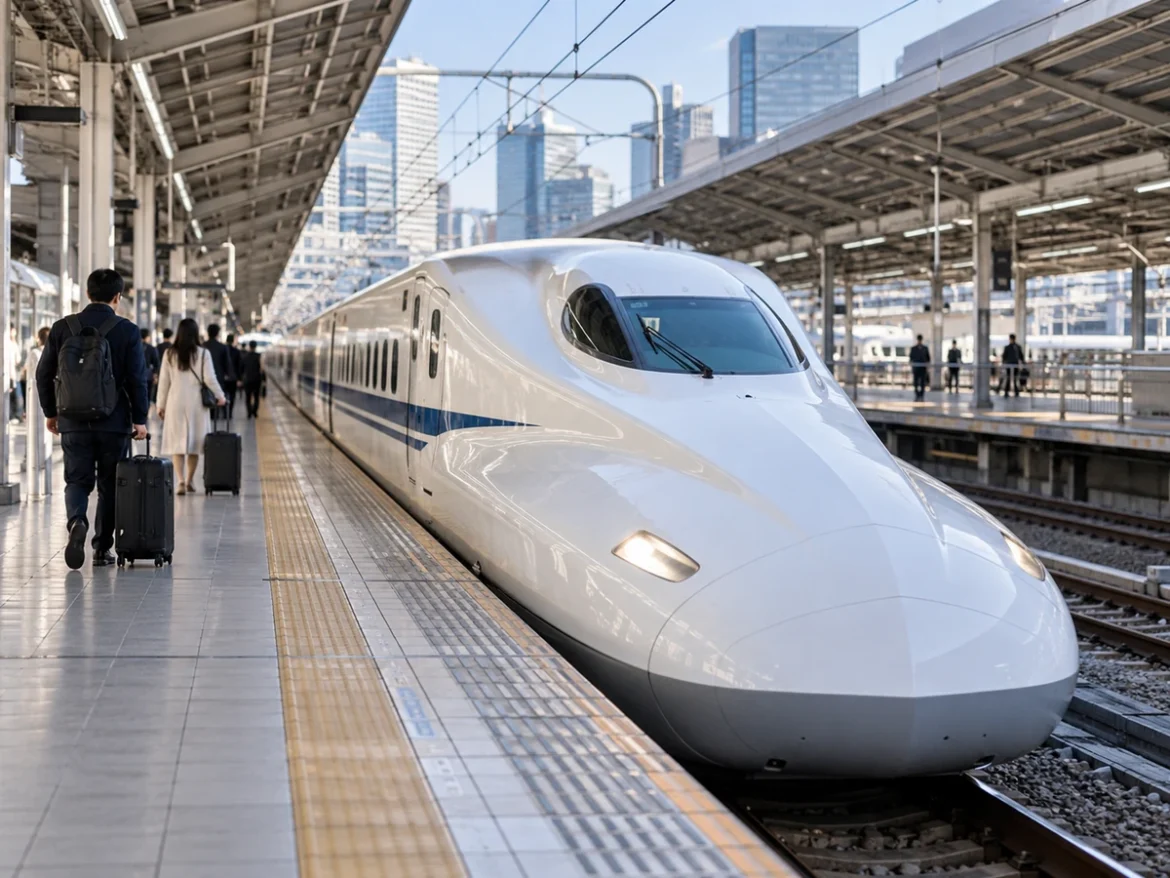
For most first-time visitors, the Tokaido Shinkansen is the most practical way to travel from Tokyo to Osaka. It runs directly from Tokyo Station or Shinagawa to Shin-Osaka, avoids airport security and baggage collection, and puts you onto Osaka’s urban rail network immediately after arrival.
The important detail is that the Shinkansen does not arrive at Osaka Station. It arrives at Shin-Osaka, north of the main Umeda/Osaka Station district. From there, you still need a short JR or Osaka Metro transfer to your hotel area.
Flying can make sense if you find a genuinely low fare, are already near Haneda Airport, or need to connect with another flight. For a normal central-Tokyo-to-central-Osaka journey, however, the one-hour flight time hides the airport journeys, check-in margin, security and arrival transfer.
An overnight highway bus is the main budget alternative. It can save the cost of one night of accommodation, but the trade-off is sleep quality and a much less predictable first morning in Osaka.
For a first visit, the simplest default is: reserve a Nozomi from Tokyo or Shinagawa to Shin-Osaka, choose an oversized-baggage seat if your suitcase requires it, then continue by JR to Osaka/Umeda or by the Midosuji Line toward Namba.

Tokyo to Osaka: Which Transport Is Best?
| Option | Typical main journey | Typical price pattern | Best for | Main drawback |
|---|---|---|---|---|
| Nozomi Shinkansen | Fastest 2 hr 21 min; commonly about 2 hr 30 min to Shin-Osaka | Around ¥14,000–¥15,000 one way in ordinary class, depending on seat/product/season | Most first-time visitors, luggage, city-centre travel | Does not arrive at Osaka Station or Namba |
| Hikari Shinkansen | About 3 hr | Similar standard-fare range; useful with a nationwide JR Pass | JR Pass holders avoiding the Nozomi supplement | Slower and fewer convenient departures than Nozomi |
| Kodama Shinkansen | About 4 hr | Can be cheaper with selected advance products | Travellers prioritising a discounted rail product over time | Too slow for most Tokyo–Osaka transfers |
| Haneda–Itami flight | About 1 hr in the air | Dynamic; can be above or below rail depending on date | Airport connections, travellers already near Haneda | Airport time makes the door-to-door journey much longer than the flight time suggests |
| Haneda/Narita–Kansai flight | About 1–1.5 hr in the air | Dynamic, sometimes low with advance purchase | Very low fare, KIX connection, southern Osaka itinerary | KIX is far from central Osaka |
| Overnight highway bus | Usually overnight | Often lower than Shinkansen; varies by seat and date | Budget travellers who can sleep on buses | Poor sleep can reduce the value of the following day |
Best all-round choice: Nozomi Shinkansen.
Best choice with a nationwide Japan Rail Pass: Hikari unless paying the Nozomi supplement saves enough time to justify it.
Best budget choice: an overnight bus when its fare is meaningfully lower than a train ticket plus the hotel night it replaces and you tolerate overnight travel well.
Best flight combination: Haneda to Itami, not Haneda to Kansai, for most central-Osaka stays.
Shinkansen: The Best Choice for Most Travellers
Tokyo and Osaka are linked by the Tokaido Shinkansen. Westbound trains leave Tokyo Station, call at Shinagawa and continue toward Nagoya, Kyoto and Shin-Osaka.
The route is simple because no transfer is required between Tokyo or Shinagawa and Shin-Osaka. You board once, keep your luggage with you and arrive on the same major rail network you will use for the rest of Kansai.
If you are also deciding between Tokyo, Kyoto and Osaka, the Tokyo to Kyoto by Shinkansen guide explains the same ticketing and luggage system for the previous major stop.
Nozomi, Hikari or Kodama?
| Train | Tokyo–Shin-Osaka time | Main advantage | Who should choose it? |
|---|---|---|---|
| Nozomi | Commonly about 2 hr 30 min | Fastest and most frequent | Most visitors buying an ordinary ticket |
| Hikari | About 3 hr | Covered by the nationwide JR Pass without the Nozomi add-on | JR Pass users |
| Kodama | About 4 hr | Stops at every Tokaido Shinkansen station and can have special advance-fare products | Price-focused travellers with a specific discounted product |
Nozomi is not merely a few minutes faster. It also has the most useful frequency for ordinary travellers. If you miss your preferred time, there is usually another suitable Nozomi much sooner than the next Hikari.
Kodama is technically a direct Tokyo–Shin-Osaka train, but spending roughly four hours on the train to save a modest amount rarely improves a first-time Japan itinerary. It becomes more interesting only when a specific advance product creates a large enough saving.
Tokyo to Osaka Shinkansen Fares
A normal one-way ordinary-class ticket is roughly in the ¥14,000–¥15,000 range. The exact amount depends on the train, reserved versus non-reserved seating, season and booking product.
Do not build the budget around a single fare copied from an old guide. Tokaido Shinkansen pricing includes ordinary tickets, SmartEX products, advance products and seasonal reserved-seat adjustments.
For most visitors, paying slightly more for a reserved Nozomi seat is worthwhile because it removes the uncertainty of finding a seat and lets you choose the side of the train, keep a family together and reserve the correct luggage space when required.
SmartEX is useful, but understand what the ticket covers
SmartEX is JR Central’s online reservation system for the Tokaido, Sanyo and Kyushu Shinkansen. It is useful for choosing a train and seat before travel and can remove the need to queue at a staffed ticket counter.
One detail catches travellers out: a SmartEX Shinkansen product is not automatically equivalent to a traditional basic-fare ticket that includes travel within designated Tokyo or Osaka city zones. If you use conventional trains before or after the Shinkansen, those local fares may be charged separately.
That difference is normally small, but it matters when comparing two tickets that appear only a few hundred yen apart.
Compare the same fare product
| Adult one-way Tokyo–Shin-Osaka ticket | Regular-season price | What to check |
|---|---|---|
| Standard Nozomi ordinary reserved seat | ¥14,720 | Regular station-ticket reference; seasonal adjustments apply |
| Standard Hikari/Kodama ordinary reserved seat | ¥14,400 | Saving is small unless a pass or discount changes the comparison |
| SmartEX Nozomi ordinary reserved seat | ¥14,520 | Local trains at either end cost extra |
| SmartEX Hikari/Kodama ordinary reserved seat | ¥14,200 | Slower train; same local-fare caveat |
| SmartEX ordinary non-reserved seat | ¥13,870 | No seat guaranteed; Nozomi peak restrictions apply |
| SmartEX Nozomi Green Car | ¥19,390 | Reserved upgrade; compare with ordinary class |
These are per-adult reference fares, not a promise of availability. Check the official SmartEX fare tables for your date. The ordinary reserved fare changes with the season; reseller totals can also include service charges.
Early booking: EX Hayatoku 21
EX Hayatoku 21 lists Tokyo/Shinagawa–Shin-Osaka at ¥12,980 for an adult on an eligible direct Nozomi. Book from 10:00 one month before departure until 23:30 Japan time 21 days before travel. Discount seats are limited and excluded dates apply. It is tied to the booked train: changing trains requires a refund and a new booking, and you cannot simply take a later non-reserved train if you miss it.
Do not budget for the old SmartEX round-trip product: it ended for travel after 31 March 2026. Compare the two one-way bookings. If you want to stop in Shizuoka or Nagoya, buy suitable separate journeys; SmartEX and Hayatoku tickets do not permit a sightseeing stopover on the same through ticket.
Ordinary class, Green Car or Supreme Class?
An ordinary reserved seat is enough for most visitors. Green Car is an optional comfort upgrade, especially if you value more space. Supreme Class Cabins began on selected trains on 1 October 2026. They are a separate premium product with cabin-specific occupancy and ticket rules, not a standard feature of every Nozomi or an automatic benefit of a rail pass.
Tokyo Station or Shinagawa: Where Should You Board?
Both Tokyo Station and Shinagawa are valid departure points for the same westbound Tokaido Shinkansen.
Choose Tokyo Station when
- Your hotel is around Marunouchi, Ginza, Nihombashi, Asakusa or the eastern side of central Tokyo.
- You want the simplest experience at the route’s starting station.
- You want maximum time to board, organise luggage and settle into the correct seat.
- You are buying an ekiben or food before departure and want a wider station selection.
Choose Shinagawa when
- Your hotel is in Shinagawa, Shibuya, Ebisu or parts of southern/western Tokyo.
- Going back to Tokyo Station would mean travelling in the wrong direction first.
- You are coming from Haneda and continuing west without spending time in eastern Tokyo.
The fare difference is not the important issue here. The useful question is which station reduces your local Tokyo travel and luggage handling.
Where Do You Actually Arrive in Osaka?
Your Shinkansen stop is Shin-Osaka Station; some trains continue west beyond it. Shin-Osaka is a major interchange, but it is not the same station as Osaka Station in Umeda.
This is the most common first-time misunderstanding on the route.
For Umeda and Osaka Station
Follow signs from the Shinkansen to JR conventional lines and take a short local journey to Osaka Station. This is usually the simplest choice for hotels around Osaka Station, Umeda and the northern business/shopping district.
For Namba, Shinsaibashi and Dotonbori
Transfer to the Osaka Metro Midosuji Line at Shin-Osaka. The Midosuji Line runs directly through Umeda, Hommachi, Shinsaibashi, Namba and Tennoji, so no second Metro transfer is necessary for most Namba hotels.
Osaka Metro’s current Shin-Osaka station information confirms direct transfer between the Shinkansen/JR station and the Midosuji Line. Namba is a major interchange for Osaka Metro, Nankai, Kintetsu, Hanshin and JR, but those platforms are spread across a large district rather than one compact station hall.
If you are staying in Minami, the Namba hotel guide explains why Nankai Namba, Osaka-Namba, JR Namba and Osaka Metro Namba should not be treated as interchangeable.
Official station maps for the transfer
Open the Tokyo Station layout and Shin-Osaka Station layout before travelling. Locate the Tokaido Shinkansen gates, the JR conventional-line transfer and the Metro connection. These are official station maps, useful for planning the walk with luggage.
Oversized Luggage Rules on the Tokaido Shinkansen
Measure very large luggage before booking.
- Total three dimensions 160 cm or less: no oversized-baggage reservation is required.
- Total three dimensions 161–250 cm: reserve a seat with an oversized-baggage area behind the designated last row.
- Over 250 cm total dimensions: the baggage cannot be brought onto the train.
The luggage reservation does not add an extra fee to the normal reserved-seat price. The problem is availability: the relevant seats can sell out before ordinary seats.
If you board with oversized baggage without the required reservation, JR can charge a ¥1,000 baggage fee and direct you to store it in another location. On a full train, that can turn an otherwise easy journey into unnecessary stress.
What about strollers, sports equipment and instruments?
Strollers, sporting equipment and musical instruments are treated differently from ordinary oversized suitcases, but using the designated oversized-baggage space still requires the appropriate reservation.
Families with a folded stroller often benefit from reserving the last-row baggage area even when the stroller itself does not trigger the oversized-suitcase rule.
Some deck storage racks can now be used without a reservation for bags measuring 160 cm or less in total. That does not waive the reservation for oversized suitcases. See the official luggage diagrams to distinguish the shared deck racks from the reserved space behind the last row.
Best Shinkansen Seat for Mount Fuji
On the Tokyo-to-Osaka journey, Mount Fuji is generally on the right-hand side of the train when travelling west.
A window seat on that side gives you the best chance of seeing it, but visibility is never guaranteed. Cloud, rain, haze and darkness can obscure the mountain completely.
Do not choose a much worse train time purely for the view. A convenient reserved departure is more valuable than planning an entire transfer around a mountain that may be hidden by cloud.
Nozomi Peak Periods: Do Not Rely on a Non-Reserved Seat
JR Central’s announced all-reserved Nozomi windows are 24 April–6 May, 7–16 August, 18–23 September, 10–12 October and 21–23 November 2026; 25 December 2026–5 January 2027; 9–11 January and 20–22 March 2027. These are specific dates, not the whole cherry-blossom season. Check the official Nozomi calendar before booking.
During those dates, ordinary Nozomi cars do not offer their normal non-reserved seating. Travellers holding an applicable non-reserved ticket may be allowed to stand in designated ordinary-car areas, but that is a poor plan for a 2.5-hour intercity journey.
If your travel date falls in one of the published peak windows, reserve as soon as your itinerary is stable, particularly for a family or a group that wants adjacent seats.
Can You Use the Japan Rail Pass from Tokyo to Osaka?
Yes, but the train choice matters.
The nationwide JAPAN RAIL PASS covers Hikari and Kodama on the Tokaido Shinkansen. It does not include ordinary use of Nozomi without an additional Nozomi/Mizuho ticket.
The current special-ticket price for Tokyo–Shin-Osaka is ¥4,960 per Nozomi use for a valid pass holder.
That means a traveller who already owns a nationwide pass has three sensible choices:
- Take Hikari with no Nozomi supplement.
- Pay the Nozomi supplement when the schedule saving materially improves the day.
- Reconsider whether the nationwide pass itself makes financial sense before buying it, especially for an itinerary built mainly around Tokyo, Kyoto and Osaka.
Do not buy a nationwide pass solely because you need a Tokyo–Osaka round trip. Compare the full itinerary first.
For context, a seven-day ordinary nationwide pass bought through the official JAPAN RAIL PASS Reservation website costs ¥50,000; the overseas-agency exchange-order price is ¥53,000. Two regular-season standard Nozomi reserved tickets total ¥29,440 before local travel, so a simple return trip alone does not justify either pass price. Regional Kansai passes do not cover Tokyo–Shin-Osaka. Check official pass prices and eligibility before comparing a reseller offer.
Is Flying from Tokyo to Osaka Faster?
In the air, yes. Door to door, often no.
Haneda–Itami is the flight combination that competes most seriously with the Shinkansen for central-city travel. Both airports are relatively well positioned, and Itami has direct limousine buses to Shin-Osaka, Umeda and Namba.
But the complete journey includes:
- Tokyo hotel to Haneda Airport.
- Check-in and security margin.
- Boarding.
- Flight.
- Taxiing and disembarkation.
- Checked-baggage collection when applicable.
- Itami Airport to central Osaka.
- Final walk or train to the hotel.
By contrast, the Shinkansen lets you board in central Tokyo and remain in the same seat until Shin-Osaka.
When Haneda to Itami makes sense
- You are connecting from or to another flight.
- Your Tokyo hotel is close to Haneda.
- You find a substantially cheaper airfare for the exact date.
- Your Osaka destination is particularly convenient from an Itami limousine-bus stop.
- You have airline status or benefits that materially improve the airport process.
When the Shinkansen is better
- You are staying in central Tokyo and central Osaka.
- You have large luggage and want to avoid checking it.
- You want frequent departures and flexible timing.
- You are travelling with children.
- You prefer to work, eat or move around more easily during the journey.
As a planning allowance, central Tokyo–Haneda–Itami–central Osaka can easily take three to four hours or more door to door. Narita–Kansai commonly needs a larger allowance, around four to six hours once both airport transfers are included. These are itinerary estimates, not promised service times. For ANA departures from Haneda, checked-baggage acceptance closes 30 minutes before departure from September 2026; that is a cutoff, not a sensible airport-arrival target. Follow your airline’s current boarding instructions.
What About Flying to Kansai International Airport?
Kansai International Airport is useful when your fare is much lower, you are connecting through KIX or your Osaka stay is concentrated in southern Osaka.
For a standard Tokyo-to-central-Osaka transfer, however, landing at KIX often gives back much of the time saved by flying. You still need a substantial train or bus journey into the city.
If your final hotel is in Namba, KIX is more defensible because Nankai Railway connects the airport with Namba. For Umeda or Shin-Osaka, Itami is usually the more natural domestic-airport choice.
Tokyo to Osaka Overnight Bus
An overnight highway bus can be the lowest-cost practical option, particularly when it replaces a hotel night.
The important question is not simply whether the bus fare is lower than the Shinkansen. Ask whether you will sleep well enough to use the following day.
A traveller who arrives in Osaka at dawn exhausted and then pays for luggage storage, an early café and an afternoon nap may save less than expected.
Who should consider the night bus?
- Solo budget travellers.
- Travellers comfortable sleeping in reclining bus seats.
- People with flexible first-day plans in Osaka.
- Anyone travelling on a date when Shinkansen fares and accommodation together are significantly more expensive.
Who should avoid it?
- Families with young children.
- Older travellers who need reliable sleep and easier toilet access.
- Travellers with a major attraction booked early the next morning.
- Anyone who already knows they cannot sleep while travelling.
A current bookable option is the Tokyo–Osaka/Kyoto VIP Liner night bus, with different seat layouts offered on selected departures.
Daytime Bus, Local Trains or Driving?
Daytime highway bus
JR highway buses offer daytime Tokyo/Shinjuku–Osaka services as well as overnight departures. Allow roughly eight to ten hours, depending on the stops and traffic. A day bus suits travellers who dislike sleeping on a bus and can spare most of a sightseeing day; unlike a night bus, it does not replace a hotel night. Compare the exact departure in the JR Bus timetable effective 1 June 2026, then check dated availability and service notices before paying.
Ordinary and rapid JR trains
A conventional-rail journey generally follows the Tokaido corridor through Atami, Shizuoka/Hamamatsu, Toyohashi, Nagoya/Ogaki, Maibara and Kyoto. Connections vary, and the roughly nine-to-eleven-hour planning estimate is not a through service or a guaranteed timetable. There is no reserved seat throughout. Price the actual basic-fare route and plan each connection rather than assuming an IC card can cover the entire cross-region journey.
This is a railway trip in its own right, not a useful default for a first visit with suitcases. Splitting it into Tokyo–Shizuoka, Shizuoka–Nagoya and Nagoya–Osaka over several days makes the stopovers more enjoyable.
Rental car or long-distance private transfer
Driving is most useful when the journey includes places away from the railway. For a direct city-to-city transfer, add rental or charter charges, motorway tolls, fuel, parking and any one-way drop-off fee before comparing with rail. Allow substantial time for breaks and congestion; a car full of luggage is not a reason to underestimate fatigue.
A three-day road trip could stay near Hakone or Mount Fuji on day one, continue via Shizuoka or Lake Hamana to Nagoya on day two, then visit Hikone or Lake Biwa before Osaka on day three. Choose either Hakone or the Fuji Five Lakes area rather than treating them as the same stop. Agree the allowed return location and final price with the rental company before booking.
Choose the night-bus seat as carefully as the fare
| Layout or feature | Practical trade-off |
|---|---|
| Four seats across | Often cheaper; less privacy and shoulder space |
| Three independent seats | Usually easier for a solo traveller who values space |
| Premium two-seat layout | More room, but the fare can approach rail |
| Toilet, curtains or women-oriented seating | Confirm the actual vehicle and package; these are not universal |
Bus and air prices are dynamic. Check luggage limits, exact meeting point, confirmation deadline and cancellation terms. A departure after midnight belongs to the new calendar day. The linked VIP Liner reseller product offers three- or four-seat layouts, but does not let you freely choose every departure time or seat; rely on the confirmed voucher. Leave the first morning flexible and arrange luggage storage before hotel check-in.
Same-Day Return and Late Arrival
A Tokyo–Osaka day trip is possible, but the round-trip train journey alone takes around five hours. It works best for one meeting or event; it is poor value for a rushed first Osaka visit or a full day at USJ. Stay at least one night if you can. For Osaka with Kyoto, Nara or Kobe, three to five nights gives you room to separate the journeys.
Book the return journey before committing to a late show. Work backwards from your actual Shin-Osaka departure, including travel from Namba or the venue, station walking and a missed-connection buffer. There is no all-night Shinkansen service. Check the official timetable for the date rather than assuming a fixed last train year-round.
If you miss the last practical connection, use available local accommodation or a separately confirmed overnight bus. A bus is not guaranteed to have seats, and a long-distance taxi is an expensive fallback. For a late arrival in Osaka, check your hotel’s last check-in time and the final local train; staying at Shin-Osaka can be simpler than crossing the city with luggage.
Families: Which Route Is Easiest?
For most families, reserve the Shinkansen.
The advantages become more important with children: no airport security queue, no need to surrender ordinary suitcases, easier access to toilets, more freedom to stand briefly with a restless child and a predictable arrival at a major rail station.
Reserve seats together rather than relying on non-reserved cars. If travelling with a stroller or very large suitcase, book the appropriate baggage space at the same time.
Tokyo Station also has a practical advantage over flying: families can buy food before boarding and then eat at their seats without adding a separate airport meal stop.
Older Travellers: Train or Plane?
The Shinkansen is also the easier default for most older travellers, but station walking should not be underestimated.
Tokyo Station is large. Shin-Osaka is large. If the hotel is far from the correct exit or requires another crowded subway transfer, the trip can still become tiring.
Useful adjustments include:
- Choose a reserved aisle seat if getting up frequently is important.
- Use luggage forwarding for heavy suitcases.
- Allow extra transfer time at Shin-Osaka.
- Consider staying in Umeda if the itinerary includes several JR day trips.
- Consider Namba only when its nightlife, food or KIX transport is genuinely useful.
The Osaka travel guide compares Umeda, Namba, Honmachi, Tennoji and other bases.
Correct First-Time Route: Tokyo to Namba
- Travel from your Tokyo hotel to Tokyo Station or Shinagawa.
- Arrive around 20–30 minutes before departure for a first Shinkansen journey, especially if collecting tickets or buying food.
- Follow signs for the Tokaido Shinkansen.
- Check the exact train name, number, departure time, platform and car.
- Board the reserved Nozomi.
- Travel to Shin-Osaka.
- Follow signs for Osaka Metro.
- Enter the Midosuji Line toward central/southern Osaka.
- Ride directly to Namba.
- Use the correct Namba exit for the hotel rather than simply following the first “Namba” sign.
The last step matters. Namba’s rail facilities cover a wide underground area. A hotel near Nankai Namba can still be a long luggage walk from JR Namba.
Correct First-Time Route: Tokyo to Umeda
- Board the Tokaido Shinkansen at Tokyo or Shinagawa.
- Travel to Shin-Osaka.
- Transfer from the Shinkansen to a JR conventional train for Osaka Station.
- Exit according to the hotel location within the wider Osaka/Umeda complex.
Do not assume “Osaka Station” and every station labelled “Umeda” share the same gates. JR Osaka, Osaka Metro Umeda, Hankyu Osaka-Umeda and Hanshin Osaka-Umeda are connected within the same district but remain separate railway facilities.
Can You Sightsee on the Same Day?
Yes. A morning Shinkansen leaves enough time for an afternoon and evening in Osaka.
Relaxed transfer-day plan
| Time | Plan |
|---|---|
| 08:00–08:30 | Check out and travel to Tokyo or Shinagawa Station |
| 08:30–09:00 | Collect tickets if needed, buy breakfast or ekiben |
| About 09:00 | Board a reserved Nozomi |
| About 11:30–11:45 | Arrive at Shin-Osaka |
| 12:00–13:00 | Reach hotel area and leave luggage |
| 13:00–14:00 | Lunch |
| Afternoon | Visit one compact Osaka district |
| Evening | Dotonbori/Namba or Umeda depending on hotel location |
Do not plan Universal Studios Japan, Osaka Castle, Kuromon Market, Dotonbori and Umeda all on the transfer day. The transport is fast, but hotel check-in and luggage still consume time.
Half-Day Osaka Plan After Arriving from Tokyo
If your hotel is in Namba, leave luggage and keep the first afternoon in the south:
Namba → Kuromon area → Shinsaibashi → Dotonbori → dinner in Namba.
If your hotel is in Umeda, stay in the north:
Hotel check-in → Umeda shopping/observation area → dinner around Osaka Station or Ura-Umeda.
The point is to avoid crossing Osaka repeatedly after a long travel morning.
One-Day Osaka Plan After a Previous-Night Arrival
A full first Osaka day can reasonably include:
Morning: Osaka Castle area.
Lunch: central Osaka or Kuromon/Namba.
Afternoon: Namba, Shinsaibashi and Dotonbori.
Evening: Shinsekai/Tennoji or return to Umeda depending on hotel location.
Travellers planning onward travel to Kyoto should use the Osaka to Kyoto transport guide rather than automatically returning to Shin-Osaka for every Kyoto journey.
Should You Buy an Osaka Transport Pass on Arrival?
Not automatically.
If you arrive at lunchtime and will only take two or three city journeys, paying with an ICOCA or another compatible IC card is usually simpler.
A Metro pass becomes more interesting when the arrival day or following day involves several Osaka Metro rides. Current Klook products include QR-code Osaka Metro/City Bus options, but always compare the pass price with the journeys you actually expect to make.
Where Should You Stay After Arriving from Tokyo?
Umeda: best for JR connections and day trips
Choose Umeda when Kyoto, Kobe, Himeji or other regional rail journeys are a major part of the itinerary. It is also the simplest central-Osaka area to reach after transferring from Shin-Osaka by JR.
Namba: best for food and nightlife
Choose Namba when Dotonbori, Shinsaibashi, Kuromon and late-evening dining matter more than JR regional connections. The Midosuji Line gives a direct Shin-Osaka–Namba link, so the Shinkansen arrival is still straightforward.
Shin-Osaka: best only for transport-heavy itineraries
Staying directly at Shin-Osaka can make sense for one night when you have another early Shinkansen departure, but it is less atmospheric for a first Osaka stay.
Honmachi: balanced city base
Honmachi sits on the Midosuji Line between Umeda and Namba. It can reduce hotel costs while keeping both northern and southern Osaka easy to reach.
Tokyo to Osaka with Large Luggage: Train or Flight?
The train usually wins.
You avoid airline checked-baggage queues and can keep luggage close to you. The key is booking the correct Shinkansen baggage seat when the suitcase exceeds the 160 cm three-dimension threshold.
For multiple large suitcases, luggage forwarding can be even easier. Ask both hotels about luggage forwarding and its delivery date before sending the heaviest cases; carry enough essentials until the luggage arrives.
This is particularly useful when you want to sightsee immediately after arriving rather than taking several suitcases through Namba or Umeda before hotel check-in.
Tokyo to Osaka First-Time Mistakes to Avoid
- Booking “Osaka” without checking the arrival station. The Shinkansen arrives at Shin-Osaka, not Osaka Station.
- Comparing a 70-minute flight with a 155-minute train and stopping there. Add airport journeys, check-in, security and baggage time.
- Going to Tokyo Station when Shinagawa is closer. This can add an unnecessary cross-city luggage journey.
- Bringing a 161–250 cm suitcase without the correct reservation. Reserve an eligible baggage seat/space before boarding.
- Assuming the nationwide JR Pass covers Nozomi automatically. It requires the separate Nozomi/Mizuho ticket.
- Buying a nationwide JR Pass for one Tokyo–Osaka return trip without doing the maths. Point-to-point tickets may cost less.
- Relying on non-reserved Nozomi seating during a peak period. Nozomi becomes all-reserved on specified dates.
- Choosing Kodama purely because it is a Shinkansen. It can add roughly 90 minutes compared with Nozomi.
- Flying into Kansai Airport without pricing the airport-to-city leg. The ground transfer can erase the saving.
- Assuming every Namba station is the same place. The district contains several separate railway facilities.
- Putting a full Osaka sightseeing day after an overnight bus. Poor sleep can make the itinerary unrealistic.
- Booking the Fuji-side seat and assuming the mountain will be visible. Weather can completely hide it.
- Arriving at the Shinkansen gate at the last minute. First-time travellers need time to find the correct train, car and platform position.
- Buying too much food after reaching the platform. Station concourses usually offer a better selection before the final boarding area.
- Planning an immediate cross-Kansai day trip after arrival. Leave some buffer for hotel luggage and station navigation.
Frequently Asked Questions
What is the fastest way from Tokyo to Osaka?
For most city-centre journeys, a Nozomi Shinkansen is the fastest practical door-to-door option even though a flight has a shorter airborne time.
How long does the Tokyo to Osaka Shinkansen take?
The fastest Nozomi takes 2 hours 21 minutes from Tokyo to Shin-Osaka; many departures take about 2 hours 30 minutes. Hikari is closer to 3 hours and Kodama about 4 hours.
How much is the Shinkansen from Tokyo to Osaka?
Budget roughly ¥14,000–¥15,000 one way in ordinary class. The exact fare depends on seat type, booking product and season.
Does the Shinkansen go to Osaka Station?
No. It arrives at Shin-Osaka. Transfer to JR for Osaka Station/Umeda or to Osaka Metro for Namba and other central districts.
Should I depart from Tokyo Station or Shinagawa?
Use whichever station reduces your local Tokyo travel. Tokyo Station suits eastern/central Tokyo; Shinagawa is often easier from southern and western districts.
Do I need to reserve the Shinkansen?
A reservation is strongly recommended. It becomes especially important for families, groups, large luggage and Nozomi travel during designated peak periods.
Can I buy a Tokyo to Osaka Shinkansen ticket on the same day?
Usually yes when seats remain, but popular trains can sell out. Peak holidays are the wrong time to depend on a last-minute adjacent-seat booking.
Can I use the Japan Rail Pass on Nozomi?
Only with the special Nozomi/Mizuho ticket. The current Tokyo–Shin-Osaka add-on is ¥4,960 for a valid nationwide pass holder.
Is Hikari much slower than Nozomi?
Expect roughly 20–30 extra minutes. That is acceptable for many JR Pass users, but Nozomi is usually the better choice when buying an ordinary ticket.
Is Kodama worth taking from Tokyo to Osaka?
Usually only when a particular discount makes the saving significant. Its roughly four-hour journey is long for this route.
Do I need a special reservation for a large suitcase?
Yes when the total of the three dimensions is 161–250 cm. Reserve the appropriate oversized-baggage seat or space.
Can I take a suitcase larger than 250 cm total dimensions?
No. JR Central does not permit baggage above that total size on the Tokaido Shinkansen.
Which side should I sit on to see Mount Fuji?
Travelling from Tokyo toward Osaka, choose the right-hand side for the usual Mount Fuji view. Visibility depends entirely on weather.
Is flying cheaper than the Shinkansen?
Sometimes. Airfares are dynamic, so compare the exact flight plus airport transport and baggage charges with the rail ticket.
Is Haneda to Itami better than Haneda to Kansai?
For most central-Osaka trips, yes. Itami is much closer to Umeda, Shin-Osaka and Namba than Kansai Airport.
Is an overnight bus safe and practical?
It is a normal long-distance travel option and can be economical, but comfort and sleep quality vary substantially by seat type and traveller.
Is the overnight bus good for families?
Usually not. The Shinkansen is much easier for young children, toilet access, luggage and predictable rest.
How do I get from Shin-Osaka to Namba?
Use the Osaka Metro Midosuji Line directly from Shin-Osaka to Namba.
How do I get from Shin-Osaka to Osaka Station?
Transfer to a JR conventional train for the short ride to Osaka Station.
Should I stay in Umeda or Namba after arriving?
Choose Umeda for JR connections and regional day trips. Choose Namba for Dotonbori, food, nightlife and convenient KIX access by Nankai.
Can I visit Kyoto from Osaka after this trip?
Yes. From Osaka, JR, Hankyu and Keihan serve different parts of Kyoto. The fastest-looking route is not always the one that reaches your first Kyoto attraction most efficiently.
Final Verdict: What Should You Book?
For a first Tokyo-to-Osaka journey, book a reserved Nozomi from Tokyo or Shinagawa to Shin-Osaka.
Choose the departure station that is easiest from your Tokyo hotel rather than automatically crossing the city to Tokyo Station.
If your suitcase totals 161–250 cm across three dimensions, reserve the correct oversized-baggage seat or space at the same time as the ticket.
After arriving, use JR for Osaka Station/Umeda or the Midosuji Line for Namba. Do not treat Shin-Osaka as the final city-centre destination unless your hotel is actually there.
If you already hold a nationwide JAPAN RAIL PASS, Hikari is the natural no-supplement choice. Pay the Nozomi add-on only when the faster timetable materially improves the day.
Consider Haneda–Itami only when the airfare, airport location or onward connection creates a real advantage. Avoid choosing a flight merely because its published flight time looks shorter.
Use the overnight bus when budget genuinely matters and you know you can sleep reasonably well in a reclining seat. Otherwise, the Shinkansen’s combination of frequency, central departure, luggage convenience and predictable arrival makes it the strongest all-round route between Japan’s two biggest urban regions.