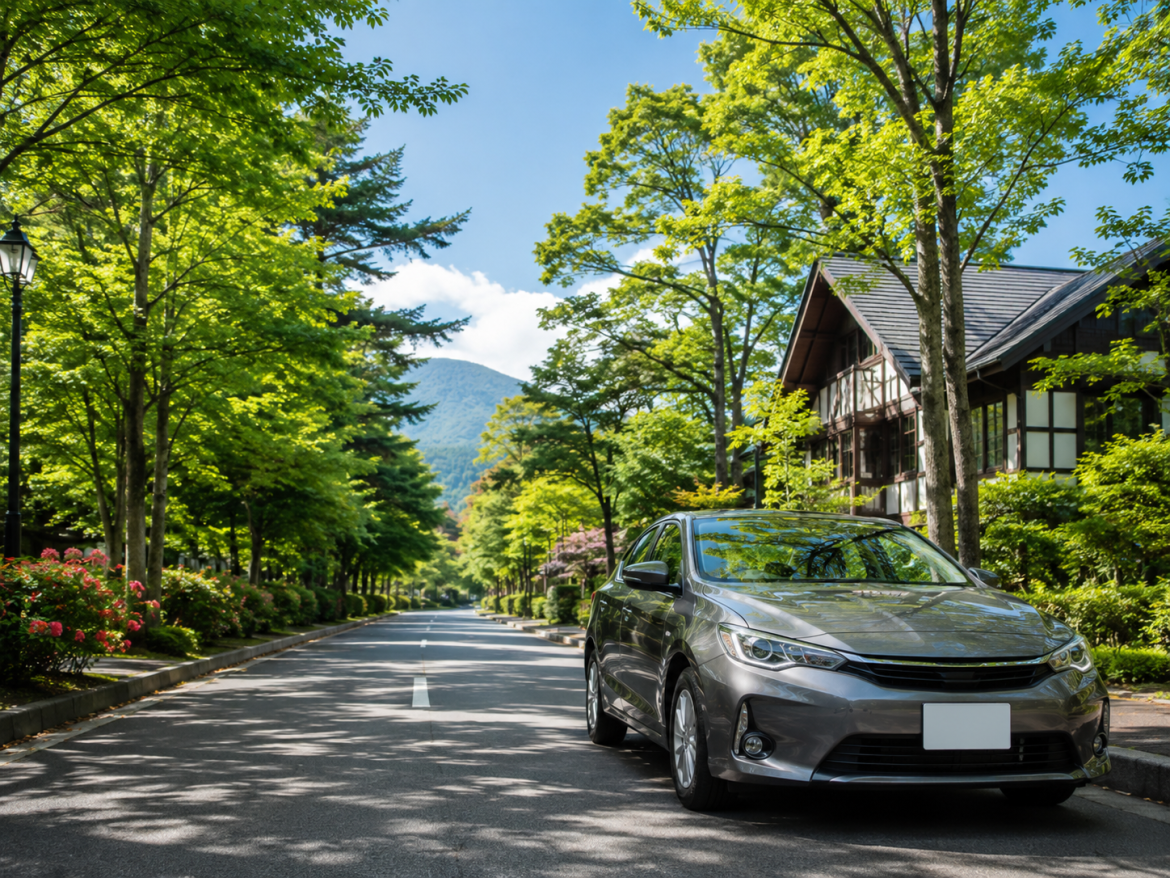

Karuizawa car rental: useful for the countryside, optional in town
A rental car makes the biggest difference when you want to connect Shiraito Falls, Oiwake, Miyota, Kita-Karuizawa or Kusatsu Onsen. It is less useful for simply moving between Karuizawa Station, the outlet mall, Kumoba Pond and the old shopping street. In busy periods, finding parking can take longer than the drive.
For a first visit, take the Hokuriku Shinkansen to Karuizawa and collect near the north exit only when you need the car. That avoids starting with Tokyo traffic and a long expressway journey. Our Tokyo–Karuizawa transport comparison explains the alternatives.
A manageable driving day might combine the falls with the Hoshino area and one town stop. Leave Kusatsu for a slower itinerary. In winter, a bus, tour or private transfer is a better choice if you have no snow-driving experience; a car with winter tyres still needs a capable driver and suitable conditions.
Is renting a car in Karuizawa worth it?
| Your plans | Practical choice |
|---|---|
| Station, outlet shopping, old town and Kumoba Pond | Walking, local transport and suitable-weather cycling are often enough |
| Shiraito Falls plus several dispersed places | A day rental provides flexibility beyond bus timetables |
| Oiwake, Miyota or a rural holiday home | A car can simplify luggage and access |
| Kita-Karuizawa, Tsumagoi or Kusatsu | Allow more time and consider an overnight stay |
| Children, older relatives or several bags | Useful if the car and last-mile walking suit the group |
| A half-day town visit before a fixed train | Rental formalities may take too much of the available time |
| Winter without snow-driving experience | Choose a bus, transfer or tour rather than learning on a mountain road |
A full-day booking can suit the outer sights, while a half-day rental only works if the branch hours and return buffer leave worthwhile sightseeing time. Late spring to autumn generally brings fewer ice-related complications, but summer holidays and autumn foliage can still mean heavy traffic.
Start with the Karuizawa itinerary guide and identify the stops that genuinely need a car before reserving one.
Karuizawa Station rental offices: use the north exit
The main offices in this shortlist are north of the station. The outlet mall is on the south side. Check the full office name and address before taking luggage outside; the company name alone is not a pickup location.
| Office | Access | Published opening arrangement |
|---|---|---|
| Toyota Karuizawa Station | About one minute from the north exit, diagonally right after descending | 08:00–18:00 January 2–March 31 and October 21–December 31; 08:00–19:00 April 1–July 19; 08:00–20:00 July 20–October 20; closed January 1 |
| Nippon Karuizawa Station North | About two minutes from the north exit | Normally 08:00–19:00. December 1–30, 2026 and January 4–March 31, 2027: 09:00–19:00. December 31, 2026–January 3, 2027: 09:00–18:00 |
| JR East Rent-A-Lease Karuizawa | Left of the north exit, beside the old station memorial building | 08:00–19:00; branch lists winter tyres as standard in winter |
| Budget Karuizawa Station | About five minutes from the north exit; second floor beside the station-area post office | Normally 08:00–19:00; check the booking date and actual collection instructions |
Confirm hours again for your date, especially a winter morning or evening return. A delayed Shinkansen does not guarantee service after closing. One-way returns also depend on vehicle class: Nippon’s north-exit office limits inbound drop-offs to the classes listed on its branch page, rather than accepting every vehicle in the fleet.
The existing Nagano rental search can help compare options, but check that the selected pickup really is Karuizawa. Nagano City is not an interchangeable station. Compare the total after protection, winter equipment, child seats, ETC, fuel and any one-way charge.
Rent in Tokyo or wait until Karuizawa?
| Option | Strength | Trade-off |
|---|---|---|
| Tokyo pickup | Door-to-door luggage handling and a wider multi-day road trip | Tokyo streets, expressway tolls, more driving and more paid rental time |
| Shinkansen then Karuizawa pickup | Shorter driving day and convenient local branches | Reserve the right car early on busy dates |
| Public transport throughout | No insurance, parking or driving task | Rural visits must fit bus connections |
| Private car with driver or group tour | Useful for families, winter travel and anyone avoiding driving | Price, itinerary flexibility and luggage limits depend on the product |
For one or two days around Karuizawa, collecting locally is usually the simpler choice. A Tokyo rental becomes more attractive if an experienced driver is continuing through several rural regions. For a group that needs door-to-door help, compare the actual language and itinerary options in a Tokyo-departure private charter.
Compare Tokyo private charters
Driving documents: arrange them before pickup
Rules depend on where the licence was issued, not simply your nationality. The National Police Agency’s guidance recognises qualifying 1949 Geneva Convention permits and a separate authorised-translation route for specified licences. Taiwan, Switzerland, Germany, France, Belgium and Monaco fall within that latter route.
For a Taiwan-issued licence, carry the valid original, an accepted Japanese translation and passport; the translation cannot stand alone, and a Taiwan international permit is not a substitute. Other visitors should carry their original home licence, required permit and passport and follow the supplier’s checklist. Document validity and the period after landing limit how long you may drive; registered residents have additional re-entry conditions.
Bring the reservation and a payment method accepted in the required person’s name. Register every intended driver and check age, licence-holding-period and vehicle-class requirements before paying. A booking does not override missing documents, and cancellation terms may still apply if collection is refused.
Insurance: CDW is not a promise of zero costs
Basic cover can leave an excess. A collision damage waiver, or CDW, deals with specified accident excesses if its conditions are met. A non-operation charge, or NOC, concerns the business loss when a car is unavailable after damage or serious soiling. One is not automatically included in the other.
Compare the exact supplier terms for wheels, tyres, glass, underbody damage, towing and keys. A fuller package may reduce exposure without removing every exclusion. Toyota’s insurance explanation shows its own distinctions; do not apply its amounts or plan names to another brand.
After a collision, stop safely, contact the police and rental company, and follow the reporting procedure even for a small scrape. Cover can be affected by missing reports, an unregistered driver, drink-driving, prohibited roads or other contract breaches. Broader protection is sensible to compare for unfamiliar roads, but it cannot make unsafe driving conditions acceptable.
Choose a car that fits the bags
For two people with light luggage, a compact or suitable kei car is easy to park. For two or three large cases, check the actual boot capacity instead of assuming every hatchback fits them. Four travellers with luggage may prefer a mid-size car, estate or suitably sized SUV.
Families should include the width of child seats and the space for a pushchair. A small MPV with a useful door opening can be easier than squeezing everything into the cheapest class. A seven-seat minivan may have very little luggage space when all seats are occupied.
“Or similar” usually means a class rather than the exact model pictured. Confirm essential features. In winter, properly specified winter tyres matter more than simply choosing a vehicle advertised as 4WD. AWD can help when pulling away or climbing; it cannot remove downhill skidding or braking risk.
Winter driving: check the road’s own equipment rules
Karuizawa can have ice at dawn, after dark, on bridges and in shade even when the station streets look clear. Shiraito Falls, Kita-Karuizawa and the Kusatsu direction involve higher roads; conditions there cannot be judged from town alone.
The Shiraito Highland Way operator’s winter FAQ warns of snow and freezing roughly from mid-November to mid-April. It asks drivers to prepare studless winter tyres or chains and specifically asks visitors not to use all-season tyres, including snowflake-marked types, on its steep mountain road. Confirm the actual tyre type with the rental company rather than accepting a vague “winter suitable” description.
- Confirm winter tyres on the car for your exact dates.
- Check any chain requirement, correct size and supplier permission.
- Keep a daylight margin for unfamiliar mountain roads.
- Allow smooth steering, braking and acceleration and more space to stop.
- Check road notices and weather before leaving, with a bus or indoor fallback.
- Do not use a winter drive to Shiraito or Kusatsu as your first snow-driving lesson.
Follow NEXCO’s winter-road guidance on expressways as well. A road closure applies regardless of equipment. A bus or driver removes your driving task, although severe weather can still disrupt the journey.
ETC, the Shiraito road toll and fuel
You may not use an expressway at all on a Karuizawa–Shiraito–Hoshino outing. Even a Kusatsu journey does not automatically require an expressway; decide on an ETC card from the actual route, not the destination name. An ETC unit is only a reader, so reserve a card separately if needed and check settlement at return.
Without an ETC card, choose entrances with general-payment lanes. Some are ETC-only: the Hoshino access page identifies Sakudaira Smart IC as one example. If you enter the wrong lane, do not reverse; follow staff or intercom instructions.
Shiraito Highland Way currently lists a ¥500 toll for an ordinary or kei car. Its toll is separate from expressway ETC. The paid entry allows exit at either toll gate, but exiting and re-entering means paying again. Follow the gate’s payment instructions; its FAQ lists credit card as the cashless option.
Follow the rental’s fuel agreement, ask which nearby station to use and keep the receipt. Leave time for refuelling before the branch deadline. Do not assume a short navigation time to the office includes a fuel queue or vehicle inspection.
A straightforward pickup routine
- Use the north exit for the branch in your confirmation, rather than heading towards the outlet mall.
- Present every driver’s required documents and the accepted payment method.
- Confirm the booked car class, winter tyres, child seats, ETC card and protection.
- Inspect existing marks on the body, glass, wheels and interior with staff.
- Photograph the car and fuel level, and save the correct return entrance.
- Set navigation while parked and check the route for restrictions.
- Learn the indicators, wipers, lights and parking brake before entering traffic.
Controls differ between models. If you operate the wrong stalk, stay calm rather than making a sudden manoeuvre. Allow enough collection time that a short delay does not force you to rush the first drive.
Parking at the main sights
| Place | What to expect | Better approach |
|---|---|---|
| Shiraito Falls | Parking is free, but the access road has a toll | Use the designated spaces and include the short uphill walk |
| Hoshino area | Several lots, with busy periods and possible overflow arrangements | Use the official access/parking map and follow attendants |
| Kumoba Pond | The town says there is no parking nearby | Leave the car at a formal town/station-area lot and continue without it |
| Kyu-Karuizawa Ginza | Public and private parking around the district | Park once, then explore on foot |
| Outlet mall | Large parking facilities, but access and departure can still be busy | Leave time to reorganise purchases and return the car |
| Oiwake | A quieter stop does not mean unrestricted roadside parking | Use a designated space for the place you are visiting |
Kumoba Pond: do not navigate to the water’s edge
The town’s Kumoba Pond page directs visitors towards formal parking elsewhere, including the north-station area and Yagasaki Park. Nearby residential roads are not a place to wait for a space. If the walk is too much for your group, choose a different stop rather than assuming a car can eliminate it.
Hoshino: allow for the walk after parking
Use the official Hoshino access and parking page. Summer and foliage weekends can be busy from late morning onwards. Temporary parking and shuttles operate only on announced dates; do not treat them as guaranteed daily services. An early arrival helps planning, but does not reserve a space.
When is driving easiest?
A weekday morning usually offers more flexibility than a holiday afternoon. If the outer sights are the reason for renting, visit them first rather than spending the morning around the station and joining rural traffic later.
- Late spring and early summer: a good starting point for a first fair-weather trip, while still checking mountain conditions.
- Summer holidays: expect busy parking and avoid repeatedly crossing the main tourist areas.
- Autumn foliage: choose a few stops rather than trying to fit Kumoba, Hoshino and the falls into one crowded afternoon.
- Winter: shorter daylight, snow and ice make experience, equipment and a backup essential.
- Midday and afternoon: use a meal and a walk from one parking place to avoid constant repositioning.
Traffic varies with the date and weather. Treat these as planning habits rather than a prediction that a particular hour will be clear.
A manageable first-day itinerary
Full day: Shiraito Falls, Hoshino and the old town
Collect when your branch opens, complete the inspection and drive to Shiraito Falls. Spend the morning there before continuing to the Hoshino area for lunch and a walk. In the afternoon, park once outside Kyu-Karuizawa and explore the shopping streets on foot. Add the outlet mall only if you still have a comfortable refuelling and return margin.
This sequence works because it gives the car a purpose beyond the station area and reduces repeated parking moves. It is not a promise of congestion-free driving or a reason to rush lunch. Church visits and individual venues also have their own access arrangements and opening times.
Half day: the outer sights, then return the car
With an early-opening branch, visit the falls and a short Hoshino stop, then refuel and return around your booked midday time. Spend the afternoon using town transport or walking. A winter 09:00 collection or a busy road may make this too tight; select the plan after checking actual branch hours.
Family version
Keep the morning falls visit, an unhurried lunch and just one afternoon area. Do not add Kumoba, Oiwake and several cafés simply because they look close. Toilet breaks, naps, child-seat checks and walking from parking all count as part of the day.
Driving from Karuizawa to Kusatsu Onsen
The two places can work together, but a Karuizawa sightseeing day plus Kusatsu plus a same-day Tokyo return is unnecessarily rushed. Read our Kusatsu Onsen guide and Tokyo–Kusatsu transport guide before deciding whether the rental is the best link.
For two days and one night, spend day one around Karuizawa and sleep there, then visit Kusatsu on day two and return to the booked Karuizawa office with sufficient daylight and buffer. If you want an unhurried ryokan dinner and overnight stay in Kusatsu as well, add another night or shorten the Karuizawa portion; do not squeeze an extra overnight into a one-night schedule.
Kita-Karuizawa and Kusatsu bring mountain-road conditions, especially in winter. Check the Shiga Kogen regional notices before any proposed through journey towards Shiga: the seasonal Shiga–Kusatsu crossing is different from the approach to Kusatsu from Karuizawa. A resort remaining open does not make every onward mountain road passable.
Do not assume you can leave a rental in Kusatsu. Check that the supplier actually offers and accepts the destination branch for your car before booking hotels and onward transport. A one-way arrangement may cost extra.
Arriving from airports and other cities
From Tokyo or Ueno, the Shinkansen followed by local pickup is straightforward for a short stay. If your trip starts with Tokyo sightseeing, use our Tokyo guide and leave the rental until you need it.
After arriving at Narita or Haneda, avoid treating a long drive as the automatic next step after an overnight flight. Airport transport and rail give you a break from driving. For a family with substantial luggage, compare a Tokyo/Karuizawa transfer option, checking that your exact origin and destination are offered rather than assuming every product includes an airport pickup.
From Nagano City, rail to Karuizawa then a local rental may be simpler for a single day. A drive from Matsumoto makes more sense as part of an existing multi-day road trip than as a long repositioning journey purely to visit the town.
Renting with children
Children under six generally require an appropriate restraint. Reserve the correct size and quantity using each child’s age and measurements; check installation and harness fit at collection. Two seats plus a pushchair can change the car class you need.
- Include the child seats and luggage together in the space calculation.
- Help children get out on the safe side, away from moving traffic.
- Schedule toilets, food and rest before everyone becomes tired.
- Keep the day’s main stops few enough that repeated loading does not dominate it.
The car’s advantage is easier transfers. It is not a reason to double the number of sights. A falls visit, lunch and one afternoon area can already make a full family day.
Is driving helpful for older relatives?
A car can reduce bus changes and luggage handling, particularly for a hotel away from the station. Check seat height, door openings, motion sickness and the walking after parking. A higher car is not automatically easier for every passenger to enter.
Shiraito’s operator describes about 200 metres uphill from the path entrance near the shop to the falls, so it is not a completely step-free, no-effort roadside view. Hoshino has designated accessible spaces and sloped access routes, but the distance depends on where you park. For limited mobility, consult the official facilities guide and avoid making Kumoba a compulsory stop.
What changes on a rainy day?
A car can reduce waiting outdoors and make luggage easier in ordinary rain. Mountain bends, wet leaves, poor visibility and standing water still require extra caution. Heavy rain is a reason to simplify, postpone or change the route, not to press on to every outdoor stop.
Replace a highland drive with a meal, outlet shopping, hotel facilities or a short old-town walk as conditions permit. A sheltered destination still involves parking and some walking, so bring suitable clothing rather than expecting to stay dry entirely inside the car.
Alternatives if you do not want to drive
Local buses connect useful parts of Karuizawa, including the Hoshino area and the Shiraito direction, but check the current timetable and last return. Cycling suits some town outings in good conditions; it is not an alternative on Shiraito Highland Way itself, where bicycles and pedestrians are prohibited on the motor road.
A group day tour can suit one or two people who want transport organised. A private charter can better match a family’s pace and luggage. Compare the actual date, language, pickup, minimum group and stops of a Tokyo-departure Karuizawa day tour; its named sights are not a guarantee that every option visits them all.
Food stops that fit the route
Karuizawa works well for Shinshu soba, highland vegetables, bread, coffee, preserves and locally inspired Western cooking. Choose one main meal area rather than reserving restaurants in several districts and then racing traffic between them.
- Shiraito Falls: plan a short sightseeing stop rather than relying on it for the day’s main meal.
- Hoshino: a convenient lunch area, with queues possible on busy dates.
- Kyu-Karuizawa: bread, cafés and afternoon snacks after parking once.
- Oiwake: a slower soba or café stop if it already fits your route.
- Outlet mall: practical around shopping, provided the meal ends comfortably before return.
The driver must remain alcohol-free. If dinner is part of the attraction, return the car first or stay overnight with no further driving planned.
Should you stay overnight?
A fair-weather day trip from Tokyo can work, but collection, inspection, fuel and return reduce the hours available for sightseeing. An overnight stay is more appealing if you want Kusatsu or Kita-Karuizawa, an early Kumoba walk, a leisurely dinner, resort facilities or a slower family pace.
Station-area accommodation is convenient when using rail and a short rental. A rural resort becomes more practical if you keep the car for several days. Check parking, access and winter clearing, using our Karuizawa hotel guide or Karuizawa ski-accommodation guide as a starting point.
How much time should you leave for return?
Work backwards from the train, adding fuel, the correct branch entrance, inspection, toll settlement, luggage unloading and the station walk. Sixty to ninety minutes is an initial planning allowance for those tasks, not a guarantee that all traffic or snow delays will fit inside it. Busy weekends, rain and winter conditions can require much more.
Follow the earlier deadline if the office closes before your ideal return time. If a delay develops, call before the agreed rental return, not only just before closing. For an early train, returning the previous evening can be less stressful.
First-time mistakes to avoid
- Booking a low headline rate without protection, child seats or winter equipment.
- Leaving by the south exit for a north-side rental branch.
- Bringing a Taiwan international permit without the required licence and translation.
- Assuming CDW includes NOC, or AWD means winter tyres are fitted.
- Using all-season tyres on a road whose operator specifically advises against them.
- Driving to Kumoba’s edge in search of parking or waiting roadside near Hoshino.
- Moving the car between individual old-town shops instead of walking.
- Combining Shiraito, Kusatsu, the outlet mall and the old town in one Tokyo day trip.
- Entering an unfamiliar winter mountain road near sunset.
- Leaving refuelling until immediately before the Shinkansen.
Karuizawa car rental FAQ
Which exit should I use?
The north exit for the main branches listed here. Check your exact confirmation before leaving the station.
Do I need a car for the outlet mall and old town?
Usually not. Rent when your itinerary includes more scattered countryside stops rather than keeping a car parked during a town walk.
Are the rental offices open at 08:00 in winter?
Not all dates and branches. Nippon’s published winter periods include a 09:00 start, and Toyota has seasonal closing times and a January 1 closure. Build the day around the booked office.
Is parking at Shiraito Falls free?
The operator lists free parking, but the road toll for an ordinary or kei car is ¥500. Leaving the toll road and re-entering incurs another charge.
Can I cycle to Shiraito Falls along the toll road?
No. Pedestrians and bicycles cannot use the motor road. Any separate walking route is a different activity that needs its own preparation.
Is AWD enough for winter?
No. Confirm proper winter tyres and any chain requirement. Shiraito Highland Way specifically asks visitors not to use all-season tyres, including snowflake-marked ones.
Can I park next to Kumoba Pond?
The town says there is no nearby parking. Use an appropriate formal lot elsewhere and continue on foot or by local transport.
Can I return the car in Kusatsu?
Only if the supplier actually offers an eligible return branch and accepts your vehicle. Do not plan around an assumed office or free one-way drop-off.
Can another person share the driving?
Yes, if the supplier registers them and they bring the required valid documents. Do not hand over to an unregistered driver.
The simplest Karuizawa rental plan
Arrive by rail, collect on the north side for a focused countryside day, then park once when you return to the town areas. Choose enough luggage space and compare the complete price rather than a single daily rate.
Keep winter equipment and road conditions separate from insurance, and keep walking needs separate from parking availability. If you want flexible sightseeing without driving, compare a customisable Karuizawa private day tour with the rental option.
Explore a custom Karuizawa tour
For a wider comparison, see our Tokyo day-trip guide. Choose Karuizawa as a day trip or overnight stay based on the season and your group’s pace, then decide how much of it really needs a car.