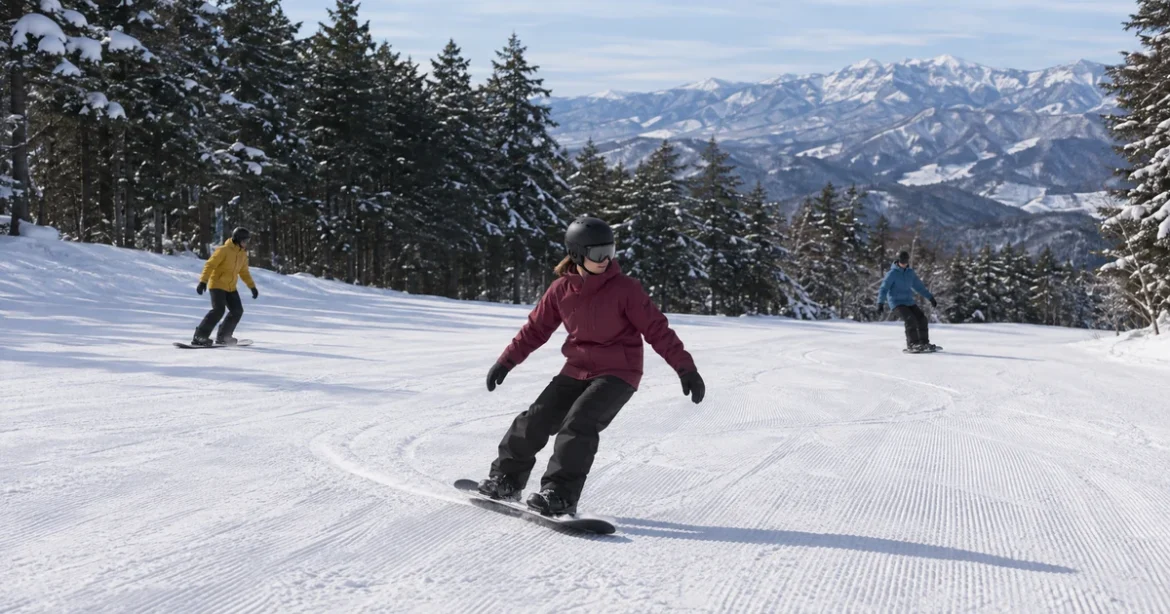
Ryuoo Ski Park works best when you separate three different plans: learning to snowboard, riding more demanding terrain, and visiting SORA terrace without skiing. They share a mountain, but not necessarily the same ticket, route or timetable. Mixed-ability groups should decide what each person will do and where they will meet before choosing accommodation and transport.
The planned 2026–27 ski season runs from December 5, 2026 to April 4, 2027, subject to snow and weather. One distinction matters especially for beginners: a gentle summit run does not establish an easy continuous descent to the base. The advanced Kiotoshi Bowl must not become a novice’s default route home.

Choose the main purpose of your day
- First-time snowboarders can consider the free introductory practice programme, while checking its dates and communication arrangements. Staff assistance is not the same as a private lesson in your language.
- Developing skiers and riders can plan around suitable open terrain such as Base, Mid or summit A, rather than linking difficult sections merely to achieve a long descent.
- Park and powder riders should account for the 2026–27 park relocation and the rules for advanced terrain.
- Non-skiers should use winter SORA terrace sightseeing arrangements, with tickets and mountain access planned separately from the skiing party.
Ryuoo is in Kita-Shiga and should not be treated as part of the interconnected Shiga Kogen ski area. If you are still choosing a Nagano base, compare the Nozawa Onsen ski resort guide for lesson bases, village stays and transport, then choose the arrangement that suits your group.
If you need a lift pass, snowboard and outerwear, compare the bundle against your dates, pickup point, sizes, deposit and refund terms. Do not assume it includes return buses, private lessons or skis instead of a snowboard.
2026–27 dates, day tickets and the IC-card deposit
The operating-hours and price page gives December 5, 2026–April 4, 2027 as the planned season. General daytime hours are listed as 08:15–17:00, with a 09:00 start on summit-only operating days. Individual lifts and facilities can have earlier closing times, so 17:00 is not a guaranteed final descent from the summit.
| Day-pass period | Adult weekday / weekend or holiday | Child weekday / weekend or holiday |
|---|---|---|
| Early season: opening through December 18, 2026 | ¥4,700 / ¥4,900 | ¥2,500 / ¥2,700 |
| Regular: December 19, 2026–March 22, 2027 | ¥6,000 / ¥6,200 | ¥3,000 / ¥3,200 |
| Spring: March 23, 2027 through season end | ¥4,700 / ¥4,900 | ¥2,500 / ¥2,700 |
Adults are junior-high-school age and above; the child category starts at age four and sits below that adult threshold. These day passes exclude night skiing. A ¥500 IC-card deposit is additionally required in cash. When comparing advance products, check whether the deposit is already included rather than mistaking different price presentations for a discount. Confirm return procedures and conditions when purchasing.
The night ticket is listed at ¥2,600 for adults and ¥1,600 for children, with a 17:00–20:00 session. Night skiing is neither daily nor full-mountain access. There are Sunday, Monday and holiday-end closures with exceptions. If night skiing is central to the trip, verify your exact date and operating lifts before committing to evening transport.
Use the piste map, with its limitations
Read the course and live-status page alongside the full Ryuoo course-map PDF. Credit: Ryuoo Ski Park. The PDF has no printed season and still depicts the older park arrangement, so it should not be labelled the latest 2026–27 map. The October 12, 2026 park notice takes precedence for those locations.
Base and summit A serve different decisions
The resort rates Base as beginner terrain, 400 metres long; summit A is also beginner-rated, at 1,370 metres. Mid is beginner-to-intermediate. Use these distinctions to discuss progression with an instructor. A first session near your meeting and rest facilities can be more useful than making the ropeway your first objective.
Before going higher, ask staff about the appropriate return route, whether downward ropeway travel is available and the final usable departure. If there is no suitable ski descent for your ability, follow the agreed return arrangement rather than entering Kiotoshi Bowl to reach the bottom. Wind and visibility can differ between the base and summit; change plans early if conditions deteriorate.
Kiotoshi Bowl and the new park layout
Kiotoshi Bowl is advanced ungroomed terrain, described by the resort as reaching 36 degrees. Helmets are mandatory in the Kiotoshi area. Wearing one does not make a difficult slope suitable for a beginner. Stay on appropriate open terrain and do not cross closures or use trees as an improvised shortcut.
The 2026–27 park announcement places Wavy Lines terrain park on Blue and moves the beginner park to BASE. Planned features include boxes, PVC rails and tabletops, with final items subject to updates. The BASE beginner park is unavailable during night skiing. “Beginner park” means introductory freestyle features, not a replacement for learning basic speed control.
Free snowboard introduction or a booked lesson?
The operator’s October 14, 2026 introductory-programme article schedules the free snowboard debut service for December 24, 2026–March 7, 2027, from 08:00 to 14:00, with no reservation planned. It covers attaching equipment, one-foot movement, side-slipping to stop and simulated lift practice. Staff support a practice area; this is not exclusive instruction for a full-mountain day.
The service begins later than the planned resort opening, so early-season learners need another arrangement. Free participation does not automatically include lift access, equipment, clothing or instruction in a particular language. Helmet lending is advertised for programme participants. Follow the day’s collection, identification, sizing and return instructions rather than assuming every visitor can borrow one without conditions.
For skiing, a chosen teaching language or more individual attention for a child, consult the recognised-school and lesson list. It includes English-information routes, but the school must confirm the actual date, instructor, minimum age and meeting location. Specify discipline, ability, language, duration and cancellation conditions when booking.
Rentals, lockers and a relevant Klook bundle
The facilities page lists SPICY Rental and changing and storage facilities in the Bus Information Center. THE BASE contains ticketing, school reception, dining and a second-floor children’s space. They are different facilities, so match your arrival point to your booked rental shop and lesson meeting point. A children’s space is not evidence of supervised childcare.
Gloves, knit hats and goggles are not offered for rental in the listing; bring them or plan to buy them. A full equipment photograph does not establish that every accessory is included. Try boots on carefully and leave time for adjustments, especially for children or unusual sizes.
If you need a pass, snowboard equipment and outerwear, compare the Klook Ryuoo lift-pass, snowboard and snow-wear bundle. An existing listing does not establish availability for your chosen 2026–27 dates. Check dates, pickup location, sizing, deposit treatment and refund conditions. Do not assume it includes round-trip buses, private instruction or ski equipment instead of a snowboard.
Carry some yen as well as electronic payment. The lift-price page requires cash for the IC deposit, and accepted methods vary between counters, storage and food outlets. Compare tickets, rentals, lessons, transport, meals and storage separately before deciding whether a bundle saves you money.
Nagano and Yudanaka transport: do not use the summer shuttle timetable
A rail plan can use Nagano Dentetsu from Nagano towards Yudanaka, followed by a winter connection arranged for your travel date. Consult Nagano Dentetsu’s Yudanaka station information and Ryuoo’s access page. Check train type, transfers and fares for the actual date; not every arrival will connect conveniently with mountain transport.
The resort access page still displays the green-season shuttle operating between April and November 8, 2026, with date-specific restrictions. Its departure times, last return and free-service conditions must not be carried over to winter. Confirm whether the winter vehicle serves the bus base or ropeway lower station, reservation requirements and equipment carriage before buying inflexible rail tickets.
For a ski bus from Tokyo, check the actual travel day and meeting point, daytime versus overnight departure, included rental shop and return assembly time. Road delays reduce time on the snow; the advertised day length is not guaranteed skiing time. Independent travellers should allow for equipment returns, changing, luggage collection and waiting. Night skiing, dinner and hot springs each need a workable evening connection.
Drivers should use the route from Shinshu-Nakano interchange with winter tyres and appropriate snow-road equipment. You cannot drive directly to SORA terrace. Follow winter parking and arrival instructions rather than assuming summer access photographs describe the ski-season approach.
Winter SORA terrace for non-skiers
Non-skiers can consider the snowy-buggy and SORA terrace sightseeing plan. A snow vehicle connects the Information Center to the ropeway lower station before the ropeway ascent. The planned period is December 19, 2026–March 22, 2027, at ¥5,500 for adults and ¥3,500 for children, including return buggy and ropeway travel. The operator states same-day counter reception, with snow and weather affecting operation.
This period differs from the full ski season, and an ordinary day ski pass does not automatically include the buggy trip. Mixed groups should agree on a shared lunch location, feasible mountain transfers and the final return rather than forcing everyone onto the same piste route. Warm clothing, gloves and grippy snow boots still matter because sightseeing involves snowy ground. Cloud seas and clear mountain views depend on conditions, not the ticket purchased.
Ryuoo Ski Park FAQ
1. When is the 2026–27 ski season?
The planned dates are December 5, 2026–April 4, 2027. Actual opening and available terrain depend on snow, weather and operational decisions.
2. Does a day pass include night skiing?
No. Check the night ticket and operating date separately; only specified lifts and slopes operate.
3. Can I pay the IC-card deposit entirely by card?
The current price page specifies a ¥500 cash deposit. Bring yen and check whether your advance product already includes it.
4. Does beginner-rated summit A mean an easy descent to the bottom?
No. Summit practice terrain and the route down are different questions. Agree on an appropriate return method before ascending.
5. Is a helmet compulsory in Kiotoshi Bowl?
The resort requires helmets in the Kiotoshi area. It remains advanced ungroomed terrain, unsuitable as a first descent.
6. Is the free debut programme available all season?
Its planned period is December 24, 2026–March 7, 2027, 08:00–14:00. Do not assume it operates during the rest of the ski season.
7. Can I use the BASE beginner park at night?
No. The 2026–27 relocation notice explicitly excludes night use of that park.
8. Does the linked Klook bundle include buses and a teacher?
The linked product is a lift-pass, snowboard and outerwear bundle. Do not add transport or private lessons to its stated inclusions.
9. Can I plan winter trains from the current Yudanaka shuttle table?
Not directly. The access page currently covers the green season through November 8, 2026. Confirm date-valid winter transport first.
10. Can non-skiers visit SORA terrace in winter?
The buggy-plus-ropeway sightseeing plan is an option during its stated period, subject to conditions. It is a separate product and does not guarantee a cloud sea.
A useful order for a first trip
Choose skiing, snowboard practice or sightseeing first. Then align lessons and group responsibilities with winter return transport, rental collection and the correct ticket. Beginners should aim for manageable practice and a reliable return; experienced riders should follow open terrain and the new park plan; non-skiers should use the winter sightseeing route. Keeping those decisions separate makes the shared day much easier to organise.