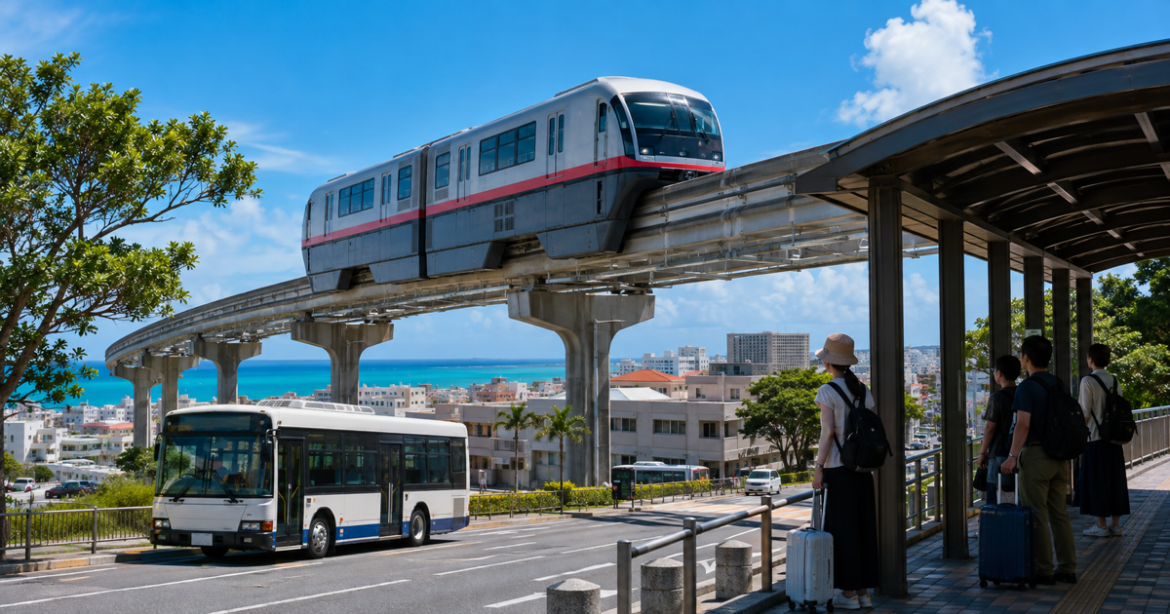

Okinawa Without a Car 2026: Yui Rail, Bus, Airport Shuttle & Day Tour Guide
Can you travel around Okinawa without renting a car? Yes—but the experience depends heavily on where you stay and what you want to see. Naha is extremely manageable without driving thanks to the Yui Rail monorail, buses, taxis and walkable sightseeing areas. Chatan, Onna Village, Motobu and Okinawa Churaumi Aquarium are also reachable by direct or semi-direct buses. The challenge begins when you try to combine several spread-out attractions, beaches and northern Okinawa stops in one day.
For most first-time visitors, the smartest car-free strategy is not to reproduce a rental-car itinerary using buses. Instead, stay somewhere with strong public transport, use Yui Rail for Naha, reserve direct shuttles for resort transfers, take a sightseeing tour for difficult northern routes such as Kouri Island, and use taxis only for short gaps. This usually produces a much easier trip than attempting three or four local-bus transfers every day.
If you are flying into Naha Airport, there is also no need to arrange a rental car immediately after landing. Yui Rail connects the airport directly with central Naha, while airport limousine buses and other shuttle services run toward Chatan, Onna, Nago and the Motobu area. Travelers carrying several suitcases, families with young children and groups can also compare a Naha Airport private transfer.
Can You Really Visit Okinawa Without a Car?
Yes, if you plan the trip around transport corridors rather than individual attractions. Okinawa Main Island does not have a JR railway network, Shinkansen or conventional intercity trains. The only rail system is the Yui Rail monorail, which serves Naha and continues east to Tedako-Uranishi. Everywhere beyond that corridor is reached mainly by bus, taxi, shuttle, tour bus or private vehicle.
This means Okinawa is very different from Tokyo, Osaka or Fukuoka. You cannot simply arrive at the nearest railway station and walk five minutes to every attraction. On the other hand, several of Okinawa’s most popular visitor areas have surprisingly usable direct transport from Naha.
| Area | Naha |
|---|---|
| How Easy Without a Car? | Very easy |
| Best Transport | Yui Rail, walking, local bus, taxi |
| Best Strategy | Stay near a monorail station and explore independently |
| Area | Shuri |
|---|---|
| How Easy Without a Car? | Easy |
| Best Transport | Yui Rail + walking or short bus/taxi |
| Best Strategy | Ideal half-day trip from central Naha |
| Area | Chatan / American Village |
|---|---|
| How Easy Without a Car? | Moderately easy |
| Best Transport | Direct shuttle or local bus |
| Best Strategy | Good as a half-day or evening trip |
| Area | Onna Village |
|---|---|
| How Easy Without a Car? | Moderately easy |
| Best Transport | Airport limousine bus, Okinawa Airport Shuttle, local bus |
| Best Strategy | Choose a hotel close to a major bus stop |
| Area | Nago |
|---|---|
| How Easy Without a Car? | Moderately easy |
| Best Transport | Express or local bus |
| Best Strategy | Useful northern transport hub |
| Area | Churaumi Aquarium / Motobu |
|---|---|
| How Easy Without a Car? | Moderately easy |
| Best Transport | Direct northbound bus, shuttle or day tour |
| Best Strategy | Very possible as one dedicated day trip |
| Area | Kouri Island |
|---|---|
| How Easy Without a Car? | Possible but inconvenient |
| Best Transport | Northern local shuttle, tour or private charter |
| Best Strategy | A tour is usually better if combining other sights |
| Area | Southern Okinawa attractions |
|---|---|
| How Easy Without a Car? | Possible |
| Best Transport | Local bus, sightseeing bus or tour |
| Best Strategy | Public bus works for one destination; tour works better for several |
| Area | Kerama Islands |
|---|---|
| How Easy Without a Car? | Easy with planning |
| Best Transport | Ferry from Naha |
| Best Strategy | One of the best car-free side trips from Naha |
| Area | Remote Yanbaru |
|---|---|
| How Easy Without a Car? | Difficult |
| Best Transport | Limited bus + taxi, tour or private charter |
| Best Strategy | Avoid an ambitious multi-stop public-transport itinerary |
Editor’s tip: A traveler spending three nights in Naha, one day at Churaumi Aquarium and one day on the Kerama Islands can have an excellent Okinawa trip without ever driving. A traveler hoping to visit Cape Manzamo, Kouri Island, Nakijin Castle, remote beaches and several cafés in one day will find public transport much less practical.
Where to Stay in Okinawa Without a Car
Your hotel location matters more in Okinawa than in most major Japanese cities. Saving a small amount on accommodation can be a false economy if the hotel sits far from the transport you need every morning.
| Base | Naha Airport / Akamine |
|---|---|
| Best For | Late arrivals, early flights |
| Main Advantages | Quick airport access by Yui Rail |
| Limitations | Less convenient for nightlife and central sightseeing |
| Editor’s Tip | Useful for a one-night airport stay rather than an entire vacation |
| Base | Asahibashi |
|---|---|
| Best For | Bus-heavy itineraries |
| Main Advantages | Yui Rail plus convenient access to Naha Bus Terminal |
| Limitations | Not the liveliest part of Kokusai-dori |
| Editor’s Tip | One of the strongest bases for travelers taking several day trips |
| Base | Kencho-mae |
|---|---|
| Best For | First-time visitors |
| Main Advantages | Near the western end of Kokusai-dori and direct Yui Rail access |
| Limitations | Some sightseeing areas still require walking |
| Editor’s Tip | A very balanced car-free location |
| Base | Miebashi |
|---|---|
| Best For | Kokusai-dori and Tomari Port |
| Main Advantages | Good access to central Naha and ferries |
| Limitations | Tomari Port is not directly beside the station |
| Editor’s Tip | Excellent if a Kerama Islands trip is part of your itinerary |
| Base | Makishi |
|---|---|
| Best For | Food, shopping and nightlife |
| Main Advantages | Excellent Kokusai-dori access |
| Limitations | Less convenient than Asahibashi for some long-distance buses |
| Editor’s Tip | Choose this if evening convenience matters most |
| Base | Chatan |
|---|---|
| Best For | Seaside atmosphere |
| Main Advantages | American Village, restaurants and sunset views close by |
| Limitations | No monorail; onward sightseeing depends on buses/taxis |
| Editor’s Tip | Good for travelers who want a resort feel without going far north |
| Base | Onna Village |
|---|---|
| Best For | Beach resort stay |
| Main Advantages | Excellent resort hotels and direct airport transport at selected stops |
| Limitations | Attractions and restaurants can be spread out |
| Editor’s Tip | Confirm the exact bus stop serving your hotel before booking |
| Base | Motobu |
|---|---|
| Best For | Churaumi and northern Okinawa |
| Main Advantages | Easy access to Ocean Expo Park and nearby northern sights |
| Limitations | Long transfer from Naha; fewer evening transport options |
| Editor’s Tip | Consider staying overnight rather than making repeated trips from Naha |
Naha Without a Car: Yui Rail Is the Backbone
Naha is the easiest part of Okinawa to explore without driving. Yui Rail runs from Naha Airport through central Naha and Shuri toward Tedako-Uranishi, with 19 stations across the full line. The end-to-end journey takes around 40 minutes.
From Naha Airport, the monorail reaches Asahibashi in roughly 11 minutes and Kencho-mae in about 13 minutes. These are two of the most useful stations for visitors staying around Kokusai-dori and the Naha Bus Terminal area. Omoromachi, convenient for shopping and hotels around Naha Shintoshin, takes roughly 19 minutes from the airport.
The regular fare from Naha Airport to central stations such as Asahibashi and Kencho-mae is inexpensive enough that a pass is not automatically necessary. For travelers making several monorail trips, however, the unlimited passes can be useful.
| Yui Rail Ticket | Regular one-way ticket |
|---|---|
| Adult Price | Varies by distance |
| Child Price | Varies by distance |
| Validity | Single journey |
| Best For | Travelers making only one or two rides |
| Yui Rail Ticket | 1-Day Ticket |
|---|---|
| Adult Price | ¥1,000 |
| Child Price | ¥500 |
| Validity | 24 hours from purchase |
| Best For | A full day of repeated sightseeing rides |
| Yui Rail Ticket | 2-Day Ticket |
|---|---|
| Adult Price | ¥1,800 |
| Child Price | ¥900 |
| Validity | 48 hours from purchase |
| Best For | Visitors using Yui Rail heavily over two consecutive days |
The 24- and 48-hour validity is useful because the clock starts when the ticket is purchased rather than simply ending at midnight. That can work well if, for example, you activate a pass after arriving in Naha in the afternoon and continue sightseeing the following morning.
Yui Rail also accepts major nationwide transportation IC cards such as Suica. Okinawa’s local OKICA card can also be used. Be careful not to assume that nationwide IC cards accepted by the monorail will automatically work on every Okinawa local bus; bus payment systems differ.
Yui Rail for Shuri Castle
For Shuri, take Yui Rail to Shuri Station. Shuri Castle Park is approximately a 15-minute walk from the station, depending on your pace and exact entrance. A short local bus or taxi can reduce the walking if you are traveling with children, seniors or in hot weather.
Editor’s tip: Yui Rail makes Naha an ideal arrival-day and departure-day destination. Even travelers renting a car for part of their Okinawa trip can often avoid paying for an unnecessary rental on the days spent entirely in Naha.
How to Use Okinawa Local Buses
The bus network is the key to traveling beyond Naha without driving, but it takes more planning than the rail networks found elsewhere in Japan. Four major operators provide a large network across Okinawa Main Island, and the same destination can sometimes be served by a fast express service, a slower local route and a tourist-oriented shuttle.
For route planning, Google Maps can be useful as a starting point, but travelers should also check Okinawa’s dedicated transport planners and the operator’s current timetable before departure. Bus travel times can change considerably with traffic, especially around Naha and major resort corridors.
Boarding and Paying on Local Buses
On many distance-based buses, passengers board at the front and take a numbered boarding ticket. The number corresponds to the fare zone shown on the display near the front of the bus. When leaving, check the displayed fare for your boarding number and pay at the front.
With an OKICA card, tap when boarding and again as required when exiting. Some flat-fare city services use a different payment procedure and charge when boarding.
If paying cash, carrying coins and ¥1,000 notes is sensible. Do not assume that every bus offers exactly the same cashless options. Tourist shuttles and airport buses may have their own ticketing or reservation systems.
Why Asahibashi Is Useful
Naha Bus Terminal is connected to the Asahibashi area, making this one of the best locations for a traveler planning multiple bus journeys. You can arrive from Naha Airport by monorail and then use the terminal for many onward routes.
Editor’s tip: Screenshot the Japanese and English name of your destination and the bus stop before leaving the hotel. When several bus routes use the same street, knowing the exact stop name is more useful than simply knowing the attraction name.
Naha Airport to Central Naha Without a Car
For most visitors, Yui Rail is the default choice between Naha Airport and central Naha. It avoids road congestion, runs directly from the airport and serves the main hotel areas around Asahibashi, Kencho-mae, Miebashi, Makishi and Omoromachi.
| Destination | Asahibashi / Naha Bus Terminal |
|---|---|
| Recommended Transport | Yui Rail |
| Approximate Journey Logic | Direct, about 11 minutes |
| Best For | Day-trip and bus-focused travelers |
| Destination | Kencho-mae / west Kokusai-dori |
|---|---|
| Recommended Transport | Yui Rail |
| Approximate Journey Logic | Direct, about 13 minutes |
| Best For | First-time visitors |
| Destination | Miebashi |
|---|---|
| Recommended Transport | Yui Rail |
| Approximate Journey Logic | Direct |
| Best For | Central Naha and Tomari-area stays |
| Destination | Makishi / east Kokusai-dori |
|---|---|
| Recommended Transport | Yui Rail |
| Approximate Journey Logic | Direct |
| Best For | Shopping and dining |
| Destination | Hotel far from a station |
|---|---|
| Recommended Transport | Taxi or private transfer |
| Approximate Journey Logic | Door-to-door |
| Best For | Heavy luggage, groups and late arrivals |
For four or five travelers, the convenience of a taxi or pre-booked Naha Airport transfer may outweigh the savings from public transport, particularly if the hotel is not close to a monorail station.
Naha Airport and Naha to Chatan Without a Car
Chatan and American Village are popular car-free destinations because they are far enough from Naha to feel different but still served by direct and local transport. There is no railway station in Chatan, so the trip is entirely road-based.
Direct airport-to-Chatan shuttle services operate toward the Chatan Gateway area, and selected services also connect central Naha or the Kokusai-dori area with Chatan. Depending on the service and traffic, allow roughly an hour from Naha Airport or central Naha.
Local buses are another option. Route 120, for example, travels from Naha Airport north through areas including Chatan, Kadena, Yomitan and Onna before continuing toward Nago. It is useful for travelers who value flexibility and low cost rather than speed.
Who Should Use the Direct Chatan Shuttle?
Choose a direct shuttle if American Village is your main destination and you do not want to learn the local bus system. It is particularly attractive for visitors transferring directly from the airport to a Chatan hotel.
Who Should Use a Local Bus?
Choose a local bus if your accommodation sits conveniently along a route, you are not rushing, or you have a bus pass that covers the service you plan to use.
Editor’s tip: American Village works well as an afternoon-to-evening excursion. Travel from Naha after lunch, explore the waterfront and shops, stay for sunset and dinner, then return to Naha. Check your return bus before settling in for the evening rather than assuming buses run as frequently as city trains.
Naha Airport to Onna Village Without a Car
Onna Village is one of Okinawa’s main resort corridors, and it is entirely possible to stay there without driving if you choose your hotel carefully. The key is to select accommodation served directly by an airport limousine or shuttle stop.
The Airport Limousine Bus links Naha Airport with major resort hotels in central and northern Okinawa. Tickets and boarding procedures differ from ordinary local buses, and seats can be limited, so treat it as a reserved airport-transfer service rather than simply walking up with the same expectations as a city bus.
The Okinawa Airport Shuttle also connects Naha with the Onna, Nago and Motobu corridors. Stops include several useful west-coast locations, although not every service follows exactly the same stopping pattern. Faster services may skip some intermediate resort stops.
Route 120 provides a slower local-bus alternative from Naha Airport through Chatan and Onna toward Nago. This can be economical but is less comfortable for travelers with large luggage and takes longer because of frequent stops.
| Option | Airport Limousine Bus |
|---|---|
| Best For | Resort hotel guests |
| Advantages | Luggage-friendly and direct to selected hotels |
| Disadvantages | Fixed stops and schedule; advance ticketing may be required |
| Option | Okinawa Airport Shuttle |
|---|---|
| Best For | Travelers near a shuttle stop |
| Advantages | Connects airport, Onna, Nago and Motobu corridor |
| Disadvantages | Stopping pattern varies by service |
| Option | Local Bus 120 |
|---|---|
| Best For | Budget travelers |
| Advantages | Serves many communities along the west coast |
| Disadvantages | Slower and less convenient with luggage |
| Option | Private Transfer |
|---|---|
| Best For | Families and groups |
| Advantages | Door-to-door and no transfers |
| Disadvantages | Higher cost |
Editor’s tip: Before booking an Onna hotel without a car, check three things: the nearest airport-bus stop, the walking distance to restaurants, and how you will reach any beaches or attractions you want to visit. Two hotels that look close on a map can feel very different once you discover that the road between them is not pleasant to walk.
Naha to Churaumi Aquarium Without a Car
Okinawa Churaumi Aquarium is far from central Naha, but it is one of the easier major northern attractions to reach without driving because several long-distance services target the Motobu and Ocean Expo Park area.
Option 1: Okinawa Airport Shuttle
The Okinawa Airport Shuttle runs from Naha toward Onna, Nago, Motobu and Okinawa Churaumi Aquarium. Depending on the exact departure and stopping pattern, a journey between the Naha side and Churaumi can take roughly two to three hours.
This is a strong choice for independent travelers who want to spend most of the day at Ocean Expo Park rather than visit many separate northern attractions.
Option 2: Highway Bus 117
Route 117 is a highway bus linking the Naha Airport side with Nago and Okinawa Churaumi Aquarium. It is one of the useful direct northbound options for travelers whose priority is reaching the aquarium rather than stopping frequently along the coast.
Note that Route 117 is specifically excluded from the Okinawa route-bus tourist pass discussed later in this guide. Buying an unlimited local-bus pass does not mean every bus to northern Okinawa is covered.
Option 3: Yanbaru Express
Yanbaru Express services connect Naha Airport with northern Okinawa and the Motobu/Nakijin corridor, including services useful for the Churaumi area. The exact stops and timetable should be checked for your travel date, particularly if you are continuing beyond the aquarium toward Nakijin or Unten.
Option 4: Guided Day Tour
A tour becomes much more attractive when you want to combine Churaumi with Kouri Island, Cape Manzamo, Bise or American Village. Public transportation can reach many of these places individually, but connecting all of them efficiently in a single day is difficult.
One option is a Churaumi Aquarium, Kouri Island and American Village day tour. The value is not merely having transportation; it is eliminating several separate timetable connections.
| Churaumi Option | Okinawa Airport Shuttle |
|---|---|
| Best For | Independent aquarium visit |
| Main Advantage | Direct northbound tourist corridor |
| Main Drawback | Long journey and fixed return times |
| Churaumi Option | Bus 117 |
|---|---|
| Best For | Direct highway-bus users |
| Main Advantage | Fast route logic compared with local stopping buses |
| Main Drawback | Not covered by the standard Okinawa route-bus pass |
| Churaumi Option | Yanbaru Express |
|---|---|
| Best For | Motobu / Nakijin itineraries |
| Main Advantage | Useful northbound network |
| Main Drawback | Requires careful stop and timetable planning |
| Churaumi Option | Guided day tour |
|---|---|
| Best For | Multiple northern sights |
| Main Advantage | Most efficient multi-stop solution |
| Main Drawback | Less freedom over how long you stay at each place |
| Churaumi Option | Private charter |
|---|---|
| Best For | Families and small groups |
| Main Advantage | Flexible door-to-door itinerary |
| Main Drawback | Highest cost |
Editor’s tip: If Churaumi Aquarium is the only major northern attraction you care about, use a direct bus and travel independently. If your wish list also includes Kouri Island and two or three other stops, a tour often gives you substantially more sightseeing time.
Kouri Island Without a Car
Kouri Island is possible by public transport, but this is where the limitations of a car-free Okinawa itinerary become more obvious. A northern local service connects the Nakijin area with Kouri Island and serves destinations around the island, but departures are much less frequent than urban transport.
That means the issue is not whether a bus exists. The issue is whether the available timetable allows you to visit Kouri Island, Churaumi Aquarium, Nakijin Castle and other northern stops on the same day without spending a large part of your trip waiting.
For travelers starting from Naha, a northern Okinawa day tour from Naha is therefore often the better car-free choice.
If you prefer your own pace, another solution is a private car charter in Okinawa. This costs more than a tour bus but allows a family or group to choose its stops and avoid repeated public-transport connections.
Southern Okinawa Without a Car
Southern Okinawa contains major attractions such as Okinawa World, the Peace Memorial Park area, coastal viewpoints and historical sites. Individual destinations can be reached by bus, but sightseeing becomes progressively less efficient as you add more stops.
If you want to visit only one attraction, such as Okinawa World, public transport from Naha is reasonable with a properly planned timetable. If you want to combine Okinawa World, historical war memorials, a sacred site and a coastal attraction in a single day, a scheduled sightseeing bus or guided tour is usually more practical.
This is an important difference between Okinawa and railway-oriented regions of Japan: two attractions can look geographically close but still require returning to a main road or transport hub before moving between them.
Kerama Islands Without a Car: One of the Best Car-Free Day Trips
The Kerama Islands are an excellent example of a destination where not having a car is barely a disadvantage. Ferries leave the Tomari port area in Naha for islands including Tokashiki, Zamami and Aka.
High-speed services can reach Tokashiki in around 35–40 minutes and Zamami in roughly 50–70 minutes, while conventional ferries take longer. Sailing times vary by island, vessel and service.
Once on the islands, local buses, taxis, rental bicycles and walking can be used depending on the island and beach you are visiting. For a first visit, choose one island rather than trying to island-hop aggressively on a day trip.
| Island | Tokashiki |
|---|---|
| Typical Fast-Ferry Journey from Naha | About 35–40 minutes |
| Good For | Beach-focused day trip |
| Car-Free Tip | Coordinate ferry arrival with local beach transport |
| Island | Zamami |
|---|---|
| Typical Fast-Ferry Journey from Naha | About 50–70 minutes |
| Good For | Beaches, village atmosphere, overnight stay |
| Car-Free Tip | Works well as a full-day or overnight trip |
| Island | Aka |
|---|---|
| Typical Fast-Ferry Journey from Naha | About 50 minutes on suitable express sailings |
| Good For | Quieter island experience |
| Car-Free Tip | Study onward transport before arrival |
Weather, sea conditions and vessel maintenance can affect ferry operations. Always check your exact outbound and return sailing before leaving your accommodation, especially if you have a flight later the same day.
Editor’s tip: Staying around Miebashi or the western-central side of Kokusai-dori makes Tomari easier to reach while keeping you close to Yui Rail and Naha’s restaurants.
Okinawa Bus Passes: Are They Worth It?
The main visitor-oriented Okinawa route-bus pass offers unlimited travel on eligible local routes operated by the major participating bus companies on Okinawa Main Island. It can save money for a bus-heavy itinerary, but it is not a universal Okinawa transport pass.
The most important restriction is that express highway routes 111 and 117, airport limousine buses and scheduled sightseeing buses are excluded. This matters because some of the fastest and most convenient services for visitors fall into those categories.
You can compare and purchase the visitor pass through the Okinawa Bus Pass for tourists.
| Pass | 1-Day Okinawa Route Bus Pass |
|---|---|
| Adult Price | ¥2,900 |
| Child Price | ¥1,450 |
| Best For | A day with several eligible long local-bus rides |
| Pass | 3-Day Okinawa Route Bus Pass |
|---|---|
| Adult Price | ¥5,800 |
| Child Price | ¥2,900 |
| Best For | Travelers using eligible local buses extensively over several days |
| Pass | 1-Day Route Bus + Yui Rail Pass |
|---|---|
| Adult Price | ¥3,500 |
| Child Price | ¥1,750 |
| Best For | A bus-intensive day that also includes Naha monorail travel |
| Pass | 3-Day Route Bus + Yui Rail package |
|---|---|
| Adult Price | ¥6,400 |
| Child Price | ¥3,200 |
| Best For | Multi-day bus travel plus Naha monorail use |
When the Okinawa Bus Pass Is Worth Buying
- You plan several substantial rides on eligible local routes.
- You are sightseeing independently across central and southern Okinawa.
- Your accommodation and attractions sit directly on participating local-bus routes.
- You prefer predictable transport spending rather than paying each fare separately.
When the Okinawa Bus Pass Is Not Worth Buying
- You are staying mainly in Naha and using Yui Rail.
- You need Route 111 or Route 117 for fast northbound travel.
- You primarily use airport limousine buses.
- You are joining organized sightseeing tours.
- Your itinerary contains only one or two paid bus rides per day.
Editor’s tip: Choose your itinerary first and the pass second. Do not buy an unlimited pass and then design a slower itinerary simply because you feel obligated to use it.
Yui Rail Pass or Okinawa Bus Pass?
| Your Itinerary | Best Ticket Strategy |
|---|---|
| Airport + Kokusai-dori + Shuri | Regular Yui Rail fares or 1-Day Yui Rail Ticket depending ride count |
| Two sightseeing days entirely in Naha | 2-Day Yui Rail Ticket if you expect frequent rides |
| Naha + several eligible local-bus excursions | Consider the bus + monorail package |
| Naha + direct Route 117 trip to Churaumi | Pay separately; Route 117 is excluded from the route-bus pass |
| Airport + Onna resort | Airport limousine/shuttle ticket rather than a local-bus pass |
| Churaumi + Kouri + multiple northern attractions | Day tour or private charter |
| Kerama Islands day trip | Yui Rail/local Naha transport + ferry ticket |
Day Tour, Private Charter or Public Bus?
Travelers sometimes treat organized transport as a compromise. In Okinawa, it can be the opposite. A well-designed day tour can produce more actual sightseeing time because it removes long waits and awkward transfers between rural attractions.
Choose Public Transport If…
- You enjoy independent travel and do not mind checking timetables.
- You plan only one or two major destinations each day.
- You are staying near a major bus or monorail stop.
- Your trip focuses on Naha, Chatan, Churaumi or the Kerama Islands.
Choose a Guided Day Tour If…
- You want to combine Churaumi Aquarium and Kouri Island in one day.
- You want three or more northern Okinawa stops.
- You would rather spend your time sightseeing than waiting for connecting buses.
- You are a first-time visitor and do not need complete schedule freedom.
Choose a Private Charter If…
- You are traveling with young children or seniors.
- Your group can divide the charter cost among several people.
- You have a custom list of rural attractions.
- You need door-to-door transportation.
- You want flexibility over rest stops and meal times.
For families, the difference can be particularly significant. A direct private vehicle may cost more on paper, but avoiding repeated luggage handling, waiting at exposed bus stops and waking children for transfers can make the overall trip much easier.
Suggested Okinawa Without-a-Car Itineraries
3-Day Car-Free Okinawa: Naha + Churaumi
Day 1: Arrive at Naha Airport, take Yui Rail to your hotel, explore Kokusai-dori and central Naha.
Day 2: Take a direct northbound bus to Okinawa Churaumi Aquarium. Spend enough time at Ocean Expo Park rather than trying to add several complicated bus connections.
Day 3: Use Yui Rail for Shuri and central Naha before returning to the airport.
Best for: First-time visitors who want the major highlights without rushing.
4-Day Car-Free Okinawa: Add the Kerama Islands
Day 1: Naha and Kokusai-dori.
Day 2: Churaumi Aquarium by direct bus.
Day 3: Ferry from Tomari to Tokashiki or Zamami for a full-day island trip.
Day 4: Shuri, shopping and departure.
Best for: Travelers who prioritize ocean scenery and want to avoid complicated rural bus travel.
5-Day Car-Free Okinawa: Naha + Northern Tour + Chatan
Day 1: Airport to Naha by Yui Rail.
Day 2: Naha sightseeing and Shuri.
Day 3: Join a northern day tour combining Churaumi, Kouri Island and other west/north-coast attractions.
Day 4: Travel independently to Chatan in the afternoon, stay for sunset and dinner at American Village.
Day 5: Shopping or a relaxed Naha morning before flying home.
Best for: Visitors who want variety without needing to understand the entire bus network.
5-Day Resort Itinerary: Naha + Onna Village
Spend the first two nights in Naha, then transfer directly to an Onna Village resort using an airport limousine or shuttle service. Stay two nights at a resort where the beach, restaurants and facilities can be enjoyed without daily transport. Return directly to Naha Airport by limousine or pre-booked transfer.
Best for: Couples, families and travelers who want both city sightseeing and beach time.
Traveling with Luggage Without a Car
Large luggage changes the best transport choice. Yui Rail is straightforward, but local buses with many stops can be awkward when crowded. Tourist shuttles, airport limousine buses and private transfers are generally more luggage-friendly.
- Naha hotel near Yui Rail: use the monorail.
- Onna resort: prioritize a direct limousine or shuttle stop.
- Chatan hotel: look for a direct airport/Chatan shuttle.
- Motobu stay: use a direct northbound service rather than chaining several local buses.
- Hotel not near public transport: consider a taxi for the final segment.
If changing hotels, do not automatically carry every suitcase through a full sightseeing day. Ask whether your current hotel can hold your luggage after checkout, whether your next hotel accepts forwarded luggage, or whether a door-to-door transfer makes more sense.
Okinawa Without a Car for Families and Senior Travelers
Families and senior travelers can absolutely visit Okinawa without driving, but minimizing transfers is more important than minimizing fares.
In Naha, hotels close to Yui Rail stations are the easiest choice. For a resort stay, choose a hotel directly served by an airport limousine. For Churaumi Aquarium and Kouri Island, a guided tour or private charter can be far less tiring than negotiating several buses.
Also factor in Okinawa’s weather. Walking 15 minutes between a hotel and a bus stop can feel easy on a map but much harder in strong sun, humidity, heavy rain or while pushing a stroller.
Editor’s tip: When comparing two hotels, treat “direct bus stop at the hotel” as a real amenity. For a car-free family itinerary, it can be more valuable than saving a small amount per night.
What to Do If You Arrive at Naha Airport Late at Night
If your flight arrives late, check the Yui Rail timetable for your exact date before assuming you can take the monorail. The last service is not something to plan around tightly after immigration, baggage collection and a delayed flight.
If you miss practical public transport, use a taxi or pre-arranged Naha Airport transfer. For an overnight arrival, staying in Naha is generally much simpler than attempting an immediate late-night transfer to a distant northern resort.
Common Mistakes to Avoid
- Planning Okinawa like Tokyo. There is no island-wide rail network, so attractions that look close can require substantial bus travel.
- Booking a remote hotel without checking its bus stop. A low hotel rate can become inconvenient if every excursion starts with a taxi.
- Trying to visit too many northern attractions by local bus. Churaumi alone is straightforward; Churaumi plus Kouri plus several rural stops is a different challenge.
- Buying the bus pass before checking exclusions. Routes 111 and 117, airport limousine buses and scheduled sightseeing buses are not covered by the standard Okinawa route-bus pass.
- Assuming Suica works everywhere. Nationwide IC cards are convenient on Yui Rail, but local-bus payment systems vary.
- Ignoring traffic. Road transport can run late, so avoid tight bus-to-flight or bus-to-ferry connections.
- Forgetting the return journey. Rural buses are less frequent in the evening. Check your last practical return before beginning the day.
- Choosing the cheapest transport for every journey. One well-placed shuttle, taxi or day tour can save several hours of waiting.
Okinawa Without a Car FAQ
What is the best way to get around Okinawa without a car?
Use a combination of Yui Rail in Naha, direct buses and shuttles for Chatan, Onna and Churaumi, ferries for the Kerama Islands, and guided tours for complicated multi-stop northern itineraries. There is no single transport mode that works best for the entire main island.
Does Okinawa have JR trains?
No. Okinawa Main Island has no JR railway, Shinkansen or conventional intercity train network. Yui Rail is the main rail service and operates between Naha Airport, central Naha, Shuri and Tedako-Uranishi.
Can I use Suica or another Japanese IC card in Okinawa?
Major nationwide IC cards such as Suica can be used on Yui Rail. Do not assume they are accepted on all local buses. OKICA is Okinawa’s local transport IC card and is used on participating local transport.
Is Okinawa’s bus pass worth it?
It can be worthwhile if you plan several rides on eligible local buses. It is less useful if your itinerary relies mainly on Yui Rail, Route 117, airport limousine buses or sightseeing tours. The Okinawa Bus Pass is best purchased after checking that your planned routes are covered.
Can I get from Naha to Churaumi Aquarium without a car?
Yes. Direct or near-direct northbound options include the Okinawa Airport Shuttle, highway bus services and Yanbaru Express services. Allow a substantial portion of the day for the return journey. If you also want Kouri Island and several additional sights, a guided day tour is usually easier.
Can I visit Kouri Island without a car?
Yes, but the limited northern local-bus schedule makes it harder than visiting Churaumi Aquarium. Independent travel works if Kouri is a major focus and you plan around the timetable. For a multi-stop northern sightseeing day, a tour or private charter is more efficient.
Is Chatan easy without a car?
Reasonably easy. Direct Chatan shuttles and local buses connect it with Naha Airport and central Naha. Once you reach the American Village area, many restaurants, shops and waterfront attractions are walkable.
Can I stay in Onna Village without renting a car?
Yes, especially at a resort directly served by an airport limousine or shuttle. Check how far the hotel is from restaurants and any attractions you want to visit, because the Onna coast is spread out.
What is the best Okinawa base if I do not drive?
Naha is the strongest all-around base. Asahibashi is particularly convenient for buses, while Kencho-mae, Miebashi and Makishi work well for Kokusai-dori. Chatan is a good alternative for a seaside atmosphere, while an Onna resort works if you intend to spend more time at the hotel.
Is Okinawa worth visiting without a car?
Yes. A car is useful but not essential. Naha, Shuri, Chatan, Churaumi Aquarium and the Kerama Islands can all fit naturally into a car-free trip. The key is to avoid building an itinerary that depends on moving rapidly between many remote attractions.
Final Verdict: The Best Okinawa Without-a-Car Strategy
Okinawa without a car works best when you stop thinking of public transport as a direct replacement for a rental car. Use each mode where it is strongest.
Stay near Yui Rail in Naha. Use the monorail for airport transfers and city sightseeing. Take a direct shuttle or airport limousine when moving to Chatan or an Onna resort. Use a northbound bus when Churaumi Aquarium is your main destination. Take the ferry for a Kerama Islands day trip. And when you want to combine Kouri Island, Churaumi, Cape Manzamo and several other scattered attractions, use a guided tour or private vehicle rather than losing half the day to connections.
That approach gives car-free travelers the best balance of cost, flexibility and sightseeing time—and makes Okinawa a much easier destination than its car-dependent reputation suggests.