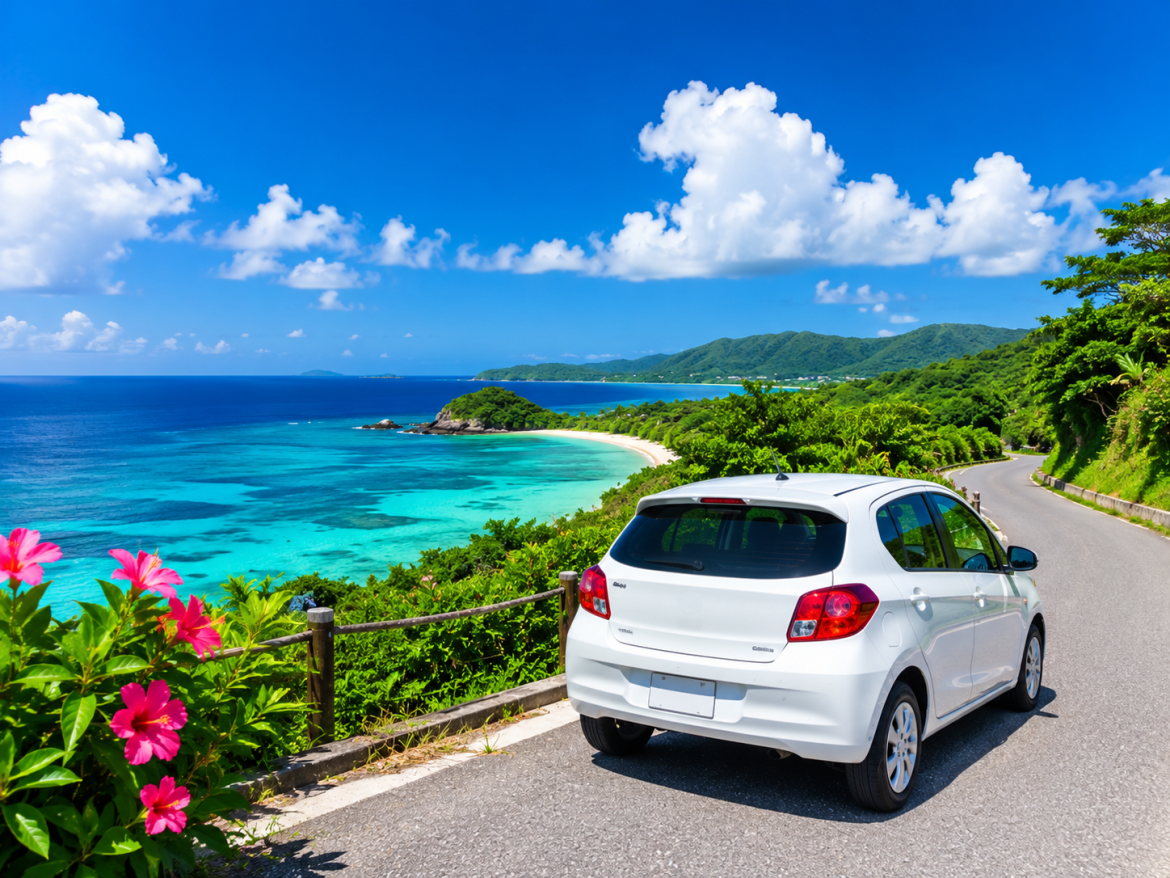

Rent for Ishigaki’s coast, then plan ferry days separately
A car is useful for the scattered sights of Ishigaki: Kabira Bay, Tamatorizaki Observatory, Hirakubozaki, Yonehara and Cape Oganzaki. It makes a coastal day easier than connecting several infrequent buses, particularly with children, older relatives or beach equipment. It does not mean you should drive to every corner in one day.
Choose your hotel and island-hopping days before the rental dates. Our Ishigaki accommodation guide compares areas in Traditional Chinese. A day spent on Taketomi, Iriomote or Kohama often leaves an Ishigaki rental parked at the port, incurring both rental and parking charges.
At Painushima Ishigaki Airport, most rentals involve a shuttle from the general parking area to an office nearby. It is not normally a car handover in the arrivals hall. Bring the driving documents valid for your licence’s issuing jurisdiction and register every driver.
Start with the Ishigaki itinerary guide, also in Traditional Chinese, then reserve the days when you will actually explore the island.
Compare Ishigaki rental options
Is a rental car worthwhile?
| Your itinerary | Practical choice |
|---|---|
| Kabira Bay, western coast and northern viewpoints | Rent for one or two focused driving days, rather than rushing every cape |
| Resort outside town | A car may be useful; compare any confirmed hotel transfers |
| Ferry trips to other Yaeyama islands | Usually arrange transport on the destination island instead |
| Town, market and ferry terminal only | Walking, buses, taxis or tours may be sufficient |
| Family or mobility needs | Driving reduces transfers, but check seats, luggage and walking at each stop |
| Late arrival or early departure | Match branch hours and transfers; avoid paying for an unusable rental period |
For a typical mixed trip, one day around Kabira and the west plus another around Tamatorizaki and the north is a comfortable starting point. A remote resort stay may justify more rental days. Travelers who dislike left-side driving or want everyone to drink at dinner should consider a private driver, sightseeing bus or taxi plan.
An ETC card is not a priority for ordinary Ishigaki sightseeing, which uses normal island roads. Pickup formalities, fuel, the return shuttle and insurance conditions are more important planning details.
Prepare the correct licence documents
Rules depend on the licence-issuing jurisdiction, not just passport nationality. Check the National Police Agency requirements before paying for a rental.
| Licence route | Bring |
|---|---|
| Japanese licence | Valid original licence and supplier-required identification/payment documents |
| Eligible 1949 Geneva Convention IDP | Original valid IDP, passport and original domestic licence as required by the supplier; a 1968-only permit is not sufficient |
| Taiwan, Switzerland, Germany, France, Belgium or Monaco | Valid original licence, authorized Japanese translation and passport |
| Every additional driver | The same complete documents and registration at collection |
Taiwan-issued IDPs do not replace the licence-and-translation route. Hong Kong licence holders generally use a qualifying 1949 IDP. Neither a phone photo nor a self-made translation replaces the required originals. In general, driving is permitted for the shorter of one year after entry and document validity; Japan-registered residents have special rules when re-entering after less than three months abroad. Bring entry-date evidence if requested, including after automated immigration.
Do not leave the translation until pickup day
Arrange a legally accepted translation through an eligible route with sufficient time. JAF’s direct online application is accepted only from within Japan, so it is not a last-minute overseas application or instant airport service. As, its temporary-driving translation for the six eligible jurisdictions remains ¥6,000; the ¥6,600 fee introduced on 1 July 2026 applies to licence-conversion translations. Processing and printing still take time.
Check age, licence tenure, vehicle-class restrictions and whether the main driver’s own credit card is required. Save the booking, branch name, address, phone number and meeting-point instructions. A paid reservation cannot make incomplete documents acceptable.
Choose the exact company and branch
Branch details below were. Hours are not a guarantee that every flight arriving before closing can be served. Confirm the final shuttle, latest accepted arrival and delay procedure for your booking.
| Company | Useful branch detail | Important limit |
|---|---|---|
| Toyota | Ishigakijima Airport office lists 08:00–19:00 and an airport shuttle | Its listing says one-way returns are not possible |
| ORIX | Ishigaki Airport Yuna office lists 08:00–19:00 | Eligible one-way rentals are within Ishigaki only, with exceptions; other branches may differ |
| Nippon Rent-A-Car | Ishigaki Airport office lists 08:00–20:00 and flight-linked shuttle pickup | No one-way returns from other offices; the separate Ishigakijima town office is listed as closed |
| Nissan | An island rental option to compare by actual branch and package | Confirm current hours and whether the chosen package supports advance or self-service procedures |
| OTS | Ishigaki Airport branch lists 08:00–19:00 with airport transfers | Its branch information says no port transfer; check protection and pickup details |
| Local suppliers | May offer a different vehicle selection or pickup arrangement | Check genuine office details, assistance, transfer coverage and written terms rather than a headline price |
Consult the actual Toyota airport listing, ORIX Yuna branch, Nippon airport office and OTS branch information. Some pages are in Japanese or Traditional Chinese.
Times is another daytime option: its Ishigaki Airport office lists 09:00–19:00 through 31 October 2026, 09:00–18:00 from 1 November, and 09:00–17:00 from 28 December to 3 January. It does not offer out-of-hours pickup or return. A later-closing supplier is useful only if it confirms your actual arrival is acceptable.
Do not board the first shuttle carrying a familiar brand. Match the branch on your voucher. If a late flight cannot be accommodated, go to your hotel and collect the next day through a confirmed branch arrangement; do not assume the closed Nippon town office is available.
Compare the total cost, not the daily headline
Rental prices change with dates, holidays, vehicle class, length of hire and available stock. Summer, Golden Week and other busy holiday periods are reasons to book early, especially for family cars and child seats. There is no fixed cheapest company for the entire year.
Use the Ishigaki rental comparison page with matching pickup/return times, driver age and car class. Then compare base rent, mandatory charges, CDW, NOC protection, assistance, child seats, additional-driver rules, mileage, fuel, parking and any permitted one-way charge.
Check how the period is calculated: calendar days and 24-hour blocks can produce different totals. Read cancellation, no-show and flight-disruption conditions before payment. A low base rate without the protection or transfer you need is not necessarily good value.
Basic cover, CDW and NOC are different
Basic compensation
The rental normally includes specified liability and damage protection, but limits and deductibles still apply. Read the actual agreement rather than assuming every car has the same terms.
CDW or deductible waiver
This addresses eligible accident deductibles. It may not cover tyres, wheels, interior soiling, wrong fuel, lost keys or all towing costs. Toyota’s insurance guide is one supplier-specific example of these distinctions.
NOC waiver
NOC is the supplier’s loss-of-use charge while a car cannot be rented following damage or another covered incident. CDW does not automatically waive it. Look for an explicit NOC waiver or the equivalent benefit and its exclusions.
Before leaving the office
Confirm glass, tyre, wheel, underside and roadside-assistance limits, and save the emergency procedure. Following a scrape or collision, stop safely, obtain help for injuries, contact police and the rental company, and document the scene. Do not privately settle and drive away. Unregistered driving, alcohol, prohibited roads or failure to report may affect protection.
Airport pickup: where to go
The airport’s official shuttle map places rental-car shuttles inside the general parking area in front of the domestic terminal. Cross at the pedestrian crossing facing the domestic terminal’s central entrance. International arrivals should exit and head right toward that crossing. The neighboring hotel-bus area is a different pickup zone.
- Collect all baggage and check whether the voucher asks you to call first.
- Go to the correct rental shuttle area and identify your company and branch.
- Take the transfer to the rental office.
- Present every driver’s documents and required payment card.
- Confirm protection, seats, fuel and return rules.
- Inspect and photograph the car with staff, including wheels, glass, roof, interior, fuel and mileage.
- Ask staff to record existing marks, learn the controls and set the first destination before moving.
A short shuttle drive does not equal a short pickup process. As a planning allowance, leave around 45–60 minutes after baggage collection, or 60–90 minutes or more during busy periods or with a larger group. Queues, paperwork and seat fitting can take longer; avoid a tightly timed activity straight after landing.
Return the car before heading to the terminal
- Confirm the exact return office, opening hours and final airport shuttle.
- Remove belongings, rubbish and beach sand.
- Refuel according to the contract and retain the receipt.
- Return to the agreed office, not the terminal curb.
- Allow time for inspection, payment and any questions about the vehicle.
- Take the shuttle and reach the correct airline’s check-in area.
Work backward from your airline’s required terminal-arrival time, adding refueling, the drive to the office, inspection, payment, shuttle waiting and travel. A blanket two- or three-hour pre-flight rule is not a guarantee. An international flight, crowded period or complex luggage arrangement may require a much earlier office arrival.
For an early flight, check whether branch opening and the first transfer are early enough. Returning the previous evening may be more practical. Never assume you can leave keys in the car, use an unattended drop box or deliver the vehicle directly to the airport.
Which car size works?
| Group | Starting point | Check |
|---|---|---|
| 1–2 people, light luggage | Kei or compact | Two large cases may already use most of the boot |
| 2–3 people and cases | Compact hatchback | Stroller or snorkel equipment changes the calculation |
| Four-person family | Estate, medium car, compact SUV or MPV | Space with child seats fitted |
| 5–7 people | Van/MPV or two cars | Remaining boot space with all rows in use; qualified drivers |
| A photo-focused couple | An ordinary compact is a practical choice | Convertibles add sun, rain and luggage trade-offs |
Five seats do not mean five travelers and five large suitcases. Ask for the actual luggage capacity and do not plan to carry unsecured bags on laps. An SUV is not required for normal sightseeing and does not make sand, private land or rough tracks permissible.
Traveling with children
Children under six must use an appropriate child restraint. Reserve the correct type using age, height and weight. Older children may also need a suitable booster for an adult belt to fit safely. Check installation and routing at pickup, even if staff have fitted the seat.
- Count child seats, stroller and beach equipment in the space calculation.
- Do not assume three seats fit across a small rear bench.
- Reserve required equipment early; availability is not guaranteed.
- Never leave a child in a parked car.
- Break long journeys for toilets and rest, rather than using every nap for another long drive.
Kabira Bay, a cultural stop such as Ishigaki Yaima Village and one beach can make a more enjoyable family day than several capes and the entire northern coastline.
Traveling with older relatives
A car can reduce bus changes, but the daily distance still matters. Check the walk from each car park to the actual viewpoint, the terrain, toilets and available rest stops. A car park beside an attraction does not establish step-free access.
Choose an easy seat height and door opening, and confirm room for a wheelchair or walking aid if needed. Plan breaks roughly every hour to hour and a half as a starting point, with more whenever anyone needs them. Avoid a long northern return after dark, and keep a backup lunch option in less populated areas.
Realistic first-time driving routes
Use these as suggested sequences, not timetables. Check the day’s weather, local sunset, attraction hours and the drive back to your hotel. If you want to avoid night driving, leave the final remote stop early enough to complete the return before dark; watching sunset there necessarily changes that plan.
West-coast half day
After an early lunch and town pickup, choose Yaima Village or another western stop, then Kabira Bay. Add Cape Oganzaki only if there is sufficient daylight and everyone is comfortable with the return. For a short winter afternoon, omit the cape rather than chasing a fixed 18:30 return time.
A Kabira Bay glass-bottom boat is an option for travelers who prefer to stay out of the water. Check the chosen operator’s duration, boarding needs and current sailing decision; rough seas, poor visibility or a typhoon can change the plan.
Check Kabira glass-bottom boat options
Northern coast day
Start with drinking water and sufficient fuel, visit Tamatorizaki and then Hirakubozaki, and plan lunch in the north or east with a backup. Choose one further stop around Yonehara or Kabira if time, daylight and energy allow, then return. A full loop is possible as a longer driving day, but it should not automatically include both Kabira and Oganzaki after the northern cape.
Split the west and north over two days for a slower trip. Do not add a long snorkeling activity to an already full island circuit; heat, exertion and seasickness can affect the driver afterward.
A gentle arrival afternoon
From the airport, Tamatorizaki and one east-coast stop can fit before town accommodation if the flight and pickup run smoothly. Skip the detour if delayed or tired. Do not race to Hirakubozaki and then chase sunset on the opposite side of the island.
Do you need a car on a snorkeling day?
Check the actual meeting point. A tour with confirmed pickup from your town hotel may make the rental unnecessary that day; a self-meeting activity near Kabira, Yonehara or the north may make a car useful.
Before booking, check transfer coverage, meeting time, changing and shower arrangements, and whether you will be fit to drive afterward. Seasickness, drowsiness-inducing medication, sun and fatigue are reasons to arrange a safer return. Do not assume every Blue Cave or snorkeling package has the same facilities.
Explore Blue Cave snorkeling options
Alternatives to driving
An island sightseeing tour
A day tour can work for a short visit or anyone uncomfortable driving. It removes licence, navigation, parking and return logistics, but limits time at each stop. Check whether glass-boat tickets, meals and pickup are included and whether the actual itinerary suits your group.
Compare an Ishigaki island day tour
A private driver
A private tour can offer more flexible stops for families, older relatives or cruise visitors. Give the operator passenger and luggage numbers, child-seat needs, pickup location and desired sights. Confirm accessible boarding or wheelchair arrangements rather than assuming them.
Compare a private Ishigaki tour
Airport bus and a town base
For a late arrival followed by a ferry day, an airport bus or taxi to a town hotel can be simpler than collecting a car immediately. Check the flight against the final service and arrange a fallback. Our Okinawa transport guide and Japan transport-app guide are in Traditional Chinese; always verify the actual island timetable rather than expecting big-city frequency.
Port parking and taking a car to another island
The city’s official port-parking page covers four municipal lots near the terminal and Yashima. Until 31 March 2027, the published rate is ¥100 for the first hour, then ¥50 per 30 minutes; the 20:00–08:00 night period is ¥50 per hour. From 1 April 2027, the announced rate is ¥200 for the first hour, then ¥100 per hour, without a separate night rate. Check the entrance signs and the lot’s payment methods.
These lots list a vehicle limit of 5 m long, 1.7 m wide and 2.3 m high. Check a large rental against the actual lot restrictions. Popular lots can fill early; leave time to find a space and walk to the ferry counter, and do not wait on the road blocking traffic.
Returning the car before several island-hopping days often saves more than looking for a cheaper parking space. Regular passenger speedboats are not a drive-on arrangement for your rental. Separate cargo/passenger services may carry vehicles, but their existence does not grant rental permission. Obtain explicit approval from the rental company, confirm insurance and assistance away from Ishigaki, and separately reserve with the vessel operator. Anei Kanko’s cargo-ferry information describes its vehicle-carrying services. Confirm the actual sailing, vehicle space, loading conditions and current price directly with your chosen operator.
Usually it is simpler to rent or arrange transport on the destination island. Cruise visitors should also confirm the exact pickup point: the cruise berth and the regular island ferry terminal are not interchangeable. Port traffic controls can change with ship calls.
Safe driving on Ishigaki
Left-side driving
Concentrate after right turns, when leaving parking areas and on narrow roads without a clear center line. Learn the car’s controls before joining traffic. Keep everyone belted, including in the rear.
Dark rural roads and wildlife
Expect limited lighting outside town, bends and wildlife. Ishigaki’s crested serpent eagles can be at risk beside roads; the city’s wildlife traffic warning is a reminder to slow down. Quiet roads are not a reason to speed.
Beaches, farm roads and alcohol
Do not follow navigation onto sand, rough farm tracks, private land or prohibited roads. Use legal parking rather than verges or field entrances. If dinner includes alcohol, leave the car at the hotel and walk or take a taxi; only a registered, qualified and sober driver should drive.
Fuel and final-return checks
- Confirm the correct fuel at pickup; do not guess from the car’s appearance.
- Check whether the agreement requires a full tank or another fuel level.
- Save a suitable station near the return office and verify its hours.
- Keep the receipt when refueling is required.
- For an EV, confirm charging and return-charge rules separately.
- Contact the supplier if a problem develops rather than rushing to make the flight.
- Return only at the agreed place; airport parking is not an unauthorized drop-off point.
Do not assume all fuel stations operate late at night. On a northern day, check fuel earlier instead of leaving the search until you are far from town.
Typhoons, heavy rain and flight disruption
Check JMA warnings, the airport’s typhoon guidance, your airline and the rental supplier. Offices may shorten hours, stop shuttles or request early return. A canceled flight does not automatically extend the rental or waive cancellation/no-show fees.
Contact the supplier and booking channel about the approved extension, price, return office, child-seat availability and safe parking. Arrange accommodation if stranded: the airport explicitly says passengers cannot remain in either terminal after closing.
Do not use the rental to continue sightseeing in a storm. Floodwater, poor visibility, fallen trees and closed roads require a different plan. Shelter safely and follow local instructions; a warning or flight status change does not prove all roads are safe.
Seasonal driving considerations
| Season or condition | Plan around |
|---|---|
| Spring and holiday periods | Outdoor sightseeing can be pleasant, but holiday demand affects cars and seats |
| Rainy periods | Slippery roads, visibility and canceled marine activities |
| Summer | Heat, strong sun, hot parked cars and possible sudden showers |
| Late summer and autumn | Typhoon and flight changes; keep cancellation and return contacts handy |
| Winter | Stronger northeasterly winds, shorter daylight and possible sea-activity disruption |
Seasonal patterns are planning context, not a forecast. Check current conditions before each remote drive or water activity.
Plan food stops without detours
Yaeyama soba is a convenient lunch choice around a coastal route. Small rural restaurants can close or sell out, so have a second option. Do not arrive at a remote lunch stop relying on an old opening-time listing.
Save Ishigaki beef, island dishes, seafood, sea grapes and local vegetables for a relaxed meal where it fits the route. Town dinner is often easier than a long detour for one restaurant. If visiting an izakaya or enjoying island music with drinks, park at the hotel first and arrange non-driving transport.
Where to stay with a rental
Near the island ferry terminal
Good for ferry days, town meals and renting for only part of the trip. Confirm a real open branch or transfer arrangement for later pickup rather than assuming every brand has a town office.
South coast and resort areas
Useful for family or hotel-focused stays. Ask whether parking is charged, guaranteed and close to the room or lobby; resort parking is not automatically free.
Kabira and the western coast
A convenient base for a slower coastal stay, but dinner, shopping and late transport choices can be more limited. Plan fuel and evening meals before setting off.
Use the Ishigaki travel guide for regional planning. If combining islands, see the Okinawa guide and Miyakojima transport guide, in Traditional Chinese. Do not transfer the main-island or Miyako rental rules to Ishigaki without checking the actual supplier.
First-time mistakes to avoid
- Arriving with a Taiwan-issued IDP alone or another ineligible document combination.
- Leaving a translation application until collection day.
- Expecting the car at the terminal door instead of finding the correct shuttle.
- Comparing only rent and ignoring protection, seats and parking.
- Confusing passenger capacity with luggage capacity.
- Letting an unregistered person drive.
- Assuming a delayed flight means the office will stay open.
- Booking a return time that ignores inspection and the airport transfer.
- Paying for several rental days while visiting other islands.
- Driving a long circuit immediately after snorkeling.
- Planning a remote sunset stop without allowing for the drive back in darkness.
- Assuming weather disruption automatically cancels or extends the rental.
Ishigaki car rental FAQ
How many rental days do I need?
One or two days can cover a western day and a northern day. Add more for a resort-based trip if useful, and reconsider the car on ferry or transfer-included activity days.
Can I collect inside the airport?
Most suppliers shuttle you to an office. The rental pickup area is in the general parking lot opposite the domestic terminal; international arrivals head toward the central domestic crossing.
Do I need a translation or an IDP?
That depends on the licence’s issuing jurisdiction. Taiwan and five specified European jurisdictions use the authorized translation route; eligible others may use a valid 1949 IDP. Bring originals and register all drivers.
Are child seats compulsory?
Yes for children under six. Reserve the right type in advance, and check fit for older children too.
Do I need an SUV?
Not for ordinary sights reached by normal roads. A compact is easier to park, provided everyone and the luggage fit.
Can I return at another branch?
Only if the branch pair and plan permit it. ORIX Yuna lists eligible Ishigaki-only one-way service, while Toyota and Nippon airport listings restrict incoming one-way returns. Never assume a return at the port is included.
Can I take the rental to Taketomi or Iriomote?
Not as part of an ordinary passenger-speedboat ticket. Any vehicle-carrying service needs a separate reservation and explicit rental-company permission, including insurance and assistance terms. Arranging transport on the destination island is usually simpler.
What if my flight is early or late?
Confirm opening, last shuttle and latest accepted flight before booking. Do not assume an unattended return or after-hours collection. A previous-evening return or next-morning pickup may be necessary.
Must I refuel before return?
Follow the contract’s fuel rule, use the correct fuel and keep the receipt. Check station hours instead of assuming 24-hour service.
Is port parking easy?
There are municipal lots, but early ferry departures and busy dates can fill them. Check vehicle dimensions, rates, payment methods and walking time. Published port rates change on 1 April 2027.
Does a typhoon mean a free extra day?
No automatic extension or fee waiver should be assumed. Ask the supplier and booking channel about your booking and safe return arrangements.
How can I reach Kabira without driving?
Compare a route bus, island tour, private driver or taxi, with return transport arranged. A single sightseeing day is often easier with a coordinated tour than several infrequent bus connections.
Once the route is settled, compare accommodation by location and parking needs.
Read the Ishigaki hotel guide
A better Ishigaki rental plan
Use the car for the parts of Ishigaki that benefit from it, and separate those days from ferry trips. Bring eligible documents, choose the correct branch and compare CDW, NOC and equipment in the final price. Divide western and northern sights into manageable days, allow for daylight and weather, and return through the agreed office with enough time to reach the airline’s check-in area. A simpler itinerary usually makes better use of the rental than a rushed full-island checklist.