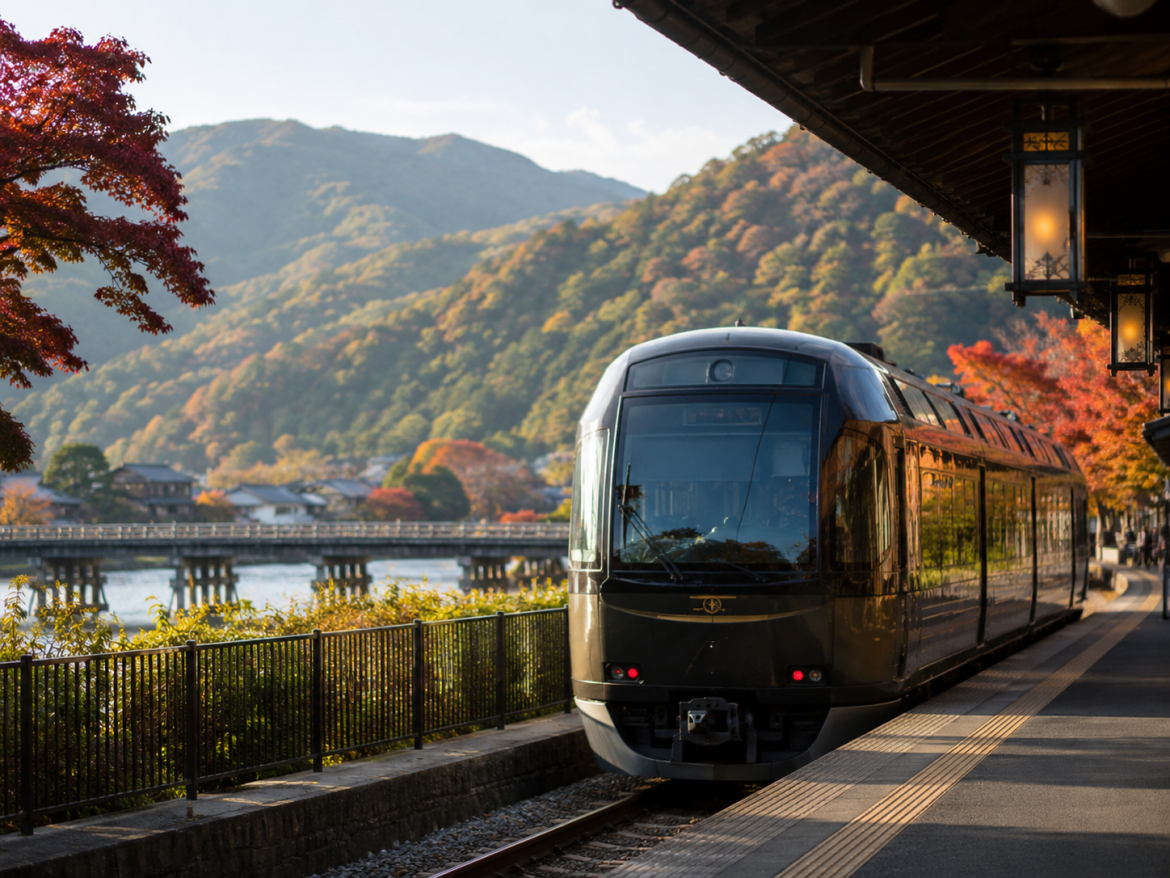

Getting to Arashiyama: choose the railway nearest your starting point
From Kyoto Station, take the JR Sagano Line to Saga-Arashiyama. From Osaka-Umeda or Kyoto-Kawaramachi, use Hankyu and change at Katsura. From Shijo-Omiya, Randen takes you straight to the main sightseeing street. These are three different stations, so choose your arrival point before planning the bamboo grove, Tenryu-ji and Togetsukyo Bridge.
Rail is usually the most predictable way to reach Arashiyama, especially during cherry blossoms, autumn foliage and busy weekends. Buses and taxis can be useful for the final connection, but crossing Kyoto by road can consume much of a sightseeing day. The scenic Sagano Romantic Train is a separate, reserved experience through the river gorge; you do not need to ride it to reach Arashiyama.
Hotel location makes a bigger difference than buying a pass first. Compare the Kyoto hotel areas, then use the Kyoto itinerary guide and Arashiyama autumn guide to decide how much time to leave. Those linked planning guides are in Chinese.
| Starting point | Practical route | Arrival station | Planning time | Best reason to choose it |
|---|---|---|---|---|
| Kyoto Station | JR Sagano Line | Saga-Arashiyama | About 15–20 minutes on a local train; some rapid services are faster | Direct train and convenient Saga-side approach |
| Shijo-Omiya | Randen Arashiyama Main Line | Randen Arashiyama | About 25 minutes on the tram | Arrives beside shops and Tenryu-ji |
| Kawaramachi or Karasuma | Hankyu via Katsura | Hankyu Arashiyama | Allow roughly 25–35 minutes | Convenient from the Shijo hotel and dining district |
| Osaka-Umeda | Hankyu Kyoto Line, then Arashiyama Line | Hankyu Arashiyama | Allow roughly 50–60 minutes | Simple Osaka day-trip route |
| Namba or Shinsaibashi | Osaka Metro to Umeda, then Hankyu | Hankyu Arashiyama | Allow roughly 70–90 minutes | A clear route from southern Osaka |
| Kiyomizu-dera or Gion | Reach Kyoto-Kawaramachi, then Hankyu via Katsura | Hankyu Arashiyama | Allow roughly 45–70 minutes, often longer from the temple itself | Avoids a long cross-city bus ride |
| Fushimi Inari | JR Nara Line local to Kyoto, then Sagano Line | Saga-Arashiyama | Allow roughly 35–50 minutes | Straightforward rail connection |
These are route-planning estimates, not guaranteed door-to-door times. Add walking to the first station, waits, crowded platforms and the final walk to your attraction. A rapid train’s shorter ride does not remove the time needed to reach Kyoto Station’s distant Sagano Line platforms.
A train and Hozugawa day tour can take care of some connections. It is a tour rather than a standalone train ticket: check the Osaka or Kyoto meeting point, whether the chosen option includes the boat, guide language, seat allocation, meals, child requirements and the replacement itinerary if boating is cancelled.
For other Kyoto days, compare the admission products below individually. A Nijo Castle art event, Taizo-in and Kyoto Aquarium are separate attractions, not one combined pass. An art-event ticket should not be assumed to include the castle’s ordinary daytime visit.
Which Arashiyama station should you use?
Open the Hankyu Arashiyama walking map to see the river, railway stations and sightseeing streets together. The three everyday railway stations are separate from the Torokko stations used by the scenic train.
JR Saga-Arashiyama: easiest from Kyoto Station
JR Saga-Arashiyama is useful for the bamboo grove, Tenryu-ji, the northern Saga temple streets and Torokko Saga Station next door. It is the natural choice if you stay near Kyoto Station or have a valid JR pass covering the route. You still need to walk into the sightseeing district; arriving at the station is not the same as reaching Togetsukyo Bridge.
A practical walking order is the bamboo area, Tenryu-ji, then the river and bridge. Add Jojakko-ji only if the group is comfortable with more walking. The station is also convenient for finishing a scenic-train outing and returning to Kyoto by regular JR.
Hankyu Arashiyama: useful from Osaka and downtown Kyoto
Hankyu’s station is south of the Katsura River. Walk through the park and across the bridge toward the main shopping street. This makes Togetsukyo Bridge a natural first stop, followed by Tenryu-ji and the bamboo grove. The trade-off is a longer walk to the northern Saga temples and Torokko Saga.
Use the official Hankyu station map and timetable for exits, facilities and your return train. If you have booked the scenic railway, do not treat the Hankyu arrival time as your Torokko boarding time.
Randen Arashiyama: right beside the main street
Randen arrives close to Tenryu-ji and the central shops. It is particularly convenient from Shijo-Omiya and the northwest temple district. From Kitano-Hakubaicho, take the Kitano Line and change at Katabiranotsuji; Kinkaku-ji itself is not directly beside a Randen station, so allow a walk or local connection first.
Randen is an enjoyable local tram ride, but going out of your way to use it from Kyoto Station usually adds a transfer. Travellers near Nijo should compare the direct JR route before choosing the tram.
Kyoto Station to Arashiyama by JR
- Follow the signs for the JR Sagano Line, also identified with the San-in Line.
- Take a local or rapid train stopping at Saga-Arashiyama. A limited express is not interchangeable with an ordinary train ticket.
- Leave at Saga-Arashiyama and walk toward the bamboo grove or Tenryu-ji.
- If riding the scenic train, follow signs for the separate Torokko Saga Station.
The local ride is generally around 15–20 minutes; Kyoto’s official access guide gives approximately 11 minutes for a rapid service. Leave extra time inside Kyoto Station and use the full platform rather than crowding into the nearest carriage. The straightforward direct ride is why JR is the usual first choice for a Kyoto Station hotel.
When JR is especially crowded, an alternative is the Karasuma subway to Karasuma Oike, the Tozai subway to Uzumasa Tenjingawa, then Randen from Randen-Tenjingawa. This involves more changes but can suit a hotel already on the subway network. See Kyoto’s official Arashiyama access guidance and area map.
Osaka to Arashiyama: Umeda and Namba routes
From Osaka-Umeda: Hankyu via Katsura
Take the Hankyu Kyoto Line from Osaka-Umeda to Katsura, then change to the Arashiyama Line for its terminus. Check the departure display and stopping pattern instead of assuming every train has identical stops. Allow around 50–60 minutes for a useful connection, plus the station approach and river walk.
This route works well from Umeda and hotels with easy access to it. Travellers near Yodoyabashi or elsewhere on Keihan should compare their whole journey rather than detouring to Umeda automatically. For a full day, start with the bridge, continue to Tenryu-ji and the bamboo, and return to the same Hankyu station when finished.
From Namba or Shinsaibashi
The easiest route to understand is Osaka Metro to Umeda, followed by the walk to Hankyu Osaka-Umeda and the change at Katsura. The Metro and Hankyu stations are not one platform, so allow time for the transfer. A planning allowance of 70–90 minutes is sensible before the final sightseeing walk.
| Route | When it makes sense | Trade-off |
|---|---|---|
| Namba → Umeda → Hankyu Arashiyama | Arashiyama is your first destination | A station walk at Umeda |
| Namba → Osaka/Shin-Osaka → Kyoto → JR Saga-Arashiyama | A JR-based itinerary or stop at Kyoto Station | More transfers and the Kyoto platform walk |
| Namba → downtown Kyoto → Hankyu Arashiyama | You deliberately want a downtown stop first | Usually a detour for a direct Arashiyama visit |
Do not make Arashiyama, Nara, Fushimi Inari and eastern Kyoto a single independent sightseeing day. Choose one main area and, at most, a second nearby or rail-connected focus. For the rest of your trip, the Osaka guide and Kansai itinerary provide broader planning ideas in Chinese.
From Kawaramachi, Karasuma and Shijo-Omiya
From Kyoto-Kawaramachi or Karasuma, take Hankyu toward Katsura and change to the Arashiyama Line. Allow roughly 25–35 minutes for the rail journey and connection. This is particularly useful if you want to return to Shijo for dinner or shopping.
From Shijo-Omiya, Randen’s Arashiyama Main Line is direct and takes about 25 minutes. You emerge beside the main sightseeing street, making it a good choice for Tenryu-ji and a gentle walk toward the bamboo. From Karasuma Oike or a Tozai subway hotel, compare the Uzumasa Tenjingawa–Randen connection instead of travelling south to Kyoto Station.
From Kiyomizu-dera or Gion
Kiyomizu-dera is in eastern Kyoto and Arashiyama is in the west. The trip is possible, but a crowded road crossing is a poor use of limited sightseeing time. Walk or take a short local connection to the Shijo area, reach Kyoto-Kawaramachi and use Hankyu via Katsura. Gion-Shijo is a Keihan station across the river, not the Hankyu boarding point.
Going through Kyoto Station and using JR can work if you need to collect luggage there. A taxi is an option for a small group with a higher budget, but it remains subject to the same road congestion and the fare can rise with delays.
If you must combine both districts, give Arashiyama the morning and leave Gion and Higashiyama for later. Check temple last entry: an evening visit or illumination is only possible on announced operating dates. The Kiyomizu-dera autumn guide can help with that separate seasonal plan.
Fushimi Inari to Arashiyama
Use JR Inari Station, take a Nara Line local train to Kyoto, then change to the Sagano Line for Saga-Arashiyama. Confirm that the first train stops at Inari; rapid services can pass it. Allow around 35–50 minutes for the overall connection, with longer waits possible.
You can visit Fushimi Inari Taisha and its shrine surroundings and Arashiyama on the same day, but both are popular early-morning destinations. Choose which deserves the quieter start. During autumn foliage, prioritising Arashiyama first often makes more sense; on another day, a short early shrine walk followed by JR to Arashiyama is a practical alternative.
Cherry-blossom and autumn transport strategy
- Use rail for the long journey; leave buses for necessary short connections.
- Leave Osaka early enough to arrive in the morning, rather than reaching the bridge around lunch.
- Allow at least half a day for Arashiyama and more if visiting several Saga temples.
- Reserve scenic-train seats separately once the travel date is fixed.
- Keep suitcases at your hotel or a suitable storage service rather than taking them into narrow paths.
- Build time for crowds at Togetsukyo Bridge and station ticket gates.
A transport pass only saves money when your chosen services are included. Ordinary JR, Hankyu and Randen fares belong to different operators; a Kyoto subway/bus product does not automatically cover these railways. Use the Kansai pass comparison after choosing the route, not before.
Connecting the Sagano Romantic Train and Hozugawa boat
The scenic railway follows the gorge from Torokko Saga through Torokko Arashiyama and Torokko Hozukyo to Torokko Kameoka. Its roughly 25-minute journey is an attraction in its own right. Torokko Saga is beside JR Saga-Arashiyama; Torokko Kameoka is a separate station from JR Kameoka, normally connected on foot with JR Umahori.
For a train-and-boat circuit, ride toward Torokko Kameoka, take the required bus or taxi transfer to the boat reception, then travel downstream to Arashiyama. The boat landing is not at the scenic station. Allow at least half a day for the combination and a full day if you also want temples and the bamboo grove.
Check the official train operating calendar and Hozugawa boat operator before committing. Boats depend on river and weather conditions; a train ticket does not guarantee that the boat will run. A guided train-and-river outing is useful when you prefer someone else to coordinate those connections, provided its actual inclusions match your plan.
Other Kyoto guided walks and private cars can simplify a day, but compare the meeting point, guide language, attraction admission and meals. A private car is not a transport pass and does not automatically include temple tickets.
Four realistic Arashiyama day plans
1. A half-day from Kyoto Station
Kyoto Station → JR Saga-Arashiyama → bamboo grove → Tenryu-ji → Togetsukyo Bridge → shops or an early lunch → JR back to Kyoto. This is the simplest first visit. Check attraction opening times if you begin before breakfast.
2. A full day from Osaka
Osaka-Umeda → Katsura → Hankyu Arashiyama → Togetsukyo Bridge → Tenryu-ji → bamboo grove → Jojakko-ji → return to Osaka. A scenic-train booking can replace part of the walking programme; adding both the train and boat means reducing the temple list.
3. Arashiyama and Fushimi Inari
Choose one early start, then use the JR connection through Kyoto for the other district. Keep Arashiyama to the bamboo, river and one temple rather than attempting every northern stop. A long shrine mountain walk and a full train-and-boat circuit would make the day too crowded.
4. Arashiyama and eastern Kyoto
Spend the morning in Arashiyama, use Hankyu back to Kawaramachi, then continue through Gion and the Higashiyama streets. Only add Kiyomizu-dera if the entry hours leave enough time. In peak foliage season, separate days are more comfortable.
Arashiyama transport FAQs
What is the quickest straightforward route from Kyoto Station?
JR to Saga-Arashiyama. Local trains are around 15–20 minutes; some rapid services are faster. Add time for the platform and sightseeing walk.
Which station is closest to the sights?
Randen is convenient for Tenryu-ji and the main street, JR for Saga and the scenic-train connection, and Hankyu for an approach across the river. There is no single best station for every itinerary.
Can I take a bus?
Yes, but avoid relying on a long bus ride during blossom or foliage crowds. Rail usually gives a more predictable journey.
Is Hankyu the best option from Osaka?
It is particularly practical from Umeda. From other hotel areas, compare the complete station-to-station route, including Metro transfers and the final walk.
Can I visit Kiyomizu-dera or Fushimi Inari the same day?
Either can be combined with a shorter Arashiyama visit. Fushimi Inari has a straightforward JR connection; Kiyomizu-dera involves more walking and a cross-city journey. Choose one, rather than attempting all three in a rushed day.
Does the ordinary JR ticket include the scenic train?
No. The Sagano Romantic Train has its own tickets and operating calendar. Allow time to reach the correct Torokko station.
The simplest choice for your Arashiyama trip
Take JR from Kyoto Station, Hankyu from Umeda or Kawaramachi, and Randen from Shijo-Omiya or a suitable northwest Kyoto connection. Build the walk around where you arrive, use trains during busy seasons and make the scenic railway a deliberate addition rather than a compulsory transfer.
For seasonal extensions, see the Arashiyama foliage route, Kiyomizu-dera autumn plan or Nara Park autumn guide in Chinese. Leave enough time to enjoy one area before crossing Kansai to the next.