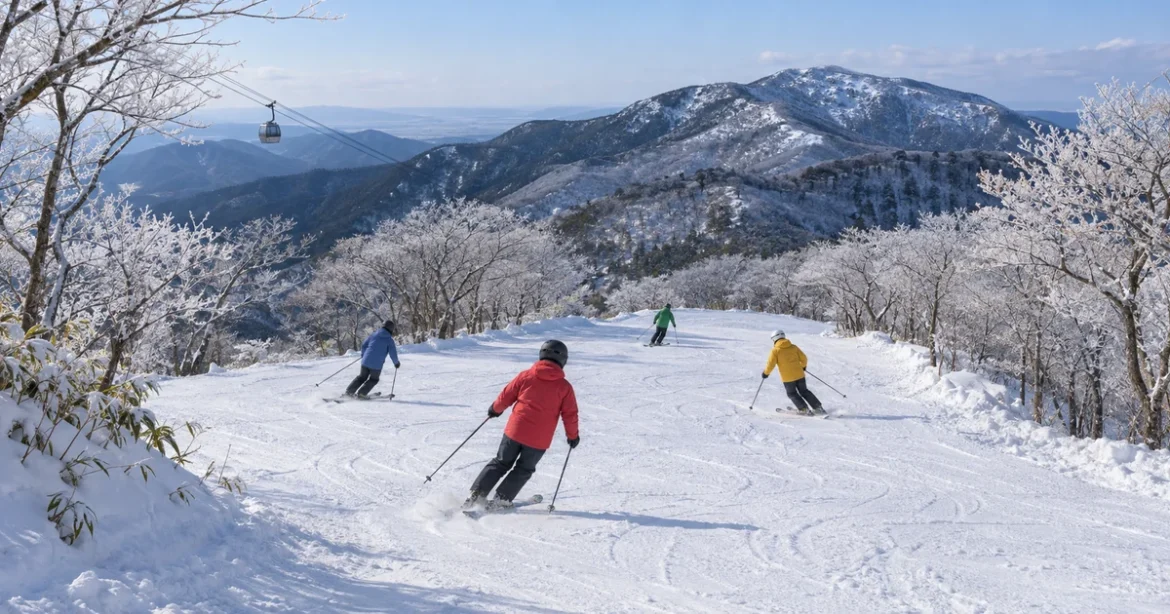
Gozaisho Ski Resort sits on Mount Gozaisho above Komono in Mie Prefecture, reached by riding the Gozaisho Ropeway. It suits a day combining a short ski session, sledding and summit scenery, including a winter outing from a Nagoya base. This is a small ski area with runs measured in hundreds of meters, and snowboarding is prohibited. If your priority is rotating through long pistes all day, snowboarding or a terrain park, choose a different resort. Understanding the scale first makes the name ‘ski resort’ much less likely to lead to the wrong itinerary.

The 2026–27 season is pending: skiing and snow play have different dates
The 2026–27 opening date remains unconfirmed; plan around the new-season announcement. In the previous season, low snow brought skiing to an early close on February 23, 2026, instead of the planned March 1 finish. See the 2025–26 skiing closure notice. The general ski page separately states that the 2025 operating year’s skiing, sledding and rental services had all ended by March 15, 2026. That later umbrella notice does not establish continuous downhill skiing through March 15.
For late 2026 or early 2027, wait for the new winter operating announcement rather than treating a running ropeway as evidence that skiing is available. Sightseeing, sledding, skiing and rental can have different operating states. If skiing is the essential purpose of your holiday, keep another resort in consideration; if summit winter scenery is the main aim, your plans can be more flexible.
Full piste map: distinguish three types of transport
Open the complete Gozaisho ski-area PDF map, or use the ski-area page. The linked map does not identify itself as a 2026–27 edition. Its old prices and times are not new-season promises, but the positions of the slopes, ski house, ropeway station, ski lift and sledding areas are useful for planning. Map source: Gozaisho Ropeway.
The aerial ropeway on the right brings visitors from the lower Yunoyama-Onsen station to Sanjo-koen station. The summit sightseeing chairlift is a separate facility, and the ski lift beside the beginner slope is different again. A ropeway ticket does not automatically cover both chairlifts. Once at the summit, identify the Ski House rental location and the ski-lift ticket counter inside the beginner area instead of simply following the sightseeing crowd.
How big is the skiing, and who is it for?
Beginner slope: repeated short runs, not flat ground
The beginner slope has a published maximum length of 210 meters, maximum width of 30 meters and average gradient of 17 degrees. The scale encourages repeated practice and basic movements rather than long-distance cruising. A short run does not teach someone in ski boots how to stop. Arrange introductory instruction and establish speed control before concentrating on repeated lift rides.
Advanced slope: a line on the map is not an opening guarantee
The map also shows an advanced slope measuring 220 meters long and up to 80 meters wide, with a 25-degree average gradient. However, the 2025–26 ski page explicitly marks it unavailable for that season. Its 2026–27 status needs a new announcement. Do not book on the assumption that both slopes will operate, especially if you are experienced and want variety throughout the day.
Snowboarders should choose somewhere else
Snowboarding is prohibited throughout the ski area. It is not a restriction affecting only one run or one time slot, and bringing your own board does not create an exception. Mixed groups wanting both boarding and snow play should choose a resort that permits snowboarding and has a separate play area.
Family snow play: sledding areas are separate from ski slopes
Gozaisho has dedicated sledding areas. The first is in front of the Ski House, with published dimensions of 100 by 40 meters; the second is 80 by 20 meters. Both have a listed average gradient of 5 degrees. This is a compact family-outing layout, not a substitute for the variety of a large destination resort. Sleds do not belong on the ski runs; accompanying adults should also follow the designated waiting arrangements.
A non-skiing family can combine renting a sled, short snow-play sessions, lunch and views. Avoid assuming children will want several uninterrupted hours outside. Keep spare gloves and dry socks accessible, and build indoor breaks into the plan. A snowshoe route also exists on the summit, but it is a walking activity rather than an extra ski run. Do not squeeze the entire route into a family half-day simply because it appears on the map.
Costs: ropeway, ski lift and rental are separate
Use these ropeway fares as autumn 2026 budget references and reconfirm them for your travel date. There is no separate ski-area admission charge, but the ropeway, ski lift and rental each have their own charges. The ropeway tariff page displayed round trips at ¥2,600 for adults and ¥1,300 for children aged four through elementary school. These are the ropeway fares displayed at that time, not an all-inclusive skiing package or a guarantee against future winter changes. Drivers should add lower-station parking and their road-transport costs.
For understanding the previous season’s cost structure only, the 2025–26 ski page listed a ¥2,000 ski-lift day pass and ¥3,000 adult rental for skis, poles and boots. These are not confirmed 2026–27 quotes. Adding them to a current ropeway fare would not establish a valid new-season total. A family only sledding should budget for the ropeway and the rental items it needs instead of automatically adding ski-lift day passes.
Ski-lift tickets are sold at the counter inside the beginner slope, not at the lower ropeway ticket office. Some summit services do not accept cards or electronic payments, so carrying enough yen is sensible. Identify whether you are buying a sightseeing-lift ticket or a ski-lift ticket before paying.
Rental and clothing: this is not a complete arrive-empty-handed package
Skis, boots and poles are available to rent, with sleds, snow boots and snowshoes also listed. However, the FAQ says ski clothing, gloves and goggles are not rented. Turning up in city clothing and expecting to hire a complete outfit is therefore not a workable plan. Bring waterproof outer layers, suitable insulation and gloves; skiers should also arrange appropriate head and eye protection.
Rental is at the Ski House inside Gozaisho Nature School. A locker-room space can be used to change, but do not expect a large resort-style changing complex. Leave unnecessary luggage at your accommodation and bring day-use items rather than moving a suitcase around the summit. Sizes and quantities are limited, especially relevant when several family members need different boots. Arrive early, complete fittings and then settle the rest of the activity plan.
Access: reach the lower station, then take the ropeway
By public transport from Nagoya, plan Kintetsu rail via the Yokkaichi direction, transferring to the Yunoyama Line for Kintetsu-Yunoyama-Onsen Station, followed by a bus to the ropeway. The railway station and lower ropeway station are different places, so do not omit the final connection. The access page and current bus timetable cover the railway station, Aqua Ignis, ropeway and Nagoya services. Match the timetable and its effective dates to your winter visit.
Drivers can approach from Komono Interchange on the Shin-Meishin Expressway; allow approximately ten minutes to the lower station as a general reference, with extra time for road conditions. Parking is followed by a ropeway ride, so the navigation arrival time is not your skiing start time. If wind suspends the ropeway, ordinary sightseers or skiers should not improvise a winter mountain hike as an equivalent transport alternative.
A realistic day and where to stay
For a ski-focused visit, arrive at the lower station in the morning, confirm slope and ropeway operation, then go up to rent equipment and ask about lessons. The previous season’s Gozaisho Ski School used same-day registration and small, one-hour lessons. New 2026–27 dates and arrangements still need confirmation. Explain each person’s experience and language needs; family members at different levels cannot automatically share one instructor.
Keep lunch and afternoon activities on the mountain rather than rushing through several distant attractions. Equipment return, changing, walking back to the ropeway and queues all take time. The general winter ropeway page lists a last descent at 16:30, which does not mean you can leave the ski area at 16:30. Confirm that day’s operation when going up. For an overnight hot-spring stay, compare Yunoyama Onsen accommodation below the mountain and check dinner, transfers and return arrangements rather than assuming every inn offers the same services.
If shopping, food and urban sightseeing dominate the rest of the holiday, a Nagoya base with one separate mountain day is easier to adjust. The Nagoya travel guide and winter illumination guide can help organize the remaining days. Multi-stop sightseeing tours that include the ropeway do not necessarily allow enough time for rental and skiing; travelers who genuinely want to ski should prioritize control over their time on the mountain.
Gozaisho: 10 frequently asked questions
1. When does the 2026–27 ski season open?
A confirmed opening date is not established. Ropeway operation alone does not mean the ski slopes are open.
2. Can I snowboard?
No. Gozaisho is a ski-only area and prohibits snowboarding.
3. Can I drive directly to the slopes?
No. Ordinary visitors park at the lower station and ride the ropeway, with further time needed for the ascent and equipment.
4. Does the ropeway ticket include the ski lift?
No. The aerial ropeway, sightseeing chairlift and ski lift are separate facilities with separate ticket coverage.
5. How long is the beginner slope?
Its maximum length is 210 meters and listed average gradient is 17 degrees. Short slopes still require stopping and speed-control skills.
6. Is the advanced slope on the map always available?
No. It was marked unavailable in the 2025–26 information, and a new operating notice is needed for 2026–27.
7. Can I rent ski clothing?
Do not rely on it. Ski clothing, gloves and goggles are not rented, so bring them yourself.
8. Do sledding visitors need ski-lift day passes?
Do not buy them automatically. Sledding and skiing use separate areas; budget for the ropeway and rental, then follow the season’s actual admission rules.
9. Can I reserve a lesson in advance?
The previous season used same-day Ski House registration without advance reservations. Check the new-season arrangements, language and available lesson times.
10. Is Gozaisho suitable for a full week of skiing?
Not for visitors wanting many long runs. It is better suited to a day of short ski practice, family snow play and summit scenery.