
Niseko United is not one single ski area. It combines Grand Hirafu, Hanazono, Niseko Village and Annupuri on different sides of the mountain, and choosing the right base matters more than trying to ski all four on your first day.
For the 2026–27 season, all four areas are scheduled to open on 28 November 2026, subject to snow and operating conditions. Grand Hirafu and Annupuri are planned through 5 May 2027, Hanazono through 11 April, and Niseko Village through 4 April. The late-spring period therefore does not mean all four areas remain open.
This guide focuses on the decisions that actually affect a trip: where to stay, whether you need an All Mountain Pass, how beginners should organise lessons and rentals, and what to do when wind or lift closures disrupt a cross-mountain plan.

Which Niseko ski area should you choose?
| Area | Best fit | Planning point |
|---|---|---|
| Grand Hirafu | Travellers prioritising restaurants, services and a convenient village base | Check the actual walking distance and slope between your accommodation and the lifts |
| Hanazono | Beginners, lessons and resort-based stays | A useful lesson base; do not assume a beginner can easily ski between Hanazono and Hirafu |
| Niseko Village | Hotel-based ski holidays | Works well if you prefer to keep skiing and accommodation centred in one resort area |
| Annupuri | A quieter, more self-contained ski trip | A practical choice when you do not need Hirafu’s village atmosphere every evening |
The four areas can connect on the mountain when the relevant lifts, routes and weather conditions allow. That does not mean the connection is a flat walk or an easy green run for beginners. Strong wind, poor visibility or lift closures can break a planned cross-area route.
Before skiing across to another sector, check the official operating information and have a surface-transport or arranged-pickup fallback for returning to your accommodation.
Open the official Niseko United digital map and trail-map hub. Grand Hirafu also lists its current 2026–27 winter course guide, released on 18 September 2026.
For a first ski day, check the lesson meeting area, teaching language, equipment and lift access in the selected package. A lesson-period ticket is not a full-day All Mountain Pass.
Niseko United 2026–27 trail map: choose your base first
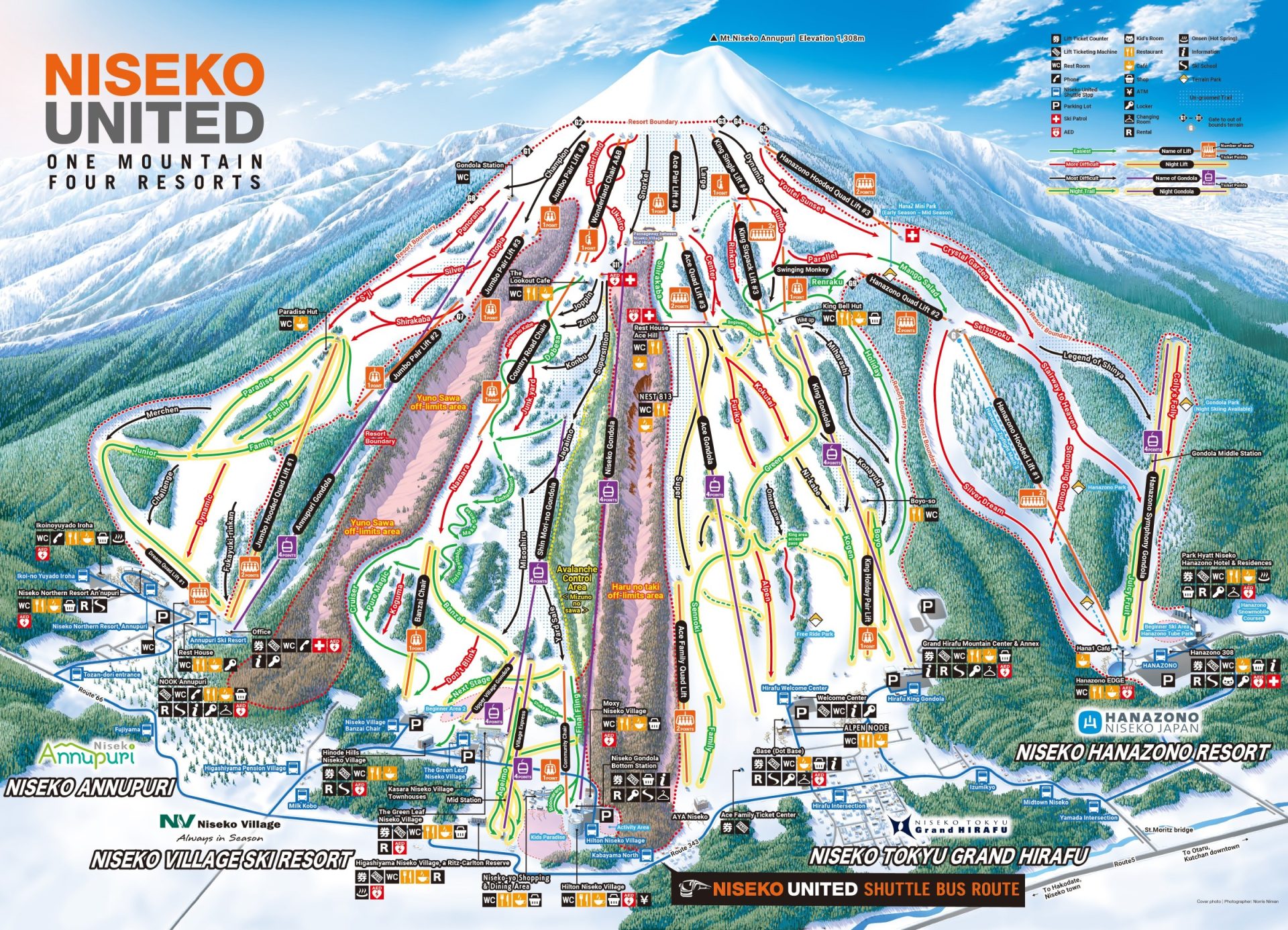
Read the bases from left to right: Annupuri, Niseko Village, Grand Hirafu and Hanazono. Green arrows mark the easiest trails; beginners should identify a base-area practice run rather than assume the four connected sectors provide an easy cross-mountain route. Check the day’s lift and trail status before leaving your home area.
Niseko 2026–27 season dates
| Ski area | Planned 2026–27 season |
|---|---|
| Grand Hirafu | 28 Nov 2026–5 May 2027 |
| Hanazono | 28 Nov 2026–11 Apr 2027 |
| Niseko Village | 28 Nov 2026–4 Apr 2027 |
| Annupuri | 28 Nov 2026–5 May 2027 |
These are planned operating dates and remain subject to snow, weather and resort operations. They should not be read as a guarantee of powder conditions, full terrain availability or uninterrupted links between the four areas.
The published Niseko United night season is 12 December 2026 to 22 March 2027. Night skiing does not mean every slope, lift or all four resort areas operate after dark, so check the day’s operating information before planning an evening session.
2026–27 Niseko All Mountain Pass prices
The Niseko United All Mountain Pass is designed for skiers who want access across the four resort areas under the applicable operating conditions. It can be useful for confident skiers moving around the mountain, but it can be unnecessary for a first-day beginner spending most of the day in one lesson area.
| 2026–27 period | Adult 1-day counter price |
|---|---|
| 28 Nov–11 Dec 2026 | ¥8,800 |
| 12–23 Dec 2026 | ¥12,600 |
| 24 Dec 2026–28 Feb 2027 | ¥13,500 |
| 1–22 Mar 2027 | ¥12,600 |
| 23 Mar–4 Apr 2027 | ¥8,800 |
| 5 Apr–5 May 2027 | ¥6,300 |
The final-price period continues to 5 May, but not all four resorts are scheduled to remain open that late. Always compare the open terrain with what you actually intend to ski.
Multi-day Niseko United passes are consecutive. An eligible day ticket remains valid through night skiing on its final day when that date falls within the official night-skiing period.
When is the All Mountain Pass worth considering?
- Beginner spending most of the day in a lesson: confirm what lift access the lesson requires before buying a full-mountain ticket.
- Staying and skiing mainly in one area: compare that area’s local-pass options with the All Mountain Pass.
- Confident skier wanting several areas: the full-mountain pass gives more flexibility when lifts and connections are operating.
- Windy or disrupted day: paying for mountain-wide access does not guarantee that cross-area lifts will operate.
Local-area prices vary, so check the relevant resort rather than assuming the All Mountain Pass is automatically better value.
Buying a Niseko lift pass online
As checked on 1 October 2026, the official 2026–27 online lift-pass page is marked Preparing for Sale. Do not assume online checkout is already open simply because seasonal prices have been published.
When online sales become available, the official system uses a permanent keycard. The initial purchase has a ¥500 keycard fee; this is a purchase fee, not a refundable deposit. The official site describes online pricing as an average discount of about 5%, but this should not be treated as a universal discount on every ticket. Hourly tickets are excluded from that claim.
Official online purchases are non-refundable and non-cancellable, so confirm the date and pass type before paying.
A day or hourly ticket activates at the first lift-gate scan or when scanned on the Niseko United bus. If you are not ready to activate your ski day, avoid scanning the card on the shuttle and pay the regular bus fare instead. Only one pass type can be charged to a keycard at one time.
Check the official Niseko online lift-pass page
Niseko for beginners: plan the lesson before the lift pass
A beginner does not need to “complete” Niseko United. A better first-day plan is to choose one lesson base, collect properly fitted equipment, learn basic control and repeat familiar beginner terrain after the lesson.
- Choose your accommodation area first.
- Book a lesson with a meeting point you can realistically reach in ski boots.
- Confirm whether the lesson includes lift access or requires a separate ticket.
- Allow enough time for rental fitting before the lesson.
- Stay in the same beginner area afterwards rather than chasing a cross-mountain route.
- Consider broader mountain access only when your control level and the day’s lift operations justify it.
The beginner package normally combines a lesson, equipment and lift access during the lesson, not a full-day Niseko All Mountain Pass. Additional skiing afterwards requires the appropriate ticket. The supplier states that bookings made within three days provide lesson-only service because rental arrangements need at least three working days. For a short-notice booking, confirm the equipment and lift-ticket arrangements directly before paying.
Private lessons: meeting area matters
A private lesson can simplify a first or second ski day, especially when several people want to learn together. The important detail is not only the language or lesson duration: confirm the selected ski area and exact meeting point before paying.
The verified Snow and Flow private option offers 3-hour or 6-hour lessons with English, Mandarin or Cantonese instruction options. Language, meeting area, selected date and package inclusions must still be confirmed for the booking you choose.
If your accommodation is in one resort and the lesson begins in another, do not assume you can simply ski across in the morning. Cross-mountain access depends on ability, lifts and weather, and may not be suitable for a beginner.
Ski and snowboard rental planning
Rental logistics are easiest when the shop is close to your accommodation, lesson meeting point or first lift. This matters more than saving a small amount and carrying skis or a snowboard across the village twice a day.
The verified Rhythm Hirafu product offers ski or snowboard equipment and ski-wear packages depending on the option selected. A helmet is not included, and gloves and goggles are not rented through this product, so bring or buy those separately. Confirm the branch, return time, package contents and selected date before booking.
Grand Hirafu, Hanazono, Niseko Village or Annupuri?
Grand Hirafu
Grand Hirafu is the easiest area to shortlist when restaurants and village services are important. It also works well for groups whose members are not all following the same ski schedule.
The key accommodation check is the actual walking route. A property may be described as being in Hirafu while still requiring an uphill walk, shuttle or other connection to your preferred lift.
Hanazono
Hanazono is a practical base for travellers building the trip around lessons and resort facilities. It can also be combined with Grand Hirafu when mountain connections are operating and the skier has sufficient ability.
For a complete beginner, however, treat Hanazono and Hirafu as separate bases rather than assuming the on-mountain link is an easy beginner transfer.
Niseko Village
Niseko Village suits a hotel-centred holiday where accommodation and skiing are planned around the same resort base. It is worth considering if you prefer fewer daily transfers rather than using Hirafu as the centre of every evening.
Annupuri
Annupuri works well for a quieter ski trip where the priority is staying around one base instead of moving repeatedly between villages. If you intend to spend evenings elsewhere, check transport arrangements before booking accommodation.
Getting to Niseko from New Chitose Airport or Sapporo
Airport and Sapporo transfers involve enough seasonal timetable detail that they are better planned separately from the ski-area decision.
See our dedicated guides:
The official Niseko access page checked on 1 October 2026 notes that Chuo Bus 2026–27 reservations and timetable information are expected around October, while parts of the page still display previous-season 2025–26 data. Do not reuse old Chuo Bus departure times or fares for the new season.
For any airport transfer, choose the stop based on your actual accommodation area, confirm luggage and ski-bag rules, and leave a sensible buffer after the flight. Winter weather and road conditions can delay transfers.
A rail journey via Otaru towards Kutchan or Niseko still requires a final bus, taxi or accommodation pickup. JR Hirafu Station is not Hirafu Welcome Center, so do not select it simply because your hotel is marketed as being in Hirafu.
Check the official Niseko access hub
How the Niseko United shuttle affects your lift pass
The Niseko United shuttle connects the resort areas. Valid All Mountain day, hour, season and point tickets can be used under the applicable shuttle rules.
- Scanning a day pass on the bus activates one ski day.
- Scanning an hourly pass deducts one hour.
- Scanning a point ticket deducts one point.
- Travellers without an eligible pass pay the regular fare.
This is important on arrival day. If you have already loaded tomorrow’s ski pass but only want to use the bus to reach another area, do not scan the card unless you intend to activate or deduct from that ticket.
What to do when wind closes upper lifts
Niseko’s four-area layout gives you options, but weather can also make an over-ambitious itinerary frustrating. High lifts or cross-area connections may close even while skiing continues lower on the mountain.
A sensible weather fallback is:
- Check current lift operations before leaving your accommodation.
- Keep beginners in the resort where their lesson or familiar terrain is located.
- Do not ski into another sector unless you have confirmed a realistic way back.
- If the mountain connection closes, use surface transport or an arranged pickup rather than trying to force a closed route.
- Leave extra time on airport-transfer days instead of planning skiing until the final possible lift.
The official Niseko United homepage and current lift-status information should be checked on the day, because published season dates do not guarantee that every lift operates.
Niseko gates and backcountry safety
Niseko’s powder reputation does not make terrain outside controlled runs automatically safe. Under the Niseko Rules, backcountry access is only through officially opened gates. Never duck ropes, use closed gates or enter off-limits terrain.
The Niseko Rules say backcountry skiers and snowboarders should wear a helmet and carry an avalanche beacon; a probe and shovel are also strongly recommended. Follow these rules and patrol instructions. Carrying equipment does not by itself make a route safe.
Check the official Niseko avalanche bulletin and follow ski-patrol directions. Backcountry terrain is not an ordinary first-day skiing activity. Appropriate avalanche training, a qualified guide and suitable insurance coverage are important for anyone planning to leave controlled pistes.
A practical first Niseko trip
Instead of scheduling one resort per day regardless of conditions, build the trip around ability and weather.
| Day | Suggested approach |
|---|---|
| Arrival | Reach your accommodation, collect equipment if practical and confirm the next day’s lesson meeting point |
| First ski day | Lesson and repeated practice in your home resort; avoid unnecessary cross-area travel |
| Second ski day | Continue locally or expand terrain once basic control is reliable |
| Later ski days | Consider the All Mountain Pass and other areas according to ability, lift status and weather |
| Departure day | Leave enough time for equipment return, luggage collection and winter transport delays |
Common Niseko planning mistakes
- Buying the most expensive pass before booking lessons: a lesson-only beginner may not need full-mountain access.
- Assuming four connected areas means easy beginner travel: mountain links depend on routes, lifts, ability and weather.
- Booking a lesson in another area without checking transport: meeting points can be far apart.
- Choosing accommodation from the word “Niseko” alone: confirm the exact resort area and transfer stop.
- Scanning a loaded lift pass on the shuttle too early: this can activate or deduct from the ticket.
- Using an old airport-bus timetable: verify the current 2026–27 operator schedule once published.
- Planning a cross-mountain return late in the day: lift closures can leave surface transport as the practical fallback.
- Treating a gate as permission to ignore avalanche risk: an open gate does not make backcountry terrain hazard-free.
Niseko Ski Resort FAQ
How many ski areas are in Niseko United?
Niseko United consists of Grand Hirafu, Hanazono, Niseko Village and Annupuri.
When does the 2026–27 Niseko season start?
All four areas are planned to open on 28 November 2026, subject to snow and operating conditions.
Do all four areas stay open until May?
No. Grand Hirafu and Annupuri are planned through 5 May 2027, while Hanazono is planned through 11 April and Niseko Village through 4 April.
How much is a Niseko All Mountain 1-day pass?
The adult counter price varies by season period, from ¥6,300 in the final period to ¥13,500 during the 24 December 2026–28 February 2027 peak period.
Should a first-time skier buy an All Mountain Pass?
Not automatically. If most of the day is spent in a lesson and one beginner area, first confirm what lift access the lesson requires and compare that with the local ticket options.
Are 2026–27 Niseko lift passes already on sale online?
As checked on 1 October 2026, the official page says 2026–27 online passes are preparing for sale.
Is the Niseko keycard deposit refundable?
No. The initial ¥500 charge is a permanent keycard purchase fee rather than a refundable deposit.
Can beginners ski from one Niseko area to another?
They should not assume so. Cross-area skiing depends on operating lifts, routes, weather and the skier’s ability. For beginners, surface transport between bases may be the safer and simpler solution.
When is Niseko night skiing scheduled for 2026–27?
The published night season is 12 December 2026 to 22 March 2027. Only designated operating lifts and terrain are available; this does not mean all four areas or all slopes are open at night.
What happens if upper lifts close in strong wind?
Stay within the terrain that remains officially open and use surface transport or arranged pickup if a planned mountain connection is no longer available.
Can I enter Niseko backcountry anywhere?
No. Use only officially opened gates, never cross ropes or closed gates, check the avalanche bulletin and follow patrol instructions.
Niseko ski resort planning summary
The easiest way to plan Niseko is to choose your home ski area first, then build lessons, rental and lift tickets around it.
- Grand Hirafu: choose it when village restaurants and services are a priority.
- Hanazono: a practical base for lessons and a resort-focused stay.
- Niseko Village: useful for travellers who prefer a hotel-centred ski holiday.
- Annupuri: a good fit for a quieter, more self-contained trip.
Beginners do not need to pay for full-mountain access simply because four resorts are available. Learn in one area first, then expand the trip when your ability, the weather and lift operations make it worthwhile.
For experienced skiers, the All Mountain Pass offers valuable flexibility, but it still cannot guarantee powder, open upper lifts or a skiable connection between every area. Check the official map, lift information and Niseko Rules each day rather than treating the resort layout as fixed.
Season dates, lift-pass information and official operating guidance checked 1 October 2026: Niseko United lift information, online lift passes, official map, access information and Niseko Rules.