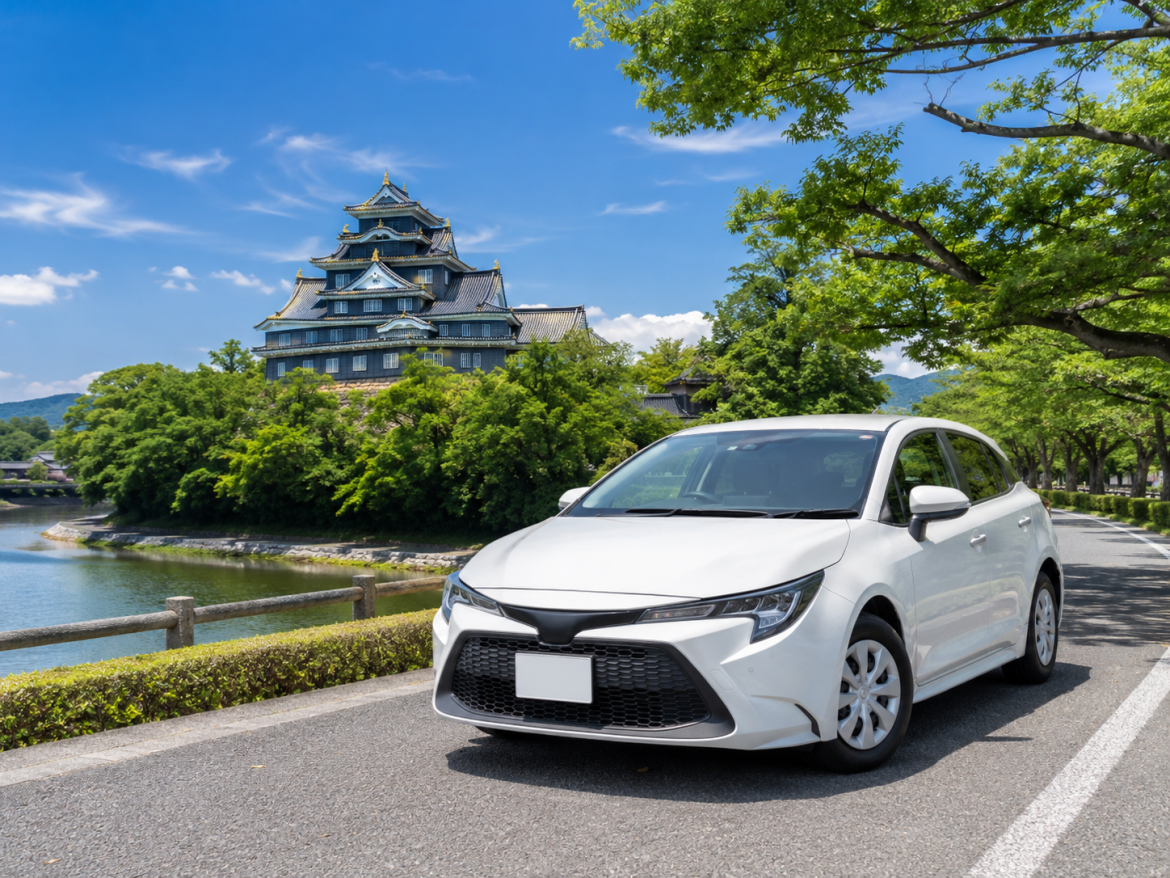

Okayama car rental: decide which days need a car
A car is most useful in Okayama when you leave the main rail corridor for Ushimado, Washuzan, Ojigatake, Kinojo, Bitchu Matsuyama Castle, Fukiya, Yubara Onsen or the Hiruzen Highlands. If your plan is Okayama Castle, Korakuen, Kurashiki’s historic quarter and Naoshima, trains, trams, buses and ferries are often enough.
Families, travellers with several bags and anyone staying in northern Okayama can gain flexibility from driving. The most useful comparison is the complete itinerary cost: collection point, office hours, protection, ETC, child seats, winter equipment, parking and the return fee. A low headline daily rate answers only part of that question.
The prefecture’s visitor rental discount can help eligible travellers, but accommodation, collection/return location, application timing and payment method all matter. Do not prepay a third-party booking and assume the discount will be applied later.
Start with our three-day Okayama itinerary. You can compare Okayama rental cars on Klook, then check whether the chosen booking/payment route qualifies for any promotion.
When is a car worthwhile in Okayama?
| Itinerary | Recommendation | Reason |
|---|---|---|
| Okayama Castle and Korakuen | Usually no car | Public transport and walking avoid collection and city parking |
| Okayama and Kurashiki | Usually no car | Rail connects the towns and the historic quarter is best on foot |
| Okayama and Naoshima | Usually no car | Travel to Uno, then use the ferry and island transport |
| Kibiji and Kinojo | A car can help | Dispersed countryside sights take more effort to combine by transit |
| Ushimado, Bizen and the Seto coast | A good driving day | Coastal stops are spread out |
| Kojima, Washuzan and Ojigatake | Useful beyond central Kurashiki | Viewpoints and coastal accommodation are easier to link |
| Bitchu Matsuyama Castle and Fukiya | Useful, with walking still required | The car links the areas but does not reach the castle keep |
| Yubara and Hiruzen | A strong case in suitable conditions | Rural stops and overnight luggage favour driving |
| Daisen in Tottori | Allow at least two days for a relaxed extension | A long return trip is a poor substitute for time at the destination |
If a day contains only one city or one rail-served attraction, renting may add little. If it combines several rural stops, compare a car with the actual bus connections rather than simply assuming driving is faster.
Compare rental companies and exact branches
| Company | Useful comparison | Detail to check |
|---|---|---|
| Toyota | Airport, station and wider prefectural branch choices | Similar station branch names do not mean the same entrance or hours |
| Times | Okayama Station west side, airport and Kurashiki options | Walking distance and vehicle-height/length return restrictions |
| Nippon Rent-A-Car | Airport and station-side options | Airport counter reporting, branch transfer and return shuttle |
| Orix | Airport rentals, ETC cards and approved one-way routes | Its airport closing time may not suit a late arrival |
| Heisei | Local network and multilingual reservation information | Confirm winter equipment by class and the shuttle window |
| Nissan | Airport vehicle availability | Do not infer subsidy participation from airport presence |
Toyota: distinguish the two west-side offices
Toyota’s official Okayama Station listing places the West Exit branch at Ekimotomachi 11-10, about one minute from the west exit, and the West Exit Plaza branch at Ekimotomachi 18-3, about two minutes away. Both normally list 08:00–20:00 but show 08:00–16:00 on 21 October in the current calendar. The West Exit branch also lists shorter 09:00–18:00 New Year hours. Check the date-specific calendar rather than assuming the same return deadline all year.
The wider network includes options around Kurashiki, Shin-Kurashiki, Tsuyama and Bitchu-Takahashi. This can help a one-way route within the prefecture, subject to office and vehicle acceptance.
Times: allow for the station walk
Times Okayama Station West Exit is about five minutes on foot from the west exit and lists 08:00–20:00. Its directions use the west-side walkway and the route past ANA Crowne Plaza. Height and garage restrictions mean it cannot accept all tall or long vehicles as one-way returns.
Nippon, Orix and Heisei at the airport
Nippon Okayama Airport lists 08:00–20:00. Report at its arrival-area counter, then transfer to the office. On return, take the car to the office and allow for the airport transfer, listed as around five minutes by car.
Orix Okayama Airport lists 08:30–18:30, about five minutes on foot from arrivals, with a free transfer from its airport counter. Heisei’s airport branch lists 09:00–18:00 and a pre-arranged shuttle taking around three minutes. Give it the flight and passenger details when reserving. Neither schedule should be assumed to fit every evening flight.
Heisei has Traditional Chinese reservation information. For cold-weather routes, use its winter-tyre vehicle information and obtain confirmation of the actual class and fee; its published options state that chains are not rented. Do not assume a basic low-price car can be upgraded to the required equipment at collection.
Airport, Okayama Station, Kurashiki or Takahashi?
| Pickup | Best for | Trade-off |
|---|---|---|
| Okayama Momotaro Airport | Driving straight to the coast, Kurashiki or northern accommodation | Arrival procedures and transfer must fit branch hours |
| Okayama Station | Starting a rural trip after sightseeing in the city | Choose the correct side and allow for city traffic |
| Kurashiki Station | A historic-quarter stay followed by Kojima, Washuzan or Takahashi | Check vehicle availability early on busy dates |
| Bitchu-Takahashi area | A focused Takahashi, Fukiya or Niimi trip after rail arrival | Fewer branch/class choices and office-specific hours |
Airport arrival followed by driving
The airport’s official rental-counter guide locates the rental information on the first floor. Collection may still require a walk or transfer to the company’s premises; “airport pickup” does not mean the vehicle waits beside baggage reclaim.
If you arrive too late for the office, use the Okayama Airport–Okayama/Kurashiki transport guide and collect the next day. Do not begin a tired night drive solely because the car was reserved for arrival.
Collect after the city stay
For many first visits, take the airport bus into Okayama, see the city by transit, and rent only when leaving for the countryside. A west-side branch may suit your hotel and outward road, but the best choice still depends on the exact entrance and destination.
Collect after Kurashiki
Explore the Bikan Historical Quarter without a car, then collect for Kojima, Washuzan, Ojigatake, the castle or Fukiya. Compare the station, historic-quarter and coastal areas in our Kurashiki accommodation guide. Check overnight parking if keeping the vehicle.
Okayama’s 2026–2027 visitor rental discount
The official campaign page lists eligible rentals starting 6 April 2026–28 February 2027, with return by 10 March 2027. Applicants need qualifying foreign-passport tourist status, a paid accommodation stay in Okayama and both pickup and return at eligible offices within the prefecture. Staying with friends or relatives does not qualify.
| Vehicle capacity | Base discount per vehicle | With qualifying Mimasaka-area accommodation bonus |
|---|---|---|
| Up to five seats | JPY 3,000 | JPY 5,000 total |
| Six or more seats | JPY 5,000 | JPY 8,000 total |
The Mimasaka bonus has its own eligible rental-start window, 5 July 2026–28 February 2027. Apply at least four days before collection and check the published holiday cutoffs, processing suspensions and final application date. Funding and approval still matter: submit early and retain the acceptance number and required stay evidence.
Check the payment route before booking
Times and Orix require advance reservation with payment at the rental office under this scheme. Toyota Okayama accepts the listed online-prepayment and on-site methods; Nippon and Heisei specify their own websites for eligible prepaid bookings. Travel-agency vouchers are excluded under the published rules. Check the exact office and booking method with the campaign before paying.
A platform may still be the better option if you do not qualify, have missed the deadline, or will return in Hiroshima, Tottori or another prefecture. Compare the actual final rates and cancellation terms rather than choosing a larger vehicle only to obtain a larger discount.
Compare the total rental cost
| Cost | What to verify |
|---|---|
| Base rental | Duration, class and tax on the same booking dates |
| Basic insurance | Limits and remaining excess |
| CDW and NOC | Whether both protections are included and their exclusions |
| ETC card | Separate reservation/hire fee and toll settlement |
| Child seats | Correct restraint and confirmed availability |
| Winter tyres/equipment | Eligible vehicle class, seasonal inclusion and extra charges |
| One-way return | Specific office pair, car class and charge |
| Fuel and tolls | Route costs outside the rental quote |
| Parking | Hotel, city and attraction fees |
| Late return or special arrangements | Whether the company permits them and at what cost |
Do not compare a lightly protected base rate against a package with equipment and waivers. Nor should you count a subsidy before checking approval and the payment conditions.
Choose a vehicle for passengers, bags and the route
| Group | Possible starting point | Capacity check |
|---|---|---|
| One or two people, cabin bags | Kei or compact car | Boot size and comfort for the actual route |
| Two people, large suitcases | Hatchback or standard car | Confirm dimensions rather than relying on a class name |
| Three or four people | Standard car or suitable SUV | Passenger room after luggage is loaded |
| Four people and four large cases | Estate, larger SUV or minivan | Five seats do not establish luggage capacity |
| Five or six family members | Legally suitable seven/eight-seat vehicle | Child restraints and third-row luggage space |
| Hiruzen or Daisen in winter | Explicitly confirmed winter-tyre vehicle | Road opening, weather, chains and driver experience |
“Or similar” bookings generally promise a class rather than the pictured model. Explain hard luggage requirements before reserving. Four-wheel drive cannot replace winter tyres or make a closed road usable.
Driving documents for Taiwan and other visitors
Taiwan licence holders normally need the valid original licence, an accepted Japanese translation and their passport with entry evidence, alongside the reservation and an operator-accepted payment method. A Taiwan international permit alone does not replace the translation. Update the translation when the licence or its recorded details change.
For other issuing jurisdictions, consult JAF’s driving-document guidance. A valid 1949 Geneva Convention IDP is the relevant route for many visitors, including qualifying Hong Kong licence holders; designated jurisdictions use a different original-licence-plus-translation route. A phone image or unofficial online document is not a substitute for the required original.
Eligibility depends on the issuing jurisdiction, permitted vehicle category, entry date and document validity. Residents have additional re-entry rules. Register every driver with complete documents, and verify the company’s minimum age, licence-history, payment-name and class restrictions. Keep acceptable entry evidence if using automated immigration gates.
Insurance: read CDW and NOC separately
Basic insurance may leave a vehicle or third-party-property excess. CDW reduces specified excesses under the contract; NOC concerns loss of rental business while the vehicle is unavailable. Including CDW does not automatically waive NOC.
For a first trip, mountain roads or a larger vehicle, compare a package reducing both exposures. Read tyre, wheel, key, towing and incorrect-fuel exclusions, and distinguish rental-company waivers from a platform reimbursement policy that may require payment first.
Toyota’s insurance page provides a company-specific example, not a universal policy. Follow the accident procedure even for minor damage: secure safety, notify police and contact the rental company as required. Unregistered or ineligible driving and failure to report can affect protection.
ETC cards and the San’in–Setouchi–Shikoku Expressway Pass
The reader, card and toll bill are different
A fitted ETC reader does not mean a card is included. Confirm card availability, the hire charge, one-way-return handling and how tolls are settled. If driving without ETC, check that your selected entrances support a general payment lane; some are ETC-only.
When SEP is worth comparing
The official SEP page describes eligible travellers, participating rental operators and three- to ten-day options. It is a comparison for longer paid-road trips towards Tottori, Shimane, Hiroshima, Yamaguchi or Shikoku, not an automatic saving for Okayama and Kurashiki.
All Honshu–Shikoku Expressway sections are excluded, including Seto-Chuo over the Seto Ohashi bridges and the Shimanami Kaido. Add those tolls separately. Compare the exact route and valid days before choosing a pass; its name does not make every bridge or urban expressway free.
Does a one-way rental make sense?
| Route | Why consider it? | Cost or eligibility issue |
|---|---|---|
| Airport pickup, Okayama Station return | Drive first, then finish by rail or in the city | Check the two specific branches |
| Okayama pickup, Kurashiki return | Avoid a modest backtrack | The fee may exceed the time saving |
| Okayama pickup, Tottori or Yonago return | A genuinely one-direction regional trip | Cross-prefecture fee and no Okayama campaign qualification |
| Okayama pickup, Takamatsu return | Continue into Shikoku | Bridge toll plus cross-prefecture return fee; campaign condition not met |
| Both branches within Okayama | Potentially compatible with the campaign | Accommodation, participating office and payment rules still apply |
Reserve the final office when booking. A brand offering one-way rentals does not guarantee every vehicle can be returned to every branch. Never assume a last-day change will be accepted.
Road difficulty, parking and mountain access
Okayama city and Kurashiki
Watch for trams, buses, taxis, one-way streets and busy junctions around Okayama Station. Set navigation before leaving the branch. For Kurashiki, navigate to a formal car park outside the historic streets, then explore on foot.
The city’s official parking map and notices list a closure of the municipal station-front car park from 28 September 2026 to 31 January 2027, planned for renovation work. Choose another suitable facility and recheck the notice before travelling. Do not use a shop’s parking simply to visit the historic quarter.
Bitchu Matsuyama Castle and Fukiya
A rental car does not reach the castle keep. The official castle shuttle guidance explains that when the management shuttle operates, private vehicles cannot drive up to Fuigo Pass; use the designated lower parking/boarding arrangement. Even after the upper stop, the climb to the keep takes about twenty minutes on foot. The operation calendar and weather can change the access procedure.
Fukiya and Takahashi’s mountain roads can be narrow with limited lighting. Finish the mountain-driving part in daylight where possible, and do not assume a late-afternoon village departure will reach an onsen before its dinner deadline.
Hiruzen, Yubara, Niimi and the north
Clear roads in Okayama city do not establish conditions in the north. Use Okayama’s official winter road cameras and weather map and follow its road-restriction links. Snow, ice, fog, tyre/chain restrictions and closures require separate checks. Inexperienced snow drivers should not attempt a mountain route simply because a winter-tyre car is available.
Renting with children
Children under six generally require an appropriate child restraint. Reserve the correct infant, child or booster seat for the child’s size; verify that it fits the vehicle and is properly installed. Count the stroller, suitcases and supplies as well as the passengers.
If four adults and two children are travelling, a five-seat vehicle is not an option at all. Even with no more than five occupants, two child seats can leave little usable room. Choose a legal, comfortable seating arrangement and plan regular safe stops; never leave a child unattended in the car.
Is driving suitable with older travellers?
Driving can reduce transfers and luggage handling for Ushimado, Yubara, Hiruzen and Washuzan. It cannot remove the climbs at Bitchu Matsuyama Castle, Kinojo or some viewpoints. Match the sights to the group’s mobility rather than treating the rental car as a reason to add every hilltop attraction.
A gentler route can focus on Kurashiki, accessible coastal views, onsen and roadside rest stops. Build in time to sit down, eat and use toilets, and keep the driver’s workload manageable.
One-day driving routes from Okayama
Kibiji and Kurashiki
| Part of the day | Plan |
|---|---|
| Morning | Collect after opening, then visit Kibitsu Shrine and the Kibiji/Bitchu Kokubunji area |
| Lunch | Soja or Kurashiki |
| Afternoon | Park outside the Bikan quarter and walk through the historic streets |
| Return | Leave enough time for traffic, fuel and the actual branch deadline |
This is a relatively approachable first-driving-day outline. If Kurashiki is the only destination, take JR instead. Do not apply an 18:30 return plan on a date when your branch closes at 16:00.
Ushimado and the Seto Inland Sea
Start from a suitable station or airport branch, choose a Bizen/Setouchi-area stop, then have lunch in Ushimado and explore the olive garden and coastal views. Leave room for a café or harbour walk rather than packing in every coastal detour.
If sunset is important, staying in Ushimado avoids rushing back through unfamiliar roads in darkness. Otherwise choose a return time that fits both the season’s sunset and the office’s hours.
Two days: Takahashi, Fukiya, Yubara and Hiruzen
On day one, leave Okayama early enough for Bitchu Matsuyama Castle’s parking/shuttle and uphill walk. Have lunch in Takahashi, then continue to Fukiya if time allows. For an overnight in Yubara or Maniwa, depart Fukiya early enough for daylight driving and the accommodation’s check-in or dinner time.
This is a full day with several separate drives. If the castle visit runs long, omit Fukiya or choose a nearer overnight rather than pressing on late. In the colder months, a less ambitious southern itinerary may be more suitable.
On day two, spend the morning around Yubara and the Hiruzen Highlands, choose a farm, dairy-food or roadside-station stop, then return to Okayama with a realistic refuelling and inspection buffer. Weather and the booked return office decide how much sightseeing fits.
Three days: coast, castle country and the highlands
| Day | Suggested route | Overnight |
|---|---|---|
| 1 | Airport → Kurashiki → Kojima or Washuzan if daylight permits | Kurashiki or Kojima |
| 2 | Bitchu Matsuyama Castle → Takahashi → optional Fukiya → Yubara | Yubara or a nearer base if the day is running late |
| 3 | Hiruzen → Okayama Station or airport return | Depart or continue without the car |
An early flight is incompatible with a leisurely Hiruzen morning. In that case, stay back in Okayama on night two, shorten the northern loop or put it earlier in the trip. The route is a planning suggestion, not a guaranteed sequence of timed connections.
Can you combine a rental car with Naoshima?
You can drive to Uno, but most first-time visitors should park legally on the mainland and use the ferry plus island transport, or finish the rental before the island visit. Transporting a car adds a vehicle fare, loading uncertainty and parking decisions without guaranteeing access to each art site.
If taking a car, first obtain the rental company’s permission, confirm the specific vehicle-carrying ferry and its dimensions, and arrange appropriate island parking. Shikoku Kisen’s FAQ states that it does not accept reservations or advance ticket sales; arrive with time to spare and do not assume the next boat has vehicle space. A passenger boat is not interchangeable with a car ferry.
Use our Naoshima transport guide to distinguish Miyanoura, Honmura and the island’s transport options.
What about driving on Shodoshima?
Shodoshima can be a stronger case for island driving because its attractions are dispersed. Still compare carrying the mainland rental with travelling as a foot passenger and reserving a separate island car. Include the vehicle fare, passengers, fuel adjustments, waiting time and rental permission.
For the Shin-Okayama–Tonosho route, use Ryobi’s official port access and booking links. Shin-Okayama Port is not Uno Port. Follow the chosen sailing/operator’s reservation and check-in rules rather than copying rules from another ferry route.
Our Shodoshima transport guide compares mainland ports, vehicle ferries and island car rental. Returning the car on the island is a separate one-way-rental question, not an automatic consequence of permission to carry it there.
When you should skip the rental
Skip it for a city-only Okayama/Kurashiki visit, or when your itinerary primarily follows the Shinkansen through Osaka, Himeji, Okayama, Hiroshima and Hakata. Compare the rail option with tolls, fuel, one-way fees and driver fatigue.
A tired arrival, unfamiliar left-side driving, heavy rain after dark or a snowy Hiruzen plan without relevant experience can also make public transport or a professional driver the better option. Equipment does not remove the need to choose a safe route.
For a Kansai–Okayama trip, see the Kansai transport pass comparison, then add a rental only for the rural days.
Alternatives to self-driving
JR, trams and walking
Okayama Castle, Korakuen and Kurashiki do not require a rental. Combine public transport with walking, and check the final attraction-to-station segment rather than assuming every sight is beside a platform.
A private driver for rural stops
A private vehicle with a driver can suit a group visiting the castle or countryside without Japanese driving experience. Compare the Okayama private day-tour options and check the actual route, pickup area, duration, overtime, tolls and parking. Do not infer inclusions from the headline alone.
Compare Okayama private day tours
An airport transfer for a single journey
If you only need to reach a hotel after a late flight or with substantial luggage, compare a private transfer with the airport bus rather than hiring a car for a full day.
Compare Okayama Airport transfers
A regional rail pass for several cities
For Okayama, Kurashiki, Fukuyama, Onomichi, Hiroshima, Miyajima and Yamaguchi, compare the current regional JR products against your actual rail fares. Confirm eligibility, validity, route and reservation rules before payment. A rail pass does not replace a plan for Ushimado or Hiruzen’s dispersed sights.
Compare Okayama–Hiroshima rail pass options
Before returning the car
- Confirm the full return-office name, vehicle entrance and opening hours.
- Use the required fuel and follow the branch’s refuelling-distance instructions.
- Keep the final fuel receipt and settle any contractual fuel shortfall appropriately.
- Remove bags, child supplies and belongings from under seats, door pockets and charging points.
- Return the hired ETC card and equipment and complete the condition check.
- Allow for toll settlement and any airport transfer after handover.
- Work backwards from the airline’s required terminal arrival, not merely the flight departure.
Find a suitable fuel station before the final evening; not every nearby station opens late. If using an EV, confirm the return charge requirement and a working charging plan. As, the airport’s fast-charger outage notice remains published, so do not rely on that charger for a last-minute top-up.
Common Okayama rental mistakes
- Booking a prepaid platform rate before checking subsidy payment eligibility.
- Assuming an airport counter is the vehicle handover/return point.
- Choosing an office whose closing time does not fit the flight.
- Ignoring a date-specific early closure at the station branch.
- Counting seats without allowing for bags and child restraints.
- Treating ETC hire as included tolls or SEP as covering Seto Ohashi.
- Driving into Kurashiki’s narrow historic streets rather than a designated car park.
- Expecting to drive directly to Bitchu Matsuyama Castle’s keep.
- Taking a car onto a ferry without rental permission, the correct sailing and a parking plan.
- Using 4WD to justify an unsuitable snowy mountain route.
- Leaving refuelling and return navigation until closing time.
- Failing to report a minor collision under the rental procedure.
Okayama car rental FAQ
Airport or station pickup?
Airport pickup suits a rural trip beginning immediately after arrival. Station pickup suits a city stay first. Check actual office hours and the transfer/walking procedure in either case.
How much should I budget?
Obtain a dated quote including tax, required protection, equipment and one-way fees, then add fuel, tolls and parking. There is no single reliable daily price for every season and vehicle.
Can a Klook booking use the prefectural discount?
Do not assume so. The promotion specifies participating branches and payment methods, including on-site-only payment for Times/Orix. Check before paying.
Can I return in another prefecture?
Only with a branch/class combination the provider accepts, usually subject to a fee. It would not meet the Okayama campaign’s within-prefecture pickup/return condition.
Does SEP include Seto Ohashi?
No. Seto-Chuo and the other Honshu–Shikoku Expressway sections are outside the covered network and must be budgeted separately.
Can several people drive?
Yes if each is legally eligible, has the required original documents and is registered with the rental company. One qualified main driver does not authorize everyone else.
Can I reuse a Japanese licence translation?
Only while it still corresponds to the valid licence and applicable rules. Reissue after relevant licence/detail changes. The permitted driving period is separately limited by entry and document validity.
Does CDW mean complete protection?
No. Check NOC and exclusions separately, and follow accident-reporting requirements. “Full” or “安心” branding is not a promise that every expense is waived.
Are winter tyres automatic?
No universal rule applies to every branch/class. Confirm the actual equipment and fees, and recheck road restrictions. Four-wheel drive is not a tyre substitute.
Is a rental useful for Naoshima?
Usually only to reach Uno as part of a wider driving trip. Leaving it on the mainland or returning it first is often simpler than paying to transport it.
How many rental days should I plan?
One day can suit Kibiji, Ushimado or Washuzan. Castle country, Fukiya, Yubara and Hiruzen need a more relaxed two- or three-day plan, adjusted for daylight and weather.
Must I return with a full tank?
Follow the specific contract. Many conventional rentals require a full tank and receipt; EVs have their own return-charge conditions.
A practical Okayama rental plan
Use public transport for the city and Kurashiki, then rent for the coast or north when the car genuinely simplifies the route. Choose the exact branch, check the day’s hours and return instructions, and reserve the right capacity and equipment.
The prefectural discount is worth checking, but the lowest final cost depends on the whole booking, not just its headline saving. For a first driving day, choose Kibiji–Kurashiki or Ushimado. Add castle country and the highlands only when you have the time, mobility and conditions to enjoy them without rushing.