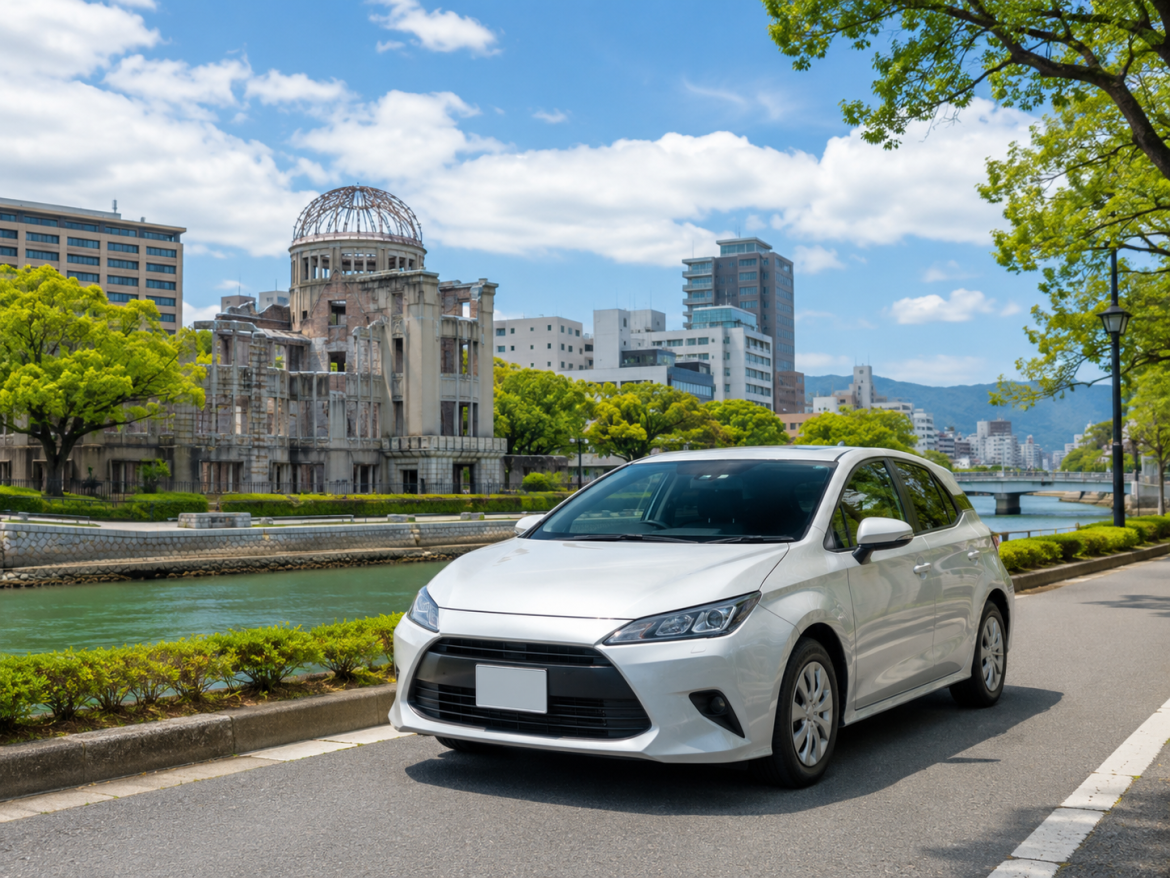

Hiroshima car rental: rent for the countryside, then return for the city
A car is useful in Hiroshima when you want to connect Takehara, Sera, Miyoshi, Shobara, rural Onomichi or the Shimanami Kaido islands. It is usually less useful for Hiroshima Station, Peace Memorial Park, Hondori, Hatchobori and Miyajima, where trains, trams, ferries and walking remove the parking problem.
For a first visit, consider two separate parts: explore Hiroshima and Miyajima by public transport, then collect a car near Hiroshima Station for the countryside. Alternatively, collect at the airport, explore the eastern prefecture, and return the car before staying in Hiroshima city. Avoid paying for several rental days simply to leave the car at a hotel.
Hiroshima Airport is in Mihara, outside central Hiroshima. It can be a practical starting point for Takehara, Mihara, Onomichi, Sera and the islands without driving into the city first. Use our Hiroshima itinerary guide and Hiroshima transport guide, both in Traditional Chinese, to decide which days actually need a car.
Is renting a car in Hiroshima worthwhile?
| Plan | Recommendation | Why |
|---|---|---|
| Hiroshima city only | Usually skip the car | Trams, buses and walking serve the main sightseeing areas |
| Hiroshima and Miyajima | Usually use public transport | A car adds parking while the island visit is largely on foot |
| Airport, Takehara and Onomichi | Good case for renting | Combines places that otherwise need more connections |
| Shimanami Kaido island stops | Useful for a flexible road trip | Choose islands and carry luggage without depending on every bus |
| Sera, Miyoshi, Shobara and the mountains | Useful when conditions are suitable | Attractions are dispersed; winter brings additional risk |
| One day in Hiroshima | Focus on one area without renting | Collection, driving and return can consume much of the day |
Families and older travellers may benefit on a rural itinerary, but a car does not eliminate walking in the city or on Miyajima. For a three- or four-day visit, a one- or two-day rental is often a better starting point than keeping the vehicle throughout.
Hiroshima Airport, Hiroshima Station or Fukuyama Station?
| Pickup point | Best fit | Important detail |
|---|---|---|
| Hiroshima Airport | Takehara, Mihara, Onomichi, Sera and the Shimanami Kaido | Allow for arrival formalities before the office closes |
| Hiroshima Station Shinkansen/north side | Start driving after a city stay or a train arrival | Reception and vehicle/return premises can differ |
| Fukuyama Station | Tomonoura, Onomichi and eastern Hiroshima | A return at Hiroshima Airport may carry a one-way charge |
| Onomichi area | A focused island-driving day after arriving by rail | Check the exact station, office, opening hours and available classes |
Airport collection: the current walking route
The official airport access guide and map directs customers from the terminal’s second floor across the pedestrian bridge to RENT-A-Car.Port, around three minutes on foot. Orix, Times, Toyota, Nissan, Nippon and Mazda Rent-A-Car Hiroshima have counters there. J-net does not; follow its own confirmed meeting instructions.
The airport lists Orix, Toyota, Nissan, Nippon and Mazda at 08:00–20:00, Times at 08:00–19:00 and J-net at 09:00–19:00. These are published operating hours, not a promise to accept every late or delayed flight. Confirm the latest collection time and what to do if delayed before booking a late arrival.
Hiroshima Station: check the counter and return entrance
Station pickup works well after completing Peace Memorial Park, the city and Miyajima. Several providers operate around the Shinkansen exit. Save the full office name, not just the brand, and check whether you report at a reception desk before walking to the car.
For example, Toyota’s Hiroshima Station listing separates its Shinkansen-exit reception counter in the Sheraton Grand Hiroshima first-floor entrance from the vehicle branch at Wakakusacho 22-9. Both list 08:00–20:00; departures report to the reception counter. The north-exit walk is approximately two minutes to reception and three minutes to the branch.
Trams now enter the station building, following the station-front route change in 2025. Do not rely on old street arrangements or make a last-second lane change while following navigation. Check current signs and the rental company’s return route.
Fukuyama or Onomichi for eastern Hiroshima
If arriving from Osaka, Kobe or Okayama, a Shinkansen to Fukuyama can put you closer to Tomonoura, Onomichi and the island route. Compare returning to the same branch with an approved one-way return in Hiroshima or at the airport.
For one day of island driving, taking rail closer to Onomichi before collecting can avoid an unnecessary Hiroshima–Onomichi return drive. Do not assume every “Onomichi” branch is beside JR Onomichi Station.
Which rental company should you choose?
| Company | What to compare | What not to assume |
|---|---|---|
| Toyota | Branch network, family classes and protection options | A displayed model is guaranteed unless the booking says so |
| Nippon | ETC availability and the exact cross-region return quote | Every office has unlimited ETC-card stock |
| Orix | Compact, larger and one-way options | The cheapest base rate includes the return fee |
| Times | Short rentals and convenient collection points | Its airport office closes as late as neighbouring counters |
| Nissan | Available vehicle classes and energy/fuel requirements | A pictured hybrid or EV is the booked vehicle |
| Mazda Rent-A-Car Hiroshima | Airport availability, protection and return conditions | Brand preference matters more than the complete terms |
| Budget | Additional station/city pricing options | Reception, vehicle storage and any transfer use one entrance |
| J-net | Airport-area rates and vehicle availability | It has a counter inside RENT-A-Car.Port |
Compare the same dates, collection and return offices, vehicle class and level of protection. The Klook Hiroshima rental comparison can help identify options, but a price shown for one day is not an annual standard.
Compare Hiroshima rental pickup points
The full cost: more than the daily rental rate
| Item | Check before payment |
|---|---|
| Base rental and tax | Whether the period is hourly, 24-hour or calendar-day based |
| Basic insurance | Limits, excesses and exclusions |
| CDW and NOC | Whether both are included and what remains payable |
| ETC reader and card | The fitted device is not the same as a supplied card |
| Tolls and fuel | Normally separate from the quoted rental |
| Parking | City hotels, Miyajimaguchi and Onomichi can add costs |
| One-way return | Exact office-pair acceptance and vehicle-class charge |
| Child seats and winter equipment | Availability, suitability and whether the fee is included |
| Late return and cancellation | Contract deadlines and applicable charges |
A slightly higher base rental can be the better deal if the necessary protection and equipment are included. Compare the final pre-payment breakdown rather than the first search-result price.
Licences, passports and additional drivers
Eligibility depends on where your licence was issued. Consult JAF’s jurisdiction-specific driving guidance before booking. Many visitors use a valid international driving permit under the 1949 Geneva Convention; designated jurisdictions have a different route using an original licence with an authorized Japanese translation.
| Licence holder | Documents to prepare | Important distinction |
|---|---|---|
| Taiwan | Valid original licence, accepted Japanese translation and passport/entry evidence | A Taiwan-issued international permit does not replace the translation |
| Hong Kong | Valid original licence, valid 1949 Convention IDP and passport | Check expiry, category and the operator’s document rules |
| Other jurisdictions | The legally applicable document combination | Do not infer eligibility from nationality or language |
| Additional driver | Complete qualifying documents and registration at collection | Do not change drivers informally during the trip |
| Renter/payer | Reservation and an accepted payment method | Credit-card name, age and licence-history rules vary by company |
Keep evidence of entry available when using automated immigration gates. The permitted driving period is limited by entry and document validity, with special re-entry rules for residents. A translation must still match the current licence; update it when the licence or recorded details change. Check seat/category limits before reserving a large vehicle.
CDW and NOC: what protection actually means
CDW generally reduces specified vehicle/property excesses. NOC is a separate charge for loss of business while a damaged or contaminated vehicle cannot be rented. “Insurance included” does not establish that either is waived.
Read the company’s own exclusions for tyres, wheels, keys, towing, incorrect fuel and contract breaches. Toyota’s explanation is a useful provider-specific example. Another brand’s terms may differ, and a platform’s reimbursement product may require you to pay first and claim afterwards.
For a first left-side-driving trip, compare a package reducing both excess and NOC exposure. Even with broader protection, stop safely after an incident, contact police and notify the company as required. Minor damage still needs the contractual reporting process.
ETC cards, tolls and expressway passes
The ETC reader is the device in the car; the card records eligible toll transactions. Reserve a rental card if needed, since stock can be limited. Toll charges are then settled under the operator’s process, not automatically included in the card-hire fee.
Without ETC, some routes still have general payment lanes, but individual interchanges can be ETC-only. Plan a usable entrance and follow the lane signs. If you enter incorrectly, use the intercom rather than reversing.
For a longer regional journey, compare ordinary tolls with the San’in–Setouchi–Shikoku Expressway Pass only after checking eligibility, a participating rental branch and the covered route. All Honshu–Shikoku Expressway sections are outside SEP coverage, including the Shimanami Kaido and Seto-Chuo Expressway. Do not assume an island-driving day is covered merely because the pass includes “Shikoku” in its name.
Choosing a car: luggage matters more than the seat count
Kei and compact cars
A small vehicle can suit one or two people with modest luggage and is easier to place in tight parking spaces. Check the actual luggage allowance and long-distance comfort rather than inferring safety from the vehicle class. A five-seat label does not promise space for five large suitcases.
Standard cars, SUVs and minivans
Three or four adults with bags may benefit from a larger boot. An SUV’s higher seating position does not remove the disadvantage of a wider body on Onomichi’s narrow streets. For a seven- or eight-seat vehicle, check luggage room with the third row in use and confirm that every intended driver’s licence covers the vehicle.
Winter equipment
For Miyoshi, Shobara, Taishaku Gorge, San-in or higher roads during cold weather, obtain explicit confirmation of suitable winter tyres. A request in the comments field is not confirmation. Four-wheel drive does not replace the tyres, chains where required, or the decision to cancel an unsafe mountain route.
Where driving helps, and where it adds work
| Area | Driving value | Practical approach |
|---|---|---|
| Hiroshima Station, Hatchobori, Hondori and Peace Memorial Park | Low for ordinary sightseeing | Use public transport and walk between nearby sights |
| Miyajima | Low on the island | Leave the car on the mainland and take the ferry |
| Kure | Depends on the route | Rail suits central sights; a car helps for Ondo, Etajima and dispersed coast stops |
| Takehara | Useful as part of an eastern trip | Park outside the historic streets |
| Central Onomichi | Useful to reach the town, not each sight | Park once and walk/use the ropeway |
| Shimanami Kaido | Useful for selected island stops | Include bridge tolls and island driving, not just the through-route |
| Sera and northern mountains | High for dispersed attractions | Check seasonal opening and road conditions |
| Iwakuni’s Kintai Bridge | Conditional | Public transport works; driving adds value if combining rural stops |
Can you take a rental car to Miyajima?
Vehicle-carrying ferries exist, but most sightseers are better off leaving the car at Miyajimaguchi. The island’s main visitor area is walkable, tourist parking is limited, and narrow streets, pedestrians and deer make a car more burden than benefit.
The JR ferry access guide shows both the pedestrian route and the separate vehicle boarding approach. If you have a specific reason to transport a car, first obtain the rental company’s permission and confirm island parking, vehicle dimensions, loading arrangements and the return sailing. A ferry’s ability to carry cars is not permission under your rental agreement.
JR’s usual crossing is around ten minutes. Weekend, holiday and autumn queues at Miyajimaguchi can add far longer before boarding. Arrive early, or consider lawful parking near a more distant JR station and continue by train. Check overnight parking terms if staying on the island.
See the Miyajima travel guide and Miyajima one-day itinerary, both in Traditional Chinese, for the walking part of the visit.
Driving and parking in central Hiroshima
Pay attention to tram tracks, turn restrictions, pedestrians and the road layout around the station. Do not treat rails as a place to stop while checking the map. Set navigation before moving and use a legal stopping place if you need to reassess the route.
Hotels and multistorey car parks may impose height, width, weight or access-hour limits. Ask about overnight charges and re-entry; a room booking does not guarantee a suitable parking space. Keep a backup car park rather than circling a busy station entrance.
If your hotel is near Hiroshima Station, Hatchobori or Hondori and the remaining days are city-based, returning the car is often simpler than driving because you already have it.
Onomichi and the Shimanami Kaido
Onomichi’s temples, Cat Alley and hillside streets are not a sequence of drive-up attractions. Choose formal parking, then explore on foot or by ropeway. Our Onomichi guide helps separate the town visit from the island road trip.
A car is more useful for selected stops on Mukaishima, Innoshima, Ikuchijima and Omishima. Leave time for island access roads, parking, meals and walks. Visiting Onomichi thoroughly, every major island and Imabari in one day is far more demanding than the through-driving time suggests.
If adding Okunoshima, park at Tadanoumi or another appropriate mainland port and travel as a foot passenger. Kyukamura’s official island guidance says general vehicle circulation is not allowed. A car carried by the vehicle ferry must remain in the designated arrival parking area; it does not become a self-drive tour of Rabbit Island. Check the boat, rental permission and parking separately if transporting one for a specific reason.
Collection checklist
- Go to the exact booked reception point.
- Present your reservation, passport and qualifying original driving documents.
- Register every driver and confirm the accepted payment method.
- Review the rental period, protection, NOC, ETC card, child seats and return office.
- Confirm the correct fuel or EV charging requirement.
- Inspect bodywork, roof, wheels, glass, interior and fuel level; photograph existing damage.
- Check navigation, reversing aids, restraint installation and ETC operation.
- Save the emergency number and the exact return entrance before leaving.
Allow time for the process, especially with multiple drivers, child seats or language questions. Collection is more than collecting a key.
Return checklist
- Confirm the branch’s deadline and entrance before the final day.
- Allow time for traffic and refuelling; use the correct fuel and keep the receipt.
- Remove luggage, rubbish and personal information, including paired-device data where appropriate.
- Return the hired ETC card and other equipment.
- Complete the condition check and settle tolls, fuel differences or other valid charges.
- At the airport, allow for the walk back to the terminal and the airline’s check-in/security requirements.
Navigation arrival at the rental facility is not arrival at the airline desk. Work backwards from the airline’s required terminal time, then add the return process. Contact the branch early if delayed.
Approximate driving times around Hiroshima
| Route | Planning estimate | Allowance still needed |
|---|---|---|
| Hiroshima Airport → Takehara | About 20–30 minutes | Collection, parking and walking |
| Airport → Onomichi | About 45–60 minutes | Exact destination and road choice |
| Airport → central Hiroshima | About 45–60 minutes or longer | Peak traffic and incidents |
| Central Hiroshima → Miyajimaguchi | About 40–60 minutes or longer | Holiday queues, parking and the ferry |
| Central Hiroshima → Kure | About 40–60 minutes | Destination and traffic |
| Central Hiroshima → Onomichi | Roughly 1½ hours | Breaks, toll route and town parking |
| Onomichi → Ikuchijima | About 40–60 minutes depending on the start/end points | Island stops and local roads |
These are approximate planning ranges, not live traffic predictions or guaranteed connections. Recalculate the actual itinerary for weather, roadworks, festivals and the precise return branch.
One-day driving routes
Airport, Takehara and Onomichi
With a suitably early arrival, collect at the airport, explore Takehara’s preserved streets and have lunch, then continue to Onomichi. Park once for the hillside, shopping streets and waterfront, and stay in Onomichi if continuing to the islands the next morning.
If you must return to Hiroshima city that evening, shorten the sightseeing rather than adding Rabbit Island. A ferry excursion requires its own timetable and cannot be treated as a quick roadside stop.
Hiroshima Station, Kure and Takehara
Collect after the office opens, spend the morning in Kure, then continue east along the itinerary to Takehara in the afternoon. Choose an approved airport return or allow enough time to drive back to Hiroshima. Confirm attraction openings and the return deadline before using this outline.
If visiting only central Kure, rail is already convenient. The car earns its place when you continue to dispersed coastal sights, not simply because Kure is outside Hiroshima city.
Two days: Takehara, Onomichi and selected islands
Day one: collect at Hiroshima Airport, explore Takehara and, if the timetable genuinely allows, the Tadanoumi area. Continue to Onomichi for the evening. A full Okunoshima visit needs more time than a brief port stop.
Day two: drive to Mukaishima, then choose Innoshima or Ikuchijima, with lunch around Setoda if that fits. Turn back according to the booked return location: Hiroshima Airport, Fukuyama or the original office.
You do not need to reach Imabari to enjoy the Shimanami Kaido. A focused selection of islands gives time for coastal cafés, temples and local meals.
Three days: airport arrival, island driving, city finish
| Day | Plan | Overnight |
|---|---|---|
| 1 | Airport pickup → Takehara → Onomichi | Onomichi |
| 2 | Selected Shimanami Kaido islands, returning at a comfortable pace | Onomichi or Fukuyama |
| 3 | Drive to Hiroshima, return at the agreed branch and switch to public transport | Hiroshima city |
After returning the car, use trams and JR for Peace Memorial Park and Miyajima on the following days. Check the one-way charge in advance; the reduction in hotel parking and unnecessary rental time may outweigh it, but that requires an actual quote.
Alternatives if you would rather not drive
For a trip linking Osaka, Kyoto, Kobe, Hiroshima, Miyajima and other main JR cities, compare a regional rail pass with individual fares. Check the exact current product, eligibility, validity and route coverage before payment.
Compare Kansai–Hiroshima JR pass options
For journeys extending towards Iwakuni, Yamaguchi, Shimonoseki or Hakata, compare the relevant JR West pass options. A long-distance pass is not automatically worthwhile for a city-only stay; match the actual travel days and product coverage.
Compare Hiroshima–Yamaguchi JR pass options
A Hiroshima–Miyajima bus tour can simplify a short first visit if its meeting point, walking demands and schedule suit the group.
Compare Hiroshima and Miyajima tours
A private driver can suit travellers who need hotel pickup or want several rural stops without handling navigation, parking and rental return. Confirm whether tolls, parking, ferry travel, overtime and admission are included; a private tour is not the same product as a self-drive rental.
Compare private Hiroshima-area tours
Best seasons for a Hiroshima road trip
Spring suits Takehara, Onomichi and the islands, with blossom weekends and holidays requiring earlier booking. Summer reduces outdoor transfers but brings hot parked cars, thunderstorms and possible typhoon disruption. Autumn is attractive on the coast and in the mountains, with busy foliage car parks.
Winter coastal conditions can differ sharply from Miyoshi, Shobara and the roads towards San-in. Consult Hiroshima Road Navi’s official restriction map and the prefecture’s road-control guidance. Ice can matter even without visible snowfall. Chain restrictions, winter-tyre requirements and closures are distinct conditions; postpone an unsuitable trip.
Renting with children
Children under six generally need an appropriate child restraint in Japan. Reserve a seat matched to age, height and weight and verify fitting at collection. Check rear-seat room after installation, stroller and suitcase space, door access and planned rest stops.
Do not leave children unattended in a vehicle, even briefly. When visiting Miyajima on foot, carry essential supplies and valuables with you; do not bring every large piece of luggage onto the ferry. Plan a day that leaves enough time for meals and breaks rather than using the car to add more cities.
Travelling with older family members
A car can reduce transfers for Takehara, Sera and northern rural sights. It does not eliminate walking around central Hiroshima, Miyajima or Onomichi. Consider slopes, steps, the distance from parking and available rest stops when choosing attractions.
The Miyajima pier and main visitor area can be easier to fit than a demanding Mount Misen or Daisho-in itinerary. If the driver is unfamiliar with Japan, fatigued or managing all navigation alone, a private driver may be a better choice than a large rental vehicle.
Food stops and the driving plan
- Hiroshima-style okonomiyaki: easiest to enjoy around the city after returning the car.
- Oysters and anago rice: fit lunch into a Miyajimaguchi or Miyajima visit without making the return deadline too tight.
- Onomichi ramen: park first and walk to the restaurant, rather than searching narrow streets by car.
- Saijo sake breweries: take JR if tasting is part of the plan. The designated driver should not drink, and waiting a short time is not a safe strategy for resuming driving.
Where to stay on a driving trip
For Hiroshima and Miyajima by public transport, a central base near Hiroshima Station, Hatchobori or Hondori is practical. See our Hiroshima accommodation guide.
For Takehara, Onomichi and the islands, an Onomichi overnight avoids driving back to Hiroshima purely to sleep. Confirm the hotel’s parking arrangements and choose the next day’s islands according to the return deadline.
A Miyajima overnight is worthwhile for a slower island visit, but driving visitors should usually keep the car on the mainland and verify that the parking facility permits overnight stays. For the non-driving arrival or departure day, compare our Hiroshima Airport transport guide.
Common mistakes to avoid
- Renting for the whole stay when most days are in the city.
- Comparing rates without matching CDW, NOC, equipment and one-way fees.
- Confusing an ETC reader with a reserved card or included tolls.
- Bringing the wrong licence documents or failing to register another driver.
- Arriving late without the branch’s confirmed delayed-flight procedure.
- Trying to fit Hiroshima, Miyajima and Onomichi into one day.
- Taking the car to an island without rental permission and a parking plan.
- Driving through Onomichi’s historic lanes to reach every attraction.
- Filling all seats before considering bags and child restraints.
- Checking only city weather for a northern mountain trip.
- Driving after sake tasting or leaving the fuel stop until closing time.
Hiroshima car rental FAQ
Should I collect at the airport or station?
Choose the airport for an eastern-prefecture trip starting on arrival. Choose the station after your city and Miyajima days, or when arriving by Shinkansen.
Where are the airport counters?
Most are at RENT-A-Car.Port across the second-floor pedestrian bridge, around three minutes from the terminal. J-net uses separate arrangements.
Can I collect after a late flight?
Only if the booked office explicitly accepts your arrival. Published airport hours differ by company, and a delay does not guarantee extended opening.
Can I return to a different city?
Some providers and classes allow it when reserved. Compare the approved one-way fee, tolls and fuel with rail, especially for Osaka or Fukuoka.
Do I need to reserve an ETC card?
If the route uses toll roads and you want ETC, reserve it separately unless the booking clearly includes it. Its hire does not include the toll charges.
Does SEP cover the Shimanami Kaido?
No. Honshu–Shikoku Expressway sections are excluded. Add those bridge tolls separately when comparing the pass with ordinary payment.
Do I need a car for Miyajima?
Usually not. Use rail/tram plus the ferry, or leave the car at suitable mainland parking. Vehicle ferry service does not make island driving convenient.
Is a compact car enough for the islands?
It can be for a small group with little luggage. Check actual capacity, comfort and child-seat needs rather than selecting solely by the listed passenger count.
Are winter tyres needed?
Match equipment to the route and conditions. Northern Hiroshima and roads towards San-in can require a very different plan from the coast, and 4WD is not a tyre substitute.
Does a platform booking cover all desk charges?
Not necessarily. Read payment, deposit, cancellation, protection, equipment and return terms. Confirm whether any protection is reimbursement-based.
Car rental or a JR pass?
Rail suits main-city trips including Okayama, Hiroshima and Osaka. A short rental is more useful for Sera, mountain attractions and several island stops. A mix of rail and one or two driving days can work well.
A practical first Hiroshima rental plan
Use the car where it meaningfully connects places: Takehara, rural Onomichi, selected Shimanami islands, Sera or northern Hiroshima. Return it when the trip becomes city-based. This avoids paying for a parked car while leaving time for the countryside.
Before paying, settle five details: the correct collection point, complete driving documents, the full protected price, route-appropriate equipment and the exact return deadline. Then leave enough slack for parking, walking and weather rather than measuring the trip only in navigation minutes.