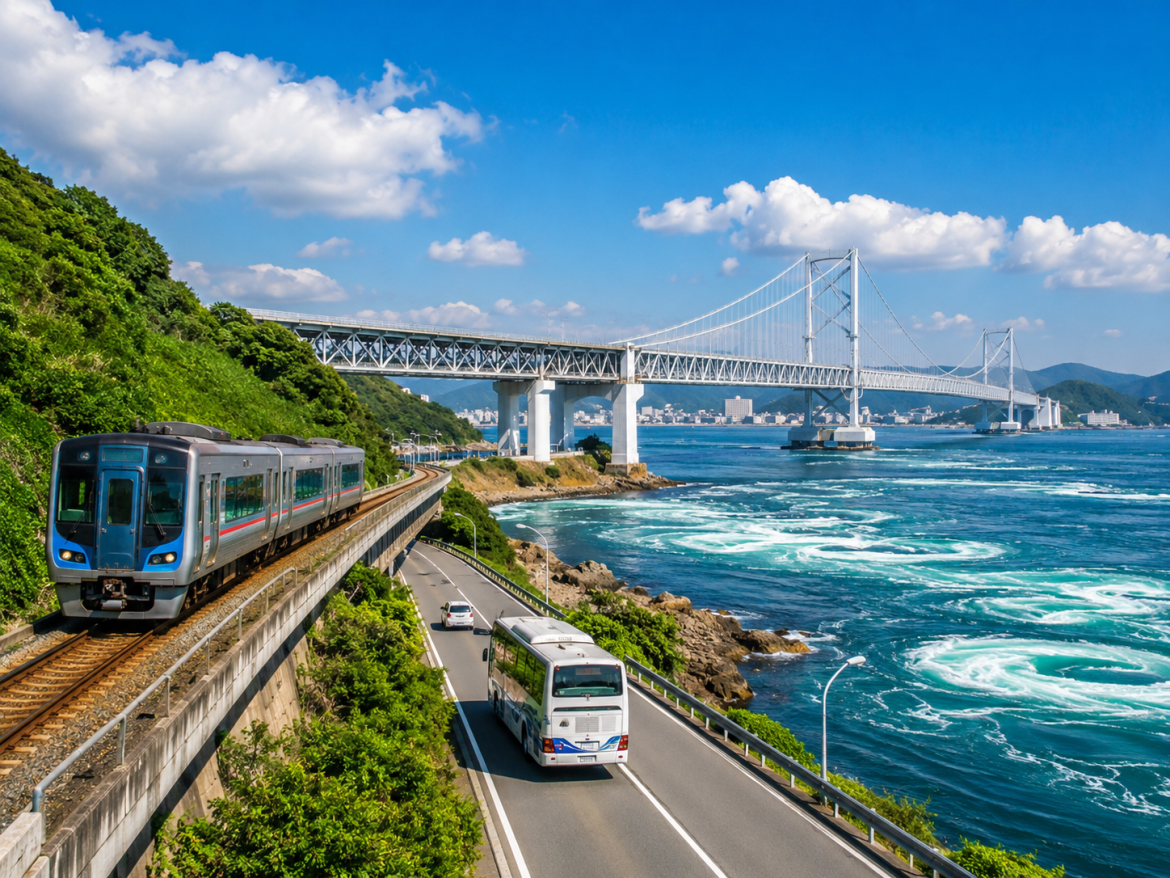

Osaka to Tokushima: which route should you take?
For a straightforward trip from Osaka to Tokushima, take a direct highway bus. It crosses Awaji Island and the Akashi Kaikyo and Onaruto bridges, reaching Tokushima Station without a transfer. Allow roughly 2½–3¼ hours, depending on the departure point and service, plus extra time for holiday traffic. The regular adult fare on the main Osaka–Tokushima routes is ¥4,100 one way.
The cheaper scenic alternative is Nankai Railway from Namba to Wakayamako, followed by Nankai Ferry to Tokushima Port. The ¥2,500 Tokushima Skip ticket covers the train and ferry, but not the final bus or taxi to Tokushima Station. Allow around 4–5 hours with workable connections; a long wait can make it slower.
Rail makes more sense if you are visiting Okayama and Takamatsu along the way, or already hold a suitable pass. There is no direct Shinkansen to Tokushima. Before choosing transport, decide whether you actually need Tokushima city, the Naruto attractions or the Iya Valley: they are different destinations.
| Option | Route and planning time | Cost guide | Best for | Main drawback |
|---|---|---|---|---|
| Direct highway bus | Osaka/Umeda or Namba → Tokushima Station; roughly 2½–3¼ hours | ¥4,100 regular one way; limited early-booking discounts | Most city-to-city trips, including luggage | Road congestion |
| Nankai train + ferry | Namba → Wakayamako → Tokushima Port → city; allow 4–5 hours or more | ¥2,500 train-and-ferry ticket, plus city transfer | Lower fares and a relaxed sea crossing | Several connections and a reduced ferry timetable |
| JR trains | Shin-Osaka → Okayama → Takamatsu → Tokushima; plan roughly 3–4 hours | Base fare plus Shinkansen and limited-express charges | Rail-pass holders or a multi-city itinerary | A substantial detour for a simple transfer |
| Rental car | Osaka → Kobe → Awaji → Naruto → Tokushima; around 2½–3 hours in favourable traffic | Rental, tolls, fuel and parking | A family or group exploring rural Tokushima | Cost and congestion on the bridge corridor |
| Kansai Airport bus | KIX Terminal 1 → Tokushima Station; scheduled about 2 hours 45 minutes | ¥5,000 one way | Arriving at KIX and continuing directly to Shikoku | Only a few departures each day |
The time ranges above are planning estimates, not guaranteed arrival times. For a broader trip, see our Kansai itinerary guide, Osaka travel guide and Osaka accommodation guide (Traditional Chinese).
Direct highway buses: the simplest Osaka–Tokushima journey
There are two main service groups to compare: Awa Express Osaka, serving JR Osaka Station and JR Namba/OCAT, and the Tokushima Bus Osaka route, whose services use stops such as Hankyu Sanbangai, Herbis Osaka and Nankai Namba. Selected departures serve Universal Studios Japan. A similar destination name does not mean the buses leave from the same terminal.
For the JR route between Osaka/JR Namba and Tokushima Station, the published regular adult fare is ¥4,100 one way or ¥7,380 return. Limited Hayauri 7 seats cost ¥3,280 and Hayauri 3 seats ¥3,690. Discount seats can sell out and some busy dates are excluded. The ¥7,380 return product requires travel within its ten-day validity; compare it with two available early-booking singles rather than assuming the return ticket is always cheapest.
Reserve a specific departure. The JR group normally opens sales one month and one day before travel. Check the operating company, boarding stop, date and ticket-display instructions before paying. Save the terminal map for finding your stop, but display the actual mobile ticket when boarding: the JR operator does not accept a ticket screenshot. Around major holidays and the Awa Odori period, book both directions early and avoid a tight onward train or flight connection.
Which Osaka bus terminal should you use?
| Stop on your ticket | Where to go | Useful distinction |
|---|---|---|
| Osaka Station JR Expressway Bus Terminal | Outside the Central North Exit, on the ground floor of the North Gate Building | Use the official JR Osaka terminal map |
| JR Namba / Minatomachi Bus Terminal / OCAT | Second floor of OCAT, connected to JR Namba | Use the official OCAT boarding map |
| Hankyu Sanbangai | The Hankyu Osaka-Umeda area | Separate from the JR terminal |
| Herbis Osaka | The west side of the Osaka/Umeda area | Do not wait at the JR terminal |
| Nankai Namba Highway Bus Terminal | The Nankai Namba station area | Different from OCAT; follow the Nankai boarding maps |
| USJ | The bus terminal specified in the reservation | Only selected services stop here |
Namba is the easiest place to make a costly mistake. JR Namba/OCAT and Nankai Namba are separate terminals, with a walk between them. Choose the actual stop nearest your hotel, then arrive early enough to find the departure bay without rushing.
Tokushima Station or Naruto?
Tokushima Station is the useful arrival point for city hotels, Awa Odori Kaikan, Mount Bizan and onward local transport. For the Otsuka Museum of Art or a Naruto resort, look for a service that explicitly stops there. Kosoku Naruto is a highway interchange stop, not the whirlpool viewing area.
Naruto Koen-guchi is particularly important to understand: it is a drop-off stop on Tokushima-bound services, not a boarding stop for your Osaka return. Plan the return from Kosoku Naruto, or from a museum/resort stop actually served by your reserved bus. Do not walk back to the outward stop expecting the same journey in reverse.
Returning to Osaka after a day trip
The JR timetable lists the last Tokushima Station departure at 19:45, reaching JR Namba at 22:10 and JR Osaka at 22:30. The separate Tokushima Bus group lists a later 20:45 departure to Hankyu Sanbangai, Herbis Osaka and Nankai Namba. These are different bookings and terminals; confirm your travel date and service calendar. Reserve the return first if you must be back that evening, and allow time to retrieve luggage and locate the stop.
Nankai train and ferry: lower fare, longer journey
The Tokushima Skip ticket combines a one-way Nankai journey from an eligible departure station to Wakayamako with a one-way ferry to Tokushima Port. The adult price is ¥2,500; children pay ¥1,250. Reserved accommodation on Nankai trains and ferry Green seats costs extra. The ticket is for the designated day, rather than an unlimited sightseeing pass.
- Start at Nankai Namba and take a suitable service toward Wakayamashi/Wakayamako.
- Change at Wakayamashi if your train does not continue to Wakayamako.
- Follow the connection from Wakayamako Station to the ferry terminal.
- Cross to Tokushima Port, then take a separately paid local bus or taxi into the city.
Buy the paper ticket at a participating Nankai ticket office or ticket machine. The reverse-direction Skip ticket from Tokushima Port is a separate purchase. Do not buy an ordinary online ferry ticket and assume the train discount will be added: the ferry website does not sell Skip through its normal web-reservation flow.
Use the reduced timetable, not an old ferry connection chart
From 1 August 2026 until further notice, Nankai Ferry has reduced service to six round trips daily. In particular, the former 19:10 Wakayama departure and 21:50 Tokushima departure are suspended. Check the reduced-service notice and current timetable before choosing your train. The operator has also announced an intended withdrawal around the end of March 2028, with the possibility of an earlier end if safe operation cannot be maintained; that is not a confirmed final sailing date.
Crossings generally take a little over two hours. Select the sailing first, then work backwards to your train. Complete pedestrian boarding formalities at least 15 minutes before departure; arriving at the railway platform 15 minutes before sailing is too late a target. Weather or maintenance can alter the service.
Tokushima Port is not beside Tokushima Station. The operator quotes about 25 minutes by city bus or 15 minutes by taxi, before any waiting time. Ferry and city-bus connections are not guaranteed. The Wakayama terminal guide and Tokushima terminal guide include official access maps and boarding instructions. A late-night arrival can leave you needing a taxi; check that final transfer before booking.
This route suits travellers with time to enjoy the sea crossing. It is less suitable for a short day trip, seasickness-prone travellers or anyone with a fixed appointment shortly after arrival.
JR via Okayama and Takamatsu: when the detour is worthwhile
The usual rail journey is Shin-Osaka → Okayama by Sanyo Shinkansen, Okayama → Takamatsu by Marine Liner, then Takamatsu → Tokushima by Uzushio limited express. A few Uzushio services run through from Okayama, so use the official Tokushima–Takamatsu rail timetable to check the exact connection. There is no railway across Awaji Island to make the direct road route a direct train route.
Allow roughly 3–4 hours from Shin-Osaka with a sensible connection, plus the journey from your Osaka hotel. Price the actual trains and seat types: the total combines a base fare, a Shinkansen charge and an Uzushio limited-express charge. A single universal fare would hide differences between services and reserved-seat seasons. For an isolated Osaka–Tokushima transfer, the bus is normally the better-value choice.
A nationwide Japan Rail Pass can make the rail route attractive if already justified by your wider trip. Hikari and Sakura are useful covered Shinkansen choices; using Nozomi or Mizuho requires the additional ticket specified by JAPAN RAIL PASS. The Kansai WIDE Area Pass does not cover the complete journey to Tokushima. Never assume that reaching Takamatsu on a regional pass also covers the onward Kotoku Line.
ALL SHIKOKU Rail Pass after 1 October 2026
The ALL SHIKOKU Rail Pass now has 3-day and 7-day adult options at ¥12,000 and ¥20,000. The 4-day and 5-day versions have been discontinued. New purchases exclude Shodoshima Ferry and Shodoshima Olive Bus; Iyotetsu is also excluded. Earlier purchases have specific transitional rules, so use the official revision notice for your ticket edition.
It covers ordinary non-reserved seats on eligible Shikoku trains and specified local railways, not the Osaka highway bus or Nankai Ferry. Rail coverage starts at Kojima on the mainland approach, leaving Okayama–Kojima and Osaka–Okayama to pay separately. It is for eligible foreign visitors with Temporary Visitor status. QR-ticket products and exchange-order products have different activation or collection procedures.
For just Osaka–Tokushima and back, skip this pass. Compare it for an onward journey through Takamatsu, Kochi, Oboke or Matsuyama. Add up the covered journeys you will actually take; local sightseeing buses, reserved accommodation and gaps in coverage still affect the budget.
Setouchi Round Pass: a five-day loop, not an unlimited rail pass
The Setouchi Round Pass is a different product from the JR Setouchi Area Pass. It links Osaka, Tokushima, Takamatsu and Hiroshima in either direction, using specified daytime buses and one Uzushio non-reserved train journey between Tokushima and Takamatsu.
The operator’s published package costs ¥17,700 and is valid for five days including the first bus-travel day. It includes one ride on each specified leg and a ¥2,000 shopping coupon for designated Shikoku Kiosk stores; overnight buses are excluded. See the official route map and package conditions. This is useful when that loop matches your plans, not a reason to squeeze three cities into an otherwise relaxed Tokushima break.
The Klook voucher must be exchanged for physical tickets at the specified Osaka Station or OCAT counter. Check counter hours and arrange bus reservations; a pass does not guarantee a seat on a sold-out departure. Complete the loop within the five-day validity, rather than interpreting it as a pass for a trip of at least five days.
Driving to Tokushima and renting locally
Driving follows the road corridor through Kobe, Awaji Island and Naruto. Allow roughly 2½–3 hours in favourable conditions, with substantially more time possible on busy weekends. Your exact starting point matters: collecting a car, leaving central Osaka and finding parking all add to the headline driving time.
Budget for rental charges, expressway and bridge tolls, fuel and parking. Use the NEXCO West toll search with your actual interchanges and ETC conditions instead of applying a single Osaka-wide toll. A group may split the cost, but a car is rarely necessary for a stay around Tokushima Station.
For Naruto, Oboke and the Iya Valley, driving gives you more flexibility between sights. An alternative is to take the bus to Tokushima and then compare Tokushima rental cars, avoiding an Osaka city drive and the bridge journey in a rental. Check the pickup branch, opening hours, return location and any one-way fee before booking.
For a stop on the way, our Awaji Island accommodation guide can help. The Shikoku autumn foliage guide is relevant if you continue into the mountains. Iya and Oboke are in western Tokushima; do not treat them as quick stops beside the city or Naruto.
Can you visit Tokushima or Naruto on a day trip from Osaka?
A city-only day trip is workable: arrive on an early bus, visit Awa Odori Kaikan and Mount Bizan, then leave time for a meal and your reserved return. With roughly five to six hours or more spent travelling, keep the sightseeing list short. Check individual attraction opening hours and ropeway operation separately.
For Naruto, build the day around the tide forecast and the specific attraction you want to visit. Whirlpool conditions do not peak at the same clock time each day. The Otsuka Museum of Art can take much of the available day, so combining it with several Tokushima city sights is ambitious.
An Osaka-departure Awaji/Naruto tour can reduce the transfer planning. Choose by the actual dated itinerary: whirlpool viewing, the museum and Awa Odori activities are not interchangeable inclusions, and a tour cannot guarantee natural whirlpools. Do not add the Iya Valley to an Osaka day trip.
Kansai Airport to Tokushima: check the direct bus first
If your flight lands at KIX, the direct airport bus avoids travelling into Osaka first. The official Tokushima airport-bus timetable shows an adult fare of ¥5,000 one way or ¥9,000 return, with a 14-day return validity. Terminal 1 to Tokushima Station is scheduled at about 2 hours 45 minutes.
On the timetable, Terminal 1 departures are 10:05, 12:20, 16:20 and 18:20; Terminal 2 departures are 13 minutes earlier. The last listed Tokushima Station departure for KIX is 16:45. Recheck the dated timetable when booking. Leave room for immigration, baggage collection and finding the correct bus stop; a landing time is not a landside-ready time.
If the direct service does not fit, compare an onward route via Kobe or Osaka with an overnight stay. Confirm every connection before leaving the airport, especially late in the day. Do not assume another direct bus will follow soon.
Luggage, children and accessibility
A direct bus usually means fewer luggage transfers than the railway or ferry route. However, underfloor space and acceptance rules depend on the operating company and vehicle. Check large suitcases, folding bicycles, sports equipment and strollers before travel. Keep passports, valuables and power banks with you; power banks must not be left in hold luggage on these buses.
Wheelchair users should contact the bus reservation centre before booking: coach steps, chair storage and assistance need individual confirmation. Nankai Ferry asks passengers needing assistance to notify staff; not every vessel has an onboard lift, and the shore-side assisted route may be needed. Do not infer step-free travel simply from the presence of a station or port elevator.
If taking the Shinkansen, bags whose three dimensions total more than 160 cm and up to 250 cm require the appropriate oversized-baggage seat reservation. See JR West’s luggage rules. Allow more transfer time at Okayama and Takamatsu if you need elevators or station assistance.
For families, a through bus is easiest for the city; the ferry offers a change of scene but adds waiting and transfers. Check the child-seat and fare rules with the chosen operator rather than assuming a young child occupying a seat travels free.
A practical two-day Tokushima itinerary
Spend the first day in Tokushima city after an early bus from Osaka. Leave your bags at your hotel if storage is available, then visit Awa Odori Kaikan, Mount Bizan and the central area. Stay near Tokushima Station if you will continue by public transport.
- For art and coastal scenery, use day two for the Otsuka Museum of Art or Naruto, then return from a confirmed highway-bus boarding stop.
- For the mountains, rent locally and dedicate day two to Oboke and Iya, with a realistic driving plan and return deadline.
- For a longer rail trip, continue to Takamatsu and reassess whether a Shikoku pass fits the remaining journey.
- For an Awaji road trip, split the coastal stops across an overnight stay rather than rushing through them en route.
Trying to fit Tokushima city, Naruto, Oboke and Iya into two days creates a transfer-heavy trip. Pick either the eastern coastal area or western mountain area for the second day.
Osaka to Tokushima FAQs
What is the cheapest route?
The ¥2,500 Nankai train-and-ferry ticket is a strong budget option, but add the Tokushima Port–city transfer. A limited ¥3,280 early-booking bus seat may be worth the extra money for a shorter, transfer-free journey.
Is there a direct train from Osaka to Tokushima?
No. You normally change at Okayama and Takamatsu, although selected Uzushio services run from Okayama to Tokushima without the Takamatsu change.
Does a JR pass cover the highway bus?
Do not assume so because the coach has JR branding. The nationwide rail pass and ALL SHIKOKU Rail Pass do not include this intercity highway-bus journey. The separate Setouchi Round Pass includes a specified Osaka–Tokushima bus leg.
Can I return from Naruto Koen-guchi?
No. It is a Tokushima-bound drop-off stop. Reserve the Osaka-bound bus from Kosoku Naruto or another stop explicitly offered on that service, and arrange the local journey to it.
Can I walk from the ferry terminal to Tokushima Station?
It is not a station-side terminal. Plan a city bus or taxi, and check late-arrival options before choosing your sailing.
Which route is best for a short stay?
Choose the direct bus for Tokushima city or a carefully planned Naruto visit. Choose the ferry if the crossing is part of the holiday, and JR if the detour matches your existing pass or wider itinerary.
The best choice depends on where in Tokushima you are going
For most Osaka–Tokushima journeys, reserve a direct bus from the correct Osaka terminal and finish at Tokushima Station. The train-and-ferry ticket is good value when you have time for its connections. JR is most useful as part of a larger Okayama–Shikoku trip, while a local rental car can simplify the mountain portion of your stay.
Before paying, confirm three things: your actual arrival area, your last usable return connection and what your ticket includes. That avoids the most common mistakes: confusing Osaka bus terminals, treating Naruto Koen-guchi as a return stop, or forgetting the transfer from Tokushima Port.