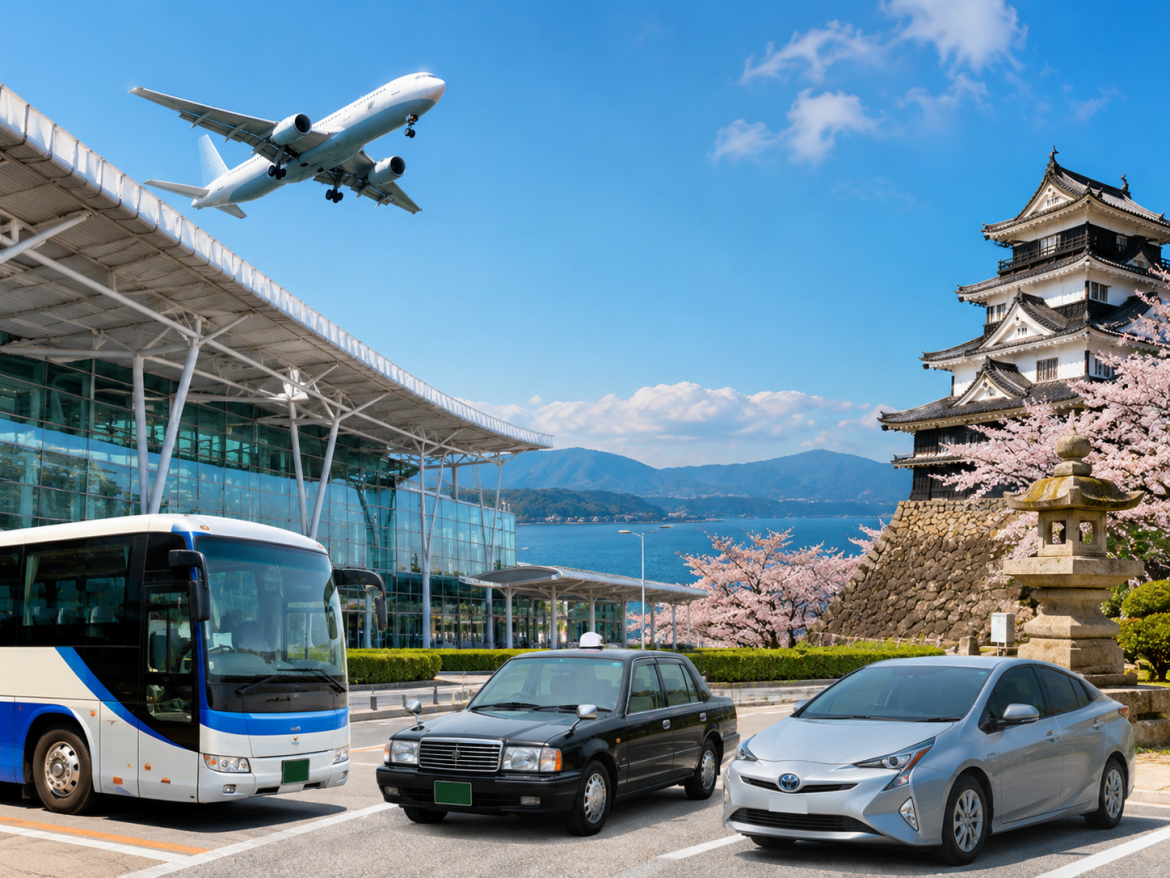

Saga Airport transport: station bus, shared taxi or rental car?
For Saga city or an onward train to Hakata, start with the ¥600 bus to Saga Station Bus Center. For Ureshino, Takeo or Yanagawa, a prebooked shared limousine taxi can be more practical than travelling through Saga Station. Rent a car when your trip connects several rural sights, rather than just because you are arriving at an airport.
Saga Airport has no railway station. The flight-linked bus timetable and the location of your first hotel are therefore more important than looking for an airport train. A cheap flight can still be a good choice, but compare the complete journey with the Fukuoka Airport to Hakata guide if your destination is Fukuoka.
| Option | Best for | Main trade-off |
|---|---|---|
| Saga Station airport bus | Saga hotels and onward rail | ¥600; about 30–35 minutes, then another journey if continuing |
| Airport bus + JR limited express | Hakata and central Fukuoka | One luggage transfer at Saga Station |
| Reserved shared limousine taxi | Ureshino, Takeo, Yanagawa and other covered areas | Fixed fare per passenger and designated stops; advance booking required |
| Ordinary taxi | Direct arrival at a Saga city hotel | Metered cost is higher than the bus |
| Rental car | Several countryside stops | Parking, fuel, tolls and rental conditions |
| Direct Hakata/Tenjin highway bus | Historically linked to Shanghai flights | Currently suspended; do not use as your main plan |
Airport bus to Saga Station: flight-linked, not a frequent shuttle
The adult one-way fare is ¥600. Domestic-flight semi-express services take about 35 minutes, while international-flight nonstop services take around 30 minutes. No seat reservation is required. Payment can be made with cash or a supported nationwide transport IC card such as nimoca, Suica or PASMO.
Check the flight-connection timetables and boarding information for your travel date. Separate schedules cover 1–24 October 2026 and 25 October 2026–27 March 2027. The domestic semi-express uses airport stop 1 and the international nonstop service uses stop 2; at Saga Station Bus Center, airport departures use stop 1. Read the route and flight label instead of assuming every departure uses the same airport stop.
The airport-bound timetable is tied to flight schedules. Airport departures are delayed when the corresponding flight arrives late, and international arrival processing can also affect departure time. Go to the boarding point after completing arrivals. Check again if the airline changes or cancels your flight, because connecting bus arrangements can change too.
A full bus is not a guaranteed seat on a second vehicle: extra services may be provided, but you may need the next bus or a taxi. On the return trip, select the correct flight-linked departure and keep a traffic buffer. A planned bus connection is not a substitute for meeting your airline’s check-in deadline.
Saga Airport to Hakata and Tenjin
The practical route is the airport bus to Saga Station, followed by a direct JR limited express to Hakata. The train journey is commonly around 36–45 minutes. With the airport bus, waiting and transfer, allow roughly 1½–2 hours overall rather than adding only the two moving times. For Tenjin, continue from Hakata by subway.
An ordinary non-reserved limited-express journey is around ¥2,300; a normal reserved seat costs more. JR Kyushu currently lists a Kyushu Net Ticket between Saga and Hakata at ¥1,300 for an ordinary-class reserved-seat limited express. It is an online product with its own booking, payment and ticket-use rules, not the fare automatically charged at every ticket machine.
Ordinary trains are another option if you have time, with the railway portion around ¥1,300, but they are slower and some journeys require a change around Tosu. Compare the discounted limited express before choosing a slower train solely to save money. With large bags, give yourself a comfortable transfer at Saga rather than booking a departure only a few minutes after the bus arrives.
Why the old direct Fukuoka bus is not the current default
The official Hakata/Tenjin bus notice says the service is suspended following the suspension of the Shanghai flight it connected with. The suspension began on 22 December 2025, with no restart date announced in the suspension notice. This is a specific route suspension, not a closure of the Saga Station airport bus.
Older timetables and fare pages remain searchable. Use the Saga Station and JR route unless a service notice confirms a service that actually operates on your date. If comparing a longer domestic journey before reaching Kyushu, see the Tokyo–Fukuoka transport guide.
Reserved shared limousine taxis to onsen towns and Yanagawa
Saga’s shared limousine taxis are designed for airport passengers travelling to designated places in Saga Prefecture and southwestern Fukuoka. They can run for one booked passenger, but they are not a walk-up taxi rank or a private car available at any time. Confirm that the listed stop serves your accommodation.
| Area | Normal per-person fare | Approximate journey | Useful stop examples |
|---|---|---|---|
| Ureshino | ¥4,000 | 60 minutes | Ureshino Onsen district |
| Takeo | ¥4,000 | 60 minutes | Takeo-Onsen Station south exit, onsen district, Mifuneyama Rakuen |
| Kashima | ¥4,000 | 50 minutes | Hizen-Kashima Station, Yutoku Shrine stop |
| Kanzaki / Yoshinogari | ¥3,500 | 40 minutes | Station south exits and Yoshinogari Historical Park |
| Ogi | ¥3,000 | 35 minutes | Ogi Station and designated city stops |
| Kurume | ¥3,500 | 60 minutes | JR Kurume and Nishitetsu Kurume stations |
| Yanagawa / Okawa | ¥2,500 | 25 minutes | Nishitetsu Yanagawa, Ohana and designated stops |
Use the shared-taxi coverage map, stop list and reservation rules before booking. Online reservations close at 16:00 two days before travel. Telephone reservations generally close at 16:00 the previous day, but bookings associated with ANA451 or ANA452 close two days before. Select your actual flight; a different flight’s booking does not protect you when your own flight is delayed.
Payment is normally cash. The allowance is one large suitcase, so discuss additional luggage and strollers before booking. ANA452 early-morning service costs 1.2 times the normal fare. For domestic-flight passengers sharing the same reservation and boarding/alighting point, the second and subsequent passengers receive half-price fares under the stated conditions.
This can make the shared taxi competitive for a couple or family, especially where rail would require several changes. It still uses designated stops and a shared schedule: a ryokan may need to collect you for the last leg. For Tara accommodation, for example, the listed Oura branch-office stop is not every hotel’s front door.
Other covered areas include Tosu, Taku, Kiyama, Kamimine, Miyaki, Arita, Omachi/Kohoku/Shiroishi, Tara, Omuta, Chikugo, Miyama and Oki. Consult the current directory for the operator serving your date, since some areas rotate companies by month. Do not assume an unlisted address is included just because it lies in the same municipality.
Ordinary taxis to Saga city
An ordinary taxi is a useful fallback when the bus is full, you arrive at an awkward time or your hotel is far from the station. The fare is metered, so request an estimate for the actual address rather than treating the airport bus fare as a point-to-point comparison.
For three or four travellers, the value comes from avoiding the station transfer and final walk. Check vehicle and luggage capacity, especially with a stroller. For a solo traveller staying beside Saga Station, the ¥600 bus is usually the more sensible starting point.
Rental cars and the airport’s ¥1,000 campaign
A car becomes useful when the itinerary includes Ureshino, Takeo, Yutoku Inari Shrine, Arita or Tara in the same trip. Compare Saga rental cars for the required dates and luggage capacity. A short Saga city stay alone rarely needs a car.
The official airport rental campaign runs from 1 April 2026 to 31 March 2027, with blackout dates and conditions. For eligible kei/compact classes, the first 24 hours’ basic rental is ¥1,000 per car with at least two eligible arriving passengers, or ¥2,000 for one. ANA457 arrivals are excluded. Fuel, additional time, optional cover and other charges need separate checking.
The 48-hour promotion was limited to 1 June–15 July 2026; it should not be assumed to apply in October just because the page title still mentions it. For the regular campaign, use the listed operator’s prescribed reservation route: phone by the previous day, or a listed campaign web option at least three days ahead. Blackout rental-start dates include 26 December 2026–3 January 2027.
A platform booking does not automatically qualify for the airport campaign, and other rental benefits cannot simply be stacked on top. Compare complete costs and cancellation terms before paying. If continuing toward Fukuoka’s western coast, the Itoshima transport guide can help decide when a car remains useful and when to return it.
JR or SUNQ Pass: decide from the rest of the trip
| Ticket | Reference adult price | Best use |
|---|---|---|
| Saga–Hakata Kyushu Net Ticket | ¥1,300 | A single booked limited-express journey |
| Northern Kyushu JR Rail Pass | 3/5 days ¥15,000/¥17,000 | Several eligible rail journeys across northern Kyushu |
| All Kyushu JR Rail Pass | 3/5/7 days ¥22,000/¥24,000/¥26,000 | A larger itinerary extending south |
| SUNQ Pass | Depends on area and duration | Several eligible bus journeys |
| Single bus tickets or IC payment | Actual fares | A simple arrival and short stay |
A JR Kyushu Rail Pass does not include the Saga Airport bus. Check JR’s eligibility and coverage and calculate the eligible train journeys. A trip including Nagasaki, Kumamoto, Fukuoka or Kagoshima merits a different calculation from a single ride to Hakata.
Likewise, compare a SUNQ Pass only if the onward itinerary uses enough covered buses. A pass cannot make the suspended direct Hakata service run.
From Saga Station to sightseeing and accommodation
Saga Station is a convenient base for onward JR journeys, but the castle and museum area is farther south. Store bags before walking or taking a local bus. A station-to-castle walk can take around half an hour depending on the exact starting point and pace; a taxi or city bus is easier in heat, rain or with limited mobility.
The Balloon Museum fits a central-city walk, while Yoshinogari, Ogi, Kashima, Takeo and Ureshino lie in different directions. If the main purpose is an onsen stay, going directly from the airport to that area is usually more coherent than entering Saga city first.
A relaxed Saga arrival-day plan
| Part of day | Plan after an early arrival |
|---|---|
| Morning | Airport bus to Saga Station; leave luggage |
| Late morning | City-centre walk and Balloon Museum area |
| Lunch | Eat in the centre without a tightly timed onward connection |
| Afternoon | Saga Castle History Museum and surrounding district |
| Evening | Stay in Saga or take a planned train to Hakata |
This is an itinerary outline, not a bus timetable. Check attraction opening days separately. If your priority is Ureshino or Yanagawa, make that the day’s main destination instead. A rental car adds flexibility, but it does not make Saga city, Takeo, Ureshino and Yanagawa a relaxed single-day circuit.
Families, larger bags and common mistakes
The airport bus stop is close to arrivals, making Saga a fairly straightforward airport for a family arriving for a city stay. For the Hakata train connection, a reserved seat can reduce the stress of finding seats together. For an onsen hotel, compare the family’s shared-taxi total with a suitable rental car, remembering that the taxi may still leave a final hotel connection.
Tell the taxi or rental provider about strollers and multiple large cases before booking. Fewer changes may be worth more than a small fare saving, but luggage capacity is not guaranteed merely by the number of seats.
- There is no airport JR station
- The Saga Station bus is different from the suspended direct Fukuoka bus
- A JR pass does not pay the airport bus fare
- Shared limousine taxis need an advance booking for your actual flight
- The airport rental promotion is not automatically added to a platform order
- Pick one main sightseeing area for a short arrival day
Saga Airport transport FAQ
How long does the bus to Saga Station take?
About 30–35 minutes depending on the service, plus any wait for the flight-linked departure. The adult fare is ¥600.
Can I use Suica?
Yes, the Saga Station airport bus accepts supported nationwide IC cards. Keep sufficient balance and follow the driver’s payment instructions.
How should I travel to Hakata?
Take the station bus and a JR limited express. Allow a realistic transfer and compare the online Kyushu Net Ticket with ordinary fares.
Is a shared taxi private and door-to-door?
No. It is a reserved shared service with specified areas and stops. Confirm the last leg to your hotel and any luggage needs.
Is the ¥1,000 car offer an all-inclusive price?
No. It is a conditional first-24-hours basic-rental offer for eligible vehicles and arriving passengers. Check additional charges, reservation deadlines and excluded dates.
Should I buy a rail pass for Saga Airport?
Not for the airport transfer alone. A pass is worth assessing only after adding the eligible longer train journeys elsewhere in Kyushu.
Which Saga Airport route is best?
For Saga city or Hakata, start with the inexpensive station bus and plan any train connection. For an onsen stay or Yanagawa, check the shared taxi before accepting several transfers. For a multi-stop rural trip, compare car rental and the airport campaign separately. The key is to match your flight, first hotel and onward route, then leave enough room for delays.