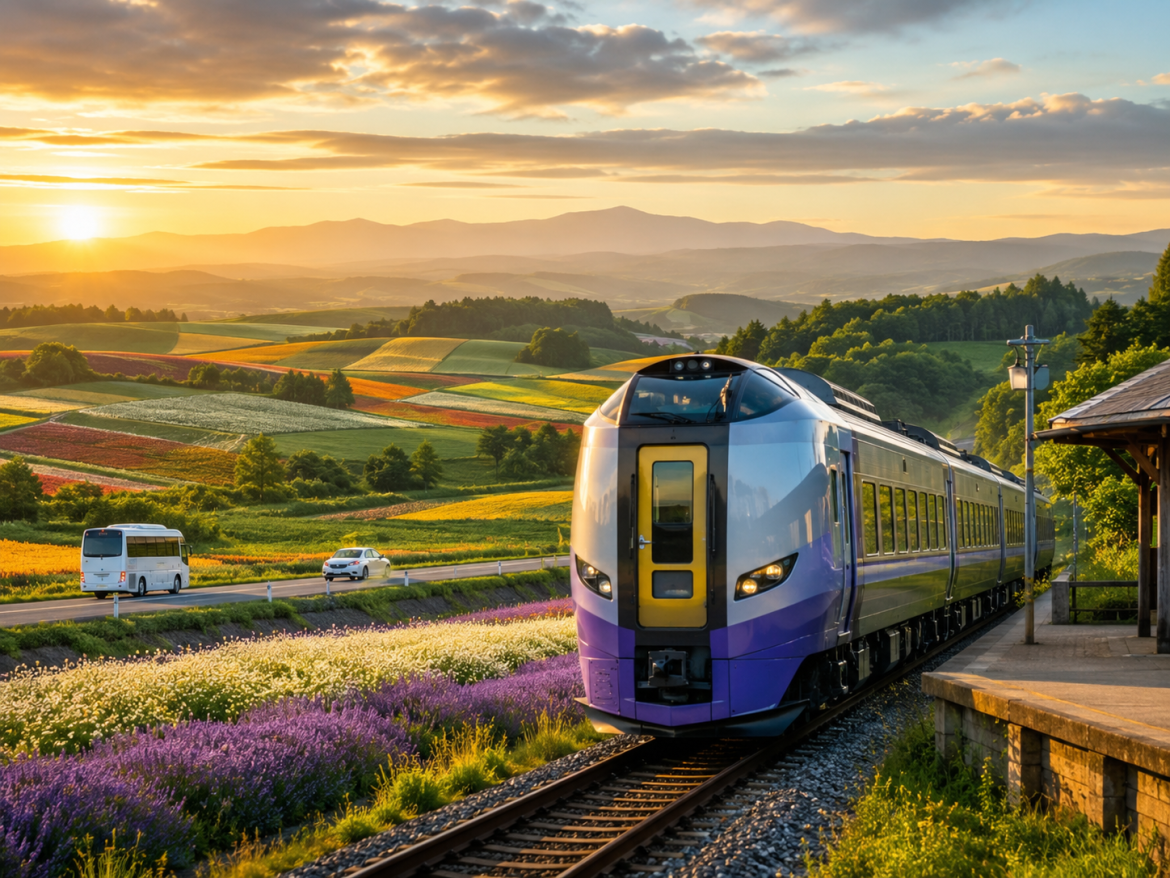

Plan Around the Season You Are Visiting
The 2026 seasonal train examples below are dated background. Norokko ended on September 23, 2026; the 2026 Lavender Express calendar has also finished. For a new trip, plan around ordinary trains via Takikawa or Asahikawa and use Nakafurano for Farm Tomita. Check JR’s seasonal train announcement before relying on a new direct service.
Traveling from Sapporo to Furano and Biei looks straightforward on a map, but the two areas should not be treated as a single station or attraction. Furano Station, Farm Tomita, Biei Station, Shirogane Blue Pond, Shikisai-no-Oka and Ningle Terrace are spread across a large rural area, and the transport between them is much less frequent than transport within Sapporo.
The best option therefore depends on what you actually want to see. A seasonal direct train is enjoyable if Furano itself is your main destination. JR via Asahikawa is the most reliable public-transport route to Biei. A one-day bus tour is usually the easiest choice for first-time visitors who want Farm Tomita, Shikisai-no-Oka and Blue Pond in the same day. A rental car offers the most flexibility, but winter driving should not be underestimated.
The 2026 summer railway season has ended: the Furano Biei Norokko Train’s final operating date was September 23, 2026. Its timetable below is historical, not a route available for a new trip. Use ordinary Furano Line trains and local road transport; future seasonal trains require a new operator announcement. Rural rail sections are outside the transport IC-card area.
If this is your first stay in the city, use the Sapporo travel guide and day-trip planner to decide which days should remain in Sapporo and which can be used for longer regional excursions.
For most first-time travelers with only one day, the editor’s recommendation is simple: choose an organized tour when you want several rural attractions, use JR when you want a slower railway-focused trip, and stay overnight when you want to explore both Furano and Biei without constantly watching the clock.
Quick Answer: What Is the Best Way from Sapporo to Furano and Biei?
| Transport option | Typical journey | Best for | Main disadvantage | Editor’s verdict |
|---|---|---|---|---|
| Seasonal Furano Lavender Express | About two hours from Sapporo to Furano | Rail fans, Furano stays and travelers prioritizing Furano | Does not stop at Biei or Farm Tomita | Fast and scenic, but not a complete Furano–Biei solution |
| JR via Asahikawa | Usually around two to two and a half hours to Biei, depending on the connection | Independent travelers and Biei-focused itineraries | Local connections are infrequent | Best year-round public-transport route to Biei |
| Highway Furano Go | Approximately two hours and 55 minutes to Furano | Budget travelers, luggage and Furano stays | Does not go to Biei and is slower than the seasonal express | Useful for Furano, not for a multi-stop sightseeing day |
| Organized day tour | Usually a full day of around ten to twelve hours | First-time visitors, solo travelers and non-drivers | Fixed stop durations | Easiest way to see several famous attractions in one day |
| Private charter | Customizable full-day route | Families, older travelers and small groups | Higher total price | Most comfortable option when divided among several passengers |
| Rental car | Approximately two and a half hours before sightseeing stops | Flexible summer and autumn road trips | Traffic, navigation and winter road conditions | Best flexibility outside winter for confident drivers |
The regional rail pass and a guided bus tour solve different travel needs. Rail does not by itself get you to every flower field or the Blue Pond; check the actual covered sections and last-mile transport. For the tour, check the selected departure date, route, meeting point, guide language, children and meal inclusions. Summer flowers are not a year-round attraction.
Are Furano and Biei Worth Visiting from Sapporo?
| Question | Practical answer |
|---|---|
| Worth a day trip? | Yes, especially during flower season, autumn scenery and winter illumination periods, but the day will be long. |
| Best for | Landscape photography, flower fields, rural scenery, seasonal experiences and relaxed sightseeing. |
| Can you visit both in one day? | Yes by tour, charter or car. By public transport, limit the number of attractions. |
| Recommended duration | Ten to twelve hours for a day trip; two days and one night for a relaxed visit. |
| Largest difficulty | Transport between stations and rural attractions. |
| Suitable for children? | Yes, but a private vehicle or tour is easier than repeated train and bus transfers. |
| Suitable for older travelers? | Yes when using a tour or charter; less suitable when relying on cycling and long transfers. |
| Should you stay overnight? | Recommended when visiting both Furano and Biei in depth, traveling with children, or adding Ningle Terrace after dark. |
| Who can skip it? | Travelers with only two or three days in Sapporo, people uninterested in seasonal scenery, and anyone expecting attractions immediately beside the train stations. |
Furano and Biei are worth visiting when rural Hokkaido is one of the main reasons for your trip. They are less suitable as a last-minute addition to a short Sapporo itinerary because transport consumes a substantial part of the day.
The most common source of disappointment is expecting to step off a train and immediately see lavender fields, Blue Pond or the famous Biei hills. The stations are gateways to the region, not the final attractions.
Understand the Geography Before Booking
Furano Station
Furano Station is useful for Furano city, Furano Marche and connections to local buses or taxis. It is not beside Farm Tomita, Ningle Terrace or the main Furano Ski Resort accommodation area.
Farm Tomita
Farm Tomita is in Nakafurano, north of central Furano. During the completed Norokko seasons, Lavender Farm Station was the closest rail stop, followed by a walk of approximately seven to eight minutes.
Outside the seasonal train period, Nakafurano Station is the alternative rail stop, but the walk to Farm Tomita takes approximately 25 minutes. A taxi or organized tour can be much more practical for families, hot summer days and travelers with limited mobility.
Biei Station
Biei Station is in the town center. It provides access to restaurants, bicycle rental businesses, the tourism association and sightseeing-bus departures, but it is not beside Blue Pond or the famous countryside roads.
Shirogane Blue Pond
Blue Pond is in the Shirogane area outside central Biei. A route bus, sightseeing bus, taxi, charter or rental car is required. Even after reaching the parking area, allow a short walk along the designated path to the viewing area.
Shikisai-no-Oka
Shikisai-no-Oka is south of Biei Station in the Panorama Road area. It is not a practical walk from central Biei for most day trippers. Travelers usually arrive by sightseeing bus, taxi, bicycle, charter or car.
Ningle Terrace
Ningle Terrace is beside New Furano Prince Hotel, not Furano Station. Use an appropriate local bus when the timetable works, take a taxi or visit as part of a tour. Trying to add it to a public-transport day trip without checking the return connection can leave you with a long wait or an expensive taxi journey.
Important 2026 Transport Changes
Furano Lavender Express Has Reserved Seats Only
The seasonal Furano Lavender Express operates directly between Sapporo and Furano. All seats are reserved, so travelers should reserve before boarding rather than arriving at the platform and expecting a non-reserved carriage.
The Furano Biei Norokko Train Ended in September 2026
The final operation was September 23, 2026. Preserve this distinction when reading older trip reports: Norokko and its Lavender Farm Station stop are not a current travel plan.
In that final season, both a basic-fare ticket and a reserved-seat ticket were required. Visitors had to arrange tickets before reaching unstaffed rural stops. For current ordinary trains, buy the necessary paper tickets or arrange an eligible pass before entering the rural section.
IC Cards Do Not Work Throughout the Entire Route
Do not assume that Kitaca, Suica, PASMO or another nationwide IC card can be tapped at every station. IC cards cannot be used between Takikawa and Furano, and the Asahikawa–Furano rural section should be approached as a paper-ticket or rail-pass journey.
If you need to adjust a fare aboard the sightseeing train, cash may be necessary. Carry some Japanese yen even when most of your Sapporo transport has been cashless.
Option 1: Seasonal Furano Lavender Express from Sapporo
The Furano Lavender Express is the fastest and simplest seasonal JR connection for travelers going directly from Sapporo to Furano. It avoids the transfer at Asahikawa or Takikawa and gives visitors a useful sightseeing window in Furano.
| Direction | Departure | Arrival | Travel time |
|---|---|---|---|
| Sapporo to Furano | 07:41 | 09:44 | Approximately 2 hours 3 minutes |
| Furano to Sapporo | 16:53 | 18:52 | Approximately 1 hour 59 minutes |
The completed 2026 operating calendar included June 6, June 7, June 13 through August 11, selected dates during the second half of August, and selected dates through September 23. It does not run every day throughout the year.
What the Direct Train Does Not Solve
- It does not stop at Biei.
- It does not stop at Lavender Farm Station.
- It does not deliver passengers directly to Farm Tomita.
- It does not include local buses or taxis.
- It does not leave enough time to visit every major Furano and Biei attraction independently.
If Farm Tomita is your main objective, check the Furano Line connection after arriving in Furano. Depending on the day and seasonal timetable, returning north to Lavender Farm Station or Nakafurano may consume a large part of the available sightseeing time.
Who Should Take the Furano Lavender Express?
This train is best for travelers staying overnight in Furano, visitors concentrating on Furano city, and railway enthusiasts who value the direct ride. It is less useful for a Biei-focused day or for travelers trying to combine Blue Pond, Shikisai-no-Oka and Farm Tomita before returning to Sapporo.
Option 2: JR from Sapporo to Biei via Asahikawa
The most dependable public-transport route to Biei is:
Sapporo Station → Limited Express Lilac or Kamui → Asahikawa Station → JR Furano Line → Biei Station
The total journey normally takes around two to two and a half hours, depending on the transfer. Limited express trains between Sapporo and Asahikawa have reserved seats, while the Furano Line connection is a local rural train with less frequent service.
Why This Route Is Better for Biei
Arriving at Biei Station gives you access to the tourism association, local sightseeing buses, taxis and bicycle rentals. It is the logical starting point for Blue Pond, Shirahige Falls, Shikisai-no-Oka and the Biei hills.
The official Biei View Bus connection guide currently recommends an early Sapporo departure on the Limited Express Lilac for passengers joining its 09:40 morning course. This illustrates an important point: a Biei day trip often requires leaving Sapporo shortly after 07:00.
Using the Biei View Bus
The Biei View Bus departs from Shiki-no-Johokan, approximately one minute on foot from Biei Station. The dated 2026 summer/autumn courses are:
| Course | Time | Main stops |
|---|---|---|
| Morning course | 09:40–12:45 | Blue Pond, Shirahige Falls and Shikisai-no-Oka |
| Afternoon course | 14:10–17:10 | Shikisai-no-Oka, Blue Pond and Shirahige Falls |
The route is particularly useful because it connects several attractions that are awkward to combine using ordinary buses. Online reservations normally close at 17:00 four days before departure. Passengers must check in at least 15 minutes before departure and present the booking QR code.
Same-day seats may occasionally be available, but advance booking is the safer choice during flower season, weekends and holidays.
Going to Furano via Takikawa instead
For Furano city rather than Biei, another year-round rail route is Sapporo → Lilac or Kamui → Takikawa → local Nemuro Line train → Furano. It avoids the Asahikawa detour, but sparse connections can erase the time saving. Compare the complete timetable in both directions before choosing it. Buy a through paper ticket or use an eligible pass; the rural section is outside the IC-card area.
Summer View Bus dates are not winter dates
The 2026 View Bus calendar finishes with October 9–12 departures after its main summer schedule. Those 09:40 and 14:10 courses are not a winter illumination timetable. Use the tourism association bus page for the season you will visit. A late illumination visit needs a confirmed return or prearranged taxi; a daytime bus pass does not create an evening service.
Option 3: Furano Biei Norokko Train
The following timetable and ticket rules describe the completed 2026 season only. The final day used a special timetable, so even these regular-service examples did not apply on September 23.
The retired Furano Biei Norokko Train operated between Asahikawa, Biei, Lavender Farm, Nakafurano and Furano on selected seasonal dates. Its slower pace and rural views make the journey part of the sightseeing experience.
| Example service | Asahikawa | Biei | Lavender Farm | Furano |
|---|---|---|---|---|
| Norokko No. 1 | 10:00 | 10:42 | 11:13 | 11:40 |
| Return Norokko No. 6 | Arrives 17:46 | 17:19 | 16:44 | Departs 16:14 |
The detailed timetable varies by service and operating date. Do not build an itinerary around a train shown in an old blog post without confirming that it runs on your exact travel date.
Ticket Rules That Are Easy to Miss
- All seats are reserved under the current timetable.
- A basic-fare ticket and a reserved-seat ticket are required.
- Passengers without a reservation may not board.
- Tickets are not sold at Lavender Farm, Bibaushi or Nakafurano stations.
- Buy the return ticket before entering the rural section.
- Do not rely exclusively on an IC card.
Is the Norokko Train the Best Way to Sightsee?
It was a memorable way to travel between Furano, Farm Tomita and Biei, but it was not the fastest. It did not reach Blue Pond, Shirahige Falls or the remote Biei hills. For a new trip, use ordinary trains to Biei or Nakafurano and arrange the final local connection.
Option 4: Highway Furano Go Bus
The Highway Furano Go links Sapporo with Furano without a train transfer. The July 1, 2026 summer timetable lists Sapporo departures of 08:50, 10:40, 12:10, 13:40, 14:50, 17:10 and 18:40 under the published summer timetable.
| One-way adult fare | ¥2,700 |
|---|---|
| Adult return fare | ¥5,100 |
| Approximate travel time | 2 hours 55 minutes |
| Rest stop | No scheduled rest stop |
| Facilities | Restroom, reclining seats, luggage compartment and Wi-Fi |
| Payment | Cash and eligible IC cards |
Advantages of the Highway Bus
- Lower return fare than many JR combinations.
- No train transfer.
- Large luggage can be placed in the luggage compartment.
- A restroom is available onboard.
- Useful for travelers staying overnight in Furano.
Disadvantages of the Highway Bus
- It does not travel to Biei.
- It does not stop at Farm Tomita.
- It is not designed as a sightseeing loop.
- The full journey has no scheduled rest stop.
- If a service is full, passengers may need to use an auxiliary seat or wait for another departure.
This bus is a practical Sapporo–Furano transfer, but it should not be mistaken for a Furano and Biei sightseeing bus.
See the official boarding-point map before leaving Sapporo. The July 1, 2026 return timetable lists Furano Station departures from 07:00 to 16:50; the outbound final departure from Sapporo is much later, so do not infer the last return from that list. Recheck the winter timetable and leave a backup connection.
Option 5: Furano and Biei Day Tour from Sapporo
A group tour is generally the easiest option for a first visit when your list includes three or more rural attractions. Typical seasonal routes combine Farm Tomita, Shikisai-no-Oka, Blue Pond, Shirahige Falls, the Biei countryside and sometimes Ningle Terrace.
The main advantage is not simply avoiding train tickets. The tour replaces several infrequent rail, bus and taxi connections with one vehicle. This makes it possible to see more without spending the day waiting beside rural stations.
The disadvantage is limited time at each stop. Travelers who want two hours for photography at Farm Tomita or a slow meal in Biei may find the schedule restrictive.
Who Should Choose a Group Tour?
- Solo travelers who do not want to pay for several taxis.
- First-time visitors who want the major attractions in one day.
- Travelers uncomfortable driving in Japan.
- Visitors traveling during a period when seasonal trains do not operate.
- Anyone who prefers one meeting point and one return journey.
What to Check Before Booking
- Exact meeting point in Sapporo.
- Language used by the guide.
- Whether admission to Shikisai-no-Oka is included.
- Whether Farm Tomita appears on the selected seasonal route.
- Whether Ningle Terrace is included.
- How much free time is provided at each stop.
- Cancellation rules for weather or insufficient participants.
- Whether infants need a reserved seat.
Option 6: Private Charter from Sapporo
A private vehicle with a driver offers the most comfortable balance between flexibility and convenience. It is especially useful for families with young children, older relatives, travelers carrying mobility equipment and groups that want to control the order of attractions.
The total price is considerably higher than a group tour, but the difference becomes smaller when divided among four to six passengers. A private charter also allows the group to shorten a stop that is not appealing and spend longer at a preferred flower field or restaurant.
Confirm the service duration, overtime charges, parking fees, child-seat arrangements and whether the driver can modify the route on the day.
Option 7: Self-Driving from Sapporo
Driving provides the greatest freedom for Patchwork Road, Panorama Road, Farm Tomita, Blue Pond, Shirahige Falls and viewpoints that do not have frequent public transport. It is normally the strongest option for a two-day Furano and Biei road trip outside severe winter conditions.
Before renting, read the Hokkaido car rental, insurance and winter-driving guide. Pay particular attention to full insurance coverage, the Hokkaido Expressway Pass, fuel policy, snow tires and the closing time of the rental office.
Advantages of Driving
- Freedom to stop at rural viewpoints.
- Easier transport between Furano and Biei attractions.
- More comfortable for children and luggage.
- Possible to stay in countryside accommodation.
- No need to organize the day around infrequent local trains.
Disadvantages of Driving
- Heavy traffic near famous flower fields during peak summer.
- Parking queues at Blue Pond and other attractions.
- Navigation may direct drivers onto unsuitable minor roads.
- Rural roads can be dark after sunset.
- Snow, ice, whiteout conditions and early darkness create serious winter risks.
Should First-Time Winter Visitors Drive?
Travelers without substantial snow-driving experience should use a train, tour or private transfer. Four-wheel drive and winter tires improve traction but do not remove the dangers of black ice, poor visibility or long stopping distances.
Technical ability to rent a vehicle is not the same as having the experience required to drive safely through a Hokkaido snowstorm.
JR Tickets and Rail Passes
| Ticket | Best for | Important conditions |
|---|---|---|
| Individual JR tickets | One isolated day trip or one-way journey | Reserve limited express and sightseeing-train seats separately |
| Sapporo–Furano Area Pass | Four-day routes including Sapporo, airport, Otaru, Asahikawa, Biei and Furano | Available to eligible non-Japanese passport holders |
| Full Hokkaido Rail Pass | Long-distance multi-region Hokkaido rail itineraries | Too expensive for a single Furano day trip |
| Highway-bus return ticket | Return travel between Sapporo and Furano | Does not cover Biei or local sightseeing transport |
| Organized tour ticket | Several attractions in one day | Fixed itinerary and meeting time |
Sapporo–Furano Area Pass Price
- Advance purchase: ¥11,000 per adult and ¥5,500 per child aged 6–11.
- Purchase at an eligible JR station: ¥12,000 per adult and ¥6,000 per child.
- Validity: four consecutive days.
- Eligible users: non-Japanese passport holders.
The pass covers JR travel in the designated area, including New Chitose Airport, Sapporo, Otaru, Asahikawa, Biei and Furano. It does not cover the Sapporo subway, Sapporo streetcar, local non-JR sightseeing buses or private taxis.
A normal Sapporo–Furano return journey via Asahikawa currently costs more than the advance-purchase pass, so the pass can be worthwhile even before adding Biei, Otaru or the airport. However, it is unnecessary when taking only the highway bus or an organized coach tour.
You can compare redemption conditions and available packages on the JR Sapporo–Furano Area Pass booking page.
Do Rail-Pass Holders Still Need Seat Reservations?
Yes. A rail pass covers eligible fares, but passengers should still issue reserved-seat tickets for limited express services. The retired Norokko also required reservations during its final season; a pass did not guarantee a seat.
If you choose rail, compare the regional pass with your exact journeys and budget separately for attraction access. Check eligibility, valid days, permitted trains and seat arrangements. This is not the same product as the all-Hokkaido JR Pass.
Ordinary bus passes and discounted rail tickets
The Biei–Shirogane one-day bus pass costs ¥2,000 for adults and ¥1,000 for children. It covers routes 39 and 42 between Biei Station and Shirogane Onsen for one day, not the section to Asahikawa and not the guided View Bus. Compare it with the rides you will actually take.
Eki-net Tokudane 1 is a train-, seat- and section-limited package of base fare plus reserved-seat limited-express fare; its price can vary and booking closes at 23:50 the previous day. A ticketless limited-express supplement is different and still needs a base-fare ticket. Do not mistake either for a flexible regional pass.
The official pass page and area map allow all non-Japanese passport holders to use the Sapporo–Furano Area Pass and Hokkaido Rail Pass, including eligible residents; bring the original valid passport. The regional pass excludes Tomamu and buses. The all-Hokkaido pass excludes the Hokkaido Shinkansen. Its adult advance prices are ¥22,000/¥28,000/¥37,000 for 5/7/10 consecutive days, with station purchase ¥1,000 more.
How to Reach Each Major Attraction
Sapporo to Farm Tomita
Historical Norokko route, available only during its completed operating seasons:
Sapporo → Asahikawa or Furano → Furano Biei Norokko Train → Lavender Farm Station → seven-to-eight-minute walk → Farm Tomita
Current ordinary-train alternative:
Sapporo → Asahikawa → Nakafurano Station → approximately 25-minute walk or taxi → Farm Tomita
For a same-day trip including Biei, a tour or car is normally much easier.
Sapporo to Biei Station
Sapporo → Limited Express Lilac or Kamui → Asahikawa → JR Furano Line → Biei
Reserve the limited express seat and allow enough transfer time at Asahikawa. The local Furano Line does not operate with urban frequency, so missing a connection can substantially alter the day.
Biei Station to Blue Pond
Use the Biei View Bus, an ordinary route bus, taxi, charter or rental car. Blue Pond is not within practical walking distance of Biei Station.
The Biei View Bus includes approximately 30 to 35 minutes at the pond. Allow around five minutes to walk between the parking area and the viewing route.
Biei Station to Shikisai-no-Oka
The easiest methods are the Biei View Bus, taxi, tour or car. Cycling is possible during suitable weather, but Biei’s landscape is hilly. An electric bicycle is more realistic than a standard bicycle for many visitors.
Furano Station to Ningle Terrace
Use a local bus serving the New Furano Prince Hotel area when the schedule aligns with your visit, or take a taxi. Ningle Terrace is not a short walk from Furano Station.
After an evening visit, verify the last bus before entering the forest area. A taxi may be the only convenient alternative later at night.
Use the official Biei sightseeing map to distinguish the Patchwork Road hills northwest of town, Panorama Road to the south and the separate Shirogane corridor for Blue Pond and Shirahige Falls. Choose one cluster before adding another; never enter private fields for photos. Check the date-specific JR timetable for the final complete connection to Sapporo, not just the last local departure.
Best Transport by Season
| Season | Best options | Main issue |
|---|---|---|
| Late spring | JR via Asahikawa, tour or car | Some flower fields may still be developing |
| Summer flower season | Tour, rental car and any newly announced seasonal rail services | Peak crowds, sold-out reservations and road congestion |
| Autumn | Rental car, tour or JR | Shorter daylight and changing seasonal schedules |
| Winter | Organized tour, JR or private charter | Snow, delays, ice and limited daylight |
| Rainy day | Tour, private charter or Furano-focused rail trip | Outdoor viewpoints may be less rewarding |
Summer
Summer provides the widest choice of seasonal trains and sightseeing tours. It also creates the strongest demand. Reserve operating trains, tours and accommodation early; do not book a trip on the assumption that the retired Norokko will return.
Lavender conditions depend on weather and variety. Do not assume that every field will be purple throughout the entire summer timetable.
Winter
Winter changes the emphasis from flower fields to snow-covered hills, illuminated Blue Pond, Shirahige Falls and Ningle Terrace. Ordinary public transport continues to require careful planning, while tours adjust their routes around later illumination times.
Check the selected product date carefully because winter itineraries, departure times and illumination periods differ from summer packages.
Physical Effort, Walking and Accessibility
Farm Tomita
The walk from Lavender Farm Station is short, but visitors still need to move across a large outdoor site. Paths, slopes, crowds and summer heat may be difficult for travelers with limited stamina.
Blue Pond
The final route from the parking area is relatively short, but winter snow and ice can make the surface slippery. A stroller may be inconvenient when snow accumulates.
Biei Hills
Biei’s scenic roads cover a wide area with repeated gradients. Standard bicycle rental is not a low-effort substitute for a bus or car. Travelers who rarely cycle should choose an electric bicycle, guided bus or taxi.
Ningle Terrace
Ningle Terrace follows a forest setting with wooden paths and steps. Snow and ice increase the difficulty in winter, particularly after dark.
Traveling with Large Luggage
Leave large suitcases at your Sapporo hotel whenever possible. They reduce flexibility on local trains and make transfers more stressful. Highway buses have luggage compartments, but local trains, sightseeing buses and small taxis may offer limited space.
For an overnight trip, send luggage ahead, use hotel storage or travel with a smaller overnight bag.
Traveling with Children
Furano and Biei are suitable for children, but the transport method matters more than the attractions themselves.
Best Choices for Families
- Private charter for maximum flexibility.
- Rental car outside difficult winter conditions.
- Group tour for school-age children comfortable with a long day.
- Two-day trip instead of a rushed public-transport day trip.
Potential Problems
- Early departure from Sapporo.
- Long periods seated on trains or coaches.
- Limited flexibility for naps on group tours.
- Hot outdoor conditions in summer.
- Cold, snow and slippery paths in winter.
- Few convenient places to stop between rural attractions.
When booking a tour or private vehicle, confirm whether infants need their own seat and whether a child seat can be provided.
Traveling with Older Visitors
A tour or private charter is generally easier than using a combination of limited express trains, local trains, buses and taxis. It reduces platform changes and long waits at rural stations.
For visitors who can walk short distances but not climb hills or stand for long periods, prioritize Blue Pond, Farm Tomita’s most accessible sections and vehicle-based viewpoints. Avoid planning a long Biei cycling route.
A private charter offers the greatest ability to shorten stops and remain inside the vehicle during poor weather.
Recommended Sapporo–Furano–Biei Itineraries
One-Day Organized Tour
| Approximate time | Plan |
|---|---|
| 07:30–08:30 | Meet in central Sapporo and depart |
| Late morning | Farm Tomita or another seasonal Furano attraction |
| Lunch | Furano, Biei or included tour meal |
| Afternoon | Shikisai-no-Oka, Blue Pond and Shirahige Falls |
| Evening | Return to Sapporo; some seasonal tours add Ningle Terrace |
This is the most efficient one-day plan for first-time visitors. The exact order changes with season, traffic and tour operator.
Independent Biei Day Trip by Train and View Bus
| Approximate time | Plan |
|---|---|
| Around 07:00 | Leave Sapporo by limited express |
| Morning | Transfer at Asahikawa and arrive at Biei |
| 09:40–12:45 | Join the morning Biei View Bus |
| 13:00–14:00 | Lunch near Biei Station |
| Afternoon | Explore central Biei, a nearby viewpoint or a short bicycle route |
| Late afternoon | Return through Asahikawa to Sapporo |
This route provides a realistic public-transport day without trying to force Furano into the same schedule.
Furano Railway Day: Historical 2026 Seasonal Example
| Approximate time | Plan |
|---|---|
| 07:41 | Depart Sapporo on the seasonal Furano Lavender Express |
| 09:44 | Arrive at Furano |
| Morning | Explore Furano city or connect toward Nakafurano |
| Lunch | Furano omurice, curry or local produce |
| Afternoon | Choose one main attraction rather than several distant stops |
| 16:53 | Return to Sapporo on the direct seasonal train |
These clock times describe the completed 2026 Lavender Express season. For a new trip, rebuild both directions with the current ordinary train connections via Takikawa or Asahikawa; they do not provide a complete Biei sightseeing day.
Two Days and One Night
Day 1: Travel from Sapporo to Biei, visit Blue Pond, Shirahige Falls and Shikisai-no-Oka, then stay in Biei or Furano.
Day 2: Visit Farm Tomita, Furano city and Ningle Terrace before returning to Sapporo.
This is the editor’s preferred itinerary for travelers who want more than quick photo stops. It provides flexibility if weather is poor on one of the days.
From New Chitose Airport to Furano and Biei
Most travelers should first reach Sapporo or connect through an appropriate JR route rather than attempting a complicated same-day airport arrival and full sightseeing itinerary.
The Sapporo–Furano Area Pass includes eligible JR travel from New Chitose Airport, making it more attractive when the airport journey, Sapporo, Otaru, Asahikawa, Biei and Furano fall within the same four-day period.
Use the New Chitose Airport to Sapporo transportation guide to compare the airport train, bus and taxi before planning the regional connection.
Do not schedule Farm Tomita or Blue Pond immediately after an international arrival unless you have a private transfer and substantial delay allowance. Immigration, baggage collection and weather-related transport disruption can make a tight connection unrealistic.
From Asahikawa and Asahikawa Airport
Asahikawa is a more convenient base than Sapporo for a Biei-focused itinerary. The JR Furano Line connects Asahikawa, Biei and Furano, while the Lavender Bus links Asahikawa, Asahikawa Airport, Biei, Kamifurano, Nakafurano and Furano.
The Lavender Bus does not accept advance reservations. Connections with flights and trains are not guaranteed, so allow extra time rather than treating it like a dedicated airport transfer.
Travelers arriving at Asahikawa Airport can often reach Biei more efficiently than travelers starting in central Sapporo. This can justify an open-jaw flight plan for a longer Hokkaido itinerary.
Food Planning
A full Sapporo day trip leaves limited time for a leisurely restaurant lunch. Tour participants should check whether lunch is included or whether they need to buy food during a short stop.
What to Eat in Furano
- Furano omurice.
- Local curry.
- Melon and melon desserts during the appropriate season.
- Cheese, dairy products and soft-serve ice cream.
- Local vegetables and wine-related products.
What to Eat in Biei
- Biei wheat bread and pastries.
- Local vegetable dishes.
- Potato-based meals.
- Dairy desserts.
- Seasonal produce.
Farm cafés and attraction stalls are useful for snacks, but they should not always be treated as a guaranteed full lunch. Opening hours and queues vary by season.
Do You Need to Stay Overnight?
| Travel plan | Overnight recommendation |
|---|---|
| One organized day tour | No; stay in Sapporo |
| Only Biei View Bus and town center | No; a Sapporo day trip is possible |
| Farm Tomita, Blue Pond, Shikisai-no-Oka and Ningle Terrace | Recommended unless using a comprehensive tour |
| Photography at sunrise or sunset | Yes |
| Traveling with young children or older relatives | Often worthwhile |
| Winter visit with evening illumination | Consider staying in Furano, Biei or Asahikawa |
Where to Stay
Stay near Furano Station for JR and bus convenience. Stay near the Kitanomine or New Furano Prince Hotel area for skiing, resort facilities and Ningle Terrace. Stay in Biei for early countryside access and a quieter atmosphere. Stay in Asahikawa for more restaurants, hotels and frequent limited express connections to Sapporo.
Book early for peak lavender dates, summer weekends, winter ski periods and major Japanese holidays.
Choosing your Sapporo base
Stay near Sapporo Station for an early JR or highway-bus departure. Odori or Susukino works well for restaurants, but adds a walk or subway ride and is only convenient for a tour when its stated meeting point is nearby. A late flight arrival may justify Chitose accommodation, yet it does not shorten the next day’s rural rail transfers. If most sights are around Biei, staying in Asahikawa is more efficient than repeatedly returning to Sapporo.
First-Time Mistakes to Avoid
- Assuming Furano and Biei are one destination. They contain multiple towns and widely separated attractions.
- Taking the Furano Lavender Express for Biei. The direct train terminates at Furano and does not stop in Biei.
- Getting off at Furano Station for Farm Tomita. Use Nakafurano for a new rail-based trip; Lavender Farm Station was served by the retired Norokko.
- Planning to use Lavender Farm Station after Norokko retirement. Use Nakafurano Station for a new rail-based Farm Tomita visit unless JR announces another service.
- Using the retired Norokko timetable as a current connection.
- Expecting an unreserved carriage on JR Hokkaido limited express trains. Reserve your seat before boarding.
- Relying only on an IC card. It cannot be used throughout every rural JR section.
- Planning Farm Tomita, Blue Pond, Shikisai-no-Oka and Ningle Terrace independently in one day. The waiting and transfer time makes the route fragile.
- Taking the Highway Furano Go and expecting it to continue to Biei. It is a Sapporo–Furano intercity bus.
- Underestimating Biei’s hills. Cycling routes include repeated slopes and substantial distances.
- Bringing large luggage on a day trip. Leave it in Sapporo or send it ahead.
- Arriving shortly before the last return service. Rural alternatives are limited and taxis can be expensive.
- Buying a full Hokkaido Rail Pass for one day. Compare the regional pass and individual fares first.
- Driving in winter without snow-driving experience. Winter tires do not eliminate ice or whiteout risks.
- Assuming summer attractions look identical throughout the season. Flower timing depends on weather and variety.
- Using last season’s tour route. Product stops and departure times can change between flower and illumination seasons.
Frequently Asked Questions
How long does it take to travel from Sapporo to Furano?
The seasonal Furano Lavender Express takes approximately two hours. The Highway Furano Go takes approximately two hours and 55 minutes, while normal JR routes involving a transfer may take longer.
How long does it take from Sapporo to Biei?
Allow around two to two and a half hours by limited express to Asahikawa and local train to Biei, depending on the connection.
Is there a direct train from Sapporo to Furano?
The Lavender Express operated on specified dates in the completed 2026 season. Check a new JR announcement before planning a future direct train; otherwise transfer at Takikawa or Asahikawa.
Is there a direct train from Sapporo to Biei?
The normal year-round route requires a transfer at Asahikawa. Seasonal sightseeing arrangements may vary, but travelers should plan around the Asahikawa connection.
Does the Furano Lavender Express stop at Biei?
No. It travels directly from Sapporo to Furano via Iwamizawa, Takikawa and Ashibetsu.
Does the Furano Lavender Express stop at Farm Tomita?
No. It terminates at Furano Station. Farm Tomita is closer to seasonal Lavender Farm Station or Nakafurano Station.
What is the nearest station to Farm Tomita?
Lavender Farm Station was the closest during Norokko operation. After its September 2026 retirement, plan around Nakafurano Station, roughly a 25-minute walk or a taxi ride from Farm Tomita.
Can I use Suica or another IC card to Furano?
Not throughout the whole journey. IC cards cannot be used between Takikawa and Furano, so buy the correct paper ticket or use an eligible rail pass.
Do I need to reserve the Furano Lavender Express?
The completed 2026 Lavender Express season used all-reserved seating. For a future season, confirm operation first and then arrange seats under the announced rules.
Was the Norokko Train reservation-only?
Yes, during its final season. The service has now ended, so those reservation rules are historical rather than a current booking option.
Has the Norokko Train ended?
Yes. Its final operating date was September 23, 2026; do not assume a replacement uses the same schedule or station stops.
Is the Sapporo–Furano Area Pass worth buying?
It can be worthwhile when your four-day itinerary includes a Sapporo–Furano return journey plus Biei, Asahikawa, Otaru or New Chitose Airport. It is unnecessary for travelers using only a coach tour or highway bus.
Does the rail pass cover Blue Pond buses?
No. The Sapporo–Furano Area Pass covers eligible JR trains, not ordinary local sightseeing buses, private tours or taxis.
Can I visit Furano and Biei in one day without a car?
Yes, but an organized tour is usually the most realistic method. Independent public-transport travelers should reduce the number of attractions.
Can I visit Farm Tomita and Blue Pond in one day by train?
It is technically possible on selected timetables, but the route requires careful coordination of JR and local transport. A tour or car is more reliable.
How do I get from Biei Station to Blue Pond?
Use the Biei View Bus, an ordinary route bus, taxi, private charter or rental car. It is not a practical walk from the station.
Can I walk from Biei Station to Shikisai-no-Oka?
It is not recommended for an ordinary day trip. Use a sightseeing bus, taxi, car or bicycle.
Is cycling around Biei difficult?
The landscape is hilly, so the ride can be demanding. An electric bicycle is more suitable for many visitors.
Is a Furano and Biei day tour suitable for children?
Yes, particularly for school-age children who can manage a long coach day. For infants and toddlers, confirm seat requirements and consider a private charter.
Is the trip suitable for older travelers?
Yes when using a tour, taxi or charter. Repeated public-transport transfers and countryside cycling are less suitable for limited mobility.
Can I bring a large suitcase?
You can use highway-bus luggage storage, but large suitcases are inconvenient on local trains and sightseeing buses. Leave them in Sapporo whenever possible.
Should I drive from Sapporo in winter?
Only experienced snow drivers should consider it. Other travelers should use JR, a group tour or a private transfer.
What happens if bad weather affects a tour?
Cancellation and refund rules depend on the operator. Review the selected product’s policy and monitor messages from the operator before departure.
Should I stay overnight in Furano or Biei?
Stay overnight when you want both regions in depth, plan sunrise or evening photography, travel with children, or want Ningle Terrace after dark without rushing back to Sapporo.
What is the easiest option for a first visit?
A Sapporo-departure day tour is the easiest option for seeing several major attractions. JR is better for travelers who prefer a slower, more independent trip.
Sapporo to Furano and Biei Transportation Summary
Furano and Biei are among the most rewarding regional excursions from Sapporo, but the journey only works smoothly when you plan beyond the first train station. Furano Station is not Farm Tomita, Biei Station is not Blue Pond, and the famous viewpoints are spread across a large rural area.
When a new operating season is announced, the seasonal Furano Lavender Express can offer a direct rail journey to Furano, but it does not stop at Biei or Lavender Farm Station. It is best for a focused Furano visit or an overnight stay.
For Biei, the most reliable public-transport route is the limited express from Sapporo to Asahikawa, followed by the Furano Line to Biei. Combining this with the Biei View Bus creates a realistic independent day trip.
The Highway Furano Go offers an affordable and luggage-friendly transfer to Furano, but it does not solve transport around Biei. Use it for an overnight Furano stay rather than an ambitious multi-attraction day.
A group tour is the editor’s recommended choice for first-time visitors who want Farm Tomita, Shikisai-no-Oka, Blue Pond and other rural sights in one day. Families and groups seeking more control should consider a private charter.
Self-driving provides the best flexibility during suitable road conditions, particularly for a two-day trip. In winter, inexperienced snow drivers should use a tour, train or private vehicle instead.
Finally, reserve seasonal trains and tours early, carry a paper ticket or eligible rail pass for rural JR sections, and never plan the day around an old timetable. If winter skiing is your main priority rather than countryside sightseeing, compare this route with the Sapporo to Niseko transportation guide before choosing where to spend your overnight stay.