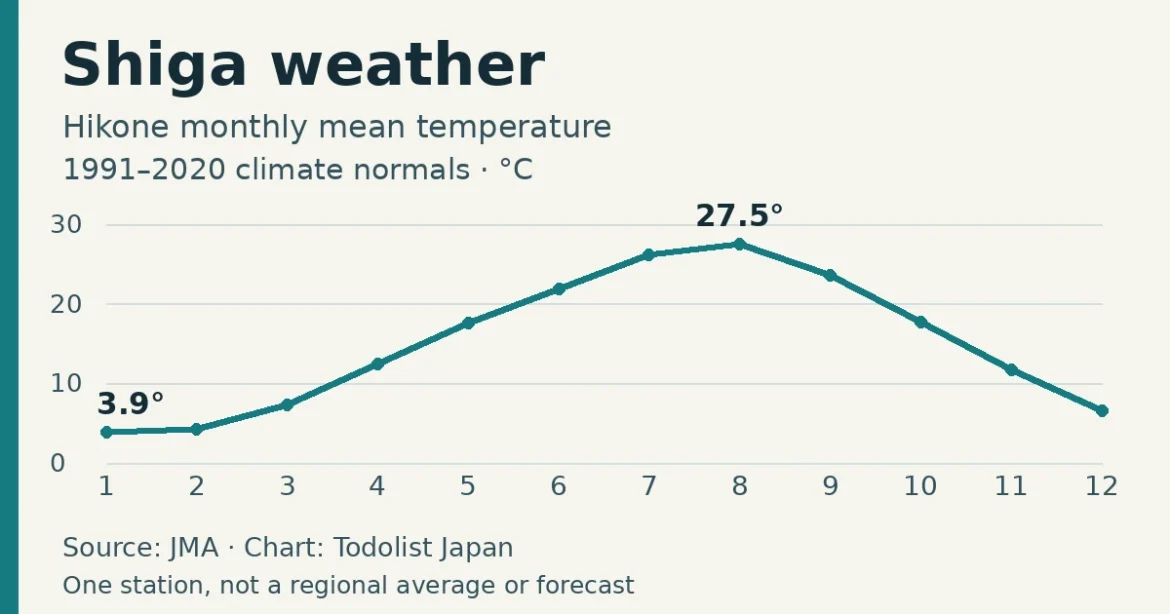
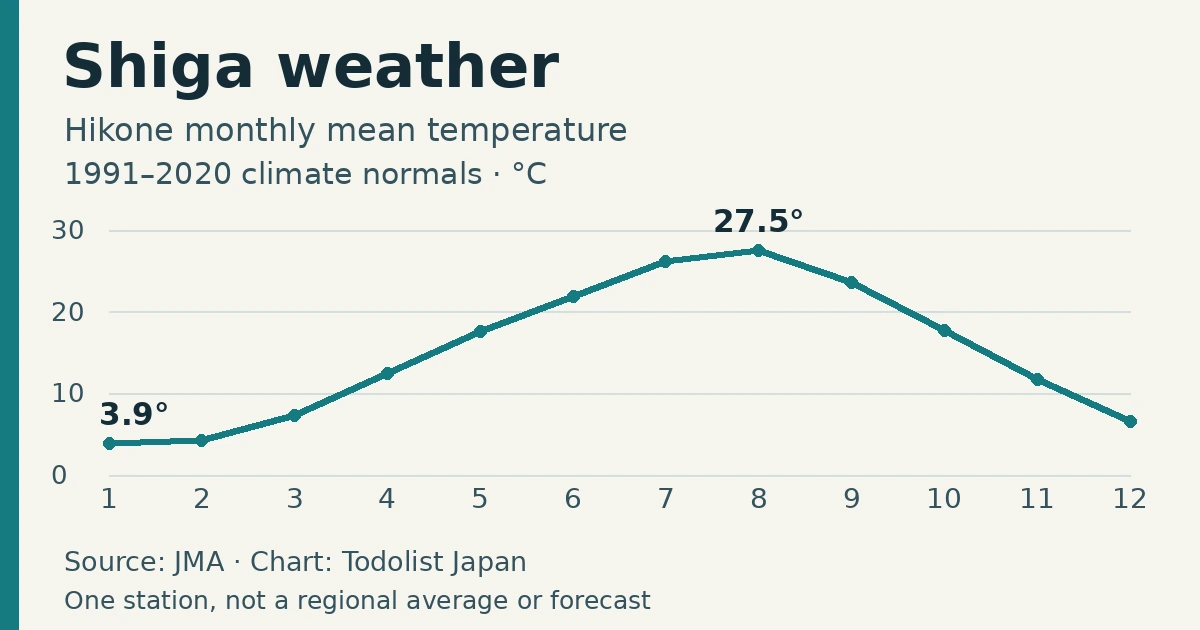
The opening chart is Todolist Japan’s original visualization of Hikone monthly mean temperatures for 1991–2020. It is not an official JMA graphic, a prefecture-wide average or a daily forecast.
Shiga weather needs a regional plan. A day around Otsu and the southern shore of Lake Biwa can feel very different from a winter outing to Nagahama, Makino or the mountains above the western shore. If your itinerary includes Biwako Valley, use its mountain conditions and operating notice as well as the forecast for the town below.
For a first visit centred on walking, temples and the lake, April–May and October–November are useful starting points. Spring blossoms, autumn colour and snow scenery each have their own location-specific timing. None can be guaranteed by choosing a calendar month, and a lakeside breeze does not make hot summer days harmless.

South, north and mountain Shiga: why one temperature is not enough
Otsu and Kusatsu are practical southern bases for access from Kyoto. Farther north, Nagahama and the northern lake area have a different winter-snow exposure. Takashima stretches along the western shore and into mountain districts, so even its place name is too broad to describe every stop with one weather number.
Hikone is on the eastern shore. Its long-running JMA station provides the reference table below, but it is not an “Otsu average” or an average of all Shiga. Mountain sites such as Biwako Valley and Mount Hiei require their own temperature, wind and surface-condition checks. Avoid the shortcut of subtracting a fixed three to seven degrees from the lowland forecast.
For a Biwako Valley outing, the Kyoto to Biwako Valley transport guide explains the train, bus and ropeway stages. A train reaching Shiga Station does not establish that the bus connection or ropeway is operating as you expected.
Shiga monthly climate: Hikone station normals
The values below are JMA’s 1991–2020 normals for Hikone station, number 47761. They describe the long-term seasonal pattern at that station. Average daily highs and lows are not temperature limits, and monthly rainfall totals are neither daily predictions nor a measure of how many days will be rainy.
| Month | Mean °C | Average high °C | Average low °C | Rainfall mm |
|---|---|---|---|---|
| Jan | 3.9 | 7.1 | 1.0 | 112.0 |
| Feb | 4.2 | 7.7 | 1.0 | 99.6 |
| Mar | 7.3 | 11.6 | 3.5 | 114.9 |
| Apr | 12.4 | 17.4 | 8.1 | 117.3 |
| May | 17.6 | 22.6 | 13.5 | 146.9 |
| Jun | 21.8 | 26.0 | 18.4 | 175.6 |
| Jul | 26.1 | 30.2 | 22.9 | 219.0 |
| Aug | 27.5 | 32.1 | 24.1 | 124.6 |
| Sep | 23.6 | 27.6 | 20.2 | 167.7 |
| Oct | 17.7 | 21.8 | 14.0 | 140.7 |
| Nov | 11.7 | 15.6 | 8.0 | 85.8 |
| Dec | 6.5 | 9.9 | 3.2 | 105.9 |
Winter is not uniformly dry: the table still shows substantial precipitation in January and December. Summer can be hot at lake level, with an August average high above 32°C. Plan around the daily weather and your activity rather than using “beside a lake” as a substitute for heat or rain preparation.
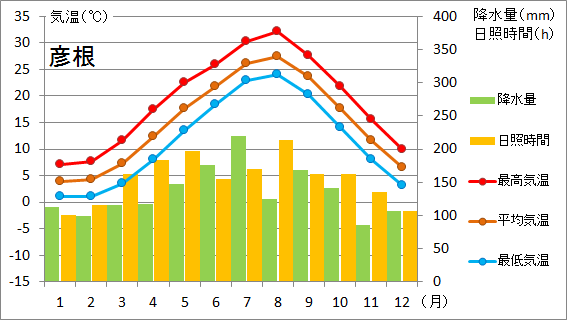
Hikone climate reference: lines show average daily high, monthly mean and average daily low temperature; green bars show precipitation and yellow bars sunshine. This is neither an Otsu or prefecture-wide average nor a daily forecast.
Shiga weather and what to wear in every month
January: snow plans need local confirmation
A winter trip to the northern lake area may encounter snow or ice, while conditions can be different around the southern shore. Makino’s tree-lined road does not wear a fresh coat of snow every day. Treat snow scenery as weather-dependent, and check transport before making it the sole purpose of a long excursion.
Use a warm coat, removable insulating layers, gloves and a scarf. For forecast snow or slush, wear suitable waterproof footwear with grip. Confirm winter tyres, chains and road restrictions for a drive; a clear road at your starting point does not prove the whole route is clear.
February: winter continues at the lake and above it
Cold weather remains relevant even when lowland plum blossoms begin attracting attention. A mountain snow activity needs the resort’s opening, snow and lift information, not simply a February date. Wind can make time spent waiting outside or standing at a viewpoint feel much colder.
Keep winter layers and choose clothes that are easy to adjust on heated transport. Add waterproof protection for snow play. Use hand warmers according to their instructions and do not rely on them as a replacement for appropriate clothing and shoes.
March: warming lowlands, variable northern and mountain conditions
March can bring milder afternoons while snow or icy surfaces remain possible in northern or elevated areas. Early spring wind also matters for lakefront walks and cycling. The first blossoms somewhere in Kansai do not mean the northern Lake Biwa cherry trees are at their peak.
Pack long sleeves, a sweater and a wind-resistant jacket, with warmer options if your route includes the mountains. Use grippy closed shoes and carry rain protection. Keep a scarf or similar layer for an exposed boat deck or a long wait beside the lake.
April: follow the blossoms by site
April is a useful month for cherry blossom planning, but do not assume Shiga is exactly one week behind Kyoto every year. Kaizu Osaki, Hikone and Otsu can progress differently. Use the actual bloom reports and transport arrangements for the specific destination.
A light midlayer and jacket suit changeable spring conditions. Keep something warmer for early starts, evening viewing or a lake cruise. Cycling can create a different wind exposure from strolling through a sheltered street, so pack for the activity as well as the forecast temperature.
May: fresh greenery and flexible outdoor plans
Fresh greenery makes May appealing for lakeside towns and the Makino tree avenue. This does not promise an uninterrupted run of clear days. Biwako Terrace can offer a broad lake view when conditions allow, but cloud and wind may change whether a mountain visit is worthwhile.
Light long sleeves or short sleeves with a compact outer layer give flexibility. Take sun protection for open lakeside paths and a wind-resistant jacket for higher ground. Before travelling to a ropeway, read the operator’s current status rather than relying on a saved timetable.
June: keep a local rainy-day alternative
Rainy-season conditions can affect walking, cycling and boat plans. Ordinary rain may still permit a short town visit, while warnings or severe weather require a more substantial change. A distant “indoor alternative” that depends on multiple rural connections may be less practical than staying near your base.
Choose breathable, quick-drying clothes with rain protection, spare socks and shoes that grip wet surfaces. Keep a bag for wet gear. Add an indoor break between outdoor stops and avoid slippery paths or waterside routes when official advice calls for caution.
July: rain and summer heat can overlap
The rainy season does not end on a fixed date every year. When hot weather arrives, shade and rest still matter around Lake Biwa. Swimming, SUP and other water activities should follow the facility’s season, local rules and the conditions on the day.
Wear light breathable clothing and carry water, a hat and sun protection. Use activity-appropriate footwear and safety equipment. Thunderstorms or strong winds are reasons to leave exposed water and open ground, not simply reasons to put on a raincoat.
August: the hottest month in the station normals
August’s normal average high in Hikone is 32.1°C. Open lakefront paths and event queues can feel demanding, especially in the afternoon. If attending a fireworks event, check that year’s official schedule, admission arrangements and weather notices rather than copying a previous year’s date.
Plan cooling breaks and carry enough water for the time between shops or stations. Light clothing is useful, but avoid an itinerary that depends on walking all afternoon in the sun. A summer evening event can remain warm and crowded after sunset.
September: lingering heat and wind-related disruption
Early autumn can still be warm at lake level. Typhoons and strong winds can affect trains, boats and mountain facilities, even when a stop looks close to Kyoto on the map. Check the service notices for the exact JR line and onward transport used by your itinerary.
Keep summer-weight clothes with a thin long-sleeved layer. Pack rain protection, but prioritise route changes when severe weather is expected. Allow enough flexibility to return earlier rather than depending on one late connection after a remote stop.
October: comfortable walking does not mean peak foliage
October can be a useful time for town walks and cycling in suitable weather. Makino’s metasequoia avenue is generally still in its green season into October; do not book an October trip on the promise of its famous late-autumn brick-coloured foliage. Mountain and lowland colour seasons differ.
Wear light long sleeves with an adjustable jacket. A warmer midlayer helps for the evening, a boat deck or higher ground. Continue checking rain and typhoon information instead of assuming autumn has removed those risks.
November: choose one foliage area and watch its reports
Autumn colour progresses by site and elevation. Takashima’s official tourism guide places the metasequoia avenue’s usual colour window in late November to early December, with annual variation. The colour is often described as brick red or brown, rather than a uniform bright maple red.
Bring an insulating midlayer and warm outer layer, adding gloves or a scarf for long photography stops. Use designated parking and stay alert to traffic along the avenue. A photo plan should never require standing in the road or stopping a car where it obstructs traffic.
December: winter conditions and uncertain ski opening dates
December brings a return to winter preparation. Snow, icy roads and resort opening dates depend on actual conditions and operating decisions. Do not assume every lake-view terrace or ski facility runs throughout the month, or that winter automatically produces a cloudless panorama.
Pack a warm coat, removable insulation and footwear suited to the expected surface conditions. Check the resort and access-road notices before leaving. If winter driving is unfamiliar, consider a simpler rail-accessible lowland day rather than using a mountain road to save a transfer.
Shiga’s rainy season and local backups
JMA’s Kinki regional rainy-season normals run from around 6 June to around 19 July. These dates describe the seasonal transition rather than a fixed stretch of continuous rain, and actual onset and ending dates vary each year. Heavy rain is possible after the normal ending date too.
Keep the backup close to the area where you are staying. Otsu, Hikone, Nagahama and Omihachiman are separate bases; shortening one local route can be more useful than crossing the lake area repeatedly during poor weather.
Biwako Valley, lake cruises and cycling: what to check
For Biwako Valley, read the official operating status, weather and seasonal facilities information. Strong winds and other conditions can affect the ropeway or activities. A valid admission ticket is not a weather guarantee; review cancellation and change conditions before purchasing.
For a lake cruise, check the operator’s sailing notice and dress for time on an exposed deck. For cycling, choose a route appropriate to the forecast and your experience, with an easy way to shorten it. A full-lake ride is a different undertaking from a short rental-bike outing around one town.
When conditions deteriorate, reduce the route rather than adding another faraway attraction. Hikone, Nagahama, Omihachiman and Otsu are separate bases with different onward travel. A backup close to the station you are already using is often more practical than crossing the lake area several times.
Shiga weather FAQ
Is Shiga colder than Kyoto?
It depends on the place, season and exposure. A sheltered Kyoto street, Otsu lakefront and Biwako Valley summit are not equivalent locations. Use the forecasts for your actual stops instead of a blanket prefecture-to-city comparison.
Will I definitely see snow at the Makino metasequoia avenue?
No. Snow scenery depends on the current weather and how recently snow has fallen. Check local reports before travelling, and do not assume a winter month guarantees snow-covered branches.
Does the monthly table describe Otsu?
No. It uses Hikone station on Lake Biwa’s eastern side. It is clearly labelled so that a northern or southern itinerary is not planned around an invented prefecture-wide average.
What should I wear to Biwako Terrace?
Take an extra adjustable layer and check the mountain forecast and operating information. Wind and elevation matter, and a fixed temperature subtraction from the lakeshore cannot describe every day.
When is the best time for the metasequoia autumn colour?
Late November to early December is the usual window. Check current reports because the timing and appearance vary; October is generally too early for the famous late-autumn colour.
When do the Kaizu Osaki cherry blossoms peak?
Use the current local blossom reports rather than a fixed 10 April promise. The useful planning season is spring, but weather changes the exact progress each year and different Shiga sites need separate checks.
Do I need winter tyres everywhere in Shiga?
Equipment needs depend on the route, forecast and restrictions. Discuss the exact journey with the rental company. Northern and mountain roads need particular attention, while a clear lowland road is not proof of safe conditions farther along.
Can the Kosei Line be disrupted by wind?
Strong weather can affect rail services, so check JR West’s current operation information for the route and direction you will use. Do not assume an outward train guarantees an unchanged return service hours later.
Is Lake Biwa swimming possible all summer?
Follow the opening period and safety rules of the specific beach or activity provider. Heat, lightning, wind and water conditions can change a plan even within the advertised season. Access to the shore does not automatically mean swimming is permitted.
Is a rainy Shiga day still worthwhile?
In ordinary rain, a shorter town-based plan with indoor breaks can work. Severe-weather warnings need a different response: follow official advice, avoid exposed or flood-prone areas and consider remaining near your accommodation.
Climate data and live forecasts
The table uses 1991–2020 normals for Hikone station (47761). Use the packing and route ideas to plan your trip, then check local forecasts and operator notices before departure.