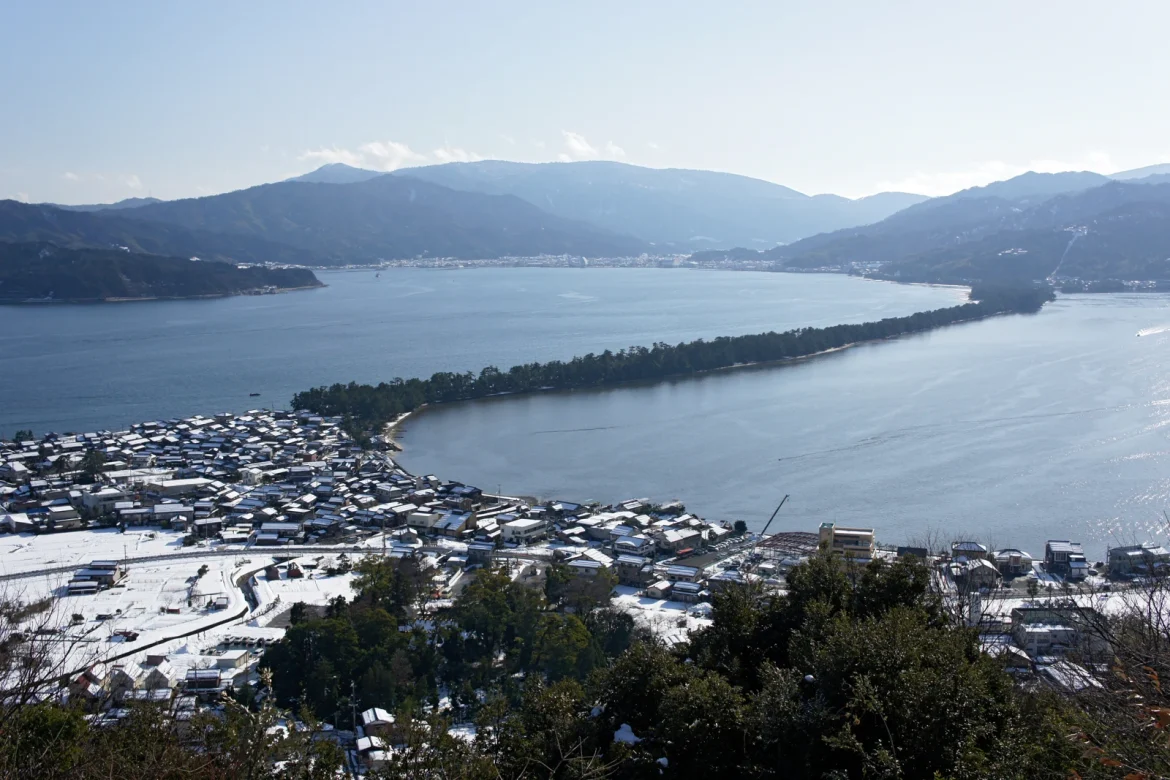
Getting from Osaka to Amanohashidate is straightforward on a map, but the quality of the day depends on much more than the advertised two-to-three-hour journey. The important decisions are how early you can arrive, whether you want to reserve a train seat, how you will cross between the south and north sides of Amanohashidate, and what return service you are willing to commit to.
For most independent first-time visitors, the train is the most flexible choice. A common route is Osaka Station → JR Limited Express Kounotori → Fukuchiyama → Kyoto Tango Railway → Amanohashidate Station. It normally requires a transfer at Fukuchiyama, but it gives you more useful departure choices than the direct highway bus.
The direct Osaka highway bus is simpler and usually cheaper, but from October 1 2026 there are only three departures from Osaka Hankyu Sanbangai: 09:30, 12:40 and 17:50. The earliest reaches Amanohashidate at 12:18. That makes the bus attractive for a transfer-free journey but much less attractive if your goal is to maximise a one-day sightseeing visit.
Amanohashidate is worth the trip from Osaka when the coastal scenery itself is one of your priorities. It is less convincing as a casual extra stop in an already crowded first Japan itinerary: the round trip consumes several hours before you have crossed the 3.6 km sandbar, visited a viewpoint or continued to Ine.
For a first visit, choose one of three clear strategies: take an early train for the most independent sightseeing time; use a guided tour if you specifically want Amanohashidate and Ine in one day; or stay overnight if you want both viewpoints, the sandbar and Ine without constantly watching the clock.
If you are still choosing an Osaka base, the Osaka travel guide explains why Umeda is particularly useful for regional day trips. Travellers arriving immediately before the excursion can also compare airport access in the Kansai Airport to Osaka transport guide.

Osaka to Amanohashidate: Quick Verdict
| Option | Typical journey | Best for | Main drawback |
|---|---|---|---|
| JR + Kyoto Tango Railway | About 2 hr 20 min or more depending on connection | Independent day trips, flexible return, rail-pass users | Usually requires a Fukuchiyama transfer and Kounotori seat reservation |
| Direct highway bus | About 2 hr 32–48 min | Transfer-free travel and lower cost | Only three Osaka departures; earliest post-revision arrival is 12:18 |
| Guided day tour | Usually a 9–11 hr organised day | Amanohashidate + Ine without coordinating local buses | Fixed sightseeing time and less freedom |
| Rental car / private charter | Variable with traffic and weather | Families, groups, luggage, Amanohashidate + Ine | Tolls, parking, traffic and winter driving conditions |
Best overall for a first independent day trip: take an early limited express from Osaka and return by rail.
Best for the lowest-effort Amanohashidate + Ine day: use an organised tour rather than trying to force long-distance rail, local buses, two sightseeing areas and a fixed Osaka return into the same timetable.
Best for a slower visit: stay one night around Amanohashidate or Miyazu. This removes the pressure to choose between the viewpoints and Ine.
Transport Changes and Seasonal Services to Check
Osaka highway-bus fares and times changed on October 1 2026
The current revision matters because many older English guides quote fares that are now too low. From October 1 2026, a one-way adult fare from Osaka/Umeda or Shin-Osaka to Amanohashidate Station is ¥3,400–¥3,900, with the exact fare depending on the operator’s travel-date fare band.
The three departures from Osaka Hankyu Sanbangai leave at 09:30, 12:40 and 17:50. They reach Amanohashidate Station at 12:18, 15:12 and 20:22 respectively. Only the first outbound service stops at Shin-Osaka after the revision.
Selected autumn dates have a through Amanohashidate → Shin-Osaka train
On specified dates in October and November 2026, Kounotori 20 is extended north from Fukuchiyama. On those operating dates, it leaves Amanohashidate at 14:57 and reaches Shin-Osaka at 17:27 without requiring a Fukuchiyama transfer.
This is useful but should not be treated as the standard daily route. Check the operating date before building the itinerary around it.
The October–November 2026 operating notice lists the exact dates. The 14:57 departure is an early return, so it is useful for a short visit rather than a full afternoon at both viewpoints.
Use the current Kyoto Tango Railway timetable
The current base timetable is the version effective March 14 2026. Northern Kyoto rail connections are much less frequent than the urban railways in Osaka, so an old screenshot can create a long wait at Fukuchiyama.
Route 1: Osaka to Amanohashidate by Train
The most practical independent route is:
JR Osaka Station → Limited Express Kounotori → Fukuchiyama → Kyoto Tango Railway → Amanohashidate Station.
Allow roughly 2 hours 20 minutes or more depending on the connection. Unlike an Osaka–Kyoto trip, this is not a route where missing one train simply means waiting five minutes for the next one.
Rail cost depends on the selected trains and seat type. On the Kyoto Tango Railway section alone, Fukuchiyama–Amanohashidate has an adult base fare of ¥800; a reserved limited-express seat adds ¥950. Add the JR Osaka–Fukuchiyama fare and Kounotori charge to compare the complete journey, or use an eligible regional pass. See JR-West’s fare guide rather than treating a local-train quote as the total limited-express price.
Step 1: Start at JR Osaka Station
Kounotori services depart from JR Osaka Station, not Nankai Namba and not the Shinkansen platforms at Shin-Osaka. This makes Umeda the most convenient Osaka base for an early start.
If you are staying in Namba, allow time for the Osaka Metro or another local connection to Osaka/Umeda before the intercity train. For comparison, our Osaka to Kyoto transport guide explains the difference between Osaka Station, Osaka-Umeda and Shin-Osaka; the same station-name confusion can affect this trip.
Step 2: Reserve a seat on Limited Express Kounotori
Kounotori ordinary cars operate as reserved seating. Do not treat it like an ordinary JR rapid train where you can tap an IC card and board whichever carriage is convenient.
Seat bookings open one month before travel at 10:00 Japan time through JR-West’s reservation system. Pass holders still need the seat reservation; a pass alone does not reserve a place on a particular train.
Reserve the service that gives you a sensible Fukuchiyama connection. On a long day trip, saving 20 minutes by choosing a better connection is more useful than saving a small amount of money and spending the difference waiting at a transfer station.
Step 3: Change at Fukuchiyama
At Fukuchiyama, continue toward Amanohashidate on the Kyoto Tango Railway. Depending on the service, the onward train may be a local train or a limited express.
Do not assume every Kyoto Tango Railway train leaves from a completely separate station area. Some limited-express operations use JR-side tracks at Fukuchiyama. Follow the live platform display for your specific train rather than walking automatically toward a remembered platform number.
Step 4: Arrive at Amanohashidate Station
Amanohashidate Station is the correct rail gateway for the southern sightseeing area. You do not need another bus simply to reach the sandbar, Chion-ji or the southern viewpoint.
The south end of Amanohashidate is about a five-minute walk away. Amanohashidate View Land’s lift and monorail base is about five to seven minutes from the station.
Is the Kansai WIDE Area Pass Worth It for Amanohashidate?
The current five-day Kansai WIDE Area Pass costs ¥12,000 for an adult and ¥6,000 for a child. Amanohashidate is included in its valid area, and the pass covers reserved seats on Kounotori within the conditions of the pass.
The official eligibility rules require a passport issued by a foreign government and Temporary Visitor entry status. Its validity is five consecutive calendar days, not five separate travel days. The basic pass does not include local sightseeing boats, View Land admission or the buses to Ine.
For a traveller buying only one return journey between Osaka and Amanohashidate, compare the pass price against the exact regular fares for your selected trains before purchasing. The pass becomes much easier to justify when the same five-day period also includes another substantial JR-West journey such as Kinosaki Onsen, Okayama, Himeji, Shirahama or Kansai Airport.
The pass does not cover the Osaka–Amanohashidate highway bus. It is a rail product, so do not buy it with the assumption that every regional transport mode is included.
Compare the JR West Kansai WIDE Area Pass product options, including any packages that add local Amanohashidate/Ine sightseeing tickets. Check the exact package inclusion before paying, because a basic rail pass and a rail-pass-plus-local-sightseeing package are not the same product.
Does the Japan Rail Pass Cover Osaka to Amanohashidate?
The nationwide Japan Rail Pass covers the eligible JR portion, but the Kyoto Tango Railway section beyond Fukuchiyama requires a separate fare and, when applicable, a limited-express charge. This also applies when a JR through train continues onto the private railway. The official Japan Rail Pass coverage table explicitly lists these extra-charge sections.
This is one reason the Kansai WIDE Area Pass is unusually relevant here: its published coverage specifically extends to Amanohashidate. Always compare the actual validity of the pass you hold rather than relying on the words “JR Pass.”
Route 2: Direct Highway Bus from Osaka
The highway bus is the easiest route to understand: board in Osaka and get off at Amanohashidate Station without changing trains. It is also usually cheaper than buying a full limited-express rail journey.
The trade-off is frequency. From October 1 2026, the timetable is:
| Osaka departure | Shin-Osaka | Amanohashidate arrival | Practical use |
|---|---|---|---|
| 09:30 Osaka Hankyu Sanbangai | 09:40 | 12:18 | Only realistic outbound bus for a same-day sightseeing trip |
| 12:40 Osaka Hankyu Sanbangai | Does not stop | 15:12 | Better for an overnight stay |
| 17:50 Osaka Hankyu Sanbangai | Does not stop | 20:22 | Evening transfer / overnight arrival |
The corresponding Amanohashidate departures for Osaka are 07:13, 12:25 and 16:45. The 16:45 service reaches Osaka/Umeda at 19:28 and also serves Shin-Osaka at 19:19.
Why the bus is less attractive for a sightseeing day than it first appears
If you take the earliest outbound bus and the last return bus, you arrive at 12:18 and must leave at 16:45. That gives you only 4 hours 27 minutes on the ground before allowing time to return to the bus stop.
That is enough for a focused visit: lunch, View Land and part of the sandbar, or the south side plus a boat journey. It is not a comfortable schedule for both major viewpoints, a full sandbar crossing and Ine.
Current bus fare
From October 1 2026, the adult one-way fare between Osaka/Umeda or Shin-Osaka and Amanohashidate Station is ¥3,400–¥3,900 depending on the applicable fare band. Child fares follow the operator’s published child rules.
The operator’s current Osaka timetable and fare bands also show the boarding locations. Osaka departures use Hankyu Sanbangai; the return Osaka/Umeda stop is at Hankyu Department Store, so the departure and arrival points are not interchangeable.
Reservations are sensible because services are limited, and the official tourism guidance states that highway-bus bookings can be made from one month before travel. Road congestion, accidents and severe weather can delay buses, so do not schedule a tight onward reservation immediately after the planned arrival.
Train or Highway Bus: Which Should You Choose?
| Question | Train | Highway bus |
|---|---|---|
| Best for a full day? | Yes; earlier and more flexible combinations are possible | Weak if using bus both ways because earliest arrival is 12:18 |
| Transfers | Usually one at Fukuchiyama | None from Osaka to Amanohashidate |
| Seat planning | Kounotori requires a reservation | Reserve the highway-bus seat |
| Traffic risk | Lower road-traffic exposure | Arrival can be delayed by road conditions |
| Large luggage | Manageable but transfer still required | Less platform handling; check baggage rules |
| Pass value | Kansai WIDE Area Pass may be useful | Rail passes do not cover the expressway bus |
| Best for overnight arrival | Good | Very good if the departure time suits your hotel plan |
For a first-time same-day trip, the train wins because usable sightseeing time matters more than eliminating one transfer. For an overnight visit, the bus becomes more attractive because a midday or evening arrival is no longer a serious disadvantage.
Route 3: Guided Amanohashidate and Ine Day Tour from Osaka
A guided day tour makes the most sense when your real goal is not simply Amanohashidate but Amanohashidate plus Ine. Those two destinations are individually straightforward, but combining intercity rail, a local sightseeing area and a second coastal town creates a timetable-heavy day.
When comparing Osaka/Kyoto tour packages, check the actual departure point, total duration and whether the viewpoint ride and Ine Bay cruise are included or paid separately. A multi-stop tour occupies a full day.
The advantage is coordination: you trade route freedom for a single meeting point, pre-arranged transport and a fixed return. The disadvantage is equally clear: if you want two hours simply walking the sandbar or lingering over lunch, an organised tour gives you less control.
A separate Amanohashidate and Ine day tour from Osaka is another option to compare. Compare meeting location, included tickets, languages and actual time at each stop rather than choosing solely by headline price.
Route 4: Rental Car or Private Charter
Driving is most useful when Amanohashidate is part of a wider northern-Kyoto trip rather than a simple return from Osaka. A car makes it much easier to combine the south side, Fuchu/Kasamatsu, Ine and accommodation that is not immediately beside a station.
The drawbacks are tolls, parking and variable road conditions. On busy sightseeing weekends, traffic around Amanohashidate can erode the time saved by having a car. In winter, snow and ice change the calculation completely; visitors without winter-driving experience should not rent a car merely to avoid a train transfer.
A private charter can make sense for four or more people, travellers carrying substantial luggage, families with young children, or groups including older travellers who would find repeated rail and bus transfers tiring. For a private customised Kansai charter from Osaka, have the provider confirm an Amanohashidate–Ine route, driving hours, overtime, tolls, parking and luggage capacity before booking.
Which Ticket or Pass Should You Buy?
If your wider trip continues to Hiroshima or Miyajima, also compare the Kansai–Hiroshima Area Pass with your complete itinerary. HARUKA is only the Kansai Airport access leg; a HARUKA ticket alone does not cover Osaka to Amanohashidate. Adding Miyama to Amanohashidate and Ine is best treated as a structured tour or multi-day drive, not an improvised public-transport extension.
| Ticket / pass | Current key point | Best for | Important limitation |
|---|---|---|---|
| Regular rail tickets | Buy the exact Osaka–Amanohashidate itinerary and required reserved seat | One isolated trip with no other long JR journeys | Compare total cost against passes |
| Kansai WIDE Area Pass | ¥12,000 adult / 5 consecutive days | Amanohashidate plus other substantial JR-West travel | Eligibility applies; highway buses are excluded |
| Kyoto by the Sea Amanohashidate & Ine Free Pass 1 Day | ¥3,550 adult | Heavy local sightseeing around Amanohashidate and Ine | Does not replace your Osaka intercity journey or cover highway buses |
| Osaka highway-bus ticket | ¥3,400–¥3,900 one way from Oct 1 2026 | Direct, transfer-free travel | Very limited frequency |
| Nationwide Japan Rail Pass | Useful on JR portions depending on validity | Travellers already using the national pass | Do not assume the complete Kyoto Tango Railway section is included |
When the local ¥3,550 pass makes sense
The one-day Kyoto by the Sea Amanohashidate & Ine Free Pass includes Kyoto Tango Railway ordinary/rapid services and limited-express non-reserved seats, designated local buses, the Amanohashidate sightseeing boat, Kasamatsu Park cable car/lift and the Ine Bay cruise.
It is strongest when you are genuinely using several of those components. If your plan is only Amanohashidate Station → View Land → lunch → station, buying individual local tickets is simpler.
If you want a reserved limited-express seat on Kyoto Tango Railway, the local pass does not automatically turn that reserved seat into a free upgrade; the required reserved-seat charge is separate.
The local pass’s current coverage and prices are separate from the JR-West rail pass. View Land is not one of its included attractions; the included northern viewpoint is Kasamatsu Park.
What Happens After You Reach Amanohashidate Station?
Use the official Amanohashidate area map (PDF) to locate the station, southern pier, sandbar, northern pier and both viewpoint entrances before deciding how to cross.

This is where the destination becomes easier than many maps make it look—and then more spread out than many day-trip itineraries admit.
Amanohashidate Station → south end of the sandbar
Allow roughly five minutes on foot. Chion-ji, the rotating bridge, Amanohashidate Pier and the start of the pine-covered sandbar all cluster on this southern side.
Amanohashidate Station → Amanohashidate View Land
The lift/monorail base is about five to seven minutes from the station. The round-trip ride and park admission currently cost ¥1,000 for adults and ¥500 for primary-school children; junior-high-school students and older pay the adult fare.
The chairlift takes about six minutes. The monorail takes about seven minutes and normally runs every 20 minutes. Wheelchair users can access the monorail boarding level using the dedicated elevator; the monorail is therefore the practical option instead of the chairlift.
Check View Land’s accessibility and maintenance notices before travelling. Wheelchair access depends on the monorail operating; it is not available on monorail inspection days. The admission rules allow one child below primary-school age free per paying adult; additional young children pay the child fare.
Amanohashidate Station → north side / Kasamatsu Park
You have three practical approaches:
- Walk across the sandbar: about 3.6 km and roughly 50 minutes one way.
- Cycle across: roughly 20 minutes for the crossing itself.
- Take the sightseeing boat: about 12 minutes from Amanohashidate Pier to Ichinomiya Pier, followed by roughly five minutes on foot toward the Kasamatsu cable-car/lift base.
The boat is therefore not merely a scenic extra. On a day trip from Osaka, it can preserve a large block of sightseeing time.
Amanohashidate Sightseeing Boat: Current Fare and Role
The current Amanohashidate Pier ↔ Ichinomiya Pier fare is ¥800 adult / ¥400 child one way, or ¥1,300 adult / ¥650 child round trip. The crossing takes about 12 minutes.
If your itinerary includes both the south and north sides, a useful pattern is to walk or cycle the sandbar in one direction and return by boat. This gives you the physical experience of crossing Amanohashidate without spending almost two hours walking the same 3.6 km corridor twice.
Kasamatsu Park: The North-Side Viewpoint
Kasamatsu Park overlooks Amanohashidate from the north. Current cable-car/lift fares are ¥800 adult and ¥400 child round trip. The normal cable-car hours are 09:00–18:00 from March through October, 09:00–17:30 in February and November, and 09:00–17:00 in December and January. The chairlift has a different timetable, generally ending at 16:00, and winter operating days are restricted.
Check the separate cable-car and chairlift schedules. The operator has announced a full-day Kasamatsu closure on December 18 2026, covering the cable car, lift, Nariaiji mountain bus and Amaterrace facilities.
From Amanohashidate Station, the official access options are approximately 25 minutes by local bus to the Kasamatsu cable-car area, or about 12 minutes by sightseeing boat plus a short walk.
You do not need to visit both View Land and Kasamatsu Park simply because both exist. On a tightly timed Osaka day trip, one viewpoint plus time at ground level is more satisfying than rushing between two similar elevated panoramas.
Real Walking and Physical Difficulty
| Section | Physical demand | What to expect |
|---|---|---|
| Amanohashidate Station → south sightseeing area | Low | Short, mostly straightforward walk |
| Sandbar crossing | Moderate by distance | 3.6 km; roughly 50 minutes on foot |
| Sandbar by bicycle | Low to moderate | About 20 minutes for the crossing itself |
| View Land | Low with monorail | Mechanical ascent; wheelchair route available via monorail |
| Kasamatsu Park | Low to moderate | Cable car/lift handles the major climb; local walking still remains |
| Amanohashidate + Ine | Moderate | The difficulty comes from transfers and schedule pressure more than steep walking |
Do not underestimate summer heat on the sandbar. The terrain is not a mountain hike, but 3.6 km becomes substantially harder in high heat, especially when the same day already contains five hours of intercity travel.
Winter creates a different problem. Snow, icy surfaces and road disruption can slow local movement even when the main attraction remains accessible. Build more buffer into the return journey.
Families with Children
Families can make the Osaka day trip work, but the train is usually preferable to the direct bus when flexibility matters. A child who needs an unscheduled rest is much easier to accommodate when the entire return plan is not tied to one of only three highway buses.
At View Land, the monorail is the easier choice with very young children. On the chairlift, children below primary-school age may ride on an adult’s lap facing forward; primary-school children may ride individually. The facility does not offer stroller rental, although wheelchairs are available.
For a family day, avoid turning the 3.6 km sandbar crossing into an obligation. Boat one way, cycle when age and confidence make that sensible, or simply explore one end of the sandbar and spend more time at the viewpoint.
Older Travellers and Limited Mobility
The destination is more manageable than the length of the sandbar suggests because neither principal panorama requires walking up the mountain. View Land has a monorail and wheelchair access to its boarding level, while Kasamatsu Park uses a cable car or lift.
The better itinerary is not to prove that the full sandbar can be walked. Use the boat between the southern and northern areas, choose one principal viewpoint, and leave generous connection time at the station.
If repeated transfers are the main difficulty, a private charter or overnight stay can be a rational comfort decision rather than an extravagance. The trip becomes tiring when mobility limitations are combined with Osaka commuter transfers, Fukuchiyama, local rail, a sightseeing boat and a late return all in one day.
What to Do with Large Luggage
The official Amanohashidate area map marks luggage lockers at Amanohashidate Station. Use them rather than pulling a suitcase onto the sandbar or carrying it between the pier and viewpoint.
If you are continuing to a local hotel, dropping luggage at the accommodation may be more useful than returning to the station solely to retrieve it.
The seasonal Amanohashidate–Ine sightseeing express specifically states that it has no trunk room and that large baggage may be refused. This makes it a poor choice for travellers trying to combine a hotel change with sightseeing in Ine.
Best Time to Leave Osaka
For a day trip, leave early enough to reach Amanohashidate before late morning. The destination itself is not a dawn attraction, but your usable day shrinks quickly once transport consumes the morning.
| Departure approach | Effect on the day |
|---|---|
| Early rail departure | Best balance; enough time for viewpoint, lunch and north/south movement |
| 09:30 direct bus | Arrives 12:18; usable but compressed |
| 12:40 direct bus | Too late for a normal day trip; suitable for overnight arrival |
| 17:50 direct bus | Transport-only day; useful for positioning overnight |
If photography is important, afternoon light can be attractive, but do not sacrifice your return connection to chase sunset. Viewpoint operating hours also shorten outside summer.
Is a Half-Day Trip from Osaka Realistic?
No, not in the normal meaning of a half-day excursion. Even the official access guidance puts the one-way rail journey at about 2 hours 20 minutes and the bus at about 2 hours 40 minutes.
You can spend only three or four hours at Amanohashidate and call the sightseeing portion a half day, but the complete Osaka round trip still occupies most of a day.
If you have only half a free day in Osaka, choose a closer excursion. Our Osaka to Koyasan guide is another example of a destination that deserves a long day rather than being squeezed between city activities.
A Realistic One-Day Amanohashidate Itinerary from Osaka
| Approximate period | Plan | Why |
|---|---|---|
| Early morning | Osaka Station → Fukuchiyama → Amanohashidate by rail | Protects the useful sightseeing hours |
| Late morning | Walk to View Land | Get the main panorama before lunch queues and afternoon schedule pressure |
| Midday | Lunch around Monju / station area | Many convenient restaurants are concentrated on the south side |
| Early afternoon | Walk or cycle part/all of the sandbar | Experience Amanohashidate at ground level rather than only from above |
| Afternoon | Boat to or from Ichinomiya; add Kono Shrine or Kasamatsu if time permits | Boat saves time over repeating the full walk |
| Late afternoon | Return to Amanohashidate Station with a buffer | Northern-Kyoto trains are not frequent enough for a last-minute sprint |
| Evening | Rail back to Osaka | More flexible than relying on the 16:45 highway bus |
The important word is “if” beside Kasamatsu Park. A first visit does not fail because you saw only one elevated panorama. The day becomes less enjoyable when every transfer exists solely to tick off both viewpoints.
Can You Visit Amanohashidate and Ine in One Day from Osaka?
Yes, but the practical answer depends on how much independence you want.
Independent by public transport
It is possible if you leave Osaka early, keep Amanohashidate focused and plan the Ine bus before you arrive. From October 1 to December 20 2026, a separate sightseeing express leaves Amanohashidate Station for Ine at 09:50, 10:50 and 12:50, reaching Ine about 43 minutes later. Regular local buses also operate.
The regular local bus between Amanohashidate/Miyazu and Ine costs ¥400 one way. The seasonal Ine sightseeing express is a different service: ¥1,200 one way for adults and ¥600 for children. Its published return departures from Ine are 12:30, 14:30 and 15:50 during October 1–December 20 2026. Do not apply the ¥400 local-bus fare to the express. Crowding and road traffic can delay either service, so leave a generous margin before a reserved train.
Guided day tour
This is the easier option when seeing both places matters more than travelling independently. The operator coordinates the long road sections, while you accept fixed stop durations.
Overnight
This is the most comfortable option if you want both viewpoints at Amanohashidate, a meaningful walk or cycle, a boat ride and time in Ine. One night changes the trip from timetable management into a coastal visit.
Should You Stay Overnight?
An overnight stay is not necessary for Amanohashidate alone. An early train from Osaka gives enough time for one viewpoint, the sandbar, lunch and some north-side sightseeing.
Stay overnight when:
- You want Amanohashidate and Ine without rushing.
- You want both View Land and Kasamatsu Park.
- You are travelling with young children or older family members.
- You want to cross the full sandbar at walking pace.
- You are travelling in winter and want more weather buffer.
- You prefer an onsen or coastal evening to another late arrival in Osaka.
If you remain based in Osaka, Umeda is the most efficient area for this particular day trip because JR Osaka Station and the Osaka highway-bus terminal are both in the wider northern city-centre area. Namba remains better for nightlife and Nankai airport access; see our Namba hotel guide if those priorities matter more than this one excursion.
Best Season for an Osaka–Amanohashidate Day Trip
Spring
Mild walking weather is a strong advantage. Peak blossom periods can bring heavier visitor numbers, so reserve limited-express seats and any must-have transport earlier.
Summer
The sea is visually at its brightest, but the sandbar crossing can feel much harder in heat and humidity than the flat terrain suggests. Boat transport becomes especially useful.
Autumn
This is one of the easiest seasons for outdoor walking. Selected October–November 2026 dates also receive the useful Kounotori 20 extension from Amanohashidate to Shin-Osaka.
Winter
Snow can make northern Kyoto atmospheric, but it also increases the chance of road disruption, slippery surfaces and slower local travel. Prefer rail if road uncertainty is a concern and keep more time around the return connection.
Food Planning Around Amanohashidate
The easiest lunch area for a first-time day trip is around Amanohashidate Station, Chion-ji and the southern pier. This avoids committing to a long local transfer while hungry and keeps you close to the transport hub.
Northern Kyoto is known for seafood, especially products from the Sea of Japan coast. Seasonal crab is a major winter draw, while seafood bowls, grilled fish and local soba are common practical lunch choices around the sightseeing areas.
Do not postpone lunch until late afternoon if you are depending on a specific return train. Small tourist-area restaurants do not necessarily follow the late continuous opening pattern common in central Osaka.
First-Time Mistakes to Avoid
- Using an old highway-bus fare. The Osaka route revised its fares and timetable on October 1 2026.
- Assuming “about 2.5 hours” means every departure takes the same time. Connection quality matters on the rail route.
- Treating Kounotori like an ordinary commuter train. Arrange the required reserved seat.
- Assuming the nationwide JR Pass automatically covers every kilometre. Kyoto Tango Railway is not simply another JR line.
- Taking the direct bus because it has no transfer without checking arrival time. The earliest post-revision bus reaches Amanohashidate at 12:18.
- Trying to walk the sandbar both ways on a short day. Use the boat for one direction when time matters.
- Feeling obliged to visit both viewpoints. One viewpoint plus time on the sandbar is a better first visit than two rushed panoramas.
- Adding Ine without fixing the return connection first. Local buses are far less frequent than Osaka city transport.
- Taking large luggage to Ine on the seasonal sightseeing express. The service has no trunk room and may refuse large baggage.
- Planning a tight bus-to-train connection. Road traffic can delay both highway and local buses.
- Using the chairlift when the monorail is the more suitable accessibility option. View Land provides wheelchair access to the monorail platform.
- Assuming a rail pass covers the expressway bus. The Kansai WIDE Area Pass does not.
- Leaving Osaka too late. The real value of the train is not only speed but preserving the morning.
- Booking a Namba hotel solely for this day trip. Umeda is the more useful departure area for Osaka Station and the direct highway bus.
Frequently Asked Questions
1. What is the best way from Osaka to Amanohashidate?
For most independent day trippers, use JR Limited Express Kounotori from Osaka to Fukuchiyama and continue by Kyoto Tango Railway to Amanohashidate. It offers more useful sightseeing time than the direct highway bus.
2. How long does Osaka to Amanohashidate take?
The official tourism guidance lists roughly 2 hours 20 minutes by express train and about 2 hours 40 minutes by highway bus. Exact rail time depends on the Fukuchiyama connection.
3. Is there a direct train from Osaka to Amanohashidate?
Not as the normal all-day pattern. Most journeys require a transfer at Fukuchiyama. On selected dates in October and November 2026, Kounotori 20 is extended from Amanohashidate to Shin-Osaka for a no-transfer return.
4. How much is the Osaka–Amanohashidate highway bus?
From October 1 2026, the adult one-way fare from Osaka/Umeda or Shin-Osaka to Amanohashidate Station is ¥3,400–¥3,900 depending on the applicable fare band.
5. Do I need to reserve the highway bus?
Advance reservation is recommended because departures are limited. Official tourism guidance states that bookings can be made from one month before travel.
6. Is the Kansai WIDE Area Pass valid to Amanohashidate?
Yes. JR-West explicitly includes Amanohashidate in the current pass area and allows reserved-seat travel on Kounotori under the pass rules.
7. Is the Kansai WIDE Area Pass worth buying only for Amanohashidate?
Compare the ¥12,000 five-day pass with the exact regular fare for your selected outbound and return trains. Its value becomes much stronger when you also use it for another substantial JR-West trip within the same five days.
8. Can I visit Amanohashidate and Ine in one day from Osaka?
Yes, but it is a long day. An early rail departure plus carefully timed local buses works; an organised tour is easier if both places are non-negotiable.
9. What happens if the weather is bad?
Rail, highway-bus, lift, boat and local-bus operations can all be affected by severe weather. Check the operating notices on the morning of travel, especially during heavy snow, storms or strong winds.
Final Verdict
Amanohashidate is a worthwhile Osaka day trip when the destination itself is a priority, not merely a spare box to tick. The sandbar, the elevated view and northern Kyoto’s slower coastal atmosphere are different enough from central Osaka and Kyoto to justify the travel time.
For most first-time independent travellers, use the train. The normal Osaka → Fukuchiyama → Amanohashidate route requires more thought than a direct bus, but it protects the most valuable resource in a day trip: time at the destination.
Use the direct highway bus when the transfer-free ride matters more than arriving early, or when you are travelling to Amanohashidate for an overnight stay. From October 1 2026, the earliest bus reaches Amanohashidate at 12:18, so a bus-out-and-bus-back day is much tighter than the headline journey time suggests.
If Ine is essential, either leave Osaka very early and build the day around current local transport, or use an organised tour. Trying to improvise Ine after lunch is how an otherwise relaxed coastal day turns into a sequence of missed buses and rushed viewpoints.
You do not need to walk the sandbar twice or visit both elevated viewpoints. For a balanced first day, see one panorama, spend time at ground level, use the sightseeing boat strategically and return to the station with a real buffer.
Finally, compare the Kansai WIDE Area Pass only against the travel you will actually make during its five-day validity. It is especially useful when Amanohashidate is one part of a broader western-Japan itinerary, rather than a pass bought reflexively for a single excursion.
If Amanohashidate is one of several possible excursions from Osaka, compare the time commitment with the routes in our Osaka to Hiroshima transport guide and Osaka to Koyasan transport guide before assigning your limited Kansai days.