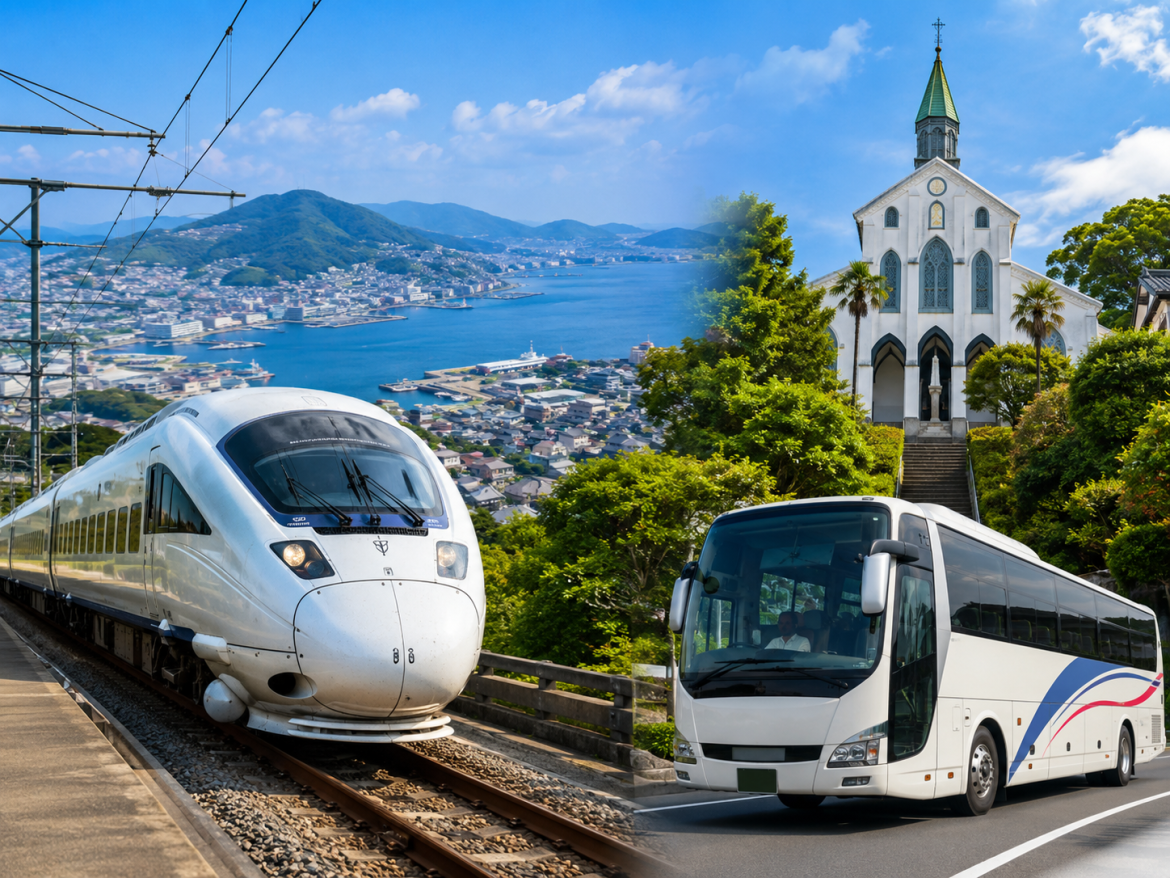
Nagasaki is one of the most rewarding side trips from Fukuoka, combining important modern history, hillside neighborhoods, international heritage sites, harbor scenery and one of Japan’s best-known night views. It is close enough for a day trip, although staying overnight gives you more time for Glover Garden, Dejima, Peace Park, Mount Inasa and a Battleship Island cruise.
The fastest way to get from Fukuoka to Nagasaki is by JR train. From Hakata Station, take the Relay Kamome limited express to Takeo-Onsen and transfer across the platform to the Kamome on the Nishi Kyushu Shinkansen. The fastest journeys take around 1 hour 20 minutes.
The most affordable straightforward option is usually the direct Kyushugo highway bus from Hakata Bus Terminal or Tenjin. It takes a little over two hours under normal traffic conditions and does not require a transfer. Travelers covering several cities by train should compare the JR Kyushu Rail Pass, while travelers who prefer a fully arranged day can consider a Nagasaki day trip from Fukuoka.
For more ideas before or after Nagasaki, browse the Fukuoka travel guides or compare this journey with the Fukuoka to Hiroshima transportation guide.

How to Get from Fukuoka to Nagasaki|Quick Fukuoka to Nagasaki Transportation Comparison
| Transportation Option | Best For | Route Overview | Pros | Cons | Editor’s Tip |
|---|---|---|---|---|---|
| JR Relay Kamome + Kamome Shinkansen | Fastest journey and day trips | Hakata → Relay Kamome → Takeo-Onsen → Kamome → Nagasaki | Around 1 hour 20 minutes on the fastest connections; reliable; comfortable reserved seating | One transfer; regular fare is higher than the bus | Best choice for most first-time visitors and anyone returning to Fukuoka the same evening |
| JR discounted online ticket | Travelers booking ahead | Same JR route using Kamome Net or advance-purchase fares | Can reduce the one-way fare substantially | Restrictions apply; the cheapest tickets must be purchased in advance | Check the official JR Kyushu booking site before buying a rail pass |
| Direct Kyushugo highway bus | Budget travelers | Hakata Bus Terminal or Tenjin → Nagasaki | Direct; lower fare; stops near Peace Park and Nagasaki Station | Traffic can cause delays; reserved seating is required | Choose the bus if saving money matters more than saving an hour |
| Direct bus from Fukuoka Airport | International arrivals | Fukuoka Airport International Terminal → Nagasaki | No need to enter central Fukuoka; luggage stored below the bus | Domestic terminal passengers must change terminals; fewer options than Hakata | Convenient after an international arrival with a well-timed connection |
| JR Kyushu Rail Pass | Multi-city Kyushu itineraries | Unlimited eligible JR travel within the pass area | Covers both JR sections to Nagasaki; useful for several long-distance trips | Poor value for only one Fukuoka–Nagasaki round trip | Consider it when adding Kumamoto, Beppu, Yufuin or other JR destinations |
| SUNQ Pass Kyushu Bus Pass | Bus-heavy Kyushu trips | Use participating highway and local buses | Flexible for travelers visiting several bus-based destinations | Not worthwhile for only one return trip to Nagasaki | Best when Nagasaki is part of a wider bus itinerary |
| TWO STARS 4047 sightseeing train | Scenic rail enthusiasts | Hakata-area rail connection → Takeo-Onsen → scenic train to Nagasaki | Slower, more memorable journey with sightseeing-train atmosphere | Limited operating days; much slower; reservations required | Use it as part of an overnight trip rather than a rushed day trip |
| Nagasaki day trip from Fukuoka | Travelers who do not want to plan transfers | Organized transport with selected Nagasaki attractions | Simple logistics; guided schedule; useful for first-time visitors | Less freedom and fixed sightseeing times | Good for visitors with only one free day in Fukuoka |
| Kyushu private car charter | Families, seniors and small groups | Private vehicle between Fukuoka and Nagasaki | Door-to-door; luggage-friendly; customizable | Expensive for solo travelers or couples | Compare the per-person cost when traveling with four or more people |
| Self-driving | Regional road trips | Fukuoka → Kyushu Expressway and Nagasaki Expressway → Nagasaki | Flexible stops at Ureshino, Takeo or other destinations | Tolls, fuel and parking; city driving is less convenient | Best for a multi-stop Kyushu itinerary, not just central Nagasaki |
Is There a Direct JR Train or Bus from Fukuoka to Nagasaki?
There is no single through JR train from Hakata Station to Nagasaki Station.
The normal rail journey uses two coordinated services:
- Relay Kamome limited express from Hakata to Takeo-Onsen
- Kamome on the Nishi Kyushu Shinkansen from Takeo-Onsen to Nagasaki
At Takeo-Onsen, the trains normally stop on opposite sides of the same platform. This makes the transfer much easier than changing platforms through a large station. Follow signs for the Kamome and move directly to the carriage shown on your reservation.
There is a direct highway bus. The Kyushugo service runs from Hakata Bus Terminal and Nishitetsu Tenjin Highway Bus Terminal to Nagasaki. Some services also originate at Fukuoka Airport International Terminal.
The bus serves several useful stops in Nagasaki, including Peace Park, Ohato and Nagasaki Station. This can save time if Peace Park and the Atomic Bomb Museum are your first sightseeing stops.
The JR Kyushu Rail Pass and nationwide Japan Rail Pass can cover the JR journey when the pass conditions are met. However, neither pass is normally worth buying only for one Fukuoka–Nagasaki trip.
Best Departure Area and Where to Stay in Fukuoka
Hakata Station
Best for: First-time visitors, JR travelers, day trips and travelers arriving by Shinkansen.
Advantages:
- Direct access to the Relay Kamome
- Hakata Bus Terminal is beside the station
- Easy subway access from Fukuoka Airport
- Wide choice of hotels, restaurants and luggage lockers
- Simplest area for an early departure
Editor’s tip: Stay near Hakata Station if Nagasaki is one of several Kyushu day trips. It gives you easy access to both the fastest train and the direct bus.
Tenjin
Best for: Budget travelers, shopping-focused stays and travelers planning to use the highway bus.
Advantages:
- Direct Kyushugo buses depart from Nishitetsu Tenjin Highway Bus Terminal
- Convenient for shopping, nightlife and restaurants
- No need to travel to Hakata before boarding the bus
- Easy subway connection to Hakata if you later choose the train
Editor’s tip: Tenjin is often the most convenient base if you prefer buses and want to stay in Fukuoka’s main shopping district.
Fukuoka Airport
Best for: Travelers heading directly to Nagasaki after landing.
Advantages:
- Direct highway bus from the International Terminal
- Domestic Terminal is only a short subway ride from Hakata Station
- Avoids an unnecessary overnight stay in central Fukuoka
- Suitable for travelers carrying large suitcases
Editor’s tip: From the Domestic Terminal, taking the subway to Hakata and continuing by train is often faster. For the direct Nagasaki bus, use the free terminal shuttle to the International Terminal.
Nakasu-Kawabata
Best for: Travelers who want nightlife, riverside dining and central sightseeing.
Advantages:
- Between Hakata and Tenjin
- Direct subway access toward Hakata Station
- Easy access to the Tenjin bus terminal
- Convenient for Canal City, Nakasu and riverside food stalls
Editor’s tip: Nakasu-Kawabata is a good compromise for sightseeing in Fukuoka, but allow extra time to reach your departure terminal in the morning.
Fukuoka to Nagasaki Method 1: JR Relay Kamome and Kamome Shinkansen
Route overview:
Hakata Station → Relay Kamome limited express → Takeo-Onsen Station → Kamome Shinkansen → Nagasaki Station
Travel time:
Approximately 1 hour 20 minutes to 1 hour 45 minutes, depending on the connection.
Reference fares:
- Regular reserved-seat ticket: approximately ¥6,490 one way
- Kamome Net Ticket: approximately ¥4,500 one way
- Advance-purchase fares: from approximately ¥3,400 to ¥3,850 one way when available
Who it is best for:
- Day trippers
- First-time visitors
- Travelers who value punctuality
- Families who want reserved seating
- Travelers connecting from the Sanyo Shinkansen
- Visitors with limited sightseeing time
Pros:
- Fastest public transportation option
- Comfortable reserved seating
- Easy coordinated transfer at Takeo-Onsen
- Nagasaki Station is close to hotels and city trams
- Fully covered by eligible JR rail passes
Cons:
- More expensive than the highway bus at the regular fare
- Not a completely direct train
- Discounted tickets may restrict changes or refunds
- The cheapest fares require advance purchase
Editor’s tip:
For a one-day Nagasaki trip, leave Hakata early and reserve both train sections together. Do not book the two trains as unrelated journeys; JR’s search system normally displays the coordinated connection.
If your schedule is fixed, compare the regular fare with Kamome Net Ticket and advance-purchase fares before buying a pass.
Fukuoka to Nagasaki Method 2: Direct Kyushugo Bus from Hakata or Tenjin
Route overview:
Hakata Bus Terminal or Nishitetsu Tenjin Highway Bus Terminal → Nagasaki city stops → Nagasaki Station
Travel time:
Allow approximately 2 hours 10 minutes to 2 hours 30 minutes, depending on the departure point, stop and traffic.
Reference fares:
- Adult one-way fare: approximately ¥2,900
- Adult return fare: approximately ¥5,400
Who it is best for:
- Budget-conscious travelers
- Travelers staying in Tenjin
- Visitors who prefer a direct journey
- Travelers beginning at Peace Park
- Visitors who do not have a JR pass
Pros:
- No train transfer
- Usually much cheaper than the regular JR fare
- Large luggage can be placed in the underfloor compartment
- Stops are available in central Nagasaki
- Some services stop near Peace Park before reaching Nagasaki Station
Cons:
- Travel time is affected by road traffic
- Slower than the train
- Seats should be reserved
- Less room to walk around than on a train
- Service frequency and journey time vary by departure stop
Editor’s tip:
Choose the Peace Park stop if your first priorities are Peace Park and the Atomic Bomb Museum. You can then travel south through the city by tram and finish near Nagasaki Station or the harbor.
Reserve the bus for weekends, holidays and busy travel periods rather than relying on last-minute availability.
Fukuoka to Nagasaki Method 3: Direct Bus from Fukuoka Airport
Route overview:
Fukuoka Airport International Terminal → Nagasaki city → Nagasaki Station
Who it is best for:
- International arrivals
- Travelers bypassing central Fukuoka
- Visitors with large luggage
- Travelers whose flight arrival matches the bus schedule
Pros:
- Direct journey from the airport
- No need to carry luggage through Hakata Station
- Lower cost than a private transfer
- Luggage storage under the bus
Cons:
- Nagasaki buses use the International Terminal
- Travelers arriving at the Domestic Terminal must take the free terminal shuttle
- Flight delays can make reserved connections difficult
- Service is less frequent than departures from Hakata or Tenjin
- Road traffic can affect arrival time
Editor’s tip:
Domestic passengers should compare two routes:
- Free shuttle to the International Terminal followed by the direct bus
- Subway to Hakata Station followed by the JR train
The second option is usually faster when the next direct airport bus requires a long wait.
Avoid booking a highway bus too soon after an international arrival. Immigration, baggage collection and terminal navigation can take longer than expected.
Fukuoka to Nagasaki Method 4: JR Kyushu Rail Pass
The JR Kyushu Rail Pass covers eligible JR services between Hakata and Nagasaki, including the Relay Kamome and the Nishi Kyushu Shinkansen.
The Northern Kyushu version is normally the most relevant pass for this route.
Published adult pass prices:
- Northern Kyushu 3-Day Pass: approximately ¥15,000
- Northern Kyushu 5-Day Pass: approximately ¥17,000
Who it is best for:
- Travelers taking several long-distance JR journeys
- Visitors combining Nagasaki with Kumamoto, Beppu or Yufuin
- Travelers making multiple day trips from Fukuoka
- Temporary visitors eligible for the pass
Pros:
- Covers the complete JR route to Nagasaki
- Reserved-seat bookings are available under the pass rules
- Simplifies a multi-city rail itinerary
- Can provide significant savings over several long trips
Cons:
- More expensive than one discounted Fukuoka–Nagasaki return journey
- Fixed consecutive-day validity
- Does not cover the Kyushugo highway bus
- Does not cover Nagasaki city trams
Editor’s tip:
Do not buy the pass only because the route includes a Shinkansen. Calculate every planned JR trip first. A Fukuoka–Nagasaki return journey alone normally costs less than the pass, especially when discounted JR tickets are available.
Fukuoka to Nagasaki Method 5: Scenic Journey on TWO STARS 4047
TWO STARS 4047 is a special sightseeing train operating selected routes in northern Kyushu. One itinerary travels from Takeo-Onsen toward Nagasaki on a slower, scenic route.
A possible journey is:
Hakata → Takeo-Onsen by regular JR service → TWO STARS 4047 → Nagasaki
Who it is best for:
- Railway enthusiasts
- Couples
- Repeat visitors to Kyushu
- Travelers staying overnight in Nagasaki
- Visitors who prefer the journey to be part of the experience
Pros:
- More scenic and memorable than the fastest route
- Distinctive sightseeing-train interior
- Regional food and drinks may be offered
- Creates a slower introduction to Nagasaki
Cons:
- Much slower than the Kamome connection
- Limited operating days
- Reserved seating is required
- Not practical for a tightly scheduled day trip
Editor’s tip:
Build the scenic train into an overnight itinerary. Use the regular Kamome route for the return journey so you do not lose two full days to transportation.
Check the official operating calendar before making hotel arrangements.
Fukuoka to Nagasaki Method 6: Organized Day Tour
A Nagasaki day trip from Fukuoka can be useful for travelers who want transportation and major sightseeing stops arranged in advance.
Typical stops may include:
- Peace Park
- Atomic Bomb Museum
- Central Nagasaki
- Glover Garden
- Historic districts
Who it is best for:
- First-time visitors
- Travelers uncomfortable with train transfers
- Visitors with only one available day
- Travelers who prefer guided context
- Small groups wanting simpler logistics
Pros:
- Transportation and sightseeing are combined
- No need to study tram routes
- Easier to cover attractions in different parts of the city
- Guided explanations can add historical context
Cons:
- Fixed departure and return times
- Less freedom for meals and photography
- Attraction inclusions vary
- Tours may not operate every day
Editor’s tip:
Read the meeting point, language, attraction admission and return time carefully. A guided tour is convenient, but independent train travel gives you more control over how long you spend at the museum and heritage areas.
Fukuoka to Nagasaki Method 7: Private Transfer or Car Charter
A Kyushu private car charter offers door-to-door transportation and can be customized around your group.
Possible routes include:
- Fukuoka hotel → Nagasaki hotel
- Fukuoka → Peace Park → Glover Garden → Fukuoka
- Fukuoka → Ureshino Onsen → Nagasaki
- Fukuoka Airport → Nagasaki
- Nagasaki sightseeing with hotel drop-off
Who it is best for:
- Families with young children
- Seniors
- Groups with several suitcases
- Travelers with mobility concerns
- Groups of four or more
- Visitors combining Nagasaki with regional stops
Pros:
- Door-to-door journey
- No station transfers
- Flexible rest stops
- Easier with strollers and luggage
- Customizable itinerary
Cons:
- Higher total price
- Travel time remains subject to traffic
- Vehicle size and luggage capacity must be selected carefully
- Long-distance charter-hour limits may apply
Editor’s tip:
Compare the total charter price with the combined cost of train tickets, taxis and luggage handling for the whole group. The per-person difference can become reasonable for a larger family.
Confirm whether tolls, parking, overtime and child seats are included.
Fukuoka to Nagasaki Method 8: Self-Driving
The drive from Fukuoka to Nagasaki normally takes around 2 to 3 hours before sightseeing stops, depending on traffic and your starting point.
The usual route uses expressways toward Nagasaki. Tolls, rental fees, fuel and city parking are additional costs.
Who it is best for:
- Travelers visiting Ureshino Onsen or Takeo Onsen
- Families carrying substantial luggage
- Visitors continuing to Unzen or Shimabara
- Multi-day Kyushu road trips
- Groups comfortable driving in Japan
Pros:
- Complete schedule flexibility
- Easy access to rural destinations
- Convenient for hotel-to-hotel travel
- Allows stops between Fukuoka and Nagasaki
- Useful when combining Nagasaki with hot spring areas
Cons:
- Expressway tolls and parking costs
- Central Nagasaki has hills, tram tracks and limited parking
- The driver cannot fully enjoy the scenery
- Traffic can make the trip slower than the train
- An International Driving Permit or recognized license translation may be required
Editor’s tip:
Once in central Nagasaki, leave the car at your hotel or a parking facility and use the tram. The compact sightseeing area is generally easier to explore without repeatedly moving the car.
The Kyushu Expressway Pass may reduce toll costs for eligible foreign visitors renting a participating ETC-equipped vehicle, but it is only worthwhile when your itinerary includes several expressway journeys.
How to Get from Fukuoka to Nagasaki|Fukuoka to Nagasaki Ticket and Pass Comparison
| Ticket / Pass / Activity | Best For | Main Use | Editor’s Tip |
|---|---|---|---|
| Regular JR reserved-seat ticket | Flexible train travel | Relay Kamome and Kamome from Hakata to Nagasaki | Choose this when your plans may change and discounted fares are unavailable |
| Kamome Net Ticket | Online JR booking | Discounted JR journey on the standard route | Often better value than paying the station-counter fare |
| Kamome advance-purchase fare | Fixed travel dates | Lower-priced JR journey booked several days ahead | Use only when you are confident you will not change trains |
| JR Kyushu Rail Pass | Multi-city rail itineraries | Eligible JR trains in Northern Kyushu or all Kyushu | Worth considering after adding several long-distance JR fares |
| Kyushugo one-way or return ticket | Budget direct travel | Highway bus from Hakata or Tenjin to Nagasaki | Usually the best simple choice for travelers without a rail pass |
| SUNQ Pass Kyushu Bus Pass | Bus-heavy Kyushu itineraries | Participating highway and local buses | Do not buy it solely for one Nagasaki return journey |
| Nagasaki tram one-day pass | City sightseeing | Unlimited rides on Nagasaki’s tram network for one day | The ¥600 adult pass becomes useful after several tram journeys |
| Nagasaki day trip from Fukuoka | No-planning day trip | Transport and selected attractions | Check whether admission fees and meals are included |
| Kyushu private car charter | Families and groups | Customized door-to-door travel | Confirm driving-hour limits before adding too many stops |
| Glover Garden admission ticket | Heritage sightseeing | Entry to Glover Garden | Useful for an itinerary focused on southern Nagasaki |
| Battleship Island cruise | Overnight visitors and maritime history | Cruise from Nagasaki Port toward Hashima | Allow extra time because landing depends on sea conditions |
Is the JR Kyushu Rail Pass Worth It for Fukuoka to Nagasaki?
For only one Fukuoka–Nagasaki journey, the JR Kyushu Rail Pass is not worth buying.
Even a round trip at the regular reserved-seat fare is approximately ¥12,980, which remains below the published ¥15,000 price of the Northern Kyushu 3-Day Pass. Discounted online fares can make individual tickets considerably cheaper.
The pass becomes more attractive when Nagasaki is one of several long-distance JR trips within a short period.
| Itinerary | Approximate Ticket Situation | Is the Pass Worth It? | Editor’s Tip |
|---|---|---|---|
| Fukuoka → Nagasaki one way | Regular or discounted ticket is much cheaper than the pass | No | Buy an individual JR ticket or take the bus |
| Fukuoka → Nagasaki → Fukuoka | Regular return fare is below the 3-day pass price | Usually no | Check Kamome Net and advance fares first |
| Fukuoka → Nagasaki → Kumamoto → Fukuoka | Several long-distance JR sectors | Possibly | Add the individual fares before purchasing |
| Fukuoka with day trips to Nagasaki and Beppu | Multiple limited-express and Shinkansen journeys | Often worth comparing | A 3-day pass can work well when trips are on consecutive days |
| Nagasaki plus several Northern Kyushu cities over five days | Extensive regional rail travel | Potentially worthwhile | Compare the 3-day and 5-day versions |
| Mostly highway buses and rural bus destinations | JR coverage is less useful | No | Compare the SUNQ Pass instead |
When it is worth buying:
- You are making several long JR journeys on consecutive days.
- You are combining Nagasaki with Kumamoto, Beppu, Yufuin or other rail destinations.
- You prefer flexible eligible JR travel rather than restricted advance tickets.
- Your total individual JR fares clearly exceed the pass price.
When it is not worth buying:
- Nagasaki is your only trip from Fukuoka.
- You have found a low advance-purchase Kamome fare.
- You are using highway buses for most of the itinerary.
- Your long journeys fall outside the pass-validity period.
Editor’s tip:
Calculate your itinerary using the actual trains you plan to take. Do not compare the pass only with the highest possible walk-up fare.
Suggested Fukuoka to Nagasaki Itineraries
Itinerary 1: Classic Nagasaki Day Trip by Train
Best for:
First-time visitors who want the maximum amount of sightseeing time.
Suggested route:
- Early Relay Kamome from Hakata
- Transfer to the Kamome at Takeo-Onsen
- Arrive at Nagasaki Station
- Tram to Peace Park and Atomic Bomb Museum
- Continue to Dejima or Shinchi Chinatown
- Visit Glover Garden and Oura Cathedral
- Return to Nagasaki Station
- Evening JR train to Hakata
Editor’s tip:
The northern historical area and southern heritage area are separated by central Nagasaki. Start at Peace Park, then work south so you do not repeatedly cross the city.
Itinerary 2: Budget Day Trip by Highway Bus
Best for:
Travelers prioritizing cost over speed.
Suggested route:
- Morning Kyushugo bus from Hakata or Tenjin
- Leave the bus at Peace Park
- Visit Peace Park and the Atomic Bomb Museum
- Take the tram toward central Nagasaki
- Lunch at Shinchi Chinatown
- Visit Dejima, Glover Garden or the harbor
- Return by bus from Nagasaki Station
Editor’s tip:
Reserve both directions. An open-ended return can be risky on a busy evening when popular departures sell out.
Itinerary 3: Guided Day Trip from Fukuoka
Best for:
Travelers who want a simple schedule without navigating stations and trams.
Suggested route:
Book a Nagasaki day trip from Fukuoka covering selected historic and cultural attractions.
Editor’s tip:
This is most useful when you want an overview rather than extensive museum time. Independent travel is better for visitors planning a detailed visit to the Atomic Bomb Museum.
Itinerary 4: Family-Friendly Overnight Trip
Best for:
Families, seniors and travelers who prefer a relaxed pace.
Suggested route:
Day 1:
- Reserved JR train from Hakata
- Leave luggage at a hotel near Nagasaki Station
- Visit Peace Park and Atomic Bomb Museum
- Take a rest at the hotel
- Visit Mount Inasa after sunset
Day 2:
- Visit Dejima and Glover Garden
- Explore Shinchi Chinatown
- Return to Fukuoka in the afternoon
A Nagasaki morning sightseeing bus can reduce walking and simplify the main historic stops.
Editor’s tip:
Nagasaki’s hills can be tiring for young children and travelers with limited mobility. An overnight stay prevents the day from becoming a race between attractions.
Itinerary 5: Self-Driving Hot Spring and Nagasaki Route
Best for:
Travelers combining cities, countryside and hot springs.
Suggested route:
Day 1:
- Pick up a rental car in Fukuoka
- Drive to Ureshino Onsen or Takeo Onsen
- Stop for lunch or an onsen visit
- Continue to Nagasaki
- Park at the hotel and use trams in the city
Day 2:
- Explore Nagasaki
- Continue toward Unzen, Obama Onsen or Shimabara
- Return to Fukuoka or continue around Kyushu
Editor’s tip:
This route makes much better use of a rental car than driving directly to central Nagasaki and back on the same day.
How to Get from Nagasaki Station to Major Attractions
Nagasaki’s tram system charges a flat adult fare of approximately ¥150 per ride. A one-day tram pass costs approximately ¥600 for adults and is useful when taking several rides.
Major IC cards such as Suica, PASMO and SUGOCA can be used. Transfers between certain tram routes are supported at designated stops under the operator’s conditions.
| Destination | How to Get There from Nagasaki Station | Best For | Editor’s Tip |
|---|---|---|---|
| Peace Park | Take tram Route 1 or 3 to Peace Park stop, then walk | Modern history | The direct highway bus can also drop you near Peace Park before Nagasaki Station |
| Atomic Bomb Museum | Take tram Route 1 or 3 to Atomic Bomb Museum stop | Museum visitors | Allow enough time for the exhibits rather than treating it as a quick photo stop |
| Dejima | Take tram Route 1 to Dejima stop | History and central sightseeing | Easy to combine with the waterfront and Chinatown |
| Shinchi Chinatown | Take tram Route 1 to Shinchi Chinatown | Food and evening sightseeing | This is also a useful transfer point between Routes 1 and 5 |
| Glover Garden | Take Route 1 to Shinchi Chinatown, transfer to Route 5 and leave at Oura Cathedral | Heritage architecture and views | Purchase a Glover Garden admission ticket before arrival when useful |
| Oura Cathedral | Use the same tram route as Glover Garden and leave at Oura Cathedral | Religious and international history | The final approach is uphill, so allow extra time |
| Megane Bridge | Take Route 3 toward City Hall and walk, or connect to a tram serving Meganebashi | Photography and central walks | Combine it with nearby shopping streets and temples |
| Nagasaki Port and Ohato | Take Route 1 to Ohato, then walk to the relevant terminal | Harbor sightseeing and cruises | Cruise check-in locations differ by operator |
| Battleship Island cruise | Travel to the operator’s designated Nagasaki Port check-in point | Maritime and industrial history | Book the Battleship Island cruise ahead and arrive early |
| Mount Inasa | Use a local bus or taxi toward the ropeway or slope-car access point | Night views and couples | Check evening operating hours; a Mount Inasa private transfer is convenient for groups |
| Nagasaki Station hotels | Walk from the station or use a short taxi ride | Late arrivals and luggage | Staying nearby makes an early return to Fukuoka easier |
Common Mistakes to Avoid
- Do not assume the JR journey is a direct train.
You must transfer at Takeo-Onsen, although the connection is designed to be simple and usually takes place across the same platform.
- Do not buy a JR Kyushu Rail Pass for only one short itinerary.
A Fukuoka–Nagasaki return journey normally costs less than the Northern Kyushu Pass, particularly with advance tickets.
- Do not arrive at the wrong Fukuoka bus terminal.
Hakata Bus Terminal and the Tenjin Highway Bus Terminal are different facilities. Check the exact departure point on your reservation.
- Do not expect the direct Nagasaki bus at Fukuoka Airport Domestic Terminal.
Long-distance buses to Nagasaki use the International Terminal. Use the free terminal shuttle or take the subway to Hakata.
- Do not underestimate Nagasaki’s hills.
Glover Garden, Oura Cathedral and Mount Inasa involve slopes or additional transportation. Comfortable footwear is important.
- Do not carry large suitcases through the sightseeing districts.
Use your hotel’s luggage storage, station lockers or a luggage service before exploring the city.
- Do not depend only on a general map application for the final departure.
Check the official JR or highway bus timetable, especially for the last return connection.
- Do not place too many distant attractions into one day.
Peace Park, Glover Garden and Mount Inasa are in different parts of the city. An overnight stay is better if you also want a harbor cruise or a relaxed museum visit.
Fukuoka to Nagasaki: Frequently Asked Questions
1. What is the best way to get from Fukuoka to Nagasaki?
The JR Relay Kamome and Kamome Shinkansen connection is the best option for most travelers. It is the fastest, most reliable and easiest choice for a day trip.
The direct highway bus is better when keeping costs low is the main priority.
2. Is there a direct train from Fukuoka to Nagasaki?
No. Take the Relay Kamome from Hakata to Takeo-Onsen and transfer to the Kamome Shinkansen for Nagasaki.
The connection is coordinated, and the trains normally use opposite sides of the same platform.
3. Is there a direct bus from Fukuoka to Nagasaki?
Yes. The Kyushugo highway bus runs directly from Hakata Bus Terminal and Nishitetsu Tenjin Highway Bus Terminal to Nagasaki.
Some services also depart from Fukuoka Airport International Terminal.
4. How long does it take to get from Fukuoka to Nagasaki?
The fastest JR journeys take approximately 1 hour 20 minutes.
The direct highway bus generally takes a little over two hours, although traffic can extend the journey. Driving normally takes around 2 to 3 hours before stops.
5. Can Nagasaki be visited as a day trip from Fukuoka?
Yes. Nagasaki is a realistic day trip, especially by train.
Leave Hakata early and focus on two or three areas, such as Peace Park, central Nagasaki and Glover Garden. Stay overnight if you also want Mount Inasa, a slow museum visit or a Battleship Island cruise.
6. Should I take the train or bus from Fukuoka to Nagasaki?
Take the train for speed, punctuality and maximum sightseeing time.
Take the bus for a lower fare, direct travel and convenient stops near Peace Park. The bus is particularly useful for travelers staying in Tenjin.
7. Is the JR Kyushu Rail Pass worth it for Fukuoka to Nagasaki?
It is not normally worthwhile for only one return trip.
The JR Kyushu Rail Pass becomes useful when Nagasaki is combined with several other long-distance JR journeys during the pass-validity period.
8. How do I get from Nagasaki Station to the main attractions?
Use Nagasaki’s tram network. Routes 1 and 3 serve Peace Park and the Atomic Bomb Museum, while Route 1 continues toward Dejima and Chinatown.
Transfer at Shinchi Chinatown for Route 5 toward Oura Cathedral and Glover Garden.
9. Is self-driving recommended between Fukuoka and Nagasaki?
Self-driving is recommended for a wider road trip that includes Ureshino, Takeo, Unzen, Shimabara or other regional destinations.
For central Nagasaki alone, the train is faster and city trams are easier than driving between attractions.
10. What is best for families, seniors or travelers arriving late with luggage?
Reserved JR seats are usually the most comfortable public transportation choice. A Kyushu private car charter can be more convenient for groups carrying several suitcases or traveling with limited mobility.
For a late arrival, stay near Nagasaki Station and begin sightseeing the following morning. Do not rely on late-night tram, ropeway or bus connections without checking the final service.
Discount tickets have different change rules
The normal-season adult ordinary reserved fare is ¥6,490; the Kamome Net Ticket is ¥4,500, the three-day advance product ¥3,850 and the seven-day product ¥3,400. These are specific JR Kyushu internet products with membership, payment and availability conditions, not prices guaranteed at station counters or every overseas reseller.
Kamome Net changes depend on payment and collection status. The three-day product has its own deadline and allocation rules, and a missed booked train does not permit a free switch to a later non-reserved car. The advertised seven-day product cannot be changed after booking. If arriving by air, flexibility may matter more than the lowest headline fare.
Kamome Net conditions · Three-day advance conditions · Official seven-day offer and transfer guidance
Northern Kyushu 3/5-day general prices are ¥15,000/17,000, while direct JR Kyushu Rail Pass Online Booking prices are ¥14,000/16,000. Paid advance seat reservations are a separate cost; distinguish the purchase channel and collection conditions when comparing offers.
JR Kyushu online and general prices
The adult tram fare is ¥150 per full-fare ride and the day pass is ¥600. Four full-fare rides only equal the day-pass price; five or more create a fare saving. Eligible short-hop IC discounts change the calculation, so compare the trips you will actually take.
Booking, collection and choosing seats
A reserved-seat ticket is for the stated train, car and seat; a non-reserved ticket does not guarantee a seat. Choose the actual stations and ticket conditions before comparing train names. Families and anyone needing adjacent seats should settle the outbound and return reservations before booking fixed-time activities.
Ordinary reservations generally open at 10:00 Japan time one month before travel. Discount allocations and purchase deadlines are separate from overall seat availability. Leave time for ticket collection if your product requires it; a payment receipt or screenshot is not a universal boarding ticket. Follow the collection or live QR instructions for the exact product.
Luggage, strollers and assistance
On the Kyushu and Nishi Kyushu Shinkansen, bags over 160cm and up to 250cm in combined dimensions require a seat with an oversized-baggage area. This costs the same as the corresponding reserved seat. General limits are two portable pieces, each up to 30kg and 250cm combined dimensions, with length up to 2m. Boarding with oversized luggage without the required reservation incurs a ¥1,000 handling charge and staff-directed storage.
The JR Kyushu Rail Pass Online Booking system cannot reserve these baggage-area seats; pass users should use a JR Kyushu ticket office. For Nagasaki, discuss the Relay Kamome leg and transfer too. Strollers and wheelchairs have separate provisions. If boarding assistance is needed, contact the station or operating bus company ahead of time rather than relying on an ordinary seat reservation.
A bus luggage hold is not an unlimited checked-baggage service. Nishitetsu publishes a 30kg total limit per passenger plus dimensional restrictions, and joint operators may differ. Keep valuables and fragile items with you; ask about unusually large cases or sports equipment before booking. Kyushugo passengers load and unload their own bags, so allow time to retrieve them at the stop.
JR oversized-baggage rules · Nishitetsu baggage rules
JR pass eligibility and reservation limits
The JR Kyushu Rail Pass requires a qualifying non-Japanese passport and Temporary Visitor entry status; a foreign passport alone does not establish eligibility for a resident, student or worker. Carry the passport and use the pass on consecutive days. The Fukuoka/Saga JR Kyushu Mobile Pass is a different product and cannot replace the regional rail pass for these intercity journeys.
Northern and Southern passes allow up to six complimentary reserved-seat bookings in Japan; All Kyushu allows unlimited bookings. A connecting Relay Kamome–Kamome reservation counts as one. Advance KRP Option Ticket reservations online cost ¥1,000 per ordinary limited-express or Shinkansen section and do not use that complimentary allowance. Online sale allocations may differ from general seat availability.
Check JR Kyushu pass conditions and prices
Weather, holiday crowds and the return journey
Typhoons, heavy rain and strong wind can affect trains, highways and marine activities together. A bus or rental car is not automatically a safe fallback. Check operator notices the evening before and again before departure, then settle the return plan before committing to a ferry or fixed-time attraction. Holiday weekends and major local festivals can also bring bus diversions and crowded terminals.
Do not make the last intercity departure your only way back for an international flight. Reaching Hakata is not the same as reaching the terminal; local transfers, luggage and airline deadlines still matter. If your buffer disappears, dropping one sightseeing stop is more reliable than trying to recover time with a tighter connection.
JR status and timetable search · Official bus route and boarding maps