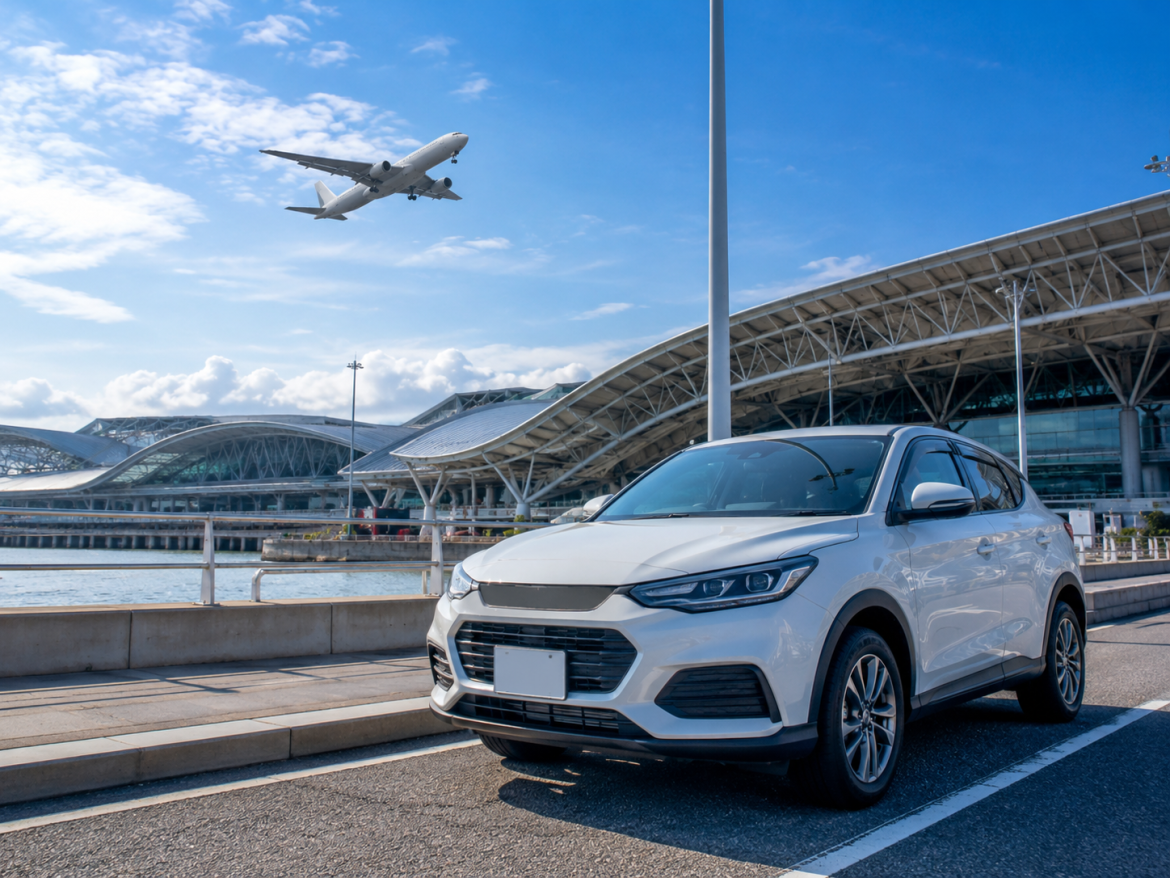

Kansai Airport car rental: should you collect a car at KIX?
Renting at Kansai International Airport makes most sense when your trip starts outside the big cities: Wakayama, Shirahama, Awaji Island, the Kii Peninsula or rural northern Kyoto. You can load your luggage once and head towards your first overnight stop without travelling into Osaka just to collect a car the next morning.
For a holiday centred on Osaka, Kyoto, Nara Park and central Kobe, take the train or airport bus instead. Parking charges, narrow streets and traffic can outweigh the convenience of having a car. Plan the places you actually want to visit with our seven-day Kansai itinerary, then rent only for the countryside portion. This guide focuses on airport collection and return; our Japan car rental guide covers the wider driving essentials.
The key airport detail is Aeroplaza, beside Kansai-airport Station. The main rental desks are not in Terminal 1’s international arrivals hall. Terminal 2 passengers need the free inter-terminal shuttle. Also check that your reservation says Kansai International Airport (KIX), not Osaka International Airport (Itami/ITM).
| Your itinerary | Best starting approach |
|---|---|
| Wakayama, Shirahama or a rural road trip immediately after arrival | Compare airport collection, provided the flight leaves enough time and the driver is rested |
| Several days in Osaka or Kyoto before driving | Travel into the city first; rent when the road trip begins |
| Late arrival or a tired sole driver | Stay near the airport and collect the next morning |
| Children, older relatives or several large bags | A car may reduce transfers, but check seats, luggage capacity and hotel parking |
Rental companies, Aeroplaza floors and opening hours
The airport’s rental directory lists five major operators. These are Aeroplaza desks with airport collection arrangements. A cheaper search result labelled “Kansai Airport” can instead be a mainland branch with a separate transfer or meeting point. Read the actual branch instructions before booking.
| Company | Desk | Published hours | Useful distinction |
|---|---|---|---|
| Nippon Rent-A-Car | Aeroplaza 2F | 08:00–21:00 | Later closing time; check the reserved reporting time |
| Nissan Rent a Car | Aeroplaza 1F | 08:00–20:00 | Compare Nissan vehicle classes and luggage space |
| Toyota Rent a Car | Aeroplaza 1F | 08:00–20:00 | Useful network for a possible one-way itinerary |
| ORIX Rent a Car | Aeroplaza 1F | 08:00–20:00 | Compare multiple vehicle makes and package inclusions |
| Times CAR RENTAL | Aeroplaza 2F | 08:00–20:00 | Book ordinary rental, not the separate car-sharing service |
Hours are not guaranteed latest collection times. Immigration, baggage delivery, walking, a Terminal 2 shuttle wait and paperwork all happen after landing. Check your reservation’s final reporting time and delay contact; an accepted booking does not promise that staff will stay after closing. Weather disruption can also shorten hours.
Getting to your desk from Terminal 1 or Terminal 2
Terminal 1: use the second-floor connection
After immigration and baggage collection, go to 2F and follow signs for Kansai-airport Station and Aeroplaza. The airport gives about three minutes for the connecting walk itself. This excludes arrival formalities and finding the correct desk. Continue to your operator’s floor rather than stopping at the first rental sign.
Terminal 2: take the free shuttle
Follow the Terminal 2 shuttle-bus signs and travel to Aeroplaza. The airport quotes about seven to nine minutes on the bus, before waiting and loading bags. Aeroplaza’s shuttle stop is on 1F. Do not plan to walk between the terminals with your luggage. The official shuttle page includes stop maps and the timetable.
Allow time beyond the transfer
The desk must inspect documents, register drivers, explain the contract and arrange the vehicle. Child seats, queues and questions about cover add time. Avoid a tightly timed first attraction or restaurant reservation immediately after your planned collection.
How to choose between the five companies
No operator is cheapest on every date. Compare the same rental period, vehicle class, protection and return branch. Nippon’s later closing time can be useful, but it does not turn a late landing into a safe collection plan. Toyota is worth comparing for family vehicles and onward one-way travel; a vehicle illustration is not a guarantee of that exact model.
Nissan may appeal if you prefer its compact cars or people carriers. A seven- or eight-seat vehicle still has limited boot space when every row is occupied. ORIX is useful for comparing classes across different makes. Times is another airport option, but its car-sharing membership product is different from a conventional tourist rental.
Branch restrictions matter as much as the brand. ORIX’s KIX branch lists ETC-card rental and one-way departures/returns, excluding Hokkaido, Okinawa and outlying islands. Times’ KIX branch restricts drop-offs of tall or long vehicles because of parking dimensions. Get the exact branch pair and vehicle approved, not just a general promise that a company offers one-way rentals.
Compare the full price, not the headline daily rate
| Cost | What to compare |
|---|---|
| Rental period | Exact pickup and return times, charging blocks and late-return charges |
| Protection | Deductible waiver, NOC waiver, roadside assistance and exclusions |
| Equipment | ETC card, child seats, winter tyres and any model-selection fee |
| One-way travel | Approved return branch, eligible vehicle and drop-off charge |
| Driving costs | Fuel, parking, motorway tolls and airport bridge charges |
| Booking conditions | Mileage terms, cancellation deadline, no-show rule, payment and card requirements |
Start with Osaka and Kansai Airport rental availability, select the correct airport branch and compare the final inclusions. Peak blossom and autumn dates, summer holidays and Japanese holiday periods can reduce choice. Reserve large vehicles and essential equipment early rather than relying on a walk-up rental.
Driving documents, payment and driver eligibility
Requirements follow the jurisdiction that issued your licence, not your nationality or the language of your passport. Check the National Police Agency’s foreign-licence guidance before paying.
- A valid Japanese licence is accepted for the relevant vehicle category.
- The international-permit route requires a valid permit in the 1949 Geneva Convention format from an eligible issuing authority. A 1968 Vienna Convention permit or an unofficial online translation is not a substitute.
- For licences issued in Taiwan, Switzerland, Germany, France, Belgium or Monaco, the alternative is the original valid licence plus an authorised Japanese translation. A Taiwan-issued IDP is not a replacement for that route.
- Hong Kong licence holders should obtain the qualifying Geneva-format IDP and carry the original Hong Kong licence and passport for supplier checks.
Bring original documents, your passport and booking confirmation; photographs and digital copies are not replacements. Driving permission is time-limited by entry into Japan and document validity, generally no more than one year. Special re-entry rules apply to residents; a short trip abroad does not necessarily restart the period. Ask about evidence of your arrival date if you use an automated immigration gate. Every additional driver must present the necessary documents and be registered.
Do not assume one card or age policy applies everywhere
Times’ general FAQ allows cash with an advance reservation, but its KIX branch lists credit-card payment. Confirm the airport contract before relying on cash. Toyota’s W4 class became credit-card-only from 1 April 2026; other classes and booking channels have their own requirements. Nippon’s online payment rules require a card in the name of the driver attending collection; eligible debit cards have authentication and refund implications, and some classes require a credit card. Bring a suitable payment method even when booking through a platform.
Likewise, there is no universal “must be 25” rule. Times says it accepts beginner drivers and has no upper age restriction for valid licence holders. Nippon provides a safety briefing for drivers under 21 or licensed for less than a year. Check age, driving experience and protection eligibility for your actual supplier and car class.
Choose a car for people and luggage
| Group | What to investigate |
|---|---|
| One or two people with modest bags | A compact car; check the actual boot before choosing a kei car |
| Two or three people with large suitcases | A compact or larger car with confirmed luggage capacity |
| Four adults and four large suitcases | An estate, suitable SUV or MPV rather than an ordinary small hatchback |
| A family with child seats and a stroller | Seat installation positions, remaining seating and usable cargo space |
| Six to eight people | A large people carrier with adequate luggage space, or two cars |
These are starting points, not capacity guarantees. Five seats do not mean five seats plus five large cases. Ask about the supplied model or class diagram, and include shopping bags, mobility aids and pushchairs. Keep luggage secured without obstructing passengers or visibility.
Insurance, deductible waivers and NOC
Basic cover, a collision/deductible waiver and a non-operation-charge waiver solve different problems. A deductible waiver can reduce the amount you pay towards covered damage; NOC compensates the supplier when a vehicle is unavailable for business. Buying the former does not automatically remove the latter.
Compare the written protection terms for third-party property, vehicle damage, NOC, towing, tyres, glass, keys and incorrect fuel. Do not treat “full cover” as unlimited protection. Toyota’s Double Protection Package, for example, can include NOC and specified tyre/wheel-related costs beyond its deductible waiver, but prohibited use and reporting failures can still leave you liable. Other providers’ similarly named packages need their own checks.
Inspect and photograph existing damage before leaving. After an accident, attend to safety and injuries, contact the police and rental company, and follow their reporting instructions. Do not privately settle damage and assume reimbursement. Unregistered drivers, drink-driving, unapproved roads or failure to report can invalidate protection.
ETC cards, motorway tolls and the airport bridge
An ETC reader in the car is not an ETC card. Reserve a card separately if needed, confirm collection/return arrangements and ask how tolls will be settled. ORIX lists KIX as an ETC-card rental location; availability still needs confirmation. A motorway pass is worthwhile only if the eligible routes, rental company and total toll savings fit your trip. Use the NEXCO West route and toll search rather than buying a pass simply because you are renting.
The airport bridge is charged on a round-trip basis when entering the airport island. The airport’s published ordinary-car total is ¥940, including the ¥100 bridge-use tax; other vehicle classes and applicable discounts differ. Do not budget two separate ¥940 charges for entering and leaving on that single round trip. Airport rental collection and one-way arrangements can involve supplier settlement, so check your contract. Toyota specifically tells customers returning to KIX to pay at the toll gate. Other motorway tolls are additional. See the official bridge and parking information.
Which destinations work best with an airport rental?
| Destination | Practical verdict |
|---|---|
| Central Osaka, Kyoto or Kobe | Usually easier by public transport; rent later for rural days |
| Nara Park | Train or airport bus usually sufficient; a car helps more for rural Nara |
| Wakayama and Shirahama | A useful southbound road trip without first detouring into Osaka |
| Awaji Island | Helpful for scattered coastal sights; allow for the drive around Osaka Bay and bridge tolls |
| Koyasan | Convenient for luggage and onward touring, but consider mountain roads and winter conditions |
| Amanohashidate, Ine and the Kii Peninsula | Useful flexibility for a multi-day trip; do not underestimate distances |
For city-first plans, see our Osaka guide, Kyoto guide and Nara guide. Driving to crowded areas such as Kiyomizu-dera rarely removes the need to walk.
Compare KIX–Kyoto transport and KIX–Nara transport before choosing a car just for an airport transfer. For rural plans, our Wakayama guide, Shirahama transport guide, Awaji transport guide and Koyasan transport guide give route context.
Your pickup checklist
- Confirm the exact airport, branch, floor, reporting time and flight-delay contact.
- Bring original licences, qualifying permit or translation, passports, payment method and confirmation.
- Reach Aeroplaza and register every driver.
- Check cover, NOC, ETC card, child seats, winter equipment and any one-way permission.
- Inspect bodywork, wheels, glass, fuel level and mileage with staff; photograph existing marks.
- Save the return entrance instructions and emergency number before leaving.
- Set your first destination and familiarise yourself with indicators, wipers, transmission, parking brake and navigation.
- Follow road signs towards the bridge without last-minute lane changes.
Keep the first drive simple
With an early arrival and a rested driver, Rinku Town, Izumisano or Wakayama can make a manageable first stop. With an afternoon arrival, aim primarily to reach your hotel. Do not count landing day as a full sightseeing day in Shirahama or deep in the Kii Peninsula.
For a late flight, staying near the airport and collecting the next morning is often the better choice. A desk still being open is not evidence that a tired driver should tackle mountain roads. If you need to continue to an Osaka hotel, compare a prearranged transfer with the operating public-transport options.
Book a Kansai Airport transfer
Travelling with children
Japanese rules generally require child seats for children under six. Reserve the right type and quantity for each child’s size, following the supplier’s installation guidance. A booking for “one child seat” does not cover two young children. Include the occupied seats and stroller in your luggage calculation.
Plan breaks for meals, toilets and movement. Map driving times omit those stops and queues. Check the final seat installation yourself; fitting help at the desk does not remove the need to secure the child correctly.
Travelling with older relatives
A car can reduce luggage handling and transfers, but assess entry height, door opening, hotel parking and walking at the attraction itself. An MPV is not automatically easier for every passenger. Central-city sightseeing may still be simpler by rail or a private vehicle with a driver.
Compare Kansai private day charters
Winter tyres and mountain routes
Weather at the airport does not describe conditions in Koyasan, northern Kyoto, Tango or mountain areas of Shiga. Confirm winter tyres for the destination and dates, possible chain requirements, road closures and the supplier’s permitted routes. Four-wheel drive does not replace appropriate tyres or experience.
Do not assume chains can be added at any desk: Times’ published FAQ says it does not rent tyre chains. If you lack winter-driving experience or conditions exceed the vehicle’s equipment, change the route or use public transport rather than pressing on.
Typhoons, wind and bridge disruption
Strong winds, accidents and severe weather can disrupt the airport bridge, rail services and rental operations. Toyota and Nippon explicitly warn that access disruption can cause temporary closures or shorter hours. Check airport, road and supplier notices before setting off. A flight operating does not guarantee that your onward road route is open.
Contact the booked branch if you cannot collect or return as agreed. Follow its alternative instructions; do not independently abandon the car at a mainland shop or an airport parking space.
Returning your car at Kansai Airport
- Confirm the booked return branch and obtain its vehicle entrance map before the final day.
- Refuel with the correct fuel as required by the contract and retain any requested receipt.
- Allow for traffic, the bridge and finding the rental return area. Navigating only to “Kansai Airport” can take you to passenger drop-off instead.
- Use your operator’s designated spaces. Nippon’s branch gives return map code 946 359 852*02 and requires final processing at its 2F counter after parking.
- Finish inspection and settle fuel, ETC and other charges. Remove the ETC card and personal belongings as instructed.
- Walk to Terminal 1, or take the shuttle to Terminal 2, then complete airline check-in and security.
Work backwards from your airline’s check-in and bag-drop deadlines. Times’ KIX branch asks for return at least 90 minutes before flight time, but that is not a guarantee that 90 minutes is sufficient for an international departure, a queue or a Terminal 2 connection. Add road, refuelling, inspection and terminal-transfer buffers beyond your airline’s recommended airport arrival time. For a very early flight, returning the previous evening may be more workable than waiting for an 08:00 desk opening.
Arrival-day and multi-day itinerary ideas
A gentle arrival day: Rinku Town and Izumisano
After arrival formalities and collection, make a short stop for food or supplies, then check in near the airport or continue to a suitable first-night base. Keep shopping optional if your flight is late. This is a sequence, not a promise of how quickly you can clear immigration.
Two days in Wakayama and Shirahama
Day one: collect at KIX, stop in Wakayama if time permits, then continue to Shirahama for an overnight stay. Day two: choose a small number of coastal sights, take proper breaks and return with a generous airport buffer. Add another night for a slower family trip or substantial sightseeing.
Two days on Awaji Island
Day one: travel to the northern island or west coast, then stay around your chosen sightseeing area. Day two: explore another cluster before returning to KIX or an approved Osaka branch. Do not try to cover both ends of the island on a tightly timed arrival day.
Koyasan and Wakayama overnight
With sufficient daylight and suitable conditions, travel to Koyasan for a temple stay, then continue towards Wakayama or Rinku Town the next day. With a late arrival or winter conditions, stay near KIX first. Avoid making a return flight depend on a rushed mountain descent.
Nearby stops that fit naturally
Rinku Town and Izumisano are practical before an airport-area overnight stay. Wakayama is a more natural combination with a southbound Shirahama trip than a detour into central Osaka. Kishiwada and southern Osaka may fit a local driving day, while Namba, Shinsaibashi and Umeda usually favour rail.
Treat Awaji as a genuine drive rather than “next to the airport.” For Amanohashidate, Ine or an extended Kii Peninsula route, add nights and keep the final day close enough to KIX to manage disruption.
Food stops around the airport
Eat at the airport or Aeroplaza before driving if you need a break, but reach your rental appointment on time. Around Izumisano and southern Osaka, seafood, udon and casual local restaurants can suit a simple first meal; Wakayama offers ramen and regional seafood stops.
Motorway service areas are useful breaks, but do not assume every restaurant is open late or can accommodate dietary requirements. Carry water and plan children’s and older passengers’ meals before a long drive. The driver should avoid alcohol entirely.
When an airport-area overnight stay helps
Stay near KIX for late arrivals, early departures, a sole tired driver, uncertain weather or a mountain itinerary starting the next morning. Aeroplaza, Rinku Town and Izumisano offer different relationships to the terminals; check the hotel’s actual shuttle and parking arrangements.
You do not need an extra airport night merely because you are renting. A rested driver arriving early enough for a modest first leg can continue directly to the planned overnight base.
Alternatives to driving
JR, Nankai and airport buses serve major city destinations; route and timetable choice depend on your hotel and arrival time. For Kobe, a high-speed ferry is another option when its schedule and transfer arrangements suit. A private airport transfer can help a group with lots of bags, while a chauffeured day trip avoids licence checks, parking and return logistics.
Compare passenger and luggage capacity, pickup times, waiting charges, tolls and the actual itinerary before booking a private vehicle. A charter is not automatically cheaper simply because a group can divide the cost.
Compare Osaka, Kyoto and Nara charters
Common mistakes to avoid
- Booking the lowest rate without checking airport-island versus mainland pickup.
- Confusing KIX with Itami, or expecting the desk in the arrivals hall.
- Using touchdown time as the desk arrival time.
- Bringing only licence photographs or an unsupported IDP.
- Choosing a full vehicle by seat count without room for luggage.
- Assuming a deductible waiver removes NOC and every exclusion.
- Assuming an ETC reader includes a card.
- Driving distant mountain roads immediately after a tiring flight.
- Keeping a car parked through several central-city days.
- Navigating to the passenger terminal rather than the return entrance.
- Leaving refuelling until the last minute.
- Judging winter road conditions by Osaka Bay’s weather.
Kansai Airport rental FAQ
Can I collect a car directly at Terminal 2?
The five major Aeroplaza desks require the free shuttle from Terminal 2. If you booked another supplier, use its specific meeting-point instructions rather than assuming the same arrangement.
Can I rent without a reservation?
Availability is not guaranteed. Book ahead for holiday periods, large cars, child seats or winter equipment. Same-day rental availability does not mean after-hours collection.
What if my flight is delayed?
Contact the branch and booking platform promptly. Ask whether the booking can be changed and what cancellation or no-show charge applies. Do not assume the car will automatically be held until tomorrow. Times’ general policy allows cancellation after one hour past the scheduled pickup if you fail to contact the station; this does not extend opening hours.
Can I return in Osaka, Kyoto or another region?
Only with an approved one-way booking for that car and branch pair. Compare the extra fee against returning to KIX, and confirm ETC-card return arrangements. Never switch branches without permission.
Do I need to return with a full tank?
Follow your contract. Full-to-full rentals require refuelling; prepaid fuel and supplier settlement arrangements differ. Keep a receipt if requested and never guess the fuel type.
How early should I return before a flight?
There is no safe universal number. Start with the airline’s required arrival time at your terminal, then add refuelling, traffic, the bridge, rental inspection and the walk or Terminal 2 shuttle. Check that the return desk is open.
Make the car serve the itinerary
KIX collection is a strong option when the trip genuinely begins with rural Kansai. Choose a suitable vehicle, prepare the correct original documents, reserve essential equipment and understand the protection. Keep arrival day light and save the exact return instructions before leaving the airport.
For Osaka and Kyoto city days, public transport is often the simpler choice. The best rental is the one that makes your countryside days easier without adding unnecessary parking, fatigue or a last-minute rush to your flight.