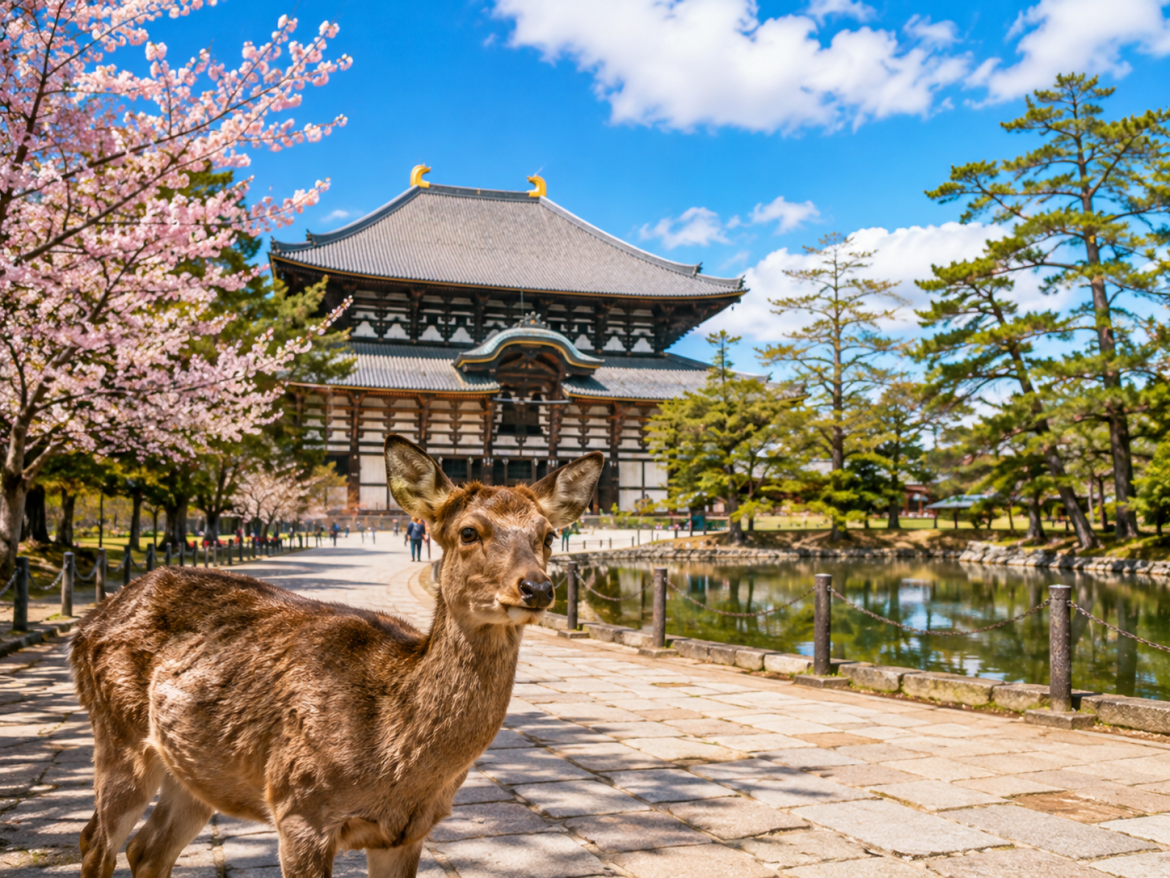
Nara Park is best known for the deer that roam between temple gates, lawns and wooded shrine paths, but treating it as a short animal-feeding stop misses most of what makes the area worthwhile. The park connects Todai-ji’s enormous Great Buddha Hall, Kasuga Taisha’s lantern-lined forest, Kofuku-ji, museums, gardens and traditional Naramachi streets within one broad sightseeing district.
For a first visit, Nara Park is worth prioritizing if you enjoy history, cultural landmarks, walking and an unusual encounter with free-roaming animals. It works especially well as a day trip from Osaka or Kyoto, although the smoothest visit needs at least four hours. A full route can easily require six to eight hours and more than five kilometres of walking.
The main point to understand is that Nara Park itself is free and always open, while Todai-ji, museum galleries, gardens and special shrine areas have separate admission fees and closing times. Visiting the deer first and leaving Todai-ji until late afternoon is therefore a common mistake. The Great Buddha Hall should be protected as the day’s first non-negotiable stop.
There is also an important current visual change. Kofuku-ji’s Five-storey Pagoda is enclosed within a large restoration structure and cannot presently be seen as it appears in older photographs. The temple remains an easy and worthwhile stop near Kintetsu-Nara Station, but visitors should adjust their expectations before arrival.
Independent travel is straightforward for most visitors. Kintetsu-Nara Station is the most convenient railway station for the park, while JR Nara Station is useful for travellers using a JR pass or staying along a JR route. Read the Osaka to Nara transportation guide or Kyoto to Nara transportation guide before choosing solely by train time.
If you prefer not to coordinate the train, walking route and return journey yourself, a Kyoto and Nara day tour from Osaka or Kyoto can simplify the trip. The trade-off is less independent time in Nara, so it works best for travellers who value convenience more than a slow temple-and-garden day.

Is Nara Park Worth Visiting?
| Question | Practical answer |
|---|---|
| Is it worth visiting? | Yes for a first Kansai trip, especially for Todai-ji, the historic landscape and the deer. It deserves more than a quick photo stop. |
| Best suited to | History lovers, families with school-age children, photographers, cultural travellers and visitors wanting an easy day trip from Osaka or Kyoto. |
| Who may prefer to shorten or skip it? | Travellers uncomfortable around assertive animals, people unable to manage long outdoor walks and visitors with an extremely limited Kyoto itinerary. |
| Park admission | Free. Individual temples, museums, gardens and special worship areas charge separately. |
| Reservation | Not required for the park or for ordinary individual admission to Todai-ji. |
| Suggested duration | One to two hours for deer and a brief walk; three to four hours for the park and Todai-ji; six to eight hours for a full cultural route. |
| Transport difficulty | Easy by train. Kintetsu-Nara is closest; JR Nara adds more walking or a bus journey. |
| Main highlight | Todai-ji’s Great Buddha Hall, combined with the unusual experience of deer moving through a historic temple district. |
| Main disadvantage | The sightseeing area is much larger than it looks on a simple map, and the deer can be aggressive around food. |
| Children | Enjoyable with close adult supervision. Young children should not hold an entire stack of deer crackers. |
| Older travellers | Possible with buses, taxis and a shorter route, but a full circuit involves considerable walking. |
| Accessibility | Many broad park paths and major approaches are manageable, but gravel, slopes, historic thresholds and long distances remain. |
| Overnight stay | Not necessary for a standard day trip. Useful for quiet early mornings, evening walks and a slower museum or garden itinerary. |
| Best time of day | Arrive between approximately 7:30 and 9:00 a.m., then visit Todai-ji before the busiest period. |
Editor’s recommendation: give Nara Park a full day when it is your first visit and you want to see Todai-ji, Kasuga Taisha and Naramachi properly. Choose a half-day only when Nara is being combined with another destination, and accept that Kasuga Taisha, a garden or Naramachi may need to be removed.
The park is less suitable as a rushed two-hour diversion. Train travel may be quick, but station walking, temple admission, deer congestion and the distance between Todai-ji and Kasuga Taisha consume more time than many itineraries suggest.
These transport passes and guided experiences are optional purchases, not admission to the free park grounds. Temple halls and museums have their own entry rules. Check the meeting point of the selected tour, language, walking distance and included temple entry before paying.
Nara Park Essential Information
| Item | Current information |
|---|---|
| Official name | Nara Park |
| Location | Eastern central Nara, surrounding Todai-ji, Kasuga Taisha, Kofuku-ji and the Nara National Museum |
| Park admission | Free |
| Park opening hours | Open throughout the year; individual attractions keep separate hours |
| Reservation | Not required for the public park |
| Nearest railway station | Kintetsu-Nara Station |
| JR access | JR Nara Station, followed by approximately 20 minutes on foot to the park’s western side or a local bus |
| Recommended duration | Three to four hours for the essential route; six to eight hours for a full day |
| Main paid attraction | Todai-ji Great Buddha Hall |
| Large luggage | Store it at the station or accommodation before entering the park |
| Parking | No single dedicated Nara Park lot; use nearby public or private parking |
| Best transport | Train and walking for most visitors |
Current Opening Status and Restoration Work
Nara Park
The outdoor park remains open and free. There is no entrance gate or single closing time. However, an evening visit does not provide access to the main paid attractions once their reception desks close, and some wooded sections become dark.
Kofuku-ji Five-storey Pagoda
The Five-storey Pagoda is undergoing major restoration and is concealed inside a tall protective structure. This is not a partial obstruction: visitors cannot currently see the famous exposed pagoda exterior.
Kofuku-ji is still useful at the beginning or end of a Nara itinerary because it is close to Kintetsu-Nara Station. Visit for the temple grounds, surviving halls and museum collection rather than expecting the classic pagoda skyline shown in old guidebooks.
Seasonal deer precautions
Extra caution is needed during the fawning period in spring and early summer, when mother deer may react defensively near a newborn fawn. Do not approach, surround or touch a fawn, even when it appears to be alone.
Autumn is the rutting season. Male deer may be more territorial or unpredictable, particularly around food. Follow staff notices and give any agitated animal more space.
Nara Park Tickets, Reservations and Passes
Nara Park does not have an admission ticket. Budgeting is instead based on which temples, museums and gardens you choose to enter.
| Site or option | Admission | Reservation | Best suited to |
|---|---|---|---|
| Nara Park | Free | Not required | Every visitor |
| Todai-ji Great Buddha Hall | Adults ¥800; children aged 6–12 ¥400 | Not normally required for individuals | Essential for a first visit |
| Todai-ji Hall and Museum combination | Adults ¥1,200; children aged 6–12 ¥600 | Not normally required for individuals | Visitors wanting deeper Buddhist art and history |
| Kasuga Taisha general worship | Free | Not normally required | Visitors satisfied with the main public shrine experience |
| Kasuga Taisha special inner area | ¥700 | Buy at the shrine, subject to ceremony closures | Visitors wanting closer access to the lantern-lined inner precinct |
| Kintetsu Rail Pass | Varies by duration and package | Advance purchase available | Travellers making several eligible Kintetsu journeys, not only one Nara return trip |
| Guided walking tour | Varies by date and package | Advance booking recommended | Visitors wanting historical explanation and a planned route |
| Coach day tour | Varies by departure city and itinerary | Advance booking recommended | Travellers combining Nara with Kyoto or Uji |
Best ticket choice for a first visit
Buy the standard Todai-ji Great Buddha Hall ticket directly at the entrance. There is no strong reason to use a third-party platform for Nara Park or Todai-ji admission alone.
Add the museum combination ticket only when Buddhist sculpture and temple art are a genuine priority. Travellers on a half-day route normally gain more from preserving time for the Great Buddha Hall, Nigatsu-do or Kasuga Taisha than from automatically adding every paid interior.
Is the Kintetsu Rail Pass worthwhile?
The pass makes sense when Nara is part of a broader itinerary using several Kintetsu services, such as journeys involving Osaka, Kyoto, Nara, Yoshino, Ise or Nagoya, depending on the package selected. Some packages also include eligible Nara bus use.
It is usually unnecessary when you are making only one ordinary return journey between Osaka-Namba and Nara. Compare the current pass price with the individual fares for your entire itinerary rather than assuming that any regional pass saves money.
Best Time to Visit Nara Park
| Time | Crowds and experience | Recommendation |
|---|---|---|
| 7:30–9:00 a.m. | Quieter lawns and temple approaches; Todai-ji opens early | Best overall arrival period |
| 9:00–11:00 a.m. | Still manageable, but tour groups begin arriving | Good for most day trips |
| 11:00 a.m.–2:00 p.m. | Busiest deer-feeding areas and main temple routes | Use this period for lunch, museums or quieter side paths |
| 2:00–4:00 p.m. | Some groups leave, but attraction closing times become important | Good for Kasuga Taisha only when you are monitoring the clock |
| Late afternoon | Pleasant light and fewer day-trippers, but paid interiors may be closing | Best for park atmosphere after completing essential admissions |
| Evening | Quiet public paths, limited lighting and no normal access to closed attractions | Best for overnight visitors familiar with the route |
For a first visit, arrive early enough to enter Todai-ji shortly after opening. The Great Buddha Hall is more impressive when the approach is not packed, and completing it first removes the risk of missing the principal paid attraction later.
Weekends, public holidays, cherry-blossom periods and autumn foliage weekends generate the greatest pressure on trains, buses, deer-feeding areas and car parks. An early train is more valuable than trying to identify a supposedly secret entrance.
The Best First-Time Nara Park Route
The smoothest route depends on whether you want a half day or full day, but the essential order should protect Todai-ji before optional stops.
Recommended full route from Kintetsu-Nara Station
- Kintetsu-Nara Station
- Kofuku-ji grounds and Sarusawa Pond
- Nara Park lawns and first deer encounter
- Todai-ji Nandaimon Gate
- Todai-ji Great Buddha Hall
- Nigatsu-do terrace
- Kasuga Taisha approach and shrine
- Ukimido or the Nara National Museum
- Naramachi and dinner
- Return to Kintetsu-Nara or JR Nara Station
Kofuku-ji appears first geographically, but keep this stop short in the morning. The current restoration enclosure means the pagoda is not a reason to delay Todai-ji.
After the Great Buddha Hall, walk uphill toward Nigatsu-do only when your group is comfortable with steps and slopes. Its elevated terrace and quieter temple atmosphere are worthwhile, but it is not essential for a limited-mobility route.
Continue through the eastern side of the park toward Kasuga Taisha. This section feels more wooded and atmospheric than the busy central lawns, although the extra distance is substantial. Finish in Naramachi if you still have energy for traditional streets, shops and dinner.
Recommended route from JR Nara Station
From JR Nara Station, either walk east along Sanjo-dori or use a local bus to a stop near the prefectural office, museum, Todai-ji approach or Kasuga Taisha. Walking to the western park edge takes approximately 20 minutes, but Todai-ji lies farther inside the sightseeing district.
Travellers arriving from Kyoto with a JR pass can use JR efficiently, but the station-to-attraction journey should be included when comparing total travel time. A train arriving a few minutes faster is not necessarily the faster door-to-door option.
Main Nara Park Highlights
Todai-ji Great Buddha Hall
Todai-ji is the reason Nara Park deserves more than a deer-feeding visit. The Great Buddha Hall provides the area’s strongest sense of scale, history and ceremonial importance. Its immense wooden interior and bronze Buddha create a very different experience from viewing the building only from outside.
Allow approximately 45–75 minutes for the Nandaimon approach, ticket purchase and Great Buddha Hall. More time is needed when the entrance is crowded or when adding the museum.
Nandaimon Gate
The approach through Nandaimon is part of the Todai-ji experience rather than merely an entrance corridor. The gate’s scale, guardian statues and deer moving through the foreground create one of Nara’s most recognizable scenes.
Keep food, maps and loose paper inside a bag. Deer around this busy approach associate visitors with crackers and may investigate anything held at waist height.
The deer lawns
The central lawns provide the easiest place to observe the deer, but they are not always the most pleasant feeding area. Groups gather around cracker vendors, and several deer may approach the same visitor at once.
For a calmer experience, observe deer before purchasing crackers, move away from the densest crowd and buy only one bundle at a time. Feeding is optional; watching the deer within the historic landscape is often more enjoyable than trying to produce a bowing photograph.
Nigatsu-do
Nigatsu-do offers an elevated view over Nara and a quieter wooden-temple atmosphere after the Great Buddha Hall. It is one of the best additions for travellers who enjoy architecture and photography.
The route involves uphill walking and steps. Travellers with knee problems, strollers or limited time can skip it without weakening the essential Todai-ji experience.
Kasuga Taisha
Kasuga Taisha feels distinct from Todai-ji because the approach moves into a forested shrine landscape lined with stone and bronze lanterns. General worship is free, while the paid inner area offers closer views of the central buildings and lantern corridors.
Do not underestimate the distance. It is approximately 25 minutes on foot from Kintetsu-Nara Station and remains a significant walk from Todai-ji. A bus or taxi can make the shrine more realistic for an older traveller.
Kofuku-ji
Kofuku-ji is the easiest major heritage site to reach from Kintetsu-Nara Station. Its open grounds make it a natural entry point to the park, and the National Treasure collection provides value for travellers interested in Buddhist sculpture.
The Five-storey Pagoda is currently hidden by its restoration structure. Photograph the surrounding halls and temple landscape rather than searching for the old unrestricted pagoda view.
Nara National Museum
The museum is a useful cultural stop and one of the best rainy-day additions. Its Buddhist art collection provides context for the temples outside, while the indoor environment offers a break from summer heat, winter cold or prolonged walking.
Exhibition schedules and admission prices vary, so check the current exhibition before deciding how much time to reserve.
Ukimido Pavilion
Ukimido sits above Sagiike Pond south of the busiest central park route. It is a calmer photography location and works well as a transition between the main park, Kasuga Taisha and Naramachi.
It is not essential for a short visit, but it adds visual variety to a full day and provides a welcome pause from temple interiors.
How to Feed the Nara Deer Safely
Nara’s deer are wild animals. Familiarity with visitors does not make them domesticated or predictable.
- Feed only authorized shika senbei deer crackers.
- Do not offer bread, snacks, vegetables or other human food.
- Buy one cracker bundle at a time.
- Keep the crackers hidden until you are ready to feed.
- Give each cracker promptly rather than holding it above the animal.
- Do not tease the deer to force repeated bows.
- When finished, open both hands to show that no food remains.
- Keep maps, tickets, shopping bags and loose paper out of reach.
- Do not touch, surround or approach a fawn.
- Move away calmly if a deer becomes pushy.
Feeding deer with children
An adult should hold the stack and give a child one cracker at a time. Standing directly in the middle of several deer can be intimidating, especially for a small child whose face and hands are closer to the animals.
Choose a quieter open area, keep the child beside rather than in front of the adult and stop immediately if several deer gather. The experience does not become less memorable because the child feeds only one or two crackers.
What to do if a deer follows you
Do not run, wave food or push the animal. Show your empty hands, place all paper and food inside a closed bag and walk away steadily. Move toward a more open or staffed area when necessary.
Walking Distance, Stairs and Physical Difficulty
Nara Park is easy to reach but physically larger than many first-time visitors expect. A standard route connecting Kintetsu-Nara Station, Todai-ji, Kasuga Taisha and central park areas can involve approximately five kilometres of walking. Adding Naramachi, Nigatsu-do, a garden or Mount Wakakusa can push the day beyond seven or eight kilometres.
| Section | Physical difficulty | Alternative |
|---|---|---|
| Kintetsu-Nara to western park edge | Short and generally straightforward | Usually no transport needed |
| JR Nara to park | Approximately 20 minutes to the western side | Use a local bus |
| Park edge to Todai-ji | Additional walking beyond the station-to-park estimate | Bus to a stop nearer the temple approach |
| Todai-ji to Nigatsu-do | Uphill with steps | Skip Nigatsu-do |
| Todai-ji to Kasuga Taisha | Longer forest and park walk | Use a bus or taxi for part of the route |
| Mount Wakakusa | Uphill and physically demanding | View the hill from below |
| Naramachi extension | Mostly urban walking but adds distance | Finish near the station instead |
The broadest public roads and central lawns are manageable for many visitors, but individual temple grounds include gravel, thresholds, steps and uneven historic surfaces. Comfortable walking shoes are more important than formal footwear.
Summer heat can make the same route feel considerably harder. Carry water, use museum or café breaks and avoid adding Mount Wakakusa in the hottest part of the day. In winter, shaded paths can remain cold and occasionally slippery.
Nara Park with Children, Older Travellers and Limited Mobility
Families with children
Nara Park is highly memorable for school-age children, but adults should treat deer feeding as a supervised activity. Toddlers may be frightened by animals approaching at eye level, and a stroller does not protect food or bags from curious deer.
- Use a stroller with sturdy wheels for paved park routes.
- Expect more difficulty on gravel and forest approaches.
- Keep snacks fully enclosed.
- Visit Todai-ji early before children are tired.
- Use the museum or lunch as a midday rest period.
- Skip Nigatsu-do or Kasuga Taisha when the route becomes too long.
Older travellers
A shorter route covering Kofuku-ji, the central lawns and Todai-ji can still provide the main Nara experience. There is no need to complete the entire Todai-ji–Kasuga Taisha–Naramachi circuit.
Use a bus from JR Nara or Kintetsu-Nara to reduce the initial walk, then consider a taxi between the eastern park area and the station. Nigatsu-do and Mount Wakakusa are the first places to remove when avoiding stairs and slopes.
Travellers with limited mobility
Some major approaches and open park areas can be experienced by wheelchair, but Nara Park should not be described as uniformly step-free. Historic surfaces, long distances and differences between individual temples require a selective itinerary.
A practical route concentrates on the flatter western and central areas, confirms the current accessible entrance at each paid attraction and uses buses or taxis rather than relying on a complete walking circuit. Wheelchair lending may be available at the Nara Park Bus Terminal, but availability should not be assumed without checking on the day.
A customizable private car tour covering Osaka, Kyoto and Nara can be practical for a group that needs door-to-door travel, luggage space or reduced station transfers. It is not necessary for most able-bodied independent visitors.
How to Get to Nara Park
From Osaka-Namba
Kintetsu trains from Osaka-Namba are normally the most convenient option for Nara Park. Ordinary rapid services take approximately 35–45 minutes depending on the train and arrive at Kintetsu-Nara Station, only a short walk from Kofuku-ji and the western park area.
Ordinary commuter services do not require a seat reservation. Travellers who want a selected reserved service can compare a Kintetsu train ticket from Osaka to Nara, but flexible visitors may find an IC card and the next convenient ordinary train simpler.
From Osaka or Umeda
The JR Yamatoji Rapid Service from JR Osaka Station reaches JR Nara in approximately 45–50 minutes without a reservation. It is useful when staying near Osaka Station or using an eligible JR pass.
JR Nara Station is farther from the park. Walk approximately 20 minutes to the western edge or take a local bus to reduce the distance. Consult the full Osaka to Nara transport comparison before deciding between the JR and Kintetsu routes.
From Kyoto
Kintetsu services from Kyoto Station normally take approximately 35–50 minutes depending on whether the train is direct, requires a transfer or uses a limited-express supplement. The key advantage is arrival at Kintetsu-Nara Station close to the park.
A prebookable Kintetsu train ticket from Kyoto to Nara may suit travellers who prefer a selected train, while ordinary services remain suitable for flexible day trips.
The JR Miyakoji Rapid Service takes approximately 41–45 minutes to JR Nara and is covered by relevant JR passes. Remember to add the final walk or bus journey when comparing it with Kintetsu. The Kyoto to Nara transportation guide explains the route choices in more detail.
From Kansai International Airport
For most visitors, travel first from Kansai Airport to Namba, Tennoji, Osaka or Kyoto, then continue to Nara. The best connection depends on where you are staying and whether Nara is a day trip or your first overnight destination.
Travellers staying in Osaka can use the Kansai Airport to Osaka guide. Those beginning in Kyoto should compare routes in the Kansai Airport to Kyoto transportation guide.
From Kintetsu-Nara Station to the park
Walk east toward Kofuku-ji and the park. The western sightseeing area begins within several minutes, but Todai-ji is farther away. Allow approximately 15–20 minutes to reach the Nandaimon approach, depending on crowds and stops.
From JR Nara Station to the park
Walk east along the city-centre route for approximately 20 minutes to the western park area, or use the bus terminal on the station’s east side. Buses serving the park stop near the prefectural office, museum, Todai-ji approach and Kasuga Taisha area.
Driving
Driving is technically possible but not recommended for an ordinary day trip during spring, autumn, weekends and public holidays. Nara Park does not have one central visitor car park, roads become congested and nearby lots may fill before midday.
A car becomes more useful when the same day includes rural destinations outside central Nara. For Nara Park alone, trains remove parking uncertainty and allow the route to finish at a different station from where it began.
| Route | Typical journey | Final access | Reservation | Best suited to |
|---|---|---|---|---|
| Osaka-Namba to Kintetsu-Nara | Approximately 35–45 minutes | Short walk to park | Not needed on ordinary rapid services | Most Osaka day-trippers |
| JR Osaka to JR Nara | Approximately 45–50 minutes | 20-minute walk or bus | Not required | Umeda-based travellers and JR pass users |
| Kyoto to Kintetsu-Nara | Approximately 35–50 minutes | Short walk to park | Only for limited-express reserved seats | Travellers prioritizing park proximity |
| Kyoto to JR Nara | Approximately 41–45 minutes | 20-minute walk or bus | Not required on rapid service | JR pass users |
| Coach tour | Varies by itinerary | Group drop-off near attractions | Advance booking recommended | Visitors combining Nara with Kyoto or Uji |
| Private car | Traffic-dependent | Flexible drop-off | Advance booking recommended | Families, groups and travellers reducing transfers |
Half-Day Nara Park Itinerary
This route assumes approximately four hours in Nara and uses Kintetsu-Nara Station.
- 8:30 a.m. — Arrive at Kintetsu-Nara Station.
- 8:40 a.m. — Walk through Kofuku-ji grounds without spending long at the restoration enclosure.
- 9:00 a.m. — Observe the deer on the central lawns.
- 9:30 a.m. — Enter Todai-ji through Nandaimon.
- 9:45–10:45 a.m. — Visit the Great Buddha Hall.
- 11:00 a.m. — Choose either Nigatsu-do or a slower walk around the park.
- 12:00 p.m. — Return toward Higashimuki or Naramachi for lunch.
- 1:00 p.m. — Depart Nara.
Do not add Kasuga Taisha, a museum, Mount Wakakusa and Naramachi to this same half-day. A short itinerary becomes enjoyable only when one or two optional areas are deliberately removed.
Guided half-day alternative
A guided walking experience suits visitors who want historical interpretation and do not want to decide the order themselves. The available Todai-ji and Naramachi option combines major landmarks with a planned route and meal, although the pace and stopping time are controlled by the tour.
Full-Day Nara Park Itinerary
- 8:00–8:30 a.m. — Arrive at Kintetsu-Nara Station.
- 8:30 a.m. — Brief Kofuku-ji and Sarusawa Pond visit.
- 9:00 a.m. — Walk through the deer lawns toward Todai-ji.
- 9:30–10:45 a.m. — Todai-ji Great Buddha Hall.
- 10:45–11:30 a.m. — Nigatsu-do, if comfortable with steps.
- 11:30 a.m.–12:15 p.m. — Walk toward Kasuga Taisha.
- 12:15–1:00 p.m. — Lunch or café break near the park route.
- 1:00–2:00 p.m. — Kasuga Taisha.
- 2:15–3:15 p.m. — Choose the Nara National Museum, Isuien Garden or Ukimido.
- 3:30–5:30 p.m. — Explore Naramachi and local shops.
- Evening — Dinner near Naramachi, Higashimuki or the station.
This itinerary is already full. Mount Wakakusa should be treated as a replacement for the museum or Naramachi, not an additional checkbox.
Nara and Uji day-tour alternative
Combining Nara and Uji independently is possible, but it divides the day between two substantial destinations. A coach tour is more practical when the priority is seeing both places rather than exploring Nara deeply.
Family-Friendly Nara Park Route
- Arrive at Kintetsu-Nara before 9:00 a.m.
- Walk directly toward the central lawns.
- Observe the deer before buying crackers.
- Feed one or two deer in a quieter open area.
- Visit Todai-ji before queues and fatigue increase.
- Have an early lunch near the park or station.
- Choose one afternoon activity: museum, Ukimido or Naramachi.
- Return before the child becomes overtired.
Kasuga Taisha can be included with older children who enjoy walking. For toddlers, the additional forest approach often turns an enjoyable half day into an unnecessarily long one.
Rainy-Day Nara Park Plan
Nara Park remains open in rain, and wet stone, moss and lantern-lined paths can be atmospheric. The disadvantages are slippery surfaces, muddy edges, umbrellas near deer and fewer comfortable outdoor rest periods.
A practical rainy-day order is:
- Todai-ji Great Buddha Hall
- Nara National Museum
- Lunch near the museum or station
- Kofuku-ji National Treasure collection or Naramachi shops
- Short deer observation only when conditions are comfortable
Do not feed deer while struggling with an umbrella, open bag and loose tickets. Keep food and paper enclosed before approaching the animals.
Nearby Attractions and Logical Combinations
Naramachi
Naramachi is the best extension for a full Nara day because it lies southwest of the park and naturally leads back toward the city centre. Traditional streets, converted townhouses, cafés and small shops provide a change from temple architecture.
Place Naramachi in the late afternoon after the major admission sites. It suits couples, food-focused travellers and visitors staying overnight.
Isuien and Yoshikien Gardens
These gardens fit between the western park area and Todai-ji. They work best for travellers who prioritize landscape design and seasonal colour and are comfortable spending less time in Kasuga Taisha or Naramachi.
Do not add both gardens automatically. Choose according to opening status, current admission and how much walking remains.
Nara National Museum
The museum is the most logical cultural combination with Todai-ji. It is especially useful in rain, summer heat or winter cold and suits travellers who want to understand the Buddhist objects encountered at the temples.
Mount Wakakusa
Mount Wakakusa provides open hillside views and a more active walking experience. Add it only when the weather is suitable and your group has the energy for additional climbing.
It is not a quick viewpoint immediately beside Todai-ji. A full hill visit should replace another afternoon attraction.
Heijo Palace Site
The Heijo Palace Site is historically important but lies outside the compact Nara Park walking route. It works better as a separate half day, an arrival-day activity or a second-day destination.
Trying to combine Todai-ji, Kasuga Taisha, Naramachi, Mount Wakakusa and Heijo Palace in one day creates more transport and walking than most visitors enjoy.
Seasonal Planning
Spring
Cherry blossoms add colour across lawns, ponds and temple approaches. This is also one of the busiest periods, so arrive early and avoid driving.
Later in spring, newborn fawns may be present. Never touch or approach a fawn, and give mothers additional space.
Summer
Heat and humidity are the main challenges. The open lawns provide limited shade, while the Kasuga forest and museum interiors offer relief. Start early, schedule a long midday break and carry water.
A full route including Mount Wakakusa is not recommended during the hottest part of the day.
Autumn
Autumn colour is attractive around the shrine forest, gardens and temple approaches. Weekends become crowded, and parking pressure is high.
Autumn also overlaps with the deer rut. Maintain more distance from male deer and do not assume a calm animal will remain calm when food appears.
Winter
Winter brings fewer visitors and clearer sightlines, but temple hours are shorter and shaded areas can be cold. Start early enough to complete paid sites before late afternoon.
Occasional snow creates memorable scenery, although paths may become slippery and transport delays are possible.
Food and Dining Near Nara Park
Nara’s most recognizable foods include kakinoha-zushi, Miwa somen, chagayu rice porridge, yomogi mochi and sweets using local ingredients. Choose food according to the route rather than crossing the park for one famous queue.
Best point for lunch
For a full-day visit, eat after Todai-ji and before Kasuga Taisha, or return toward the museum and central park area. Waiting until after Kasuga Taisha can leave tired travellers walking a long distance while hungry.
Naramachi dinner
Naramachi works well for a late lunch, café stop or early dinner after completing the park. It provides more atmosphere than immediately boarding the return train and helps spread the day beyond temples and deer.
Are deer crackers a meal for the deer?
No. The crackers are a controlled visitor treat, not a replacement for the deer’s natural diet. Do not feed other food because it can harm the animals and encourages unsafe behaviour around bags and people.
Should You Stay Overnight in Nara?
An overnight stay is not necessary for a normal Nara Park visit. Trains make Osaka and Kyoto practical day-trip bases, and most first-time visitors can complete the essential route before returning in the evening.
Staying overnight improves the trip when you want:
- A quiet early-morning deer and temple walk
- Late-afternoon photography after tour groups leave
- A slow combination of museums, gardens and Naramachi
- Two days covering Heijo Palace, Horyu-ji or other outer areas
- Less pressure on children or older travellers
Stay near Kintetsu-Nara for the shortest park access and the greatest concentration of restaurants and shops. Naramachi suits travellers prioritizing atmosphere. JR Nara is useful when continuing by JR, but it adds distance from the main park area.
Travellers using Osaka as a base can continue planning with the Osaka travel guide. Visitors based in Kyoto can use the Kyoto travel guide to decide where Nara fits within a wider Kansai itinerary.
First-Time Mistakes to Avoid
- Calling the entire visit free. The park is free, but Todai-ji, museums, gardens and special shrine areas charge separately.
- Assuming Kofuku-ji’s pagoda is visible. It is currently hidden inside a restoration enclosure.
- Visiting Todai-ji at the end of the day. The outdoor park remains accessible after paid attractions close.
- Underestimating the final walk from JR Nara. The 20-minute estimate reaches the park area, not every major attraction.
- Carrying large luggage through the park. Store suitcases at the station or accommodation.
- Holding a whole cracker stack in front of several deer. Reveal and distribute one piece at a time.
- Teasing deer to make them bow. This can trigger biting, butting and crowding.
- Allowing a young child to feed deer alone. An adult should control the crackers and choose a quiet area.
- Approaching a fawn. A protective mother may attack.
- Buying a rail pass only for one return trip. Calculate all eligible journeys before purchasing.
- Trying to see every Nara attraction in one day. Remove Mount Wakakusa, Heijo Palace or a museum rather than rushing everything.
- Driving during peak foliage or blossom periods. Congestion and full parking can erase any convenience.
- Assuming every path is wheelchair or stroller friendly. Historic surfaces, slopes and long distances require route adjustments.
- Waiting until late afternoon to eat. The walk between Todai-ji and Kasuga Taisha is longer than it appears.
Nara Park FAQ
Is Nara Park free?
Yes. Entry to the public park is free, but Todai-ji, museums, gardens and special shrine areas have separate charges.
Does Nara Park require a reservation?
No. The park and ordinary individual admission to Todai-ji do not normally require advance reservations.
How much is Todai-ji?
The Great Buddha Hall costs ¥800 for adults and ¥400 for children aged 6–12. The combined hall and museum ticket costs ¥1,200 and ¥600 respectively.
How many hours do I need at Nara Park?
Allow at least three to four hours for the park and Todai-ji. A full route with Kasuga Taisha and Naramachi needs approximately six to eight hours.
Can I visit Nara Park in two hours?
Yes, but only for a brief deer encounter and one major sight. Prioritize Todai-ji rather than attempting a full circuit.
Which station is closest to Nara Park?
Kintetsu-Nara Station is closest. JR Nara Station is approximately 20 minutes on foot from the western park area.
Is JR Nara Station inconvenient?
No, but it adds walking or a bus journey. It remains useful for JR pass holders and travellers staying near a JR route.
Are the deer dangerous?
They can bite, kick, butt or charge, especially around food and during fawning or rutting seasons. Treat them as wild animals.
What can I feed the deer?
Only authorized shika senbei deer crackers. Do not offer human snacks, bread, vegetables or other food.
Can children feed the deer?
Yes, with close adult supervision. Give the child one cracker at a time in a quieter area rather than an entire stack.
Can I touch a fawn?
No. Do not approach or touch a fawn because its mother may react aggressively.
Is Nara Park stroller friendly?
The broader paved routes are manageable with a sturdy stroller, but gravel, steps and forest paths can be difficult. Use a shorter route.
Is Nara Park wheelchair accessible?
Parts of the park and several major approaches are accessible, but the entire district is not uniformly step-free. Confirm individual attraction routes and use buses or taxis to reduce distance.
Are there many stairs?
The central park and Great Buddha Hall route can be kept relatively moderate. Nigatsu-do, Mount Wakakusa and some historic areas involve more steps and slopes.
Is Kofuku-ji’s Five-storey Pagoda visible?
No. It is currently enclosed within a large restoration structure and cannot be viewed as the exposed pagoda shown in older photographs.
Is Nara Park open at night?
The outdoor park has no general closing gate, but temples, museums and shops close earlier. Some paths are poorly lit.
What happens when it rains?
The park remains open. Prioritize Todai-ji, the Nara National Museum and other indoor attractions, and take care on wet stone and gravel.
Can I bring a suitcase?
You can, but you should not. Store large luggage at the station or accommodation before entering the park.
Is a Kintetsu Rail Pass necessary?
No. It is useful only when your wider itinerary includes enough eligible Kintetsu or bus journeys to justify the price.
Is a guided tour worthwhile?
Yes for travellers wanting historical explanation, a fixed route or easier multi-destination transport. Independent travel is better for flexibility.
Can I combine Nara Park and Uji in one day?
Yes, but time in both places will be limited. A tour makes the combination easier; independent travellers should start early and choose only Nara’s essential sights.
Can I combine Nara Park and Kyoto in one day?
Technically yes, but it is rushed. It works better with a coach tour or when Kyoto is limited to one compact district.
Is parking available?
Nearby public and private parking is available, but Nara Park has no single central visitor car park. Peak-season congestion makes trains preferable.
Should I stay overnight?
Not for a standard day trip. Stay overnight for quiet mornings, evening photography, a slower cultural itinerary or visits to outer Nara attractions.
Final Recommendation
Nara Park is worth visiting because it combines one of Japan’s most important Buddhist monuments with an open historic landscape where deer move between temples, lawns and shrine forests. The deer are memorable, but Todai-ji is the attraction that gives the trip lasting cultural weight.
For a first visit, allocate at least four hours and preferably a full day. Arrive between approximately 7:30 and 9:00 a.m., keep the initial Kofuku-ji stop short and enter Todai-ji before the main group-tour period.
Use Kintetsu-Nara Station when convenience and minimum walking are the priority. Use JR Nara when your pass, accommodation or wider route makes JR more logical, but include the final walk or bus in your time comparison.
The most important current expectation to adjust is Kofuku-ji’s Five-storey Pagoda. It is hidden by the restoration enclosure, so older photographs do not represent the current view. The temple can remain in the itinerary, but it should not be the day’s photographic centrepiece.
Families should supervise every deer interaction and buy only one cracker bundle at a time. Older travellers and visitors with limited mobility should concentrate on the central lawns and Todai-ji, use buses or taxis and treat Nigatsu-do, Mount Wakakusa and the complete Kasuga circuit as optional.
Buy Todai-ji admission directly. Consider a Kintetsu pass only after calculating all eligible journeys. Choose a guided walk when explanation matters, a coach tour when combining destinations, and a private car only when group comfort, luggage or mobility justifies the additional cost.
The best-balanced independent day is Kofuku-ji, Todai-ji, one eastern park highlight and Naramachi. Removing one optional attraction will usually produce a better visit than adding three more places and spending the afternoon watching the clock.