
Kenrokuen is easiest to enjoy when you choose your entrance before you choose your bus. For a first visit, allow 60–90 minutes in the garden and combine it with neighbouring Kanazawa Castle. Enter at Katsurazaka if you are coming from the castle, then leave at Mayumizaka for the 21st Century Museum and Korinbo. Reverse the route if you start in the museum district.
The garden is worth visiting beyond cherry blossom season. Ponds, winding streams, carefully shaped pines and changing viewpoints make it rewarding throughout the year. Winter’s cone-shaped yukitsuri rope supports are a particular attraction, but snow is never guaranteed. Night illumination is an occasional event, not a daily extension of opening hours.
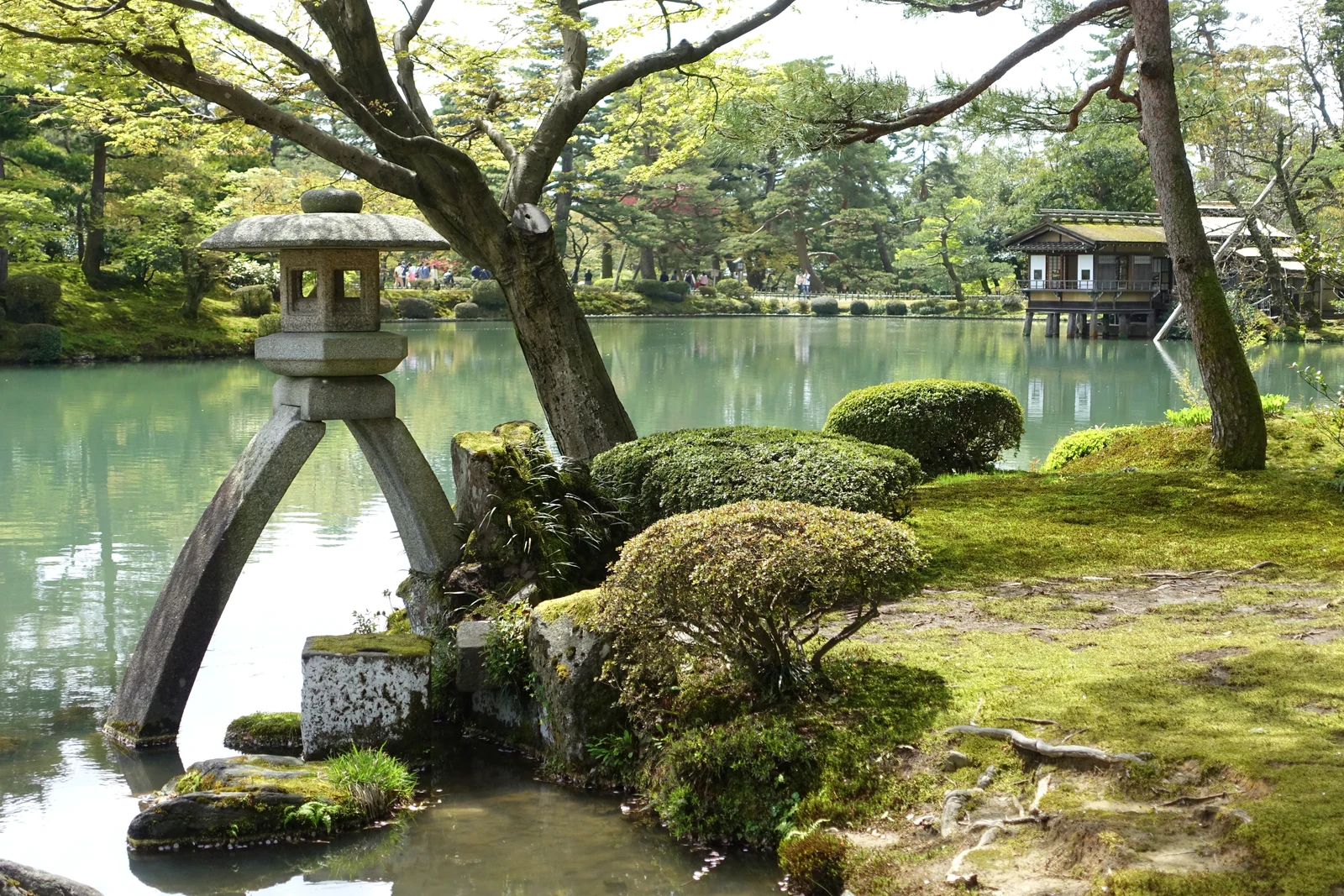

Kenrokuen at a glance: tickets, time and the best approach
| Your plan | Practical choice |
|---|---|
| First visit to Kanazawa | Castle → Katsurazaka entrance → garden → Mayumizaka exit → museum district |
| Only one hour | Prioritise Kotoji-toro lantern, Kasumigaike Pond, Karasaki Pine and the viewpoint |
| Photography and tea | Allow 90 minutes to two hours rather than rushing between landmarks |
| Early, quieter visit | Use the special free early-entry period and its two designated entrances |
| Wheelchair or limited walking | Choose the accessible route before arrival; do not follow the full walking circuit automatically |
| Autumn or winter | Check closing time, yukitsuri progress and separately announced illumination dates |
For the wider city route, use our Kanazawa travel guide. Kenrokuen, the castle and the museum district fit into one sightseeing area; Higashi Chaya and a mountain-village excursion need separate time.
Compare an electronic admission ticket if you prefer advance payment, or an English-language walking tour for historical context. These are different products: check entry instructions, cancellation terms and inclusions before booking.
Opening hours and admission
| Item | Regular arrangement |
|---|---|
| March 1–October 15 | 7:00–18:00; last admission 17:30 |
| October 16–last day of February | 8:00–17:00; last admission 16:30 |
| Adults, age 18 and over | ¥320 |
| Children, ages 6–17 | ¥100 |
| Age 65 and over | Free with accepted official proof of age, such as a passport |
Ordinary individual visits do not require an advance reservation. The garden normally opens daily, although weather and operational notices can affect access. Cash and supported card/electronic payment methods are available; carry a backup rather than assuming every payment method works at every entrance. See the admission information before travelling.
Should you buy a ticket in advance?
Buying at the entrance is straightforward and keeps your plans flexible. An electronic ticket is useful if you prefer to pay before arrival, but it should not be treated as guaranteed priority admission. Check the voucher instructions, eligibility and cancellation terms before paying. Confirm the selected package’s validity, refund rules and entry instructions before booking.
If you also want a participating cultural attraction, compare the locally sold Kenrokuen + 1 ticket with separate admissions. Do this against the places you actually intend to enter. A garden ticket does not automatically include Seisonkaku, museum exhibitions or the paid interiors at Kanazawa Castle.
Free early entry: the gates and departure rule matter
Kenrokuen opens free of charge before regular paid admission. It can be a good option when staying near the garden or Korinbo and wanting a quiet walk before breakfast. Only Renchimon and Zuishinzaka entrances operate for this arrangement. Katsurazaka, the obvious approach from the castle, is not an early-entry gate.
| Period | Early-entry hours | Last entry |
|---|---|---|
| March | 5:00–6:45 | 6:30 |
| April–August | 4:00–6:45 | 6:30 |
| September 1–October 15 | 5:00–6:45 | 6:30 |
| October 16–31 | 5:00–7:45 | 7:30 |
| November–February | 6:00–7:45 | 7:30 |
You must leave 15 minutes before regular opening. Early entry does not allow you to stay in the garden through the start of the paid period. Check the early-admission schedule, especially if planning a visit close to a seasonal change. From Kanazawa Station, do not assume a sightseeing bus will get you there in time for this early session.
Which entrance should you use?
Katsurazaka: from the castle and Kenrokuen-shita
This is the simplest first-time approach if you have just visited Kanazawa Castle. Cross Ishikawa Bridge from the Ishikawa-mon side and enter the garden. It also works well from the bus stop signed Kenrokuen Garden / Kanazawa Castle Park, commonly described as Kenrokuen-shita.
Mayumizaka: from Hirosaka and the museum district
Choose this side when the 21st Century Museum, Hirosaka or Korinbo comes before the garden. It is also a useful exit after a garden visit beginning near the castle. Entering and leaving through different gates makes a better through-route than retracing your entire walk.
Kodatsuno: consider it for a gentler approach
Kodatsuno is worth checking if reducing changes in level matters more than following the classic castle approach. Compare your arrival point with the accessible route rather than choosing an entrance solely because it is closest on a general city map.
Renchimon and Zuishinzaka: early-entry gates
These are the two designated options before regular opening. Locate them the day before if arriving in darkness. The official Kenrokuen garden map is better for entrance names and path orientation than a pin placed in the middle of the grounds.
A first-time walking route in 60–90 minutes
Start at Katsurazaka, walk toward Kotoji-toro and Kasumigaike Pond, then continue through the surrounding pine and stream scenery. Treat the following as a flexible sightseeing sequence: signs, temporary restrictions and your chosen exit take priority over completing every stop.
- Kotoji-toro lantern and Kasumigaike Pond: begin with the garden’s recognisable pond view, but step aside after taking photographs so others can pass.
- Viewpoint: pause for a wider view beyond the enclosed pond scene.
- Karasaki Pine: look at the spread of the branches. During the cold season this is a key place to appreciate the protective yukitsuri structure.
- Neagari Pine, Hanami Bridge and the winding stream: continue beyond the busiest photograph spot to see different textures, water channels and seasonal planting.
- Shiguretei area, Hisagoike Pond and Midori Waterfall: add these if time and mobility allow, then work toward your intended exit.
With only 30–40 minutes, concentrate on the main pond, lantern and pine area. With an hour, add nearby viewpoints without promising a complete circuit. Allow 90 minutes for a more relaxed walk; tea, queues and careful photography can take the visit closer to two hours. These are planning allowances, not fixed tour durations.
Footwear matters. Gravel, slopes and damp surfaces slow the visit, particularly in rain or winter. Leave large luggage at your hotel or station storage rather than pulling it around the garden.
Which season is best?
Spring brings plum and cherry blossoms followed by fresh leaves. Summer emphasises greenery and water, with an early visit more comfortable on hot days. Autumn is attractive for contrasting foliage around ponds and paths. Winter makes the sculpted pines and protective ropes especially prominent. None of these requires the garden to look exactly like a promotional photograph to be worthwhile.
Yukitsuri: ropes do not mean snow is guaranteed
Installation normally begins on November 1 and continues until around mid-December. The ropes remain into roughly mid-March. An early-November visit may show gardeners at work and incomplete structures; a winter visit is more likely to show the finished arrangement. Their purpose is to support branches under heavy snow, but the ground can be bare or wet on your visit. See the yukitsuri installation information and check local weather close to departure.
November 2026 illumination: check the actual date
The remaining autumn 2026 night openings are November 7, 14, 15, 21, 22, 28 and 29. The session begins at 18:00, last admission is 20:45 and the garden closes at 21:00; admission is free during these designated sessions. See the autumn event notice and Kanazawa’s tourism listing for the dates and any changes before travelling.
Plan the daytime and night sessions separately, with a meal or rest between them. Do not assume you can remain inside continuously until illumination begins. Future winter and spring sessions should be planned only after their own dates and entry conditions are announced.
Children, strollers and wheelchair access
The garden can work well for families if you shorten the route and allow stops. Gravel paths, bridges, slopes and water edges mean it is not equivalent to a flat paved city park. Hold young children’s hands near narrow bridges and ponds, and avoid making a long garden circuit the first of several demanding walks.
Free wheelchairs may be borrowed at Katsurazaka, Renchimon, Kodatsuno and Zuishinzaka. Availability is not a promise of unrestricted access to every path. The garden has inclines, so a companion may be helpful. The city’s accessible Kanazawa itinerary links to a recommended wheelchair course and more detailed facility information. Use that route to decide your entrance, resting points and exit before arrival.
For someone with limited stamina, a shorter main-sights visit followed by a rest nearby is more useful than insisting on every pine, bridge and pond. Rain, ice or snow should make the route shorter again.
Kenrokuen and Kanazawa Castle: a practical half-day
Classic route from Omicho Market
Start with a market breakfast or early lunch, continue through Kanazawa Castle Park, cross toward Katsurazaka, explore Kenrokuen, and leave at Mayumizaka for Hirosaka. Finish with the museum district or a meal in Korinbo. A half-day gives a useful introduction; entering several museum exhibitions or castle buildings needs additional time.
Reverse route from the museum district
If staying in Korinbo or beginning at the 21st Century Museum, enter at Mayumizaka and finish near Katsurazaka. Continue across to the castle instead of walking back around the outside of the garden.
The castle park grounds and its paid interiors are different experiences. For historical interpretation, an English-language walking tour may be worthwhile. Read the inclusions carefully: seeing the castle exterior does not automatically include entry to every reconstructed building.
Nearby places worth adding
Seisonkaku suits an interest in historic residences and decorative interiors, with separate admission. The 21st Century Museum adds contemporary art, but check the exhibition you want rather than assuming every space is included in one ticket. Omicho Market works best as a daytime food stop. Higashi Chaya is another district, so leave time for the transfer rather than labelling it part of the garden’s immediate surroundings.
Getting to Kenrokuen from Kanazawa Station
For Katsurazaka and the castle, choose a bus serving Kenrokuen Garden / Kanazawa Castle Park. For Mayumizaka, Hirosaka / 21st Century Museum is the more useful stop. Once off the bus, allow several minutes to walk to the actual entrance. Journey time depends on the route and traffic; a longer loop-bus circuit is not equivalent to the shortest local bus.
The Kanazawa Loop Bus uses the east-side terminal, stop 7. The adult fare is ¥220 per ride and the child fare is ¥110. Compare your day’s covered journeys before buying a one-day pass: if you take a bus out, walk between the castle and museums, then take one bus back, individual fares may be enough. Use the official bus route map for the route and payment details.
The one-day pass is ¥800 for adults and ¥400 for children. At the ¥220 adult loop-bus fare, four eligible rides cost ¥880, so compare your actual covered journeys before buying. Check Hokutetsu’s current loop-bus timetable and fare page for service and payment details.
For arrival from other cities, see Tokyo to Kanazawa or Kyoto to Kanazawa. Arriving at Kanazawa Station does not mean you have arrived at the garden: include luggage storage and the city transfer in your sightseeing time.
Kenrokuen FAQ
Is Kenrokuen worth visiting if I am not especially interested in gardens?
It is a strong first-time Kanazawa stop because it combines naturally with the castle. Try a 45–60-minute main-sights visit instead of forcing a long circuit. If outdoor walking is difficult or the weather is severe, prioritise an indoor cultural stop.
Do I need a reservation?
Not for an ordinary individual garden visit. A private guide or organised tour has its own booking requirements.
Can I visit for free early in the morning and remain all day?
No. The special early session has a departure deadline before regular opening. Re-enter under the normal admission rules if you want to continue later.
Can I see Kenrokuen and the castle in half a day?
Yes, for the garden and a selective castle visit. Add time for paid interiors, tea, extended photography or another museum.
Is January guaranteed to have snow?
No. Yukitsuri is a seasonal garden feature; snow cover depends on the weather. Check conditions close to the visit.
Can I visit in the rain?
Light rain can still suit a garden walk, but wet gravel and slopes require care. A shorter route and shoes with good grip are more practical than trying to complete the whole circuit.
Are the garden and castle illuminated on the same schedule?
Do not assume so. Castle lighting and Kenrokuen night admission have different arrangements. Check the specific garden event before travelling for an evening visit.
What should I decide first?
Your entrance and next destination. For most first visits, castle first, Katsurazaka in and Mayumizaka out is the clearest way to avoid unnecessary backtracking.
Which gates open for the free early session?
Only Renchimon and Zuishinzaka. Katsurazaka is not an early-entry gate, and everyone must leave before the normal paid opening.
Does a Kenrokuen ticket include the castle buildings?
No. Ordinary garden admission does not automatically include Kanazawa Castle’s paid interiors, Seisonkaku or museum exhibitions. Compare separate tickets or a relevant combination ticket for your actual plan.