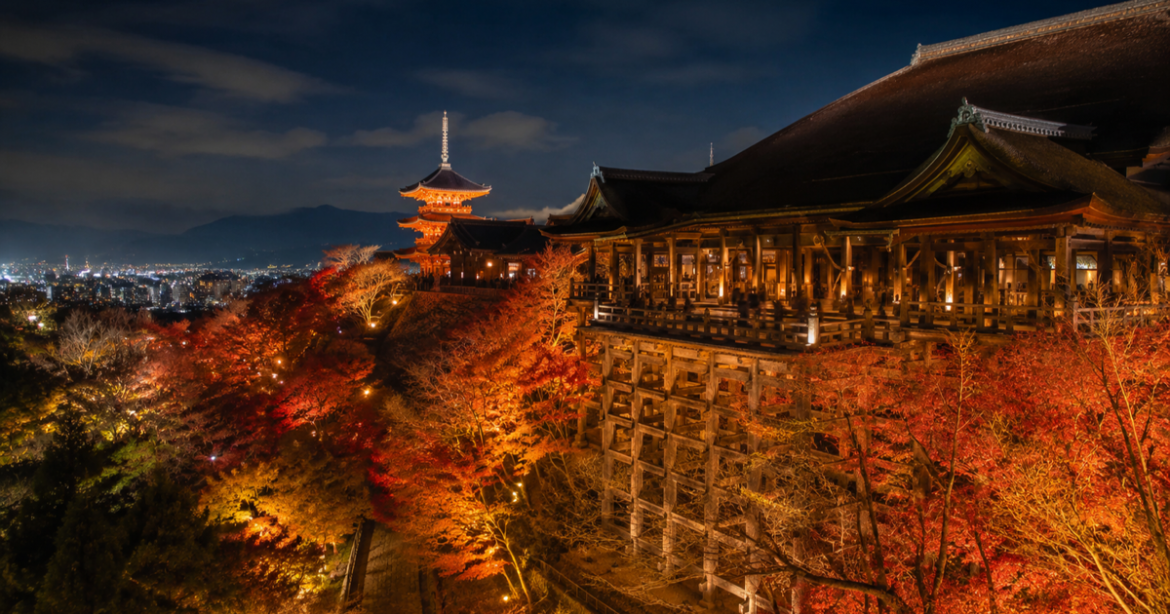
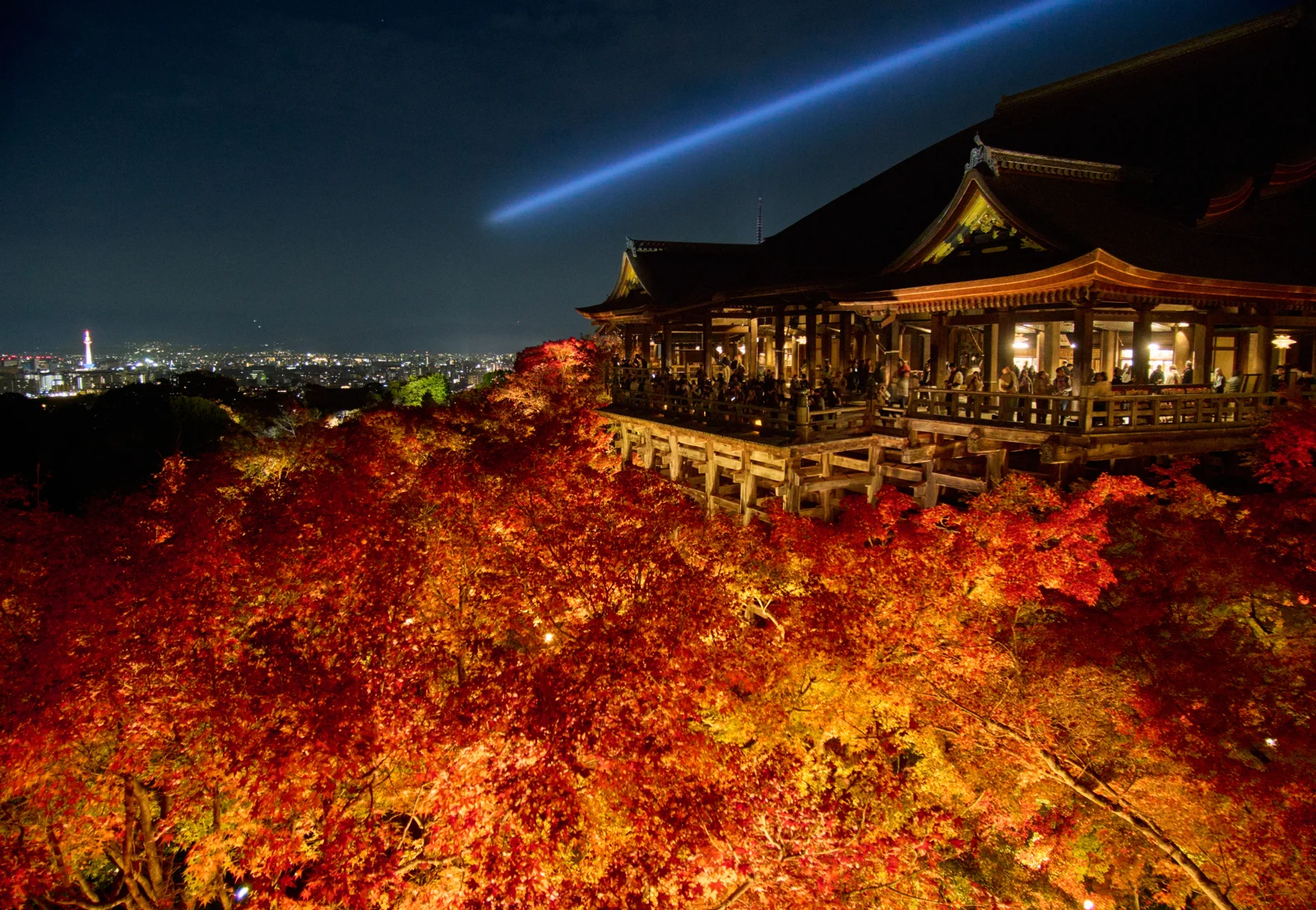
Kiyomizudera’s autumn night visit brings the wooden stage, the maple-filled valley, Kyoto’s city lights and the temple’s blue beam into one view. It is a different experience from daytime sightseeing, with more emphasis on atmosphere and a more demanding journey home. Give the evening to Higashiyama and plan the downhill walk before you join the entrance queue.
| Item | 2026 autumn night viewing |
|---|---|
| Dates | 21–30 November 2026 |
| Evening reception | From 17:30; last admission 21:00; closes 21:30 |
| Admission | Adult ¥500; elementary and junior-high pupils ¥200; no reservation |
| Joju-in Garden | Separate admission: adult ¥600, schoolchild ¥300; evening reception 18:00–20:30 |

2026 dates, hours and ticket price
The autumn special night viewing runs November 21–30, 2026. The evening programme begins at 17:30; admission ends at 21:00 and the temple closes at 21:30. Adults pay ¥500, elementary and junior-high-school pupils ¥200. Advance reservations are unnecessary for the ordinary visit.
The address is 1-294 Kiyomizu, Higashiyama, Kyoto. Allow roughly 90–120 minutes in the grounds, or 2.5–3 hours including the approach, queues and descent. These are planning allowances, not a fixed tour duration. For daytime photo positions and the broader foliage season, keep the separate Kiyomizudera daytime guide in your plan.
The audio guide is interpretation, not temple admission; enter through the temple’s reception.
free Kiyomizudera audio guide
If arriving from Kansai Airport, choose the Kyoto option on the HARUKA airport-ticket product and leave luggage before visiting. This is airport transport, not temple admission.
Is the night visit right for you?
It is a strong choice for first-time Kyoto autumn visitors, couples and photographers who are comfortable with uphill walking and crowds. A family or older traveller can also enjoy it, but should save energy during the day. After a long Arashiyama outing, another major hillside visit may be too much.
Staying in Kyoto makes the evening easier, though returning to Osaka is possible. A visit around 17:30–19:30 followed by a walk towards Gion or Kawaramachi gives a more relaxed end than staying until closing and only then investigating transport. An arrival around 19:00 can also work; no particular time guarantees a short queue.
Event dates and leaf colour are different things
The temple’s usual foliage season is mid-November to early December. Late November is a sensible window, but it is not possible to promise a fully red valley on a specific date. The opening night is an event date, not a biological deadline for the trees.
Early December may still have daytime foliage, but the 2026 autumn night event ends November 30. Check recent leaf conditions near departure instead of using an old photograph as a forecast. A flexible Kyoto itinerary is more useful than treating one supposedly perfect date as certain.
Tickets, audio guidance and special openings
For the ordinary night visit, follow the temple’s on-site reception; there is no need to search for a complicated package just to pay admission. The Klook free Kiyomizudera audio guide is a separate interpretive service, not an entrance ticket. Use headphones and avoid letting the commentary distract you on steps or in a crowd.
free Kiyomizudera audio guide
The temple’s disability policy allows eligible visitors and one companion free entry on presentation of the relevant disability identification. Consult the current official policy for your documentation. Jojuin Garden is a separate special opening: November 21–30, 2026, daytime reception 10:00–16:00 and evening reception 18:00–20:30. Admission is ¥600 for adults, ¥300 for elementary and junior-high pupils, separate from the temple admission. With only 90 minutes, prioritise the Main Hall and Okunoin rather than squeezing in every additional area.
Current access: Jishu Shrine is still closed
The temple’s 2026 night dates are published, but the neighbouring Jishu Shrine remains closed for building and grounds work, with reopening undecided. Do not make its matchmaking attractions a must-complete part of the evening. Geographic proximity does not mean that a place is open.
Use the official grounds map for the layout and the temple’s accessibility guidance for step-free routes. Map apps may propose paths that do not enter the grounds. The official approaches are via Kiyomizuzaka and Niomon, or Chawanzaka and the emergency-road side.
Use the grounds map to locate Niomon, the Main Hall and Okunoin, then use the wheelchair-route diagram below when planning step-free access. The route still includes slopes and gravel; it is not a promise of a completely flat journey. Follow the evening’s on-site signs for entrances, closures and direction of travel.
Choosing an arrival time
Arriving near 17:00–17:30 gives time to find the entrance and see the change into evening, but may coincide with the opening crowd. From 17:30–18:30 you have ample viewing time, with popular positions still busy. Around 19:00–20:00 is a workable balance for people who have eaten or rested beforehand. After 20:30, the admission deadline leaves little flexibility for a first visit.
Do not treat 21:00 as the time to reach the foot of the hill. That is the reception cut-off inside the approach sequence. Add time for slow movement and queues rather than relying on the shortest navigation estimate.
The bus stop, Niomon and the stage are three different places
The walk from Gojozaka or Kiyomizumichi bus stop to the temple is about ten minutes uphill. Autumn crowds and stopping in shops add time. Reaching Niomon still does not put you on the stage: you continue past the pagoda area, reception and Todorokimon towards the Main Hall.
For planning, allow additional walking and entry time beyond the bus-stop reference, potentially 20–30 minutes or more from the stop to the Main Hall when people are moving slowly. This is a buffer, not a guaranteed journey time. A few minutes saved on a bus are not useful if the uphill portion is forgotten.
A clear first-visit sequence
Niomon and the pagoda area
The illuminated red architecture introduces the evening. Take a short look, then keep time for the Main Hall, Okunoin and valley rather than spending the whole opening period at the first photograph.
Main Hall and Kiyomizu Stage
The view combines foliage, dark hillside and city lights. Keep the space respectful for worshippers and other visitors. The stage is for looking out; the wider photograph of the stage itself comes from farther along the route.
Okunoin
Look back towards the Main Hall for the familiar view of the wooden stage above the maples. It is popular, so wait briefly for a space, photograph without blocking movement and continue when asked.
The blue beam
The blue light represents Kannon’s compassion and gives the event a distinctive visual identity. It is part of the religious setting, not merely decorative lighting. Compose it with the landscape if visible from your position without stepping into a restricted area.
Otowa Waterfall and the descent
The waterfall is meaningful to the temple’s identity, but queueing can consume the last part of the evening. If you enter late or have tired children or older companions, prioritise the Main Hall, Okunoin and safe descent. Do not turn a completed visit into a rush simply to tick off one more stop.
Photography rules: leave the tripod behind
Drones, monopods and tripods are prohibited. The temple also prohibits unapproved commercial recording, including temple buildings used as a background, and forbids wedding, cosplay and model-fashion photo sessions. A kimono or photographer booking does not override these rules.
Use handheld night mode or stabilisation, watch people moving through the frame and avoid long occupation of a viewpoint. Do not block paths, use intrusive lighting or enter planted areas. For portraits, daylight before the visit is often simpler than the crowded night grounds. Respect private-property and no-photography signs on surrounding streets as well.
Children, strollers and wheelchair users
The temple has step-free routes and accessible toilets; strollers can use the appropriate route. The difficult part is often the approach through hilly, crowded streets rather than the facilities themselves. Large strollers on busy stone stairs can make a long evening harder, so shorten the daytime programme and use the official route.
Wheelchair access uses the Chawanzaka/emergency-road approach. The temple does not lend wheelchairs. A taxi may reduce the urban journey, but road controls and the final access arrangement still matter; it cannot be assumed to deliver any vehicle directly to the stage. Contact the relevant provider about assistance rather than inferring accessibility from a generic car photograph.
A Kyoto private charter can help with an authorised daytime itinerary, but the listed standard service ends at 20:00 and wheelchair carriage is restricted. Do not buy it assuming a late-night accessible pickup. Any overtime, vehicle suitability and pickup location must be explicitly confirmed in the selected offer.
Three approaches from Kyoto Station
Bus to Gojozaka, then walk
This is straightforward in principle but exposed to Higashiyama road congestion. Ordinary bus services and tourist express buses have different routes, fares and timetables. The weekend/holiday tourist express services EX100/EX101 charge ¥500 adult and ¥250 child; do not assume their daytime schedule provides a ride home after the temple closes.
JR to Tofukuji, Keihan to Kiyomizu-Gojo
A rail-based approach reduces dependence on a bus through the busiest streets. The trade-off is the approximately 25-minute uphill walk from Kiyomizu-Gojo. It suits people comfortable walking, not every family or traveller with mobility limitations.
Subway towards Kujo, then a local bus
A subway journey followed by a shorter surface connection near Oishibashi can be another way to avoid the largest Kyoto Station boarding queues. Check the current 202/207 direction and stop before boarding. This is a route-planning option, not a promise that the remaining road section is free of congestion.
The Kansai pass comparison is useful for a wider Osaka–Kyoto–Nara trip, but one evening in Kyoto alone is not a reason to buy a large rail pass.
From Kiyomizu-Gojo, Gion or Kawaramachi
Kiyomizu-Gojo Station is about 25 minutes away on foot, with climbing towards the end. After the visit, the reverse walk is a useful alternative if bus queues are long. It is not an easy shortcut for someone already exhausted, wearing uncomfortable footwear or travelling with a tired child.
From Gion-Shijo or Kyoto-Kawaramachi, allow roughly 30 minutes or more without extended stops, and longer if visiting Yasaka Shrine or the historic lanes. Treat this as your afternoon sightseeing route. If a long walk is unsuitable, a bus towards Kiyomizumichi still leaves an uphill final section.
Arriving from Kansai Airport
An early arrival can connect by HARUKA to Kyoto, leave luggage at the hotel and visit in the evening. An afternoon or evening flight creates too many uncertain steps: flight delay, immigration, bags, rail travel and the uphill approach. Do not drag large luggage through the temple streets to rescue a tight schedule.
The HARUKA airport-ticket product has Kyoto options, but select the correct destination and conditions. It is airport transport, not temple admission or a guarantee that a late flight can make the night event.
Getting home is the part to decide first
For Gion/Higashiyama, walking back through the appropriate open streets is often the simplest finish. For Kawaramachi, the walk towards Gion and over the river gives access to restaurants and transport. If staying near Kyoto Station, assess bus queues or use the Kiyomizu-Gojo–Tofukuji rail route if your group can manage the walk.
For Osaka, include the downhill walk, waiting and final city connection. Leaving around 19:30–20:00 is a sensible first-visit plan rather than using 21:30 closing as your departure target. Do not rely on a tourist express bus after the night event, and check the actual last connection to your accommodation.
Why driving is a poor autumn fallback
Kiyomizudera has no car park. Kyoto’s Kiyomizuzaka tourist parking facility excludes private cars throughout October 7–December 10, 2026, covering all the night-viewing dates. A crowded bus does not mean a car will be easier. Use an appropriate park-and-ride arrangement farther from the core if driving is part of the wider trip.
Kimono rental: return time matters more than proximity
A shop close to the temple is not enough if its ordinary return deadline overlaps the night opening. The MOCOMOCO Kiyomizudera rental product lists a normal 17:30 return time and separate hotel-return/next-day-return options. A return-service-only option does not itself include the kimono rental.
MOCOMOCO Kiyomizudera rental product
Select the actual rental and return arrangement that fits your evening, confirm any extra cost and allow for footwear on slopes. Photograph portraits in daylight, then keep the evening route short. Commercial photography permissions remain separate from clothing rental.
Half-day and full-day itineraries
The most straightforward afternoon-to-night plan
Begin around 14:30 in Gion or Kawaramachi, visit Yasaka Shrine and the Higashiyama streets, then take a snack or early meal before moving towards Niomon around 17:00. Visit approximately 17:30–19:30, descend towards Gion/Kawaramachi and eat dinner or return to the hotel. The advantage is staying in one district.
Fushimi Inari, a rest and Kiyomizudera
Start with Fushimi Inari in the morning, have lunch, then rest before the Gion–Higashiyama walk and evening temple visit. With children or older travellers, keep the shrine walk to a suitable shorter section rather than climbing the entire mountain. Do not add Arashiyama to this already substantial walking day.
Nearby visits, rain and dinner
Ninenzaka, Sannenzaka, Yasaka Shrine and Gion fit naturally. Nanzenji can be a daytime choice farther north, but adding several night illuminations turns the evening into transfers and queues. The Nanzenji guide can help assess that extra journey. Put Arashiyama foliage on another day where possible.
Light rain may add reflections to stone, while making stairs and slopes slippery. Do not assume ordinary rain means cancellation or severe weather guarantees operation; follow the temple’s current announcement. In heavy rain, shorten the street walk and prioritise the main temple route.
Buy souvenirs and enjoy sweets before entering: shops do not all stay open until 21:30. The temple is not a night market; avoid eating while walking around the grounds. For a late meal, Gion or Kawaramachi offers a more practical starting area than relying on every shop at the gate remaining open.
Where to stay
Gion/Higashiyama reduces the final transfer, Kawaramachi balances dining and transport, and Kyoto Station suits airport trains and onward journeys. Osaka offers a broad accommodation choice but adds a cross-city return. You do not need a special overnight stay solely for the temple, yet staying in Kyoto is valuable when you want a late, unhurried evening. Use the Kyoto itinerary and accommodation-area guide to compare the overall trip.
Frequently asked questions
What are the 2026 autumn night dates?
November 21–30, 2026.
When does the evening programme start?
At 17:30; local lighting and entry arrangements may be adjusted on site.
When is last admission?
21:00. The temple closes at 21:30.
Do I need a reservation?
No advance reservation is required for the standard special night visit.
What is the admission price?
Adults ¥500; elementary and junior-high-school pupils ¥200.
Is the audio guide an admission ticket?
No. Audio, clothing and transport services are separate from temple admission.
Which 2026 date will have the reddest leaves?
There is no guaranteed single day. Use the usual season and recent conditions together.
Is late November certain to be colourful?
It is a sensible seasonal window, but weather can change timing and leaf condition.
How far is the bus stop?
Allow roughly ten minutes uphill from Gojozaka or Kiyomizumichi to the temple, before extra crowd and entry time.
Is Niomon the same place as the stage?
No. You still continue through the grounds and reception towards the Main Hall.
How long is the walk from Kiyomizu-Gojo?
About 25 minutes, with an uphill final section.
Can I walk from Gion-Shijo?
Yes if comfortable walking. Allow roughly half an hour or more without extended sightseeing stops.
Is the direct bus always fastest from Kyoto Station?
No. Autumn congestion can make the JR–Keihan approach plus walking more predictable for fit walkers.
Can the tourist express bus take me home after closing?
Do not rely on it. Its normal visitor timetable is not a late-night service after 21:30.
Should I queue at Otowa Waterfall at night?
It is worthwhile when time permits, but keep the Main Hall, Okunoin and safe descent first if arriving late.
Are tripods allowed?
No. Tripods, monopods and drones are prohibited.
Can I bring a stroller?
Use the official step-free route; crowded hillside streets remain a challenge.
Is wheelchair access possible?
Yes via the appropriate official route, including the Chawanzaka/emergency-road approach. The temple does not lend wheelchairs.
Is the evening suitable for older visitors?
Yes with a lighter daytime plan, rest and realistic walking arrangements.
Does rain cancel the event?
Do not assume a universal rain rule. Check the temple’s current notice during severe weather or operational changes.
Is Jishu Shrine open?
It remains closed for renovation and grounds work, with reopening undecided.
Must I stay overnight in Kyoto?
No, but it reduces the return journey, especially for families or visitors who want to stay later.
Which area is most convenient?
Gion/Higashiyama for the shortest local return, Kawaramachi for dining and connections, Kyoto Station for onward transport.
Can I combine the night visit with Arashiyama?
It is possible, but separate days are more comfortable in the busy foliage season.
Check your chosen date’s opening arrangements, transport and weather before travelling.