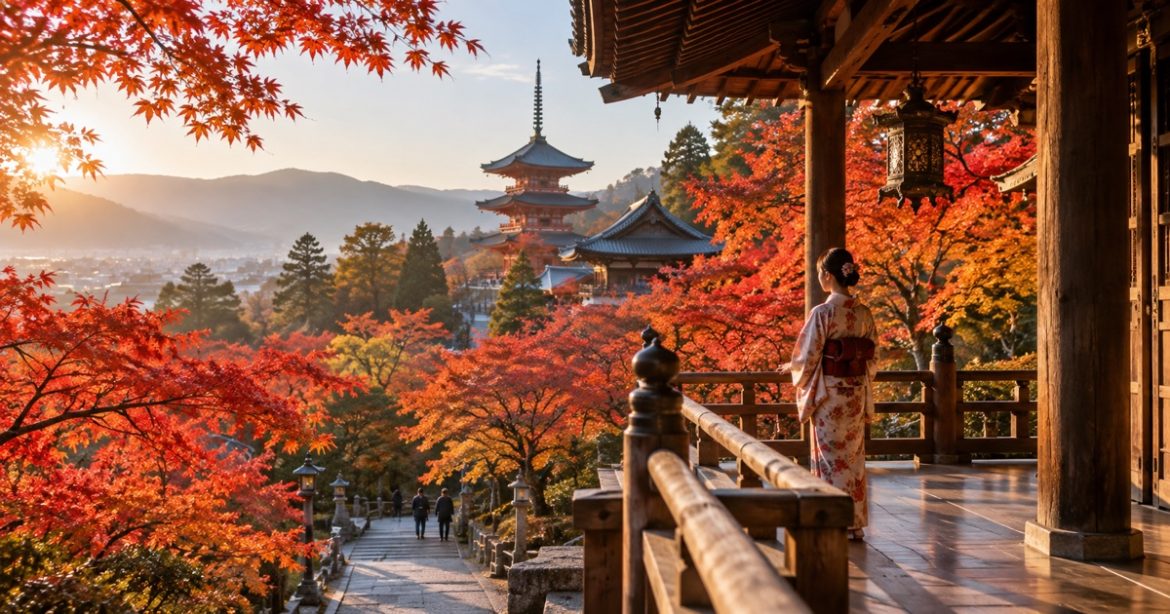

Kyoto Autumn Leaves 2026: When Should You Go?
For most travellers, Kyoto’s autumn leaves are best treated as a moving season rather than a single peak date. Mountain and northern districts such as Takao and Ohara normally change earlier, while many central, eastern and western Kyoto sights colour later. Historical windows are useful for planning, but they should not replace current foliage reports.
Japan Meteorological Corporation’s second 2026 forecast, issued on 1 October, places Kyoto’s representative maple date at 11 December and ginkgo date at 27 November. These are six and three days after their historical references, respectively, but both remain classified around normal. They use standardized representative-tree observations, not a shared peak date for every temple. Northern districts, mountains and individual gardens can differ. The next release is scheduled for early November; check the latest official forecast before travelling.
The city forecast describes a seasonal reference, while individual temple gardens and hillsides can change at different times.
Before travelling, compare the latest Japan Meteorological Corporation autumn forecast with the Kyoto City Autumn Leaves Calendar. Once venue-level reports become available, they are more useful for choosing where to go on a particular day than a single citywide forecast date.
Before the scheduled 30 October 2026 update, the official Kyoto Autumn Leaves Calendar still displays the 2025 season, last updated 12 December 2025. It now explicitly announces that 2026 updates will begin on 30 October. Treat the existing colour rows as historical references, then check each location’s update date when the new season starts.
Swipe to compare →
| Trip timing | Best planning approach | Main risk |
|---|---|---|
| Late October to early November | Check higher, northern and earlier-changing areas first | Central Kyoto may still be mostly green |
| Mid-November | Compare Takao, Ohara and southern Kyoto with current reports | Historical averages may not match the season |
| Late November | Compare the major city districts and confirmed night events | Very heavy crowds at famous sights |
| Early December | Keep central Kyoto, Higashiyama and later locations in play | Earlier mountain districts may already be past peak |
| After the main peak | Look for remaining colour, fallen-maple scenery and flexible city sightseeing | Do not expect every famous garden to retain full colour |
The key point: do not tell your entire Kyoto trip to follow one forecast date. Elevation, exposure and tree species vary enough that switching districts can make a substantial difference.
How to Read the Kyoto Autumn Leaves Forecast
Japan Meteorological Corporation forecasts red maple and yellow ginkgo separately. Its Kyoto figure is a broad seasonal indicator based on representative-tree observation standards. It does not mean Arashiyama, Kiyomizu-dera, Takao and every temple garden will look their best on December 11.
Use three layers of information:
- National forecast: for the overall seasonal tendency.
- Kyoto foliage reports: for current colour in individual areas.
- Venue information: for opening hours, special admission, reservations and illumination schedules.
This last step matters because good foliage conditions do not automatically mean a temple has a night opening or follows the same entry rules as another venue.
Use page 1 to locate Kyoto Station, Higashiyama and Okazaki before deciding which eastern temples belong in the same day. Page 2 has separate insets for Arashiyama, Takao, Ohara and Kurama–Kibune. Choose the arrival and departure stations for one district before adding stops. This is a geographical reference, not an illumination layout or live timetable; slopes, steps and actual entrances still need attention, and a short straight line does not establish step-free access.
Kyoto Autumn Leaves by District
Swipe to compare →
| District | Best use | Planning character |
|---|---|---|
| Takao | Earlier-season option | Mountain setting; useful when central Kyoto is still green |
| Ohara | Earlier northern alternative | Allow at least half a day because of travel time |
| Southern Kyoto / Tofukuji | Foliage plus Fushimi Inari | Good rail geography; popular foliage sights get busy |
| Higashiyama / Okazaki | Classic temple-and-maple day | Strong walking route with several evening options |
| Kinugasa / Kitano | Northwestern alternative | Useful for Kitano Tenmangu and nearby northwest Kyoto |
| Arashiyama / Saga | Western Kyoto foliage day | Best kept as its own half-day or full-day cluster |
| Central Kyoto | Flexible fallback and evening base | Convenient for dining and rail connections |
Takao: Check It When Your Trip Is Early
Takao is useful because its mountain setting generally changes ahead of central Kyoto. Consider it when current reports still show the city mostly green, but treat it as a deliberate half-day destination rather than trying to squeeze it between Arashiyama and Higashiyama.
Ohara: A Northern Alternative
Ohara suits travellers who prefer a slower temple-and-countryside day. Because reaching it takes longer than moving between central districts, do not combine it with an ambitious Arashiyama or southern Kyoto schedule.
Southern Kyoto: Tofukuji + Fushimi Inari
Southern Kyoto creates one of the most geographically sensible autumn combinations. Visit Fushimi Inari early, then continue toward the Tofukuji area instead of crossing Kyoto to Arashiyama.
The Todolist Japan Fushimi Inari Taisha guide covers access and route planning in detail.
Higashiyama: Best for a Classic Kyoto Autumn Day
Higashiyama gives first-time visitors a dense combination of traditional streets, temples and autumn scenery without repeated cross-city transfers.
- Start with your highest-priority daytime temple.
- Continue along one connected walking corridor.
- Take a proper break before late-afternoon crowds build.
- Finish with one night venue that fits the same side of the city.
Kiyomizu-dera works especially naturally with southern Higashiyama, Nene-no-michi, Kodai-ji and Gion. See the Todolist Japan Kiyomizu-dera guide for detailed access and temple planning.
Arashiyama: Give Western Kyoto Its Own Block of Time
Arashiyama is not a convenient quick add-on to a full Higashiyama day. Use it for an early-morning-to-lunchtime western Kyoto route or make western Kyoto the main focus of the day.
From Kyoto Station, rail is normally the better first choice than relying on a city bus. During peak foliage season, road congestion and boarding delays can erase the apparent convenience of a direct bus.
Kinugasa and Kitano: A Separate Northwestern Cluster
Kitano Tenmangu is useful when you want a northwest Kyoto alternative rather than another Higashiyama circuit. Its Maple Garden is open from October 31 to December 6, 2026, 9:00 AM–4:00 PM with last reception at 3:40 PM. The night illumination runs only from November 13 to December 6, from sunset until 8:00 PM with last reception at 7:40 PM. Do not treat October 31–November 12 as night-viewing dates. Check the official Maple Garden information before visiting.
Best Kyoto Autumn Leaves Day Routes
Route 1: First-Time Kyoto Autumn Day
Best for: classic eastern Kyoto scenery.
- Early morning: Kiyomizu-dera
- Morning: Sannenzaka and Ninenzaka
- Late morning: Kodai-ji / Yasaka area
- Lunch: Gion or nearby
- Afternoon: northern Higashiyama or Okazaki
- Evening: Kodai-ji, Kiyomizu-dera or another confirmed eastern Kyoto night event
Keeping the evening in eastern Kyoto is much more efficient than crossing to Arashiyama.
Route 2: Fushimi Inari + Southern Kyoto Autumn
- Early morning: Fushimi Inari
- Late morning: Tofukuji area
- Lunch: southern or central Kyoto
- Afternoon: one rail-accessible district
- Evening: Kyoto Station area or a separately confirmed night event
This is far more practical than trying to connect Fushimi Inari, Arashiyama and Kiyomizu-dera in one sightseeing day.
Route 3: Arashiyama + Central Kyoto
- Morning: Saga-Arashiyama
- Late morning to early afternoon: western Kyoto foliage sights
- Mid-afternoon: return toward central Kyoto
- Evening: dinner, shopping or a night event with realistic travel time
Route 4: Earlier-Season Takao Day
- Morning: travel to Takao
- Late morning and afternoon: focus on the mountain temple area
- Late afternoon: return toward central Kyoto
- Evening: dinner or a separately confirmed event
This is a useful fallback when current reports show central Kyoto has not yet developed strong colour.
Kyoto Autumn Night Viewing 2026
Night viewing should be planned separately from daytime foliage. Dates, admission sessions and re-entry rules are not the same at every temple. The dates below apply to the 2026 season.
Swipe to compare →
| Venue | 2026 dates and times | Key session rule |
|---|---|---|
| Kiyomizu-dera | Nov 21–30; extended opening to 9:30 PM, last entry 9:00 PM | No reservation required. Check the temple’s arrangements for your visiting day before setting an arrival time. |
| Eikando | Night illumination Nov 20–Dec 6; entry 5:30–8:30 PM, closes 9:00 PM | Separate from the daytime Autumn Treasure Exhibition. Visitors cannot remain inside continuously from the day session into the night session. |
| Kodai-ji | Oct 23–Dec 13; open from 9:00 AM, lights from 5:00 PM, last entry 9:30 PM, closes 10:00 PM | Day and night are not replacement sessions, but once you exit you cannot re-enter with the same ticket. |
| Toji | Oct 31–Dec 13; night visit 6:00–9:30 PM, last entry 9:00 PM | Autumn illumination plus night access to Kondo and Kodo. Do not assume this means night access to the Five-storey Pagoda interior. |
| Kitano Tenmangu Maple Garden | Night illumination Nov 13–Dec 6; sunset–8:00 PM, last reception 7:40 PM | The daytime garden opens earlier, Oct 31–Dec 6. October 31–November 12 is not the night-illumination period. |
Choose the night venue by geography. Kiyomizu-dera and Kodai-ji fit naturally after southern Higashiyama, Nene-no-michi and Gion. Eikando works better after Nanzenji, the Philosopher’s Path or Okazaki than after a full Kiyomizu route. Toji is especially practical around a Kyoto Station arrival or departure day. Kitano Tenmangu belongs to its own northwestern cluster.
Check the arrangements for your chosen date: Kiyomizu-dera, Eikando, Kodai-ji, Toji and Kitano Tenmangu.
Do not use illuminations as a guaranteed crowd-avoidance strategy. Their main practical advantage is that they extend sightseeing beyond ordinary daytime temple hours.
How to Avoid the Worst Kyoto Autumn Crowds
1. Use trains and subway before buses
During peak foliage periods, buses and roads can become heavily congested. Use rail or subway for the longest part of a journey where practical, then walk or use a bus for the final connection.
2. Stop returning to Kyoto Station between attractions
Kyoto Station is an excellent hub, but not the natural midpoint of every route. If you are already in Higashiyama, continue through Higashiyama. If you are in Saga-Arashiyama, finish the western cluster before crossing the city.
3. Put your highest-priority sight first
Use the earliest practical part of the day for the place that matters most instead of saving it for a crowded mid-afternoon slot.
4. Check congestion before changing districts
The Kyoto Travel Congestion Forecast provides area-level congestion information and selected live cameras. It is most useful for deciding whether crossing the city is worthwhile on the day itself.
5. Travel without large luggage
Suitcases are awkward on crowded buses, station stairs and narrow Higashiyama streets. Leave luggage at your hotel, use suitable storage or arrange delivery before sightseeing.
6. Avoid driving into the busiest districts
Public transport is normally the safer default for Arashiyama, Higashiyama and other heavily visited foliage areas during peak autumn periods.
What If the Autumn Leaves Are Early or Late?
If your trip is earlier than the colour
- Check Takao and Ohara first.
- Choose places where autumn colour is only one part of the experience.
- Keep major central temples for later in your stay if possible.
- Do not travel across Kyoto solely because an old seasonal article says a site “should” be at peak.
If the season is running later
- Keep lower-elevation central Kyoto in play.
- Check current Kyoto foliage reports close to your visit.
- Move your main foliage day later within a multi-day stay if conditions support it.
- Remember that a city reference-tree forecast does not determine every temple’s timing.
If you arrive after peak
“Past peak” does not automatically mean a wasted day. Fallen maple leaves can create strong ground colour, while maple and ginkgo timing can differ. Use current site-level reports or recent official images rather than cancelling a district based on one generalized forecast.
If it rains
Rain does not require abandoning the itinerary, but wet stone paths, stairs and fallen leaves can be slippery. Reduce the number of transfers, prioritise one compact district and wear shoes with reliable grip. Heavy rain is also a good reason not to force a long mountain transfer simply to chase colour.
What to Wear for Kyoto Autumn Leaves
Kyoto autumn days often involve long periods of walking and standing, followed by noticeably cooler conditions after sunset.
- Wear comfortable walking shoes with good grip.
- Use layers rather than relying on one bulky garment.
- Carry an outer layer suitable for evening illumination.
- Bring rain protection when the daily forecast requires it.
- For Takao, Ohara and other less-central areas, check the weather for the actual district rather than assuming central Kyoto conditions apply everywhere.
What Should You Book in Advance?
There is no single autumn-leaves ticket covering Kyoto, and booking rules differ by venue.
- Secure accommodation early for popular autumn dates.
- Check any venue that announces timed or special autumn admission.
- Confirm whether your chosen night event requires advance booking rather than assuming it does.
- Reserve long-distance trains when your travel dates coincide with particularly high-demand periods if appropriate for your route.
For example, Kiyomizu-dera’s confirmed November 21–30, 2026 night viewing does not require a reservation. Other venues may use different rules. Always check the exact event you plan to visit.
Plan entrances and walking demands before the evening
Use the official Kyoto maps and transport tools to choose a railway approach, walking direction and luggage-storage point. Higashiyama’s slopes, stone steps and temple gravel paths make a straight-line distance an unreliable measure of effort. With young children, older relatives or mobility needs, prioritise one temple and nearby breaks instead of recovering every missed daytime stop after dark.
Temple exhibitions, gardens and evening sessions can have different tickets. Eikando clears the daytime session; Kodaiji does not, but the same ticket cannot be used after exiting. Kiyomizu-dera says its 2026 autumn evening opening does not require a reservation. Compare the exact admission area before comparing prices.
Kyoto Autumn Leaves FAQ
When is the best time to see autumn leaves in Kyoto?
Historically, much of Kyoto’s main foliage season falls from November into early December, but timing varies by district and year. In the second 2026 forecast issued on 1 October, Kyoto’s representative maple date is December 11 and ginkgo date November 27, while both remain classified around normal. These are reference-tree dates, not guarantees for individual temples.
Does the December 11 forecast mean I should wait until December 11?
No. It should not be used that way. Mountain and northern areas can colour earlier, and individual gardens have their own microclimates and tree mixes. Use the city forecast to understand the broad season, then use current local reports to select your district.
Is late November always peak autumn foliage in Kyoto?
No. Late November is an important historical planning period, but it is not a guarantee. Takao, Ohara, central Kyoto, Higashiyama and Arashiyama can progress differently.
Is December too late for Kyoto autumn leaves?
Not necessarily. Some city locations can retain good colour into early December, particularly in a season with later colour development. Check current venue-level conditions rather than treating November 30 as an end date.
Where should I go for earlier autumn leaves?
Takao and Ohara are useful areas to check first because northern and higher areas generally change ahead of many central locations. Confirm current conditions before making the longer journey.
Is Arashiyama or Higashiyama better for autumn leaves?
Choose Arashiyama for a western Kyoto day centred on Saga-Arashiyama and its surrounding scenery. Choose Higashiyama for a denser first-time route combining historic streets, temples and convenient eastern Kyoto night events. Trying to cover both fully in one relaxed half-day is unrealistic.
Are Kyoto autumn night illuminations worth it?
They are useful for extending sightseeing beyond daytime temple hours and seeing gardens under different lighting. They are not necessarily quieter. Pick one that fits your daytime district rather than crossing Kyoto simply to collect another illumination.
How many autumn foliage areas can I visit in one day?
One major district plus a nearby evening event is often the most comfortable plan. Two compatible geographic clusters can work, but trying to cover Takao, Arashiyama, Higashiyama and southern Kyoto in one day creates more transport than sightseeing.
Do I need a car?
No. For Kyoto’s major foliage districts, public transport is generally the more practical choice during the busy autumn season, particularly when road congestion affects buses and private vehicles.
When does Kyoto’s official calendar begin its 2026 colour updates?
The published start date is 30 October 2026. The 2025 rows retained before then are not current conditions. Always check the update date for the individual location as well as the year.
Can I stay at Eikando from the daytime exhibition until the lights come on?
No. The autumn exhibition and evening illumination are separate sessions. Leave after the daytime visit and buy the evening admission separately. Evening entry is 17:30–20:30, with closing at 21:00 in 2026.
Does Kitano Tenmangu’s night viewing start on 31 October?
No. Its 2026 maple garden opens for daytime visits on 31 October, but illumination starts on 13 November. Both periods end on 6 December.
Can I leave Kodaiji for dinner and return on the same ticket?
No. Although the 2026 autumn opening does not clear visitors between day and evening, the same ticket cannot be reused after you exit. Eat beforehand or plan your break before admission.
Which Kyoto Autumn Leaves Plan Is Best for You?
First-time visitor: choose Higashiyama, put your priority temple first, stay within one connected eastern Kyoto route and finish with a confirmed nearby night viewing.
Travelling relatively early: check Takao and Ohara before assuming central Kyoto is already red.
Returning visitor: consider Takao, Ohara or Kinugasa/Kitano instead of repeating the busiest central circuit.
Arashiyama is your priority: give western Kyoto at least half a day rather than attaching it to an overloaded Higashiyama schedule.
You only have one autumn day: check the latest foliage and congestion information, choose the strongest single district for your date and stay geographically compact.
You have two or three Kyoto days: keep the foliage day flexible until close to travel. Put less weather-dependent attractions on the other days, then use current colour reports to decide whether your autumn day belongs in Takao, Arashiyama, southern Kyoto, Kitano or Higashiyama.
That flexibility matters more than choosing a supposedly perfect date months in advance. Kyoto’s colour progresses differently across districts, elevations and tree species; the most useful itinerary follows the conditions that actually develop when you visit.
Event dates, fees and access can change; check your chosen venue’s arrangements before travelling.