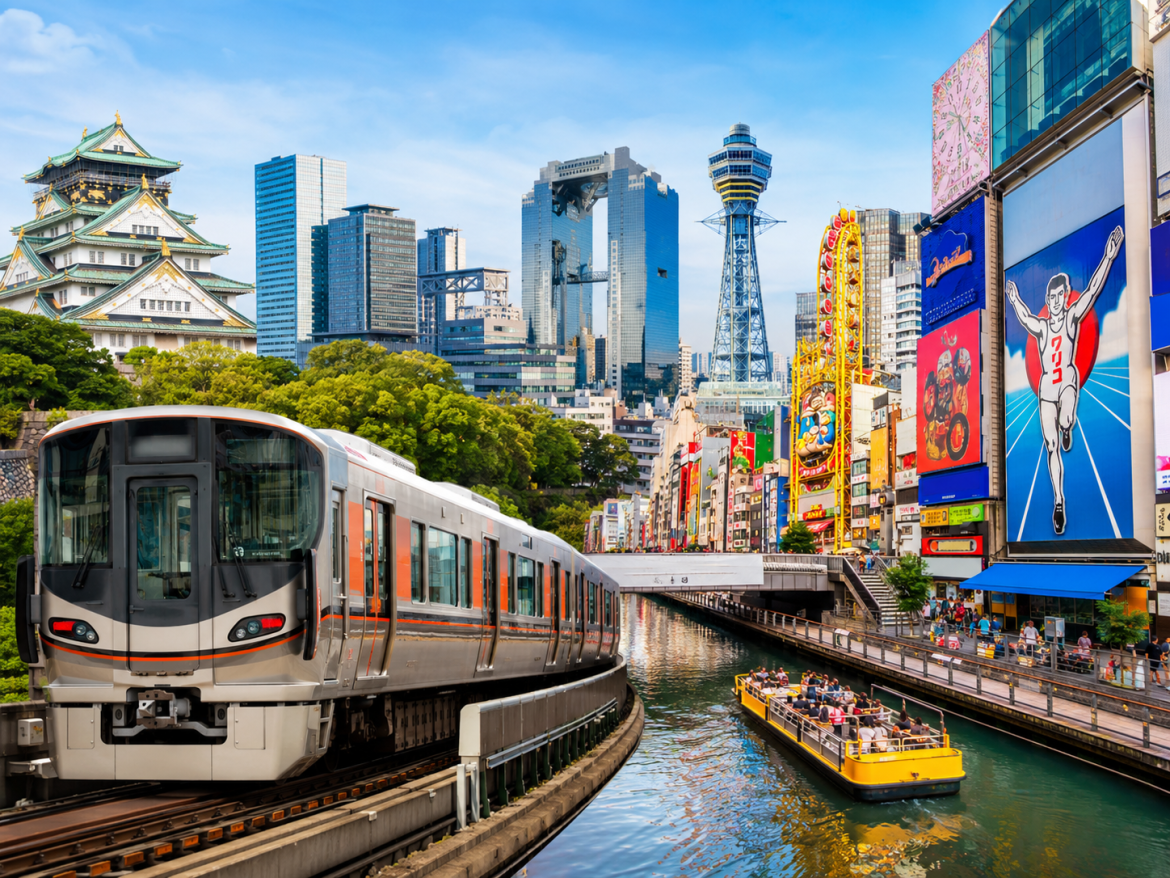

Getting around Osaka: the simple version
Osaka is easier to navigate once you separate the railway companies. Use Osaka Metro for most central sightseeing, JR for Universal Studios Japan and useful stretches of the Osaka Loop Line, and the appropriate private railway for Kyoto, Nara, Kobe or the airport. An ICOCA, Suica or other compatible transport IC card is a convenient starting point; an unlimited pass is an optional purchase for a particular day.
The red Midosuji Line links Shin-Osaka, Umeda, Hommachi, Shinsaibashi, Namba and Tennoji. Staying near one of these stations often matters more than simply being “near JR.” Compare the Osaka hotel-area guide with the station exit nearest your hotel, then use the Osaka sightseeing guide to group nearby stops.
For a busy Metro day, compare Osaka Metro ticket options; for several participating paid attractions, price the Osaka Amazing Pass instead. KIX arrivals should choose Nankai Rapi:t for Namba or JR HARUKA for Tennoji, Osaka Station and Shin-Osaka.
| Transport | Where it helps most | Main limitation | Best approach |
|---|---|---|---|
| Osaka Metro | Umeda, Shinsaibashi, Namba, Tennoji and central sightseeing | A Metro ticket does not cover every railway | Start with an IC card; consider a day pass for frequent rides |
| JR Osaka Loop Line and connecting lines | Osaka Station, Osaka Castle, Tennoji and USJ | Not the most direct network for Dotonbori or Shinsaibashi | Combine with Metro rather than forcing every trip onto JR |
| Private railways | Kyoto, Nara, Kobe, Wakayama and KIX | Different terminals and pass boundaries | Choose by your starting point and destination |
| Osaka City Bus | Destinations beyond an easy station walk | Road congestion; regular adult fare ¥210 | A useful connection, rarely the backbone of a first visit |
| Taxi | A short final journey with children, older relatives or luggage | Cost and traffic | Use selectively rather than for a full sightseeing day |
| IC card | Mixed operators and a flexible itinerary | Pay-per-ride, not unlimited transport | The simplest default for light travel days |
A shopping day involving two or three train journeys rarely needs a regional pass. Equally, owning a JR pass is no reason to take an awkward JR route when Metro gets you much closer. The aim is less time transferring, not using one ticket at every opportunity.
Affiliate options: Osaka Aquarium Kaiyukan, Osaka Castle’s main tower and Solaniwa Onsen are separately ticketed attractions. Check any pass you already hold before purchasing admission. These products are not Metro travel tickets.
Osaka Metro, IC cards and contactless payment
The Midosuji Line is the most useful line to learn first. For Osaka Castle add the Chuo or Tanimachi lines; for the aquarium use the Chuo Line to Osakako. Station names, line letters and station numbers are more dependable navigation aids than memorizing an exit number without checking where it leads.
Standard adult Metro fares are ¥190, ¥240, ¥290, ¥340 or ¥390 by distance zone. The Yumeshima section has an additional fare, and travel onto another company’s tracks can cost more even when you stay on the same train. Ordinary Metro trains have no advance seat reservation: take an available seat or stand without blocking doors.
Compatible IC cards work across the main urban networks, but do not turn separate operators into one unlimited fare. Use the same card to enter and leave railway gates, keep enough stored value, and obtain the correct child card or ticket where applicable. Buying an ICOCA is unnecessary if you already have a usable Suica or PASMO.
Osaka Metro contactless bank-card payment is another option on the subway and New Tram, with eligible City Bus services also supported. Use the dedicated reader and the same physical card or device throughout the journey. Adult fares apply, including when a child uses a bank card. Acceptance on Metro does not prove that a JR, Kyoto subway or other connecting journey accepts the same payment method. Do not assume an automatic day-pass cap or free transfers.
For directions, open the current official Osaka Metro route map and its station information. Check the operating line as well as the station name; a through train toward Kita-Osaka Kyuko, Hankyu or Kintetsu can leave a Metro-only pass area.
JR: Osaka Castle, Universal Studios Japan and regional connections
The Osaka Loop Line is especially useful if you stay around Osaka Station or Tennoji. It reaches Morinomiya and Osakajokoen for Osaka Castle, although the castle tower remains a substantial walk through the park. Pick the entrance that suits the rest of your day rather than treating every castle-adjacent station as interchangeable.
For USJ, travel toward Nishikujo and take the JR Yumesaki Line to Universal-City. Some services run through, while others require a transfer: check the destination board instead of assuming every Loop Line train goes to the theme park. USJ is best treated as a full-day outing.
Regional JR passes deserve a calculation only when your wider trip includes journeys such as the airport, Kyoto, Kobe or Himeji. The Kansai Area Pass product listing now needs careful option selection: the legacy paper pass ended sales on 30 September 2026, while WEST QR remains a separate live product. Do not apply old paper-pass prices or extras to a QR purchase.
Which private railway should you use?
| Operator | Useful Osaka stations | Typical purpose | What to check |
|---|---|---|---|
| Hankyu | Osaka-Umeda | Kyoto-Kawaramachi, Arashiyama via Katsura, Kobe | Which Kyoto district you actually want |
| Hanshin | Osaka-Umeda, Osaka-Namba | Kobe direction | Departure station and any change required |
| Kintetsu | Osaka-Namba, Osaka-Uehommachi | Nara | Limited Express is a paid reserved-seat product, unlike ordinary services |
| Nankai | Nankai Namba | Kansai Airport, Wakayama; Koyasan via the appropriate connection | Airport Express versus reserved-seat Rapi:t |
| Keihan | Yodoyabashi, Temmabashi, Kyobashi | Eastern Kyoto, Gion and Fushimi | Stopping pattern; not every fast train stops at every sightseeing station |
For Kyoto, Hankyu can be more convenient from Umeda to Kawaramachi than travelling via Shin-Osaka. For Nara, Kintetsu from Namba is often the natural choice. Kobe has JR, Hankyu and Hanshin options; Wakayama is served by different JR and Nankai stations. Compare the entire hotel-to-destination route.
The Kansai Railway Pass LITE is aimed at intensive eligible private-rail travel, not a routine Osaka city break. Its exclusions include JR, Kyoto City Subway, Randen, Keihan’s Otsu lines and all buses. Paid reserved seats require separate supplements.
City buses and taxis: useful for the last stretch
Regular Osaka City Bus journeys cost ¥210 for adults. Airport and other special services have separate rules. On ordinary routes, board through the rear door and pay at the front when leaving, following the vehicle’s signs. An IC card avoids preparing exact change, but does not make every transfer free.
A short taxi ride can be worthwhile for a small group, a tired child or the gap between the station and hotel. Confirm that your party and suitcases fit the vehicle. Taxis still get caught in traffic; a city-centre rental car adds parking, one-way streets and collection time without helping most sightseeing routes.
Kansai and Itami airports: match the arrival station to your hotel
For Namba, Dotonbori and southern Shinsaibashi, Nankai is usually the straightforward railway. Rapi:t offers reserved seating and luggage space; Nankai advertises a fastest journey of 34 minutes, but use the actual train time rather than adding 34 minutes to your flight’s landing time. Immigration, baggage reclaim and walking to the station come first.
HARUKA directly serves Tennoji, Osaka Station and Shin-Osaka. Typical train-time planning ranges are roughly 35 minutes, 45 minutes and 50 minutes respectively, depending on the departure. Reserve the seat required by your ticket product before boarding. An IC-card tap alone does not pay the whole limited-express fare. HARUKA’s underground platforms at Osaka Station can involve a longer walk to your hotel exit than the station name suggests.
For lower cost, compare Nankai Airport Express or JR Kansai Airport Rapid. They use ordinary commuter-style accommodation, so seats and suitcase space are not guaranteed. On a JR airport journey, follow the destination and car guidance carefully: some coupled services split at Hineno. Check the last usable connection before booking a very late flight arrival.
Itami Airport is a different airport
From Itami, limousine buses serve major Osaka districts, including Umeda, Namba, Tennoji and Shin-Osaka. Allow roughly half an hour or more depending on the destination and traffic, plus waiting time. The monorail with a railway connection is another option if road delays are a concern. Nankai’s KIX train is not an Itami service.
Choose your routes before buying a pass
Start with your hotel and the places you want to visit. An IC card suits changeable days using Metro, JR and private railways, with actual fares deducted per ride. Compare a Metro day ticket or 30-hour ticket when most of that day’s travel stays on its covered network. A JR pass is not a universal Osaka transport ticket.
Similar names do not mean identical coverage. Metro day and 30-hour tickets differ on buses and Yumeshima; Amazing Pass needs to be judged against the paid attractions you will actually visit; regional rail passes depend on longer journeys outside Osaka. A city ticket is not automatically an airport return ticket.
For current prices, validity, child tickets and fare-calculation examples, use the dedicated Osaka transport card and pass comparison. The following sections focus on getting between hotel areas, stations and sights without unnecessary transfers.
Best transport by Osaka hotel area
| Base | Useful networks | Strength | Trade-off |
|---|---|---|---|
| Osaka Station / Umeda | JR, Midosuji Line, Hankyu, Hanshin | Regional trips and northern Osaka | Large station complex with several separate terminals |
| Namba | Metro, Nankai, Kintetsu, Hanshin | KIX, Nara, Dotonbori and late dining | Check which “Namba” station is closest |
| Shinsaibashi | Midosuji and Nagahori Tsurumi-ryokuchi lines | Shopping; Namba is one stop or a walk away | Regional trains generally need a connection |
| Tennoji | JR, Metro; nearby Osaka-Abenobashi | KIX and southern Osaka | Kintetsu’s adjacent terminal serves different routes from Osaka-Namba |
| Shin-Osaka | Shinkansen, conventional JR, Midosuji Line | Frequent long-distance train departures | Less convenient for late-night Namba sightseeing |
Osaka Station is in Umeda. Shin-Osaka is the Shinkansen station, one conventional JR journey or a Metro ride away. Umeda, Higashi-Umeda and Nishi-Umeda are separate Metro stations within a large walkable district, not one platform. Likewise, Nankai Namba, Osaka-Namba, Metro Namba and JR-Namba occupy different parts of the Namba area. Allow time for signs, underground corridors and lifts when changing companies.
Stations for Osaka’s main sights
| Sight | Useful station | Final approach |
|---|---|---|
| Dotonbori | Namba | Usually a 5–10-minute walk, depending on exit |
| Shinsaibashi shopping street | Shinsaibashi | Shopping area beside the station |
| Kuromon Market | Nippombashi | A short walk; leave large luggage elsewhere |
| Osaka Castle | Morinomiya, Tanimachi 4-chome or Osakajokoen | Allow time to cross the park to the tower |
| Universal Studios Japan | Universal-City | JR Yumesaki Line, then walk to the park |
| Osaka Aquarium Kaiyukan | Osakako | Chuo Line, then roughly 5–10 minutes on foot |
| Tsutenkaku / Shinsekai | Ebisucho or Dobutsuen-mae | Usually around 5–10 minutes on foot |
| Abeno Harukas | Tennoji / Osaka-Abenobashi | Beside the station district |
| Umeda Sky Building | Osaka / Umeda | Allow roughly 10–15 minutes from a suitable exit |
Affiliate options: private city walks and Kuromon or Shinsekai food tours need their own time slot. Check the selected tour’s language, meeting point, food, drinks and age restrictions. A food tour is not a city transport or attraction pass.
A one-day route without unnecessary backtracking
Do not combine USJ, the aquarium and a full central-Osaka itinerary in one day. For a first visit, use Osaka Castle as a morning anchor, then group southern Osaka before heading north for the evening. This adjusts the common zigzag of visiting Shinsaibashi, going south to Tennoji, then returning north again.
| Time | Plan | Transport logic |
|---|---|---|
| Morning | Osaka Castle park; enter the tower after its opening time if desired | Choose Metro or JR according to the hotel |
| Late morning | Tennoji or Shinsekai | Make the southern stop before moving north |
| Lunch / early afternoon | Kuromon Market, Namba and Dotonbori | Walk between nearby districts where comfortable |
| Afternoon | Shinsaibashi shopping | Continue north on foot or take one Metro stop |
| Evening | Umeda for dinner; an observation deck if wanted | Midosuji Line north, checking admission costs and last entry |
This is a flexible outline, not a guaranteed timed tour. Drop a district for a slower family day. Price a Metro pass against the journeys you retain, then compare Amazing Pass only if the included attractions and their admission windows fit.
Give USJ its own day and allow several hours for the aquarium. During major festivals or fireworks, expect busier stations and check your return route before the event; the Japan fireworks guide can help with seasonal planning.
Children, older travellers, accessibility and suitcases
A direct Midosuji Line journey is often more comfortable than a technically faster route with several changes. Use Metro’s accessibility information to find the lift route, and check maintenance notices before travelling. A station with lifts can still involve a long detour to the exit you need. Ask staff for assistance where required; do not equate step-free station access with an entirely step-free attraction.
Avoid the busiest commuter periods when your schedule allows. Keep bags close, leave doors and priority spaces clear, and do not assume a large locker will be available at Osaka, Shin-Osaka or Namba. Ask the hotel about luggage storage or arrange a suitable delivery service before a sightseeing day.
For the airport, reserved-seat Rapi:t or HARUKA can reduce standing and suitcase handling. For the final kilometre, a taxi may be worth more than a small fare saving through another transfer. Carry phone battery power and internet access if you depend on a digital pass; a screenshot may not be an acceptable ticket.
Common Osaka transport mistakes
- Booking around Osaka Station when you actually need an early Shinkansen from Shin-Osaka
- Assuming all Umeda or Namba railway names mean the same gates and platforms
- Using a JR pass as if it also covered Metro, Nankai or Kintetsu
- Buying an unlimited ticket before checking the day’s actual fares and boundaries
- Counting only the train journey and overlooking station walks, lift detours and waiting time
- Expecting a train to continue all night or assuming an airport express ticket includes every supplement
Osaka transport FAQs
What is the easiest transport for a first visit?
Osaka Metro with a compatible IC card is the simplest starting point for central Osaka. Add JR for USJ and useful Loop Line trips, then choose private railways by your day-trip destination.
Is a Metro day pass always cheaper?
No. Two or three short journeys can cost less. Compare the total with ¥820 on weekdays or ¥620 on weekends and Japanese holidays, and check the Yumeshima and bus exclusions.
Should I buy Amazing Pass instead?
Only when the covered attractions you actually want, their opening times and the included journeys justify its price. A day of shopping and eating is usually better served by ordinary fares or a transport-only ticket.
Which train should I take from Kansai Airport?
Nankai Rapi:t or Airport Express for Namba; JR HARUKA or Kansai Airport Rapid for the relevant JR station. HARUKA directly serves Tennoji, Osaka and Shin-Osaka.
Do Kyoto, Nara and Kobe day trips require JR?
No. Hankyu and Keihan are useful for different parts of Kyoto, Kintetsu for Nara, and Hankyu or Hanshin for Kobe. The destination station matters more than the operator’s name.
Do I need a regional JR pass or rental car?
Usually neither for Osaka alone. Consider a regional pass only after adding up eligible longer journeys; rent a car when a genuinely car-dependent rural itinerary makes it useful.
Can a family use the same ticket choice?
Not necessarily. Children have different fares, bank-card contactless charges adult fares, and some digital passes have no child version. Price each traveller’s needs rather than multiplying an adult recommendation.
The practical plan for a first Osaka visit
Choose accommodation near the right station, use Metro for central Osaka and add other networks when they make the route easier. Buy a pass for a clearly cost-effective travel day rather than designing every day around a pass. For airport transfers and travellers with luggage, fewer changes often matter more than saving a small amount on the fare.